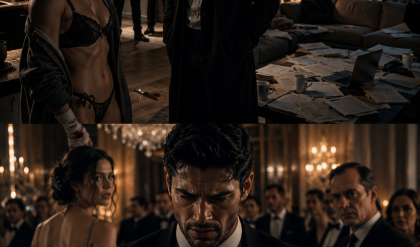
“Why did you help me?”
Alexander did not answer immediately. The city lights slid across his face, turning him into a series of sharp shadows and brief illuminations.
“I know your work,” he said.
Mia frowned. “My work?”
“North Window.”
Her breath stopped.
Nobody knew that name.
North Window was the username she used on a small online writing forum where she posted essays at two in the morning after her father had gone to bed. She wrote about shame, hunger, loneliness, the strange courage of surviving ordinary cruelty. She wrote under false names, from library computers and borrowed devices, because Grant checked her laptop history whenever he wanted to remind her that privacy was something he owned.
“How do you know that?” she whispered.
Alexander looked away, and for the first time since she had seen him, something like pain touched his face.
“Because one of your essays kept me alive.”
Mia stared at him.
The man beside her was worth billions. He commanded rooms without raising his voice. He seemed carved from discipline and steel.
“What essay?”
“‘The Weight of Light.’”
Her eyes filled before she could stop them.
She remembered writing it at sixteen, sitting on the bathroom floor after her father told her no man would ever love a girl who looked like her. She had written about an old church window in Oak Park she passed every day after school, how the glass was thick and uneven, how the flaws were what made the sunlight scatter into color.
“I wrote that because I was sad,” she said.
“I read it because I was worse than sad.”
His honesty frightened her more than his power.
“I lost someone,” he continued. “My younger sister, Claire. She died three years ago. Officially, it was an accident. Privately, I believed it was my fault. I built a company that saved hospitals money and made investors rich, but I couldn’t save one person who mattered to me.”
Mia swallowed. “I’m sorry.”
“So am I.” His voice was quiet. “For a long time, I thought grief was a room with no door. Then I found your essay. You wrote, ‘A broken window does not stop the light. It only teaches the light another way through.’”
Mia pressed a hand to her mouth.
Her own words, spoken in his voice, felt impossible.
“I didn’t know anyone read those,” she said.
“I did. For almost two years.”
“You followed my posts?”
“Yes.”
“Why didn’t you ever message me?”
“Because you wrote like someone hiding from danger. I did not want to become another stranger demanding access.”
That answer undid her.
Not because it was dramatic.
Because it was careful.
Her father had never treated her fear as something worthy of respect.
The car turned into an underground garage beneath a glass tower overlooking the Chicago River. Alexander stepped out first and waited until she chose to follow.
In the elevator, Mia watched the numbers rise.
Thirty.
Forty.
Fifty.
Her ears popped.
The doors opened directly into a penthouse of steel, warm wood, and impossible views. Chicago glittered beyond floor-to-ceiling windows: bridges, towers, the black ribbon of the river, the silver edge of Lake Michigan in the distance.
It should have felt cold.
Instead, it felt quiet.
Alexander stopped several feet inside, giving her space.
“There is a guest suite down the hall,” he said. “You may lock the door. My housekeeper, Mrs. Alvarez, will bring clothes in the morning. No one will enter without permission. Tomorrow, if you want to go anywhere else, I’ll arrange it. A hotel. A lawyer. A women’s shelter with private security. A relative, if you trust one.”
Mia almost laughed.
Trust a relative?
Her father had burned that word down.
“And if I stay?” she asked.
“Then we discuss terms that protect you.”
“Terms?”
“You are eighteen. Legally an adult. But you have been controlled for so long that freedom may not feel simple. I won’t pretend kindness erases power. I have money, staff, lawyers, influence. You have been denied options. That imbalance matters.”
Mia stared at him.
No man in her father’s circle would have said that.
They would have called imbalance “opportunity.”
“What kind of terms?” she asked.
“Written ones. You need independent counsel. Separate from me. Your own bank account. Your own phone. Access to education if you want it. A place to write if you still want to write. And a clear understanding that you owe me nothing personal.”
Her throat tightened.
“Why would you do all that?”
“Because your words helped me survive a night I was not sure I would survive. Because I have spent years building systems that move goods faster than people move compassion. Because tonight I watched a father try to monetize his daughter’s shame, and I had the means to stop it.”
His voice hardened.
“So I stopped it.”
Mia turned toward the window.
Below, the city looked distant and unreal.
A few hours ago, she had belonged to a house where every mirror felt like an enemy.
Now a billionaire was offering her a lawyer and a locked door.
She should not have trusted it.
She did not fully trust it.
But when she stepped into the guest suite and found soft pajamas folded on the bed, bottled water on the nightstand, and no one waiting to tell her what she owed, Mia sat on the carpet and cried until the tight silver dress blurred into a puddle at her feet.
The next morning, Mrs. Elena Alvarez knocked with a breakfast tray and the kind of face that made Mia’s defenses ache from disuse.
“Good morning, honey,” the older woman said. “Mr. Reed said you might prefer something simple. Scrambled eggs, toast, fruit. Coffee if you want it, tea if you don’t.”
Mia blinked. “He said that?”
“He said choices matter.”
The words were small.
They hit hard.
After a hot shower and clothes that actually fit—black leggings, a soft sweater, warm socks—Mia found Alexander in the kitchen standing beside a coffee machine like a man negotiating with hostile equipment.
Mrs. Alvarez took one look and sighed. “Mr. Reed, you run a global company and still lose arguments with espresso.”
“I’m persistent,” he said.
“You’re stubborn. Sit down before you ruin it.”
Mia almost smiled.
Alexander noticed, but did not comment. He simply pulled out a chair at the breakfast island.
On the counter sat a folder.
Not the thick, threatening kind her father used for bills and legal notices. This one was clean, labeled in precise handwriting:
MIA BELL — OPTIONS
She hesitated.
Alexander pushed it toward her.
“Your attorney arrives at ten. Her name is Dana Whitcomb. She does not work for me. She represented my sister years ago, which means she has no patience for my ego. She will explain everything in that folder and tell you which parts are foolish.”
Mia opened it carefully.
Inside were lists.
Housing options.
Educational programs.
Information on restraining orders.
Banking instructions.
Mental health resources.
Writing fellowships.
A page titled: “Things You Are Allowed to Refuse.”
Mia stared at that page the longest.
Alexander watched her read it.
“You look angry,” he said.
“I am.”
“At me?”
“No.” Her voice shook. “At how strange it feels to see permission written down.”
He said nothing.
That silence let her breathe.
By noon, Dana Whitcomb had arrived, a sharp-eyed Black woman in her fifties with silver braids, red glasses, and no visible fear of billionaires.
She shook Mia’s hand and said, “My job is not to be impressed by him. My job is to protect you from needing to be grateful.”
Mia liked her immediately.
For three hours, Dana explained what Grant Bell had done at the gala, what legal protections Mia had, and what risks came with staying in Alexander’s home.
“People will talk,” Dana said bluntly. “They already are. Some will assume the worst. Some will pretend concern while enjoying the scandal. The question is not whether gossip exists. The question is whether your arrangement is documented, safe, and chosen by you.”
“Can I make him pay back the money?” Mia asked.
Dana lifted a brow. “Your father?”
“Yes.”
“If he cashes the check, that becomes interesting.”
Alexander, who had been silent near the window, said, “He cashed it at 9:17 this morning.”
Dana smiled slowly.
Mia felt a strange, dangerous spark of satisfaction.
Her father had not waited a day.
Not even twelve hours.
“So,” Dana said, making a note, “he accepted funds after publicly framing his daughter as transferable property. That will matter.”
Mia sat straighter.
For years, her father’s cruelty had evaporated the moment other people entered the room. He became charming. Reasonable. A tired single father with an ungrateful daughter.
Now something was written down.
Now something had a timestamp.
That afternoon, Alexander showed her a room down the hall from his office.
It had three tall windows, a desk, a bookshelf, a comfortable chair, and a laptop still in its box.
“This is not a gift,” he said before she could panic. “It’s equipment. If you choose to work as a writer, you need tools. If you leave tomorrow, it leaves with you. If you hate it, Mrs. Alvarez will help pick something else.”
Mia touched the desk.
A desk where no one had yelled.
No one had slammed a hand down beside her notebook.
No one had read her pages aloud in a mocking voice.
“I don’t know if I can write anymore,” she admitted.
Alexander stood in the doorway. “Then don’t write today.”
“But you said my words—”
“I said your words mattered. I didn’t say you had to bleed on command.”
That evening, Mia sat before the blank document anyway.
The cursor blinked.
She typed one sentence.
I was not rescued because I was helpless.
She deleted it.
She typed another.
A cage does not become kindness because the bars are made of gold.
She deleted that too.
Then she opened an old file from North Window and read her own essays like they had been written by a braver girl.
By midnight, she had written only five words.
I am still in here.
She saved them.
For the first time, five words felt like a beginning.
Weeks passed.
Freedom did not arrive like fireworks.
It arrived awkwardly, in paperwork and passwords, in Mia learning the pin number to her own debit card, in buying a dress because she liked the color instead of because someone said it hid her body.
It arrived in online college applications.
It arrived in therapy appointments Dana recommended and Alexander did not ask about.
It arrived in Mrs. Alvarez leaving muffins outside Mia’s writing room with sticky notes that said, “Eat, genius.”
It arrived in arguments, too.
When Alexander tried to arrange a private tutor without asking, Mia snapped, “You don’t get to plan my life because you’re better at calendars.”
He looked startled, then said, “You’re right.”
No defense.
No lecture.
Just correction.
That scared her almost more than anger would have.
She enrolled in a creative writing program through Northwestern’s continuing education department. She met twice a week with Professor Harold Lang, a retired literature professor Alexander had once funded but never controlled.
Professor Lang read her essays with a pencil in hand and mercy in his voice.
“You have instinct,” he told her during their first meeting at a quiet library reading room. “That is rare. But instinct without discipline becomes confession. Discipline turns confession into art.”
Mia frowned. “Is confession bad?”
“No. Confession says, ‘This hurt me.’ Art says, ‘This hurt me, and here is why it matters to you too.’”
She wrote that down.
Alexander drove her to the library the first few times, then stopped when she said she wanted to take a rideshare alone.
He did not like it.
She could tell.
But he nodded and said, “Text Mrs. Alvarez when you arrive.”
“I’m texting her, not you?”
“You don’t need another man monitoring your location.”
That was the problem with Alexander Reed.
Every time Mia prepared herself to discover the hidden hook in his kindness, he cut the line himself.
Still, danger gathered.
It began with a gossip column.
THE BILLIONAIRE AND THE GIRL IN THE SILVER DRESS
Then a blurry photo of Mia entering Alexander’s building.
Then speculation.
Then Grant Bell.
Her father appeared on a morning news segment wearing a navy suit and an expression of wounded dignity.
Mia watched the clip in her writing room, cold spreading through her chest.
“I am a father who made mistakes,” Grant told the interviewer, his voice thick with practiced sorrow. “But Mr. Reed exploited a vulnerable family. He humiliated me, took my daughter, and now I can’t even reach her.”
Mia’s hands clenched.
Her phone had twenty-seven blocked voicemails from him.
The interviewer leaned forward. “Are you saying Alexander Reed purchased access to your daughter?”
Grant lowered his eyes.
“I’m saying powerful men don’t write large checks for innocent reasons.”
Mia slammed the laptop shut.
For a moment, she was back in the ballroom, trapped in silver fabric, listening to laughter.
Then Alexander appeared in the doorway.
His face told her he had seen it too.
“I’m sorry,” he said.
The old Mia would have apologized back.
For being trouble.
For being inconvenient.
For existing in a way that created mess.
Instead, she said, “He’s lying.”
“Yes.”
“And people will believe him.”
“Some will.”
“Your board?”
Alexander’s jaw tightened.
That was answer enough.
Reed Meridian’s board had tolerated Alexander’s intensity because he made them rich. They tolerated his privacy because it added mystique. They tolerated his grief because it made him seem human in magazine profiles.
They would not tolerate scandal involving an eighteen-year-old woman living in his penthouse, no matter how carefully documented.
By Friday, the board requested an emergency meeting.
By Saturday, reporters camped outside his building.
By Monday morning, sponsors called to “pause conversations.”
Mia heard Alexander on the phone in his office, his voice controlled but edged with exhaustion.
“No, she is not leaving because strangers misunderstand decency.”
A pause.
“No. I will not describe her trauma for shareholder comfort.”
Another pause.
“Then call the vote.”
Mia backed away from the door.
Her stomach twisted.
That evening, Alexander did not come to dinner.
Mrs. Alvarez carried a tray into his office and came out with her mouth pressed tight.
“He won’t eat?” Mia asked.
“He said later.”
“Later means no.”
Mrs. Alvarez looked at her with tired affection. “You’re learning.”
Mia took the tray herself.
Alexander sat behind his desk, tie loosened, sleeves rolled up, papers spread before him like battlefield maps. He looked older than thirty-four for the first time.
“You need food,” Mia said.
He looked up. “So do you.”
“I ate.”
“Two bites of soup is not eating.”
She set the tray down. “You’re not stepping down.”
His face stilled.
“Mia.”
“No.”
“The board has enough votes to force a leave of absence. If I step down voluntarily, I protect the company from instability and you from further attention.”
“Don’t make me the noble reason you surrender.”
A flash of surprise crossed his face.
She continued before courage failed. “You taught me that people who want me silent will call silence protection. Don’t do the same thing.”
His eyes darkened.
“That is not what I’m doing.”
“Isn’t it?”
The room went very still.
Mia’s voice shook, but she did not stop. “My father said he was protecting me from embarrassment when he wouldn’t let me buy clothes that fit. He said he was protecting me from disappointment when he told me not to apply to college. He said he was protecting me from the world when he kept me small enough to control.”
Alexander rose slowly. “I am not your father.”
“No,” she said. “You’re not. That’s why I’m asking you not to act like sacrificing your life’s work is a decision you made for me.”
Pain moved across his face.
For a moment, she thought she had gone too far.
Then he said quietly, “Claire told me something similar once.”
His sister’s name entered the room like a ghost.
Mia softened. “What happened to her?”
Alexander turned toward the window.
For a long time, he did not answer.
When he finally spoke, his voice had lost all corporate steel.
“Claire was a systems analyst at Reed Meridian. Brilliant. Funny. The only person who could tell me I was being an arrogant idiot and make me thank her for it. Three years ago, she found irregularities in one of our defense logistics contracts. Inflated routes. Phantom vendors. Shell companies.”
Mia’s pulse quickened. “Fraud?”
“Yes. She believed someone on the board was using our emergency supply network to launder money through disaster relief contracts.”
“That’s horrible.”
“She came to me with concerns. I told her to document everything. Quietly. I thought I was protecting her by keeping it internal until we had proof.”
Mia already knew the shape of the tragedy before he said it.
“She died two weeks later,” Alexander said. “Car off the road during heavy rain. Police called it an accident. Her laptop disappeared from the scene.”
Mia whispered, “And you blamed yourself.”
“I still do.”
“Who was the board member?”
Alexander looked at her.
“Victor Harrow.”
The name had been in half the articles about him: chairman of Reed Meridian’s board, silver-haired, philanthropic, always standing near Alexander in photographs but never smiling with his eyes.
“Does he know you suspect him?” Mia asked.
“He knows I suspect someone. Not that I found Claire’s backup drive.”
Mia’s breath caught. “You found it?”
“Encrypted. Damaged. My security team recovered fragments—documents, notes, partial transcripts. Nothing admissible. Nothing complete enough to expose him.”
“Why are you telling me this now?”
“Because the scandal with your father did not spread by accident.” Alexander tapped a folder on his desk. “My team traced the first paid placement. It came through a PR shell linked to Harrow’s son-in-law.”
Mia sat down.
The room shifted around her.
“My father and your board chairman are connected?”
“Possibly through debt. Your father owes money to several private lenders. One of those lenders is tied to Harrow.”
The logic clicked into place with sickening clarity.
Grant had not simply gone to the tabloids for sympathy.
He had been aimed.
Mia pressed her fingertips to her temples. “So this isn’t just about me.”
“It is about you,” Alexander said. “But not only you.”
She looked at the folder.
“Show me Claire’s fragments.”
“No.”
“Alexander.”
“No.”
The answer came too fast, too sharp.
Mia stood. “You said my words mattered. You said I noticed things.”
“I said that about essays, not corporate crime.”
“Writing is noticing.”
“This is dangerous.”
“So was my father.”
He flinched.
Mia stepped closer, anger burning through fear. “Do not put me back on the shelf because the room has knives in it. I have lived with knives. I know the difference between danger and helplessness.”
Alexander stared at her.
Then, slowly, he opened the folder.
For the next three nights, Mia read Claire Reed’s recovered notes.
At first, she understood little. Vendor names. Contract codes. Internal memos. Calendar entries. Half-sentences from transcripts.
But Professor Lang had trained her to look for pattern.
Voice.
Intention.
What was said.
What was avoided.
She noticed that one vendor appeared under three slightly different names. She noticed that Claire used exclamation points only when quoting someone else. She noticed a phrase repeated in two memos from different departments:
“Route inefficiency acceptable under emergency discretion.”
It sounded like bureaucracy.
It was too identical to be accidental.
Then she found the phrase in a transcript fragment.
VH: Route inefficiency acceptable under emergency discretion. Nobody audits urgency.
Mia’s heart began to pound.
“Alexander,” she called.
He came from the kitchen, carrying two cups of coffee.
She pointed to the line.
“VH,” she said. “Victor Harrow?”
“Maybe.”
“No. Look at the language.”
She pulled three documents together. “This memo was supposedly written by a logistics director. This one by a finance supervisor. This transcript is Claire’s note from a meeting. But the phrase is identical. Not just similar. Identical. People don’t naturally repeat dead language like that unless they’re copying from a script.”
Alexander leaned over her shoulder, reading.
Mia continued, faster now. “And here—Claire wrote ‘not his phrase’ beside the transcript. I thought she meant the logistics director. But what if she meant Harrow? What if he was repeating language drafted by someone else?”
Alexander’s eyes sharpened.
“Someone legal,” he said.
“Or someone covering legal exposure.”
They searched until dawn.
At 5:42 a.m., Mia found it.
A scanned attachment recovered without a file name. It was a letter on Bell Strategic Consulting stationery.
Her father’s old business.
Before his gambling, before the debt, before he became a man who sold dignity for survival, Grant Bell had been a compliance consultant.
The letter was addressed to Victor Harrow.
Mia read the first line and felt the world tilt.
Per your request, I have revised the emergency discretion language to reduce audit sensitivity while preserving plausible operational justification.
Her father had written the language.
Grant Bell had helped cover the fraud that Claire died trying to expose.
Mia could not breathe.
Alexander read the letter once, then again.
His face went white with controlled rage.
“Mia,” he said carefully.
She stood so fast the chair scraped the floor. “He knew.”
Alexander did not answer.
“He knew your sister died because of this, and then he stood in that ballroom smiling at you?”
“We don’t know what he knew about Claire.”
“He knew enough to be afraid. He knew enough to let Harrow use him.”
Her hands shook, but not from weakness.
From recognition.
Her father had always told her she was the family shame.
But shame had been his profession.
The twist became public two days later, but not before Grant Bell tried to strike first.
He appeared at Reed Meridian headquarters with reporters behind him, demanding to see his daughter.
Mia watched from Alexander’s office window as her father stood on the sidewalk below, performing grief for cameras.
“My child has been manipulated!” Grant shouted. “Mia, if you can hear me, your father forgives you!”
The word forgive made something old and frightened rise inside her.
For one second, she was thirteen again, apologizing for eating dinner before he got home.
Then Dana Whitcomb touched her shoulder.
“You don’t owe him a response.”
Mia looked at Alexander.
His expression was lethal.
But he stayed silent.
He let the choice remain hers.
Mia turned away from the window.
“I want a podium,” she said.
Dana smiled slightly. “That’s my girl.”
The press conference was arranged in the lobby of Reed Meridian, beneath a wall of glass overlooking the river. Reporters packed the room. Board members gathered near the back, Victor Harrow among them, silver hair immaculate, expression professionally concerned.
Grant stood near the front, looking smug until he saw Mia step onto the platform.
She wore a navy dress that fit.
No jacket to hide beneath.
No father’s hand on her arm.
Alexander stood off to the side, not beside her. Not owning the moment. Witnessing it.
Mia adjusted the microphone.
Her heart hammered.
Then she looked directly at her father.
“My name is Mia Bell,” she began. “You may have heard that I was taken from my father by Alexander Reed. That is not true. I walked away from a man who tried to sell me in a ballroom.”
The lobby erupted.
Questions flew.
She raised one hand.
“I am going to speak. You are going to listen. For eighteen years, my father told me I was too heavy to love, too emotional to respect, and too much to deserve a future. Last month, he put those beliefs into action. He dressed cruelty as concern and humiliation as opportunity.”
Grant’s face twisted. “Mia, sweetheart, you’re confused.”
She looked at him without flinching.
“No. I was confused when I thought your voice in my head was truth. I’m not confused anymore.”
A murmur moved through the reporters.
Mia continued.
“Alexander Reed did not purchase me. He intervened. He gave me access to independent legal counsel, education, safety, and something my father never offered me: choice.”
She took a breath.
“But this story is bigger than what my father did to me. It is also about what powerful men do when they believe no one vulnerable will be believed.”
Victor Harrow’s expression changed.
Barely.
But Mia saw it.
Writers noticed shifts.
“Three years ago,” she said, “Claire Reed died after discovering evidence of fraud inside Reed Meridian’s emergency logistics contracts. For years, that evidence was incomplete. Until now.”
The room went deadly quiet.
Alexander’s eyes locked on her.
This was the part he had not wanted her to carry.
She carried it anyway.
“My father, Grant Bell, was not merely a desperate parent misled by scandal. He was a compliance consultant who drafted language later used to hide inflated routes, phantom vendors, and suspicious payments tied to disaster relief contracts. Those contracts are now being referred to federal investigators.”
Grant lunged forward. “You stupid girl!”
The microphone caught every word.
The cameras caught every face.
And Mia, who once would have folded under that tone, simply looked at him with devastating calm.
“There he is,” she said softly. “That is the man I know.”
Security stepped between them.
Victor Harrow turned to leave.
Dana Whitcomb lifted her phone.
“Mr. Harrow,” she called, “federal agents are already on their way. I’d avoid the elevators if I were you. Cameras love a chase.”
For one absurd second, nobody moved.
Then everything moved at once.
Reporters shouted.
Security blocked exits.
Grant cursed so violently that every remaining illusion of the grieving father shattered on live television.
Harrow tried to push through a side corridor and found two federal agents entering from it.
Mia gripped the podium.
She should have felt triumphant.
Instead, she felt grief.
Not for losing her father.
For accepting, finally, that she had never truly had one.
Alexander stepped onto the platform only after Dana nodded that the official statement was done. He did not touch Mia until she turned toward him.
Then he offered his hand.
Just as he had in the ballroom.
A choice.
Mia took it.
This time, cameras captured not a purchase, not a rescue, but a young woman standing beside the man who had believed her before the world did.
The aftermath was brutal and bright.
Grant Bell was arrested on charges connected to fraud, witness intimidation, and financial conspiracy. Victor Harrow resigned before the board could remove him, then discovered resignation did not protect him from indictment. The federal investigation into Reed Meridian’s contracts widened across three states.
Alexander remained CEO after an emergency board vote that was less about loyalty than survival. The board publicly praised his “commitment to transparency,” which made Mrs. Alvarez laugh so hard she nearly dropped a saucepan.
“Transparency,” she said. “Rich people learn a new word every scandal.”
Mia’s anonymous essays became impossible to keep anonymous.
North Window turned into a public blog under her real name: Mia Bell Writes.
Her first post after the press conference was titled:
I Was Never for Sale
It went viral before midnight.
Messages poured in from girls, women, men, teachers, mothers, survivors, people who had been mocked in their homes and minimized in their lives. Some wrote about bodies. Some wrote about poverty. Some wrote about fathers, mothers, coaches, pastors, bosses, spouses—anyone who had made love feel conditional on becoming smaller.
Mia read until she cried.
Then she wrote back.
Not to everyone.
That was impossible.
But to enough people to understand that pain, when spoken honestly, did not remain only pain. It became a bridge.
Months passed.
Mia moved out of Alexander’s penthouse into a small apartment two blocks from the lake, with big windows, uneven floors, and a radiator that hissed like an old cat. Alexander hated the building’s security. Mia loved the bookstore downstairs.
They argued about it for twenty minutes.
Then he bought her a better door lock and said nothing else.
Their relationship changed carefully.
Slowly.
No grand confession under chandeliers. No dramatic kiss after victory. Mia had been handled, defined, and rushed by other people for too long. Alexander understood that love, if it ever came, would have to arrive without pressure.
So they built trust in ordinary ways.
Coffee on Sunday mornings.
Notes in the margins of her essays.
Walks along the river.
Arguments about whether endings should be hopeful or honest, until Professor Lang declared, “The best endings are both, and you two are exhausting.”
A year after the gala, Mia’s essay collection was published.
The title was Too Much Light.
On launch night, the line outside the independent bookstore wrapped around the block. Mia stood in the back room wearing a deep green dress she had chosen because it made her feel like spring after a hard winter.
Mrs. Alvarez fussed with her hair.
Dana checked the event contract.
Professor Lang pretended not to be emotional.
Alexander stood by the door holding the first copy of the book as if it were made of glass.
“Ready?” he asked.
Mia looked at him.
She remembered the ballroom. The silver dress. Her father’s hand. The check. The whisper.
I did not buy you. I interrupted an auction.
Then she looked at the book in his hand.
Her name on the cover.
Her words bound and real.
“Yes,” she said. “I am.”
The reading was not perfect.
Her voice shook during the first paragraph. She lost her place once. A baby cried in the back. Someone’s phone rang during the most emotional line.
But when Mia looked up, she saw faces lifted toward her with recognition.
Not pity.
Recognition.
Afterward, a teenage girl approached the signing table with trembling hands.
“My dad says nobody will ever take me seriously if I don’t lose weight,” the girl whispered.
Mia closed the book she had just signed and looked at her fully.
“What’s your name?”
“Kayla.”
“Kayla, listen to me. Your body is not an apology. Your voice is not a mistake. And anyone who needs you small to love you does not know how to love.”
The girl burst into tears.
Mia stood and hugged her.
Across the room, Alexander watched with quiet pride.
Later, after the store emptied and the staff began stacking chairs, Mia found him near the front window. Her book filled the display behind him, catching the glow of streetlights.
“You’re staring,” she said.
“I’m allowed. I bought a copy.”
“You bought twelve.”
“I have employees.”
“You have an empire.”
“I have favorite authors.”
She smiled, but her eyes stung.
“Alexander.”
He straightened, hearing the change in her voice.
She stepped closer.
“For a long time, I thought you saved me.”
His expression softened. “Mia—”
“Let me finish.”
He did.
“You gave me a door. A lawyer. A desk. A way out. And I will always be grateful for that. But I know now that saving me was never something you could do alone. I had to walk out. I had to speak. I had to write. I had to choose myself.”
Alexander nodded. “Yes.”
“And you never tried to take that choice from me.”
“I hope not.”
“You didn’t.” She took his hand. “That is why I trust you.”
His fingers closed gently around hers.
Outside, Chicago moved through the cold night, bright and restless and alive.
Mia thought of her father, awaiting trial, still blaming everyone but himself. She thought of Claire Reed, whose courage had survived in fragments long enough to become justice. She thought of the girl in the silver dress who had believed shame was the same thing as truth.
Then she looked at the man beside her.
Not a rescuer.
Not an owner.
Not a savior.
A witness.
A friend.
Maybe, one day, more.
But not because he had paid a price.
Because he had refused to let a price define her.
Alexander lifted her hand and kissed her knuckles softly, asking with his eyes before he did.
Mia smiled.
For once, the answer did not come from fear.
It came from freedom.
“Yes,” she whispered.
And beneath the bookstore lights, surrounded by shelves of stories and the quiet evidence of a life rewritten, Mia Bell finally understood what her own words had been trying to teach her all along.
A broken window does not stop the light.
It only teaches the light another way through.
THE END