“Are you going to tell me why everyone inside suddenly looks like they swallowed glass?”
“They know my family.”
“Your family,” I repeated. “As in restaurants? Construction? Nightclubs?”
“As in all the things people say quietly after dinner.”
I almost laughed. It came out wrong, too brittle to be humor.
“You’re mafia.”
“I’m a businessman whose father left behind enemies, obligations, and a vocabulary other people enjoy using.”
“That sounds like a yes.”
“It is not a no.”
I pressed the handkerchief beneath my eye. “Why are you here?”
“To collect a debt.”
“Gerald’s?”
“At first.”
“At first?”
Luca turned his face toward the ballroom. Through the glass, Piper was still on the platform. Adrian had one hand at her waist. Gerald was speaking urgently to a Voss attorney near the bar.
“Yes,” Luca said. “At first.”
I folded the handkerchief carefully, because if my hands were busy, they would not shake. “And now?”
“Now I am offering you a way out.”
“I don’t need saving.”
“No,” he said. “You need leverage.”
That stopped me.
Most people saw pain and called it weakness. Luca saw the shape of the trap.
“What kind of leverage?” I asked.
“Your stepfather’s debt cleared tonight. Directly with the bank and the private notes. Not through Gerald. Not through Adrian. You receive proof before midnight.”
“In exchange for what?”
“A civil marriage.”
The terrace seemed to tilt.
I stared at him.
He did not blink.
“A what?”
“A legal marriage. Quiet. Courthouse. Forty-eight hours from now.”
“You’re insane.”
“Possibly.”
“You don’t know me.”
“I know enough.”
“That is the least comforting sentence a man like you could say.”
For the first time, the corner of his mouth moved. Not a smile exactly. A recognition.
“You kissed me in front of two hundred people,” he said. “If I leave alone, they call you desperate. If you leave with me, they call you dangerous. Dangerous is more useful.”
“And what do you get?”
His gaze moved over my face, not greedily, not tenderly, but with unsettling precision.
“My enemies stop looking at you as a loose thread.”
My anger, which had been cold until then, found a sharper edge.
“Why would your enemies look at me at all?”
He was quiet too long.
There it was.
The first locked door.
“Because your mother once worked for my family,” he said.
My breath caught.
“My mother was a nanny.”
“Yes.”
“In Evanston. For some rich family whose name she never said.”
“Not Evanston.”
His voice lowered.
“Bridgeport. For the Marcones.”
I stepped back.
The ballroom noise pushed faintly against the glass behind us. Applause rose suddenly inside, weak and confused. Piper’s performance was ending. Mine, apparently, was just beginning.
“You knew who I was before tonight,” I said.
“Yes.”
“How long?”
“Six weeks.”
My hand tightened around his handkerchief. “You watched me.”
“I protected you.”
“Those are not the same thing.”
“No,” Luca said. “They are not.”
The honesty should have reassured me.
It did not.
“What was my mother to your family?”
His jaw shifted once. “Important.”
“That is not an answer.”
“It is the only answer I can give you here.”
I looked back into the ballroom. Adrian was watching us now, his face tight with outrage. Gerald’s expression had collapsed into calculation. Piper, for once, looked uncertain.
Forty minutes ago, I had been a daughter, a fiancée, a woman standing inside an arrangement she disliked but understood.
Now my dead mother had a secret past, my stepfather had sold me twice, and a mafia boss was offering me marriage like a legal umbrella in a storm.
“Proof before midnight,” I said.
Luca’s eyes held mine.
“Yes.”
“The debt is paid directly.”
“Yes.”
“No money touches Gerald.”
“Agreed.”
“I keep my work. My apartment. My name.”
“You may keep anything you want.”
“And the marriage ends when I say it ends.”
His answer came after one measured breath.
“Yes.”
I searched his face for mockery and found none.
That was the problem.
Cruel men were easier when they smiled.
“Forty-eight hours,” I said.
“Forty-eight hours.”
“And if I say no?”
“Then I pay the debt anyway.”
That was the first thing he said that frightened me more than the marriage.
“Why?”
Luca looked through the glass toward Gerald.
“Because your mother once saved my life,” he said. “And Gerald Whitmore has been spending her ghost like counterfeit money for too long.”
The debt was cleared before midnight.
Not promised. Cleared.
At 11:43 p.m., while Adrian’s family tried to reshape scandal into respectability and Piper sat upstairs pretending morning sickness gave her privacy, my phone received three documents from a law firm I had never hired. The mortgage arrears were paid. Gerald’s private note was satisfied. The lien on my mother’s house was released.
I read the documents twice.
Then a third time.
Gerald found me in the side hall near the coatroom, staring at my screen.
“You have no idea what you’re doing,” he hissed.
I looked up slowly.
It was strange how quickly fear could die when the bill attached to it had already been paid.
“No,” I said. “For the first time in years, I think I do.”
His mouth tightened. “Marcone is not a man you play games with.”
“Neither am I.”
“You think he cares about you? Men like that collect pretty things and break them.”
“You would know about collecting daughters and spending them.”
He flinched, but only because other people were close enough to hear.
“You’re upset,” he said, switching tones. “Piper made a mistake. Adrian made a mistake. We can still handle this privately.”
“Privately?” I laughed once. “She used a microphone.”
Gerald lowered his voice. “The Voss alliance must stay intact. If Piper is carrying Adrian’s child, then the family connection remains. You should be grateful this didn’t destroy us.”
That was the moment I stopped mourning him.
Not because he had betrayed me.
Because he truly thought “us” included me.
“It did destroy us,” I said. “You just haven’t seen the invoice yet.”
Luca appeared at the end of the hall before Gerald could answer.
He did not threaten. He did not raise his voice. He did not even come close.
He simply said, “Savannah is leaving.”
Gerald’s eyes flicked from him to me. “She is my daughter.”
“No,” Luca said. “She was your collateral.”
The silence that followed was clean enough to cut with.
I walked past Gerald without looking back.
The courthouse smelled like old paper, wet coats, and vending-machine coffee.
Forty-eight hours after my sister’s announcement, I stood beside Luca Marcone in a plain navy dress and signed my name on a marriage license while a clerk with purple glasses chewed gum and asked if we wanted vows.
“No,” I said.
Luca signed after me in hard, slanted handwriting.
The clerk stamped the certificate.
“That’s it,” she said. “Congratulations, Mr. and Mrs. Marcone.”
Mrs. Marcone.
The name landed strangely. Not like a chain. Not like a crown. Like a coat someone had placed over my shoulders in a burning building.
Outside, a man in a charcoal overcoat waited beside a black sedan.
He was older than Luca, maybe fifty-five, thin, silver-haired, with glasses and the mournful patience of a priest trapped in accounting.
“Mrs. Marcone,” he said, bowing his head. “Elias Rinaldi. I manage difficult matters.”
“What kind of difficult matters?”
“All of them, ideally before Mr. Marcone makes them louder.”
Luca exhaled through his nose.
It was almost a laugh.
“Elias,” he said.
“Yes, sir?”
“Do not scare my wife before lunch.”
“I would never. I prefer to scare people after they have eaten. It stabilizes the blood sugar.”
Against every instinct I had, I smiled.
Elias opened the car door. “Tea with honey is waiting. I was told you dislike coffee after emotional legal proceedings.”
I looked at Luca.
He looked out toward the street.
“I never told you that,” I said.
“No,” Luca admitted.
The warmth from that tea should not have made me angry.
It did.
Because the honey was exactly right.
The apartment Luca took me to was not what I expected from a man whose name made hotel heirs go silent.
It was on the North Side, in a three-story brick building with no obvious guards, though two men near the entrance had shoulders too alert to be tenants. Inside, the apartment was spare, warm, and almost aggressively simple. White walls. Dark wood floors. An open kitchen. A living room facing a small courtyard. Three doors down the hall.
Bedroom.
Bathroom.
And one locked room with a keypad and no handle.
I stopped in front of it.
Luca stopped behind me.
“That room is mine,” he said. “Do not open it.”
“I was not going to.”
“You were.”
I turned.
He was not smiling.
That annoyed me because he was right.
“I do not like being studied,” I said.
“I know.”
“You keep saying that.”
“I keep meaning it.”
That night, he slept on the couch.
He was too tall for it. I knew it. He knew it. Neither of us discussed it.
Before I went to bed, he knocked on the bedroom door and left a glass of water on the dresser. He did not step inside until I said he could. He did not brush my hand. He did not look around as if marriage had given him rights.
That restraint disturbed me more than arrogance would have.
Arrogance, I understood.
Careful distance was harder to file.
The next morning, there was tea with honey waiting on the kitchen counter.
I stood barefoot in Luca’s borrowed apartment, staring at the cup like it had accused me of something.
“You watched me make this in my own apartment,” I said when he came in.
“Yes.”
“You had someone watching my apartment.”
“Yes.”
“Do you understand how disturbing that is?”
“Yes.”
“And?”
“And I would rather you be angry alive than trusting and dead.”
I laughed, but there was no humor in it.
“Your charm needs work.”
“I have been told.”
“By women you secretly surveilled?”
“By Elias.”
“That sounds more believable.”
Luca leaned against the counter, his own cup plain black, no honey. “You can hate me for it.”
“I haven’t decided what to do with you.”
“That is fair.”
“No. Fair would have been telling me the truth before the courthouse.”
His eyes darkened.
“Yes,” he said. “It would have.”
That was the second thing that unsettled me.
He did not defend the indefensible.
He let it stand between us, ugly and accurate.
So I did the only thing I knew how to do. I went to work.
For three days, I buried myself in site drawings and planting schedules. I revised a city garden project built around a crooked wisteria vine that had to be trained deliberately off-center so it could curve around a steel arbor and bloom over a bench meant for one lonely person or two people willing to lean.
The design was confidential. I had told no one outside the office.
On Thursday evening, Luca looked over my shoulder at the sketch on my kitchen table and said, “Use copper cladding on the arbor.”
I went still.
“What?”
“Galvanized steel will stain the young wisteria after rain. Copper costs more, but it will age better.”
I closed the notebook.
Slowly.
“How do you know what plant that is?”
He looked at the closed cover.
Then at me.
“I read.”
“You read my confidential project files?”
“No.”
“Then how?”
He did not answer fast enough.
I stood. “This marriage ends very quickly if I find out you have people inside my office.”
“I do not have people inside your office.”
“Inside my email?”
“No.”
“Inside my life?”
His silence answered before he did.
“I am trying to keep danger away from you,” he said.
“And I am trying to understand whether you are the danger.”
That landed.
For the first time since I had met him, Luca looked tired.
“Both can be true,” he said.
The first public test came at a charity auction for the new Lakeshore Children’s Annex, a project whose courtyard I had designed before my life became a crime drama with good tea.
I wore a dark green dress, high at the throat, professional enough to discourage gossip and fitted enough to prove I was not dead.
It did not discourage Adrian.
He arrived with Piper on his arm.
She wore pale pink and a fragile expression. Her hand rested on her stomach so often I wondered if she was reminding herself of the lie or protecting herself from it. Adrian, meanwhile, looked less like a man in love and more like a man furious that his discarded fiancée had become interesting.
He waited until I was speaking with two donors near the annex model.
“Well,” Adrian said loudly, “Chicago really is generous. Even women who marry criminals for attention get invited to charity events.”
The donors froze.
Piper whispered, “Adrian, don’t.”
But she did not pull him away.
I looked at him and felt something unexpected.
Not shame.
Boredom.
“You embarrassed yourself once this week,” I said. “It’s ambitious to attempt a sequel.”
His smile hardened. “You always were smug. That’s why this happened. Piper is soft. Sweet. She knows how to make a man feel wanted.”
“No, Adrian. Piper knows how to take something shiny after I’ve already paid the deposit.”
Color climbed his neck.
“You think Marcone wants you?” he snapped. “He wants whatever Gerald owes him. You’re just another payment.”
A hand touched Adrian’s shoulder.
Not hard.
Not dramatic.
Just enough.
Luca stood behind him in a dark suit without a tie.
“Voss,” he said.
Adrian’s face emptied.
“I’m speaking to my former fiancée.”
“No,” Luca said. “You are speaking too loudly near my wife.”
The words moved through the room with astonishing force.
My wife.
Not as possession.
As warning.
Adrian swallowed. “You don’t scare me.”
Luca looked at him with calm interest. “That is unfortunate. Fear would make you smarter.”
The donors suddenly discovered the silent auction table across the room.
Piper stared at Luca as if seeing him clearly for the first time.
Luca did not touch Adrian again. He simply leaned closer and said something too low for anyone else to hear.
Adrian’s confidence drained from his body.
He left within ten minutes, dragging Piper with him.
“What did you say?” I asked Luca later, outside near the courtyard where my young trees stood under temporary lights.
“I reminded him that hotels have cameras.”
I looked at him.
“He hit her?” I asked.
“Not tonight.”
The air left my lungs.
I turned toward the exit through which Piper had disappeared.
Luca’s voice softened. “She is not innocent, Savannah. But she may still be in trouble.”
That was the cruelest thing about family.
Betrayal did not erase concern.
It only made concern humiliating.
“Can you have someone check on her?” I asked.
“I already did.”
I should have been angry.
Instead, I was grateful.
And that frightened me.
The attack happened on a Wednesday morning.
My intern, Lucy, had brought iced coffee and a terrible joke about my new last name sounding like a pasta brand. I was pretending to be normal at the drafting table when the glass door to my office exploded inward.
Three men entered.
Not burglars.
Not desperate strangers.
They came in with purpose, scanning the room before they looked at me.
One said, “Marcone’s wife.”
Lucy whispered, “Oh, absolutely not.”
“Bathroom,” I told her.
For once, she did not argue. She ran, locked herself inside, and shouted through the door, “I am unpaid emotionally and underpaid legally!”
The men moved closer.
My mind became strangely clear.
Luca had placed a small emergency device in my desk drawer two days earlier. I had yelled at him for it. Then I had left it there because anger was not the same as stupidity.
My hand found the drawer.
The first man lunged.
I hit the button.
Then I grabbed the heavy brass scale from my drafting table and swung it into his wrist hard enough to make him drop the knife.
He cursed.
The second man raised a gun.
The office doorframe behind him shattered as Luca came through with two of his men.
Everything after that happened fast enough to become sound instead of image. A body hitting the floor. A chair breaking. Luca’s voice, low and lethal, saying, “Alive.” Elias entering last with a thermos in one hand and the expression of a man deeply disappointed in everyone’s timing.
When it was over, the three attackers were on the floor, breathing, restrained, and no longer confident.
Luca crossed to me.
“Are you hurt?”
I picked up the emergency device from the desk and threw it at his chest.
He caught it.
“Truth,” I said. “Now.”
His men went still.
Elias lowered his gaze.
Luca looked at me for a long moment.
Then he said, “I am the head of the Marcone family.”
“No more polite vocabulary?”
“No more.”
“Those men?”
“Camorra-connected. Rivals. They came because they found out I married you.”
“Why does that matter?”
“Because they believe your mother left you something.”
“My mother left me a house Gerald nearly lost and a box I haven’t opened in ten years.”
“The box is what they want.”
The floor seemed to shift.
“My mother was a nanny.”
“She was also the only person outside my blood family who knew where my father kept his ledger.”
I shook my head. “No.”
“Your mother protected that ledger after my father was killed. She disappeared from our world, married Gerald Whitmore, and raised you far away from us. I thought the secret died with her until Gerald started borrowing against names he should never have known.”
“Gerald knew?”
“Enough to sell rumors.”
My throat tightened.
“And you married me because of a box?”
“No.”
The answer came too fast.
Luca stepped closer, then stopped when he saw my face.
“I approached because of the box,” he said carefully. “I married you because Gerald and Voss were about to hand you to people who would use you as leverage. I stayed because I wanted to. That is not an excuse. But it is the truth.”
My hands began to shake.
Not from fear.
From rage.
“You watched me,” I said. “You moved pieces around me. You paid debts. You put devices in my office. You married me. And the whole time, you knew my mother’s life had a second half no one told me about.”
“Yes.”
I slapped him.
The sound cracked through the ruined office.
His men looked away.
Elias closed his eyes briefly, as if he had expected this and found it proportionate.
Luca did not touch his face.
He only looked at me.
“You deserved that,” he said.
“I deserved the truth.”
“Yes.”
“I am going to my mother’s house.”
“Savannah—”
“If you say it’s not safe, I will use that brass scale again.”
Elias cleared his throat softly. “For what little it is worth, sir, I believe Mrs. Marcone has established credible intent.”
Luca’s jaw flexed.
Then he nodded.
“We go together,” he said. “You open the box. You decide what happens after.”
The house smelled exactly as grief remembered it.
Dust, lemon oil, old wood, and the faint lavender my mother used to tuck into drawers.
Gerald was not there. That was good. I did not trust myself to see him before I understood everything.
The box was in my bedroom closet, behind winter coats I never wore and a suitcase with a broken handle. Plain cardboard. Soft at the corners. My mother had written my name on top in her slanted hand.
Savannah, when you are ready.
I sat on the floor.
For ten years, I had believed the box stayed closed because opening it would make her death final.
Now I understood something worse.
I had kept it closed because some part of me knew my mother had left me more than comfort.
Luca stood in the doorway, not entering.
Elias waited downstairs.
I opened the box.
Letters in Italian.
A rosary.
A small brass key.
A photograph of my mother at twenty, laughing in the arms of a light-eyed man I did not know.
On the back, written in English, were six words.
Joseph Marcone. Luca’s brother. Forgive me.
My blood went cold.
I read it again.
Joseph Marcone.
Luca’s brother.
The room narrowed until all I could hear was my own breathing.
Luca saw my face.
“Savannah.”
I stood, holding the photograph.
“Did you know?”
He did not answer.
That was answer enough.
I walked to him and pressed the photograph against his chest.
“You married me knowing I might be your niece?”
Pain moved across his face so quickly someone else might have missed it.
I did not.
“You are not my niece.”
“You knew this photo existed?”
“I knew Joseph loved your mother.”
“And you still married me?”
“Savannah, listen to me.”
“No.”
I pulled the ring from my finger.
His expression broke then. Not loudly. Not theatrically. But something behind his eyes gave way.
I placed the ring on the dresser.
“You said the marriage ended when I said it ended.”
His voice was rough. “Yes.”
“It ends now.”
I walked past him.
He did not stop me.
That was the worst part.
Some desperate, foolish corner of me wanted him to.
Piper found me that night.
Not Gerald. Not Adrian. Piper.
She came to my old apartment with no makeup, a bruise yellowing beneath her sleeve, and her white-blond hair tied back like a teenager who had run out of ways to look pretty.
I almost closed the door.
Then I saw her stomach.
Not the theatrical hand over it. Not the performance.
The fear.
“Is it true?” I asked.
Her mouth trembled.
“The pregnancy?”
She nodded.
“Adrian’s?”
She shook her head.
The hallway went silent.
“Whose?”
“I don’t know if I want to say.”
“That is an answer too.”
She started crying, but quietly, as if she had learned noise was dangerous.
“Gerald told me Adrian would marry me if I said it was his. Adrian agreed because his mother wanted your engagement broken without returning the money Gerald had already gotten from them. They were going to make it look like you were unstable. Like you ran off with Marcone because you were humiliated.”
I leaned against the doorframe.
“And you agreed.”
Piper flinched. “Yes.”
The word was small.
Ugly.
True.
“I hated you,” she whispered. “Not because you deserved it. Because Gerald always said you were the strong one, the useful one, the one Mom would have trusted. I was just the pretty mistake he had to manage. When Adrian looked at me, I thought I had finally taken something before it got handed to you.”
I stared at my little sister and saw, beneath the betrayal, the same house that had trained us differently. I had become the pillar. She had become the decoration. Gerald had used both.
“That does not excuse you,” I said.
“I know.”
“Good.”
She cried harder then, because I had not comforted her.
I let her cry.
Then I stepped aside.
“Come in,” I said. “You can sleep on the couch. Tomorrow we find you a lawyer and a doctor. After that, you decide what kind of woman you want your child to meet.”
Piper covered her mouth.
“Savannah—”
“I am not forgiving you tonight.”
“I know.”
“But I am not giving Gerald another daughter to spend.”
That was not forgiveness.
It was a boundary with a blanket.
For now, it was enough.
The truth about Joseph came from Elias.
He arrived the next morning with a folder, two coffees, one tea with honey, and the exhausted expression of a man who had been waiting twenty years for young people to stop making pain more difficult than necessary.
“I am here without Mr. Marcone’s permission,” he said.
“Does he know?”
“He knows I am disobedient in emergencies.”
Piper was asleep in the bedroom. I sat at the kitchen table and did not touch the tea.
Elias opened the folder.
“Joseph Marcone was Luca’s brother legally, not biologically. Luca’s father adopted him when Joseph was eleven. Joseph’s birth name was Joseph Bell. He and your mother were in love. They planned to leave Chicago together.”
I could not breathe properly.
“Was he my father?”
“No.”
I closed my eyes.
“Then who was?”
Elias slid a birth certificate copy across the table.
Father unknown.
Then a second document.
A DNA comparison.
“Luca had this done with a sample from Joseph’s military records after he found you,” Elias said. “You are not Joseph’s daughter. Your mother was already pregnant when she met him.”
I stared at the paper until the letters blurred.
“Why didn’t Luca tell me?”
“Because the test proves who you are not. It does not prove who you are. And because Mr. Marcone is very skilled at protecting people from bullets and remarkably bad at protecting them from silence.”
A laugh broke out of me, sharp and unwilling.
Elias pushed the tea closer.
“Joseph died getting your mother out. Luca was twelve. Your mother later saved Luca during the retaliation by hiding him in a church basement for two days. He never forgot.”
“And the ledger?”
“In the box, presumably. Or the key to it.”
I remembered the small brass key.
Elias nodded when I pulled it from the box.
“That opens a deposit drawer at an old private bank. Your mother’s letters contain the number.”
“What is in it?”
“The original ledger tying Gerald, the Voss family, and several Camorra intermediaries to illegal lending, laundering, and the murder of Joseph Marcone.”
My stomach turned.
“Gerald?”
“Gerald was a junior accountant for Voss then. He helped move money. Your mother married him because he promised safety. When she realized he was part of the machine she had escaped, it was too late. She hid the evidence and left you instructions for when you were ready.”
I looked toward the bedroom where Piper slept.
Gerald had not merely failed us.
He had built our lives on the grave my mother had tried to escape.
“Where is Luca?” I asked.
Elias’s face changed.
“At the Voss Hotel. Gerald offered to sell the key to Luca’s enemies tonight. Mr. Marcone intends to stop the sale.”
I stood.
Elias sighed.
“I expected that.”
“Expected what?”
“That you would insist on going.”
“I am.”
“Yes,” Elias said, picking up his coat. “That is why there are three cars downstairs.”
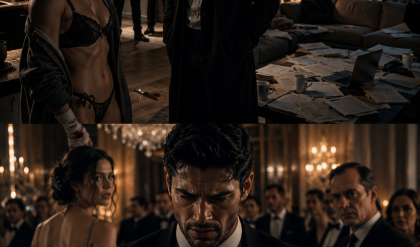
The Voss Hotel ballroom looked different when I entered it the second time.
The chandeliers still glittered. The marble still shone. The same families still gathered beneath expensive flowers, pretending money could disinfect anything.
But I was not the woman they had watched collapse.
I wore black.
Not mourning black.
Verdict black.
Luca stood near the center of the room with Gerald, Adrian, Mrs. Voss, and two men I recognized from the attack by their posture alone. Dangerous men never looked as unique as movies promised. Most looked like tired businessmen who had stopped believing in consequences.
Gerald saw me first.
His face went gray.
“No,” he said.
I held up the brass key.
“Yes.”
The room quieted.
Luca turned.
For one second, everything between us stood visible.
The terrace kiss. The courthouse. The locked room. The tea. The slap. The ring on the dresser. The truth he had delayed too long and the care he had given before I knew what to call it.
“Savannah,” he said.
I walked past him to Gerald.
“You used Mom’s name to sell me to Adrian,” I said. “You used Piper’s fear to keep the Voss money. You used a dead man’s secrets to borrow from criminals. And now you were going to sell the last thing my mother protected.”
Gerald tried to smile.
“Sweetheart, you don’t understand what kind of people you’re standing with.”
“For once, I do.”
Adrian stepped forward. “This is family business.”
Piper’s voice came from behind me.
“No, Adrian. It’s evidence.”
Everyone turned.
My sister stood near the doors, pale but steady, with Elias beside her and two federal agents behind them.
Mrs. Voss whispered, “What is this?”
“A long-overdue correction,” Elias said.
The agents moved first toward the Camorra men.
Then toward Gerald.
Gerald backed away. “You can’t prove anything.”
I lifted my mother’s letters.
“No,” I said. “She can.”
The ballroom erupted.
Not with gunfire. Not with cinematic chaos.
With panic.
Rich people are very brave until paperwork arrives.
Adrian tried to leave through the side hall. Luca caught his arm and held him there without visible effort.
“You should stay,” Luca said. “Hotels have cameras, remember?”
Adrian looked at me with pure hatred.
For the first time, it did nothing to me.
Gerald, handcuffed, turned toward Piper.
“You stupid girl,” he spat. “After everything I did for you?”
Piper flinched.
Then she straightened.
“No,” she said. “After everything you did to us.”
That was the moment I began to forgive her.
Not fully.
Not easily.
But the door opened.
Gerald was taken out beneath the chandeliers he had once admired like a man studying heaven from the wrong side of the glass.
Mrs. Voss sat down as if her bones had been removed. Adrian said nothing. The agents took him too.
When the room finally thinned, Luca and I stood alone near the terrace doors.
He looked at my bare hand.
“I do not deserve to ask for that ring back,” he said.
“No,” I agreed.
His mouth tightened.
“I should have told you everything.”
“Yes.”
“I was afraid if I told you about Joseph, you would run before I could prove you were not tied to him by blood.”
“I did run.”
“You had reason.”
I looked through the glass at the terrace where I had first kissed him out of fury.
“Why did you really marry me, Luca?”
He took time to answer.
That was how I knew it would be true.
“Because your mother saved my life,” he said. “Because my father’s sins reached for you through Gerald. Because my enemies were circling. Because you stood in a ballroom with everyone waiting for you to break, and you refused to give them the pleasure.”
His voice lowered.
“And because when you kissed me, I wanted, for the first time in years, to be the kind of man a woman could choose without needing a disaster first.”
My throat tightened.
“That is a dangerous answer.”
“I am a dangerous man.”
“Yes,” I said. “But that was not the dangerous part.”
He waited.
“The dangerous part is that I believe you.”
I did not take the ring back that night.
A humane ending is not the same thing as a rushed one.
Gerald went to trial. The Voss family lost enough money to discover gravity. Adrian’s name became a headline he could not buy his way out of. Piper moved into a small apartment near her doctor’s office and began the slow, humiliating work of becoming honest. Some days I helped her. Some days I did not answer her calls. Both were part of healing.
Luca opened the locked room before I asked again.
Inside were files, photographs, maps, security plans, and one small framed picture of my mother, younger than I had ever seen her, standing beside a twelve-year-old Luca outside a church.
On the back, in my mother’s handwriting, it said:
He lived. That must mean something.
I stood in that room for a long time.
Then I added my own file to the desk.
A new garden design.
A crooked wisteria vine growing around a copper arbor. Beneath it, a bench wide enough for two people who did not need to lean unless they wanted to.
Luca looked at the drawing.
“Is this for a client?”
“No.”
“For the city?”
“No.”
“For whom?”
I took the ring from my pocket.
Not because everything was fixed.
Not because I had forgotten.
Because truth had finally entered the house, and for the first time in my life, nobody was asking me to pay for someone else’s lie.
“For us,” I said.
Luca looked at the ring, then at me.
“You are sure?”
“No,” I said. “But I am willing. That is better than sure.”
He held out his hand.
I placed the ring in his palm.
He did not slide it onto my finger.
He gave it back to me.
“You decide the day,” he said.
So I did.
Spring.
When the wisteria bloomed crooked on purpose.
THE END