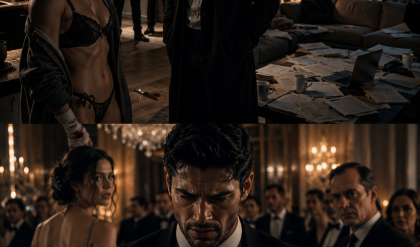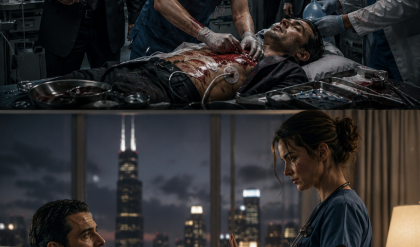
Her smile vanished. “Excuse me?”
He set his untouched champagne on a passing tray and began walking.
He had no strategy. That alone should have stopped him. Nathan did not move without strategy. He had once planned an acquisition so precisely that the target company’s CEO thanked him while being ruined.
Yet now he crossed a ballroom because Nora Bennett had laughed for someone else.
Nora saw him coming.
The warmth left her face so quickly that Nathan felt ashamed before he understood why. Her shoulders straightened. Her mouth settled into the calm, efficient line he had mistaken for personality.
“Mr. Voss,” she said.
Not Nathan.
Never Nathan.
Julian Avery turned. “Mr. Voss. Good evening.”
Nathan shook his hand with enough pressure to be impolite and not enough to be openly hostile.
“Dr. Avery,” he said, though he barely remembered the man. “Enjoying the evening?”
“Very much. Miss Bennett has been explaining the foundation’s expansion strategy. You are fortunate to have her.”
“Yes,” Nathan said. His eyes moved to Nora. “I am.”
Nora blinked.
The silence that followed was small but dangerous.
“I should check the keynote timing,” she said. “We’re seven minutes out.”
“Nora,” Nathan said.
Her name came out rougher than he intended. He saw her absorb it like a slap.
“Walk with me.”
She did not look at Julian. That, for some reason, irritated Nathan even more.
“Of course, Mr. Voss.”
He led her into a side corridor lined with mirrors and white roses. Behind them, the gala continued in glitter and music, unaware that something delicate and long-neglected had just cracked open.
When they reached a quiet alcove overlooking Madison Avenue, Nora stopped at a professional distance.
“You wanted to discuss something?”
Nathan turned.
For the first time in two years, nine months, and six days, he truly looked at her.
That was his first punishment.
Because once he looked, he saw everything he had missed.
The exhaustion under her eyes. The dignity in the way she held herself. The small red mark on her collarbone where the locket chain had rubbed her skin. The intelligence, the restraint, the quiet fury she had spent years folding into useful shapes for his benefit.
He had thought she was calm.
She had been surviving him.
“Who is he?” Nathan asked.
Nora’s brows drew together. “Dr. Avery?”
“Yes.”
“He chairs a hospital board.”
“I know that.”
“Then I don’t understand the question.”
Nathan stepped closer. She did not retreat, which made him feel both relieved and worse.
“He held your hand.”
“He shook my hand.”
“He held it too long.”
Nora stared at him for three full seconds.
Then she laughed once, but it was not the laugh Julian had earned. This one was dry, exhausted, and sharp enough to cut.
“Mr. Voss, I have worked for you for nearly three years. In that time, you have sent me into rooms with governors, surgeons, union leaders, grieving parents, angry donors, and one man who threatened to sue us because we would not name a pediatric wing after his yacht. But tonight you have discovered that I possess a hand, and this is the emergency?”
He flinched.
She saw it. Her expression changed, not softened exactly, but steadied.
“I’m sorry,” she said. “That was unprofessional.”
“No,” Nathan said quietly. “It was accurate.”
The word hung between them.
From the ballroom, applause rose and faded.
Nora glanced toward the sound. “The keynote starts in five minutes.”
“I have never heard you laugh,” Nathan said.
She looked back at him.
“What?”
“I have worked beside you for almost three years, and I have never heard you laugh.”
“I’m at work.”
“That cannot be the whole answer.”
“No,” she said, and there was sadness now beneath the professionalism. “The whole answer is that you have never been listening.”
Nathan could have defended himself. He was good at that. He could have said he trusted her, relied on her, respected her work. All true. All insufficient.
Instead he said, “I deserve that.”
“Yes,” Nora said. “You do.”
It was the first honest conversation they had ever had.
He almost reached for her. His hand lifted before reason stopped it, hovering near her cheek. Nora went completely still. Her eyes widened, not with invitation, but with the terror of a woman watching a long-held fantasy become real at the worst possible moment.
Nathan lowered his hand.
“I’m sorry,” he said. “I don’t know what I’m doing.”
“That makes two of us.”
“I want to talk after the gala.”
“I have cleanup after the gala.”
“Tomorrow.”
“I have a board debrief tomorrow.”
“Then when?”
Nora’s gaze was steady now. “Why?”
The question was quiet.
Nathan had no answer worthy of her.
Because another man touched you sounded ugly.
Because I just realized you are beautiful sounded worse.
Because I may have been in love with you while treating you like furniture sounded insane.
So he said nothing.
Nora nodded, as if his silence had confirmed something she already knew.
“Good night, Mr. Voss,” she said. “I have a microphone to check.”
She walked away.
He let her.
That was the first thing he did right.
The keynote was flawless because Nora made it flawless. The donor pledge total exceeded projections by four million dollars. A video of a little girl ringing a hospital bell after her final chemotherapy treatment made half the ballroom cry. Nathan spoke for twelve minutes from a teleprompter Nora had rewritten at two in the morning, and every line landed.
People congratulated him afterward.
He accepted their praise and watched Nora stand near the stage curtains with her clipboard, invisible again by force of habit.
At midnight, when the last donor had left and the staff began breaking down the room, Nora slipped out through the service entrance.
Nathan followed five minutes later, but he stopped before turning the corner.
Dr. Julian Avery was already there.
He stood beneath the awning in the rain, holding his tuxedo jacket over one arm, leaving a careful distance between himself and Nora.
“I’m sorry,” Julian said. “I don’t mean to intrude. I only wanted to make sure you got to your car safely.”
Nora’s face changed in the lamplight.
Not completely. She was too guarded for that.
But something in her eased.
“Thank you,” she said. “That’s kind.”
“It’s not kindness. It’s basic civilization, though I admit the distinction has become rare in some circles.”
She smiled.
Nathan felt the small, brutal fact of that smile like a blade.
Julian walked beside her down the wet sidewalk. “May I ask you something?”
“You may.”
“Is there something between you and Nathan Voss?”
Nora stopped.
Nathan stopped too, hidden in the shadow behind the loading dock.
“No,” Nora said. “Not anything that includes him noticing.”
Julian nodded. “I see.”
Nora looked embarrassed. “I’m sorry. That sounded bitter.”
“It sounded honest.”
They stood beneath a streetlight while rain silvered the pavement around them.
Julian said, “Would you have coffee with me Saturday morning?”
Nathan’s breath caught.
Nora was quiet for a long moment.
Then she said, “Yes.”
Nathan stayed in the alley until they disappeared.
Then he leaned one hand against the cold brick wall and closed his eyes.
He had bought companies for less than the pain that single word cost him.
On Monday morning, Nora arrived at Voss Meridian at 8:57, three minutes earlier than usual because she wanted a moment alone before the day began.
Nathan was waiting outside her office.
He held two coffees.
She stopped.
“Mr. Voss.”
“Nora.” He glanced at the cups, suddenly looking less like a billionaire than a man holding the wrong flowers at a funeral. “This one is yours. Oat milk, one raw sugar, cinnamon.”
Her expression did not move. “Who told you?”
“Marta in the kitchen.”
“Marta has known for years.”
“Yes,” he said. “I’m aware of how that sounds.”
She unlocked her office and walked in. He followed only after she stepped aside. She did not sit, so neither did he.
“I owe you an apology,” he said.
“You do.”
“I have been careless with you.”
Nora’s eyes sharpened. “No. You have been careless around me. With me implies you had any claim.”
He inhaled.
“Correct,” he said. “I have been careless around you. I have relied on your labor, your intelligence, your judgment, and your patience while giving you less recognition than I give my attorneys for billing me too much.”
That almost got a smile.
Almost.
He continued, “I cannot repair that with coffee.”
“No,” she said. “You cannot.”
“And I cannot ask you to trust a sudden change that began when I saw another man appreciate you.”
“No,” she said again. “You cannot.”
He nodded. “I know.”
Nora reached into her bag and removed an envelope.
Nathan looked at it, and for the first time in years, fear moved visibly across his face.
“This is my resignation letter,” she said. “I drafted it yesterday.”
He did not speak.
“I planned to submit it this morning. Six-week transition. Full documentation. No drama.”
“Nora.”
“No,” she said, not loudly but finally. “You don’t get to say my name like it’s a rope you can throw after I’ve already started climbing out.”
Nathan sat down as if his body had failed him.
She watched him.
It would have been easier if he had been arrogant. Easier if he had ordered her to stay, offered money, threatened breach clauses, done anything that fit the version of him she had spent years preparing to leave.
Instead he looked wounded.
Not offended.
Wounded.
“Do not submit it today,” he said.
Her mouth tightened. “Why?”
“Give me ninety days.”
“For what?”
“To become the employer I should have been. Nothing romantic. No pursuit. No touching, no flowers, no dinners disguised as work, no punishing you for seeing Dr. Avery, no jealousy made into policy. Ninety days of respect, transparency, and overdue correction. At the end, if you still want to leave, I will write the strongest recommendation letter of my life and make sure every foundation in the country knows exactly what I failed to value.”
Nora stared at him.
“That sounds very noble.”
“It is selfish,” he said. “I don’t want you to leave. But I am trying, for once, not to make my wanting the most important fact in the room.”
That sentence reached her against her will.
She hated that it did.
“I am not going to be the lesson you teach yourself,” she said. “I am worth more than your character development.”
Nathan’s face tightened with something like pain.
“Yes,” he said. “You are.”
Silence.
Nora looked down at the envelope in her hand.
She thought of the coffee she had agreed to with Julian and then canceled because she had been too exhausted to move from her couch. She thought of Juniper asleep beside her. She thought of the foundation team, who would suffer through the transition even if she wrote perfect handover documents.
And she thought of Nathan stopping his hand an inch from her cheek because, whatever else he was, he had understood at the last second that desire did not grant permission.
“Ninety days,” she said. “During which I continue my job, you correct my title and compensation if warranted, and you do not confuse gratitude, guilt, jealousy, or attraction with love.”
“Yes.”
“And on day ninety-one, I decide.”
“Yes.”
She placed the resignation letter back in her bag.
Then she picked up the coffee and tasted it.
The cinnamon was perfect.
“That does not earn you points,” she said.
“I know.”
“It does, however, mean Marta likes you enough to be precise.”
“I will take what little comfort I can.”
For the first time in nearly three years, Nora smiled in his presence.
Nathan did not smile back too quickly.
That was the second thing he did right.
The first month was humiliating for Nathan because decency, he discovered, was not dramatic.
It was procedural.
He stopped scheduling meetings over lunch. He made his executives justify any meeting that ran past six. He learned the names of receptionists, drivers, assistants, and janitors. He attended the foundation’s Friday strategy meetings and did not speak for the first three weeks except to ask questions.
The first time he sat in the back of the conference room with a notebook, Nora’s entire team stared at him as though a wolf had entered and politely requested minutes from the last sheep meeting.
Nora said, “Mr. Voss will be observing. He will not be interrupting.”
Nathan said, “Correct.”
He did not interrupt.
Afterward, May Ortiz from communications whispered, “Did you threaten him?”
Nora replied, “Worse. I told him the truth.”
Nathan began reading grant reports. Really reading them. He learned that the mobile clinics cost less than one gala centerpiece per patient visit. He learned that one rural literacy coordinator named Denise in eastern Kentucky produced better outcome numbers than three entire consulting firms. He learned that Nora had been shielding her team from impossible timelines by absorbing pressure herself.
He also learned that her salary was insulting.
By week four, he corrected it.
Nora found the revised compensation package in her HR portal and walked into his office without knocking.
“No,” she said.
He looked up. “Good morning.”
“No.”
“To which part?”
“To you attempting to triple my salary in silence.”
“You are underpaid.”
“I am. But you do not get to fix guilt with a number so large it becomes another kind of problem.”
Nathan leaned back. “What number would not be a problem?”
“The market rate for a vice president, plus ten percent because I have been doing the job without the title for eighteen months.”
He nodded. “Done.”
“You are not supposed to say done before negotiation.”
“You are not negotiating. You are correcting me.”
That stopped her.
She hated, again, that it did.
The second month was harder because Nathan became real.
Not good. Not redeemed. Not magically transformed.
Real.
He had sharp edges. He was impatient with stupidity, allergic to inefficiency, and terrifying when lawyers wasted time. But he began catching himself. He apologized without making speeches. He stopped praising Nora only in private and began crediting her in rooms where credit mattered.
At a donor luncheon, an older man with too much money and too little humility referred to Nora as “Nathan’s girl from operations.”
Nathan set down his fork.
“The woman you are referring to is Nora Bennett, director of foundation strategy. She designed the program you are currently asking to support, and if you call her my girl again, I will assume you are not serious enough for this partnership.”
The donor turned purple.
Nora did not look at Nathan.
She looked at the donor and continued her presentation.
That night, she went home, fed Juniper, sat on her kitchen floor, and cried into the cat’s fur.
Not because Nathan had defended her.
Because part of her had wanted that defense so badly, for so long, that receiving it felt almost like grief.
Julian Avery remained in her life with careful grace.
They had coffee twice. He was kind, funny, and emotionally literate in a way that made Nora feel both safe and suspicious. He had lost his wife to ovarian cancer seven years earlier and spoke of her without self-pity.
On their second coffee, Nora told him, “I need to be honest. There is something unresolved with Nathan.”
Julian stirred his tea slowly. “I assumed there was.”
“I don’t want to waste your time.”
“Nora, I am forty-one. I have wasted time on bad wine, hospital politics, and one very regrettable boat purchase. I do not consider honest company a waste.”
“I don’t know what I’m choosing yet.”
“Then don’t choose under pressure.” He smiled. “Pressure is for operating rooms and bad investors. Not hearts.”
She looked at him for a long time.
“You are a very decent man.”
“I try.”
“That makes this harder.”
“Decency often does.”
He walked her to her car afterward and did not touch her except for a brief, respectful handshake.
Nora drove home with an ache in her chest, because Julian had given her a gift Nathan never had.
A comparison.
A standard.
Proof that being wanted did not have to feel like being hunted.
The third month began with Nathan’s sister.
Lila Voss arrived at the office on a rain-dark Tuesday wearing a sweater too large for her and sunglasses she did not remove. She asked for Nora, not Nathan.
Nora took one look at her and canceled a budget call mid-sentence.
“Come with me,” she said gently.
Lila sat in Nora’s office for nearly two hours. What she said was not Nora’s story to repeat. It involved a man, a secret, shame, fear, and the unbearable burden of having a brother who fixed problems so aggressively that people sometimes hid their pain from him to avoid becoming one.
Nora listened. She did not take notes. She did not offer strategy. She made tea, closed the blinds, and said, “You are not stupid because someone studied your loneliness and used it against you.”
Lila cried then.
When she finished, she whispered, “He’ll destroy him.”
“Maybe,” Nora said. “But first he needs to hear you.”
“I can’t tell him alone.”
“You won’t have to.”
Nora walked into Nathan’s office.
He rose immediately when he saw her face.
“What happened?”
“Your sister is in my office. She needs to talk to you. She is afraid you will turn her pain into a war before you understand it. I think you should come listen.”
Nathan went pale.
Then he nodded once.
For ninety minutes, Nora sat in the corner while Lila spoke and Nathan listened.
He did not interrupt.
He did not call a lawyer.
He did not threaten murder, litigation, or financial annihilation, though Nora could see all three pass through his eyes.
He cried once.
Quietly.
When Lila finished, Nathan knelt in front of her chair and said, “I am sorry I made it hard for you to come to me. I thought protecting you meant controlling everything around you. I should have made myself safe instead.”
Lila put her arms around his neck.
Nora looked away.
Later, after Lila had gone home with a female attorney Nora trusted and a plan that belonged to her, Nathan stood in Nora’s doorway.
“Thank you,” he said.
“For what?”
“For teaching me that listening can be an action.”
Nora’s throat tightened.
“Nathan.”
It was the first time she had used his name without being asked.
He closed his eyes briefly.
When he opened them, he said, “Whatever you decide at the end of the ninety days, I will not unbecome this.”
Then he left before she could answer.
That was the moment Nora became afraid.
Not of him.
Of herself.
Because it was one thing to love a careless man in secret. That kind of love could be starved, mocked, outgrown.
It was another thing entirely to love a man who had begun, slowly and painfully, to become worthy of it.
Two weeks before the deadline, Nathan’s mother summoned Nora to tea.
Helena Voss lived in a limestone townhouse on East Seventy-Third Street, where even the silence looked inherited. She was sixty-three, elegant, famously controlled, and capable of making a compliment feel like a tax audit.
Nora arrived at four exactly.
Helena did not rise.
“Miss Bennett.”
“Mrs. Voss.”
“Sit.”
Nora chose the chair with the best view of the door.
Helena noticed. A faint smile touched her mouth.
“I will not waste your time,” Helena said. “What are your intentions toward my son?”
Nora took one careful sip of tea.
“With respect, Mrs. Voss, your son is thirty-six. My intentions are not yours to audit.”
Helena’s brows lifted.
Most people folded under that look.
Nora had spent nearly three years surviving Nathan Voss before he learned manners. She did not fold easily.
Helena set down her cup. “My son has recently changed in ways that are difficult to ignore. He attends family dinners. He asks his sister questions and waits for answers. He has stopped appearing in gossip columns. Last Sunday, he spent ten minutes explaining pediatric literacy metrics to me with the intensity of a man describing a religious conversion. Your name came up four times.”
Nora’s cheeks warmed.
“I did not ask him to do any of that.”
“No. That is what concerns me.” Helena’s eyes narrowed. “Women have wanted Nathan for his money, his name, his grief, his power, and occasionally for the challenge of being the one who finally wounded him. I am trying to determine which category contains you.”
Nora sat very still.
Then she laughed once.
Not because it was funny.
Because it was outrageous.
“Mrs. Voss, I have worked for your son for nearly three years. In that time, I helped build a foundation that has done more measurable good than most institutions with twice our endowment. I did that while underpaid, under-credited, and mostly unseen. If I wanted Nathan’s money, I had a strange way of showing it. If I wanted his name, I wasted years letting him forget mine.”
Helena’s expression changed.
Nora continued, quieter now.
“I am not after your son. I am trying to decide whether the man he is becoming is real. Because if he is, then I may have to forgive myself for loving him before he deserved it.”
The room went silent.
Helena looked at her for a long time.
Then she did something Nora never expected.
She laughed.
It was rusty and brief, like a door opening in an old house.
“Oh,” Helena said softly. “So that is what happened.”
“What?”
“He finally noticed someone who could not be bought.”
Nora said nothing.
Helena reached beside her chair and lifted three sealed envelopes from a small table.
“I had prepared these,” she said. “Different amounts. Different assumptions. One for an opportunist. One for a wounded romantic. One for a clever employee seeking leverage.”
Nora’s stomach turned.
Helena dropped all three envelopes into the fireplace.
Unlit, but still symbolic enough.
“I will not insult you by opening them.”
“That is probably wise,” Nora said.
Helena smiled again, and this time it was almost genuine.
“Tell me about the rural literacy program.”
Nora blinked.
“You invited me here to interrogate me.”
“I did. I have finished. Now I would like to understand why my son sounded like his father last Sunday.”
Tea lasted two hours.
When Nora left, Helena walked her to the door herself.
On the threshold, she said, “Nathan’s father loved me poorly for the first five years of our marriage. Then one day he looked at me as though the room had finally cleared. I asked him, years later, what changed. He said, ‘I stopped mistaking your presence for permanence.’”
Nora’s hand tightened on her purse.
“I am not asking you to forgive my son quickly,” Helena said. “I am asking you to consider whether a slow arrival can still be an arrival.”
That night, Nora did not sleep.
The next morning, she wore a deep green dress she had bought months earlier and never been brave enough to wear.
Nathan saw her step out of the elevator.
For one second, his composure cracked. His hand flexed at his side as if stopping itself from reaching.
Then he said, “Good morning, Nora.”
Only that.
No compliment.
No hunger disguised as praise.
No claim.
Nora walked into her office, closed the door, and pressed both hands over her face.
“Damn you,” she whispered.
But she was smiling.
The climax began with a photograph.
Three days later, a business journalist named Mara Ellison called Nathan’s private number.
“I received something this morning,” she said. “Long-lens photos from the Renard terrace last night. You and Nora Bennett. Close, but not touching. Intimate enough for a bad headline.”
Nathan’s blood went cold.
He and Nora had attended a board dinner at the Renard the previous evening. She had been brilliant. The board chair had called her promotion overdue in front of everyone. Afterward, on the terrace overlooking the river, Nathan had told her the truth.
“I love you,” he had said. “I will not ask for your answer before the ninety days are over. But I will not insult you by pretending I haven’t arrived there.”
Nora had looked at him with tears in her eyes and said, “I am tired of pretending my answer is still neutral.”
He had driven her home. They had talked until two in the morning on opposite ends of her couch while Juniper judged him from the bookshelf. He had not touched her.
But photographs did not care about context.
Mara continued, “The email suggests she is a subordinate and implies coercion. I am not running it. But someone else will. I traced enough metadata to suspect Roland Keene.”
Nathan closed his eyes.
Roland Keene had lost a billion-dollar infrastructure bid to him three years earlier and had been nursing revenge ever since.
“Thank you,” Nathan said.
“You have maybe twenty-four hours.”
He hung up and called Nora.
She did not answer because she was in a grant review. He texted instead.
When you are free, please come to my office. Important. You are safe. Your job is safe. I need to tell you before anyone else does.
She arrived forty minutes later.
“What happened?”
“There are photographs,” he said. “Of us on the terrace. They will be used to suggest I promoted you because of a private relationship or that I abused my position. Neither is true. But the framing will be cruel.”
Nora sat down slowly.
Nathan forced himself to continue.
“I will do whatever you choose. We can issue a statement with your approval. We can say nothing. We can have counsel threaten every outlet. I will not name you without consent. I will not let you be punished for my enemies.”
Nora looked at him.
Then she asked, “Who?”
“Roland Keene.”
She was quiet for a long moment.
Then her face changed.
Not fear.
Strategy.
“Good,” she said.
Nathan stared. “Good?”
“If he wants a public fight, we give him a public autopsy.”
“Nora.”
“No. Listen.” She leaned forward. “We issue a statement before the photographs drop. We confirm I am being promoted to vice president because the board approved the title based on eighteen months of documented work. We state that the dinner was a board function. We state that any private relationship between two unattached adults, should one ever exist, is private and will be handled with appropriate governance. We state that nonconsensual surveillance of a female executive is not a scandal about the woman being watched. It is evidence against the watcher.”
Nathan’s pulse shifted.
She continued, “Then we send Mara Ellison everything legal already has on Keene. Not rumors. Documents. Payments. Investigator contracts. Harassment patterns. Vendor infiltration. If he wants to make me the angle, we make him the story.”
Nathan looked at her as if she had just solved a war.
“Nora Bennett,” he said quietly.
“Yes?”
“Will you marry me?”
She blinked.
“Did you just propose during a reputational counterattack meeting?”
“Yes.”
“That is deranged.”
“I know.”
“We have a crisis.”
“I know.”
“The ninety days are not over.”
“I know. I am not asking for an answer now. I just needed the sentence to exist in the world.”
Nora stared at him.
Then she began to laugh.
A real laugh.
The one he had lost to Julian at the gala and spent three months earning the right to hear.
“Nathan Voss,” she said, wiping her eyes, “handle Roland Keene properly, and I will consider your application.”
His smile broke open.
“Application?”
“For the position of husband. It is a senior role. The interview process will be rigorous.”
“I would expect nothing less.”
The statement went out at eight the next morning.
It was calm, precise, and devastating.
By noon, the photographs appeared on a minor gossip site with a headline designed to bruise. By one-thirty, Mara Ellison’s investigation dropped in a national business magazine. It detailed Roland Keene’s surveillance campaign, his payments to private investigators, his attempts to seed false narratives, and his use of women near his rivals as reputational weapons.
By four, two institutional investors had suspended business with him.
By Friday, Keene Capital was radioactive.
Nora’s name did appear in headlines, but not the way Keene intended.
The woman he tried to shame was recognized as the architect of one of the country’s most effective private foundations. Former colleagues, hospital directors, rural educators, and grant recipients came forward publicly to praise her. Dr. Julian Avery gave one quote and only one.
“Nora Bennett did not need powerful men to make her important. Some of us were simply fortunate enough to notice.”
Nathan read it twice.
Then he sent Julian a handwritten thank-you note.
On day ninety-one, Nora walked into Nathan’s office and placed her resignation letter on his desk.
His face went white.
Before he could speak, she placed a second envelope beside it.
“The first envelope,” she said, “is the resignation letter I did not submit because you asked for ninety days. I am giving it to you because I no longer need to carry it.”
Nathan touched it like it might burn him.
“And the second?”
“My acceptance of the vice presidency, with a compensation package revised by someone who understands her market value.”
His breath left him.
“And,” she added, “a governance clause requiring you to attend Friday foundation meetings as long as you remain chair.”
“Done.”
“You have not read it.”
“I accept the terms.”
“That is terrible business.”
“No,” Nathan said, looking at her with the quiet certainty of a man who had finally learned the difference between cost and value. “It is the best investment I will ever make.”
She sat across from him.
For a moment, they were simply two people in a glass office above New York, surrounded by all the evidence of the life that had nearly swallowed them.
Then Nora said, “Ask me again.”
Nathan stilled.
“Nora Bennett,” he said, voice low, “will you marry me?”
“Yes,” she said. “But not because you finally noticed me.”
“No.”
“And not because you saved me.”
“No.”
“And not because I waited prettily while you became decent.”
His eyes softened.
“No. Because you did not wait. You lived. You built. You held your ground. And when I finally arrived, you made me knock.”
Nora rose.
This time, when Nathan stepped closer, he waited.
She reached for him first.
Their first kiss was not dramatic. No music swelled. No glass shattered. No one applauded outside the door.
It was quiet, careful, and adult.
A beginning, not a rescue.
They married nine months later in Helena Voss’s garden, under white dogwood trees and a sky that threatened rain but never delivered. Julian Avery attended with a kind smile and no bitterness. Lila cried through the vows. Helena wore dove gray and told Nora, “This family will spend a lifetime trying to deserve you.”
Juniper the cat refused to walk down the aisle despite three rehearsals and had to be carried by Nathan himself, who accepted the scratches as part of his vows.
Years later, when Nora became president of Voss Meridian’s philanthropic division and then, eventually, CEO of the entire company, journalists loved to retell the gala story.
They loved the chandelier.
The jealous billionaire.
The other man’s hand.
The scandal.
The proposal.
They always wanted to make it sound as if Nora Bennett became valuable because Nathan Voss finally saw her.
Nora never let that version stand.
At forty-two, standing again on the Renard terrace with the river moving below and Nathan beside her, older now, silver at his temples, gentler in the eyes, she told him the truth.
“A woman’s worth is not created by being noticed,” she said. “Attention is not a crown. Sometimes it is only a mirror.”
Nathan took her hand.
“And what did I see?”
She smiled.
“You saw a woman who had already become herself while you were busy looking elsewhere.”
He nodded.
“That is true.”
“And the miracle,” Nora said, leaning her shoulder lightly against his, “is not that you saved me.”
“No,” he said.
“The miracle is that when you finally saw me, you understood you had to rise. Not reach down. Rise.”
Nathan lifted her hand and kissed it once.
“I am still rising,” he said.
Nora laughed then, full and bright over the water.
It was the laugh he had never heard for nearly three years.
The laugh another man had awakened by accident.
The laugh Nathan had spent a lifetime learning to deserve.
And this time, when the city glittered around them, Nora Bennett Voss did not feel like a woman waiting to be chosen.
She felt like what she had always been.
The most valuable thing in the room.
THE END