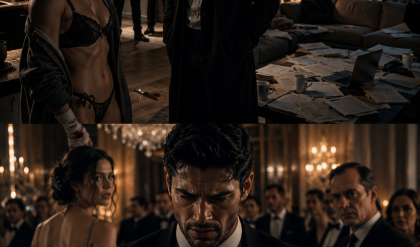
“Then he planned more than the divorce.” Tessa grabbed the papers from Naomi’s purse and began reading. Her eyes narrowed. “This settlement is trash. No company interest? No long-term support? He’s acting like you were a houseguest.”
“I don’t even know what we have anymore,” Naomi admitted. “Marcus handled the accounts. He said it was easier because he understood the business side.”
Tessa looked up sharply. “No. He said that because it helped him hide things.”
Naomi leaned back, exhausted. “I gave him everything. My career, my savings, my contacts. I wrote his first pitch deck, Tessa. I named the company. I built the first client list from my marketing network.”
“And he put none of that in writing.”
“We were married. I trusted him.”
Tessa’s anger softened. “Trusting your husband isn’t stupidity. Using that trust against you is the crime.”
The next morning, Tessa took Naomi to see Lorraine Bell, a divorce attorney in Midtown Atlanta whose office overlooked Peachtree Street and whose reputation made powerful men suddenly interested in settling.
Lorraine was sixty, silver-haired, and calm in the dangerous way a courtroom veteran becomes calm after watching liars ruin themselves under oath.
She listened without interrupting.
Then she read the papers.
Then she removed her glasses.
“Mrs. Hale,” she said, “your husband either thinks you’re foolish, or he thinks you’re too heartbroken to fight. Both assumptions are useful to us.”
Naomi swallowed. “Do I have a case?”
Lorraine’s eyebrows lifted. “You have a war.”
Naomi sat straighter.
“In Georgia,” Lorraine continued, “marital property is subject to equitable division. Not automatic equality, but fairness. If his company gained value during the marriage, and you contributed to that growth financially or professionally, that matters. If he hid assets or undervalued the company in anticipation of divorce, that matters even more.”
“He mentioned a prenup,” Naomi said quietly. “I remember signing papers before the wedding. His lawyer told me they were standard business protections.”
Lorraine’s face sharpened. “When?”
“The rehearsal dinner. Two days before the wedding. I was twenty-seven. My mother had flown in. Everyone was there. Marcus said if I didn’t sign, it would scare investors.”
Lorraine made a note. “A prenuptial agreement presented under pressure that close to the wedding can be challenged. Especially if you had no independent counsel.”
Naomi felt the first thin thread of air enter her lungs.
Lorraine leaned forward. “Here is what I need from you. Bank statements from when you funded payroll. Emails. Texts. Drafts. Old pitch decks. Anything proving your role. And I’m bringing in a forensic accountant.”
Naomi hesitated. “I don’t have money for this kind of fight.”
Lorraine’s smile was small and lethal. “If I’m right about Marcus Hale, he’s going to pay for it.”
Over the next month, Naomi learned that betrayal had paperwork.
The forensic accountant, Ava Chen, found the first hidden account within five days.
By the second week, she had found three more.
Marcus had moved money through a consulting firm registered in Delaware, then into an offshore account connected to a Cayman Islands holding company. He had transferred a vacation cabin in Blue Ridge to his brother for “estate planning.” He had taken a seven-figure loan against the marital home and routed the proceeds through a vendor that did not appear to provide any real services.
Most damning, he had valued Vantage Loop at four million dollars in the divorce filing while telling investors, in writing, that the company was worth closer to twenty-two million.
Naomi sat in Lorraine’s conference room staring at the chart Ava had built across three monitors.
“So he wasn’t just leaving me,” Naomi said. “He was robbing me.”
Ava nodded. “That’s the simple version.”
Lorraine slid a document across the table. “There’s more.”
Naomi looked down and saw an old slide deck dated nine years earlier.
Her slide deck.
The one she had created before Marcus even had a product.
Across the title page were the words: Human Pulse Strategy: Predictive Emotion Mapping for Consumer Engagement.
She stared. “Where did you get this?”
“From discovery in another matter,” Lorraine said. “A company called Mercer Analytics requested early Vantage Loop materials years ago during a potential partnership dispute. Their CEO, Ethan Mercer, kept copies.”
Naomi knew the name. Everyone in Atlanta tech knew Ethan Mercer. His company was Vantage Loop’s fiercest rival, the one Marcus cursed whenever they lost a client. Ethan was known as disciplined, principled, and impossible to intimidate.
Lorraine tapped the deck. “Marcus has always claimed this framework was his idea. But the metadata says you created it.”
Naomi’s heart pounded. “Human Pulse became the foundation of Vantage Loop’s product.”
“Yes,” Lorraine said. “Which means your contribution wasn’t supportive. It was central.”
For the first time since leaving the house, Naomi smiled.
It was not happiness.
It was recognition sharpened into a blade.
Marcus had not merely underestimated her.
He had built his empire on her mind and then tried to bury the architect.
Lorraine let Marcus believe Naomi was broken.
That was the strategy.
When Marcus sent texts demanding her signature, Naomi responded rarely and vaguely. When mutual friends asked how she was, she let them report that she was “struggling.” When Marcus requested a private meeting “to settle things like adults,” Lorraine told her to go only if Georgia’s recording laws permitted it and only if she understood that Marcus’s arrogance might become their best witness.
They met at a coffee shop near Piedmont Park.
Marcus arrived in a charcoal suit, expensive watch flashing beneath his cuff. Naomi wore jeans, a sweater, no makeup, and the tired expression of a woman he expected to defeat.
He smiled when he saw her.
“You look exhausted.”
“Divorce does that.”
He sat across from her. “It doesn’t have to. Sign the papers.”
Naomi looked down at her coffee. Her phone recorded from inside her purse.
“I don’t understand how you can be this cold.”
Marcus sighed. “Naomi, we had good years. I won’t deny that. But people evolve. My life is operating at a higher level now.”
“And I’m beneath that level?”
“You said it, not me.”
“I helped build that level.”
His expression hardened. “You helped with some marketing early on. Don’t rewrite history.”
“I wrote the Human Pulse deck.”
He froze for half a second.
Then he smiled. “You wrote slides. I built a company.”
“That framework is the company.”
“Be careful,” he said softly. “You don’t want to start making claims you can’t prove.”
Naomi let her eyes fill with tears. It was not difficult. The pain was still close. “Why do you hate me so much?”
Marcus’s posture relaxed. He mistook vulnerability for surrender.
“I don’t hate you. I just can’t drag you into the future with me. Callie understands the rooms I’m entering. She knows how to move around powerful people. She looks right. She doesn’t make everything political or personal.”
Naomi whispered, “Because she’s white?”
Marcus’s eyes flashed. “Don’t do that.”
“You did it first.”
“No. This is about class. Image. Ambition. You were perfect when I was struggling. But now I need someone who doesn’t make investors wonder whether I’m still tied to the past.”
Naomi felt ice spread through her.
There it was.
Not just racism. Not just classism. Not just cruelty.
The whole ugly braid.
Marcus leaned forward. “The prenup is valid. The settlement is generous enough. If you fight me, I’ll bury you in legal fees until you have nothing. I planned this carefully.”
Naomi looked at him. “You planned to leave me with nothing?”
“I planned to protect what I built.”
“What we built.”
His smile vanished. “Face reality. You lost.”
Naomi stood.
“No,” she said quietly. “I just finally heard you clearly.”
She walked out before her hands could shake.
In the parking lot, she sent the recording to Lorraine.
Lorraine called ten minutes later.
“Naomi,” she said, almost warmly, “that man just handed us a loaded gun and dared us to aim.”
While the case built, Naomi made a decision that frightened her more than court.
She went back to work.
Not for Marcus. Not behind the scenes. Not as the invisible wife who edited speeches at midnight and coached him before investor calls.
For herself.
She applied to Sterling & Rowe, a respected Atlanta marketing firm. The founder, Diane Sterling, looked at Naomi’s résumé and did not soften the obvious question.
“You have an eight-year gap.”
“I was building someone else’s company without the title,” Naomi said.
Diane studied her. “That sounds like either a tragedy or a bad excuse.”
Naomi almost gave the careful answer she had rehearsed.
Instead, she gave the truth.
“My husband used my talent until he didn’t need my loyalty, then tried to cut me out of everything I helped build. I can either sit at home and let that story define me, or I can come back into this industry and prove I was never just his wife. I’m rusty. I’m also angry, disciplined, and very good at understanding what makes people trust a brand. Hire me for ninety days. If I’m not worth keeping, fire me.”
Diane stared at her for a long moment.
Then she smiled. “I like women who negotiate before they’re offered anything. Start Monday.”
Work saved Naomi in pieces.
The first week was brutal. The software had changed. The pace was punishing. Younger strategists spoke in acronyms she had to look up later in bed. But the instincts came back quickly: audience behavior, emotional triggers, brand credibility, message architecture.
By the third week, she had rescued a failing campaign for a healthcare startup.
By the fifth, Diane was putting her in client rooms.
By the seventh, people stopped asking where she had been and started asking what she thought.
That was how she met Ethan Mercer.
It happened at the Southeastern Tech Ethics Forum in Atlanta, where Sterling & Rowe had sent Naomi to moderate a panel on consumer trust. Afterward, a tall man in a navy suit approached her near the coffee station.
“Naomi Ellis,” he said. “You’re even sharper in person.”
She recognized him immediately. Ethan Mercer had the kind of quiet confidence Marcus had always tried to imitate. He was handsome, yes, but not polished into emptiness. His dark hair had silver at the temples, and his gaze was direct without being invasive.
“You know me?”
“I know your work.”
Naomi’s smile thinned. “Most people call it Marcus Hale’s work.”
“I’m not most people.”
A guarded silence passed between them.
Ethan lowered his voice. “Years ago, Marcus pitched me a partnership using a framework called Human Pulse. I asked him who built it. He said he did. I didn’t believe him.”
Naomi’s breath caught.
“Why not?”
“Because Marcus understood the technology, but the framework understood people. He never did.”
It was the first time someone outside her circle had said it plainly.
Naomi looked away before her eyes could betray her.
Ethan continued, “I’m sorry for what he did to you. Personally and professionally.”
“Careful,” she said. “Being kind to your rival’s soon-to-be ex-wife could look strategic.”
“It is strategic,” he admitted.
Her eyes snapped back to him.
He smiled slightly. “You’re brilliant. I’d be a fool not to want a conversation with you. But I’m not asking for secrets about Marcus. I don’t need them. He’s always been his own liability.”
Despite herself, Naomi laughed.
Ethan’s smile deepened. “Coffee?”
“That depends. Is this a professional invitation or a trap?”
“Professional. For now.”
“For now?”
“I’ve learned not to underestimate possibilities.”
Naomi should have walked away. Marcus would lose his mind if he heard she had coffee with Ethan Mercer. The old Naomi would have avoided the appearance of betrayal, even after being betrayed.
But the old Naomi had lived too long inside Marcus’s rules.
“Coffee,” she said. “One hour.”
They talked for three.
Not about Marcus at first. About ethical AI, emotional analytics, consumer manipulation, the thin line between persuasion and exploitation. Ethan asked questions and listened to the answers. He disagreed without dismissing. He challenged without belittling.
At the end, he said, “You should be leading strategy somewhere.”
“I just got my first job in eight years.”
“Then I’ll wait before trying to steal you.”
“From Diane or from Marcus?”
“Marcus never owned you.”
The sentence landed somewhere deep.
A week later, Marcus called from a blocked number.
“You had coffee with Ethan Mercer?”
Naomi stood at her apartment window, looking down at traffic on Monroe Drive. “Hello to you too.”
“Are you insane? He’s my biggest competitor.”
“I’m aware.”
“He’s using you.”
“That’s rich coming from you.”
Marcus exhaled sharply. “Naomi, whatever is happening between us, there are lines.”
“You crossed them in our bed.”
“This is different.”
“No. This is you discovering that I have a life you don’t control.”
“You’re doing this to humiliate me.”
Naomi smiled faintly. “Marcus, not everything I do is about you.”
He had no answer to that.
The divorce trial began in Fulton County Superior Court on a rainy Monday in March.
Marcus looked confident when he arrived.
By lunch, he looked irritated.
By the end of the first week, he looked hunted.
Lorraine presented the case with surgical patience. Former employees testified that Naomi had built Vantage Loop’s earliest campaigns. Investors confirmed that her presentations had helped secure funding. Emails showed Marcus praising her strategy when he needed money, then minimizing her role when he needed a divorce.
Ava Chen walked the court through hidden accounts, suspicious transfers, shell vendors, undervaluations, and the home equity loan that had vanished into offshore structures.
Then Lorraine played the coffee shop recording.
Marcus’s voice filled the courtroom.
I planned this carefully.
You were perfect when I was struggling.
Now I need someone who doesn’t make investors wonder whether I’m still tied to the past.
Face reality. You lost.
Naomi kept her hands folded as the words echoed.
Marcus would not look at her.
Then came the twist Lorraine had saved.
She called Ethan Mercer as a witness.
A murmur moved through the courtroom.
Marcus’s attorney objected immediately. Lorraine simply smiled and provided the foundation.
Ethan testified that years earlier, Marcus had pitched Vantage Loop using the Human Pulse framework. Ethan had requested supporting materials, received the original deck, and preserved it because the metadata showed Naomi Ellis—not Marcus Hale—as creator.
Lorraine displayed the title slide.
Naomi’s name appeared in the metadata.
Created by: Naomi Ellis.
Date: eighteen months before Vantage Loop’s first investor pitch.
Lorraine turned to Marcus. “Mr. Hale, isn’t it true that the core market differentiation of your company—the very reason investors valued it—came from a framework created by your wife?”
Marcus’s attorney rose. “Objection.”
Judge Marsha Whitcomb, who had tolerated a week of evasions, did not hide her impatience. “Overruled.”
Marcus swallowed. “It was collaborative.”
Lorraine lifted an email. “This is a message from you to your board: ‘Naomi’s Human Pulse framework is the only reason clients understand what we do.’ Did you write that?”
“Yes, but—”
“And this text to your wife: ‘I know I don’t say it enough, but Vantage Loop exists because of your brain.’ Did you write that?”
Marcus’s face turned gray.
“Yes.”
Lorraine stepped closer. “Then why did your divorce filing state that Mrs. Hale made no material contribution to the company?”
No answer came.
The silence did more damage than any confession.
Judge Whitcomb took four days to issue her ruling.
When court reconvened, Naomi felt strangely calm. Tessa sat behind her. Diane Sterling had come too. Ethan sat in the back row, not as a savior, not as a spectacle, but as a witness to the truth Marcus had tried to bury.
Judge Whitcomb read for nearly forty minutes.
She found that Marcus had intentionally concealed assets, deliberately undervalued Vantage Loop, and attempted to use an unfair settlement to deprive Naomi of marital property. She rejected the prenup, citing timing, pressure, and lack of independent counsel. She recognized Naomi’s financial and professional contributions as central to the company’s growth.
Then came the order.
A seventy-thirty division of marital assets in Naomi’s favor.
Full disclosure and recovery of hidden accounts.
A fair market valuation of Vantage Loop based on investor representations, not divorce filings.
Compensatory damages.
Attorney fees.
And referral of the financial records to state and federal authorities for review.
Marcus stood so fast his chair scraped the floor.
“This is insane,” he said.
Judge Whitcomb looked over her glasses. “Mr. Hale, I strongly recommend you sit down before you create a second problem today.”
He sat.
Outside the courthouse, reporters shouted questions. Naomi gave one statement.
“My husband thought he could erase my work because it was unpaid, emotional, and done in the name of marriage. Today the court recognized that invisible labor is still labor. I’m grateful. I’m ready to move forward.”
She did not mention revenge.
She did not need to.
The settlement made Naomi wealthy.
But work made her whole.
Six months after the ruling, she joined Mercer Analytics as Chief Strategy Officer—not because Ethan asked sweetly, and not because it would hurt Marcus, but because she negotiated equity, authority, and a contract reviewed by two lawyers.
Ethan laughed when she slid the terms across the table.
“You came prepared.”
“I learned from expensive mistakes.”
“I wouldn’t want you any other way.”
Their partnership changed the company.
Naomi repositioned Mercer Analytics around ethical intelligence: technology that helped companies understand consumers without exploiting fear, grief, or addiction. She built campaigns that made trust a measurable advantage. Clients came. Investors followed. The press noticed.
Marcus noticed too.
Vantage Loop lost three major accounts to Mercer Analytics in one quarter.
Then five.
Then its planned expansion collapsed after regulators began asking questions about Marcus’s financial disclosures.
Callie left him before the bankruptcy filing, taking the baby she had insisted was his future and moving to Dallas with a real estate developer who did not have subpoenas arriving every week.
Naomi heard these things through industry gossip. At first, she felt satisfaction. Later, she felt less.
By then, she had better things to feel.
Ethan became her friend before he became anything else.
He brought coffee to late strategy sessions but never assumed she owed him time. He praised her in rooms where powerful men were still learning to address her directly. He argued with her ideas and defended her authority. He did not ask her to shrink so he could appear larger.
One evening, after a board presentation that ended in unanimous approval, Ethan walked her to her car.
“There’s a gala next Friday,” he said. “The Innovation Council dinner.”
“I know. I’m speaking.”
“I know. I read the agenda three times trying to decide how nervous I should be about this conversation.”
Naomi turned. “What conversation?”
He looked uncharacteristically uncertain. “I’d like to take you. Not as my CSO. Not because it will annoy Marcus. As my date.”
Naomi’s heart moved in a way she had not permitted in years.
“Ethan…”
“I know,” he said gently. “Complicated history. Public scrutiny. Business partnership. Your divorce still being industry gossip. I’ve considered all of that, probably too much. But the truth is simple. I admire you. I trust you. I like who I am when I’m with you. And if there’s a chance you might feel something similar, I’d rather be honest than strategic for once.”
Naomi studied him.
Marcus had made love feel like negotiation and loyalty feel like debt.
Ethan made honesty feel safe.
“Yes,” she said. “One date.”
His smile was quiet and bright. “One date.”
It became many.
Marcus called the night photos of them appeared online.
“You’re dating him?”
Naomi sat on Ethan’s balcony, city lights glittering below, and almost did not answer. But something in her wanted to hear how little power Marcus had left.
“Yes.”
“My rival.”
“My partner.”
“He’s using you to destroy me.”
“No, Marcus. You destroyed yourself. Ethan is just better at business.”
“You’re doing this to punish me.”
Naomi looked through the glass door at Ethan, who was washing wineglasses in the kitchen because he had insisted partnership included cleaning up.
“I’m doing this because I’m happy,” she said. “And because he treats me like an equal. You should try that someday with someone else.”
“You’ve changed.”
“Yes,” Naomi said. “I survived you.”
He hung up first.
A year later, Ethan proposed at a small restaurant in Savannah, not far from where Naomi had first married Marcus. He chose the city deliberately, then admitted it before dinner because he said surprises should never feel like traps.
“I wanted to give this place back to you,” he told her. “Not erase what happened. Just add a better memory.”
He proposed with a sapphire ring the color of deep evening.
“Marry me,” he said, kneeling beside the table, “not because I saved you, because I didn’t. Not because you complete me, because you were whole before I arrived. Marry me because we build well together. Because love should make both people larger, not one person smaller.”
Naomi cried before she said yes.
The wedding was held in a garden outside Atlanta on a clear October afternoon.
Fifty guests. No industry circus. No performance of wealth.
Naomi walked herself down the aisle.
She wore ivory silk, her natural curls pinned with pearls, her sapphire ring flashing in the sun. Tessa cried openly from the front row. Diane Sterling sat beside Naomi’s mother. Ava Chen, who had followed every hidden dollar like a bloodhound, raised a glass before the ceremony even began.
Fifteen minutes before the vows, Marcus appeared at the gate.
Security stopped him.
He shouted that Ethan had stolen his wife. He shouted that Naomi was confused. He shouted that she would regret marrying a man who had only wanted to beat him.
The old Naomi might have frozen.
This Naomi only asked, “Is he inside the gate?”
“No,” Tessa said.
“Then start the music.”
Police removed Marcus while the string quartet began.
Naomi heard the faint echo of his voice disappear behind the swelling notes, and the symbolism was almost too perfect. The man who had once controlled the volume of her life was now background noise outside a locked gate.
At the altar, Ethan took her hands.
“You okay?” he whispered.
Naomi smiled. “I’m exactly where I chose to be.”
Their vows were not dramatic. They were better than that.
They were specific.
Ethan promised to celebrate her victories without claiming them, to disagree with honesty and respect, to protect their partnership from ego, fear, and silence.
Naomi promised to never again confuse sacrifice with love, to bring her full self into the marriage, and to stand beside him without standing beneath him.
When the officiant pronounced them husband and wife, Naomi did not think of Marcus.
Not once.
At the reception, Tessa showed her a social media post Marcus had made from the police station parking lot. It was rambling and bitter, accusing Ethan of manipulation and Naomi of revenge.
Naomi read three lines, handed the phone back, and shrugged.
“Aren’t you going to respond?” Tessa asked.
Naomi looked across the room at Ethan laughing with her mother.
“No,” she said. “A response would suggest he’s still in the conversation.”
Three years later, Naomi Mercer stood in a New York ballroom accepting an award as one of the most influential women in ethical technology.
Mercer Analytics had expanded into twelve countries. Naomi’s strategy division had become the company’s most profitable arm. She had started a foundation for women rebuilding careers after divorce, caregiving, or financial abuse. She mentored young Black women entering tech spaces that still underestimated them until they spoke.
In her acceptance speech, she did not name Marcus.
She did not need to.
“I learned,” she told the audience, “that being unseen does not mean being unimportant. Many people build empires from someone else’s labor and call that labor love. But love does not require disappearance. Partnership does not require silence. If you helped build something, your contribution matters. If someone tried to erase you, write yourself back into the record.”
The applause rose like weather.
Afterward, a young woman approached with tears in her eyes.
“How did you stop being angry?” she asked.
Naomi thought carefully.
“I didn’t stop all at once,” she said. “First I used anger to stand up. Then I used discipline to rebuild. Then one day I realized my life had grown so much bigger than the person who hurt me. That’s when anger became too small to carry.”
A week later, Naomi ran into Marcus at a grocery store in Atlanta.
He was thinner, older, dressed simply. No watch. No polished arrogance. Just a man comparing prices on coffee.
For a moment, they stared at each other.
“Naomi,” he said.
“Marcus.”
He looked down at his cart, embarrassed by its ordinariness. “I heard about your award. Congratulations.”
“Thank you.”
“You earned it.” He gave a sad smile. “You always did.”
Naomi waited.
He took a breath. “I’m in therapy. I know that doesn’t fix anything. I’m not asking for forgiveness. But I wanted to say I’m sorry without trying to win anything from it. What I did to you was cruel. And stupid. And cowardly.”
The apology surprised her less than her own reaction.
No triumph.
No ache.
Only quiet.
“I appreciate you saying that,” she said.
“I lost my company,” he continued. “Callie left. Most of my friends disappeared when the money did. For a while I told myself you ruined me.”
Naomi held his gaze. “And now?”
“Now I know I ruined me.”
There it was. The truth, finally arriving years late with no power to change the past.
Naomi nodded. “I hope you keep getting better.”
“That’s it?”
“What else should there be?”
He looked at her then, really looked, and she saw the moment he understood. There was no door left open. No hidden longing. No revenge still tying them together.
She had become unreachable to him.
Not because she hated him.
Because she had healed.
“I’m glad you’re happy,” he said.
“I am.”
“With him?”
“With myself,” Naomi said. Then, after a gentle pause, “And yes, with Ethan.”
Marcus nodded. His eyes shone, but he did not ask for more.
Naomi walked away with a bag of groceries, got into her car, and drove home.
Ethan was on the porch when she arrived, their rescue dog sleeping at his feet, late afternoon light turning the windows gold. He looked up from his laptop and smiled in the way that still made her feel chosen without feeling possessed.
“You okay?” he asked after she told him.
Naomi sat beside him, leaned into his shoulder, and watched the dog chase something in his sleep.
“Yes,” she said. “I think I finally am.”
“Do you regret any of it?”
She considered the question, not because she doubted the answer, but because the answer deserved honesty.
“I regret how much I abandoned myself before I learned better,” she said. “But I don’t regret surviving. I don’t regret fighting. I don’t regret rebuilding. And I don’t regret that the road led here.”
Ethan kissed her forehead.
Below them, Atlanta hummed with evening traffic. Somewhere in that city, Marcus was living with the consequences of the man he had chosen to be. Naomi wished him growth, but not closeness. Peace, but not access.
Her victory was no longer his downfall.
It was this porch.
This marriage.
This work.
This self-respect.
This life built from the ruins of a night that had once felt like the end of everything.
Marcus had divorced his wife because he thought she no longer fit the image of his success.
Then he lost his mind watching her marry his rival.
But the truth was simpler and far more powerful.
Naomi had not become extraordinary because two men fought over her.
She had always been extraordinary.
One man tried to use it.
One man learned to honor it.
And Naomi, at last, learned to own it for herself.
THE END