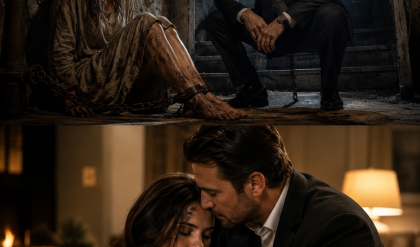
“How should I leave?”
His jaw tightened. “Not while you’re upset. Not while you’re six months pregnant. Not alone.”
“You lost the right to worry about me alone.”
“Nora, please.”
That word should have meant something from a man who never begged. Instead, it sounded like a thief asking permission to keep what he had already destroyed.
She looked down at his hand on her wrist.
“Let go.”
He did.
Not immediately, but he did.
“I love you,” he said.
Nora looked at the stairs, then at the hallway above them, where Camille was probably gathering her clothes in Nora’s bedroom.
“No,” Nora said. “You love owning things that make you feel human.”
He flinched.
Then she opened the front door.
“Nora, wait. The baby—”
“She is exactly why I’m leaving.”
The door closed behind her without a slam.
That quiet click would haunt Dante Marlowe longer than any gunshot.
Outside, Boston was cold and glittering under a hard November sky. Nora walked to the black Range Rover Dante had given her for their anniversary, slid behind the wheel, and placed both hands on the steering wheel until the trembling stopped.
Then she drove.
She did not go to her mother’s house. Dante would look there first. She did not go to her best friend’s apartment. Dante knew that address too.
She drove to a hotel near the harbor, one with private elevators, discreet staff, and enough rich men with secrets that nobody looked twice at a pregnant woman checking in under her maiden name.
Nora Bennett.
The name felt strange in her mouth when she gave it at the front desk.
In the suite, she locked the door, set the chain, and took the ultrasound envelope from her purse with careful hands.
She had put it on the dresser. She remembered doing it.
Then why was it still in her purse?
Nora opened the flap.
Inside was not the ultrasound.
Inside was a folded piece of paper she had never seen before.
On it, written in a woman’s sharp handwriting, were six words:
He is not the only liar.
Nora stared at the message until the room seemed to tilt.
For the first time that night, fear cut through the grief.
Because the envelope she had left on the dresser had been switched before she ever walked into that bedroom.
And whoever had done it had wanted her to find Dante with Camille.
The discovery did not soften the betrayal. Dante had still been there. Camille had still been in his shirt. Whatever trap had been laid, he had walked into it willingly.
But Nora was a Bennett before she was a Marlowe, and Bennetts did not ignore evidence.
Her father had been a federal prosecutor. Her grandfather had built a shipping company from nothing and taught her to read contracts before she could drive. Before marrying Dante, Nora had worked as a forensic accountant, the kind of woman corporations hired when money disappeared and nobody wanted the police involved yet.
So she did not collapse.
She sat at the hotel desk, opened her laptop, and began making a list.
At the top she wrote three words:
Protect my daughter.
Below that:
Divorce. Custody. Money. Evidence. Camille. Envelope.
Her phone began vibrating.
Dante.
Again.
Again.
Again.
She turned it over and let it shake against the wood until it stopped.
At 2:13 a.m., she listened to his first voicemail.
“Nora. Please call me. I know what you saw. I know there’s no excuse. I need to know you’re safe. Please. Just tell me where you are.”
The second was colder.
“I sent men to your mother’s house and Leah’s place. You’re not there. That means you’re hiding from me. Fine. Hide. But don’t put yourself in danger to punish me.”
The third was almost unrecognizable.
“I opened the envelope. It’s our daughter.” A long silence. “I missed the moment you came home to tell me about our daughter because I was…” His voice broke. “God, Nora. I don’t know what I am.”
Nora deleted all three.
Then she called Leah Park, the best divorce attorney in Boston, at exactly 7:02 a.m.
Leah answered on the fourth ring with the voice of a woman who already knew bad news paid well.
“Nora?”
“I need a divorce.”
There was a pause. “From Dante Marlowe?”
“Yes.”
“Are you safe?”
“For the moment.”
“Is the baby safe?”
“Yes.”
“Then come to my office through the back entrance at nine. Don’t bring your car. Don’t use your regular phone after this call. And Nora?”
“Yes?”
“Do not underestimate him.”
Nora looked out over the harbor, where gray water moved like metal under the morning light.
“I’m done underestimating everyone.”
By noon, Dante Marlowe had frozen three joint accounts, sent two attorneys to Leah’s office, and placed four men outside Nora’s mother’s house.
By sunset, Nora had moved money from the trust her grandfather left her, hired a security firm with no Marlowe connections, and filed an emergency petition for temporary separation, exclusive control of her medical decisions, and protection from intimidation.
Leah read the filing twice, then looked across her desk at Nora with professional admiration.
“You did most of this analysis before I even got involved.”
“I had a long night.”
“You also found the infidelity clause in the prenup.”
“Section forty-one,” Nora said. “Infidelity during pregnancy triggers enhanced custody review and invalidates the loyalty penalty.”
Leah smiled faintly. “You read your prenup?”
“Three times before I signed it. Four times last night.”
“And the note in the envelope?”
Nora handed it over in a plastic sleeve.
Leah’s expression sharpened. “You think Camille switched it?”
“I think Camille wanted me to think she switched it.”
“That’s not the same thing.”
“No. It isn’t.”
Leah leaned back. “Most women in your position come in wanting revenge.”
“I want my daughter born outside a war zone.”
“That may require revenge.”
Nora lowered her gaze to her belly. The baby moved, a small pressure under her palm.
“Then I’ll be precise.”
Three days later, Nora returned to the Beacon Hill townhouse with Leah, two private security officers, and a court order allowing her to retrieve personal belongings.
Dante was waiting in the foyer.
He looked as if he had not slept since she left. His suit was perfect, but his face betrayed him. Shadows under his eyes. Stubble along his jaw. A bruise across one knuckle, as if he had introduced his fist to a wall and lost.
“Nora,” he said.
“Mrs. Bennett for legal purposes,” Leah corrected.
Dante’s eyes cut to the attorney.
Nora stepped between them before he could speak.
“I’m here for my clothes, my family jewelry, my documents, and my personal electronics. I’ll be gone in two hours.”
His gaze returned to her face. “Can we talk alone?”
“No.”
“I won’t hurt you.”
“I know,” Nora said. “You’d call it protection.”
That landed. She saw it.
“Nora, what you saw—”
“Was enough.”
“No,” he said, voice low. “It wasn’t.”
For a moment, she almost asked. The note burned in her mind. He is not the only liar. But Camille had been in his shirt. His body had been in that room. The trap, if it existed, did not absolve him.
So Nora turned toward the stairs.
“I’ll be finished by two.”
Collecting her belongings felt like performing surgery on a corpse.
The closet first. Dresses into garment bags. Shoes into boxes. Her grandmother’s pearls from the velvet drawer. Her father’s watch. The first baby blanket she had bought and hidden because superstition had made her afraid to show Dante too soon.
She left the wedding album.
She left the lingerie.
She left every gift Dante had given her, except the ones that would help in court.
In the study, she gathered her passport, laptop, tax documents, medical folder, and a locked notebook where she kept household account details.
Then she saw the safe behind Dante’s bookshelf.
She had known it was there. Dante had once joked that every man in his family had three safes: one for money, one for guns, and one for sins.
The joke had not seemed funny then.
It was less funny now.
The safe required a six-digit code. Nora tried Dante’s birthday. No. Their wedding date. No. His sister’s birthday.
The lock clicked.
Nora stood still.
Then she opened it.
Inside were cash packets, two passports under names she did not recognize, a pistol, and a black leather ledger.
At first, she thought it was a record of women. More betrayal.
Then she saw the columns.
Payments. Dates. Initials. Shell companies.
Her stomach tightened.
Camille Archer appeared seven times.
So did Vincent Marlowe, Dante’s father.
Nora photographed every page with her phone. Then she found a second envelope tucked into the back cover.
Inside was a draft custody trust.
Not for Dante.
Not for Nora.
For Baby Marlowe, unborn child of Dante and Nora Marlowe, with Vincent Marlowe named as emergency trustee in the event both parents were deemed unfit.
Nora read the page three times.
Then once more.
A sound came from the doorway.
Dante stood there.
His face changed when he saw the ledger in her hands.
“Nora.”
She looked up slowly.
“What is this?”
He did not answer fast enough.
That was answer enough.
She lifted the custody trust. “Why is your father preparing documents for my unborn child?”
Dante crossed the room and closed the door behind him.
“Listen to me carefully.”
“No. I asked you a question.”
“My father has always made contingency plans.”
“For stealing my baby?”
His eyes flashed. “Nobody is stealing our daughter.”
“Then why is Camille Archer being paid through one of his companies?”
Dante went still.
Nora watched the realization move through him. Not guilt this time. Shock.
He reached for the ledger.
She stepped back. “Don’t.”
“I’ve never seen those payments.”
“You expect me to believe that?”
“No,” he said. “I expect you to hate me enough not to. But I’m telling you the truth.”
Nora laughed once. “You destroyed the usefulness of that phrase.”
His face tightened with pain. “I know.”
She slid the ledger into her bag.
“That stays here,” Dante said.
“No.”
“It contains things that could get people killed.”
“Then maybe those people should have made cleaner choices.”
“Nora, my father cannot know you have that.”
The fear in his voice was not for himself.
That stopped her more effectively than a threat.
“Why?”
Dante looked toward the closed door, then back at her.
“Because if he paid Camille, then last night was not just my betrayal. It was a move.”
“A move against who?”
His answer was quiet.
“Both of us.”
Nora wanted to reject it. She wanted the world simple: husband betrays wife, wife leaves husband, court decides consequences. But the paper in her hand said the world was not simple. It said someone had built a trap beneath the trap.
She put the ledger in her bag.
“Then I suggest you start asking better questions.”
She left at exactly two.
Dante did not stop her.
The legal war became a family war within a week.
Dante’s attorneys contested the separation but not as aggressively as Leah expected. Vincent Marlowe’s attorneys, however, appeared from nowhere, filing motions “on behalf of family interests” and requesting sealed review of the unborn child’s security needs.
Leah threw the papers onto her desk.
“This is insane.”
“No,” Nora said, reading the language. “This is strategy.”
Leah pointed to the motion. “His father is arguing that your unstable separation from Dante creates a security risk requiring Marlowe family oversight.”
“He wants access.”
“To your baby?”
“To leverage.”
Leah’s mouth tightened. “What kind of family did you marry into?”
Nora looked at the ledger copies spread across the table.
“The kind that writes down sins because it thinks no one will ever dare read them.”
That night, Dante appeared outside Nora’s new apartment building.
He did not try to come up. He did not call her. He stood across the street beneath a streetlamp until her security called to report it.
Nora watched from behind the curtain.
For twenty minutes, he stood there like a man waiting outside a church he had burned down.
Finally, her phone buzzed.
A text.
I know I have no right to ask. But please be careful with my father. He does not love gently.
Nora typed back before she could stop herself.
Neither do you.
His reply came a full minute later.
I am learning that love without gentleness is just another kind of violence.
She stared at the message until the screen went dark.
Then she cried for the first time.
Not because she forgave him.
Because she missed the version of him she had believed existed, and she was beginning to fear that version had been both real and not enough.
Labor came four weeks early.
It began at 3:18 a.m., with a sharp pain that made Nora grip the bathroom sink and whisper, “No, not yet.”
But babies do not negotiate with calendars, lawyers, or mob wars.
By dawn, Nora was in a hospital bed with Leah in the waiting room, her mother at her side, and two security guards outside the door.
Dante was not called.
Nora had made that clear.
Then, during the tenth hour, when pain had stripped her down to breath and bone, the door opened.
Her mother turned sharply. “You can’t come in.”
Dante stood in the doorway wearing the same black suit he must have slept in. His face was pale, eyes wild with terror.
“I’m not here to argue,” he said. “I’m here because the hospital received a false transfer order for Nora and the baby. My father’s signature was on the authorization.”
The room went silent except for the machines.
Nora’s breath caught. “What?”
Dante held up a folder. “He tried to move you to a private facility owned by a Marlowe foundation before delivery.”
Her mother whispered, “Oh my God.”
Another contraction hit. Nora cried out, and Dante stepped forward on instinct.
“Don’t,” she gasped.
He stopped immediately.
That mattered, even through pain.
The doctor came in. Nurses moved. Security doubled. Leah stormed down the hall making calls that sounded like threats wrapped in legal language.
And at 5:46 p.m., Nora gave birth to Grace Bennett Marlowe.
Six pounds, two ounces. Dark hair. Furious lungs. Her father’s eyes.
When the nurse placed Grace on Nora’s chest, the entire world became smaller and larger at once.
“Hello,” Nora whispered, tears slipping into her hair. “Hello, my brave girl.”
Dante stood across the room, near the wall, both hands clenched at his sides as if he had to physically restrain himself from approaching.
Nora looked at him.
He looked broken open.
“Do you want to hold her?” she asked.
Her mother made a sound of protest.
Dante’s face changed. “Nora, you don’t have to—”
“I know what I don’t have to do.”
He came forward slowly.
When Nora placed Grace in his arms, the man who had ruled Boston’s underworld lowered his head and wept without making a sound.
“I’m sorry,” he whispered to the baby. “I’m so sorry.”
Nora watched him and felt no triumph.
Only the terrible ache of knowing love did not disappear simply because trust did.
Two days later, Camille Archer appeared at Nora’s hospital room.
She looked nothing like the woman in Dante’s shirt. No red lipstick. No smug smile. Her blonde hair was pulled back, her face hollow with fear.
Security blocked her at the door.
“I need to talk to Nora,” Camille said.
Dante, who had been sitting near the window while Grace slept, stood so fast his chair nearly fell.
“What are you doing here?”
Camille flinched. “Trying not to die.”
Nora’s hand tightened around the blanket.
Dante’s voice went cold. “Who sent you?”
“Your father.” Camille looked at Nora. “And if I don’t tell the truth now, he’s going to kill me anyway.”
The hospital room seemed to shrink.
Nora nodded once to security. “Let her in.”
Dante turned. “Nora—”
“No,” she said. “I want to hear her.”
Camille stepped inside, trembling.
“It was supposed to be simple,” she said. “Vincent hired me to get close to Dante. He said the marriage was making Dante weak, that Nora was turning him legitimate, making him careless. He wanted leverage.”
Dante’s face went white with rage.
Camille looked at him with exhausted contempt. “Don’t look at me like that. You still made your choices.”
“I know,” Dante said, voice deadly quiet.
That answer surprised her.
She swallowed and continued. “Vincent told me when Nora would be coming home. He had someone switch the ultrasound envelope in her purse at the clinic. He wanted her to find us. He wanted the separation. The custody trust. The security motions. All of it.”
Nora felt cold from the inside out.
“Why?” she asked.
“Because Grace is the first Marlowe child in twenty years born inside a legal marriage,” Camille said. “Vincent believes bloodline is power. If Dante lost control of the family, Vincent wanted the baby as his symbol. If Nora fought, he planned to paint her unstable. If Dante fought him, he planned to use the scandal to weaken him.”
Dante looked as if he might tear the room apart with his bare hands.
Nora kept her eyes on Camille.
“And you helped him.”
Camille’s eyes filled. “Yes.”
“Why are you confessing?”
“Because Vincent doesn’t pay loose ends forever.”
She reached into her coat and removed a small recorder.
“I recorded him.”
Dante stared. “You recorded my father?”
Camille gave a bitter little smile. “I’m a mistress, not an idiot.”
That was the second false twist. For one brief moment, Nora thought Camille had come to save them.
Then Camille said, “But there’s more.”
Nora knew from her tone that the worst had not arrived yet.
Camille looked at Dante.
“The false transfer order wasn’t just to move Nora. Vincent planned to take the baby tonight.”
Dante did not shout. He did not threaten.
He simply turned toward the door with a calm so complete it terrified Nora.
“Dante,” she said.
He stopped.
Their eyes met.
In his face, Nora saw the old world calling him. Blood for blood. Violence for insult. A father’s betrayal answered with a son’s wrath.
Then Grace stirred in the bassinet.
The small sound changed the room.
Dante closed his eyes.
When he opened them, he was still furious, but he was not lost.
He looked at Nora.
“What do you want me to do?”
No one in the room moved.
It was the first time he had asked her that before acting.
Nora looked at Camille. At Leah, who had just entered and was absorbing the scene with sharp, silent focus. At her daughter.
Then she looked back at Dante.
“We don’t handle this your father’s way,” she said.
His jaw worked. “And what is your way?”
Nora picked up the leather ledger from the side table. She had brought it to the hospital because instinct told her paper could be more dangerous than guns.
“My way,” she said, “is we make him read his sins in front of witnesses.”
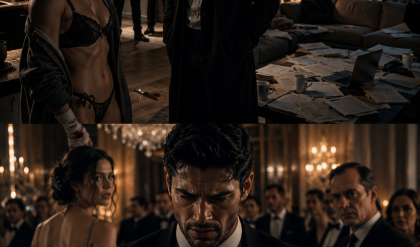
The Marlowe family gathered three nights later in the private dining room of Bellamy’s, an old North End restaurant where judges, union chiefs, politicians, and criminals had pretended not to know one another for fifty years.
Vincent Marlowe arrived like a king.
Seventy years old, silver-haired, elegant in a charcoal suit, he kissed cheeks, accepted respect, and took his seat at the head of the table beneath a painting of Saint Michael casting out demons.
Dante sat at the opposite end.
Nora entered last.
Every conversation died.
She wore black. Simple. Severe. Her postpartum body still ached. Her daughter was safe with her mother and four guards Leah had personally vetted. Nora had no business standing in a room full of dangerous men less than a week after giving birth, and every man there knew it.
That was why it worked.
Vincent’s eyes narrowed. “Nora. You should be resting.”
“I’ll rest after the minutes are read.”
A few men exchanged glances.
Dante stood. “Sit down, Nora.”
“No.”
His face tightened, but he did not argue.
Vincent smiled. “Still dramatic, I see.”
Nora placed the leather ledger on the table.
Vincent’s smile disappeared.
Good, she thought.
There you are.
“This belonged to Dante’s safe,” she said. “But many of the payments inside appear to come from you.”
Vincent leaned back. “Family financial matters are not your concern.”
“My daughter is my concern.”
“She is a Marlowe.”
“She is a baby.”
The words struck the table harder than shouting would have.
Nora opened the ledger to a marked page.
“Mr. Bellamy,” she said to the restaurant owner standing near the wall, pale and sweating. “You agreed to witness, correct?”
He nodded weakly.
“Leah?”
Her attorney stepped forward with a recorder and two notarized copies.
Vincent laughed once. “You think paperwork protects you here?”
“No,” Nora said. “But the federal agents listening in the kitchen might.”
The room changed.
It was subtle but immediate. Men shifted. Hands went still. Eyes moved toward doors.
Vincent looked at Dante.
Dante did not look away.
“You brought law into a family room?” Vincent asked softly.
Dante’s voice was flat. “You tried to steal my daughter.”
“She is my blood.”
“She is not your property.”
Vincent’s mask cracked, just slightly. “You weak fool.”
Nora turned the ledger toward the family accountant, a narrow man named Paul Sutter who looked as if he wanted to evaporate.
“Read the highlighted entries.”
Paul did not move.
Dante said, “Read.”
Paul read.
Payments to Camille Archer. Payments to private investigators following Nora. Payments to a clinic employee. Payments to a judge’s former clerk. Payments to a security company that filed the false transfer order.
With every line, Vincent seemed to age and harden at the same time.
Then Leah played Camille’s recording.
Vincent’s voice filled the room.
“She’ll leave him. Pregnant women are emotional. Dante will lose focus. Once the child is born, we create instability. A baby needs a family, and I am the family.”
No one spoke.
Nora looked down the table at the old man who had mistaken blood for ownership and fear for loyalty.
“You called yourself family,” she said. “But family does not set traps around a pregnant woman. Family does not threaten a newborn. Family does not turn love into leverage.”
Vincent’s eyes burned. “You think you’ve won because you made a speech?”
“No,” Nora said. “I won because your son has to choose now, in front of everyone, what kind of man he is.”
She looked at Dante.
The room turned with her.
For a long moment, Dante said nothing.
Then he removed the heavy gold ring from his right hand, the Marlowe signet, and placed it on the table.
Vincent stared at it.
“No,” he said.
Dante pushed the ring toward him.
“I’m done being your weapon.”
“You are what I made you.”
Dante’s face was pale but steady. “That’s the tragedy, not the excuse.”
Vincent stood, shaking with rage. “You would destroy this family for her?”
Dante looked at Nora.
“No,” he said. “I destroyed my family when I betrayed her. I’m trying to save what’s left.”
Federal agents entered through the kitchen.
Vincent did not struggle when they took him.
He looked only at Nora as they cuffed him.
“You have no idea what you’ve done.”
Nora held his gaze.
“I became my daughter’s mother.”
The aftermath did not feel like victory.
It felt like waking after a fire and counting what the flames had spared.
Vincent was indicted on conspiracy, kidnapping-related charges, bribery, and financial crimes. Camille entered witness protection. Several Marlowe associates disappeared before subpoenas could find them. Dante spent months with attorneys, prosecutors, accountants, and ghosts.
He cooperated.
Not completely at first. Men like Dante did not learn surrender in a day. But Nora watched him make one difficult choice after another. He gave up routes. Closed operations. Sold assets. Put legitimate companies into employee trusts. Paid restitution quietly where he could and publicly where he had to.
He also went to therapy.
The first time he told Nora that, she laughed because she thought he was joking.
He was not.
“I don’t know what to say in there,” he admitted during one of his supervised visits with Grace.
Nora sat across the room, folding tiny socks.
“Start with the truth.”
“That may take more than an hour.”
“Then book two.”
He almost smiled.
Grace, three months old and unimpressed by adult damage, grabbed his finger and refused to let go.
Dante looked down at her.
“I don’t want her to grow up afraid of me.”
Nora’s hands stilled.
“Then don’t be frightening.”
“I don’t know how to be anything else.”
“Yes,” Nora said. “You do. I’ve seen it.”
He looked up.
It was dangerous, giving him that much. Dangerous because hope had teeth. But it was also true.
“You’re gentle with her,” Nora said. “You were gentle with me once, before you forgot that gentleness was a choice.”
His throat moved.
“I didn’t forget,” he said. “I thought I could save it for special moments and be ruthless everywhere else.”
“And?”
“And poison spreads.”
That was the closest thing to wisdom he had ever said.
A year passed.
Then two.
Dante did not ask Nora to come back.
That helped more than any apology.
He showed up when invited. Left when asked. Answered questions without anger. Gave Nora access to financial records, security plans, legal documents, anything concerning Grace. When she doubted him, he did not punish her for it. When she grew cold without warning because a memory opened under her feet, he did not demand reassurance.
He learned to say, “I understand why you feel that.”
At first, it sounded rehearsed.
Later, it sounded true.
Grace grew into a bright, stubborn little girl with Dante’s dark eyes and Nora’s deliberate stare. She loved ducks, blueberries, and throwing blocks into laundry baskets. She called Dante “Daddy” with the casual ownership of a child who knew nothing of court orders or betrayal, only that he knelt when she ran to him.
On Grace’s second birthday, Dante stayed after the party to help clean.
Nora washed frosting from a plate while he gathered wrapping paper from the floor. For a while they moved around each other with the old rhythm of marriage, but without the old blindness.
“You don’t have to do that,” she said.
“I know.”
“You always say that.”
“Because I’m trying to only do things I choose.”
She looked at him.
He had changed physically in small ways. Less expensive armor. Fewer perfect suits. More shirtsleeves rolled up while building block towers with Grace. The tattoos remained, but they no longer seemed like warnings. Just history written on skin.
“Do you ever hate me?” he asked quietly.
Nora dried her hands.
“For what?”
“For leaving? For not leaving sooner? For letting you back into Grace’s life? For still caring?”
He set the trash bag down.
“I hate what you did,” she said. “I hate that part of my mind will always know you’re capable of it. I hate that sometimes, when you’re late, I feel twenty-six again, standing outside that bedroom door.”
He closed his eyes.
“But no,” she said. “I don’t hate you.”
When he opened his eyes, they were wet.
“I don’t deserve that.”
“No,” Nora said. “You don’t.”
He nodded.
She stepped closer. Not much. Enough.
“But Grace deserves parents who tell the truth,” she said. “And the truth is, people can do unforgivable harm and still spend their lives becoming better than the worst thing they did.”
His voice was rough. “Is that forgiveness?”
“No.”
He accepted that.
“Is it a beginning?”
Nora looked toward the nursery, where Grace was sleeping under a blanket patterned with yellow ducks.
“Maybe.”
They did not remarry quickly.
That mattered too.
Their first marriage had been all speed and heat and certainty. Their second chance was built slowly, with therapy sessions, parenting schedules, difficult conversations, and months where Nora pulled away because the past had risen up and demanded to be feared again.
Dante stayed.
Not perfectly. Sometimes he grew frustrated. Sometimes Nora was unfair. Sometimes trust felt less like a bridge and more like a rope stretched over a canyon. But every time they reached a hard place, they did what they had failed to do before.
They told the truth before the lie could grow roots.
Three years after the night Nora found him with Camille, Dante asked her to dinner.
Not at a restaurant he owned. Not somewhere with private rooms and men guarding doors.
A small Italian place in Cambridge with paper menus and candles in glass jars.
Nora almost said no.
Then she said yes.
At the end of the meal, he did not produce a ring.
Instead, he handed her a folded piece of paper.
She opened it carefully.
It was a promise, written in his handwriting.
Not romantic. Not poetic.
Specific.
He promised financial transparency. Legal accountability. No private security decisions concerning Grace without Nora’s consent. No contact with any woman from his past without disclosure if it affected their family. Continued therapy. Continued cooperation with investigators. Continued separation from Vincent, who had died in prison six months earlier still insisting he had only protected the family.
At the bottom, Dante had written:
I will not ask you to trust my words. I will make my life readable.
Nora read it twice.
Then she cried in the restaurant, quietly, while he sat across from her with his hands folded, not touching her until she reached for him first.
A year later, they married again in a courthouse on a rainy Friday morning.
Grace wore a yellow dress and carried plastic daisies. Nora wore blue. Dante wore a navy suit and no signet ring.
Their vows were not grand.
Nora said, “I will not pretend the past vanished. I will build with you anyway.”
Dante said, “I will spend my life making honesty safer than fear.”
Grace interrupted to ask if there would be cake.
There was cake.
Years later, when Grace was old enough to ask why her parents had two wedding anniversaries, Nora sat with her on the back porch of their house outside Boston and told her a careful version of the truth.
“Your father and I loved each other,” Nora said. “But love alone wasn’t enough because love without respect can hurt people. He made choices that hurt me. I made choices to protect you. Then he made different choices for a long time, and slowly we built something better.”
Grace frowned with the seriousness of a child deciding whether adults were sane.
“So Daddy was bad?”
Nora looked across the yard.
Dante was helping their younger son, Caleb, untangle a kite from a maple tree. He was laughing, patient, alive in a way the old Dante had never been.
“Daddy did bad things,” Nora said. “That’s not exactly the same as being only bad.”
Grace considered that.
“Did you forgive him?”
Nora took her daughter’s hand.
“Forgiveness isn’t one thing. It’s a lot of little choices. Some days were easy. Some days weren’t.”
Grace leaned against her.
“Are you happy now?”
Nora watched Dante free the kite. Caleb cheered. Dante looked back toward the porch and smiled at her, not with possession, not with triumph, but with gratitude.
“Yes,” Nora said. “I am.”
That evening, after the children were asleep, Dante found Nora standing in the hallway outside their bedroom.
For a moment, memory flickered.
A door. A strip of light. A life breaking open.
Dante saw it cross her face. He always did now.
“I can sleep in the guest room,” he said softly.
Nora looked at him.
That was why they had survived. Not because he had never failed again. Not because she had forgotten. But because he no longer demanded that her wounds heal on his schedule.
She took his hand.
“No,” she said. “Come in.”
Inside, the room was quiet. No candles. No lies. Just the ordinary darkness of a home where children slept down the hall and two imperfect people chose each other again after learning exactly what choice cost.
Dante kissed her hand, the one that had once carried his ring and later carried the evidence that destroyed his father’s empire.
“I love you,” he said.
“I know.”
“No,” he said. “I mean I love you in the way I should have loved you then. With truth. With fear. With respect.”
Nora touched the old tattoo across his knuckles.
Family first.
Once, those words had mocked her.
Now they were not a slogan. They were a debt he paid every day.
“I love you too,” she said. “Not because you fixed everything. Because you never stopped repairing what you broke.”
Outside, Boston moved through another cold night, full of secrets and second chances, betrayals and reckonings, endings that became beginnings only because someone finally told the truth.
Nora Bennett Marlowe had walked away from a bedroom where her heart was broken.
Then she had walked into a room full of powerful men and made them read the ledger out loud.
That was the night everyone said she destroyed the Marlowe family.
But Nora knew better.
She had saved the only part of it worth keeping.
THE END