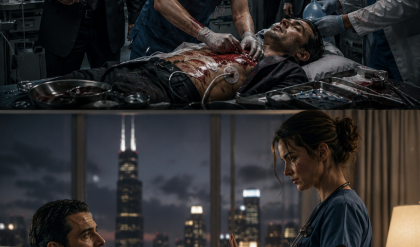
“North house?” the man asked.
Dante looked at me.
“Hospital,” I whispered.
Something painful crossed his face.
“You need one,” he said. “But Victor may have people watching emergency rooms. My doctor can treat you safely at my house tonight. After that, you choose.”
I almost laughed at that word.
Choose.
People like Dante Moretti did not give choices. They gave orders wrapped in velvet.
Still, the front door of Victor’s house stood open behind us, spilling yellow light onto wet stone. Men were tearing through rooms. Someone shouted from upstairs. Somewhere inside that house, the hole under the kitchen floor waited empty.
I could go with Dante or stay in the rain.
“Your house has floors?” I whispered.
His mouth tightened.
“Yes.”
“No basements.”
“No basements,” he said.
The drive north took forty minutes. I counted every streetlight because counting meant I was not under the floor. I did not close my eyes. Each time I blinked, I saw the trapdoor shutting again.
Dante spoke only once.
“My brother did this?”
I looked at his reflection in the dark window.
“Yes.”
He closed his eyes for half a second.
When he opened them, the man looking back was not shocked anymore.
He was deciding what kind of war to start.
His house sat behind iron gates near Lake Forest, built of stone and glass among winter-black trees. It looked less like a home than a courthouse for rich sinners. An older Black woman opened the door before the car stopped. She wore a robe over pajamas and carried herself with the authority of someone who had raised dangerous men and still expected them to wipe their feet.
Then she saw me.
“Oh, Lord,” she whispered.
“Mrs. Bell,” Dante said. “Warm room. Clean clothes. Broth. Call Dr. Keene. No hospital records.”
The woman’s eyes filled, but her voice stayed steady.
“Bring her upstairs.”
Upstairs.
That one word nearly broke me again.
Dante must have felt me go rigid because he stopped in the foyer.
“Second floor,” he said. “Big windows. Locks on your side. Mrs. Bell can stay with you. I’ll stay out unless you ask.”
“You keep saying that.”
“What?”
“Unless I ask.”
He looked down at me.
“Someone should have said it before.”
Mrs. Bell helped me bathe.
Her first name was Ruth, but everyone in the house called her Mrs. Bell because, she said, “When men carry guns for a living, they can afford manners.”
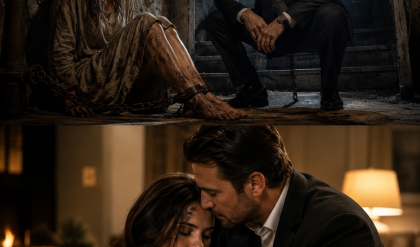
The water ran brown at first. Then pink. Then clear. I sat on a teak stool while she washed my hair with hands so gentle I cried without sound.
“You don’t have to talk,” she said.
“I’m a nurse,” I whispered, because I needed to remember I had been something before this.
Mrs. Bell paused.
“Then you know healing is ugly before it’s useful.”
I did know that.
I had just never been the wound before.
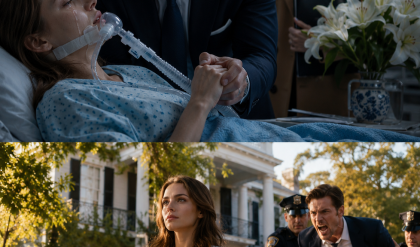
Dr. Miriam Keene arrived after midnight with two medical bags and a face that did not flinch. She examined my ankle, ribs, throat, bruises, dehydration, malnutrition, infection, and the pressure sores I was too ashamed to name.
Dante stood outside the open door where I could see him but not feel trapped by him. Ruth had placed a chair by my bed and sat like a guard dog in a cardigan.
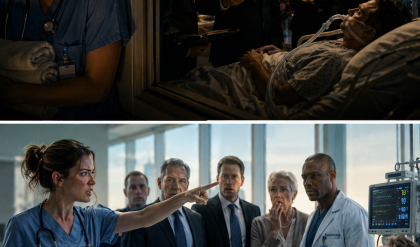
“She needs IV fluids,” Dr. Keene said. “Antibiotics. Food in careful stages. Her ankle is infected but salvageable. She has two cracked ribs. Severe trauma. Vocal strain. She needs a hospital.”
“No,” I said.
Everyone looked at me.
My voice shook, but I forced the words out.
“Not tonight.”
Dr. Keene nodded once.
“Then not tonight.”
Dante’s shoulders lowered as if he had been bracing for a fight on my behalf and did not know what to do when no one started one.
For four days, I slept in pieces.
I woke screaming when heaters clicked. I woke choking when sheets twisted around my ankle. I woke convinced the window was a trick painted on a wall.
Each time, Ruth came first.
Sometimes Dante appeared in the doorway, never entering unless I said his name.
On the fifth morning, I could sit up without fainting.
Dante came in carrying a tray. He wore a white shirt with the sleeves rolled up. Without the rain, without the gun, without the broken kitchen around him, he looked younger than his reputation. Tired too. There were shadows under his eyes and a healing cut across his knuckles.
“Ruth said you’re refusing eggs,” he said.
“Ruth is a snitch.”
“She raised me. Betrayal comes naturally to her.”
A laugh escaped me before I could stop it.
It hurt my ribs.
Dante set the tray on the bedside table and stepped back.
“I need to ask you questions,” he said. “Not now if you can’t.”
“I can.”
His eyes searched my face.
“You don’t have to be brave for me.”
“I’m not,” I said. “I’m angry.”
“Good.”
The word came out with quiet approval.
So I told him.
Victor had come into the ER after a crash on Lake Shore Drive. He was drunk but polished, charming to everyone except the intern who made him wait. I cleaned the cut over his eyebrow. He asked for my number. I said I did not date patients. He said he could stop being my patient. I said no again.
His smile changed.
Not much. Just enough.
“You think you’re too good for me?” he asked.
“No,” I said. “I think I’m working.”
Two months later, after a double shift at Mercy Presbyterian, I walked into the parking garage. I was thinking about coffee, rent, and whether I had clean scrubs left.
A hand covered my mouth.
A needle bit my neck.
I woke in the dark.
At first Victor visited. He stood above the trapdoor, never close enough for me to reach him, talking as if we were having dinner.
“You embarrassed me,” he said the first week.
“You’ll apologize,” he said the second.
“You’ll understand,” he said the third.
By the fourth, he stopped sounding angry and started sounding delighted.
“You’ll love quiet eventually,” he told me. “Everyone becomes honest in the dark.”
After that, someone else brought food.
Masked. Gloved. Silent.
“Male?” Dante asked.
“I thought so at first. But I don’t know. They never spoke.”
“Anything else?”
“Gardenias,” I said.
Dante went very still.
“What?”
“The person who fed me smelled like gardenia perfume. Not every time. But enough.”
Dante looked toward the window.
I watched his face and saw the first crack in the story he wanted to believe.
“Who smells like gardenias?” I asked.
“My mother.”
The room went cold.
Dante did not try to soften it.
“Her name is Celeste Moretti. She lives in Palm Beach most of the year. She flew back to Chicago two weeks after you disappeared.”
“You think she knew?”
“I think,” he said carefully, “that my brother is cruel, but he is not disciplined. Someone kept you alive. Someone made sure the house looked normal. Someone kept staff away from the kitchen wing.”
I felt sick.
“Why?”
Dante’s eyes returned to mine.
“That is what I need to find out.”
The next week, my death was undone.
That was how Dante phrased it when he handed me a folder.
“Your legal status can be corrected,” he said. “Your hospital will be notified privately first. Your apartment was cleared by your landlord after your memorial, but your belongings are in storage. Your friend Sarah Liu has called the police every week since you vanished.”
Sarah.
My supervisor. My friend. The woman who had once driven across the city at midnight because I had food poisoning and no ginger ale.
I touched her name on the paper.
“She thought I was dead.”
“Yes.”
“And you knew all this?”
Dante’s face closed slightly.
“I knew after we found you.”
“After?”
He hesitated.
That hesitation cost him.
“What did you know before?” I asked.
Ruth, who was pretending to dust shelves, stopped moving.
Dante looked at her.
“Leave us, please.”
“No,” I said.
They both looked at me.
“She stays.”
A flicker of something like respect crossed Ruth’s face.
Dante accepted it.
“Three weeks after you disappeared,” he said, “I received your hospital ID in an envelope.”
The room tilted.
“My ID?”
“Yes.”
“With a note?”
“Yes.”
“What did it say?”
His jaw tightened.
“It said, ‘Your brother is learning how to keep what he wants. Maybe he learned from you.’”
I stared at him.
“You had proof Victor had me.”
“No. I had proof someone wanted me to think Victor had you.”
“That is the same thing.”
“It isn’t.”
“It was to me,” I snapped, my voice breaking. “I was under his floor.”
Dante flinched as if I had struck him.
Good.
“I searched,” he said. “Quietly at first. Then less quietly. Victor denied everything. He left town twice. I had his phones cloned, his cars tracked, his men questioned. The house we found you in was under renovation. He said he wasn’t living there.”
“He was.”
“I know that now.”
I looked away because if I kept looking at him, I would start screaming, and once I started I might never stop.
“You should have found me.”
The words were unfair. I knew they were unfair even as I said them.
Dante did not defend himself.
“Yes,” he said.
That made it worse.
For two days, I refused to see him.
Ruth brought food. Dr. Keene checked my ankle. Sarah came and cried into my shoulder so hard I had to remind her about my ribs.
“You’re coming home with me,” Sarah declared.
“I don’t have a home.”
“You have my couch.”
“I have men with guns outside my door.”
Sarah looked around Dante’s guest room with open hatred.
“I hate that you’re safest here.”
“So do I.”
She took my hand.
“Then make sure safe doesn’t become stuck.”
That sentence stayed with me.
Safe was a dangerous word. It could build walls and call them kindness. It could lock doors and call them protection. It could convince a person who had lived through a basement that any room with windows was enough.
On the third day, I asked Dante to come in.
He stood just inside the doorway.
“You can sit,” I said.
He sat.
“I don’t forgive you,” I told him.
“I know.”
“But I believe you tried.”
His eyes lifted.
“I should have tried harder.”
“Yes.”
He accepted that too.
I studied him carefully.
“Your mother knew.”
“I think so.”
“Your brother kidnapped me because I rejected him.”
“That may be part of it.”
“Part of it?”
Dante reached into his jacket and removed a small plastic evidence bag.
Inside was my necklace.
A thin gold chain. A plain little key I had worn since I was twelve.
My father’s key.
I sat forward too quickly, and pain flashed through my ribs.
“Where did you get that?”
“Victor’s office. Hidden behind a drawer.”
My hand shook when I took it.
“My dad gave me this before he disappeared.”
Dante said nothing.
I looked at him.
“You know something.”
“I know your father’s name was Daniel Hayes.”
“He was a city accountant.”
“He was a forensic accountant,” Dante said. “He was auditing union pension funds tied to my father’s businesses.”
My grip tightened around the key.
“No.”
“Emma—”
“No. My father balanced budgets. He hated confrontation. He wore the same brown coat for ten years because he said winter was a scam invented by department stores. He was not involved with people like you.”
Dante’s voice stayed low.
“He was involved because he found something.”
“What?”
“A ledger. Names, payments, police contacts, judges, shell companies. Enough to destroy the old Moretti organization.”
I shook my head.
“If that were true, why didn’t he go to the FBI?”
“I think he tried.”
The room seemed to shrink.
“My father disappeared when I was twelve,” I said. “My mother told me he left. She cried for a month and then never said his name again.”
Dante’s face softened in a way that made me want to hate him less.
“I don’t think he left you.”
The key lay in my palm, warm from my skin.
All those years, I had worn my father’s goodbye around my neck.
Maybe it had never been goodbye.
Maybe it had been a map.
The key opened a storage box at Union Station.
That was what Dante’s people discovered after three days of old records, fake company names, and a retired locksmith who remembered too much after being offered enough money.
Box 318 had been rented twenty years earlier by Daniel Hayes under the alias David Harper. The payments had continued automatically from an account nobody had touched.
Victor had recognized the key when he saw it at the ER.
That was why his smile had changed.
Not only because I refused him.
Because I was not just a woman who had said no.
I was the daughter of a dead man his family had never stopped hunting.
“We go to the police,” Sarah said when I told her.
We were sitting in Dante’s library because it was the only room in the house with enough exits for me to breathe.
“With what?” Dante asked. “A key and a theory?”
“With her statement.”
“About the kidnapping, yes. About Daniel Hayes, no. If Celeste is involved, she will know the moment a report enters the system.”
Sarah glared at him.
“You sound experienced at avoiding justice.”
“I am.”
“At least you’re honest.”
“Only recently.”
I interrupted before they could start a war across the coffee table.
“I want the box.”
Dante looked at me.
“No.”
I laughed once. It sounded harsh even to me.
“That was quick.”
“If Victor took you because of that key, then Celeste wants what it opens. Union Station will be watched.”
“Then we watch back.”
“I will not put you in reach of them again.”
“You don’t get to decide that.”
His face tightened.
Sarah leaned toward me.
“Emma, I’m not agreeing with him because he terrifies me, though for the record, he does. I’m agreeing because you are still healing.”
“I healed in the dark,” I said. “Do not ask me to hide in the light.”
No one answered.
That was the first time I understood that survival had made me dangerous too.
Not reckless. Not fearless. I was afraid all the time. Fear sat beside me at breakfast. It followed me into showers. It curled at the foot of my bed.
But fear had used up its authority.
Dante stared at me for a long moment.
Then he said, “If we do this, we do it with planning, exits, surveillance, and no heroics.”
“Fine.”
“And you wear a vest.”
“Fine.”
“And you listen when I tell you to move.”
I leaned back.
“Dante.”
“What?”
“I said fine twice. Don’t get greedy.”
For the first time since he had found me, he smiled.
It vanished quickly, but I saw it.
The plan took shape over a week.
Not because Dante was slow, but because he was thorough in a way that scared me. He mapped Union Station like a battlefield. Cameras, tunnels, exits, maintenance corridors, security rotations, blind spots. His men—especially the scarred one named Miles—treated me with a cautious respect that made me wonder what Dante had threatened them with.
On the morning we went, snow fell over Chicago in thin silver lines.
Ruth pressed a thermos into my hands.
“Tea,” she said.
“I’m not going on a picnic.”
“You’re going where ghosts live. Tea helps.”
Sarah came too, despite Dante’s objections.
“I have spent twelve years in emergency medicine,” she said. “I can follow instructions and apply pressure to wounds. Also, I don’t trust any of you.”
Dante looked at me.
“She’s your friend.”
“That means she comes.”
He nodded once.
Union Station smelled like wet wool, coffee, old stone, and people trying to get somewhere better. I wore a gray coat, a knit hat, and a vest under my sweater that made me feel both protected and doomed. Dante walked ten feet behind me, not close enough to look possessive, not far enough to be absent.
The storage office was near a corridor most commuters ignored.
The clerk barely looked up.
“Box number?”
“318,” I said.
“Key?”
I placed it on the counter.
For a second, nothing happened.
Then a woman behind us dropped her coffee.
Dante’s hand moved under his coat.
The woman apologized, flustered, and knelt with napkins. A child laughed. A train announcement echoed overhead.
A normal accident.
Maybe.
The clerk led me into a private room and brought the box.
It was smaller than I expected.
All those years of grief and fear, and my father’s secret fit inside a gray metal rectangle no bigger than a shoebox.
My fingers would not work.
Dante stood outside the room’s glass panel, watching the hallway. Sarah stood beside me.
“Do you want me to open it?” she asked.
“No.”
I lifted the lid.
Inside were three things.
A stack of documents wrapped in plastic.
A flash drive sealed in an envelope.
And a videotape labeled in my father’s handwriting.
FOR EMMA, WHEN SHE IS OLD ENOUGH TO BE ANGRY.
I made a sound I did not recognize.
Sarah put her arm around me.
The fire alarm went off.
People began moving immediately, annoyed first, then alarmed. Dante pushed into the room.
“We leave now.”
I grabbed the contents of the box.
In the hallway, smoke drifted from the east corridor. Not enough for a real fire. Enough for confusion.
Dante’s hand hovered near my back.
“Move.”
We moved.
Not toward the main exit. Toward a service corridor Dante had already chosen. Miles appeared ahead of us, speaking into his sleeve.
Then Sarah stumbled.
A man in a transit jacket had grabbed her arm.
“Wrong way, ma’am,” he said.
Sarah’s face went pale.
Dante turned.
The man pressed something against Sarah’s side.
A gun.
Everything narrowed.
The crowd noise. The alarm. The smell of smoke. The documents under my coat. Dante’s stillness.
Then a woman’s voice came from behind us.
“Hello, Emma.”
I knew the perfume before I knew the face.
Gardenias.
Celeste Moretti stood beneath a flickering exit sign in a cream coat and pearl earrings, elegant as a funeral announcement. Her silver hair was pinned neatly. Her lipstick was perfect. She looked like someone who donated hospital wings and destroyed families before lunch.
Dante did not look surprised.
That scared me.
“Mother,” he said.
Celeste smiled.
“My son. Always dramatic. Guns in train stations now?”
“You set the fire alarm.”
“I created privacy.”
The man holding Sarah tightened his grip.
Dante’s voice dropped.
“Let Dr. Liu go.”
“When Emma gives me what her father stole.”
I swallowed.
“You fed me.”
Celeste’s eyes moved to me with mild interest.
“Sometimes.”
“You knew I was under that floor.”
“My dear, I arranged the floor.”
The words hit harder than a slap.
Victor had been the hand.
Celeste had been the mind.
Dante went very still beside me.
“Why?” he asked.
Celeste looked almost disappointed.
“Because your brother is foolish, but useful. Because Daniel Hayes thought himself noble. Because this girl walked into Victor’s life wearing the one object your father spent twenty years trying to find. Because if old sins are going to rise, they should rise under my supervision.”
“My father knew?” Dante asked.
“Your father knew many things. Understood very few.”
She looked at me again.
“Give me the documents and the drive. Keep the video if you like. Sentimental things bore me.”
Sarah’s eyes met mine.
She was terrified.
So was I.
But fear no longer held rank.
I reached into my coat slowly and removed the plastic-wrapped stack.
Dante’s voice was barely audible.
“Emma.”
Celeste smiled.
“Smart girl.”
I held the documents out.
The man with Sarah shifted his attention for half a second.
That was all Sarah needed.
She drove her heel down onto his foot and slammed her head backward into his nose. Dante moved at the same time. Miles came from the side. The gun hit the floor and skidded.
Celeste stepped back, but not fast enough.
I threw the documents into the air.
Papers exploded through the corridor like white birds.
For one insane moment, everyone looked up.
Then I ran straight at Celeste Moretti and hit her with my whole body.
We went down hard.
I was not strong. I was still too thin, still healing, still shaky from months underground.
But rage has weight.
Celeste’s head struck the wall. Her perfect hair came loose. Her pearls snapped and scattered across the dirty floor.
“You little—”
I pressed my forearm against her chest.
“My name is Emma Hayes,” I said. “My father did not die so you could call me little.”
Dante pulled me back before Celeste’s nails reached my face.
Police sirens wailed outside.
Not Dante’s men.
Real police.
Federal agents too.
Dante looked at Miles.
Miles shrugged.
“Anonymous tip,” he said.
Dante’s eyes narrowed.
Sarah lifted one hand.
“I called them before we left,” she said. “I trust Emma. I do not trust mafia logistics.”
For three seconds, no one spoke.
Then Dante laughed.
It was quiet, shocked, and almost human.
Celeste looked at her son with pure hatred.
“You would let them take me?”
Dante stared down at her.
“You let Victor bury an innocent woman under a kitchen floor.”
“For the family.”
“No,” Dante said. “For yourself.”
Her face twisted.
“You think she makes you clean? You think loving a broken nurse will wash blood out of your name?”
The corridor went silent.
Dante did not look at me.
He looked at his mother.
“I think she showed me the difference between loyalty and cowardice.”
Federal agents flooded the corridor.
Celeste Moretti was handcuffed under the exit sign while commuters filmed from a distance and train announcements continued overhead, absurdly calm.
I held my father’s videotape against my chest.
Sarah hugged me.
Dante stood a few feet away, close enough to help, far enough to let me stand on my own.
That was how the end began.
Not with a shootout in a warehouse. Not with a brother begging. Not with a mafia king choosing love in some candlelit room.
It began in a train station corridor with smoke in the air, scattered pearls on the floor, and my best friend saying, “Next time, we are calling an Uber and three lawyers first.”
The videotape changed everything.
We watched it two days later in Sarah’s apartment because I refused to watch my father’s last words in a Moretti house.
Dante came because I asked him to. Ruth came because she said no one should hear the dead alone. Sarah sat beside me with one hand wrapped around mine.
My father appeared on the screen younger than I remembered, thinner, scared in a way he had never allowed me to see.
“Emma,” he said, and my heart broke on the second syllable. “If you are watching this, then I failed to come home. I need you to know first that I did not leave you. I would never choose a world without you in it.”
I covered my mouth.
The tape crackled.
He explained the audit. The missing pension money. The shell companies. The judges paid off. The cops bought. The businesses used to clean blood into profit.
Then he said Celeste’s name.
Not as a wife.
As the architect.
“Everyone thinks the Moretti men run Chicago,” my father said. “They don’t. Not really. Celeste Moretti understands power better than all of them. Her husband enjoys fear. Her sons inherited different pieces of him. But Celeste built the machine.”
Dante looked down.
My father continued.
“If Dante Moretti ever sees this, I hope he understands something. I tried to get evidence to him once. He was young. Maybe too young. I believed there was still a chance he could become something other than what they were making him.”
Dante’s face changed.
Not dramatically. He did not cry. He did not speak.
But some old door inside him opened, and whatever stood behind it hurt.
The tape ended with my father leaning closer to the camera.
“Emma, anger will come. Let it. But do not let them turn your anger into their language. Their language is cages, threats, silence, and blood. Yours must be truth. Yours must be doors opening. Yours must be life.”
The screen went blue.
No one moved.
Finally, Ruth said, “Your father had a spine made of steel.”
I laughed through tears.
“He was afraid of squirrels.”
“Bravery and squirrels are separate categories,” she said.
Dante stood and walked to the window. Chicago moved beyond the glass, indifferent and glittering.
“I was nineteen when Daniel Hayes disappeared,” he said. “My father told me he was a thief who stole from the family.”
“Did you believe him?” I asked.
“Yes.”
The answer hurt, but not as much as a lie would have.
“I wanted to,” Dante said. “That is worse.”
The evidence from the box went to federal prosecutors. Celeste Moretti was indicted on conspiracy, obstruction, murder-for-hire, kidnapping, and financial crimes tied to twenty years of laundering. Victor was arrested three days later in a private hangar outside Indianapolis, carrying a fake passport and enough cash to prove he had never understood consequences.
He tried to claim he had rescued me.
That lasted until investigators found the hidden room under his kitchen, my blood on the pipe, his fingerprints on the chain lock, and videos he had recorded for reasons no decent mind should understand.
The trial took eleven months.
I testified twice.
The first time against Victor.
He wore a navy suit and looked at me like we were sharing a secret. His attorney implied I had invented parts of the story because trauma made memory unreliable. He suggested Dante had manipulated me. He suggested I had stayed in Dante’s house willingly. He suggested I was confused by grief, hunger, and fear.
I listened until the prosecutor asked if I could identify the man who kidnapped me.
I pointed at Victor.
“He is the man who could not understand the word no,” I said. “So he built a world where he thought I would stop saying it.”
Victor’s smile faded.
Good.
The second time, I testified against Celeste.
She never looked angry. That was her gift. She looked wounded. Dignified. Betrayed by ungrateful men and unstable women. The press loved her pearls, her white hair, her charity boards.
Then the prosecutor played my father’s tape.
The courtroom heard Daniel Hayes name her.
The jury saw Celeste blink exactly once.
Afterward, her attorney asked me, “Miss Hayes, are you romantically involved with Dante Moretti?”
Reporters leaned forward.
Dante sat behind the prosecutor, expression unreadable.
I looked at the attorney.
“No.”
The room seemed disappointed.
Then I added, “I care about him. That is not the same thing as being owned by him, influenced by him, or unable to tell the truth about him.”
The attorney tried again.
“You lived in his house.”
“I recovered in his house.”
“Under his protection.”
“Under my own consent.”
“And you expect this jury to believe a mafia boss gave you freedom?”
I looked at Dante then.
He did not save me from the question.
He let me answer it.
“Yes,” I said. “And I expect this jury to understand that a person can do wrong in one part of his life and still do right when it matters. That does not erase his wrongs. It does not make him clean. It makes him responsible for what he chooses next.”
The courtroom went silent.
Celeste was convicted on all major counts.
Victor received life without parole.
Celeste received longer than life, which seemed fitting for a woman who had tried to make the past immortal.
Dante was not arrested that day.
Not because he was innocent.
Because he made a deal.
He gave prosecutors names, accounts, routes, judges, shell companies, and enough financial records to collapse what remained of the Moretti organization. Men who had once toasted him cursed his name. Men who had feared him began fearing subpoenas. Three restaurants closed. Two trucking firms were seized. A judge resigned. A police captain shot himself in his garage rather than testify.
Dante lost power the way some men lose blood.
Quietly at first.
Then all at once.
I did not live with him during that year.
That mattered.
I rented a small apartment with too many locks and too many lamps. Sarah helped me paint the bedroom yellow because I wanted a color no basement could imitate. Ruth visited every Sunday with food and criticism. Dr. Keene checked my ankle until the infection became a scar and the scar became a fact.
Some nights I called Dante.
Some nights he called me.
Sometimes neither of us spoke much.
“Are you safe?” he would ask.
“Yes.”
“Are you sleeping?”
“No.”
“Do you want me to come over?”
I would look at my bright bedroom, my locked door, my own keys on the table.
“No.”
He always said, “Okay.”
He never came unless I asked.
That was how trust grew between us—not in grand gestures, but in absence respected.
I went back to nursing slowly.
Not the ER. Not yet.
Sarah found me a part-time position at a community clinic in Back of the Yards where people came in with untreated diabetes, infected cuts, asthma, fear of bills, fear of doctors, fear of being dismissed. The first time a patient grabbed my wrist too suddenly, I locked myself in the supply closet and shook for ten minutes.
Then I came out and finished my shift.
Healing did not feel like becoming who I used to be.
It felt like becoming someone who could carry what happened without letting it make every decision.
Six months after Celeste’s sentencing, Dante asked me to meet him at the old Moretti house.
Not Victor’s house.
His.
The Lake Forest mansion with stone walls, iron gates, and rooms full of history pretending to be taste.
I almost said no.
Then I said yes because fear was allowed to advise me, but not command me.
When I arrived, the gates were open.
No guards. No black cars. No men with earpieces.
Dante stood on the front steps in a gray coat, holding a cardboard box.
“You’re moving?” I asked.
“Selling.”
“To whom?”
“A foundation.”
“What kind?”
“Women’s transitional housing. Trauma recovery. Legal aid. Medical support.” He paused. “Only if you think that isn’t obscene.”
I looked up at the house.
The place where I had first slept after the floor.
The place where I had been safe and trapped and healing and angry.
“No,” I said slowly. “It’s not obscene. But don’t put your name on it.”
“I wasn’t going to.”
“Good.”
He smiled faintly.
“I brought something for you.”
Inside the box were my belongings from Victor’s house. Not many. My hospital ID. My old sneakers. The coat I had worn the night I disappeared. A cheap hair clip. My broken phone.
And the chain.
Not the necklace.
The chain from the floor.
I stepped back.
Dante’s face tightened.
“I’m sorry. I should have asked.”
“No,” I said.
My voice sounded far away.
“Why did you bring it?”
“Because the prosecutors released evidence. They asked if you wanted it destroyed.” He looked down at the box. “I thought maybe you should decide what happens to it.”
For a long time, I could not touch it.
Then I picked up the chain.
It was heavier than memory.
Rust still marked the links. The cuff was open where Dante had cut it. My skin remembered the bite of it, the cold, the helpless radius of its permission.
“Burying it feels wrong,” I said.
“Destroying it?”
“Too easy.”
Dante waited.
I looked at the house again.
“Can the foundation use a garden?”
“A garden?”
“For patients. Residents. Whoever comes here. Somewhere outside. No locked gates inside it. No walls blocking the sky.”
Understanding moved across his face.
“Yes.”
“Put it under the first tree.”
The following spring, we planted a white oak on the west side of the property.
Ruth came. Sarah came. Dr. Keene came. A few women from the foundation board came in practical shoes and pretended not to recognize Dante from years of newspaper photographs.
The chain was placed deep beneath the roots.
Not as a memorial to captivity.
As a warning to the ground.
Grow something better over this.
Afterward, Dante and I walked down to the lake.
The water was gray, restless, cold. Chicago’s skyline was invisible from there, but I could feel the city behind us, breathing through all its wounds.
Dante stood beside me with his hands in his coat pockets.
“I don’t know what I am now,” he said.
It was the most honest thing I had ever heard him say.
“You’re unemployed,” I said.
He laughed softly.
“That too.”
“What do you want to be?”
He looked at me.
“A man who does not need fear to enter a room.”
“That takes practice.”
“I have time.”
“You also have enemies.”
“Yes.”
“And guilt.”
“Yes.”
“And a terrible habit of trying to control outcomes.”
His mouth curved.
“I’m told that.”
I turned toward him.
“I love you.”
The words surprised us both.
Not because they were untrue.
Because they were calm.
Dante’s face changed in pieces: shock first, then hope, then restraint. Always restraint with him now, as if he had learned that love without discipline could become another form of hunger.
“I love you too,” he said.
“I know.”
“That was not as satisfying as I imagined.”
I smiled.
“I’m not finished.”
He waited.
“I love you, but I will never belong to you.”
His expression sobered.
“I don’t want you to.”
“Some part of you might.”
“Yes,” he said. “Some part of me might. I was raised by people who confused possession with devotion. But that part does not get a vote.”
That was the answer I needed.
Not perfect.
Perfect would have frightened me.
Real could be worked with.
A year later, we opened Hayes House Clinic on the South Side.
Dante wanted to fund the whole thing anonymously. Sarah said anonymous money was still money and made him sit through board oversight anyway. Ruth ran the volunteer kitchen like a benevolent dictator. Dr. Keene trained residents. I worked four days a week and spent the fifth speaking to nursing students about trauma-informed care.
The clinic had big windows, warm lights, and no basement.
That was my only architectural demand.
On opening day, a little girl in a pink coat asked why there was a white oak painted on the wall behind the reception desk.
I crouched to her height.
“Because trees can grow in places where hard things were buried.”
She considered that.
“Like treasure?”
I smiled.
“Sometimes.”
Dante arrived late with coffee and flowers. He wore a navy sweater instead of a suit. A teenager in the waiting room recognized him and whispered to his mother. Dante pretended not to hear. The mother looked at me, then at him, then back at me.
“You the lady from the news?” she asked.
“I’m Emma,” I said.
She nodded slowly.
“My sister needs help. She doesn’t trust cops.”
“She doesn’t have to trust cops to see a nurse.”
The woman’s face changed with relief so raw it hurt to witness.
That was when I knew the clinic would matter.
Not because it redeemed anyone.
Redemption was not a receipt you got for doing one good thing after years of bad ones.
It mattered because doors opened there.
For people who were used to being locked out. For people who had been told their pain was inconvenient. For people who thought survival meant silence.
That evening, after the last patient left, I found Dante in the hallway staring at the painted oak.
“You’re doing that brooding thing,” I said.
“I’m admiring community art.”
“You’re brooding near community art.”
He looked at me.
“You built something beautiful.”
“We built it.”
“No,” he said gently. “I paid for walls. You made a place.”
I leaned against the wall beside him.
“There’s a difference?”
“There is now.”
Outside, snow began to fall, soft and clean against the clinic windows.
For a long time, I thought the story of my life would always divide itself into before and after the floor.
Before Victor.
After Victor.
Before the dark.
After the dark.
But that is not how life works, not really. Trauma may split the road, but it does not get to name every mile that follows.
There was before.
There was during.
There was after.
And then, if you fought hard enough, there was something else.
There was morning coffee in a clinic break room. There was Sarah yelling at a copier. There was Ruth teaching a diabetic widower how to make soup with less salt. There was Dante sitting quietly in group meetings while women who had survived worse men than him decided whether his money was useful enough to tolerate. There was laughter that did not ask permission from grief.
There were still nightmares.
There were still days when a closing door stole my breath.
There were still moments when Dante’s phone rang and his face went old with ghosts.
But there were also keys.
My keys.
To my apartment. To my office. To the clinic. To rooms I chose to enter and leave.
On the second anniversary of the night Dante tore up Victor’s kitchen floor, I went back to that house one last time.
It had been sold after the trial to a developer who planned to demolish it. Dante offered to come inside with me. Sarah offered to come with pepper spray. Ruth offered to come with prayer and a brick.
I went alone.
The kitchen was stripped. No marble counters. No copper pans. No music. The floor had been torn open for investigators and never repaired properly. Afternoon light came through dusty windows.
I stood above the place where I had lived for ninety-one days.
It was smaller than I remembered.
That made me angry at first.
Then it set me free.
The room had not been infinite. The dark had not been endless. The chain had not been destiny. It had been a room, a man, a crime, a season of suffering that had ended.
I touched the scar around my ankle through my jeans.
“I left,” I said aloud.
The empty house gave no answer.
It did not deserve one.
When I walked outside, Dante was waiting by the curb, because he had driven me and because he understood by then which distances were respectful and which were abandonment.
He did not ask if I was okay.
I liked that.
Instead, he opened the passenger door.
“Where to?”
I looked back at the house once.
Not because it owned any part of me.
Because I wanted the dark to see my face in daylight.
Then I turned away.
“Home,” I said.
Dante nodded.
And when the car pulled away, I did not count the streetlights.
I watched the road ahead.
THE END