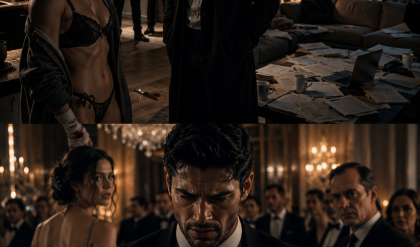
The baby woke and blinked at me. He had Adrian’s dark hair and Lucy’s frightened blue eyes.
“What’s his name?” I asked.
“Liam.”
“And yours?”
She swallowed. “Lucy.”
“Lucy what?”
“Hart.” Then, quickly, as if correcting a mistake, “Lucy Cole. I mean… Hart was my maiden name.”
I did not comment on that. Names matter. The one she chose first mattered most.
My apartment was small but warm, full of things Frank and I had kept for no good reason except that they had survived with us: a crocheted blanket over the couch, a chipped ceramic rooster on the windowsill, framed pictures of a family that had shrunk until only I was left. Lucy stood in the middle of my kitchen like she did not know what chairs were for.
“Sit,” I said.
She sat.
I put Liam on a folded towel on the floor with a wooden spoon and one of Frank’s old plastic measuring cups. The baby grabbed the cup with serious concentration.
Lucy watched him as if she expected someone to snatch him away.
I poured coffee into a mug and placed it in front of her. Her hands wrapped around it, and the shaking started immediately. Not delicate trembling. Deep shaking, from the bones.
“Lucy,” I said, sitting across from her. “Do you actually need this much sugar?”
Her eyes filled before she answered.
That was when I knew the question had broken the last thread holding her together.
“No,” she whispered.
The kitchen clock ticked once. Twice.
“I’m not coming for sugar, Mrs. Miller.”
I stayed still. When a frightened person starts telling the truth, you do not rush toward it. You let the truth come out without chasing it back into hiding.
Lucy looked at my front door.
“It’s the only reason he lets me out of the apartment.”
“Your husband?”
She nodded.
“Adrian controls everything. The money. The car. My phone. The baby supplies. He checks the trash to see what I throw away. He counts diapers. He counts formula scoops. He says I’m careless and he has to keep track because I’m not a good mother.”
Her lips pressed together, and a tear fell onto the table.
“If I go downstairs to get mail, he comes with me. If I call my mom, he stands in the room. If I take too long in the shower, he unlocks the door. But you…” She gave a small, terrible smile. “You’re different.”
“How?”
“He said you’re just a lonely old lady. He said if I’m desperate enough to borrow sugar from a widow, maybe I’ll finally learn to plan better.”
A lonely old lady.
It almost made me laugh.
Not because it was funny.
Because Adrian Cole had no idea that loneliness can become a blade if it sits long enough in a woman’s hands.
“What did he do to your wrist?” I asked.
Lucy pulled her sleeve down.
“Nothing.”
I looked at her.
She looked at the table.
“He grabbed me because I dropped Liam’s bottle and it spilled. He said formula costs money.”
“How long has this been going on?”
She closed her eyes.
“In the beginning, he was wonderful. That’s what makes me feel stupid. He brought flowers to the diner where I worked. He remembered my favorite songs. He told me I deserved somebody who would take care of me.”
Her voice thickened.
“When I got pregnant, he said I should quit work because the diner was too stressful. Then he said my mother didn’t respect our marriage. Then he said my sister Dana was jealous. Then he said I didn’t need old friends because they put ideas in my head. Little things became rules. Rules became punishments. Punishments became apologies. Then flowers. Then punishments again.”
I had heard that rhythm before.
It was the music monsters dance to.
“Has he hit the baby?”
Her head snapped up.
“No.”
I held her gaze.
“Lucy.”
Her face crumpled.
“Not hit. But he screams near him. He throws things. He says if I leave, I’ll never see Liam again because I have no job, no money, and he has proof I’m unstable.”
“What proof?”
“He writes things from my phone. Messages to himself. To his mother. He makes it sound like I’m confused or angry. Once he recorded me crying and said I was hysterical. He tells people I have postpartum depression and refuse help.”
“Do you?”
“I’m sad,” she said. “I’m scared. But I’m not crazy.”
I reached across the table and put my hand over hers.
“I believe you.”
Those three words did something to her. She bent forward over the coffee and wept without sound, trying not to wake Liam, trying even in my kitchen to take up as little space as possible.
I did not hug her. Not then. People who have been handled roughly need to choose when they are touched.
Instead, I got up, took a white ceramic sugar bowl from the cabinet, filled her mug halfway, and set it beside her.
“From now on,” I said, “you still come for sugar.”
She lifted her wet face.
“But you come in. Every day. Same time. You understand?”
“I don’t want to get you in trouble.”
“Honey, I have outlived trouble.”
She almost smiled.
Almost.
That morning, Lucy stayed thirteen minutes. Before she left, I wrote one number on the back of a grocery receipt: the hotline for a women’s shelter on the west side. I folded it small and pushed it under the sugar in her mug.
“Memorize it if you can,” I said. “Don’t take it back if he searches things.”
“He does.”
“Then read it here.”
She nodded.
At the door, she turned back.
“Mrs. Miller?”
“Yes?”
“Why are you helping me?”
There were many answers. Because of Elena. Because of guilt. Because no one should need permission to breathe. Because God, if He was still listening, had put her at my door at 8:17 and I was not going to fail the same test twice.
But I only said, “Because you knocked.”
After that, my apartment became a place with two lives.
To anyone watching, I was still Carmen Miller, widow, retired hospital records clerk, owner of too many mugs and a bad left knee. I watered my plants. I complained about the elevator. I watched Jeopardy! too loudly because my hearing was not what it used to be.
But every morning at 8:17, the real work began.
Lucy knocked.
I opened.
She handed me the mug.
I poured sugar on top, and beneath it I hid whatever we could risk that day: a clean pair of socks, a folded twenty-dollar bill, a list of documents she needed to find, the number for a shelter advocate named Nadine, a tiny prepaid phone my grandson had left in a drawer two Christmases ago.
“Do not turn this on in your apartment,” I told her.
She held the little phone like it was a live bird.
“Only here?”
“Only here, or outside when you are far from him. Keep it hidden in the lining of Liam’s diaper bag if you can.”
“He checks the diaper bag.”
“Then don’t take it today. We’ll find another way.”
That became our rule: nothing rushed unless danger rushed first.
Women in Lucy’s position are often judged for not leaving quickly. People who have never had their lives locked from the outside say things like, “Why didn’t she just go?” as if leaving were a door and not a minefield.
Leaving meant finding her ID, which Adrian kept in a fireproof box under their bed.
Leaving meant getting Liam’s birth certificate.
Leaving meant cash, medication, formula, diapers, a safe ride, a place Adrian would not guess, and a way to prove she was not the unstable woman he had been describing to everyone around him.
Leaving meant choosing a day when a mistake would not get her killed.
So we moved carefully.
The first week, Lucy memorized Nadine’s number. The second week, she called from my kitchen while I bounced Liam on my knee. Her voice shook so badly that Nadine did most of the talking.
“No, sweetheart,” Nadine said through the speaker. “You are not overreacting.”
Lucy closed her eyes as if those words hurt.
“No, he does not have the legal right to keep your documents.”
Her shoulders dropped.
“Yes, emotional abuse counts. Financial abuse counts. Threats count. Isolation counts.”
Lucy cried then, and I watched Liam pat the air with both hands, delighted by a sunbeam on my floor, too young to know his mother was trying to build a door out of scraps.
By January, Lucy could sit in my kitchen for twenty minutes without staring constantly at the hallway.
By February, she laughed once.
It was because Liam crawled under my table and came out with one of Frank’s old slippers on his head. Lucy laughed softly at first, like laughter required permission. Then it broke open, bright and young and startling.
The sound hit me so hard I had to turn toward the sink.
For one second, Elena was in my kitchen again, sixteen years old, laughing with peach ice cream on her chin.
“You okay?” Lucy asked.
I wiped my hands on a dish towel.
“Fine,” I said. “That baby has terrible taste in hats.”
Lucy smiled for real.
Small victories are still victories.
But abuse notices change.
That is one of its ugliest talents.
Adrian began starting his motorcycle later some mornings. At first, only by two minutes. Then five. Twice, he shut it off after starting it, waited in the garage, then started it again.
“He’s testing me,” Lucy said one morning.
“Yes,” I said. “So we become boring.”
For three days, I gave her actual sugar at the door and did not invite her in. I complained loudly about my arthritis. Lucy apologized loudly for bothering me. If Adrian listened from inside 302, he heard only what he expected: a foolish young wife annoying a cranky old widow.
On the fourth day, Adrian himself appeared.
I was taking trash to the chute when Apartment 302 opened.
He stepped out wearing a black work jacket and polished boots, handsome in a way that probably helped him get away with things. He had dark hair, a trimmed beard, and the calm eyes of a man who rehearsed himself in mirrors.
“Mrs. Miller,” he said warmly.
“Mr. Cole.”
“Adrian, please.” He smiled. “Lucy tells me you’ve been kind enough to help her with sugar.”
“Apparently your household runs on it.”
He laughed. A little too loudly.
“She’s forgetful. Baby brain, you know.”
“I wouldn’t know.”
His smile paused. Then it returned.
“Well, we appreciate your patience. I hope she isn’t bothering you too much.”
“She bothers me exactly enough.”
His eyes sharpened.
I let my trash bag sag in my hand and looked as old as I could. That, at least, was easy.
He stepped closer.
“Lucy has been emotional lately. New motherhood. Hormones. Sometimes she misunderstands things.”
“I’m sure.”
“If she says anything strange, I’d appreciate you not encouraging it. She can spiral.”
There it was.
The groundwork.
He was not only hurting her. He was preparing the world to disbelieve her.
I gave him my dullest old-lady smile.
“Mr. Cole, the strangest thing that happens in my day is the price of eggs.”
He studied me.
Then he smiled again.
“Good. Take care, Mrs. Miller.”
After he left, I stood by the trash chute until my hands stopped shaking.
That day, when Lucy came, I told her, “He’s started telling people you’re unstable.”
She turned white.
“He told you that?”
“Yes. Which means our plan needs evidence.”
“I don’t have any.”
“You have me.”
Over the next month, my kitchen became an archive.
I wrote down dates and times in a spiral notebook: bruises, threats Lucy repeated, times Adrian delayed leaving, days she arrived without proper clothes, days Liam had too few diapers. With Lucy’s consent, I took photographs of injuries using the old phone. We stored copies of her documents in a cookie tin that had once held Danish butter cookies but now held a life in paper form.
Liam’s birth certificate.
Lucy’s Social Security card.
A copy of her driver’s license.
A list of shelter contacts.
Cash in small bills.
A letter Lucy wrote to her sister Dana in Chicago, just in case she could not speak when the time came.
One morning, she brought me a folded paper hidden inside Liam’s sock.
“It’s the code to the fireproof box,” she whispered.
“How did you get it?”
“He was drunk and opened it in front of me. I watched his fingers.”
“You remembered?”
Her eyes hardened in a way I had not seen before.
“I remember everything now.”
That was when I began to understand that Lucy was not weak.
She had been forced to spend all her strength surviving. Once she had even an ounce left over, she began using it.
The plan was simple because complicated plans break.
On the first Monday in March, Adrian would leave for a motorcycle parts trade show in Columbus. He had talked about it for weeks. He would be gone at least six hours. Lucy would come to my apartment with Liam, the diaper bag, and whatever clothes she could wear under her coat. Nadine would send a shelter volunteer to pick them up behind the building. From there, Lucy would go to a confidential location, file for an emergency protective order, and then, if it was safe, travel to Dana in Chicago.
“Monday,” Lucy repeated the Friday before, sitting at my kitchen table while Liam ate banana pieces from a plastic bowl.
“Monday,” I said.
She looked almost peaceful.
That should have warned me.
Hope is beautiful, but it changes the face. And men like Adrian notice any light they did not give permission to shine.
On Sunday night, I heard shouting through the wall.
Apartment walls teach you the difference between normal arguments and danger. Normal arguments rise and fall. They have pauses. They have two voices.
This was mostly one voice.
Adrian’s.
I muted my television.
“Where is it?”
A thud.
Lucy crying.
“Where is it, Lucy?”
Another thud, lower this time. Furniture, maybe.
I grabbed my phone and called 911.
“My neighbor may be in danger,” I said. “Apartment 302. Lakeview Arms on Clifton. I hear shouting and banging. There’s a baby.”
The dispatcher asked questions. I answered. By the time police came, the apartment had gone silent.
I watched through my peephole as two officers knocked. Adrian opened the door in sweatpants and a T-shirt, hair damp, smile tired and apologetic.
Even through the door, I heard him.
“Sorry, officers. Baby knocked over a lamp. My wife got scared. She’s been anxious since the birth.”
Lucy appeared behind him, holding Liam.
No visible blood.
No words.
The officers left after seven minutes.
The next morning, Adrian’s motorcycle did not start.
At 8:17, no knock came.
At 8:30, I stood at my door with my hand on the knob.
At 8:41, someone scratched lightly at the wood.
Not knocked.
Scratched.
I opened the door.
Lucy stood there barefoot in the hallway, Liam clutched against her chest, a split in her lower lip and terror in every line of her body.
No mug.
No coat.
No diaper bag.
“He found the cookie tin,” she whispered.
For one second, the hallway tilted.
“Where?”
“Not here. Mine. I made a fake one. I thought if he found something, maybe he’d stop looking.” She swallowed blood. “He found the fake notes. He knows I was planning to leave.”
I pulled her inside and shut the door.
“Did he find anything that leads here?”
“I don’t know.”
“Did he hurt Liam?”
“No. He took his birth certificate from the drawer. He said I’ll never get out with him.”
“Where is Adrian now?”
“Bathroom. I told him Liam threw up and I needed paper towels from you because we were out.” Her breath broke. “He said two minutes.”
Two minutes.
The smallest unit of freedom I had ever heard.
I locked the deadbolt.
“Sit down.”
“I can’t. He’ll—”
“Sit down, Lucy.”
She sat because her legs gave out.
I took the old phone from the sugar canister, powered it on, and handed it to her.
“Call 911. Then call Nadine.”
Her fingers slipped on the screen.
Before she could dial, Adrian knocked.
Three sharp knocks.
“Mrs. Miller,” he called. “I know my wife is in there.”
That brings us back to my cane, my door, Lucy’s white face, and Liam beginning to cry.
I did not open the door at first.
“Who is it?” I called, because sometimes ordinary words are the rope you use to climb through terror.
“Adrian, ma’am. Sorry to bother you. Lucy left something in your apartment.”
Lucy shook her head.
I moved closer to the door.
“What did she leave?”
“My patience.”
The friendliness was still there, but thinner now. Stretched over rage like plastic wrap over a bowl.
“That’s not here,” I said.
Silence.
Then a soft laugh.
“You’re funny.”
“I’ve been told.”
“I need my wife.”
“She’s not feeling well.”
“She’s my wife.”
“And she’s an adult.”
His voice lowered.
“Open the door.”
“No.”
The word sounded small, but it landed like a chair pushed against a lock.
Behind me, Lucy managed to dial. I heard the faint operator’s voice. Her own voice came out in broken pieces.
“My husband… he’s outside… he hurt me… baby… please…”
Adrian heard her.
The mask broke.
“Lucy!” he shouted. “Open this door right now!”
Liam screamed.
Adrian slammed his fist against the door so hard the framed photo of Frank and me jumped on the wall.
I put the chain on, then turned the deadbolt halfway and opened the door two inches. Lucy made a sound behind me, but I needed Adrian’s face on the hallway camera the building had installed after a package theft problem. I needed his voice. I needed him seen.
He stood inches away, eyes black with fury.
“Good morning,” I said.
He looked at the chain.
“You think that stops me?”
“I think it slows you.”
His gaze moved over my shoulder.
“Lucy, get out here.”
She did not answer.
His voice softened with terrifying speed.
“Baby, come on. You’re confused. You’re scaring Mrs. Miller.”
I laughed.
He looked back at me.
“You need to stay out of my marriage.”
“I was married forty-six years,” I said. “I know the difference between a marriage and a hostage situation.”
His hand shot through the gap and hit the door, making the chain snap tight.
“You old—”
“Careful,” I said. “You’re on camera.”
That stopped him for half a second.
Then he smiled.
“No, I’m not.”
And that was when the second twist of that morning slid coldly into place.
He looked directly at the hallway camera above the elevator and said, “Maintenance turned it off last week. Wiring issue.”
I had not known that.
He had.
Adrian leaned closer.
“You think you’re clever because you watch crime shows and write things in little notebooks? You think anyone cares what a lonely old woman says?”
My stomach tightened.
He knew about the notebook.
Maybe from the fake tin. Maybe from Lucy. Maybe because he had searched more than she knew.
Behind me, Lucy whispered into the phone, “He knows…”
Adrian heard that too.
“Of course I know,” he snapped. “I know everything in my home.”
My home.
Not our home.
I looked at him through the gap.
“You’re right,” I said.
He blinked.
Behind me, Lucy went silent.
Adrian’s smile returned, cautious.
“Good. Then tell her to come out.”
“You’re right that the hallway camera is off,” I said. “I complained about it yesterday.”
His eyes narrowed.
“But Frank always said one lock is a wish and two locks are a habit.”
“What?”
“My husband was a locksmith.”
It was the first time that morning Adrian looked uncertain.
I pointed my cane, not at him, but upward toward the wreath hanging on my own door. It was ridiculous, really—a faded winter wreath with white plastic berries, left there too long after Christmas because taking things down required climbing on a chair and I had promised my doctor I would stop doing that.
Inside the wreath was a tiny camera my grandson had installed after a delivery driver stole my medication the previous year.
It was not fancy.
It did not need to be.
A small red light blinked.
Recording.
Adrian stared at it.
His face changed in a way I will never forget. Rage did not disappear. It simply lost its disguise.
“You stupid old woman,” he whispered.
“There he is,” I said softly.
He kicked the door.
The chain held once.
He kicked again.
Wood cracked around the plate.
Lucy screamed.
I slammed the door shut fully, turned the deadbolt, and shoved my body against it. The third kick made pain flash up my shoulder, bright and sharp. I nearly fell.
“Move away from the door!” the 911 operator shouted through the old phone, loud enough for me to hear. “Ma’am, move away from the door!”
I did not.
Not yet.
Because if the door gave, the first body Adrian reached would not be Lucy’s.
“Mrs. Miller!” Lucy sobbed.
“Take Liam to the bathroom,” I yelled. “Lock it. Put him in the tub with blankets.”
“I can’t leave you!”
“Yes, you can. That is the whole point.”
She moved. I heard her feet, Liam’s cries, the bathroom door closing.
Adrian kicked again.
The frame cracked.
I looked at Frank’s photograph on the wall. He was smiling in it, younger than I am now, holding a walleye he had caught on Lake Erie and exaggerated in size for twenty years.
“Well, Frank,” I muttered, “your locks better not embarrass me.”
The next kick split the wood.
Then silence.
Not safety.
Silence.
Adrian said through the door, breathless now, “You don’t know what she is.”
I said nothing.
“She’s sick. She lies. She’ll ruin that baby. I’m protecting my son.”
His son.
Again, that word like ownership.
“You hear me?” he shouted. “I’m the only reason that kid has a chance!”
Downstairs, faint but growing, sirens cut through the morning.
Adrian heard them too.
I expected him to run.
Instead, he did something smarter.
He stepped back from my door and began shouting, “Help! Someone help! My wife is having a breakdown! She kidnapped my son!”
Doors opened.
Of course they did.
People who ignored screams would open doors for a man yelling help.
Mr. Donnelly’s voice trembled from 304. “What’s going on?”
Adrian turned his panic on like a light.
“She’s postpartum! She’s been threatening to hurt herself! Mrs. Miller is confused and won’t let me get to my baby!”
There it was.
The trap he had been building for months.
Not fists.
Not kicks.
A story.
A story where Lucy was unstable, I was senile, and Adrian was a desperate father.
The police arrived into that story.
Two officers came up the stairwell, hands near their belts. Adrian immediately raised his hands, eyes wet now. If I had not known better, I might have believed him myself.
“Thank God,” he said. “My wife is inside. She’s not well. The old lady won’t open the door.”
Old lady.
Not Mrs. Miller now.
One officer knocked.
“Ma’am, this is Lakewood Police. Open the door.”
I looked toward the bathroom.
Lucy was silent, but I could hear Liam whimpering.
I opened the door with the chain still on.
The younger officer, a woman with dark hair tucked under her cap, looked at the broken frame, then at my face.
“I’m Officer Ramirez. Are you hurt?”
“My shoulder will complain later.”
“We need you to open the door.”
“Not until he steps back.”
Adrian made an injured sound.
“See? This is exactly what I mean. She’s confused.”
Officer Ramirez turned to him. “Sir, step back.”
He did, but his eyes stayed on me.
I removed the chain.
The officers entered. Adrian tried to follow.
I put my cane across the doorway.
“No.”
He stared.
Officer Ramirez said, “Sir, stay in the hall.”
“This is my wife and child!”
“And this is my instruction.”
That was the first moment I liked her.
Inside, Lucy came out of the bathroom with Liam wrapped in my best quilt. Her lip had swollen. Her cheek was red. She looked at the uniforms and nearly folded in half.
Adrian’s voice softened.
“Lucy, honey. Tell them you’re confused. It’s okay. We’ll get you help.”
She flinched.
Officer Ramirez saw it.
The older officer, Barnes according to his badge, spoke gently but cautiously. “Ma’am, did you come here willingly?”
Lucy opened her mouth.
Nothing came out.
Adrian seized the silence.
“She’s been like this for weeks. I have messages. She threatened to disappear with my son. She’s not sleeping. She’s paranoid. Ask my mother. Ask our doctor.”
“Lucy,” I said.
She looked at me.
Her eyes were wild. I knew that look too. A person can be rescued from a burning house and still run back in if the smoke has taught her that fire is normal.
“Tell the truth,” I said. “Just the next true sentence.”
Her breath hitched.
“He hit me.”
Adrian exhaled dramatically.
“Lucy—”
Officer Ramirez held up a hand without looking at him.
Lucy swallowed.
“He hit me last night. He found out I was going to leave. He took my documents. He keeps my phone. He won’t let me have money.”
“That is not true,” Adrian said.
“He counts diapers,” she continued, voice breaking. “He times my showers. He writes messages from my phone to make me look crazy. He told me if I left, nobody would believe me because he already made sure they wouldn’t.”
The hallway had gone quiet.
Not empty.
Quiet.
People were listening now.
Barnes still looked uncertain. I did not blame him entirely. Adrian had built his story with care, and the world is more comfortable believing a calm man than a trembling woman.
So I said, “Officer Ramirez, on the kitchen table there is a blue spiral notebook. Beside it is a phone. The video from this morning is saved there. So are photographs from January ninth, January twenty-second, February third, and yesterday.”
Adrian’s eyes snapped to mine.
“What photos?” Barnes asked.
“Her injuries.”
Lucy looked at me, startled.
I nodded.
“You gave me permission. Remember?”
She nodded slowly.
Officer Ramirez picked up the phone and the notebook. She watched the first video for less than thirty seconds before her jaw tightened.
The video showed Adrian at my door, hand through the gap, voice low and clear.
You think anyone cares what a lonely old woman says?
Then:
You stupid old woman.
Then the kick.
Officer Ramirez looked up.
“Mr. Cole, turn around.”
Adrian’s face went blank.
“Excuse me?”
“Turn around and put your hands behind your back.”
“This is insane.”
Barnes moved then too. “Sir, do as she says.”
Adrian laughed once, sharp and ugly.
“You’re arresting me because of some edited video and a hysterical woman?”
Officer Ramirez stepped into the hall.
“I’m detaining you while we investigate a domestic violence complaint, assault, attempted forced entry, and possible child endangerment. Turn around.”
For a second, Adrian looked at Lucy.
Not at the officers.
At Lucy.
And everything he had not managed to do with fists, he tried to do with his eyes.
Come back.
Obey.
Fix this.
Lucy trembled.
Then Liam, who had been crying against her shoulder, lifted his head and reached one damp little hand toward my ceramic rooster on the windowsill.
“Bird,” he said.
It was not clear. It was not even exactly bird. More like “buh.”
But it broke the spell.
Lucy looked down at her son.
Then she looked at Adrian.
“No,” she said.
One word.
Small.
Unsteady.
Enough.
Adrian lunged.
Not far. Not successfully. Barnes caught his arm, Ramirez caught the other, and the hallway exploded into movement. Mr. Donnelly shouted. Someone cursed. Liam screamed again. I raised my cane without thinking and brought it down hard across Adrian’s shin.
He howled.
Officer Ramirez looked at me.
I lowered the cane.
“My balance slipped,” I said.
For the first time since I met her, Lucy let out a sound that was almost a laugh.
They took Adrian away in handcuffs.
But real life does not end when the police car leaves.
That is where television lies.
The hours afterward were harder in quieter ways.
Lucy gave a statement. Then another. Then another. Nadine arrived, wearing jeans, snow boots, and the expression of a woman who had heard every version of this nightmare and still refused to become numb to it. She sat with Lucy, explained the protective order process, called the shelter, called a legal advocate, called a pediatric clinic to document Liam’s condition.
Barnes apologized to Lucy before he left.
Not dramatically. Not enough to fix anything. But he said, “I should have listened faster.”
Lucy stared at him for a long moment.
Then she said, “You should listen faster next time.”
He nodded.
After they left, my apartment looked as if a small storm had passed through it. The doorframe was cracked. Sugar glittered across the floor from the mug Lucy had dropped. Liam had smeared banana on my quilt. My shoulder throbbed so badly I could barely lift my arm.
Lucy stood in the middle of the kitchen, holding the cookie tin.
“I don’t know what to do now,” she said.
“Yes, you do.”
She shook her head.
“The plan was Monday.”
“Plans are just promises we make before life gets rude.”
She looked down at the tin.
“I’m scared.”
“I know.”
“What if they let him out?”
“They might.”
“What if he finds us?”
“Then we make it harder.”
“What if Liam hates me one day for taking him away from his father?”
That question nearly undid her.
I moved slowly because of my shoulder, but I crossed the kitchen and put both hands on her face, gently enough that she could pull away if she wanted.
“Lucy, listen to me. One day Liam may ask hard questions. Children do. He may miss the idea of a father. He may be angry at things he cannot understand yet. But one day, if you keep telling the truth with love, he will know this: his mother walked barefoot through fear to save him.”
She cried then.
Not the silent crying from before.
This time she made noise.
The kind of crying that takes up room.
The kind a person does when she finally believes she has the right to be heard.
That evening, Nadine drove Lucy and Liam to a confidential shelter outside Cleveland. Before Lucy left, she stood in my doorway with Liam bundled in my quilt.
“I’ll bring it back,” she said.
“No, you won’t.”
“But—”
“That quilt has been sitting in my closet for ten years waiting to be useful. Let it go with you.”
She pressed her face to it.
“Mrs. Miller…”
“Carmen,” I said.
She looked up.
“My friends call me Carmen.”
Her mouth trembled.
“Carmen. You saved us.”
I shook my head.
“No. You knocked. You told the truth. You made the call. You walked out. Don’t hand me the credit for your courage.”
“But you opened the door.”
I thought of Elena.
I thought of the night she had asked to come over and I had said not tonight.
I had spent years believing that one closed door could define a whole life. Maybe it could. But that evening, watching Lucy hold her son in the hallway with police tape still on my splintered frame, I allowed myself to consider that one opened door could matter too.
“Then we’ll share it,” I said.
She hugged me with one arm because Liam was between us. He smelled like baby shampoo and bananas and borrowed safety.
Then she walked away.
This time, she did look back.
Not because she was afraid.
Because she wanted to remember the door.
Adrian was released two days later, which surprised no woman who has ever depended on the system to move faster than danger.
But this time, he did not find Lucy.
Nadine knew her work. The shelter knew its work. Officer Ramirez checked the case notes herself. The prosecutor filed charges for domestic violence, attempted burglary, intimidation, and violation of a protection order after Adrian made the mistake of calling my apartment from a blocked number seventeen times in one evening.
He left one voicemail.
Just one.
He said, “You don’t know what you started.”
He was wrong.
I knew exactly what I had started.
I saved the voicemail.
By April, Lucy and Liam were in Chicago with Dana. By May, Lucy had a part-time job at a pediatric dentist’s office and a small bedroom painted pale green. By June, Liam was walking. Lucy sent me a video of him crossing a rug with both arms up, laughing at his own bravery.
I watched it eleven times.
Maybe twelve.
That summer, I testified in court.
Adrian wore a suit.
He looked handsome again. Calm. Sad. He brought his mother, who cried into a tissue whenever anyone looked her way. His attorney suggested Lucy had exaggerated because she wanted custody. He suggested I was lonely, overly involved, possibly confused about what I had seen.
“Mrs. Miller,” he said, smiling as if we were friends, “isn’t it true that you live alone?”
“Yes.”
“And isn’t it true you had formed an emotional attachment to Mrs. Cole and her child?”
“Hart,” I said.
“I’m sorry?”
“Her name is Lucy Hart.”
The attorney’s smile thinned.
“Mrs. Miller, please answer the question.”
“Yes,” I said. “I care about her.”
“Would it be fair to say you saw her almost as family?”
I looked at Lucy sitting across the courtroom, hands folded, face pale but lifted.
“Yes.”
“So your judgment may have been influenced by affection?”
“My judgment was influenced by a man kicking my door in.”
A few people in the courtroom shifted.
The attorney tried again.
“You kept notes?”
“I did.”
“Photographs?”
“Yes.”
“Videos?”
“Yes.”
“Isn’t that unusual behavior for a neighbor?”
I leaned toward the microphone.
“So is borrowing sugar every morning because your husband only lets you leave the apartment if he thinks the woman next door is too harmless to help you.”
The courtroom went very still.
The prosecutor played the door video.
Adrian did not look at the screen.
Lucy did.
She watched the whole thing.
When his recorded voice filled the courtroom—You stupid old woman—Lucy did not flinch this time.
That was how I knew she was healing.
Not because she felt no fear.
Because fear no longer got to command every muscle in her body.
The case took months. There were continuances, motions, delays, legal words that made pain sound like paperwork. Adrian eventually took a plea. Not enough, in my opinion. Men like him rarely receive enough. But he received probation with strict conditions, mandatory intervention classes, no contact, and a record that would follow him more faithfully than his charm ever had.
Lucy got full temporary custody, then a longer order. She kept building her life one ordinary decision at a time.
Ordinary is underrated.
Ordinary means buying your own sugar.
Ordinary means choosing your own phone password.
Ordinary means showering without listening for footsteps.
Ordinary means a child sleeping through the night because no one is shouting in the next room.
A year after the morning Adrian came to my door, I received a package from Chicago. Inside was my quilt, washed and folded, though I had told her not to send it back. On top of it was a photograph.
Lucy stood in a small kitchen with green walls. Liam sat on the counter beside her, grinning, holding a wooden spoon like a sword. Next to them was a glass jar labeled SUGAR in black marker.
On the back of the photo, Lucy had written:
We keep plenty now. But I still think of you every morning at 8:17.
There was a second note too, in a child’s scribble guided by an adult hand.
Thank you, Carmen. Love, Liam.
I sat at my kitchen table with both notes in front of me and cried in a way I had not cried since Frank’s funeral.
Not because I was sad.
Because for once, grief had brought someone back instead of only taking someone away.
The apartment beside mine stayed empty for a while. Then a nursing student moved in. She played music too loud on Saturdays and apologized with muffins. I accepted the muffins and complained about the music anyway, because a person must maintain standards.
The doorframe was repaired. The wreath camera stayed.
Every morning, I still woke early. Habit, age, and a bladder with poor manners.
At 8:17, I often looked toward the door.
Sometimes I imagined Lucy standing there with the chipped mug. Sometimes I imagined Elena standing beside her, arms crossed, telling me, “About time, Mom.”
Maybe that is foolish.
Maybe old women are allowed to be foolish in the privacy of their kitchens.
One rainy morning in October, I made two cups of coffee without thinking. I placed one across from me at the table, where Lucy used to sit, and realized what I had done only after the steam began rising.
For a moment, the old guilt stirred.
Then something gentler answered it.
You opened the door.
Not every door. Not in time for everyone. But that one.
And sometimes, one door is what life gives you.
People like to imagine heroes as loud. Strong. Fearless. They picture uniforms, capes, headlines, medals, men charging into burning buildings.
But I have learned that courage is often quieter than that.
Sometimes courage is a young mother knocking on a stranger’s door with a baby in her arms and terror in her throat.
Sometimes courage is telling the next true sentence when a liar has spent months stealing your voice.
Sometimes courage is an old woman in a bathrobe, holding a cane, deciding that being underestimated is not the same as being powerless.
Evil grows best in silence.
It depends on closed doors, lowered eyes, polite excuses, and neighbors who tell themselves it is none of their business.
But evil is not as strong as it pretends to be.
Sometimes all it takes to crack it open is a half cup of sugar.
And someone willing to ask why.
THE END