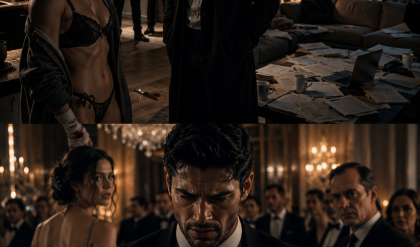
“Why did you leave with me?” she asked.
The question was too direct for charm.
I gave her the honest answer because anything else would have sounded cheap.
“Because you’re the first person tonight who made me forget I was trying to survive the night.”
Claire’s expression shifted.
“That,” she said, “was a better answer than I expected.”
“I also have worse ones.”
“I’m sure you do.”
We ended up two blocks away at a narrow bar attached to an old theater. It had dark wood booths, brass lamps, and jazz playing low enough to suggest taste without demanding attention. Claire ordered sparkling water with lime. I ordered coffee, because apparently my version of nightlife was breakfast with dimmer bulbs.
She noticed.
“Coffee at a bar?”
“I’m divorced. My rebellion has limits.”
She smiled into her water. “There it is.”
“What?”
“The reason you looked trapped all evening.”
“Divorce?”
“No. The habit of surviving instead of choosing.”
That was too accurate, and I did not like how much I liked it.
We sat across from each other this time. Not because the room demanded distance, but because we no longer needed to prove the absence of it.
Claire told me about her gallery, Whitfield House, a small independent space on Tryon Street focused on regional painters, photographers, and artists who were usually discovered too late by the institutions that eventually praised them. She talked about art without performing intelligence. She did not say “important” when she meant expensive. She did not say “challenging” when she meant ugly. She described paintings as if they were people she had learned how to hear.
I told her about my work restoring old building plans and consulting on adaptive reuse projects.
“So you help old things remain themselves,” she said.
I looked at her.
Most people heard “architectural consultant” and immediately asked whether I designed kitchens.
“In a way,” I said.
“That’s romantic.”
“It’s usually paperwork.”
“Most romance is paperwork once the weather changes.”
I laughed, but she did not. Not because she lacked humor. Because she meant it.
Her phone lit up on the table.
She glanced down.
Something in her face closed.
I did not ask. She turned the screen slightly so I could see it.
A text from someone named Marissa read:
Please tell me you didn’t leave with the younger guy. People are already talking.
Claire stared at the message for a moment, then set the phone face down.
“Your friend?” I asked.
“The one who bought my ticket.”
“That was generous of her.”
“It was strategic. She worries.”
“About you?”
“About what happens when I stop accepting smaller rooms.”
I did not fully understand that then.
I would.
My phone buzzed next.
Lydia.
Please tell me you didn’t leave already.
Then, a second message:
Wait. Someone posted a photo. Are you moving a chair next to an older woman like a Civil War bodyguard?
I closed my eyes.
Claire watched me. “Bad?”
“My sister has discovered journalism.”
“Show me.”
I turned the phone around.
Someone from the mixer had posted a picture online. Claire seated at Table Seven. Me carrying my chair around to sit beside her. The men at the bar visible in the background, caught in the act of looking exactly as foolish as they were.
The caption read:
When the surprise match goes off script.
Claire studied it.
She did not look humiliated. She looked tired, which somehow felt more intimate.
“I can ask Lydia who posted it,” I said.
“No.”
The word was gentle but final.
“No?”
“I’ve spent enough of my life chasing rooms after they decided what version of me they preferred. I’m not doing it tonight.”
I wanted to go back to the hotel, find the person who had taken the picture, and explain manners through escalating legal metaphors.
Claire saw it in my face.
“Daniel,” she said. “Do not turn your anger into a performance and call it loyalty.”
I sat back.
She was right so often it was inconvenient.
A moment later, Lydia texted again.
Okay, but she is beautiful. Also you look weirdly alive. Call me later.
I showed Claire.
This time, her expression warmed.
“Your sister has taste and no boundaries.”
“They travel together.”
We stayed for another twenty minutes, but the mood had changed. Not ruined, exactly. Exposed. The mixer had followed us through a screen. The world had a way of entering even locked rooms if enough people wanted a story.
Claire finally reached for her coat.
“I should go.”
I stood too quickly, then tried to make it look less obvious.
She noticed.
Of course she did.
“It isn’t because I want to,” she said. “It’s because I don’t want tonight to become something strangers enjoy more than we do.”
Outside, the rain had stopped. The streetlights shone on wet pavement. Ride-share cars slowed and rolled away. Claire stood under the theater awning, collar turned up, looking at the city as if it had disappointed her before but still occasionally produced good lines.
“This was unexpected,” she said.
“Good unexpected?”
She looked at me then, and for a second the guardedness lifted.
“I’ll take that.”
I should have let her go.
Instead, I said, “I’d like to see your gallery sometime.”
Claire’s eyes sharpened. “That is either sincere or very well-timed.”
“It can be both.”
“That answer should annoy me.”
“Does it?”
“Yes.”
But she smiled.
Then she pointed down the street.
“It’s two blocks away. Come on, Daniel. Before I regain judgment.”
Whitfield House sat between a closed tailor shop and a wine store, its front windows dark except for one low security light. Claire unlocked the door and entered first. I followed her into a space that smelled faintly of wood floors, dust, canvas, and lemon polish.
She turned on three lamps.
The gallery came alive slowly.
Paintings lined the white walls. Black-framed photographs rested beneath precise spotlights. A long table held catalogs, invoices, and an abandoned glass of water. There was nothing sterile about the place. It had order, but it also had pulse.
“This is yours?” I asked.
“Yes.”
“It makes sense.”
She turned. “What does that mean?”
“It has restraint without being cold.”
Claire studied me. “That was dangerously close to useful.”
“I aim for occasional competence.”
She walked toward the back wall where a large painting hung by itself. It showed a woman seated beside a window, one hand resting against the glass, face turned away from the viewer. Outside the painted window was not a landscape but a door, half-open, impossible in perspective and yet emotionally exact.
“This one is my favorite,” Claire said.
“Why?”
“Everyone thinks she’s waiting for someone.”
“And you don’t?”
“No.” Claire looked at the painting. “I think she has finally stopped.”
I felt something in my chest go still.
For a while, neither of us spoke.
Then I said, quietly, “For someone who doesn’t want strangers making a story out of tonight, you say things that make it very hard not to care what happens next.”
Claire looked at me.
No mixer. No bar. No men laughing. Just the gallery, the rain starting again outside, and a woman who seemed both completely present and prepared to disappear if I became careless.
“Tell me something honest,” she said.
“All right.”
“If nobody had been watching,” she asked, “if the room had not laughed, if there had been no chance to prove anything, would you still have chosen the seat beside me?”
I answered too quickly to make it pretty.
“Yes.”
Her face changed.
Before she could respond, someone knocked hard on the gallery door.
Claire turned.
A woman stood outside in a camel coat, phone in hand, expression tight with fear disguised as authority.
Claire exhaled.
“Marissa.”
The friend who had bought the ticket. The friend who had texted. The friend who now looked at me through the glass as if she had found evidence at a crime scene.
Claire opened the door halfway.
Marissa pushed in anyway.
“Oh, thank God,” she said. Then she saw me clearly. “You’re still with him.”
Claire closed the door. “Good evening to you too.”
Marissa lifted her phone. “Do you know people are sharing that picture?”
“Yes.”
“And you brought him here?”
“I was present for my own decisions.”
“That’s not funny.”
“It was accurate.”
Marissa turned to me.
She was close to Claire’s age, maybe a few years younger, with sharp cheekbones and the exhausted elegance of someone who managed crises for other people and called it friendship. She looked me over, and I could see the story forming in her head. Younger man. Older woman. Viral-ish photo. Gallery after hours. Risk.
“Daniel, right?”
“Yes.”
“I’m sure this has been flattering for you,” she said, “but Claire has had enough people treat her like a novelty.”
The sentence hit the room like a slap.
Claire’s eyes narrowed. “Marissa.”
“No, I’m sorry,” Marissa said, not sounding sorry at all. “I am not standing here while some man from a hotel mixer gets a thrill out of being seen as open-minded.”
I almost answered with anger.
Claire had warned me twice already.
So instead, I said, “That would bother me too.”
Marissa blinked.
I continued, “But if you’re worried I’m using her to make myself look decent, you should ask her what happened before walking into her gallery and making one more decision for her.”
Claire looked at me then.
Not gratefully.
More like I had passed a test I had not known was underway.
Marissa’s face flushed. “I’m trying to protect my friend.”
Claire’s voice dropped. “By talking over me in my own gallery?”
That stopped her.
For the first time, Marissa’s fear showed through the anger.
“I saw the comments,” she said. “I saw people laughing. Claire, I bought you that ticket because I thought it would be one normal night. Not this.”
Claire laughed softly.
“Marissa, you bought me a ticket to an event where the organizer told me not to worry because she had found someone open-minded for me.”
Marissa went still.
“What?”
“That was her phrase.”
“No.” Marissa shook her head. “No, I told Vanessa you were brilliant and intimidating and men got scared when they couldn’t impress you in under five minutes. I told her to pair you with someone who wouldn’t waste your time.”
Claire’s expression shifted.
Marissa looked genuinely horrified now. “I did not tell her to turn you into a test case.”
“I believe you,” Claire said. “But believing you does not erase being unheard.”
Marissa lowered her eyes.
“I’m sorry.”
The apology did not fix the night. Real apologies rarely do. But it stopped making the wound larger.
A few minutes later, Marissa left after making Claire promise to text when she got home. At the door, she paused and looked at me.
“If you hurt her because you like the idea of yourself with her more than the reality, I will become extremely unpleasant.”
“I’d expect nothing less.”
“Good.”
Then she left.
Claire locked the door and rested her forehead against the glass for one brief, unguarded moment.
“You okay?” I asked.
“No.”
I waited.
“But I’m not embarrassed,” she said. “That matters.”
She turned back to me.
The lamps softened the gallery around her. Rain streaked the windows. Somewhere above us, old pipes knocked softly in the walls.
“I should be embarrassed,” she said. “A younger man. A humiliating mixer. A photo. My friend bursting in as if I misplaced my judgment.” She looked at me. “There are so many convenient reasons to feel foolish.”
“And do you?”
“No.”
Her voice changed.
“I feel awake.”
That went straight through me.
I stepped closer.
“Claire.”
She lifted a hand. “Careful.”
“I know.”
“No,” she said. “You don’t. I am not a daring story for you to tell later. I am not proof that you are different from the men in that room. I am not a reward for your decency. I am a woman who has spent years being told what kind of attention she should accept because the world assumes her best years are behind her.”
I nodded slowly.
“I hear you.”
“Do you?”
“I think so,” I said. “But if I don’t, I want to learn without making you pay for the lesson.”
That was the answer that changed her face.
Not completely. Claire did not collapse into softness. She did not become easy. She stepped closer with the same care she had demanded from me.
“And if tomorrow everyone decides this was ridiculous?” she asked.
“Then tomorrow everyone can be wrong.”
Her laugh was small, disbelieving, almost painful.
“Dangerous again?”
“No.”
I looked at her properly.
“Certain.”
Claire searched my face as if looking for the performance.
Then she touched the edge of my collar with two fingers.
“You have no idea how careful I’m trying to be.”
“I do,” I said. “Because I’m trying to be careful too.”
That was when she kissed me.
Not like a woman proving she could still be wanted. Not like a man proving he was brave enough to want her. It was quieter than that. Deliberate. A decision made after the room had already done its worst and failed to make her small.
When she stepped back, she looked almost irritated by how affected she was.
I felt the same.
“Good unexpected?” I asked.
Claire looked at me for a long second.
“Good,” she said.
Then headlights swept across the gallery window.
Someone outside lifted a phone.
We both saw it.
The person took the picture anyway.
The car pulled away.
Claire looked at the empty street, then down at her hand, still close to mine.
“There it is,” she said.
“What?”
“The part where this becomes real enough to cost something.”
I did not understand how literal that sentence would become.
By morning, the second photo had spread through the same small, hungry circle that had circulated the first. It was not national news, not even local news in any meaningful way, but Charlotte had always been a city where social circles overlapped like poorly stored blueprints. A dating-event post became a private group discussion. A private group discussion became screenshots. Screenshots became jokes. Jokes became assumptions with shoes on.
I expected Claire to retreat.
She did not.
At eleven that morning, Whitfield House posted a photograph of the painting she had shown me—the woman by the window, hand against glass, face turned away.
The caption read:
Not every woman is waiting to be chosen. Some are deciding who gets to stay.
No mention of me.
No apology.
No explanation.
I stared at that caption for a full minute before Lydia texted me.
I like her. Don’t ruin this by becoming weird.
I wrote back, Too late. I was weird before she arrived.
That afternoon, Claire texted.
Dinner Thursday. No audience.
I answered, Yes.
A second message appeared.
And Daniel?
Yes?
Do not wear the blue shirt from the mixer. It made you look like you were trying to convince a bank you were emotionally stable.
That was when I knew I was in trouble.
Thursday became dinner.
Dinner became Saturday morning at the gallery while Claire unpacked a shipment and I pretended not to enjoy being handed practical tasks. Saturday became a walk through a design market where she insulted a sculpture so precisely I felt bad for the metal. Sunday became coffee at my house, where she met Lydia and somehow within twenty minutes had my sister laughing so hard she forgot she had planned to interrogate her.
After Claire left, Lydia stood in my kitchen with her arms folded.
“Well?” I asked.
“She’s terrifying.”
“She is not terrifying.”
“She made me admit I buy decorative pillows when I’m anxious.”
“That sounds like skill, not terror.”
Lydia pointed at me. “You look happy.”
That shut me up because I did.
Not foolishly happy. Not like a man trying to prove that life after divorce still had surprises. Happy in a quieter, steadier way, like a room inside me had opened and the light was better there.
For three months, the mixer photo faded.
Claire did not.
She entered my life in specific ways that felt more intimate than drama. She sent me pictures of terrible hotel lobby art when she traveled for estate sales. I sent her photographs of original brickwork and old staircases, which she either admired or insulted depending on whether the building deserved mercy. She learned I made breakfast badly but consistently. I learned she hated people touching gallery walls but would let small children sit on the floor during openings if they looked at the art seriously.
The age difference did not vanish. It became less interesting.
Sometimes people noticed. Sometimes they looked twice. Sometimes waiters assumed we wanted separate checks with the careful politeness of people trying to avoid offense and causing it anyway. Claire handled those moments with a calm I admired and occasionally resented on her behalf.
Once, at a restaurant, a woman at the next table stared too long. Claire noticed me noticing.
“Don’t,” she said.
“I didn’t say anything.”
“You were thinking in paragraphs.”
“She’s rude.”
“She is bored. There’s a difference.”
“Does that make it better?”
“No. But it makes it less important.”
That was Claire’s gift and her wound: she knew exactly what deserved her attention because she had spent years paying too much of it to people who had not earned it.
Then, in late August, the cost arrived.
It began with an email.
Claire forwarded it to me without comment. The subject line read:
Notice of Purchase Intent and Structural Review
It came from Hale Development Group, a company I knew by reputation and disliked by experience. They specialized in buying old buildings, calling them “underutilized assets,” gutting everything with a soul, and installing exposed ductwork at luxury prices.
The email stated that Hale Development had entered negotiations to purchase the entire row of buildings that included Whitfield House. Their legal team had identified “potential structural concerns” in Claire’s unit and requested access for an inspection.
I called her immediately.
“Did you know your landlord was selling?”
“I knew he was considering offers,” Claire said. “I did not know Thomas Hale was involved.”
The way she said the name made me sit straighter.
“You know him?”
“Yes.”
A pause.
“He is my ex-husband’s business partner.”
There it was.
The floor under the story shifted.
Claire had told me about her divorce in pieces. Fourteen years married. A husband named Richard Whitfield, charming in public, diminishing in private. A man who had traded loyalty for novelty and called it self-discovery. She had kept the gallery because it had been hers before the marriage, built with inheritance from her grandmother and loans she repaid through years of relentless work.
But she had not mentioned Thomas Hale.
“What does he want?” I asked.
“My building, apparently.”
“No,” I said. “People like Hale don’t want buildings. They want leverage.”
Claire went quiet.
Then she said, “There’s more.”
She forwarded me a screenshot.
It was from the same private social group where the mixer photo had first circulated months earlier. Someone had reposted the picture of me moving my chair beside Claire, along with a newer comment.
Isn’t this the gallery owner on Tryon? Heard she’s dating some younger renovation guy now. Midlife crisis comes for everyone.
Below it, another comment:
Wonder if that explains why Whitfield House is suddenly fighting redevelopment. Emotional decisions are bad for business.
I read the comments twice.
Then I called Lydia, who worked in communications and understood social poison better than anyone I knew.
“Is this coordinated?” I asked after explaining.
Lydia was quiet for less than three seconds.
“Yes.”
“You sound too certain.”
“Because normal gossip is messy. This is too directional. They’re not just mocking Claire. They’re framing her as unstable.”
“For a property dispute?”
“For public permission,” Lydia said. “If people believe she’s vain, impulsive, and dating younger men to feel relevant, then when a developer pushes her out, fewer people ask questions.”
I thought of the mixer.
Vanessa’s bright smile.
The men at the bar.
The photo taken at exactly the right moment.
The second photo outside the gallery.
A bad room could be accidental. A pattern was architecture.
Two days later, Claire received a formal notice claiming that Whitfield House had violated terms of her lease by making unauthorized structural modifications to the basement. She had thirty days to remedy or vacate.
Claire brought the letter to my house.
She stood in my kitchen, calm in the way people become when anger is too large to spend quickly.
“I did not modify the basement,” she said.
“I believe you.”
“I know every inch of that building.”
“I believe that too.”
She set the letter on the counter.
“Then why do I feel like I’m already defending myself against something that hasn’t happened yet?”
Because that was how power worked when it was cowardly. It did not always attack directly. Sometimes it arranged the room, dimmed the lights, handed out labels, and waited for everyone else to laugh first.
I read the notice carefully.
Then I read it again.
A phrase caught my eye: partition wall inconsistent with original foundation plan.
“What partition wall?” I asked.
Claire frowned. “There’s a false wall in the basement storage room. It’s been there since before I bought the place. I use the space in front of it for crates.”
“Has anyone opened it?”
“No. It’s brick behind plaster. I assumed it covered old mechanical work.”
“Do you have your original purchase documents?”
“At the gallery.”
“And any old plans?”
“A few. Not complete.”
I picked up my keys.
Claire looked at me. “Daniel.”
“What?”
“You look weirdly alive again.”
“I get that way around old walls and legal threats.”
“That should not be attractive.”
“No one is more surprised than I am.”
We went to Whitfield House that night.
The basement smelled of dust, cardboard, and old rain. Claire showed me the storage room. Crates were stacked along one wall. Behind them was a plastered partition, slightly uneven, painted the same dull white as everything else.
I ran my hand along it.
Old.
Not recent.
Not the kind of modification Hale’s inspector claimed. The plaster had hairline cracks and layers of paint. Whoever built it had done so decades earlier.
“This wall wasn’t added by you,” I said.
“I know.”
“But someone wants it treated like your violation.”
“Why?”
I crouched near the baseboard. There, beneath dust, I saw a narrow seam.
“Because maybe it’s hiding something.”
Claire crossed her arms. “That sounded dramatic.”
“It was meant to.”
“You’ve been spending too much time with me.”
“Clearly.”
We did not break the wall open that night. Claire was careful, and she was right to be. Instead, the next morning, I searched city archives, county property records, and historical survey scans. I requested old permits. I called a retired structural engineer I knew who believed every developer was guilty until proven boring.
Three days later, I found the first clue.
Whitfield House had once been the ground floor of the Barlow Printing Building, constructed in 1911. In 1948, a rear portion of the basement had been sealed after a fire damaged neighboring utilities. The building had later been subdivided, sold, resold, and folded into a row of commercial units.
In a scanned permit from 1952, there was a reference to protective interior closure over original document niche and service cavity.
Document niche.
That phrase made my pulse change.
I sent Claire the scan.
She replied:
Please tell me old buildings are not about to become smug.
I wrote:
Too late. This one has secrets.
The next day, with Claire’s permission and Marissa present as witness, we brought in my retired engineer, Mr. Alvarez. He inspected the wall, muttered insults about modern contractors, and confirmed it was not structural.
Claire stood beside me as he carefully removed a small section of plaster.
Behind it was brick.
Behind one loose brick was a metal box.
No one spoke.
Mr. Alvarez set it on the basement floor.
The box was rusted but intact.
Inside were oilcloth-wrapped papers, a brittle photograph of the building from the 1920s, and a folded deed rider recorded in 1936.
Claire lifted it with both hands.
Her face changed as she read.
“What is it?” Marissa asked.
Claire did not answer.
She handed the paper to me.
The deed rider established a preservation covenant and right of first refusal tied to the ground-floor cultural use of the property. If the building row was ever sold for redevelopment, the occupant of the original Barlow frontage—now Whitfield House—had the legal right to purchase her unit at the assessed historical-use value before any external development transfer.
I read it twice to make sure hope was not making me stupid.
Then I looked at Claire.
“This means Hale can’t just push you out.”
Claire’s voice was quiet. “It means Richard knew.”
I looked down at the document again.
There, attached to the rider, was a notarized copy from seventeen years earlier. During Claire’s marriage. During the year Richard had “helped” restructure some of her business paperwork.
Marissa swore under her breath.
Claire did not.
She simply stood in the basement of her gallery holding proof that the man who had once promised to build a life with her had concealed the one document that could protect the place she loved most.
That was the twist that made everything else make sense.
The mixer had not created the cruelty. It had revealed the machinery.
Thomas Hale did not merely want Claire’s building. He needed her discredited before she discovered she had rights. Richard Whitfield had likely told him enough to know a document existed, but not where. The false wall had become the excuse. The photos had become the character attack. The jokes had become preparation.
Claire’s age, my presence, the chair, the kiss outside the gallery—every shallow assumption had been useful to men who needed her to look foolish.
Claire folded the deed rider carefully.
Her hands were steady.
“What do you want to do?” I asked.
She looked at the wall, then at the box, then at the gallery stairs leading up toward the light.
“I want them to say it in a room where lying costs money.”
The hearing took place six weeks later.
By then, Hale Development had learned that Claire was not leaving quietly. Her attorney filed the deed rider with the county. Hale’s attorneys challenged its enforceability. Richard Whitfield submitted a statement claiming he had no knowledge of the covenant. Thomas Hale argued that the document was obsolete, irrelevant, and suspiciously convenient.
Lydia helped Claire prepare a public statement without turning her private life into a spectacle. Marissa became aggressively useful, which was her apology language. I provided architectural records, permit scans, basement photographs, and a professional assessment confirming the wall had predated Claire’s ownership by decades.
The hearing room was not large, but it was full.
Developers, attorneys, neighboring business owners, a few local reporters, curious people pretending not to be curious, and at the back—because the universe has a cruel sense of composition—two of the men from the mixer.
Cologne Commercial was there too.
His real name, I had learned, was Grant Phelps. He worked in commercial leasing for Hale Development.
Of course he did.
When Claire saw him, she did not flinch.
She only leaned toward me and whispered, “The room has upgraded its lighting but not its character.”
I nearly laughed at the worst possible time.
The proceeding was technical at first. Chain of title. Recorded riders. Structural claims. Lease obligations. Historical-use valuation. Hale’s attorney tried to make the covenant sound like a dusty accident. Claire’s attorney made it sound like what it was: a legal right deliberately ignored.
Then Hale’s attorney made his mistake.
He suggested Claire’s resistance to redevelopment had become “emotionally influenced by recent personal instability.”
The room shifted.
Claire’s attorney stood slowly.
“Personal instability?”
Hale’s attorney adjusted his glasses. “There has been public concern regarding Ms. Whitfield’s judgment.”
Claire’s attorney looked almost delighted. “Public concern from whom?”
The attorney hesitated.
Then Claire’s attorney placed printed screenshots on the table. The mixer photo. The gallery photo. The comments. The leasing associate’s account connected to early shares. Grant Phelps’s name on internal Hale emails discussing “pressure optics” and “owner credibility.”
Grant turned the color of wet paper.
Thomas Hale stared straight ahead.
Richard Whitfield, seated beside him, looked at Claire for the first time all morning.
Claire did not look back.
Her attorney continued. “Are these the concerns you mean? The ones your client’s associate helped circulate before filing a structural complaint based on a wall built before Ms. Whitfield was born?”
Silence.
Not hotel-lounge silence.
Better.
This silence had a court reporter.
The judge asked several questions after that. Precise questions. Unpleasant questions. The kind that made expensive suits look less protective.
When it was Claire’s turn to speak, she stood without notes.
“My gallery is not valuable because a developer wants the dirt under it,” she said. “It is valuable because people have stood inside it and felt less alone. That may not matter to commercial projections, but it matters to this city.”
She paused.
“I was told, directly and indirectly, that I should be grateful for whatever attention I received. Grateful to be included. Grateful to be considered. Grateful when people with more power made decisions around me and called them opportunities.”
Her voice remained steady.
“But gratitude is not a lease term. Age is not evidence of instability. A woman’s private life is not a structural defect. And a room full of people laughing does not make the joke true.”
I watched Thomas Hale’s jaw tighten.
I watched Richard look down.
I watched Claire become, in public, exactly who she had been in private all along.
The judge ruled two weeks later.
The covenant stood.
Hale Development could not force Claire out under the structural claim. The right of first refusal was valid. The concealed rider triggered a separate civil dispute that Claire’s attorney pursued with quiet ferocity.
Richard settled before trial.
Thomas Hale lost the row purchase.
Grant Phelps deleted his social media and, according to Lydia, rebranded himself as a “strategic workplace culture consultant,” which proved there was no justice system comprehensive enough for some crimes.
Claire bought her unit six months later.
The assessed historical-use value was still expensive, but possible. Friends donated. Artists reduced commissions. Neighboring businesses held a benefit. Lydia organized press so carefully that Claire remained the subject without becoming prey. Marissa cried twice and denied both times.
On the day Claire signed the final papers, she stood in the gallery beneath the painting of the woman by the window.
I handed her a cup of sparkling water with lime.
She looked at it. “Celebration beverage?”
“I know my audience.”
“That is disturbingly romantic.”
“I’ve been practicing.”
“Don’t.”
We laughed.
Then she looked around the gallery.
For once, she had no sharp sentence ready.
That was how I knew how deeply she felt it.
A year after the mixer, Claire opened a new exhibition called Rooms That Tried to Shrink Us.
The first piece was the woman by the window.
Beside it hung a second painting by the same artist, one Claire had found later in storage. The same woman stood at an open door, suitcase in hand, not fleeing, not waiting—leaving because she had finally decided the room no longer deserved her.
At the opening, people filled Whitfield House until the air hummed with conversation. Artists, neighbors, critics, students, older women in beautiful clothes, younger women with bright eyes, men who came because they loved art, men who came because they loved the women who loved art, and a few people who had once laughed in smaller rooms and now clapped in public because shame had changed sides.
Claire spoke briefly.
She thanked the artists. She thanked the community. She thanked Marissa, who cried again and threatened anyone who noticed.
She did not thank me from the podium.
I was glad.
Our story did not need to be proof.
Later, after the crowd thinned, Claire found me near the back wall.
“You’re quiet,” she said.
“I’m looking at old window trim.”
“You are hiding feelings behind millwork.”
“It’s load-bearing.”
She slipped her hand into mine.
This time, no one lifted a phone.
Or maybe they did. It no longer mattered.
Two years after the mixer, I proposed in the gallery after closing.
Not during an opening. Not under the painting by the window. Under the second one—the open door.
Claire stared at the ring.
For the first time since I had known her, she had no elegant sentence ready.
So I gave her one.
“You once asked if I would still have chosen the seat beside you if no one had been watching,” I said. “I would have. I do. Every day.”
Her eyes filled.
Then she said, “That was almost too sentimental.”
“Almost?”
“Don’t ruin it.”
“I won’t.”
“Yes,” she said.
Then she kissed me in the empty gallery, beneath a painting of a woman who had stopped waiting.
Years later, when people asked how we met, Claire usually said, “A badly designed singles mixer.”
I said, “Best bad room I ever walked into.”
Sometimes people laughed. Sometimes they asked about the age difference. Sometimes they tried to make the story smaller because small stories are easier to control.
Claire never let them.
“The age difference was never the point,” she would say.
And she was right.
They paired me with an older woman because they expected discomfort. They expected me to flinch. They expected her to absorb the insult gracefully. They expected the room to decide what she was worth before I could discover who she was.
But they had it backward.
Claire was never the test.
The test was whether I could recognize a woman who had already become exactly herself and be brave enough to sit beside her—not just when the room was watching, not just when the insult was obvious, not just when decency looked dramatic, but later, when the cost arrived quietly in paperwork, rumors, old walls, and locked boxes.
Love did not begin when I moved the chair.
That was only the moment I stopped cooperating with the joke.
Love began afterward, when Claire made sure I understood she did not need rescuing, only respect. It deepened when I learned that choosing someone is not a gesture you make once in a crowded room. It is a practice. A discipline. A thousand ordinary decisions to stay honest after the scene is over.
The night they paired me with Claire Whitfield, the room came looking for proof that everyone still deserved to be chosen.
Claire already knew better.
She was not waiting to be chosen.
She was deciding who got to stay.
THE END