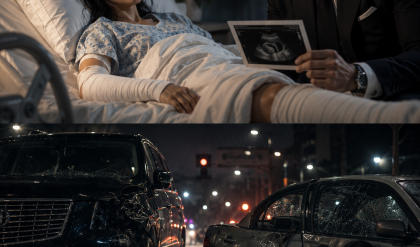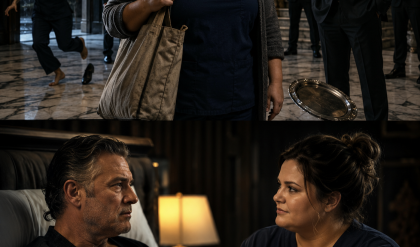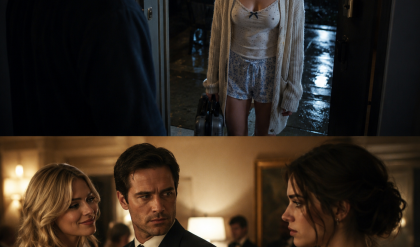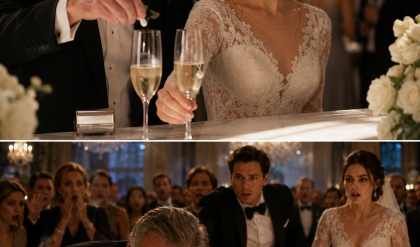
They moved with terrible discipline. One scanned the roofline. One opened a medical bag. Another stood between Nora and the mouth of the alley, not threatening her exactly, but making it clear nobody left unless Dominic Vale wanted them to.
Then Dominic stepped out.
He wore no hat. No gloves. Snow collected on his dark hair and the shoulders of his black suit. His face looked carved from stone, but his eyes went straight to Caleb and broke.
Only for a second.
But Nora saw it.
He crossed the alley and dropped to one knee beside his son.
“Caleb.”
The boy’s whole body seemed to loosen at the sound.
“Dad…”
Dominic touched his son’s face with two fingers, so gently Nora had to look away.
“I’m here.”
The medic knelt beside Nora.
“Ma’am, I need space.”
Nora shifted back, but she kept one hand near Caleb’s shoulder.
“He said it wasn’t an accident,” she told Dominic. “He said they knew the gate code.”
Dominic’s head turned.
Slowly.
“What?”
Caleb stirred beneath the coat. “Dad…”
“Don’t talk,” Dominic said, but his voice cracked around the edge.
“Blue ring,” Caleb whispered. “One of them… had your ring.”
The men in the alley went silent.
Not confused.
Afraid.
Dominic did not move.
“What ring?” Nora asked.
No one answered.
The medic looked at Dominic. “We need to move him.”
Dominic nodded once.
They lifted Caleb onto a stretcher. When the boy cried out, Dominic’s face changed so violently that every man around him froze as if waiting for a gunshot.
Nora stood too fast. Her knees buckled. She caught herself against the wall.
Dominic noticed.
Of course he did.
“You’re freezing,” he said.
“I’m fine.”
“No, you’re not.”
He removed his overcoat and placed it around her shoulders.
It was heavy, warm, and absurdly expensive. It smelled like cedar, winter air, and some sharp, clean cologne.
Nora hated how badly she needed it.
“I don’t want your coat,” she said.
“Then wear it for my son. He will worry if he sees you shaking.”
That stopped her.
Caleb was loaded into the middle SUV. Dominic kept one hand on the stretcher until it disappeared inside. Then he turned back to Nora.
“You’re coming.”
Nora lifted her chin.
“That sounded like an order.”
“It was.”
“Then no.”
The alley went dangerously still.
Dominic stared at her.
Nora’s heart hammered, but she did not step back.
“Your son asked me to stay,” she said. “You didn’t.”
Something shifted in Dominic’s expression. Not softness. Something older than softness. Something that looked like recognition.
He opened the SUV door himself.
“Please,” he said.
That was worse than the order.
Nora looked at Caleb through the open door, his face pale beneath the emergency blanket.
“All right,” she said. “But I sit where I can see him.”
Dominic nodded.
“Then sit beside me.”
The SUV smelled like leather, antiseptic, and fear.
As they sped through Chicago’s snow-clogged streets, Nora told Dominic everything. She told him when she clocked out. Where she heard Caleb. How he was positioned. What he said about the gate code and the blue ring.
Dominic listened without interrupting.
That was what scared her most.
A man who shouted was spending emotion. Dominic Vale was saving his.
At last, he asked, “Did he say anything else?”
“He said it wasn’t an accident.”
“It wasn’t.”
“You already knew that?”
Dominic stared out at the city sliding past the tinted window.
“I watched him go inside my house at 9:34.”
Nora’s stomach tightened.
“Then someone let him back out.”
His eyes cut to her.
“In my life, Miss Quinn, that sentence is a knife.”
“It’s also logic.”
For the first time since he arrived, Dominic looked at her as if she were not just another person caught in his storm.
The medic in the back muttered, “Blood pressure holding.”
Caleb’s good eye opened.
“Dad…”
Dominic turned instantly.
“I’m here.”
“Don’t… go after Cross.”
Nora looked between them.
“Who’s Cross?”
Dominic’s jaw flexed.
“Gideon Cross is a man who has wanted me dead for fifteen years.”
Caleb swallowed painfully. “They said his name. Wanted me to hear.”
Dominic leaned closer. “Who said it?”
“Masks.”
“Did you see anything?”
Caleb’s fingers twitched.
“Ring.”
“The blue ring?”
A tiny nod.
Dominic closed his eyes.
Only for a second.
But in that second, Nora saw the truth: the ring mattered more than the name.
The convoy did not stop at the main entrance of Mercy West Medical Center. It turned into a private emergency bay where a surgical team was already waiting.
No forms.
No questions.
No one asked why the most feared man in Chicago had arrived with a bleeding child, a half-frozen waitress, and three SUVs of armed men.
Caleb disappeared through double doors.
Dominic followed until a doctor blocked him.
“Mr. Vale, we need room.”
Dominic stared at him.
The doctor went pale but did not move.
Nora stepped forward.
“Let them work.”
Every man in the hall looked at her like she had just slapped a wolf.
Dominic turned his head slowly.
Nora held his gaze.
“If they’re afraid of you, they’ll still treat him, but part of their minds will be on surviving you. Caleb needs all of them.”
The silence stretched.
Then Dominic stepped back.
The doctor vanished inside.
The doors closed.
For the next forty minutes, Dominic did not sit. He stood in the hallway with his hands at his sides, looking at the doors like he could bargain with God by threatening the hinges.
Nora sat because if she did not, she would fall.
A nurse brought her scrubs, socks, and hot coffee. Nora accepted the socks but not the coffee. Her stomach was too tight.
Dominic finally spoke without looking at her.
“Why did you stop?”
Nora rubbed her hands together.
“Because there was a boy in the snow.”
“Most people would have kept walking.”
“You don’t know most people.”
“I know fear.”
She looked at him then.
Under the hospital lights, Dominic Vale seemed less like a legend and more like a man who had built armor so thick he had forgotten how to breathe without it.
“Maybe that’s the problem,” Nora said. “You know fear so well you mistake it for human nature.”
His eyes moved to her.
She should have apologized.
She did not.
Before he could answer, the trauma surgeon came through the doors.
Dominic crossed the hall in two strides.
“He’s stable,” the doctor said quickly. “Concussion, two bruised ribs, a fractured wrist, facial trauma. No internal bleeding. We’re monitoring swelling, but he’s conscious and asking for you.”
Dominic’s shoulders dropped by the smallest amount.
“And,” the doctor added, glancing at Nora, “he asked for her.”
Nora blinked.
“Me?”
Dominic looked at her.
“He trusted the person who stayed.”
Caleb’s hospital room was dim and clean. His bruises looked worse now, under honest light. He seemed too small against the white sheets, too young to belong to the violent world that had made him a message.
Dominic stood on one side of the bed. Nora stood on the other.
Caleb opened his good eye.
“There she is,” he whispered.
Nora managed a smile.
“I was told you requested difficult company.”
His mouth twitched.
Dominic bent closer.
“Caleb, only what you can tell me. Nothing more.”
The boy’s gaze shifted toward the door, where a tall man in a gray overcoat stood with rigid shoulders.
Nora recognized him from Luminara’s.
Victor Shaw.
Dominic’s closest friend. Chief of security. The man who always walked three steps behind Dominic and one step closer to Caleb than anyone else.
Caleb’s throat worked.
“I thought Uncle Vic was behind me.”
Victor flinched.
Dominic’s face hardened.
“I was,” Victor said quickly. “I checked the south gate myself.”
Caleb shook his head faintly.
“No. I heard your voice.”
The room went silent.
Victor looked wounded.
“Caleb, I would never—”
Dominic raised one hand.
Victor stopped speaking.
Caleb whispered, “Not him. A recording.”
Nora frowned.
“A recording?”
“They played it from a phone. It said, ‘Come back, kid, you dropped something.’ I thought it was Uncle Vic.”
Dominic’s expression became colder.
“And the ring?”
Caleb’s eye filled with fear.
“One man held me down. His glove tore. I saw a blue stone ring. Like yours, Dad. Like the old ones.”
Nora looked at Dominic’s hand.
No ring.
Dominic noticed.
“My father gave four sapphire signet rings,” he said quietly. “One to me. One to Victor. One to my brother. One to a man I buried last year.”
“Buried men don’t wear rings,” Nora said.
Dominic’s mouth tightened.
“No,” he said. “But thieves do.”
Victor stepped forward.
“Dom, let me pull every feed from the house and the restaurant.”
Dominic did not look away from Caleb.
“Do it.”
Victor left.
Nora watched him go.
Something about his face bothered her. Not guilt. Not exactly.
Pain.
Real pain.
Which meant either he loved Caleb…
Or he was a better liar than everyone in the room.
Dominic stayed until Caleb drifted back to sleep. Then he stepped into the hallway, where men waited for orders.
“Lock down the house staff,” Dominic said. “No one leaves. Pull cameras from Lakeview to Wabash. Find the sedan. Find every man connected to Cross who could have copied Victor’s voice.”
One man nodded and left.
Dominic turned to Nora.
“You need protection.”
“I need rent money, sleep, and for my mother not to die because insurance calls everything optional.”
He stared at her.
She immediately regretted the honesty.
Exhaustion had loosened something in her. The night had cracked open both of them in different ways.
“My mother has multiple myeloma,” Nora said. “I was supposed to bring her medicine before work tomorrow. Today. Whatever time it is.”
Dominic’s face did not soften, but his voice changed.
“What hospital?”
“Cook County.”
He nodded to one of his men.
Nora’s eyes narrowed.
“No.”
Dominic looked back at her.
“You don’t know what I was going to say.”
“Yes, I do. You were going to send someone, fix something, move her somewhere, and then call it help.”
“It would be help.”
“It would also be control.”
He studied her for a long moment.
Then, to her surprise, he nodded once.
“Fair.”
Nora was too tired to hide her shock.
Dominic said, “Tell me what you need.”
She laughed softly because the question was impossible.
“I need to not be in your world.”
His gaze moved to Caleb’s door.
“So do I.”
That was the first honest thing he had said that sounded like it cost him.
By morning, the snow had stopped.
Nora had slept ninety minutes in a hospital chair with Dominic’s coat still around her shoulders. When she woke, he was standing by the window, speaking quietly into his phone.
“No revenge moves. Not one. If Cross breathes in our direction, watch him. Do not touch him.”
He listened.
Then his voice dropped.
“Because someone wants me stupid, and I refuse to be generous.”
He ended the call.
Nora sat up.
“You think Cross didn’t do it.”
“I think Cross is capable of it,” Dominic said. “But I think whoever did this wanted me to believe it too quickly.”
“Because of the name.”
“And the ring.”
“And the recording.”
Dominic turned from the window.
“You hear the shape of it.”
“I hear bad theater.”
That almost made him smile.
Almost.
“My men see insults,” he said. “You see staging.”
“Waitresses see staging every night. Men bring women they don’t love to dinner and pretend. Families smile while they hate each other. People rehearse lies before dessert.”
Dominic looked at her with new attention.
“And what do you see when you look at me?”
Nora should have looked away.
She did not.
“A man trying not to become the worst thing people already believe about him.”
The words sat between them.
Dominic’s phone rang before he could answer.
He listened for ten seconds.
Then everything in his face closed.
“They found the sedan.”
The sedan was in an abandoned garage near the river.
Dominic did not ask Nora to come.
Nora told herself she was grateful.
Then Caleb woke again and grabbed her hand.
“Don’t let him kill Cross,” he whispered.
“He says he won’t.”
Caleb’s good eye searched hers.
“Dad says a lot of things when he’s hurting.”
Nora thought about Dominic in the hallway, about the way every man waited for his anger like it was weather.
“What do you want me to do?” she asked.
“Ask questions,” Caleb said. “He listens to you.”
Nora almost laughed.
“No, he doesn’t.”
Caleb’s mouth barely moved.
“He came when you called.”
So two hours later, Nora found herself in a black SUV again, riding toward a garage on the South Branch of the Chicago River with Dominic Vale beside her and Victor Shaw in the front passenger seat.
Dominic had argued.
Nora had argued better.
“You need someone in the room who doesn’t want blood,” she had said.
“I have doctors for that.”
“Doctors come after blood.”
Victor had looked out the window to hide his smile.
The garage smelled of oil, rust, and cold concrete. The sedan sat beneath a flickering light, its doors open, its seats stripped of obvious evidence. Dominic’s men had already found zip ties, a torn school scarf, and a phone with no SIM card.
Victor handed Dominic a plastic evidence bag.
Inside was a small speaker.
“The voice recording came from this,” Victor said. “They used my voice. Cut from security calls.”
Dominic stared at it.
Nora studied Victor’s hands.
No sapphire ring.
“Where’s your ring?” she asked.
Victor looked surprised.
“At home.”
Dominic’s eyes shifted.
Victor lifted his hand. “I stopped wearing it after Lena died. It felt wrong.”
Lena.
Dominic’s late wife.
The name changed the air.
Nora had heard rumors at Luminara’s. Some said Lena Vale had been killed by a rival. Some said illness. Some said Dominic himself had loved her too much and that love had made him weaker than enemies could tolerate.
Dominic looked away first.
One of his men called from the sedan.
“Boss.”
He held up a strip of dark fabric. Embroidered inside was a tiny gold thread design.
Nora stepped closer.
“That’s not from Caleb’s school coat,” she said.
Dominic looked at her.
“How do you know?”
“I mended one of those coats for him once when the sleeve caught on a chair. Different lining.”
Victor took the fabric.
His face changed.
Dominic noticed.
“What is it?”
Victor swallowed.
“This is from a Carroway coat.”
Dominic went still.
Nora looked between them.
“Who is Carroway?”
Dominic answered without emotion.
“Elliot Carroway. My wife’s brother.”
Nora felt the story tilt.
“Caleb’s uncle?”
“Yes.”
Victor’s voice was low. “He came back to the city last month.”
“You told me he was in Phoenix,” Dominic said.
“He was. I thought he left again.”
Dominic turned slowly.
“Thought?”
Victor’s jaw tightened.
“Dom, I checked. He vanished after Lena’s funeral. Nobody heard from him for years. Then he showed up, asking about Caleb, asking whether you had softened.”
Nora looked at Dominic.
“Why would your wife’s brother hurt your son?”
Dominic’s face looked carved from old grief.
“Because he never believed Caleb should be mine.”
The answer made no sense until it did.
Nora remembered Caleb’s eyes. Lighter than Dominic’s. His gentle manners. The way people sometimes looked at the boy with pity instead of respect.
“Caleb isn’t your biological son,” she said softly.
Dominic’s eyes met hers.
“No.”
Victor looked down.
Dominic continued, “Lena was pregnant when I met her. The father disappeared. I married her before Caleb was born. I signed the certificate. He is my son.”
No one in the garage moved.
Nora understood then why Dominic’s enemies would use Caleb. Not because the boy was a blood heir.
Because he was proof Dominic Vale could love beyond blood.
And that made him dangerous in a different way.
Dominic’s phone rang.
He answered.
A man’s voice came through on speaker, smooth and almost amused.
“Hello, Dom.”
Dominic’s face did not change.
“Elliot.”
Nora felt Victor tense beside her.
Elliot Carroway laughed softly.
“I wondered how long it would take you. I overestimated your anger, apparently. Or underestimated the waitress.”
Dominic’s hand tightened around the phone.
“Where are you?”
“Close enough to watch you disappoint me.”
“You touched my son.”
“No,” Elliot said. “I corrected a mistake my sister never should have made.”
Dominic’s voice dropped into something terrible.
“Say that again.”
“Caleb was never yours.”
“He is mine in every way that matters.”
“Sentimental garbage. Lena ruined herself loving you. Then she died, and you turned my family’s name into a bedtime story for a boy who doesn’t even carry your blood.”
Dominic closed his eyes.
Nora saw him fighting for control.
Elliot continued, “I wanted you to go after Cross. I wanted the city to burn while men remembered you were nothing but a thug in a tailored suit. But this is almost better. Now everyone gets to see you hesitate.”
Dominic opened his eyes.
“No,” he said. “Everyone gets to see what you are.”
Elliot’s voice sharpened.
“You think this is over?”
“No,” Dominic said. “I think you just told me you’re afraid.”
He ended the call.
Victor stepped forward.
“Dom—”
“Find him.”
They found Elliot in the one place Dominic should have guessed first.
Lena Vale’s childhood home.
It stood in Oak Park, a beautiful old house with white columns, dark windows, and a garden buried under snow. Elliot had inherited it after his parents died. Dominic had avoided it for years because every hallway held Lena’s ghost.
That was why Elliot chose it.
Not strategy.
Cruelty.
Dominic arrived with six men, Victor, and Nora, though he had again ordered her to stay behind.
This time, Nora did not argue in the car.
She waited until they reached the sidewalk, then said, “If you go in there like a monster, he wins.”
Dominic stared at the house.
“He hurt my child.”
“Yes.”
“He used my dead wife’s voice against me.”
Nora’s breath caught.
“What?”
Victor’s face darkened.
Dominic looked at the upstairs window.
“The second recording. Caleb didn’t remember it clearly. The doctors thought it was confusion. But he heard Lena’s voice telling him to come home.”
Nora’s chest hurt.
“That’s evil.”
“Yes.”
Dominic looked at her.
“And I have been very good at evil.”
Snow fell softly between them.
Nora stepped closer.
“Then be good at something harder.”
For a long moment, he said nothing.
Then he handed her his gun.
Victor’s eyes widened.
Nora froze.
“I don’t want that.”
“I’m not giving it to you to use,” Dominic said. “I’m giving it to you so I can’t.”
The weight of it frightened her.
But she took it.
Dominic walked into the house unarmed.
Elliot waited in the parlor beneath a portrait of Lena as a young woman. He had her pale hair, her elegant bones, none of her warmth. He wore a long camel coat with a tear at the sleeve.
On his right hand was a sapphire signet ring.
Dominic stopped in the doorway.
Elliot smiled.
“There he is. Chicago’s grieving king.”
Victor’s men spread through the house.
Dominic did not look at them.
“You used Lena’s voice.”
Elliot shrugged.
“She would have wanted Caleb away from you.”
“You don’t get to speak for her.”
“You bought her.”
“I loved her.”
Elliot’s smile flickered.
Nora stood just inside the room, Dominic’s gun heavy in her coat pocket, her hands shaking where nobody could see.
Elliot looked at her.
“And you must be the waitress who mistook herself for a conscience.”
Nora answered before Dominic could.
“No. I’m the waitress who heard a child breathing when men like you expected the world to keep walking.”
Elliot’s face tightened.
Dominic stepped closer.
“Why leave Caleb alive?”
Elliot laughed. “Because dead children make martyrs. Broken children make fathers weak.”
Dominic stopped.
The room went cold.
Elliot seemed to realize he had finally reached him.
“You should thank me,” he said. “For one night, you felt what my sister felt every day married to you. Fear. Pain. Helplessness.”
Dominic’s voice was quiet.
“My wife was not helpless.”
“She died because of your life.”
Dominic flinched.
There it was.
The deepest wound.
Nora saw it hit him, saw every cruel rumor and private guilt come alive behind his eyes.
Elliot reached into his coat.
Victor shouted.
Dominic moved.
Nora thought he was going to kill him.
Instead, Dominic caught Elliot’s wrist, twisted the object free, and threw him hard against the wall.
A small silver recorder skittered across the floor.
Not a gun.
Another recording.
Lena’s voice began to play from the device.
“Dom, please…”
Dominic froze.
The room went silent except for the dead woman’s voice, broken into fragments stolen from old messages.
“Please… come home…”
For one terrible second, Dominic looked like the sound might destroy him.
Then Nora crossed the room, picked up the recorder, and crushed it beneath her heel.
The plastic cracked.
Lena’s voice died.
Elliot stared at her with naked hatred.
“You had no right.”
Nora’s voice shook, but she held his gaze.
“Neither did you.”
Dominic looked at Elliot.
There was murder in his eyes.
Then he glanced at Nora.
Not for permission.
For a reminder.
Caleb in the hospital bed.
Caleb whispering, “Don’t kill the wrong man.”
Lena’s portrait on the wall.
The boy in the snow.
Dominic released Elliot and stepped back.
“Call the federal contact,” he told Victor. “Every file. Every transfer. Every recording. Give them all of it.”
Elliot went pale.
“You would hand family to prison?”
Dominic’s voice was flat.
“You stopped being family when you put my son in the snow.”
Elliot lunged.
Victor took him down before he reached Dominic.
No gunshots.
No blood on Lena’s carpet.
No revenge that would make Caleb wake to a darker world.
And somehow, that restraint felt more violent than any killing could have.
Three weeks later, Caleb came home.
Not to Dominic’s mansion first. He refused.
“I want windows,” he said. “Normal ones. Not bulletproof ones.”
Dominic rented a house in Evanston with a yard, oak trees, and neighbors who walked dogs without knowing that two men in a parked sedan were watching every squirrel with professional suspicion.
Nora visited because Caleb asked.
At first, she came once with soup.
Then twice with homework books.
Then on Saturdays, because Caleb claimed nobody else made grilled cheese correctly and Dominic Vale, despite ruling half the city’s shadows, could burn bread with tragic confidence.
One afternoon, Nora found Dominic standing in the kitchen, staring at a smoking skillet.
She took it from him.
“You’ve negotiated with murderers, but cheese defeated you?”
“I was distracted.”
“By what?”
He looked toward the living room, where Caleb was laughing at something on television.
“By the sound of him laughing.”
Nora’s anger softened before she could stop it.
Dominic had changed after Elliot’s arrest. Not suddenly. Not beautifully. Real change was uglier than that. It came in withdrawals, in habits resisted, in orders stopped before they became threats.
He turned over businesses that could not survive daylight. He kept the security company and made it legitimate. He sent evidence to prosecutors instead of bodies to the river. Men who had followed him out of fear began leaving, and the ones who stayed had to learn a new language.
Contracts.
Licenses.
Taxes.
Nora teased him that crime had been easier because paperwork was the true American punishment.
He almost smiled when she said it.
Her own life changed too, though she fought every inch of it.
Dominic arranged for her mother, Mae Quinn, to be transferred to a specialist clinic through a charity foundation he had founded years before Lena’s death. Nora investigated the foundation for three nights, determined to prove it was a trap. It was not. It had paid for dozens of patients who never knew Dominic’s name.
When Nora confronted him, he simply said, “Lena started it.”
Mae met Dominic once and told Nora afterward, “That man looks like trouble wearing a good coat, but he listens when you talk. That’s rare.”
“Mom, he is trouble.”
“Honey, so are medical bills. At least he has manners.”
Nora refused Dominic’s money.
Then Luminara fired her.
The manager said she had become “a distraction.” Nora suspected the real reason was that reporters had started calling, asking about the waitress who saved Dominic Vale’s son.
She walked out with her apron folded in her hand and no plan beyond not crying on the sidewalk.
Dominic was waiting across the street.
Nora stopped.
“Tell me you didn’t get me fired.”
“I did not.”
“Tell me you didn’t buy the restaurant.”
“I did not buy the restaurant.”
She narrowed her eyes.
He added, “I bought the building beside it.”
“Dominic.”
“I’m learning that honesty is best delivered quickly.”
“It is best delivered before property acquisition.”
He handed her an envelope.
“No cash,” she warned.
“No cash.”
Inside were architectural drawings, lease papers, and a photograph of an empty storefront with tall windows and old brick walls.
Nora stared.
“What is this?”
“A space.”
“For what?”
Dominic looked almost uncomfortable.
“Your mother told me she once wanted to open a bakery. You told Caleb you used to bake when hospital nights got bad. The storefront is yours for one dollar a month until you decide what you want.”
Nora’s throat tightened.
“That’s still money.”
“That’s a lease.”
“That’s control wearing a better suit.”
He nodded.
“You can say no.”
She searched his face.
For once, he did not look like a man waiting to win.
He looked like a man offering something with both hands open.
“Why?” she asked.
Dominic looked through the window toward the alley where she had found his son.
“Because the night you called me, I had power over half the city and no power over the only thing that mattered. You had nothing, and you gave what you had anyway. I don’t know how to repay that without insulting it.”
Nora looked down at the papers.
“You can’t repay it.”
“I know.”
“Good.”
She should have walked away.
Instead, she said, “The chairs will be blue.”
Dominic blinked.
“What?”
“If I do this, the chairs will be blue. Not black. Not gray. Not intimidating.”
A slow warmth moved into his eyes.
“Blue chairs.”
“And curtains. White ones.”
“White curtains.”
“And no men with guns near the muffins.”
“That may be negotiable.”
“It is not.”
He nodded solemnly.
“No men with guns near the muffins.”
Six months later, Quinn’s Bakery opened on Wabash Avenue with white curtains, blue chairs, and a bell above the door that Mae claimed sounded like hope if hope had a hangover.
Caleb came every Saturday for cinnamon rolls and stayed to do homework at the corner table.
Victor came for black coffee and blueberry scones, always pretending the scones were for someone else.
Dominic came after closing.
Never before.
Never when customers were around.
He respected the boundary because Nora had drawn it in permanent marker and threatened to ban him from the pie case.
One evening in late spring, after the last customers left and the city outside shone with rain instead of snow, Nora found Dominic standing near the front window.
He was looking at the reflection of the bakery lights in the glass.
“What?” she asked.
He shook his head.
“Nothing.”
“You never stare at nothing. You interrogate it.”
That earned her the smallest smile.
He turned.
“I used to think fear was the only honest thing.”
Nora wiped flour from her wrist.
“And now?”
“Now I think fear is loud. But mercy lasts longer.”
She leaned against the counter.
“That’s dangerously poetic for a man who still scares delivery drivers.”
“I tipped him.”
“You tipped him two hundred dollars for carrying flour ten feet. That’s not kindness. That’s confusion.”
Dominic stepped closer, slowly, as if every inch required permission.
“My son wrote an essay for school.”
“About what?”
“The person who changed his life.”
Nora’s expression softened.
“I hope he wrote about himself.”
“He wrote about you.”
She looked away.
Dominic continued, “He said you stopped when nobody would have blamed you for walking away.”
Nora swallowed.
“I almost did.”
“But you didn’t.”
From the kitchen, Mae shouted, “If you two are going to keep having emotional weather in my bakery, at least do it near the coffee machine. I’m trying to count inventory.”
Nora closed her eyes.
“Mom.”
Dominic’s smile appeared then.
Real. Brief. Devastating.
Nora pointed at him.
“Don’t enjoy this.”
“I would never.”
“You absolutely would.”
“Yes.”
When he kissed her, it was not like the stories people told about dangerous men and women who saved them.
It was not a reward.
Not a rescue.
Not a debt finally collected.
It was careful.
Human.
A man who had spent his life taking control asking, without words, for one thing he could not command.
Years later, when snow fell over Chicago and turned the alley behind Luminara’s quiet, Nora would still remember that first breath.
She would remember fifty-two dollars in tips.
Her cracked shoes.
The black card.
Dominic’s voice going silent.
Caleb’s fingers around her wrist.
She would remember that mercy had not arrived like a miracle. It had arrived tired, underpaid, scared, and late for the bus.
But it had arrived.
And because Nora Quinn stopped walking, a boy lived.
A father changed.
A mother healed.
A bakery opened its doors.
And an entire family learned that sometimes the smallest act of courage is not fighting, winning, or taking revenge.
Sometimes it is hearing someone broken in the dark…
And refusing to leave them there.
THE END