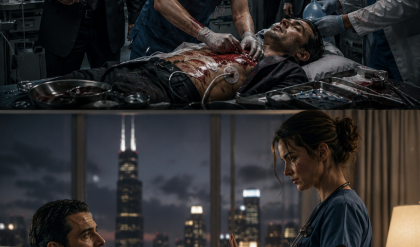
“Why me?” I asked.
“Because Rourke chose you.”
“That’s not an answer.”
“It’s the only answer you can afford tonight.”
I hated him for being right.
When I stood, Nicholas stood with me. He took my coat from Tyler before I could reach for it. The gesture was old-fashioned, smooth, and suffocating.
I turned into the coat because refusing would have looked theatrical, and I had already been made into enough of a show for one night.
At the door, I stopped. “I have rules.”
Nicholas looked down at me.
“No lies about what this is,” I said. “No touching me like I’m property. No pretending this is romance because you put a ring on my finger.”
His eyes dropped briefly to my mouth, then returned to mine. “Fine.”
“And stop looking at me like you’ve already decided how this ends.”
He opened the door to the cold Chicago night.
“I don’t decide endings, Mia,” he said. “I decide who survives long enough to reach them.”
Against every instinct I had left, I went with him.
Nicholas’s house stood behind iron gates in Lincoln Park, all limestone, black windows, and winter roses clipped so neatly they looked warned. It did not feel like a home. It felt like a verdict.
Inside, men in dark suits stood where family photographs should have been. The floor gleamed. The air smelled of lemon polish, espresso, and something savory from a kitchen hidden somewhere deeper inside.
A woman with silver hair and sharp blue eyes appeared from a hallway carrying a tablet.
“This is reckless,” she said to Nicholas.
“Good evening to you too, Claire.”
She looked at me. Not unkindly. Not warmly either.
“You’re Mia Harper.”
“I am.”
“I’m Claire Voss. I manage what Nicholas breaks.”
“I don’t break things,” Nicholas said.
Claire did not blink. “You collect broken things and call it strategy.”
Before I could decide whether I liked her, a broad-shouldered man with a bruiser’s body and a comedian’s face came through the opposite door carrying a garment bag.
“This her?” he asked.
Nicholas glanced at him. “Eddie.”
“What? I’m being welcoming.” Eddie looked at me and put a hand dramatically over his chest. “Miss Harper, I am deeply sorry in advance for whatever this family does to your blood pressure.”
Despite myself, I almost smiled.
Nicholas noticed. Of course he did.
Then an older woman entered from the kitchen, wiping her hands on a towel. She had warm brown skin, gray curls pinned back, and the kind of authority that made even armed men stand straighter.
“Enough,” she said. “The girl looks like she hasn’t eaten since Easter.”
“I ate,” I said.
She narrowed her eyes. “Lying wastes energy.”
Nicholas said, “Martha.”
Martha ignored him. “Come with me, sweetheart.”
I looked at Nicholas.
He gave one short nod. “Eat.”
I wanted to tell him not to command me. Instead, I followed Martha, because the kitchen smelled like garlic, bread, and tomatoes, and grief is weakest around food that remembers your childhood.
She set soup in front of me. I ate because my body betrayed me by wanting comfort.
Eddie hovered near the bread basket.
Claire said, “You’re on a low-carb plan.”
Eddie looked offended. “I’m on a tragedy plan.”
“You had pasta for lunch.”
“That was private.”
“You ate it in the driveway.”
Martha slapped his hand away from the bread. “You will survive.”
“Unconfirmed,” Eddie muttered.
I laughed once, and it startled me. A real laugh, small but mine.
That was the first dangerous thing about Nicholas DeLuca’s house.
It had rooms full of guns, but it also had people who knew how to make fear sit down and eat.
Later, Nicholas showed me to a bedroom upstairs. It was pale gray, spotless, and impersonal. There were fresh clothes in the closet and toiletries in the bathroom, all in my sizes.
I turned on him. “How long have you been watching me?”
“Long enough.”
“That is not an answer.”
“It’s the only one that won’t make you throw something.”
“I still might.”
His mouth shifted, almost amused.
“You can leave in the morning,” he said.
That unsettled me more than if he had locked the door.
“Can I?”
“Yes.”
“And if I do?”
“Rourke will come after the bakery. Owen will return when he is told to. Your father will believe he caused it. You will try to save everyone alone.”
The accuracy of it cut deeper than any threat.
“My father doesn’t know I’m here,” I said.
“He will by morning.”
I looked toward the window. Beyond the glass, Chicago glittered cold and distant.
“What are your rules?” I asked.
“You don’t leave without security. You don’t answer unknown calls. You don’t meet Owen. You don’t lie to me if someone threatens you.”
“That sounds like prison.”
“That sounds like breathing.”
“And your personal rules?”
For the first time, silence lasted too long.
Then he said, “I arrive when I say I will.”
The words landed strangely, as though they belonged to an older wound.
He turned to leave.
“Nicholas.”
He stopped.
“Was that woman your mistress?”
His shoulders went still.
“No.”
“Then why were you feeding her?”
He looked back at me, and something cold moved through his face. “Because she buried her husband yesterday, she is five months pregnant, and she had not eaten in thirty hours.”
Shame struck so fast I felt dizzy.
“I didn’t know.”
“No,” he said quietly. “You didn’t.”
Then he left me alone with a room too quiet for sleep.
The next morning, my face was already online.
Claire had arranged two photographs to appear on the right gossip accounts. Nicholas DeLuca leaving La Stella with a dark-haired woman in a black dress. Nicholas DeLuca standing outside Harper Bakery with his hand near the small of my back, close enough to suggest possession, not close enough to break my rules.
Protection, I learned, could be choreography.
Harper Bakery sat on a corner in Bridgeport with a faded blue awning, old brick walls, and a front window my father still cleaned every morning even after his stroke left one hand weaker than the other. The smell hit me when I walked in—yeast, sugar, lemon zest, coffee, and butter.
Home.
My father stood behind the counter, pale and furious.
“Mia Rose Harper,” he said, which meant he was scared enough to use my full name. “Tell me this is not what it looks like.”
“It isn’t.”
Nicholas entered behind me.
My father’s face tightened. “You brought a DeLuca into my shop.”
“Mr. Harper,” Nicholas said.
“Don’t ‘Mr. Harper’ me. Your father once broke a man’s jaw in this neighborhood for less than the cost of a wedding cake.”
“My father was not a subtle man.”
“No DeLuca ever was.”
“Papa,” I said softly.
He looked at me, and the anger collapsed into shame.
That hurt worse.
“You knew about the debt,” I whispered.
His weak hand gripped the counter. “I thought I could fix it before you found out.”
“With Vincent Rourke?”
“I didn’t know who he was at first.”
“You signed papers.”
“I was trying to keep your mother’s bakery alive.”
The sentence struck both of us silent. My mother had been dead twelve years, but in that room she still existed in recipes, copper pans, handwritten labels, and my father’s refusal to replace the mixer she loved.
Nicholas said nothing. His restraint scraped against me. I had expected arrogance. Cruelty. Orders. Not this unnerving ability to stand in another family’s pain without making himself the center of it.
I tied on my apron because my hands needed something honest.
“What are you doing?” Claire asked.
“Working.”
“Your life is under threat.”
“Yes. And the morning orders still need filling.”
Eddie leaned toward Nicholas. “I like her.”
“I didn’t ask,” Nicholas said.
“She scares me in a bakery way.”
I began making blood orange custard tarts because terror and grief made more sense when measured in cups and grams. Butter into flour. Sugar into eggs. Zest under my fingernails. Heat behaving because I told it to.
Nicholas watched from near the doorway.
When the first tray came out, I placed one tart in front of him. “Taste it.”
His eyebrow lifted. “Is this a test?”
“Everything is a test.”
Eddie whispered, “Marry her for real.”
Claire elbowed him.
Nicholas picked up a fork. The tiny silver edge touched the plate with a clean chime. Something about the sound pulled me back to the night before, to the spoon at La Stella, to a humiliation that had become a doorway.
He tasted the tart.
For a moment, his face closed completely.
Then he said, “Your mother made these.”
The room went still.
My father looked up sharply. “What did you say?”
Nicholas set the fork down. “I said she had talent.”
“No,” I said. “You said she made these.”
His eyes met mine.
“I was mistaken.”
“No, you weren’t.”
Before he could answer, Eddie’s phone rang. His expression changed as he listened.
Then he said, “Boss. We have a problem.”
Outside, taped to the bakery door, was a white envelope.
My name was written across it in Owen’s careful handwriting.
Inside was a reservation card from La Stella.
Table for two. Eight o’clock.
On the back, three words had been written.
I can explain.
Nicholas read it once.
Then he tore it in half.
“No,” he said.
“You don’t decide that.”
His eyes found mine. “When bait has your name on it, I do.”
I should have been furious. I was. But underneath the anger was the bruise of wanting to know why Owen had done it. Weak love leaves hooks in the skin. Even when you know it was never love, some part of you still wants the lie to apologize.
That night, I did not sleep.
I found Nicholas in the back garden just after midnight, standing under bare branches with a glass of water in his hand and a gun holstered beneath his jacket.
“You knew my mother,” I said.
He did not turn. “Go back inside.”
“No.”
“Mia.”
“Don’t say my name like a locked door.”
That made him look at me.
Cold air moved between us. The city hummed beyond the gates.
“When I was thirteen,” he said finally, “my father sent me away for a year.”
“Why?”
“Because he had enemies and sons are leverage.”
“Where did you go?”
“A church-run boys’ home on the South Side.”
My breath caught. “St. Brigid’s.”
His expression answered before he did.
“My mother volunteered there,” I whispered.
“Yes.”
The word was so quiet it nearly disappeared.
“She brought food,” he said. “Real food. Not charity that tasted like guilt. She remembered names. She treated hungry boys like they were not already ruined.”
My throat tightened.
“She made blood orange tarts every January,” he continued. “Said winter needed something bright.”
I looked away because tears had risen too fast.
“Why didn’t you tell me?”
“Because gratitude can become a debt if the wrong man holds it.”
“And are you the wrong man?”
His jaw flexed. “Often.”
The honesty should have frightened me. Instead, it made my anger soften into something more dangerous.
“You offered me protection because of her.”
“I offered because Rourke moved against you.”
“That’s not a denial.”
“No.”
A car passed beyond the gate, slow enough that Nicholas shifted his body slightly in front of mine.
I noticed.
He noticed me noticing.
“You can’t stand in front of every bad thing,” I said.
“Yes,” he replied. “I can.”
“No, Nicholas. You can only choose which ones hit you first.”
For a second, he looked almost human.
Then gunfire cracked against the front of the house.
Nicholas moved before thought existed.
He shoved me behind a stone planter and drew his gun in the same motion. Men shouted inside. Glass shattered. Eddie’s voice roared from the foyer, furious and strangely cheerful.
“I swear to God, I just got this suit tailored!”
The attack lasted less than four minutes. It felt like an hour.
When it was over, two guards were bleeding, Martha was cursing in Spanish while pressing a towel to a man’s shoulder, and Eddie had a bullet graze across his arm that he described as “emotionally fatal.”
Nicholas stood in the entry hall with blood on his collar that was not his.
His eyes found mine.
For the first time since I met him, fear broke through his control.
Not fear of being attacked.
Fear that I had been close enough to die.
“I’m sending you away,” he said.
“No.”
“This is not a discussion.”
“Then stop using words.”
His expression hardened. “You think courage is standing near bullets because your heart is confused.”
“I think running won’t save my father.”
“I can save your father.”
“But you can’t save me by removing me from my own life.”
That struck him. I saw it.
Claire entered carrying a laptop and a stack of printed records. “Rourke’s men knew the house rotation.”
Nicholas turned slowly. “A leak.”
“Yes.”
Eddie’s joking stopped.
Martha crossed herself.
In that silence, I understood something worse than violence had entered the house.
Suspicion.
Over the next two days, Nicholas’s world became a locked machine. Phones were traced. Cars changed routes. Men whispered in hallways and stopped when I entered. Claire slept in twenty-minute pieces. Eddie joked too loudly to hide pain. Martha fed everyone like soup could hold back war.
And Nicholas grew colder.
Not to me exactly.
Around me.
As if he had realized warmth could be used against both of us.
On the third morning, white lilies arrived at the front gate.
No card.
Martha opened the box in the kitchen and immediately frowned. “Funeral flowers.”
The scent hit me a heartbeat later.
Sweet.
Floral.
And underneath, sharp as wrong almond.
“Don’t touch them,” I said.
Every person in the kitchen froze.
Nicholas looked up from his coffee. “Why?”
I stepped closer without touching the flowers. “They smell chemical.”
Claire went pale. “What kind of chemical?”
“I don’t know. Bitter. Almond-like.”
Nicholas’s face went blank. “Cyanide.”
The kitchen erupted into motion.
Eddie carried the flowers outside with the cautious rage of a man holding a snake. Claire made three calls in under a minute. Martha pulled me into a chair and shoved a glass of water into my hand.
Nicholas stood across from me.
“You recognized poison by smell.”
“I recognized something that didn’t belong.”
“How?”
“I grew up in a bakery. Burnt nuts, bad extract, spoiled cream, gas leaks, fruit turning before anyone admits it. Kitchens teach you to notice what people want to ignore.”
His gaze dropped to my hands. Flour was still caught beneath one nail.
“My mother taught me,” I said.
Something moved through his eyes.
Before I could ask what, Claire returned.
“The courier was paid in cash,” she said. “Fake name. But there’s security footage.”
She turned the laptop toward us.
On the screen, Owen Carter stood at the florist counter wearing sunglasses and the expression of a man trying to become invisible.
My stomach clenched.
Weak men are dangerous because they always want forgiveness before they stop causing damage.
“I want to meet him,” I said.
Nicholas’s answer was immediate. “No.”
“I want to hear him say it.”
“No.”
“I wasn’t asking permission.”
“And I’m not giving it.”
I stood so fast the chair scraped. “You promised no pretending. No lies. No ownership.”
“I promised to keep you alive.”
“You promised me the truth.”
His face tightened.
I stepped closer. “If you keep deciding what I can survive, you are not protecting me. You are replacing one cage with a better-dressed one.”
The kitchen went silent.
Nicholas looked at me for a long time.
Then he said, “Ten minutes. Public place. My men everywhere. If he reaches for you, he loses the hand.”
Eddie muttered, “Romance is not dead. It just has rules now.”
We met Owen at Union Station.
He looked thinner, paler, and less beautiful than memory had made him. That angered me. I wanted him monstrous. I wanted betrayal to have fangs. Instead, he looked like a man who had slept badly and still believed his suffering should matter most.
“Mia,” he said.
I did not answer.
He glanced at Nicholas standing several feet behind me. “You don’t understand what he is.”
“I understand what you are.”
His mouth trembled. “Rourke said he’d kill my brother.”
“So you sold my father’s bakery?”
“I was going to fix it.”
“You left me sitting alone for two hours.”
“I had to make it look real.”
That sentence landed wrong.
I stared at him. “Make what look real?”
Owen swallowed.
Nicholas stepped forward slightly.
Owen’s eyes darted to him, then back to me. “Rourke wanted DeLuca to approach you. He knew if you were humiliated publicly, Nicholas would notice.”
My skin went cold.
Nicholas said quietly, “Owen.”
Owen flinched.
“He needed her inside your house,” Owen said. “He needed someone who could get close enough to find what Claire Harper hid.”
My mother’s name split the air.
I turned slowly toward Nicholas. “What is he talking about?”
Nicholas’s face had gone terrifyingly still.
Owen laughed once, broken and mean. “He didn’t tell you? Of course he didn’t. Your mother wasn’t just baking tarts for hungry boys, Mia. She kept books for half the men who owned this city.”
I slapped him.
The crack echoed through the station.
People turned. Nicholas’s men shifted. Owen touched his cheek, stunned.
“My mother was a good woman,” I said.
Owen’s eyes filled with tears. “So was mine. Rourke took my brother anyway.”
“That doesn’t make you innocent.”
“No,” he whispered. “It just makes me late.”
A gunshot exploded from somewhere above.
Nicholas grabbed me and threw me behind a stone column. Chaos broke open. People screamed. Eddie tackled Owen to the ground. Claire shouted into a phone. Nicholas fired once toward the balcony, controlled and exact.
When the shooter fled, Owen was bleeding from the shoulder but alive.
Nicholas looked at me through the smoke and panic.
We both knew the truth now.
Rourke had not attacked because I was useless.
He had attacked because I mattered.
Back at Harper Bakery, I tore through my mother’s old recipe cabinet with shaking hands.
My father sat in the corner, gray-faced, Claire beside him. Nicholas stood near the door, saying nothing.
I found the book behind a loose panel under the flour bin.
It was blue, cloth-bound, and stained with vanilla. My mother’s handwriting filled every page. Lemon pound cake. Oatmeal raisin cookies. Blood orange tarts.
Then I saw the numbers.
Not measurements.
Codes.
Names written as ingredients.
Dates disguised as oven temperatures.
Bank accounts hidden in recipe notes.
My father began to cry.
“I promised her I would burn it,” he said.
I looked up. “What?”
“She said if anything happened, I should burn it and take you away. But after she died, I couldn’t. It was the last thing with her hands on it.”
Nicholas closed his eyes briefly.
I turned on him. “You knew.”
“I suspected.”
“You used me to find it.”
His eyes opened. “No.”
“You knew my mother had evidence.”
“Yes.”
“And you didn’t tell me.”
“No.”
“Why?”
“Because I was afraid you would look at me exactly the way you are looking at me now.”
The answer was too honest to be satisfying.
Anger burned through me. “You let me believe this was about Owen and the bakery.”
“It is.”
“It’s also about a war you’ve been fighting since before I knew your name.”
“Yes.”
“My mother died because of this, didn’t she?”
The room went silent.
My father made a sound like he had been struck.
Nicholas stepped closer, then stopped himself. “Your mother tried to give those records to a federal agent. Rourke found out. The car accident was not an accident.”
The world narrowed to my mother’s recipe book in my hands.
For twelve years, I had lived with grief that had edges. Now it grew teeth.
My mother had not simply died.
She had been silenced.
And my father had carried that truth alone until it bent him into debt and fear.
“I need air,” I whispered.
Nicholas moved toward me.
I stepped back.
“No,” I said. “Not you.”
Pain crossed his face before he buried it.
I walked into the alley behind the bakery, where the dumpsters smelled like sugar rot and rain. I pressed my hand against the brick wall and tried not to come apart.
The door opened behind me.
Not Nicholas.
Martha.
She handed me a dish towel.
“For crying,” she said.
“I’m not crying.”
“Then for lying.”
That broke me.
She stood beside me while I cried into a towel that smelled faintly of bleach and rosemary.
When I could speak again, I said, “I don’t know who to hate first.”
Martha nodded. “Start with the living. The dead don’t improve.”
Despite everything, I laughed.
Then a van screeched into the alley.
Martha shoved me back, but two men were already out. One grabbed her. Another put a gun to my side.
“Don’t scream,” he said.
I looked past him and saw Owen in the passenger seat, pale, bandaged, and terrified.
“Mia,” he said. “I’m sorry.”
The man hit me hard enough that the alley went white.
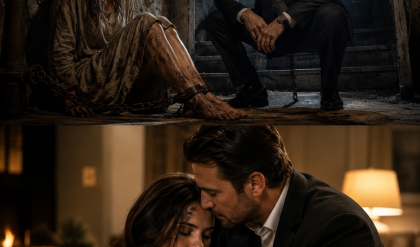
When I woke, I was in the kitchen of an abandoned banquet hall on the South Side. My wrists were tied. My mouth tasted like blood. Somewhere beyond the door, men argued.
The room smelled of dust, old grease, and stale sugar.
A bakery girl knows kitchens even in the dark.
There were flour sacks near the pantry. Metal trays. A gas stove disconnected from the wall. A rack of utensils. A copper pot hanging from a hook.
I dragged my bound wrists against the sharp edge of a broken tile until plastic cut skin and then finally snapped.
Pain cleared my head.
Outside, Vincent Rourke’s voice floated through the door, smooth and almost cheerful.
“DeLuca will come. Men like him can’t resist rescuing what they think belongs to them.”
I picked up a chef’s knife. My hand shook too hard.
Then I saw the silver spoon on the prep table.
Ridiculous thing.
Useless thing.
Except sound mattered.
I slammed it against the copper pot.
Once.
Twice.
Three times.
The clean ringing tore through the building.
Footsteps thundered.
The door burst open, and a man rushed in. I threw flour into his face and swung the pot with both hands. He dropped hard.
Gunfire erupted in the hallway.
Then Nicholas appeared in the doorway like violence wearing a black coat.
For one suspended second, our eyes met.
He was furious.
He was afraid.
He was alive.
Then Rourke stepped from behind him with a gun pressed to Owen’s head.
“Touching,” Rourke said. “Really. I nearly believe in love again.”
Nicholas did not move.
Rourke smiled at me. He was older than I expected, neat and polished, with pale eyes that seemed empty because everything human had been sold off years ago.
“You look like Claire,” he said.
My mother’s name in his mouth made me lift the knife.
He laughed. “She had that same temper. Wasted on morality.”
“You killed her.”
“I corrected a liability.”
Nicholas’s gun rose a fraction.
Rourke pressed his weapon harder against Owen’s temple. “Careful.”
Owen was crying silently.
I should have felt satisfaction. I felt only exhaustion.
Then Claire Voss’s voice came through a speaker overhead.
“Vincent Rourke, this is being recorded.”
Rourke’s smile faltered.
Nicholas’s eyes did not leave him.
Claire continued, calm and merciless. “Your accounts are being transmitted to federal agents, the Cook County State’s Attorney, and three newsrooms. The ledger is already out.”
Rourke looked at me.
I smiled through blood. “My mother wrote excellent recipes.”
He swung the gun toward me.
Nicholas fired.
The shot hit Rourke’s wrist. Owen dropped. Eddie crashed through the side door with three men behind him, shouting, “Nobody shoot the baker! I repeat, nobody shoot the baker!”
Rourke went down screaming.
I stood frozen, knife in my hand, until Nicholas reached me.
He stopped a foot away.
He did not touch me.
“Mia,” he said, voice rough. “May I?”
That nearly undid me.
I nodded.
He took the knife from my hand first. Then he pulled me into his arms with a care so fierce it felt like breaking.
“I’m sorry,” he said against my hair.
“For what?”
“For every second you had to save yourself before I got there.”
I closed my eyes.
“You arrived,” I whispered.
His arms tightened once.
This time, he did not step back first.
Rourke lived.
That was important to my father, though none of us admitted it until later. Dead men become legends. Living men sit in courtrooms while evidence is read aloud.
The ledger destroyed half the city’s quiet corruption within three months. Bankers resigned. A judge retired suddenly. Two police captains were indicted. Owen testified in exchange for a reduced sentence, and I did not forgive him, but I stopped needing him to suffer in exactly the shape of my pain.
My father sold nothing.
Harper Bakery stayed ours.
For a while, Nicholas disappeared from public life. Rumors said he had gone to war. Rumors said he had made peace. Rumors said he had turned state’s witness, bought judges, buried enemies, retired, lied, repented, or become even more dangerous.
The truth was smaller and harder.
He spent months dismantling pieces of his father’s empire that could not be made clean. Some men left. Some turned on him. Some did not survive their own choices. Nicholas never told me all of it, and I learned not every truth heals simply because it is spoken.
But every Sunday morning, before the bakery opened, a black car stopped across the street.
Nicholas came in alone.
No guards visible. No ring. No performance.
He ordered coffee and one blood orange tart.
For eight Sundays, he sat at the same small table by the window and asked me nothing.
On the ninth, I sat across from him.
“You’re late,” I said.
His mouth curved. A real smile this time, small and devastating.
“By three minutes.”
“I noticed.”
“I’m sorry.”
I studied him. “Are you still dangerous?”
“Yes.”
“Are you still trying to decide my life for me?”
“No.”
“Good.”
He reached into his coat and placed the black velvet ring box on the table.
My chest tightened.
“No,” I said immediately.
He pushed it toward me anyway. “Open it.”
Inside was the diamond engagement ring he had given me for our public lie. Beneath it lay a smaller ring, plain gold, old and worn.
I recognized it from photographs.
“My mother’s wedding band,” I whispered.
“Your father gave it to me,” Nicholas said. “He said if I ever tried to use it as leverage, Martha had permission to poison me.”
“That sounds like Papa.”
“I’m not asking you to marry me.”
I looked up.
Nicholas’s eyes were steady.
“I’m asking you to have dinner with me,” he said. “No contract. No protection deal. No ninety days. If you say no, I will still make sure no one touches this bakery. Not because you owe me. Because your mother once fed a hungry boy and expected nothing back.”
Tears burned my eyes.
“And if I say yes?”
“Then I arrive on time.”
I laughed, and it came out half-sob.
Across the bakery, my father pretended not to watch. Martha, who had apparently become part of our lives without asking permission, openly watched while frosting cinnamon rolls. Eddie pressed his face to the front window from outside until Claire yanked him away by the collar.
I picked up my mother’s ring.
Then I closed the box.
“Dinner,” I said. “One dinner.”
Nicholas stood.
“Tonight?”
“Seven.”
His smile softened. “I’ll be here at six-fifty.”
At six-fifty that evening, he was standing under the blue awning with rain on his shoulders and no umbrella, because some men never learn how not to look dramatic.
I locked the bakery door behind me.
For once, no one was waiting to humiliate me. No one was selling me. No one was deciding the ending before I reached it.
Nicholas offered his hand.
I looked at it for a moment, then took it.
Not because I belonged to him.
Because after everything—the lies, the blood, the grief, the recipes, the ruins—we had both survived long enough to choose what came next.
And this time, he was not late.
THE END