Chase looked up too quickly.
It was small, but I saw it.
My mother frowned. “What does that trucking company have to do with us?”
“More than I wanted to believe.”
I sat across from them. My legs felt weak under the table, but my voice was calm.
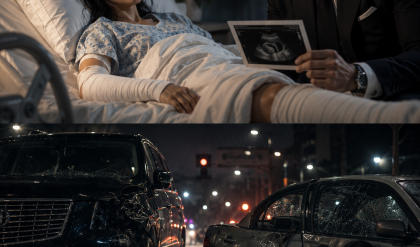
“The preliminary police report said the truck driver ran the light because he was distracted. The driver said the brakes didn’t respond. Calhoun Regional Freight said Unit 1187 had been inspected and cleared three days before the crash.”
My father exhaled sharply.
“Natalie, you’re in shock. This is not the time for one of your investigations.”
“No,” I said. “This is exactly the time.”
I opened the folder and pulled out the first document.
It was an invoice.
Calhoun Regional Freight had paid $186,400 for emergency brake system repairs on Unit 1187 five days before Ethan and Lily died. The invoice looked legitimate. It had a tax ID, service descriptions, digital authorization, and a paid stamp.
The vendor name was Bell Meridian Solutions LLC.
My mother glanced at it without understanding.
Chase understood immediately.
His face did something ugly and fast, like a curtain snapping shut.
“Bell Meridian Solutions,” I said, “was formed nine months ago. No garage lease. No employees. No mechanic certification. No commercial repair license. No equipment purchases. No insurance coverage for vehicle maintenance.”
I slid the second page across the table.
“Managing member: Chase Warren Bell.”
My mother whispered, “Chase?”
He stood so suddenly his chair scraped the floor.
“That doesn’t prove anything.”
“It proves you invoiced a trucking company for brake repairs you could not have performed.”
He pointed at me.
“You don’t know how business works. Companies outsource all the time.”
“Not to a shell company with no mechanics.”
My father hit the table with his fist.
“Careful, Natalie.”
I looked at him.
That old command might have worked on me once.
When I was twelve and Chase broke a neighbor’s window, my father told me to say I had done it because Chase “couldn’t handle another incident.”
When I was seventeen and Chase stole money from my college savings, my mother told me to forgive him because “boys mature slower.”
When I was twenty-nine and Chase drove drunk into a parked car, my father asked me to lend him money for an attorney because “family protects family.”
Careful, Natalie.
I had spent my whole life being careful around people who were never careful with me.
“No, Dad,” I said. “You were careful. You were careful when the money came in. You were careful when you hid it. I was just thorough.”
I pulled out another document.
It was an internal maintenance report from a yard mechanic named Luis Romero.
Unit 1187: severe brake pressure failure. Vehicle unsafe. Do not dispatch.
The report was dated three days before the crash.
“The mechanic flagged the truck,” I said. “Three times. The warning was closed after Bell Meridian Solutions submitted its invoice.”
My mother’s fingers tightened around the strap of her purse.
Chase said, “That’s internal Calhoun stuff. That has nothing to do with me.”
“You received $186,400 the next morning. From that payment, you transferred $62,000 to Dad’s personal account and $38,000 to Mom’s card. You paid $19,800 toward the Cabo resort package forty minutes after Mom texted me that the funeral wasn’t important enough to ruin your vacation.”
My mother went pale.
My father’s mouth opened, but no sound came out.
Rebecca stepped into the kitchen and stood beside me.
My mother turned on her instantly.
“This is none of your business.”
Rebecca’s voice was quiet.
“Ethan was my brother. Lily was my niece. It became my business when your son killed them for a fake invoice.”
Chase lunged toward the folder.
Rebecca moved faster, pulling it out of reach.
“Try it,” she said.
For a second, I thought he would hit her.
A false twist flashed through my mind: I had imagined this confrontation as clean, surgical, controlled. But grief does not make a courtroom. It makes a kitchen full of people with too much history and too little shame.
Then Chase stepped back and laughed.
“You’re insane,” he said. “You’ve always thought you were smarter than everyone.”
“I don’t think that,” I said. “I only think paper trails are smarter than liars.”
I placed printed emails on the table.
They were between Chase and Nolan Pierce, the chief financial officer of Calhoun Regional Freight.
Mark 1187 repaired.
The yard guy keeps pushing the brake report.
Close it out. Short route. Nothing will happen.
Invoice today. We’ll balance your cut after dispatch.
Chase stared at the emails.
“How did you get those?”
I did not answer.
The truth was, I had not gotten them alone.
The night after the funeral, when I could not sleep, I had opened Ethan’s laptop because I wanted to look at photos. Instead, I found a folder on his desktop named LILY ART SHOW.
Inside were pictures of our daughter holding up a painting of a yellow dog under a purple sun.
And one audio file.
At first I thought it was accidental. Then I heard Ethan’s voice.
“Nat, if you’re seeing this, I probably chickened out of telling you in person.”
My heart stopped.
In the recording, Ethan said he had been approached by a former college friend who worked in logistics compliance. That friend had noticed suspicious maintenance billing at Calhoun Regional Freight. The shell company name—Bell Meridian—made Ethan uneasy because of Chase. Ethan had planned to tell me after Lily’s art show, but he didn’t want to ruin the evening.
“I may be wrong,” Ethan said on the recording. “God, I hope I’m wrong. But if Chase is mixed up with Calhoun, you need to look at the vendor files. And Nat? Don’t let your parents talk you out of seeing what’s in front of you. They’ve done that your whole life.”
That had been the first false twist.
For one terrible hour, I had wondered whether Ethan had known the truck was dangerous and had still driven that route. Whether he had been hiding something from me. Whether our marriage had carried a secret right into the crash.
Then I dug deeper.
Ethan had not known about Unit 1187. He had not known the truck that killed him and Lily would be on that detour. He had only seen the edge of a scheme and planned to protect me from it.
Even dead, Ethan had handed me the first thread.
I pulled it.
The whole rotten fabric tore open.
My father lowered his voice now, changing tactics. He always did that after intimidation failed. He became reasonable. Fatherly. Wounded.
“Natalie,” he said, “this can be handled within the family.”
“My family is in the ground.”
No one spoke.
“You missed their funeral because you were spending money connected to the truck that killed them.”
My mother began to cry.
Not grief.
Fear.
“I didn’t know,” she said. “I didn’t know where the money came from. Chase said business was finally going well.”
“But you knew I was burying my daughter,” I said. “You knew that when you sent me a beach picture.”
She looked down.
“You knew that when you wrote that her funeral wasn’t important enough.”
Her mouth trembled, but no defense came.
Chase grabbed his backpack.
“I’m done. I’m not listening to this.”
“You can’t leave,” I said.
He turned with a sneer.
“Are you going to stop me?”
“No.”
I took my phone from my pocket and placed it on the table.
The screen was lit.
Recording.
Then the laundry room door opened.
Two investigators stepped out.
One was Detective Mara Ellison from the Pennsylvania State Police Financial Crimes Unit. The other was an assistant district attorney named Victor Hale.
Rebecca had let them in through the back fifteen minutes before my parents arrived.
My mother made a sound like all the air had been punched from her chest.
My father stood halfway, then sat again, suddenly old.
Chase backed toward the door.
Detective Ellison’s voice was level.
“Mr. Bell, do not leave the residence.”
“This is a setup,” Chase shouted.
“No,” she said. “This is an authorized investigative recording in connection with suspected wire fraud, money laundering, falsified safety documentation, and potential criminal negligence resulting in two deaths.”
His face flushed red.
“I want a lawyer.”
“You’ll have one.”
My father turned toward him.
“Chase,” he whispered. “Tell me this isn’t true.”
That was almost the cruelest thing.
Not because my father was innocent.
Because even then, even after seeing bank transfers, emails, invoices, and my dead child’s name hanging unspoken in the room, he wanted Chase to save him from the truth.
Chase did not look at him.
He looked at the exit.
There was one page left in the folder.
I had not shown it yet.
It was the reason they had come asking for exactly $40,000.
Not forty-five.
Not thirty.
Forty.
I slid it across the table.
“This is the payment you needed tonight.”
Chase froze.
This story was written by the author “hoanganh1” – if you see any account copying it, please report it to respect the author. Thank you very much, readers!!
It was a copy of a message between Chase and Nolan Pierce.
Romero wants cash or he talks. Forty by Friday. No delay.
Luis Romero, the yard mechanic, had finally refused to stay quiet. Chase needed the money not for a business opportunity, but to pay off the man who could prove the brakes had never been fixed.
My mother saw the message and covered her mouth.
My father looked at Chase as if, for the first time in his life, he was seeing the son he had protected from consequence.
Detective Ellison stepped forward.
“Chase Bell, you are being detained pending formal charges.”
My mother screamed when they put his hands behind his back.
“Don’t cuff him in front of us! He’s not some criminal!”
Rebecca’s face hardened.
“My brother and niece were buried in front of strangers because you were in Cabo. You don’t get to be embarrassed now.”
Chase twisted toward me as the detective read him his rights.
“You did this,” he spat. “You always hated me.”
I stood.
“No, Chase. I loved you too long. That was the problem.”
His expression flickered.
For one second, the boy I had once defended appeared—the little brother with scraped knees, the teenager who cried when he got caught, the man who learned tears could become keys if he aimed them at the right door.
Then he was gone.
The police took him out through the rain-wet porch where my daughter had drawn chalk flowers the week before she died.
My mother sank into Ethan’s chair.
I could not bear it.
“Get up,” I said.
She looked at me, stunned.
“What?”
“That was Ethan’s chair. Get up.”
My father helped her stand.
No one spoke for several seconds.
Then my mother, still crying, reached for me.
“Natalie, please. We are your parents.”
I stepped back.
The space between us felt like the first honest thing we had ever shared.
“No,” I said. “You are people who share my blood. That stopped being enough the day you toasted on a beach while I buried my child.”
My father’s lips moved.
“Natalie—”
“Leave.”
They did.
For the first time in my life, they left my house without taking anything from me.
Afterward, I thought I would feel triumph.
I did not.
I felt the floor rush up.
Rebecca caught me before I hit the tile.
I remember her arms around me. I remember the smell of rain and coffee and old paper. I remember saying Lily’s name over and over until it stopped sounding like a word and became a wound.
Justice did not arrive like thunder.
It came slowly, through interviews, subpoenas, warrants, spreadsheets, depositions, and men in expensive suits pretending not to be afraid.
Calhoun Regional Freight was not a small trucking company. It was part of Calhoun Holdings, a national logistics empire owned by Silas Calhoun, a billionaire who appeared on magazine covers beside phrases like “American grit” and “supply chain visionary.”
On television, he wore work boots with tailored jackets and talked about family values.
In court filings, his company paid shell vendors to fake safety compliance.
Nolan Pierce, the CFO, tried to blame everyone below him. He claimed he had never met Chase. Then investigators found dinner receipts, golf club guest logs, and a photo of the two men at a charity auction where Chase wore a borrowed tuxedo and smiled like he had finally found the rich people he believed he deserved to stand beside.
That was the second false twist.
For a week, reporters suggested Ethan might have been involved because his old college friend had flagged the vendor fraud. One headline read:
WIDOWER’S HUSBAND KNEW OF SAFETY SCHEME BEFORE FATAL CRASH?
Widower’s husband.
They could not even get the grief right.
I wanted to vanish.
Rebecca wanted to sue everyone.
But Detective Ellison called me and said, “Let them talk. Evidence has a longer memory than gossip.”
She was right.
Ethan’s recording, his emails, and his call logs proved he had been gathering information to bring to me, not hiding guilt. He had scheduled a meeting with a compliance attorney for the Monday after Lily’s art show.
He never made it to Monday.
Luis Romero became the key witness.
He was a fifty-eight-year-old mechanic with oil permanently worked into the lines of his hands. When I saw him for the first time during a preliminary hearing, he could not look at me.
Afterward, in the hallway, he approached with his hat crushed between his fingers.
“Mrs. Whitaker,” he said, voice shaking, “I told them not to send that truck out.”
I looked at him.
His eyes were red.
“I wrote it up. I emailed. I even pulled the keys once, but dispatch had a spare. Mr. Pierce told me if I wanted my pension, I’d shut my mouth. I should’ve gone to the police. I should’ve—”
“You were threatened,” I said.
“That ain’t enough.”
No. It was not.
But it was true.
He had failed. He also had tried. The difference mattered, even if it did not heal anything.
“My daughter liked yellow,” I told him, because I did not know what else to say.
He began to cry.
“I saw her booster seat in the report,” he whispered. “I got a granddaughter the same age.”
I did not comfort him.
But I did not punish him with silence either.
“Then tell the truth,” I said. “All of it.”
He did.
His testimony cracked Calhoun’s defense open.
He described the brake failure reports. The pressure from management. The invoice that appeared without any truck entering a repair bay. The day he overheard Nolan Pierce say, “Bell will handle the paperwork. Dispatch it before the state inspection window.”
Chase’s lawyer argued that Chase was only a consultant and did not understand mechanical safety standards.
The prosecutor showed emails where Chase wrote:
Don’t care what the mechanic says. If Calhoun wants it green, mark it green.
My brother looked smaller in court than he had ever looked in my kitchen.
Without my parents beside him, without my mother’s excuses wrapping around him like a blanket, he looked ordinary.
That was another terrible revelation.
Monsters are not always impressive.
Sometimes they are just selfish people who were protected too long.
My mother called me twenty-three times after Chase’s arrest.
I did not answer.
Then the letters started.
The first one was twelve pages.
Natalie, we are still a family. Your brother made mistakes, but prison will destroy him. You know he is sensitive. Ethan would not want this bitterness in your heart. Lily would want her uncle home.
I stopped reading there.
Do not use my dead child as a key, I wrote on the back of the page.
Then I placed the letter in the black folder.
My father requested to see me two months later.
At first, I ignored him too. But Rebecca said, “You don’t owe him closure. But you might want the truth from his face, not his handwriting.”
So I met him at a diner outside King of Prussia.
He arrived early. He had lost weight. His hair looked thinner. He wore a brown jacket I remembered from childhood, one my mother had always said made him look “respectable.”
Respectability, I had learned, was often just a costume people wore while asking others to pay for what they had done.
He stood when I approached.
I did not hug him.
We sat.
For a while, neither of us spoke. A waitress poured coffee. I remembered Ethan adding too much cream to his and Lily asking for “coffee milk” even though hers was just warm milk with cinnamon.
My father stared into his cup.
“I didn’t know the truck would kill anyone.”
“That isn’t the same as innocence.”
He flinched.
“Chase said the money was from consulting.”
“And you didn’t ask what kind.”
“He was finally doing well.”
“No,” I said. “He was finally making enough for you to stop seeing him as a failure.”
My father closed his eyes.
I expected anger. A defense. A lecture about respect.
Instead, he nodded.
That frightened me more than shouting would have.
“We protected him too much,” he said.
I waited.
He swallowed.
“No. That’s not true. We protected ourselves. Your mother couldn’t stand the idea that he was ordinary. I couldn’t stand the idea that I had raised a man who always needed someone else to clean up after him. So we made you the strong one. Strong enough to forgive. Strong enough to lend. Strong enough to understand. Strong enough not to need anything.”
The diner sounds blurred around me.
Plates clinking.
Coffee pouring.
A child laughing two booths away.
“You trained me to disappear,” I said.
His eyes filled.
“Yes.”
It was the first honest word he had given me in years.
But honesty that arrives after burial is not the same as love.
“Are you going to forgive us?” he asked.
I thought about Ethan dancing barefoot in the kitchen.
I thought about Lily’s yellow boots.
I thought about my mother’s Cabo photo.
“I don’t know if I’ll ever forgive you,” I said. “But I know I’m done confusing blood with permission to destroy me.”
My father cried then.
Quietly.
I did not hug him.
Not because I wanted to hurt him.
Because I had spent too many years holding people who only reached for me when they were falling.
When the civil case moved forward, Calhoun Holdings tried to settle fast.
Their first offer was insulting.
Their second was enormous.
Their third came with an apology drafted by lawyers and drained of blood.
I rejected the apology.
I accepted the money only after my attorney guaranteed three things: a public admission that Unit 1187 had been dispatched despite known brake failures, a fund for families harmed by commercial vehicle negligence, and annual independent safety audits for every Calhoun fleet company for ten years.
Silas Calhoun himself attended the final mediation.
He was tall, silver-haired, and polished in the way of men who had never been told no without paying someone to rephrase it.
He looked across the conference table and said, “Mrs. Whitaker, I hope you understand I never personally authorized unsafe trucks on the road.”
I looked at him for a long time.
“My daughter is personally dead,” I said. “So is my husband. You can discuss distance with your lawyers.”
His face changed.
Only slightly.
But I saw the billionaire become, for one second, just a man in an expensive suit sitting across from a woman he could not buy his way past.
The settlement was sealed in amount but not in meaning.
Reporters called it one of the largest wrongful death settlements in the state’s recent history. People online argued about whether money could ever equal two lives.
It cannot.
Money does not kiss your forehead in the morning.
Money does not leave socks under the couch.
Money does not ask if heaven has dogs.
But money can build a fence around the future so no one can steal the rest of your life too.
I used part of it to pay off the house.
Part went into scholarships for children who had lost parents in roadway accidents.
And part became Lily and Ethan Park.
The school district donated land beside Lily’s elementary school. I worked with designers for months. I rejected anything too sleek, too adult, too memorial. Lily would have hated a sad park.
So we built climbing tunnels shaped like storybook hills. We planted maple trees. We painted the slides yellow because Lily said yellow was “the color of running.” Near the entrance, we placed a reading bench under a young dogwood tree.
The plaque read:
For Ethan, who made ordinary days safe and beautiful.
For Lily, who believed yellow boots could make you fly.
May no child’s laughter be silenced by adult greed.
On the day of the opening, the sky was bright.
That felt almost offensive at first.
I had expected rain, because grief had taught me to distrust sunlight.
But children do not wait for sorrow’s permission.
They ran.
They shrieked.
They climbed the yellow slides and chased one another through the grass while parents watched with wet eyes and paper cups of lemonade.
Lily’s teacher, Mrs. Alvarez, came carrying a framed drawing.
“I kept this from the art show,” she said.
It was Lily’s final painting.
Three stick figures stood under a purple sun beside a yellow dog. Ethan was labeled DAD. I was labeled MOM. Lily had labeled herself LILY WITKR because she had run out of patience halfway through our last name.
Above us she had written:
MY FAMLY IS WER I AM SAFE.
I held the drawing against my chest.
For the first time since the crash, the sound of children laughing did not feel like betrayal.
It felt like a promise being made by the living to the dead.
Chase was sentenced nine months later.
He pleaded guilty to wire fraud, conspiracy to falsify safety records, and involuntary manslaughter connected to the crash. Nolan Pierce received a longer sentence. Other executives fell like pins after that, each insisting they had only followed industry practice, as if common corruption were a form of innocence.
My mother attended every hearing in pearls.
She glared at me across the courtroom as if I had driven the truck myself.
At sentencing, she submitted a letter saying Chase was “a loving son whose life had been ruined by his sister’s vendetta.”
The judge read it silently.
Then he looked over his glasses and said, “Mrs. Bell, your son’s life was altered by his own choices. Two lives were ended by them.”
My mother began to sob.
Still for Chase.
Not for Ethan.
Not for Lily.
After court, she confronted me in the hallway.
“You destroyed this family,” she hissed.
I looked at her pearls, her trembling mouth, her eyes full of rage because grief had never been useful to her unless it was her own.
“No,” I said. “I stopped letting this family destroy me.”
She slapped me.
The sound cracked through the courthouse hallway.
For a second, everyone froze.
My cheek burned.
Rebecca stepped forward, but I held up a hand.
My mother seemed shocked by what she had done. Or perhaps shocked that I had not bowed my head afterward.
I touched my cheek.
Then I said, calmly, “That is the last thing you will ever take from me.”
I filed for a protective order the next day.
My father did not fight it.
My mother did.
She lost.
Months passed.
The world did what the world does after tragedy. It kept moving in ways that felt obscene.
Flowers bloomed beside the porch.
The grocery store changed its layout.
Lily’s favorite cereal got a new box design.
I learned that grief has strange rooms. Some days I could walk through Ethan’s closet and smell his shirts without falling apart. Other days a commercial with a child in yellow boots could send me to the bathroom floor for an hour.
Rebecca stayed close, but she did not hover.
That was one of the ways I knew she loved me correctly.
She came over every Sunday. Sometimes we talked about Ethan until we cried. Sometimes we watched terrible reality television and said nothing meaningful for hours. Sometimes she brought her teenage son, Caleb, who started mowing my lawn without asking because he said Uncle Ethan would haunt him if he let the place look “tragic.”
One afternoon in late October, I found a brown paper bag on my porch.
Inside were Lily’s yellow boots.
For one wild second, I thought my mind had broken.
Then I saw Rebecca’s note.
I found a cobbler who could clean and preserve them. I hope that’s okay. I couldn’t stand thinking of them by the door forever, waiting.
I sat on the porch with the boots in my lap.
They looked almost new.
Bright.
Ridiculous.
Brave.
I cried so hard my ribs hurt.
Then I carried them inside and placed them on a shelf beside a photo of Ethan holding Lily upside down while she laughed with her whole face.
For a long time, I stood there.
The house was still quiet.
But it was no longer the same quiet.
At first, the silence after they died had felt like punishment. Like the walls were accusing me of surviving.
Now it felt different.
Not healed.
Never healed.
But honest.
A room where love had lived does not become empty just because death enters it.
It becomes sacred.
The final twist came almost a year after the crash.
I was sorting through a box of Ethan’s old things when I found a sealed envelope tucked inside a book on our bedroom shelf. My name was written across the front in his handwriting.
Nat.
My hands went cold.
For several minutes, I could not open it.
I thought it might be more evidence, another secret, another thread leading back into the nightmare. Some wounded part of me was tired of discovering that the dead had known things the living could not bear.
But when I finally opened the envelope, there were no invoices.
No warnings.
No names.
Only a letter.
Nat,
If you found this, it probably means I forgot where I hid it, because I was going to give it to you on our anniversary and pretend I wrote it that morning. You know I’m terrible at romantic timing.
I just wanted to write down something I don’t say enough.
You are not hard to love.
I know your family made you feel like love has to be earned by fixing, paying, forgiving, swallowing, understanding. I know they made you the emergency exit for everyone else’s fire.
But with me, you never had to earn your place.
You were home the second you walked into my life carrying three binders and correcting the waiter’s math on the receipt.
If we have fifty more years, I’ll spend them reminding you.
If we don’t, remember anyway.
And please, for the love of all things holy, don’t let Chase borrow money again.
I laughed.
It came out broken and wet, but it was laughter.
Then I read the last line.
P.S. Lily says if I’m writing you a love letter, I have to include that she loves you “more than pancakes, but not more than dogs because we don’t have one yet.” We need to discuss the dog.
I folded the letter against my heart.
That night, I slept in the middle of the bed for the first time.
Not on Ethan’s side.
Not avoiding it.
In the middle.
Three weeks later, I adopted a yellow Labrador mix from a rescue shelter.
He had one floppy ear and terrible manners.
I named him Friday.
Because Friday had never come for Ethan and Lily.
So I brought Friday home.
He chewed one of my slippers within an hour. He barked at the dishwasher. He slept beside Lily’s shelf the first night, his head under the yellow boots as if guarding them.
I woke before sunrise and found him there.
For once, the ache in my chest did not arrive alone.
It came with warmth.
I still visit the cemetery every week.
I tell Ethan about the park, about Rebecca, about Caleb’s college applications, about Friday’s latest crimes against household objects. I tell Lily that the yellow slides are still the most popular, that Mrs. Alvarez keeps her painting in the classroom, that children who never met her shout her name because the park belongs to her.
Sometimes I tell them about the trial.
Sometimes I do not.
Justice is not the opposite of grief.
I learned that slowly.
Justice does not resurrect.
It does not rewind the road, repair the brakes, cancel the vacation photo, or place a child back in her yellow boots.
Justice simply stops the lie from becoming the final story.
My parents are alive somewhere outside my life.
My father sends a card on Lily’s birthday each year. I do not open them, but I do not throw them away either. Maybe someday I will read them. Maybe I won’t.
My mother still tells anyone who will listen that I chose money over family.
That is almost funny now.
Because the truth is, I chose family at last.
I chose Ethan, who loved me without an invoice.
I chose Lily, whose life deserved more than silence.
I chose Rebecca, who stood with me in the rain.
I chose Luis Romero’s truth over Calhoun’s money.
I chose the children running through a yellow park, laughing beneath trees planted in memory of two people greed tried to erase.
And I chose myself.
Not the version of me who apologized for needing kindness.
Not the daughter trained to carry everyone’s shame.
Not the sister who mistook rescue for love.
Me.
The woman who stood between two graves and did not scream because something deeper than a scream was forming.
A boundary.
A blade.
A beginning.
So if you have a family that only appears when they need money, silence, loyalty, or forgiveness, let me tell you what took me almost forty years and two coffins to learn:
Blood is not a lifetime contract.
Love does not arrive with an invoice.
And the people who stay with you in the rain are worth more than the ones who toast in the sun while your world is being buried.
THE END