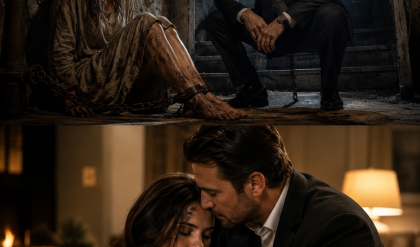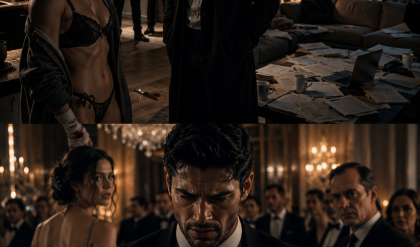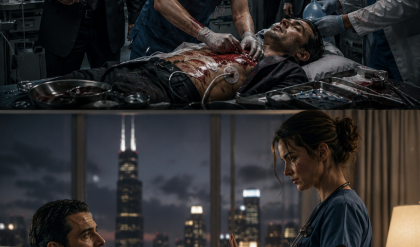
Mara went quiet. Then, carefully, “What happened?”
“He’s with another woman. At a hotel.” Grace swallowed hard. “And I’m pregnant.”
“Oh, Grace.”
“I thought if I told him, he might come back to me. Isn’t that pathetic?”
“No,” Mara said, with the fierce tenderness of an older sister who had spent years waiting for this call. “It’s human. But you listen to me now. You come here. Tonight if you can, tomorrow if you have to. You don’t warn him. You don’t argue with him. You come home.”
Home.
The word opened something in Grace’s chest.
“I’ll pack a bag,” she said. “I’ll leave in the morning.”
“Do you want Tom to drive down? He can be there in—”
The headlights appeared out of nowhere.
A black SUV burst through the rain from the opposite lane, high beams flaring white. For half a second, Grace saw the grille, the windshield, the shadow of a driver whose face she could not make out.
Then there was no time left.
Mara screamed her name through the phone as metal folded into metal.
At the Blackthorne Hotel, Damien Cross rejected his wife’s twelfth call without looking at the screen.
Sloane Mercer lay beside him on the white hotel sheets, her dark hair cut sharply at her jaw, her red mouth curved in amusement. She was not beautiful in the soft way Grace was beautiful. Sloane looked expensive, dangerous, and awake to all the darkness Damien tried to keep out of his marriage. She did not ask him to be better. She never looked away when blood stained his cuff. She never flinched when his phone rang at midnight.
“Someone wants you badly,” she said, tracing one finger over his chest.
Damien turned the phone face down. “Everyone wants something.”
“What if it’s important?”
“If it were important, Noah would handle it.”
“And if it’s Grace?”
He reached for his glass of bourbon. “Then she can wait.”
Sloane watched him over the rim of her lashes. There was satisfaction in her expression, but Damien did not see it. He saw only what he wanted to see: a woman who understood power, a woman who did not make him feel guilty for being exactly what he was.
The phone buzzed again. A text this time. Then another. Then three more calls, two from Noah.
Sloane sat up slightly. “Your loyal guard dog doesn’t usually panic.”
Damien cursed under his breath and picked up the phone.
Twelve missed calls from Grace.
Eight from Noah.
One voicemail.
Six messages.
Noah: CALL ME NOW.
Noah: Mrs. Cross is hurt.
Noah: Lake Shore crash. St. Anne’s Medical.
Noah: Damien, answer your damn phone.
For the first time in years, Damien Cross felt the world move beneath his feet.
He called Noah. “Talk.”
Noah answered before the first ring finished. “Where the hell have you been?”
The question stunned Damien as much as the tone. Nobody spoke to him like that. Not anymore.
“What happened?”
“Grace was in a crash near the marina exit. It’s bad. Ambulance took her to St. Anne’s. She was calling you from the car.”
Damien was already out of bed, pulling on his shirt with hands that did not feel steady. “How bad?”
Noah did not answer quickly enough.
“How bad?” Damien roared.
“Bad enough that you need to get there now.”
Damien did not look at Sloane as he left. If he had, he might have seen the calm way she picked up her own phone the moment the door slammed behind him.
St. Anne’s Medical Center smelled of antiseptic, coffee, and fear.
Damien entered the emergency wing like a man accustomed to doors opening before him. Nurses moved aside. Security guards hesitated. Noah was waiting near the trauma entrance, rain still dripping from his coat, his face carved from stone.
“Where is she?”
“Surgery.”
Damien grabbed him by the collar. “Why wasn’t I told sooner?”
Noah did not resist. He only looked at Damien’s hand, then back into his eyes. “You were told twelve times.”
The words landed harder than any punch.
A doctor approached before Damien could answer. She was small, middle-aged, and unmoved by the violence radiating from him.
“Mr. Cross? I’m Dr. Elaine Carter. Your wife is in surgery. She sustained a head injury, internal bleeding, broken ribs, and significant trauma to the abdomen. We’re doing everything possible.”
Damien’s throat closed. “She’ll live?”
“We are trying to make sure of that.” Dr. Carter’s voice shifted, becoming gentler and therefore worse. “There’s something else. Your wife was pregnant.”
The hospital noise faded.
“What?”
“Approximately seven weeks. I’m sorry. We could not save the pregnancy.”
Damien stared at her. The sentence did not enter him all at once. It arrived piece by piece, each one impossible.
Grace was pregnant.
Grace had called him.
Grace had been bleeding in the rain with his child inside her while he lay in a hotel bed telling another woman she could wait.
Noah turned away, but not before Damien saw the disgust on his face.
Damien reached for his phone with numb fingers and played the voicemail.
“Damien, please,” Grace whispered through static and rain. “There’s been an accident. I’m hurt. The baby—” Her breath broke. A sound came through the speaker, half sob, half gasp. “Please call me back. Please. I need you.”
The message ended.
There were more.
He listened to every one.
By the last, Grace was no longer begging. She was recording facts. Lake Shore Drive. Black SUV. No headlights. Tell Mara I tried to leave him.
Then the final sentence.
Tell my husband that I heard him when he said I was not important.
Damien lowered the phone.
In the silence that followed, he understood something with a clarity that cut through every excuse he had ever made for himself. He had not crashed into Grace’s car. He had not been behind the wheel of that SUV. But his neglect had been in the passenger seat. His arrogance had been on the road. His betrayal had been there in the rain, pressing down on her chest with the weight of all the calls he had refused to answer.
When Grace woke the next afternoon, the first thing she did was touch her stomach.
Damien saw it happen from the chair beside her bed. He had been there for eleven hours, still wearing the same rain-damp shirt, still holding a paper cup of coffee gone cold long ago. He had watched monitors rise and fall. He had watched nurses adjust tubes. He had watched blood move through clear lines into the body of the woman he had once sworn to protect.
But nothing hurt like the moment Grace’s hand moved beneath the blanket and stopped.
Her eyes opened.
For a few seconds, she looked confused. Then memory returned, and her face changed.
“The baby,” she whispered.
Damien stood. “Grace—”
“Don’t.” Her voice was hoarse but sharp. “Just tell me.”
He had commanded rooms full of armed men without blinking. Now he could barely speak.
“I’m sorry.”
She closed her eyes.
The tears came silently at first, sliding into her hair. Damien reached for her hand, but she pulled away as though his touch burned.
“You didn’t answer.”
“I know.”
“I called twelve times.”
“I know.”
Her eyes opened again. They were not pleading now. That was what frightened him most. Grace had spent years looking at him with hope, disappointment, patience, fear, love. This was different. This was the look of someone standing on the far side of a bridge that had already burned.
“Where were you?”
Damien said nothing.
Grace gave a small, bitter nod. “With her.”
“Grace—”
“I went to the hotel.” Her lips trembled, but she forced the words out. “I heard you. You said I could wait. You said I wasn’t important.”
Damien felt something inside him collapse.
“I didn’t mean it.”
“You meant it when you said it. That’s enough.”
“She means nothing to me.”
Grace laughed once, and the sound was so empty he wished she had slapped him instead. “That might be the cruelest thing you’ve said yet. You destroyed our marriage for a woman who means nothing?”
He tried to find an answer. There wasn’t one.
“I was coming to tell you about the baby,” Grace continued. “I thought maybe it would remind you that we were real once. That I was real. Then I stood outside that door and listened to you erase me in one sentence.”
“Please,” Damien said, and he hated the weakness in his own voice. “Let me fix this.”
“You can’t.”
“I can protect you. The crash wasn’t random. I already have men—”
“You think protection is love because fear is the only language you speak.” Grace turned her head toward the window, where rain still streaked the glass. “I don’t want your guards. I don’t want your house. I don’t want your name.”
Damien went still.
“I want a divorce.”
“No.”
The word came out automatically, the way orders did. Final. Cold. A command.
Grace looked back at him. “You don’t get to say no.”
“You’re grieving. You’re hurt. We’ll talk when you’re stronger.”
“I have never been stronger than I am right now.”
“You are my wife.”
“I was your wife,” she said. “Then I was your excuse. Then I was your decoration. Last night, I became your missed call. I’m done.”
Damien stepped closer. “I won’t let you go.”
For the first time, fear flickered in her eyes. Not fear of losing him. Fear of him.
It stopped him.
Grace saw it. Her voice dropped. “If there is any part of the man I married still inside you, you will leave this room.”
He stood there long enough for the monitors to mark ten heartbeats.
Then he left.
Outside the room, Noah was waiting.
Damien walked past him, but Noah spoke quietly.
“She’s right.”
Damien stopped.
Noah did not flinch. “If you try to keep her, you’ll prove every terrible thing she thinks about you.”
Damien turned. “Careful.”
“No,” Noah said. “You be careful. Because somebody tried to kill your wife last night, and while you were choosing your mistress, they learned exactly how easy it is to reach the one person you still care about.”
Damien’s face hardened. “Find them.”
“I already started.”
“Then finish.”
Noah looked toward Grace’s door. “For her sake, I hope I do.”
The next week became a slow education in pain.
Grace learned how to sit up with fractured ribs. She learned how grief could make a hospital room feel both too small and endless. She learned that nurses could be kinder than family and that doctors could say “physically recovering” while knowing the soul had not even begun.
Mara arrived from Madison the morning after Grace woke and cried so hard at the sight of her that Grace began crying too. Her sister climbed carefully onto the edge of the bed and held her the way she had when they were children and thunderstorms shook the windows of their mother’s apartment.
“I told you I’d come,” Mara whispered.
“I lost the baby.”
“I know, honey.”
“I wanted it.”
Mara stroked her hair. “I know.”
“I thought it would make him love me again.”
“Oh, Grace.” Mara pulled back just enough to look at her. “A baby should be born into love, not used as proof that love still exists.”
Grace nodded because she understood now, and understanding was another kind of wound.
By the fourth day, she had removed her wedding ring. Her fingers were swollen from fluids and injury, so it took soap, patience, and tears. When the diamond finally slid free, she dropped it into a paper cup beside the hospital bed and felt no triumph. Only the ache of a promise that had become evidence.
That afternoon, Noah came to see her.
He stood at the door holding white lilies, looking deeply uncomfortable. For a man who could oversee ships, shell companies, armed security, and million-dollar movements without blinking, he seemed defeated by flowers.
“Did Damien send you?” Grace asked.
“No.”
“Then why are you here?”
Noah looked at the floor. “Because I told you where he was. If I had lied—”
“I still would have found out.”
“Maybe not that night.”
“Then maybe I would have stayed longer.” Grace studied him. “You did not cause the crash, Noah.”
His jaw tightened. “Someone did.”
The room changed.
Grace sat straighter despite the pain. “What do you mean?”
“The SUV was found burned out in South Chicago. Plates stolen. Interior wiped. Driver gone. Traffic cameras near the crash failed eleven minutes before impact.”
Her mouth went dry. “Someone tried to kill me.”
“Someone tried to hurt Damien through you.”
“That’s supposed to make me feel better?”
“No.” His voice was grim. “It’s supposed to make you careful.”
Grace looked toward the closed door. “Who?”
“There’s pressure inside Damien’s network. A Russian crew led by Viktor Baranov wants the East Pier contracts. Damien refused. Baranov wanted to prove Damien had a weak point.”
“And I was it.”
Noah did not soften the truth. “Yes.”
Grace absorbed this slowly. For years, she had treated Damien’s world as a locked basement. She knew it existed beneath the house, knew terrible things were stored there, but told herself staying upstairs made her clean. Now the basement had opened beneath her feet.
“I need a lawyer,” she said.
“I know.” Noah pulled a card from his coat pocket. “Evelyn Pratt. Best divorce attorney in Illinois. She’s represented women whose husbands make judges nervous.”
Grace took the card. “Damien will hate this.”
“Yes.”
“Are you betraying him?”
Noah’s eyes flickered with something old. “I had a sister. She married a powerful man who thought leaving him was theft. She didn’t survive the fourth attempt.”
Grace’s fingers tightened around the card.
“I couldn’t save her,” Noah said. “I can help you.”
That was when Grace realized Noah Reyes was not loyal to Damien in the way she had always assumed. Or perhaps he was loyal to something older than Damien: a debt, a ghost, a sister whose story had never ended properly.
“Thank you,” she whispered.
“Don’t thank me yet. Damien won’t make this easy.”
Grace looked down at the pale band of skin where her ring had been. “Neither will I.”
Evelyn Pratt arrived the next day with silver hair, a navy suit, and the calm of a woman who had spent thirty years making rich men regret underestimating their wives.
Before they could begin, Sloane Mercer walked into Grace’s hospital room.
Grace recognized her instantly. Not from the hotel hallway, where she had only heard the voice, but from months of silent research conducted at midnight beside an empty bed. Sloane had been in charity photographs, gallery openings, private club posts, always near money, always looking as though she belonged to the room more than anyone who had paid to enter it.
She wore black, of course. Red lipstick. No shame.
“Grace,” Sloane said. “I wanted to see how you were doing.”
“No, you didn’t.”
Sloane smiled. “Fair. I wanted to see what kind of woman walks away from Damien Cross.”
“The kind who finally woke up.”
“How poetic.” Sloane moved deeper into the room, glancing at the machines. “You should know he’s unstable right now. Guilty men make foolish promises. Don’t confuse that with power.”
“I’m not confused about anything anymore.”
“Are you sure? Because from where I stand, you’re a schoolteacher with no job, no child, and no protection except the protection of a man you’re trying to humiliate in court.”
Grace flinched, and Sloane saw it.
There was pleasure in her eyes.
“He won’t let you go,” Sloane continued. “Men like Damien do not lose wives. They replace them, hide them, punish them, or bury the parts of them that resist. But they do not lose them.”
The door opened behind her.
“Then it’s fortunate Mrs. Cross has counsel,” Evelyn Pratt said, her voice like a blade wrapped in silk. “You have five seconds to leave my client’s room before I call security and begin documenting harassment.”
Sloane turned slowly. “And you are?”
“The woman who charges by the hour to make people like you wish they had stayed quiet.”
For a moment, Sloane’s mask slipped. Only a second, but Grace saw something colder beneath the glamour. Not jealousy. Not love.
Calculation.
Then Sloane smiled. “Good luck, Grace. Ordinary life won’t feel as noble when you’re paying your own bills.”
Grace surprised herself by answering steadily. “Ordinary sounds like heaven.”
After Sloane left, Evelyn shut the door and looked at Grace.
“That woman is dangerous.”
Grace almost laughed. “Everyone in my husband’s life is dangerous.”
“No,” Evelyn said. “That one is hungry.”
That warning stayed with Grace long after Evelyn explained the divorce strategy. Illinois did not require Damien’s permission. The prenup, once reviewed, might be challenged because Damien’s attorney had “recommended” Grace’s legal counsel before the wedding, creating a conflict. Grace was entitled to money, assets, safety, and silence only if she chose it.
“I don’t want blood money,” Grace said.
Evelyn leaned forward. “Then don’t think of it as money. Think of it as a bridge. Powerful men count on women leaving with nothing because pride feels cleaner than survival. Take the bridge. Walk across it. Build something better on the other side.”
For the first time since the crash, Grace imagined a future.
It was faint. A small apartment. A classroom. Coffee she bought herself. A bed where she slept without waiting for footsteps that might never come. A life in which no one measured her worth by whether a dangerous man came home.
“Yes,” she said. “File.”
Damien found out within forty-eight hours.
He came to the hospital after midnight, furious and unshaven, his control cracked down the middle. Security tried to stop him. He pushed through anyway until Grace herself told the guards to let him in, not because she wanted to see him, but because she was tired of being afraid of a conversation.
When they were alone, Damien stood at the foot of her bed like a man facing sentencing.
“Evelyn Pratt?” he said. “You hired a shark.”
“You taught me to respect dangerous people.”
His mouth tightened. “This doesn’t have to be war.”
“No. It has to be divorce.”
“You think leaving me will make you safe?”
“I think staying with you almost got me killed.”
“I can protect you better than anyone.”
“You didn’t answer the phone.”
The words stopped him cold.
Grace did not raise her voice. She did not need to. “Every time you tell me you can protect me, I hear the rain. I hear the ringing. I hear your voicemail.”
Damien looked away.
“Who was in the SUV?” she asked.
“I don’t know yet.”
“But you suspect Baranov.”
His eyes sharpened. “Who told you that?”
“Noah.”
For a second, something like betrayal crossed Damien’s face. Then he buried it.
“Of course he did.”
“He’s helping me.”
“He works for me.”
“Maybe that’s the problem,” Grace said. “Everyone works for you. Nobody stands with you.”
Damien’s expression changed. Pain, anger, and shame moved through him in layers. “Grace, I know I failed you.”
“You didn’t fail me like a man who forgot flowers. You abandoned me while I was dying.”
“I will spend the rest of my life paying for that.”
“I don’t want the rest of your life. I want mine.”
He stared at her for a long time.
Then, quietly, “And if I don’t know how to let you go?”
Grace felt the old pull of him then. Not love exactly, not anymore, but memory. The man who had once held her hand in a museum and confessed he did not know how to be gentle. The man she had wanted to save because saving him made her feel chosen by something powerful and wounded.
Now she understood the trap.
“Then learn,” she said.
Two weeks later, Grace left the hospital and moved into a two-bedroom apartment in Lincoln Park that Evelyn found through a client who valued discretion. It had clean white walls, old hardwood floors, a view of a maple tree, and locks that did not require Damien’s permission. Compared to the mansion, it was modest. Compared to the mansion, it was freedom.
Mara stayed three days, filling the refrigerator with soup, fruit, and more yogurt than any grieving woman could possibly eat. Noah arranged two rotating security guards without asking Damien. Evelyn filed motions. Damien’s lawyers responded with startling cooperation.
That was the first thing that made Grace uneasy.
“He’s offering eleven million, the lake house in Door County, and a trust that generates income quarterly,” Evelyn said during a meeting in her downtown office. “It’s generous enough to be suspicious.”
Grace stared at the numbers. They looked unreal. “Maybe he feels guilty.”
“Guilt from men like Damien Cross usually comes with chains attached.”
“What kind?”
“Silence. Gratitude. Emotional debt.” Evelyn tapped the papers. “But legally, the offer is clean. If you accept, you can fund your life, your security, and anything else you choose to build. If you refuse, you may spend years fighting him.”
Grace thought of the baby. Seven weeks of life. A future erased before it could become a name.
“What if I used some of it for something good?”
Evelyn smiled faintly. “That is how bridges become roads.”
Grace signed the preliminary agreement.
That evening, as snow began to dust the street below her apartment, Grace received a message from an unknown number.
South Loop Terminal. Midnight. Come alone if you want to know who killed your child.
Her hands went cold.
For a long time, she stared at the screen. The smart thing was to call Noah. The safer thing was to call Evelyn. The old Grace might have done neither, might have sat alone and let men decide which truths she deserved.
The new Grace called both.
Evelyn answered first and cursed with professional elegance. “Do not go.”
Noah said the same thing, but his voice carried fear. “That terminal is where Damien is meeting Baranov tonight.”
“About me?”
“About ending the threat.”
“And nobody thought to tell me?”
“Because you’re recovering from nearly being murdered.”
“I’m not a child.”
“No,” Noah said. “You’re leverage. That’s worse.”
Grace looked at the message again. “Who sent this?”
“I don’t know.”
She heard the lie.
“Noah.”
A long silence followed. “I think Sloane is connected to Baranov.”
Grace’s pulse slowed, not from calm but from focus. “Connected how?”
“I saw her with one of his men yesterday. I’ve been following her.”
“You didn’t tell Damien?”
“I needed proof.”
“And do you have it?”
“Not enough.”
Grace closed her eyes. Another truth locked in a room. Another group of men deciding what she could survive.
“I’m going,” she said.
“No, you’re not.”
“Yes. But not alone.”
The South Loop Terminal had once been part of a legitimate freight line. Now it sat half-abandoned near the river, its brick walls tagged with graffiti, its windows broken, its loading bays dark except for the sharp white glow spilling from one open warehouse door. Wind moved off the river with a knife’s edge. Grace wore a wire beneath her coat, a location tracker in her boot, and a kind of fear so clean it felt almost like courage.
Noah drove. Evelyn waited three blocks away with two private investigators and one federal agent she refused to identify by name. Grace had learned there were networks even Damien did not control. Some belonged to law. Some belonged to women who had spent decades helping other women leave monsters.
“You stay behind me,” Noah said as they approached the warehouse.
Grace looked at him. “Are you with Damien or with me?”
He met her eyes. “Tonight, I’m with the truth.”
Inside, Damien Cross stood beneath fluorescent lights facing Viktor Baranov.
Baranov was older than Grace expected, silver-haired, elegant, with a wool coat draped over his shoulders and hands folded over a cane he did not need. He looked less like a gangster than a retired professor, which somehow made him more frightening. Around him stood six men. Around Damien stood four. The balance of power was not as clear as it should have been.
Damien turned when Grace entered.
The blood drained from his face. “Grace. What the hell are you doing here?”
“Accepting an invitation,” she said.
Baranov smiled. “Mrs. Cross. A pleasure. You are much braver than your husband suggested.”
Damien stepped toward her. “Get out. Now.”
“No,” Grace said.
It was a small word. In that room, it sounded enormous.
Baranov chuckled. “Beautiful. You see, Damien? This is why women are dangerous. Men build empires thinking loyalty is bought with fear. Women learn the exits.”
Damien’s voice dropped. “If you sent that SUV—”
“If?” Baranov lifted an eyebrow. “Come now. We both know I authorized pressure. But the specific target, the timing, the delightful detail that your wife would be on Lake Shore Drive after discovering your little hotel arrangement—that information did not come from me.”
Grace felt Noah stiffen beside her.
Damien turned slowly. “What are you saying?”
A door opened behind a stack of containers.
Sloane Mercer stepped into the light.
For one moment, no one spoke.
She looked immaculate, wrapped in a camel coat, her lipstick perfect. But the confidence Grace had seen in the hospital had sharpened into something almost triumphant.
Damien stared at her as though his own shadow had stepped away from him and drawn a knife.
“Sloane,” he said.
She sighed. “Don’t look so betrayed, Damien. It doesn’t suit you.”
Grace’s stomach twisted. She had thought Sloane was cruel. She had thought Sloane was ambitious. She had not understood until this moment that the woman had been something much worse.
“You told them where I’d be,” Grace said.
Sloane looked at her with mild irritation. “I told them you were upset and driving. Baranov’s people handled the rest.”
“You tried to kill me.”
“I tried to remove a weakness.”
Damien lunged, but Noah grabbed his arm. Baranov’s men lifted weapons from beneath their coats, and the room tightened.
Sloane did not flinch. “You were becoming useless, Damien. Distracted. Sentimental. You think I didn’t notice? Every time Grace pulled away, you chased. Every time she cried, you softened. You built an empire on fear and then let a schoolteacher become your conscience.”
Damien’s voice was almost unrecognizable. “Our child died.”
Something flickered in Sloane’s eyes, not remorse, but annoyance at an inconvenient fact. “I didn’t know she was pregnant.”
Grace believed that. Strangely, it made nothing better.
Baranov tapped his cane once against the concrete. “Enough family drama. We are here for business. Mr. Cross, you will transfer East Pier control to my organization. You will step back from the South Loop routes. You will cease interference with my union contracts. In return, Mrs. Cross lives whatever modest life she chooses.”
Damien looked at Grace.
For years, he had chosen power first. It was the foundation beneath every room she had lived in. Power had paid for her clothes, her cars, her charities, her loneliness. Power had been the other woman in their marriage long before Sloane.
Now power stood before him dressed as a bargain.
Grace expected him to rage. To bargain. To threaten. To become the man everyone feared.
Instead, Damien said, “Fine.”
Baranov smiled. “Just like that?”
“Just like that,” Damien said. “But she walks out first.”
“Damien,” Sloane snapped. “Don’t be stupid.”
He did not look at her. “I already was.”
Grace stared at him, confused by the ache that opened in her chest. This was what she had once wanted: proof that he would choose her. But proof delivered after the funeral of hope does not resurrect anything.
Baranov extended his hand. “Then we have an agreement.”
“No,” Grace said.
Everyone turned.
Her heart hammered so hard she felt it in her injuries, in the places still healing beneath her coat. But she stepped forward anyway.
“No more agreements over my life.”
Damien’s eyes widened. “Grace—”
“No. I listened to men decide whether I was useful, important, weak, protected, leverage, property, liability. I listened from a hallway. I listened from a hospital bed. I listened from the back seat of cars while guards discussed whether I was safe.” Her voice shook, but she did not stop. “You don’t get to trade docks for my survival. You don’t get to buy me with guilt. And you don’t get to call murder business.”
Sloane laughed. “How inspiring. Unfortunately, this is not a classroom.”
“No,” Grace said. “It’s a crime scene.”
The warehouse doors exploded open.
Floodlights blasted through the room. Voices shouted. Federal agents poured in from both ends, weapons drawn, vests marked in yellow letters. Baranov’s men scattered, then froze. Sloane stepped back, shock breaking her perfect face for the first time.
Noah moved Grace behind him.
Damien did not move at all.
Baranov looked at him, fury twisting his refined features. “You brought them?”
Damien’s eyes remained on Grace. “No.”
Grace understood then.
Noah had brought them.
Evelyn had brought them.
She had brought them.
But Damien had known. Perhaps not the whole plan, perhaps not the timing, but enough. He had seen the wire beneath her collar when she entered. He had seen Noah’s hand near his phone. He had chosen not to expose her.
An agent forced Baranov to his knees. Another took Sloane by the wrists. She fought then, not elegantly, but viciously.
“Damien!” she screamed. “Tell them! Tell them who you are! Tell them what you’ve done!”
Damien finally looked at her.
“I already did.”
The words cut through the chaos.
Grace turned toward him.
Noah’s face changed.
Damien reached into his coat slowly. Agents shouted for him to stop, but he held up a flash drive between two fingers.
“Ledgers,” he said. “Routes. Payments. Names. Mine included.”
The nearest agent took it.
Baranov began to laugh, low and disbelieving. “You would burn yourself for her?”
Damien looked at Grace, and for the first time since she had known him, there was no performance in his face. No power. No seduction. No command.
Only truth.
“I should have done it before the crash.”
That was his confession. Not just to law. To her.
Sloane stared at him as if he had become something disgusting. “She’s still leaving you.”
“I know.”
“You’ll lose everything.”
Damien’s voice was quiet. “No. I lost everything when I declined the first call.”
Three months later, Grace signed the final divorce papers at Evelyn Pratt’s office while March rain tapped gently against the windows.
There was no dramatic music. No thunder. No sense of instant rebirth. Just Grace’s hand moving across paper, returning her name to herself.
Grace Whitman.
Not Cross.
Damien had entered a federal plea agreement that shook Chicago for weeks. Cross Atlantic Freight collapsed into receivership. Politicians resigned. Police captains retired early. Baranov’s network followed. Sloane Mercer, who had believed herself too clever to be anyone’s pawn, was charged with conspiracy, attempted murder, obstruction, and enough financial crimes to keep her beauty behind glass for a long time.
Noah disappeared from the headlines because men like Noah knew how not to appear in them. Evelyn said he had given testimony sealed under federal protection. Mara said Grace should stop worrying about people from that world. Grace did not tell her sister that worry and gratitude often wore the same face.
As for Damien, he wrote one letter.
It arrived on a cold morning in April, forwarded through Evelyn, sealed in a plain envelope. Grace left it unopened on her kitchen table for five days. On the sixth, she made coffee, sat beside the window of her Lincoln Park apartment, and read it.
Grace,
I have written this letter fourteen times and destroyed every version that asked for forgiveness.
I do not deserve forgiveness.
You called me twelve times. I chose not to answer. Every consequence after that belongs to me.
I used to think love was possession. I thought protecting someone meant controlling every road around them. I thought money could replace presence, apologies could replace change, and fear could keep a life from falling apart.
You knew better. You tried to tell me in a thousand quiet ways before the night I finally heard you.
I am sorry for our child. I am sorry you carried that hope alone. I am sorry your first words about the baby were spoken into my voicemail instead of into my arms.
I signed everything Evelyn sent. The settlement is yours. Not because I am generous, but because you paid for it with years of your life.
Do not visit me. Do not answer this. Do not carry my guilt for me.
Live, Grace. Please live loudly enough that the part of me that once loved you can know you escaped.
Damien
Grace folded the letter and sat very still.
She did not cry right away. Grief had become less like a storm and more like weather. It arrived, passed, returned. Some days she could stand beneath it. Some days she could not.
That day, she let the tears come.
Not because she wanted Damien back. She did not. Not because the letter healed the wound. It could not. But because there was mercy in hearing a man who had once owned every room finally admit he had no right to own her sorrow.
In June, Grace moved to Madison.
She bought a small yellow house fifteen minutes from Mara’s, with a porch that needed repainting and a backyard full of weeds. She used part of the settlement to start the Whitman House Fund, a nonprofit that helped women leave dangerous marriages without having to choose between safety and rent. Evelyn joined the board. Mara organized donation drives with terrifying efficiency. Noah sent a cashier’s check with no return address and a note that said only: For exits.
In August, Grace returned to teaching.
On the first day of school, she stood in front of twenty-three fourth graders who smelled like pencil shavings, new sneakers, and nervous energy. Her name was written on the board in blue marker.
Ms. Whitman.
A boy in the front row raised his hand before she had finished introducing herself.
“Are you strict?” he asked.
Grace smiled. “Only when necessary.”
A girl with braids leaned forward. “Do you give lots of homework?”
“Only meaningful homework.”
A freckled child in the back squinted at her. “Do you have kids?”
The room went quiet in the way children sense adult sadness before understanding it.
Grace’s hand moved, almost unconsciously, toward her stomach. The ache was still there. It might always be there. But it no longer owned the whole room.
“No,” she said gently. “But I’m very lucky. I get to spend my days with all of you.”
The children accepted this with the easy grace adults often forget.
That afternoon, after the final bell, Grace stayed behind to straighten desks. Sunlight came through the classroom windows in warm gold bars. Outside, parents lined up along the curb. Children ran toward open arms. The world continued in its ordinary, miraculous way.
Her phone buzzed.
For one breath, old fear moved through her.
Then she looked down and saw Mara’s message.
Dinner tonight? Kids want Aunt Grace pancakes, which is apparently dinner now.
Grace laughed.
She picked up her bag, turned off the classroom lights, and paused at the door. For years, she had thought safety would arrive as a man with power. Then she thought freedom would arrive as a signature on legal paper. Now she understood both ideas were too small.
Freedom was this: choosing where to go after work. Buying her own groceries. Sleeping through rain without counting missed calls. Missing what she had lost without returning to what had hurt her. Building a life that did not need to be witnessed by the man who failed to love her correctly.
Outside, the evening air smelled of cut grass and summer heat.
Grace walked to her car, not quickly, not fearfully, but with the steady pace of a woman who had survived the worst sentence ever spoken about her and written a better one herself.
She had once been told she was not important.
Now, every life she helped, every child she taught, every morning she woke in a house that belonged to her, answered back.
She was important.
She had always been.
THE END