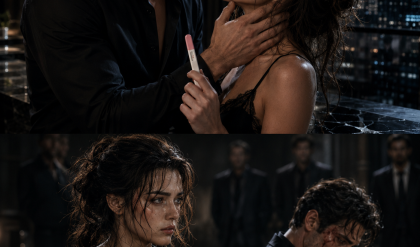
Roman looked down at it once. “You left this in my apartment.”
Her voice came out broken. “Why do you still have it?”
“Because you never came back for it.”
For several seconds, there was only rain, fluorescent light, and the impossible ache of a life neither of them had been able to bury.
Then Clara’s phone rang.
Unknown number.
Roman’s eyes sharpened. “Don’t answer.”
But panic made her clumsy, and habit made her fast. She accepted the call before sense caught up.
“Hello?”
Silence breathed into her ear. Then a man’s voice, smooth and faintly amused, said, “Clara Whitaker. You really should choose better monsters to trust.”
Cold spread through her body. “Who is this?”
“Tell Roman De Luca that graves are patient. They wait for everyone.”
The line went dead.
Clara lowered the phone slowly. Roman took it from her hand, not roughly, but with a controlled urgency that made arguing feel childish. He passed it to one of his men.
“Trace it,” he ordered.
The man disappeared toward the stairwell.
Clara stared at Roman. “How did he know I was here?”
“Because someone wanted him to know.”
The answer frightened her more than if he had lied.
Roman stepped closer, lowering his voice so only she could hear. “Five years ago, you chose your brother over me. I understood that long before I forgave it. Tonight I’m choosing your anger over your funeral. Hate me in the car.”
She should have refused. She should have called hospital security, the police, anyone. But the phone call still echoed in her ear, and beneath her anger was a deeper truth she hated: Roman had never needed theatrics to frighten her. If he had wanted revenge, she would not have seen him coming.
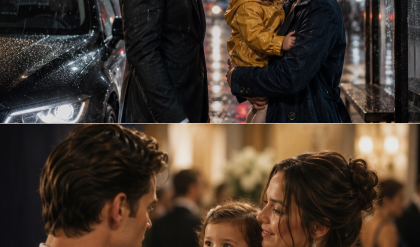
Ten minutes later, Clara sat in the back of a black SUV as Chicago smeared past the windows in rivers of neon and rain. Roman sat across from her, one hand resting near his knee, the other holding her necklace like something both precious and dangerous. The driver said nothing. Another SUV followed close behind, headlights steady in the storm.
“You should have let me stay,” Clara said.
“And let Sokolov’s men walk through the hospital doors?”
“You don’t know they would have.”
“I know men like Sokolov.”
“You mean men like you?”
Roman looked at her then. The city lights slid across his face, catching the faint scar near his jaw that had not been there five years ago.
“No,” he said quietly. “Men like my father.”
The distinction landed with more weight than she expected. Roman’s father had been a legend in the worst way, a man whose money could build churches and bury witnesses before breakfast. Roman had spent the years Clara knew him trying to convince himself he could inherit the De Luca world without becoming it. She had believed him once. Then fear had made belief feel like a luxury she could not afford.
“Where are you taking me?” she asked.
“Home.”
“That word is doing a lot of work.”
A flicker almost became a smile. “It usually does.”
The SUV turned off Michigan Avenue and descended into a private underground entrance beneath a glass tower overlooking the river. Security lights swept across polished concrete. Guards moved with disciplined speed. Roman exited first and, out of old instinct, offered her his hand.
For one dangerous second, Clara nearly took it.
Instead, she climbed out by herself.
Roman lowered his hand without comment, but she saw the small closing in his face and hated herself for noticing.
A private elevator carried them upward through the building. Chicago spread beneath them, soaked and glittering, the river black as spilled ink between towers. Clara stood near the glass wall, aware of Roman behind her the way the body remembers heat after stepping away from fire.
“What aren’t you telling me?” she asked.
Roman was silent for so long she thought he might refuse to answer.
Then he said, “There’s a boy upstairs.”
She turned. “A boy?”
“My son.”
The word struck her harder than she expected. “You have a son?”
“Yes.”
“Why am I here because of your son?”
For the first time that night, Roman’s control cracked. It was barely visible, just a tightening around his eyes, but Clara saw it.
“Because he hasn’t spoken in almost a year,” Roman said. “And three weeks ago, he drew your face.”
The elevator opened before she could ask another question.
Roman’s penthouse did not look like a home. It looked like a museum designed by a lonely man with too much money and not enough sleep. Black marble floors reflected warm gold light. Floor-to-ceiling windows wrapped around the space, revealing Chicago beneath the storm. Abstract paintings hung on dark walls. A grand piano sat untouched near the windows. Everything was elegant, expensive, and painfully controlled.
A woman in her late fifties appeared from the hallway, her gray hair twisted into a neat bun, her expression careful until she saw Clara. Then surprise softened her face.
“Mr. De Luca,” she said, taking Roman’s wet coat. “He’s awake.”
Roman’s jaw tightened. “How long?”
“Since the thunder started.” The woman looked at Clara with gentle curiosity. “You must be Miss Whitaker.”
Clara’s stomach tightened. “You know who I am?”
Roman answered before the woman could. “Ruth has worked for my family since I was sixteen.”
“That’s not an answer.”
Ruth smiled sadly. “He kept a photograph.”
Clara looked at Roman. He did not deny it.
Small footsteps sounded in the hall.
A little boy appeared near the archway, wearing an oversized navy sweater and pajama pants. He was thin, pale, and solemn, with dark hair falling into his eyes and a guarded stillness no child should have learned so young. He clutched a stack of drawings against his chest.
Roman’s entire body changed when he saw him. The cold power drained away, leaving something rawer and more fragile.
“Noah,” he said softly. “This is Clara.”
Noah looked at Clara for a long time.
She knelt immediately, not because anyone asked her to, but because she had spent years learning that frightened children met the world better when adults made themselves smaller.
“Hi, Noah,” she said gently. “I’m Clara.”
Noah did not answer. His eyes moved from her face to the silver necklace still in Roman’s hand. Then he stepped forward and pulled one drawing from the stack.
He gave it to Clara.
The paper showed three figures beneath a storm cloud: a tall man in black, a small boy with dark hair, and a woman wearing a silver crescent at her throat.
Clara’s hand trembled.
“How could he know this necklace?” she whispered.
Roman’s voice was quiet behind her. “He found the photograph Ruth mentioned.”
Clara turned the drawing slightly. The woman’s hair was the right color. The necklace was exact. But there was something else, something that made her chest tighten. The woman in the picture was holding the boy’s hand.
“He thinks I belong here,” she said.
Roman did not move. “No. I think he hopes you do.”
The answer was so different from what she expected that she looked up sharply. Roman’s face held no arrogance, no claim, none of the possessive certainty she remembered fighting with him about years ago. He looked only exhausted.
Noah sat cross-legged on the marble floor beside her. He pointed at the drawn woman.
“That’s me?” Clara asked.
Noah nodded once.
“You drew me because of the picture?”
Another nod, though slower this time.
“You don’t talk much, huh?”
Noah’s gaze dropped.
“I understand,” Clara said softly. “Sometimes words feel too heavy.”
The little boy looked up at that.
For a moment, Clara saw the child beneath the silence. Not strange. Not unreachable. Just afraid.
Roman watched from a few feet away, so still he seemed afraid that breathing too loudly might ruin it. Clara understood then that whatever else Roman had become, this boy could break him with one look.
Ruth brought tea, soup, and a plate of toast cut into triangles. Noah ignored the food until Clara picked up one triangle and took a bite herself.
“It’s safe,” she said. “A little too fancy for toast, but safe.”
Noah blinked. Then, very slowly, he took a piece.
Roman looked away, but not before Clara saw the emotion in his eyes.
“He hasn’t eaten for anyone new in months,” Ruth murmured.
Roman cleared his throat. “It’s late. Noah should sleep.”
Noah reached out and caught Clara’s sleeve.
The room went still.
His fingers were small, barely touching the fabric, but Roman stared as though the child had just lifted a mountain.
Clara glanced at him. “Is this okay?”
Roman’s voice was rough. “He hasn’t touched anyone except Ruth and me since the accident.”
The accident. There it was, the locked door in the middle of the room.
Clara did not ask yet. Instead, she settled more comfortably on the floor, and Noah leaned against her side as if some quiet decision had been made inside him. His trust was not dramatic. It was not earned through speeches or promises. It simply arrived, fragile and inexplicable, and every adult in the room knew better than to grab at it.
Hours passed in soft fragments. Ruth dimmed the lights. The storm calmed into steady rain. Noah fell asleep against Clara’s shoulder, one hand wrapped around two of her fingers. Roman stood near the windows, arms folded, watching the city like he expected it to attack.
“You should sleep,” Clara said quietly.
“I could say the same.”
“I’m not the one standing guard in my own living room.”
“Old habits.”
“You used to do that in Brooklyn,” she said before she could stop herself.
Roman looked at her. Memory moved between them, heavy and alive. There had been nights after nightmares when he sat awake at the edge of the bed, and Clara would reach for his wrist in the dark, not asking questions because some pain did not become less real just because it was explained.
“Noah’s mother died eleven months ago,” Roman said.
Clara looked down at the sleeping child. “He saw?”
“Yes.”
“Was it a car accident?”
Roman’s face hardened. “It was made to look like one.”
Clara closed her eyes briefly. “Roman.”
“Don’t.”
“I’m sorry.”
His mouth twisted. “So was I.”
The simplicity hurt. Not because it sounded cold, but because it sounded practiced, as if he had said those words to himself so often they had lost all shape.
“Did you love her?” Clara asked before she could stop herself.
Roman was silent for a long time. “I respected her. I trusted her. She gave Noah stability when I didn’t know how. Our marriage was not what the tabloids thought it was.”
Clara looked up.
Roman met her eyes. “It was an arrangement at first. Protection for her family. A mother for Noah after his birth mother disappeared. A public life clean enough to satisfy boardrooms. But she became family. In the ways that mattered, she was Noah’s mother.”
Something complicated loosened in Clara’s chest. She had no right to feel relief, but she did, and the shame of it warmed her face.
“Why does Noah say my name in his sleep?” she asked.
Roman’s expression changed.
So she had guessed correctly. There was more.
Before he could answer, a tiny voice breathed against Clara’s shoulder.
“Clara.”
The room stopped.
Noah did not wake. His brow furrowed, his hand tightening around hers, but the word had been real. Soft. Broken. Human.
Roman crossed the room slowly, as if one wrong movement might take the word back. He knelt beside his son, and for the first time in all the years Clara had known him, Roman De Luca looked completely helpless.
“He hasn’t said anything in eleven months,” he whispered.
Clara swallowed hard. “Why me?”
Roman looked at her, and there was no empire in his face now. No old anger. No control.
“I don’t know,” he said. “But I think his mother did.”
Before Clara could ask what that meant, Roman’s phone buzzed. He looked at the screen, and whatever softness had entered the room vanished.
“Yes,” he answered.
Clara heard only pieces.
“How many?”
A pause.
“No police.”
Another pause.
“Lock down the building. Find the breach.”
Noah stirred at the change in Roman’s voice. Clara placed a hand gently against his back.
Roman ended the call and looked at her.
“What happened?” she asked.
“Someone tried your apartment again twenty minutes ago. My team stopped them before they reached your floor.”
Fear tightened around Clara’s ribs. “Then this is real.”
“It was always real.”
Another sound cracked through the penthouse.
Glass shattering somewhere below.
Roman moved instantly. Ruth entered from the hallway, pale but controlled.
“Safe room,” Roman said.
“No,” Clara said, already gathering Noah carefully. “Tell me what’s happening.”
“Someone got past the lower security level.”
“That’s impossible in your own building.”
His eyes darkened. “Which means someone let them in.”
Noah woke fully then, his breathing turning fast and shallow. Panic widened his eyes. Clara recognized the beginning of a trauma spiral before it took hold.
“Hey, look at me,” she said, turning his face gently. “You’re here. You’re with me. Count my fingers.”
Noah stared at her.
“One,” she whispered, lifting a finger. “Two. Three.”
His breathing hitched.
“Good. Again.”
Roman watched for half a second, torn between father and commander, then looked at Ruth. “Take them.”
A man appeared in the hall, one of Roman’s guards, breathing hard. “Boss, west stairwell alarm tripped. Mateo is down but conscious. We found an access card.”
Roman’s face went still. “Whose?”
The guard hesitated.
“Say it.”
“Grant Vale.”
Roman froze.
Clara’s blood turned cold. “Grant?”
Roman looked at her sharply. “You know him?”
Not Grant Vale. Grant Mercer. The FBI agent who had cornered her five years ago. The man who had shown her photographs of her brother outside a stolen car and told her there were judges who owed him favors. The man who had placed a wire under her sweater and said, “Smile like you still love him, sweetheart.”
Clara’s voice barely worked. “He was my handler.”
Roman’s expression darkened into something lethal.
Ruth pulled Clara toward a hidden door behind a paneled wall. “Now, dear.”
Clara carried Noah into the safe room, though he clung to her neck so tightly it hurt. The door sealed behind them with a low mechanical lock. Inside was a small windowless space with monitors, medical supplies, water, blankets, and a phone line. Ruth stayed with them, her face composed but her hands trembling.
On the screens, Clara saw hallways, stairwells, the empty foyer, the rain-dark windows. Roman moved through one camera frame with two men behind him, his body calm in a way that frightened her. Not because he looked cruel, but because he looked ready to become whatever the night demanded.
Noah made a small broken sound.
Clara turned away from the monitors. “Noah, listen to me. We’re going to make the room smaller, okay?”
She pulled a blanket around him and sat with her back against the wall, bringing him beside her so he could feel steady pressure without being trapped. “There’s the floor. There’s the blanket. There’s my hand. That’s three safe things.”
Noah stared at her, shaking.
Ruth knelt nearby. “He used to hide under the piano after the accident.”
Clara kept her voice soft. “Did he see the person who did it?”
Ruth’s eyes filled. “We don’t know. He stopped speaking before he could tell anyone.”
On the monitor, a man stepped into view near the private elevator.
Clara’s heart slammed against her ribs.
He looked older. More polished. Expensive suit, wet hair, a smile that had always made her feel like a door locking from the outside.
Grant Mercer.
Roman appeared from the opposite hall.
The two men faced each other in silence.
The safe room audio clicked on, and Grant’s voice filled the small space.
“Roman. You always did build beautiful cages.”
Roman’s voice was calm. “You used the access card.”
“I borrowed what your grief made you careless enough to trust.”
“You killed Marissa.”
Grant smiled faintly. “Victor killed Marissa. I only told him which road she took.”
Ruth covered her mouth.
Clara felt Noah go rigid beside her.
On the screen, Roman did not move, but Clara saw the violence of grief pass through him like lightning behind glass.
“Why come here?” Roman asked.
Grant’s smile widened. “Because Clara finally surfaced. Because your son started drawing ghosts. Because Marissa was stupid enough to hide the evidence in the one place even you wouldn’t search.”
Clara’s mind raced. Marissa. Noah’s mother. Evidence. Her name in Noah’s sleep.
Grant turned his head slightly, as if he knew where the cameras were. “Are you listening, Clara? You always were good at listening when someone threatened your brother.”
A sick wave rolled through her.
Roman’s voice dropped. “Leave her out of this.”
Grant laughed softly. “You still don’t understand. She was never out of this. She was the key.”
Noah’s hand tightened around Clara’s.
Then he whispered, so faintly she almost missed it, “Watch.”
Clara stopped breathing. Ruth stared.
“Noah?” Clara whispered.
The little boy’s eyes were fixed on the monitor, huge and terrified. His lips trembled.
“Watch,” he said again.
Clara looked down at his wrist. He was pointing, not at Grant, but at the corner of the screen where Roman’s old grand piano was visible.
“Ruth,” Clara said slowly, “what did he hide under the piano?”
Ruth shook her head. “Nothing. We checked everything after the accident.”
“No,” Clara said, watching Noah’s face. “Not under it. In it.”
Understanding struck Ruth so hard she stood.
On the monitor, Grant took a step closer to Roman.
“Marissa recorded me,” he said. “She recorded Victor, the money transfers, the federal names, everything. She was going to give it to your lawyer, but then she got sentimental. She wanted to find Clara first. Said the poor nurse deserved to know she hadn’t betrayed you by choice.”
Roman’s face changed.
Clara felt the sentence pierce through five years of guilt.
Grant continued, enjoying it. “That’s the part I admired about you, Clara. You cried the whole time, but you still did what you were told. Love makes people obedient. Fear makes them useful.”
Noah suddenly pushed away from Clara and crawled toward the safe room control panel.
“Noah, wait,” Clara said, reaching for him.
But he pressed a small red button before Ruth could stop him.
A hidden speaker clicked on in the penthouse.
Noah’s voice, tiny and shaking, filled the room outside.
“Piano.”
Every person on the monitor froze.
Roman turned toward the camera, his face breaking open.
Grant’s smile disappeared.
Noah pressed the button again. Tears streamed down his face now, but his voice came stronger.
“Mom hid it in the piano.”
Grant moved first.
Roman moved faster.
The camera shook as alarms erupted through the penthouse. Clara did not see the entire struggle, only fragments: Roman lunging, a guard intercepting someone near the hall, Grant reaching for his jacket, Ruth whispering prayers under her breath. Clara pulled Noah back into her arms and covered his ears, not because she could erase the world, but because she could give him one human barrier between himself and the noise.
Minutes stretched like hours.
Then Roman’s voice came through the safe room intercom.
“Open the door.”
Ruth looked at Clara. Clara looked at Noah.
The boy nodded once.
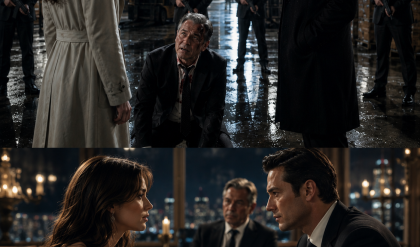
When the door opened, Roman stood outside with a cut on his cheek and blood on his white shirt that did not all appear to be his. His eyes found Noah first, then Clara. Behind him, Grant Mercer was restrained by two guards, his perfect suit torn, his face twisted with fury.
“You little mute freak,” Grant spat at Noah.
Roman turned so sharply the guards flinched, but Clara stepped forward first.
“Don’t,” she said.
Roman stopped.
Clara looked at Grant, and five years of fear stood in front of her wearing an expensive watch. The man who had made her believe she had destroyed the only love she had ever trusted. The man who had threatened her brother, used her voice, and vanished into Roman’s world under a new name.
“You don’t get his silence,” Clara said, her voice shaking but clear. “You don’t get his fear. You don’t get mine anymore either.”
Grant sneered. “You think he’ll turn me over? Men like Roman don’t call the law.”
Roman’s gaze moved from Grant to Clara, then to Noah.
Something changed in him then. Clara saw it happen. Not weakness. Choice.
“No,” Roman said quietly. “Men like my father didn’t.”
By dawn, the penthouse was full of federal agents, but not the kind Grant had controlled. Roman had called a retired judge first, then a U.S. attorney in Washington who owed nothing to the De Luca name and everything to evidence. The recording hidden inside the piano did what bullets and threats could not. It unraveled names, accounts, bribes, and deaths. It connected Grant Mercer to Victor Sokolov, Victor to the attack on Marissa, and both of them to the night Clara had been forced to betray Roman.
Clara sat on the floor near the piano while technicians carefully removed a small drive taped beneath the inner frame. Noah sat beside her, wrapped in a blanket, his shoulder pressed against hers. Roman stood near the windows, speaking quietly to officials who looked at him with suspicion, caution, and a strange new respect.
When the sun finally broke through the storm clouds, Chicago looked washed clean and impossibly fragile.
Roman approached slowly.
“Noah,” he said, kneeling in front of his son, “you were brave.”
Noah looked down at his hands. Then he whispered, “Mom said find Clara.”
Roman closed his eyes.
Clara felt tears rise before she could stop them.
Noah continued, each word small but determined. “She said Clara knows the truth. She said Dad was sad because Clara left.”
Roman bowed his head as if the words had struck him harder than any weapon.
Clara covered her mouth.
For five years, she had believed her betrayal was the center of the wound. But Marissa, a woman Clara had never met, had died trying to give the truth back to everyone who had lost it. Noah had carried those last words in silence because trauma had locked them inside him. And Roman had lived beside his child every day without knowing the key to saving him was not power, money, or revenge.
It was the truth.
Later that morning, after the agents left with Grant Mercer and the drive, after Ruth finally convinced Noah to sleep in his own bed, Clara stood near the private elevator with her hospital bag over her shoulder. She had borrowed one of Ruth’s coats because her scrubs were wrinkled and stained with tea, fear, and the longest night of her life.
Roman came down the hallway and stopped a few feet away.
“You’re leaving,” he said.
“I have patients.”
“They’ll cover your shift.”
“You called my hospital?”
“I asked Ruth to call. Politely.”
Despite everything, Clara almost smiled. “That must have been difficult for everyone.”
A faint, tired smile touched his mouth. Then it faded.
“Clara,” he said. “I need to say something without making it sound like an order.”
“That would be new.”
“I know.”
The elevator doors waited open behind her, bright and empty.
Roman reached into his pocket and held out the silver crescent necklace. “This belongs to you.”
Clara looked at it for a long moment before taking it. Their fingers brushed. The contact was brief, but it carried every year they had lost.
“I hated you,” she whispered.
“I know.”
“No, you don’t. I hated you because it was easier than hating myself. I told myself you would have become your father anyway, that I had only sped up the inevitable. But the truth is I was scared, and I let a man with a badge turn that fear into a weapon.”
Roman’s face tightened. “He threatened Tyler.”
“And I chose Tyler.”
“You were twenty-three.”
“I was old enough to break your heart.”
Roman looked down. “You were also young enough to believe you had no other choice.”
The mercy in that sentence nearly undid her.
“What happens now?” she asked.
“With Grant? Prison, if the government does its job.”
“With Victor?”
Roman’s expression cooled. “He’ll lose protection, money, allies. Men like that don’t survive long without shadows to hide in.”
“And with you?”
He looked at the city, then back at her. “I give them everything Marissa collected. Accounts. Routes. Names. Enough to tear out what’s left of my father’s world, including the pieces I should have destroyed years ago.”
Clara stared at him. “That could ruin you.”
“Yes.”
“Roman.”
“I have spent my entire life trying to hold a throne I never wanted because I thought stepping down would get everyone I loved killed. Last night, my six-year-old son had to speak through terror because I still lived in a house built for war.” His voice roughened. “I’m done.”
The words settled between them, enormous and quiet.
Clara had imagined many endings for Roman De Luca. Prison. Blood. Empire. Revenge. She had not imagined surrender as an act of love.
A small sound came from the hallway.
Noah stood there in pajamas, hair messy, blanket trailing behind him. Ruth hovered a few steps back, pretending she had not followed him.
“Clara?” Noah whispered.
Roman turned so quickly Clara saw the father before the king again.
Noah walked to Clara and held up one of his drawings. This one was new, scribbled in the shaky colors of early morning. A tall building. A sun over the city. Three people standing together by a piano.
Clara knelt. “This is beautiful.”
Noah looked at Roman, then at Clara. “Stay?”
The word broke something open in the room.
Clara looked at Roman. He did not speak for his son. He did not command, persuade, or claim. He only stood there with pain and hope held carefully apart in his eyes.
Then, slowly, Roman De Luca knelt beside Noah.
Not to propose. Not to perform. Not as a billionaire, not as a crime lord, not as the man half of Chicago feared.
As a father.
“I won’t ask you to forgive me today,” he said to Clara. “I won’t ask you to forget anything. I’m asking you to stay for breakfast. For him, if not for me. And if one breakfast becomes nothing more, I’ll accept that. But if there is even one part of you that still believes storms can end, then stay long enough to see what morning looks like.”
Clara looked at the boy who had found his voice in the middle of danger. She looked at the man who had carried her necklace for five years instead of using it as a chain. She thought of Marissa, who had used her last courage to leave truth behind. She thought of her brother Tyler, alive because she had once made a terrible choice for love. She thought of all the years she had spent calling survival peace.
Outside, sunlight broke fully over Chicago, turning the wet windows gold.
Clara fastened the crescent necklace around her throat.
Then she set her bag down.
“One breakfast,” she said.
Noah smiled.
Roman closed his eyes, just for a second, as if gratitude hurt too much to show all at once.
One breakfast did not fix five years. It did not erase betrayal, grief, danger, or the long work waiting ahead. Roman still had statements to give, enemies to face, and an empire to dismantle piece by piece. Clara still had guilt to untangle and a life to decide whether she wanted to rebuild near the man who had once been both her safest place and her greatest wound. Noah still had nightmares, doctors, and days when words would disappear again.
But healing did not arrive like thunder. It arrived like a child taking a second piece of toast. Like a feared man learning to ask instead of command. Like a nurse sitting at a kitchen island in a borrowed coat while morning light touched a city that had survived the storm.
And when Noah reached for Clara’s hand under the table, she did not pull away.
THE END