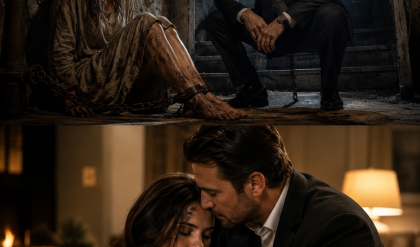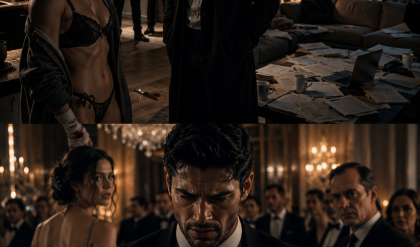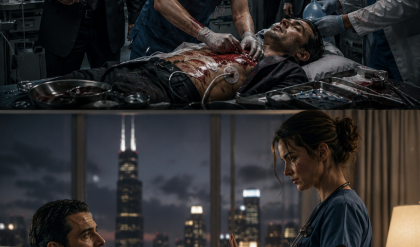
I heard my boss bet one hundred thousand dollars that he could make “the ugly secretary” look grateful.
Then I walked into his office with the file in my hands and my pride still bleeding.
If they wanted a joke, I was going to become the punchline they never recovered from.
The first time Dashel Ashcroft truly looked at me, it was because three men were waiting to see whether I would break.
I had been standing outside his office with the Callaway merger file pressed to my chest, my knuckles pale against the folder’s navy cover, when my name slipped through the crack in the door. At first, I thought I had imagined it. Executive floors did strange things to sound. Voices traveled through glass and polished walnut. Secrets leaked into hallways that cost more per square foot than my entire Queens apartment. But then Knox Ellery laughed, low and amused, and said my name again.
“Come on, Dash. Invite Marin. Your own secretary.”
A pause.
“The ugly one.”
The hallway seemed to tilt.
My body did not move, but something inside me stepped backward.
I had heard worse in my life. Girls who wore thrift-store shoes to private school learned early that people could turn cruelty into group sport if the room was comfortable enough. But there was something uniquely humiliating about hearing men in tailored suits laugh at you while standing beside the door you opened for them every morning.
One of the finance executives chuckled. “You wouldn’t do it. Not with photographers there.”
“Fifty grand,” Knox said. “Take her to the Romano Foundation gala Saturday. Walk in with her on your arm.”
Another voice cut in, eager and drunk on the safety of being cruel behind a closed door. “Make it a hundred. She has to smile, too.”
The folder became heavy.
For two years, I had worked outside Dashel Ashcroft’s office. I had memorized the temperature he preferred, the coffee he drank, the way he liked documents stacked with the signed pages facing upward and the tabs aligned to the right. I knew which investors made him impatient, which board members he respected, which hotel room he used when overseas partners came through Manhattan. I knew the man’s schedule better than I knew my own sleep.
He knew almost nothing about me.
Not that I took the 7:15 train from Queens every morning. Not that my apartment ceiling had a crack shaped like a lightning bolt. Not that my glasses were thick because eye surgery had never fit into any budget I ever had. Not that I wore shapeless blouses because invisibility had once been a form of safety.
Inside the office, leather creaked.
Dashel spoke at last.
“A hundred grand for Marin?”
There was a short silence.
Then his voice, dry and almost bored.
“Knox, you’re paying too much for a joke.”
The laughter that followed was not loud. That made it worse. It was restrained, polished, expensive laughter, the kind men used when they believed the person they were destroying would never be allowed close enough to matter.
I stood in the hallway, breathing through my nose, staring at the gold line in the marble floor.
At fourteen, I had learned not to cry in hallways. Hallways belonged to witnesses. Bathrooms were for damage. Bedrooms were for collapse. Hallways were for survival.
So I inhaled once.
Twice.
A third time.
Then I knocked.
The laughter stopped as I opened the door.
Dashel sat behind his dark walnut desk, his chair angled toward the window. Manhattan stretched behind him in hard blue light, every building sharp against the late morning sky. Knox lounged on the leather sofa with his ankles crossed, a pen spinning between his fingers. The two finance executives sat in the armchairs like schoolboys caught with stolen cigarettes.
I walked in.
No stumble. No blush. No lowered eyes.
I set the Callaway file on the exact right corner of Dashel’s desk.
“Legal sent back the signed revisions,” I said. “Mr. Callaway’s team confirmed the updated indemnity language.”
Dashel looked at me.
Not past me.
At me.
For the first time in two years, his full attention landed on my face and stayed there.
His eyes were gray, colder than I remembered, but something moved behind them. Recognition, maybe. Not of me. Of the fact that I had heard.
I turned to leave.
“Marin,” Knox said.
His voice was soft, sweet, and poisonous.
I stopped.
Knox smiled. “Mr. Ashcroft had a question for you.”
The room tightened.
Dashel’s jaw locked by a fraction.
For one second, I thought he would refuse. I thought maybe pride had limits. I thought maybe even a man like him would not continue the game once the person being played had stepped into the room.
Then Knox tilted his head.
Dashel pushed his chair forward.
“Foundation gala,” he said. “Saturday. Eight o’clock. You’re coming with me.”
Not Would you like to.
Not Are you available.
Not I apologize for what you heard.
You’re coming with me.
The three men waited for the show.
They wanted gratitude. Panic. The wide-eyed disbelief of an overlooked woman suddenly chosen by the man who had never noticed her. They wanted me to understand my assigned role.
I lifted my chin.
“Of course, Mr. Ashcroft,” I said. “Email me the address. I’ll be on time.”
Knox’s smile faltered.
One of the executives looked down at his shoes.
Dashel’s gaze sharpened.
I held it for exactly three seconds, then left the office at my normal pace.
Only when I reached the women’s restroom did my hands begin to shake.
I locked myself inside the farthest stall, sat on the closed toilet lid, and pressed both palms over my mouth.
Still, I did not cry.
I took out my phone and typed to the one person I trusted.
Ren, I need help.
She answered in less than thirty seconds.
Say less.
Ren arrived at my apartment Saturday afternoon with three garment bags, one makeup artist, one hairstylist, two pairs of heels, and the moral force of a woman who had never asked permission from a room in her life.
My apartment in Queens had never looked smaller. The radiator hissed near the window. A stack of unpaid medical bills from my aunt’s last surgery sat tucked beneath a cookbook on the kitchen counter. The living room smelled faintly of lemon cleaner and subway rain. Ren swept inside wearing dark sunglasses and a camel coat, holding a coffee like a weapon.
“Move,” she said. “Tonight we commit a controlled felony against every person who underestimated you.”
“Ren—”
“No.” She pointed at me. “You called me because you knew I would not let you make reasonable decisions.”
That was true.
I had met Ren four years earlier outside a gas station in Brooklyn, standing under fluorescent light with a split lip and a broken heel after the worst blind date of my life. She had been buying cigarettes she did not smoke and bottled water she did not need. She saw me wiping blood from my mouth with a paper towel and said, “Do you want help, revenge, or both?”
I asked for a ride.
She gave me four years of friendship.
She owned a small gallery in Chelsea and signed her name as Ren Marlowe. She had money but hated talking about it. A distant father. A dead mother. A brother she called “complicated” and never named. I never pushed. People with orphan-shaped holes in them knew better than to force open locked rooms in other people.
Now she stood in my living room, unzipping garment bags on the sofa.
The stylist, Marello, circled me with narrowed eyes.
“She hides her neck,” he said.
“I know,” Ren replied gravely. “It’s criminal.”
“I do not hide my neck,” I said.
“You dress like a witness in a tax fraud deposition,” Ren said. “Tonight we correct that.”
For two hours, they transformed me with the ruthless tenderness only friends and professionals could manage. Marello washed out the stiff bun I wore every day and let my dark hair fall in long waves down my back. Ren took my glasses, placed them on the nightstand, and handed me contacts I had bought months ago but never had the courage to wear outside.
The dress was black velvet, high-necked but sleeveless, fitted through the waist, falling long with a slit that made me consider calling the police on myself. It did not expose me cheaply. It revealed the person I had been hiding under cotton, fear, and survival.
When I finally stood in front of the mirror, I did not recognize the woman looking back.
She was still me.
That was the terrifying part.
Ren came up behind me, her face softening.
“Listen carefully,” she said. “You are not going there to be chosen. You are not there to be grateful. You will walk in like the building has been waiting for you, and you will not look for him. If he speaks, you answer. If he reaches, you decide. If he apologizes, you make him work for the privilege of being heard.”
My throat tightened. “What if I fall apart?”
“Then fall apart later. Tonight you walk.”
The car arrived at eight.
The Romano Foundation gala was held at the Plaza, under chandeliers that made every diamond in the room look awake. Photographers clustered near the entrance. Men in tuxedos turned before they knew why they were turning. Women evaluated, dismissed, reconsidered.
I walked up the marble staircase with Ren’s voice in my head.
Do not look for him.
At the top, I saw Dashel anyway.
He stood in the center of a small group, black tuxedo, champagne glass in hand, Knox at his right shoulder. He was speaking when his eyes lifted.
The sentence died on his mouth.
His glass tilted.
Knox followed his gaze.
For one long second, the entire group went still.
Then Knox said softly, “My God.”
No one laughed.
I passed them with a polite nod and entered the ballroom.
For the next hour, I behaved exactly as Ren instructed. I accepted champagne. I danced with a widowed attorney named Samuel Grayson who smelled like cedar and told me about his vineyards. I spoke to a museum trustee about children’s literacy programs. I smiled when photographed and never once looked toward the place where I felt Dashel watching me.
That was the first lesson of the evening.
Being seen by everyone was not the same as needing one man to see you.
The second lesson arrived in a red dress.
Sabine Marchetti approached me near the bar, tall and sleek, with black hair shining down her back and diamonds sitting cold against her throat. I knew her from magazines and from Dashel’s calendar. Tuesday dinner, canceled through me. Friday drinks, postponed through me. A woman whose name had appeared often enough that I had once imagined her as the natural ending to any story involving him.
“So,” she said, smiling. “You are the secretary.”
“I am Marin Holloway.”
Her eyes traveled over me slowly. “Dashel described you poorly.”
“How generous of him.”
Her smile thinned. “Careful. Men like him enjoy novelty. They do not keep it.”
I held my glass lightly.
“Sabine, if I were you, I’d save that advice for the next time your dinner gets canceled by email.”
Color rose beneath her flawless makeup.
For once, she had no elegant reply.
Across the ballroom, Dashel looked like he had forgotten how to breathe.
At 11:15, I left.
Not because I wanted to.
Because Ren had told me to leave first, and for once in my life, I listened to someone who understood power better than pain.
The night air outside the Plaza was cold enough to sting. I pulled my coat tighter and reached for the cab door when his voice came behind me.
“Marin.”
I stopped.
Dashel crossed the sidewalk with his overcoat open over his tuxedo.
“You’re leaving.”
“Yes.”
“You don’t have to.”
I turned.
“You invited me because of a bet, Mr. Ashcroft. You won. Go collect your applause.”
His face tightened.
“I owe you an explanation.”
“No.” My voice stayed calm. “You owe me respect. You can begin practicing by letting me leave.”
He looked at me then with something I had never seen in his office. Not arrogance. Not command.
Regret.
“Good night,” I said.
Then I got into the cab and shut the door.
In the mirror, I saw him standing on the curb as the car pulled away, hands in his coat pockets, wind lifting the hem around his legs.
He did not move until Fifth Avenue swallowed him.
The next three weeks became a silent education in pursuit.
Monday, I found a note folded on my keyboard.
That was cowardly.
No signature.
I placed it in the drawer with unused paper clips and began my workday.
Wednesday, a cappuccino arrived from the Italian café downstairs with a sticky note.
I’m sorry.
D.
I drank the coffee and threw away the note.
Friday, Dashel stopped near my desk, opened his mouth, closed it, and walked into his office as if speech had betrayed him.
The following week, he invited me to dinner.
I declined by email, citing that my employment contract did not include non-business meals outside working hours.
Ren howled when I showed her.
“Babe, you are starving a billionaire emotionally. I support it.”
But under the humor, something in me had changed.
At the gala, I had expected to feel triumphant. Instead, I felt unsteady. Dashel’s attention, now that I had it, did not feel like victory. It felt dangerous. For two years, I had wanted him to notice I was competent. Maybe kind. Maybe human.
Now he looked at me as if I were a locked door.
And something foolish in me wanted to open.
The corporate event at the Ashcroft Midtown Hotel happened three weeks after the gala. Investors, executives, journalists, board members, and the polished machinery of money filled the second-floor ballroom. I wore navy this time. Quiet. Elegant. No glasses.
Dashel gave the opening speech at 9:30. During eleven minutes of strategy, growth, and partnership, his eyes found mine twice.
Afterward, I took one glass of champagne.
Then another.
Sabine appeared before the third.
“You came back,” she said. “How brave.”
“How observant.”
Her smile sharpened. “He gets bored quickly.”
“Does he?”
“Always.”
I looked at her for a moment, then smiled with my mouth closed.
“Then perhaps the problem was not his attention span.”
Her face froze.
I left the ballroom through the side door before I could say anything crueler.
Downstairs, the lobby bar was dim and quiet, with black marble counters and a pianist playing something old enough to sound expensive. I sat in the corner and ordered whiskey because champagne no longer matched the night.
“Same for me,” Dashel said beside me.
I did not turn.
He sat one stool away. Close enough to be intentional. Far enough to pretend he still had restraint.
“Why do you run?” he asked.
I took a sip. It burned in exactly the way I needed.
“Because you are my boss. Because you called me ugly. Because I do not know whether you want me or whether you simply dislike being denied.” I turned then. “In that order.”
He looked down at his glass.
“I did not call you ugly.”
“No. You priced the joke.”
His face tightened.
“That night, I failed a test I did not know I was taking.”
“Men like you rarely know you are being tested. That is why you fail so often.”
The corner of his mouth moved, not quite a smile.
“I deserve that.”
“You deserve worse.”
“I know.”
The quiet after that felt different.
Not repaired.
But honest.
He looked at me then, fully, in a way that made the bar around us fade into low music and glass.
“I have spent two years walking past your desk,” he said. “Do you know what I remember now?”
I said nothing.
“You always moved my coffee three inches from the edge because I once knocked a cup over during a call. You changed the bulbs in my office from bright white to warm white after I had migraines for a week. You canceled a meeting with Maddox Reed before I asked because you knew his numbers were wrong.” He swallowed. “You were not invisible, Marin. I was just arrogant enough to confuse not looking with not seeing.”
My chest hurt.
“That sounds like an apology.”
“It is one.”
“Then make it better.”
His gaze lifted.
“I am sorry,” he said. “For the bet. For not stopping Knox. For letting pride speak before decency. For making you the object of a joke in a room where you should have been respected.” His voice lowered. “And for taking two years to understand that the most competent person on my floor was sitting outside my office while I treated her like furniture.”
The apology did not fix everything.
But it landed.
That was the problem.
Dashel Ashcroft, sorry and stripped of performance, was more dangerous than Dashel Ashcroft arrogant.
I left before I could forgive him too easily.
But after that night, the space between us changed.
There were no dramatic declarations. Not at first. Just moments. His hand brushing mine when passing a document. A glance that held too long. An almost smile when I corrected him in a meeting and he realized I was right before anyone else did. Once, in the elevator, he said, “Your hair looks nice,” with such awkward seriousness I laughed all the way to Queens.
A week later, he showed up at my apartment.
The buzzer rang at 10:15 on a rainy Friday night.
I knew before answering.
He stood in the hallway wearing an overcoat, damp hair, and an expression too uncertain for a man used to owning buildings.
“Mr. Ashcroft,” I said.
“I left the mister downstairs.”
“That’s not how names work.”
“It does tonight.”
I should not have let him in.
I did.
My apartment looked smaller with him inside. The cracked ceiling. The secondhand sofa. The kitchen mug in the sink. The gallery magnet from Ren’s studio on the refrigerator. He noticed all of it. Not with judgment. With attention.
“You live here alone?” he asked.
“Yes.”
“For how long?”
“Long enough.”
He took off his coat, folded it over the sofa, and stood in my living room like a man realizing luxury had taught him almost nothing about shelter.
“I wanted to see where you go when you leave my world,” he said.
“My world existed before yours noticed.”
“I know.”
He stayed that night.
Not in the careless way Knox would have joked about. Not in the way tabloids later imagined. He stayed because rain made the windows blur, and we talked until two in the morning about things neither of us usually admitted. His father’s expectations. My aunt’s illness. The scholarship I lost after missing one payment. The way he had learned early that softness became ammunition in his family.
At some point, the air changed.
At some point, his hand found mine.
At some point, wanting stopped being theoretical.
But when morning came, I woke before him and watched his face in the dim light, younger in sleep, less armored. For the first time, I was not afraid of what I felt.
That should have warned me.
Happiness makes careless people of us all.
The truth exploded on a Saturday afternoon.
He was in my kitchen trying to make coffee because he had declared, very seriously, that no man should own hotels and be unable to operate a simple machine. I was half-asleep on the sofa with a book open on my chest when I heard a spoon hit the floor.
I opened my eyes.
Dashel stood by my bookshelf holding a framed photo.
His face had gone white.
“Marin,” he said. “How do you know Ren?”
My body went cold before my mind understood why.
“My best friend,” I said slowly. “Why?”
He turned the frame toward me.
It was a photo of Ren and me in Central Park two years earlier, arms around each other, both laughing into the wind. She had printed it at a kiosk because she said phones were where memories went to die.
Dashel stared at me.
“Ren is my sister.”
The book slid from my chest to the floor.
For several seconds, there was no sound except the radiator.
Then my brain began rearranging four years.
Ren, who never used her family name.
Ren, who avoided coming to my office.
Ren, who sent me the job posting at Ashcroft Holdings.
Ren, who knew too much about expensive dresses and too little about coincidence.
Dashel’s face hardened in real time.
“How long have you known her?”
“Four years.” My voice sounded far away. “Dashel, I didn’t know.”
“Four years.”
“I didn’t know.”
“She never told you.”
“No.”
“She sent your resume.”
My silence answered before I could.
He laughed once, but there was no humor in it.
“I should have seen it.”
I stood too quickly, dizzy with panic.
“Look at me. I am the same person I was five minutes ago.”
He set the frame down carefully.
Too carefully.
“I have been used before, Marin.”
“I did not use you.”
“People who use you rarely announce it first.”
“That is not fair.”
“No,” he said, eyes cold now. “None of this is fair.”
He grabbed his overcoat.
I stepped forward.
“If you walk out believing this, I don’t know if I can undo it later.”
He stopped with his hand on the doorknob.
For one second, I saw him hesitate.
Then the old Dashel won.
“I should have known,” he said.
He left.
The door slammed.
I stood in my living room for forty seconds, unable to understand how quickly warmth could become evidence.
Then I called Ren.
“Come over,” I said when she answered. “You have a lot of explaining to do.”
She arrived that night with her face already broken.
We sat across from each other in my living room, the photo frame between us on the coffee table like an exhibit in court.
“Start,” I said.
Ren folded her hands together.
“Dashel is my brother,” she said. “Older by six years. Same mother. Same father. I stopped using Ashcroft when I was eighteen because that name opened doors I did not want opened. I built the gallery as Ren Marlowe because I wanted one thing in my life that was mine.”
I said nothing.
“When you needed work two years ago, I sent your resume through an internal channel. I told myself it was help. I told myself you deserved a good job and he deserved someone competent enough to save him from himself.”
“You lied.”
“Yes.”
“For two years, I told you everything about that office.”
“I know.”
“You listened to me talk about him.”
“I know.”
“You helped me dress for a gala where your brother invited me because of a bet.”
Her tears fell then.
“I didn’t know about the bet until you told me. I swear.”
“But you knew enough to tell me how to play him.”
Ren covered her mouth.
That was the part that hurt most.
Not that she was his sister.
That she had known the board better than I did while I thought we were both just trying to survive the same game.
“I thought if he truly saw you, he would change,” she whispered.
“I am not a lesson for your brother.”
“I know.”
“No, Ren. You don’t.” My voice shook. “You treated my life like a bridge between two damaged people you loved. You decided secrecy was acceptable because your intentions were good. That is what rich people do. They call manipulation protection when the outcome flatters them.”
She flinched.
Good.
I wanted the words to bruise.
Then I sat back, exhausted.
“Tomorrow,” I said, “I’m going to Ashcroft Holdings.”
Ren looked up sharply. “Marin—”
“No. You don’t call him. You don’t warn him. You had four years to speak. Now it’s my turn.”
The lobby of Ashcroft Holdings was crowded Monday morning.
Investors clustered near the elevators. A pair of photographers leaned by reception because the Callaway merger announcement had drawn press. Sabine Marchetti stood near Knox Ellery, dressed in gray, smiling like she smelled blood in the walls.
I walked through the revolving doors at 9:15 wearing a black dress, red lipstick, loose hair, and no glasses.
The receptionist, Jacinta, looked startled.
“Miss Holloway, Mr. Ashcroft requested—”
“He can fire me later,” I said. “Right now, he can listen.”
I walked to the center of the lobby and stood on the dark marble star set into the floor beneath the company logo.
The panoramic elevator descended.
Dashel was inside.
When the doors opened and he saw me, he stopped.
So did everyone else.
I filled my lungs.
“Mr. Ashcroft,” I said, loud enough for the marble to return my voice. “I did not know Ren Marlowe was your sister until Saturday. I did not know when I interviewed. I did not know when I brought you coffee. I did not know when I stood outside your office and heard your friends bet money on whether I was too ugly to take to a gala.”
The lobby froze.
Sabine’s smile sharpened.
Knox went pale.
Dashel’s face changed, but I did not stop.
“I am not here to beg you to believe me. I am here because you walked out of my apartment and wrote a story about me without allowing me to speak. I am done being described by people who do not ask me questions.”
My voice echoed upward.
“Call her.”
His eyes stayed on mine.
“Call Ren. Put her on speaker. Ask her.”
For one long second, no one moved.
Then Dashel took out his phone.
The ring sounded through the lobby.
Ren answered on the third.
“Dash?”
“Did Marin know?”
“No,” Ren said immediately. “No. She never knew. I lied by omission to both of you. She had nothing to do with it.”
Dashel closed his eyes.
For half a second, he looked like the call physically hurt.
Then he hung up.
The lobby waited.
Dashel stepped toward me.
“I’m sorry,” he said.
Not quietly.
Not privately.
Loud enough for Knox to hear. For Sabine to hear. For the photographers to hear. For every assistant in that building who had ever watched powerful men hurt people and call it business.
“I saw a photo, and I chose suspicion over trust. I walked out before listening. I spent two years not seeing you, then punished you when you finally demanded to be seen.” His voice roughened. “I am sorry, Marin.”
His hand lifted, then stopped before touching my face.
Waiting.
That waiting was what undid me.
Not the apology.
The choice.
I let him touch my cheek.
“Stay,” he said softly.
I stared at him.
“I’ll stay in my own life,” I said. “If you want to stand beside me there, earn it.”
A faint, pained smile crossed his mouth.
“I will.”
Then he kissed me in the middle of the lobby.
Flashes exploded three seconds later.
Sabine left before anyone could photograph her expression.
Knox clapped once, dry and awkward. Then again, because apparently humiliation had finally improved his manners.
I pulled away from Dashel and turned to Knox.
“One hundred thousand dollars,” I said. “That was the price of the joke, right?”
His face lost color.
“Donate it to the Holloway Literacy Fund by the end of the month.”
“There is no Holloway Literacy Fund,” he said weakly.
“There will be by Friday.”
Dashel’s hand tightened around mine.
I smiled.
“Then we can talk about whether your friendship is worth repairing.”
The first headline appeared that night.
THE GOLDEN BACHELOR AND THE SECRETARY WHO STOPPED HIS LOBBY COLD.
Then came worse ones.
WHO IS MARIN HOLLOWAY?
FROM EXECUTIVE ASSISTANT TO ASHCROFT HEIRESS-IN-WAITING?
THE WOMAN BEHIND THE CALLOWAY MERGER SCANDAL?
By Tuesday morning, my face was everywhere. The gala photo. The lobby photo. An old company event photo where I stood in the background holding a coffee tray, glasses thick, hair pinned back, looking exactly like a woman no one expected to matter.
People compared the images like I was a product redesign.
Dashel wanted to sue three publications by breakfast.
I told him no.
“We cannot sue everyone who enjoys a transformation story,” I said.
“They are insulting you.”
“They were insulting me before. Now they know my name.”
But fame, even small and vicious fame, has teeth.
By the end of the week, someone had leaked my personnel records. My old address. My college scholarship. The debt attached to my aunt’s medical bills. Articles appeared suggesting I had schemed my way into Ashcroft Holdings through Ren. Anonymous sources hinted I had manipulated a lonely billionaire heir.
I read every word.
Then I went to work.
Not as his secretary.
That ended on Wednesday.
I resigned in a formal email with human resources copied, citing conflict of interest and hostile workplace history. Dashel tried to protest. I told him if he wanted to love me, he could begin by not managing my decisions.
He listened.
That was new.
With Knox’s forced donation and Dashel’s matching contribution, the Holloway Literacy Fund became real by Friday. I used my own name. I hired an attorney independent of Ashcroft Holdings. I asked Ren to serve on the board only after she apologized again, this time without explaining herself.
“I don’t know if I forgive you yet,” I told her.
“I know,” she said. “I can wait.”
Good.
Let everyone wait.
Waiting had taught me what people were willing to do when they could not control the timeline.
Three months later, the fund opened its first small reading room in Queens, inside a community center with cracked tile floors and flickering fluorescent lights. Children came after school and sat on beanbags donated by a furniture company Dashel did not own. We stocked shelves with books in English, Spanish, Mandarin, Arabic, and Korean because Queens did not speak in one language and neither should hope.
At the opening, reporters came expecting glamour.
They found me in a green dress, carrying boxes.
Dashel stood in the back, sleeves rolled up, assembling a bookshelf badly while a twelve-year-old corrected him.
“You’re doing it wrong,” the boy said.
Dashel looked at the instructions. “I am discovering that.”
I laughed.
He looked up when he heard it.
There was still a long road between us.
Trust did not return because someone apologized in marble. Love did not become healthy because cameras caught a kiss. Ren and I were still rebuilding our friendship carefully, brick by brick. Knox had sent the money, then a handwritten apology I had not yet answered. Sabine married a French banker and stopped appearing in my story, which was the kindest ending she could have given me.
As for Dashel and me, we learned each other outside the spectacle.
He learned my subway stop. My aunt’s laugh. The way I took coffee when no one else was ordering it for him. He learned that I hated being surprised in public but loved unexpected bookstores. He learned that silence could mean peace, not rejection.
I learned that arrogance sometimes hid fear, though fear did not excuse cruelty. I learned that powerful men could change only when they accepted embarrassment as the price of honesty. I learned that desire was not dignity, but dignity made desire safe.
One evening in spring, almost six months after the bet, Dashel came to Queens with takeout and no driver.
He carried two paper bags up the stairs himself, slightly breathless by the fourth floor.
“I think your building is trying to kill me,” he said.
“My building dislikes billionaires.”
“Understandable.”
We ate on my sofa beneath the cracked ceiling.
After dinner, he looked around the apartment, at the repaired bookshelf, the gallery magnet still on the fridge, the framed photo of Ren and me back in its place.
“You kept it,” he said.
“Yes.”
“I’m glad.”
“She hurt me,” I said. “But she also saved me more than once. Both things are true.”
He nodded slowly.
“I am learning that people can be more than the worst thing they did.”
I looked at him.
He smiled faintly.
“Including me, I hope.”
“Sometimes.”
He laughed softly.
Later, standing by the window while rain blurred the streetlights below, he took my hand.
“I have something to ask you.”
My body tensed.
He felt it and immediately said, “Not marriage.”
I exhaled.
“Good.”
“Not yet,” he added carefully.
“Dashel.”
“I know. Too soon.” He looked nervous, which still felt unfamiliar on his face. “I want to ask if you will let the fund use the empty Ashcroft building in Jackson Heights. Rent-free. Ten years. Full operational independence. No branding. No Ashcroft name on the door unless you choose it.”
I stared at him.
“That building is worth millions.”
“Yes.”
“Your board will hate it.”
“Probably.”
“Your father will hate it more.”
“Definitely.”
“Why?”
He looked at me with the steadiness I had once begged for without words.
“Because a joke priced your humiliation at one hundred thousand dollars. I want the consequence to be worth more than the cruelty.”
My throat tightened.
“That is a very expensive apology.”
“No,” he said. “It is not an apology. It is a beginning.”
Outside, Queens glittered after rain. Not like Manhattan. Not cold glass and distant towers. This light was laundromat signs, corner stores, apartment windows, headlights passing over wet pavement. Real light. Lived-in light.
I thought about the woman I had been outside his office, holding a folder, listening to men decide her value in dollars and laughter.
Then I thought about the children who would read in a building paid for by the consequence of that laughter.
That was not revenge.
It was better.
Revenge burned quickly.
Reclamation built rooms.
I looked at Dashel and squeezed his hand.
“Yes,” I said. “But my name goes on the paperwork first.”
His smile came slowly.
“Of course.”
“And if you ever call me useful, even lovingly, I will throw you out of my apartment.”
“I would deserve it.”
“Yes.”
He leaned down and kissed my forehead, careful and warm.
For the first time, I believed his care because it did not ask me to shrink.
A year after the gala, the Holloway Literacy Center opened in Jackson Heights. The old Ashcroft building had been transformed into a bright, three-floor community space with reading rooms, tutoring offices, a small auditorium, and a rooftop garden where children planted tomatoes in blue ceramic pots.
The plaque by the door read:
Founded by Marin Holloway.
Built for every child ever underestimated.
No Ashcroft name.
Dashel stood beside me at the opening, holding my hand but not pulling attention from me. Ren stood in the front row, crying openly. Knox came quietly, donated another check, and left before making the day about his guilt.
Reporters asked me what inspired the center.
I thought about giving them the polished answer. Literacy. Access. Community investment. All true.
Instead, I said, “Someone once made a joke about my worth in a room where he thought I could not hear. For a while, that hurt me. Then I realized people who underestimate you are sometimes handing you the first brick. You decide what to build with it.”
That quote traveled farther than any gossip headline.
Women sent letters. Assistants. Secretaries. Nurses. Teachers. Girls in thick glasses. Women who had been called plain, invisible, difficult, lucky, desperate, too much, not enough.
I read every message.
Sometimes I cried.
This time, not in hallways.
Months later, Dashel asked me to dinner at a small restaurant in Queens, not the Plaza, not a rooftop, not anywhere cameras waited. He wore a dark sweater instead of a suit. I wore glasses because my eyes were tired and because hiding was no longer the same as comfort.
After dessert, he placed a small box on the table.
“Not a performance,” he said quickly. “No photographers. No lobby. No audience.”
My heart beat hard.
Inside the box was not a large diamond.
It was a thin gold ring with a tiny engraved line inside.
Not chosen. Seen.
I looked at him for a long time.
He did not rush me.
That was how I knew.
“Yes,” I said eventually. “But slowly.”
His eyes softened.
“Slowly is perfect.”
Outside, Queens moved in its ordinary rhythm. Trains in the distance. A delivery bike rattling over uneven pavement. Someone laughing too loudly on the corner. The city did not stop for us.
Good.
I no longer needed the world to freeze for my life to matter.
I had once been the woman outside the door, hearing my name turned into a bet.
Now I was the woman who had walked through the door, crossed the ballroom, stood in the lobby, built the center, kept the friendship, demanded the apology, and chosen love only after it learned to stand beside respect.
The ugly secretary.
That was what they had called me.
How small those words looked now.
How far below me they sounded.
I slipped the ring onto my finger and smiled, not because a powerful man had finally chosen me, but because I had already chosen myself first.
And that made all the difference