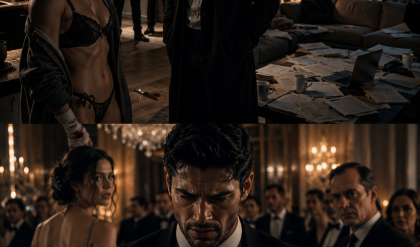
The meeting began with Nolan presenting the campaign strategy Clara had built. He used her phrases, her structure, even the line she had written at 1:12 a.m. while reheating soup for Elaine: “Make the ordinary feel chosen.”
The client loved it. The senior team praised him. Nolan nodded as if genius weighed heavily on him.
Clara took notes until her jaw ached from not speaking.
After the meeting, Nolan called her back before she could escape.
“The revised deck needs to be ready before lunch.”
She looked at him. “The client approved the direction.”
“They approved my direction. Now we elevate it.”
The word my landed between them like a theft committed in daylight.
He leaned against the table. “Also, your tone earlier was defensive.”
“My tone?”
“You have talent, Clara. That’s why I tolerate the inconsistency. But Northstar values team players. Team players do not make leadership manage around their personal lives.”
“My mother had a stroke.”
“And I’m sorry about that.” He lowered his voice, not to protect her, but to make the cruelty sound reasonable. “But there are people here without your natural ability who show up prepared, rested, grateful. Don’t make it hard for me to keep defending you.”
Clara almost laughed. Defending her. Nolan had turned her exhaustion into evidence against her, her skill into something he owned, her silence into permission. She nodded because nodding was cheaper than unemployment.
When she stepped out of the room, the coffee stranger stood near reception with a visitor badge clipped to his coat.
He looked different under the office lights. Still rain-damp. Still holding the cup she had paid for. But calmer now. Sharper. His gaze moved from Clara’s face to the conference room behind her, where Nolan was already laughing on a video call with executives.
Clara forced a smile. “Please tell me you’re not here to fix the printer. It bites.”
The stranger did not smile. “Does he always speak to you like that?”
Clara shifted the folders against her chest. She should have lied. She usually did. But she was tired. And he already owed her four dollars.
“Only on days ending in Y.”
Something hardened in his expression, not anger exactly, but recognition.
“Tomorrow may be different,” he said.
Clara nearly laughed. People who did not have to survive a place always believed tomorrow had better manners.
“Sure,” she said. “And maybe the printer will apologize.”
She walked back to her desk.
Behind her, Adrian touched the visitor badge on his coat and looked again at Nolan Price through the glass.
Tomorrow, he thought, would indeed be different.
By nine the next morning, Northstar Creative smelled like burnt coffee, printer toner, and fear disguised as productivity.
Clara had arrived early, not because she was ambitious, but because Nolan had sent seven emails before sunrise, each one more urgent and less useful than the last. The revised campaign deck had to be ready for the all-company meeting with Vale Meridian Group. Fonts needed alignment. Charts needed replacing. Nolan’s name needed to appear on the title slide even though Clara had built the entire strategy while eating cereal over the kitchen sink at two in the morning.
She sat at her desk with a coffee she had made at home to save money and a headache she had absolutely earned.
Miles rolled his chair close and whispered, “New CEO is coming in person.”
Clara kept typing. “Executives come in person when they want to say the word culture with eye contact.”
“I heard he’s intense.”
“All CEOs are intense. It’s how they justify furniture budgets.”
At 9:47, Nolan appeared beside her desk. His suit was flawless. His smile was not.
“You’ll sit near the wall and take notes,” he said. “Do not overexplain if someone asks about process. Do not correct leadership in front of the new owners. And please, Clara, do not let your personal stress affect the room.”
Clara looked at the slides open on her laptop. Her ideas. Her structure. His name.
“Understood.”
The conference room filled quickly. Managers took the front seats. Staff lined the walls. A few people tried to look excited. Most looked as if they were calculating how many layoffs could fit inside the phrase operational alignment.
Nolan stood near the screen, glowing with borrowed authority. Clara sat at a side table with a notebook, a pen, and the practiced posture of someone trained to be useful but invisible.
Then the door opened.
The man from the coffee shop walked in.
For one second, Clara’s mind refused the information. He was no longer wearing the plain raincoat. He wore a charcoal suit that fit like it had been made by someone who charged more than her rent. His hair was dry and neatly combed. His expression had shifted from confused coffee victim to something controlled, direct, and impossible to ignore.
Everyone stood.
A woman from corporate communications stepped forward. “Good morning, everyone. Please welcome Adrian Vale, CEO of Vale Meridian Group.”
Clara dropped her pen.
It hit the floor, rolled under the table, and because the universe had a taste for humiliation, stopped directly beside Adrian’s shoe.
He glanced down. Then at her. Not long. Not obviously. Just enough.
Clara bent to retrieve the pen and whispered to herself, “Fantastic. I bought capitalism breakfast.”
Adrian began without the usual acquisition speech. No slide about synergy. No inspirational promise that people were the company’s greatest asset while half the room silently refreshed job boards. He stood at the front with no notes and looked at the employees before he spoke.
“For several weeks,” he said, “I have been observing Northstar Creative.”
Nolan’s smile tightened.
“Not as a visiting executive. Not as a scheduled guest. Not through reports prepared for me. I observed as a client prospect, as an applicant, as a temporary consultant, and yesterday, briefly, as a man unable to purchase coffee downstairs.”
A nervous laugh moved through the room, then died when Adrian did not laugh with it.
He turned to the screen.
The first slide showed a timeline of complaints filed over the past eighteen months.
Bullying. Retaliation. Credit theft. Manipulated performance reviews. Employees with caregiving responsibilities labeled unreliable. Anonymous reports closed without investigation. Departures framed as lack of resilience. After-hours work normalized through calendar invitations and implied threats.
Clara felt the air leave her lungs.
The next slide showed email chains. Nolan’s emails. Some were familiar. Too familiar. Requests sent late at night, followed by morning complaints about delayed turnaround. Her language forwarded upward without attribution. Her questions reframed as resistance. A performance concern entered the week Elaine had been hospitalized.
The room became painfully still.
Miles stared at the table.
Nolan recovered enough to speak. “Adrian, with respect, these materials lack context.”
Adrian turned toward him. “Then provide it.”
Nolan’s jaw moved once before sound came out. “Northstar has been under intense pressure. High standards can be misread as hostility by employees who are struggling with accountability.”
Several people looked down.
“Some of the individuals involved,” Nolan continued, “are talented but unstable. They blur personal hardship with professional responsibility. They create friction, then interpret management as mistreatment.”
Then he made the mistake of looking at Clara.
A cold current moved through the room.
Nolan did not say her name. He did not have to. His implication was careful enough for a lawyer but clear enough for everyone else. The tired assistant. The sick mother. The late deck. The stranger’s coffee. Her private life suddenly useful as a shield for his public cruelty.
Every eye turned toward Clara.
Her stomach twisted. She had spent months trying to stay invisible, and now invisibility had been ripped away in a room full of people who had learned to survive by looking away.
Adrian saw it.
He did not rescue her by praising her. He did not call her brave. He did not turn her into a symbol of goodness or suffering. He looked at Nolan instead.
“This is not about Clara Bennett buying me coffee,” Adrian said. “It is about a company where too many people knew what was happening and learned to survive it quietly.”
No one moved.
“Nolan Price’s employment is terminated, effective immediately.”
The sentence landed without shouting. No dramatic music. No gavel. Just a man losing the power he had used to make other people feel small.
Nolan stared at him. “You are making a serious mistake.”
“No,” Adrian said. “The mistake was letting a manager confuse fear with performance for this long.”
“This will destabilize operations.”
“Then operations were already unstable.”
Nolan looked toward the staff, perhaps expecting loyalty from people he had exhausted into silence. He found none. Not courage, exactly. Not yet. But a room full of people who, for the first time in months, did not rush to protect him from consequences.
Adrian continued. “Northstar will undergo a full management review. Not because one bad manager was found, but because one bad manager was allowed to thrive.”
That was when the room changed.
Relief did not arrive cleanly. People who had lived under Nolan too long did not know how to trust fresh air immediately. Some looked near tears. Others looked terrified. A few managers looked as if they had just discovered morality could become evidence.
Clara looked at the floor.
She did not feel victorious.
She felt exposed.
After the meeting, people avoided her and stared at her at the same time. Miles came close enough to apologize, then seemed to run out of language. Clara spared him by pretending to check email.
Adrian found her near the copy room twenty minutes later, where she was trying to convince the printer to stop blinking “paper jam” when there was no visible paper and an abundance of emotional hostility.
He stood a respectful distance away.
She did not look at him.
“So,” she said, opening and closing the paper tray with unnecessary force, “do I call you Adrian, Mr. Vale, or Your Majesty of Declined Debit Cards?”
“Adrian is fine.”
“Great. Adrian.” She turned at last. “Next time you want to understand regular people, maybe try asking instead of going undercover as a financial inconvenience.”
He absorbed that. “I deserve that.”
“You deserve worse, but I’m at work.”
“I wanted to thank you for the coffee.”
Clara’s laugh was short and humorless. “That coffee was not a job interview. It was not a character reference. It was not permission to drag me into your corporate investigation.”
“I know.”
“Do you?” Her voice lowered. “Because when men like Nolan hurt people, women like me learn to stay invisible. Today everyone saw me, not because I spoke, but because you pointed a flashlight near where I was standing.”
Adrian had no quick answer.
That was the first thing Clara liked about him against her will.
He did not fill the silence with leadership language. He did not explain impact versus intent. He did not ask her to appreciate the outcome. He let the truth make him uncomfortable.
Finally, he reached into his wallet and took out a five-dollar bill. “For yesterday.”
Clara stared at it, then at him. “You’re trying to reimburse the incident that caused my existential workplace crisis?”
“I am beginning to understand the timing may be poor.”
“Keep it.” She snatched the finally printed pages from the tray. “Consider it tuition.”
She walked away before he could respond.
Adrian looked down at the five-dollar bill in his hand. Then through the glass at an office already whispering, calculating, hoping, fearing.
Yesterday, Clara had bought him coffee.
Today, she had handed him the bill for everything he still did not understand.
By the end of the week, Nolan Price was gone, but somehow his shadow still had an access badge.
Northstar did not become healthy because one man had been escorted out carrying a cardboard box and a face full of corporate betrayal. People still lowered their voices when managers walked by. Employees still apologized before asking questions. Calendar invitations still appeared after 6:00 p.m. with the cheerful violence of people who had forgotten workdays were supposed to end.
Adrian noticed all of it now.
That was the problem with seeing clearly once. It made blindness harder to return to.
He and Leah Mercer, Vale Meridian’s general counsel and the only person in the company willing to interrupt him mid-sentence without blinking, spent several days in conference rooms with closed blinds, reading complaints that had been filed, buried, softened, or rerouted into useless language.
Nolan had been cruel, yes, but he had not invented the weather.
Northstar had rewarded managers who produced fast results even when those results came from fear. High turnover had been called team evolution. Burnout had been called growth pressure. Stolen work had been called leadership synthesis.
Leah placed another report in front of Adrian without mercy. “You want Nolan to be the disease because that’s easier.”
“I know he wasn’t alone.”
“No,” Leah said. “You know it in the way executives know things when they want credit for knowing them. I mean you need to know it where it costs you something.”
Adrian leaned back, jaw tight.
Leah was not finished. “Toxic leaders rarely survive alone. Someone approved their numbers. Someone ignored their methods. Someone called complaints ‘noise’ because quarterly charts looked clean.”
Adrian knew who that someone had been.
Not directly. Not intentionally. But his company had bought Northstar’s revenue before studying its people. His acquisition team had praised efficiency without asking who had paid for it with sleep, dignity, and silence.
Meanwhile, Clara Bennett became famous in the worst possible way.
Not outside the company yet. Inside was bad enough.
By Monday, someone had started calling her the coffee girl. Not loudly. Never where HR could hear. But she heard it in the pause before conversations stopped. She saw it in the way coworkers who once asked her for help now hesitated, as if kindness had become politically dangerous.
Some people thought she was lucky. Some thought she had orchestrated Nolan’s downfall with a four-dollar beverage and feminine witchcraft. Some resented her for becoming proof of what they had been too afraid to say.
Miles apologized three times, each more awkward than the last, until Clara finally told him that if he apologized again, she would assign him a feelings spreadsheet and make him color-code his shame.
He stopped, mostly.
Adrian wanted to fix it.
Of course he did. Fixing was his native language. He wanted to move Clara to a better team, give her a raise, announce protections, assign a formal title, escort every whispering employee into a values workshop until they became better citizens through exhaustion.
Leah found him writing possibilities on a whiteboard.
“She is not a damaged department,” Leah said.
Adrian capped the marker. “I know that.”
“No. You know that intellectually. Emotionally, you are two minutes from turning her into a special initiative.”
He hated how accurate that was.
So instead of acting, Adrian did something far more difficult.
He asked permission.
Clara had left early to take Elaine to a follow-up appointment at Massachusetts General. Adrian sent a brief message asking whether he could stop by after work to apologize properly for the disruption Vale Meridian had brought into her life.
Clara did not answer for forty-three minutes.
Then she sent an address in one line.
Do not bring flowers. My mother will assume you are guilty of murder.
Elaine Bennett lived in a small apartment in Jamaica Plain filled with books, pill organizers, stubborn dignity, and the faint smell of lemon furniture polish. She was thinner than Adrian expected, with a knitted blanket over her knees and sharp eyes that had once managed a public library and could still spot an overdue apology from across the room.
Clara opened the door with suspicion. Adrian stood outside holding nothing.
Elaine approved immediately.
“So you’re the coffee man,” she said.
Adrian paused. “That appears to be my title now.”
“I’ve heard worse titles for CEOs.”
Clara made a sound that might have been a cough or a laugh.
Adrian apologized to Elaine for the stress caused by the investigation, the office gossip, and the company’s failure to protect Clara sooner. He had prepared the apology carefully in his head. No excuses. No polished sadness. No promise that everything happened for a reason, because he knew better than to insult a woman in a rehab chair with greeting-card theology.
Elaine listened.
Then she said, “A man who apologizes in complete sentences is either genuinely sorry or was raised by a terrifying grandmother.”
Adrian blinked. “My grandmother was terrifying.”
“I knew it.”
Clara laughed then, unexpectedly, and the sound did something inconvenient to Adrian’s chest.
It was not the first time he had noticed Clara was beautiful. He had seen it in the coffee shop, in the copy room, in the conference room when anger held her upright. But it was the first time he saw her in a room where she was not bracing for impact.
She handed her mother tea, adjusted a pillow, rolled her eyes when Elaine asked if the CEO had eaten lunch, and threatened to serve him crackers from what she called “the emotionally unavailable shelf.”
For twenty minutes, Adrian forgot how to be impressive.
He sat in a faded chair with one loose leg and drank tea that tasted vaguely medicinal while Elaine asked him whether he understood the difference between helping a woman and annexing her life.
“I’m learning,” he said.
Elaine nodded as if that was barely acceptable.
That evening, Adrian made his next mistake.
He sent Clara an email.
Subject: Proposal for Dinner Conversation
The body included four numbered items: apology continuation, clarification of non-work intentions, mutual food selection, and optional dessert.
Clara replied eight minutes later.
Rejected. Too many bullet points. Also, optional dessert is emotionally suspicious.
Adrian stared at his screen for a full minute.
Then, for reasons he could not fully defend, he smiled.
The next morning, Clara found a folded piece of paper on her desk. No company letterhead. No assistant. No calendar invite. Just handwriting.
Would you like to have dinner with me? No agenda. Dessert not optional if you want it.
Clara read it twice.
Miles peeked over the divider.
She threw a paper clip at him without looking, but she smiled. Not enough to say yes. Enough to make Adrian, watching from the glass conference room like a man pretending not to watch, nearly walk into a chair.
The real test came during the employee feedback session that afternoon.
Leah had insisted it be voluntary and moderated by an outside facilitator. Anonymous submissions had been gathered, but several employees chose to speak in person. Some talked about Nolan. Others talked about managers who remained. A designer described losing credit for months of work. A young father admitted he had hidden his child’s doctor appointments because flexibility was treated like weakness.
Then Clara stood.
The room became too quiet.
She held no notes. Her hands were steady, but Adrian noticed how tightly she pressed her thumb against her palm.
“I appreciate the investigation,” she said. “I appreciate that Nolan is gone. But I’m not going to become this company’s moral mascot.”
No one breathed loudly.
“I’m not proof that Northstar has a soul because I bought a stranger coffee. I’m not the inspirational employee who suffered beautifully until a CEO noticed. I’m tired. I’m angry. I’m good at my job. And I’m not interested in being used to make everyone feel redeemed.”
Several people looked uncomfortable.
Good, Clara’s expression seemed to say.
She went on. “Northstar does not need a statue of kindness. It needs overtime rules that are followed. Credit systems that name contributors. Caregiver policies that protect people before they break down. Complaint systems that cannot be quietly buried by the same managers being reported. Managers evaluated by how many people grow under them, not how many survive them.”
Adrian felt the instinct rise again: answer, reassure, explain, repair.
Instead, he listened.
Not as a CEO waiting for his turn to speak. As a man beginning to understand that respect sometimes meant letting someone’s anger remain unpolished.
When Clara finished, Leah looked at him.
Adrian did not make a speech. He only thanked the room and said the reforms would be drafted with employee input, not handed down as a performance of enlightenment.
Afterward, Adrian found Clara near the stairwell. She had the folded dinner note in one hand.
“I’ll join the reform team,” she said.
He blinked. “You will?”
“Paid consulting hours. Real authority over practical policies. Scheduling, credit, caregiver protections, complaint escalation. And I’m not your redemption arc.”
Adrian looked at her, then at the note in her hand. “Good. I was hoping to become a person, not a storyline.”
Clara tried not to smile.
Failed.
“Dinner is not guaranteed,” she said.
“Understood.”
“And if dessert becomes a bullet point again, I’m reporting you to Leah.”
“That seems fair.”
She walked away.
This time, Adrian did not follow.
He had learned at least that much.
The story leaked on a Wednesday morning.
By 8:30, three people had sent Clara the same article. By 9:15, everyone at Northstar was pretending not to read it.
The headline was exactly as humiliating as she feared:
She Paid for a Stranger’s Coffee. Then He Fired Her Boss the Next Morning.
There was a blurry photo of Adrian outside Halcyon Coffee, taken from someone’s social media post, and an even blurrier image of Clara walking into Northstar with wet hair and the expression of a woman who had not consented to becoming content before breakfast.
The internet loved it.
Of course it did.
It had everything: a tired young woman, a secret CEO, a terrible boss, a four-dollar act of kindness, and enough class tension to make strangers feel morally refreshed while scrolling at lunch.
By noon, the comments had named her Coffee Girl.
Clara hated that most of all.
She was not a girl. She was twenty-eight years old. She had a mother relearning how to button a sweater, a landlord who believed grace periods were communist propaganda, a consulting contract still being negotiated, and a nervous system that had begun vibrating every time someone said inspiring.
Vale Meridian’s public relations department loved the story even more than the internet did.
They called it organic brand redemption.
Leah called it “a lawsuit wearing lip gloss.”
By Thursday afternoon, Clara found herself accidentally copied on a campaign deck titled The Coffee That Changed a Company.
The first slide used warm brown tones, soft light, a stock image of latte art, and the phrase One Cup. One Choice. One New Culture.
Clara stared at it for ten seconds.
Then she laughed, not because it was funny, but because if she did not laugh, she would walk into PR and begin throwing ethically sourced muffins.
The storyboard was worse. A reenactment of the cafe scene. Soft rain. A hesitant executive. A brave employee. A symbolic cup placed between them. Someone had suggested filming Clara from behind “to preserve authenticity while maintaining emotional universality.”
Clara forwarded the deck to Adrian with one line.
If you approve this, I will replace every office coffee pod with decaf.
He replied two minutes later.
Please do not escalate to war crimes. I’m handling it.
But handling it was slower than humiliation.
The next morning, Clara spent forty-three minutes on the phone with Elaine’s insurance provider, trying to understand why Vale Meridian’s post-acquisition benefits transition had disrupted one portion of her mother’s rehab coverage. She listened to hold music that sounded like a dying aquarium while staring at an email asking whether she would be open to “sharing her emotional journey in a controlled environment.”
A controlled environment.
Her mother was relearning hand strength with rubber therapy balls, and Vale Meridian was debating whether Clara’s coffee purchase needed a cinematic arc.
By the time the internal town hall began that afternoon, Clara had decided she would sit quietly, take notes, and keep her blood pressure at a level her mother would approve of.
That lasted six minutes.
The lights dimmed. A giant screen behind the stage lit up with security footage from Halcyon Coffee.
There she was.
Hair damp. Shoulders tense. Card in hand. Paying for Adrian’s coffee without knowing who he was.
A few employees clapped.
Someone actually said, “Aww.”
The sound hit Clara like a slap.
Adrian, seated near the front beside Leah, went completely still.
The PR director stepped onto the stage with the bright, doomed energy of a person who had confused storytelling with consent.
“This simple human moment,” she began, “reminds us that transformation often begins with ordinary kindness—”
Clara stood.
Her chair scraped the floor loudly enough to stop the room.
The PR director paused.
Clara did not wait to be invited. She walked down the aisle, not toward the stage, but toward the screen. Her hands shook. Her voice did not.
“I did not give permission for that video to be shown.”
The room fell silent.
“No one asked whether I wanted my tired face, my private morning, or my four-dollar choice projected like a corporate fable.”
The PR director looked toward Adrian as if expecting rescue.
She did not get it.
Clara turned toward the employees. “Everyone is applauding a cup of coffee because it’s easier than talking about why I was too afraid to complain about Nolan for months. Easier than talking about why employees with sick parents stay quiet because insurance can become a leash. Easier than talking about why this company needed a viral story before it remembered workers were human.”
Her voice cracked only once when she mentioned Elaine’s rehab coverage. Not because she wanted pity. Because she was furious that her mother’s care had become a line item while Clara’s kindness had become a mood board.
Adrian stood.
He walked to the control table himself and stopped the video.
The screen went black.
Then he faced the room. His apology was not polished. That made it better.
“The company took Clara’s moment without consent and used it to make itself feel better,” he said. “That is not transformation. That is extraction with warmer lighting.”
No one spoke.
“I apologize to Clara, and to every person here who recognized the pattern before I did. We repeated the same habit in a more attractive form. We took from people with less power and called it inspiration.”
He turned toward the PR team. “The campaign is canceled. No teaser video. No interview. No coffee slogan. No brand redemption arc.”
The PR director looked physically wounded.
Leah looked like she might finally sleep eight minutes that night.
Clara sat down slowly, unsure whether she wanted to cry, laugh, or invoice someone for emotional damages.
The cancellation cost Adrian more than embarrassment.
Within hours, the board called an emergency meeting. A major investor named Richard Sloane argued that public sympathy had measurable value and reform had measurable cost. The caregiver benefits review, management retraining, complaint system, and insurance corrections would add expenses with no guaranteed return.
Clara was present as part of the reform team, seated beside Leah, not as a symbol but as a paid consultant with a folder full of practical recommendations and very little patience left.
Sloane flipped through the proposal as if it smelled bad. “This is emotionally reactive.”
Adrian almost smiled. Nolan would have loved the phrase.
Sloane continued. “You are canceling a positive narrative and replacing it with expensive internal reconstruction because one employee feels uncomfortable with attention.”
Clara’s hand tightened around her pen.
Adrian answered before she had to.
“If doing the right thing only survives when it is cheap, it is not a value. It is decoration.”
The boardroom did not cheer. Boardrooms rarely did.
Adrian leaned forward. “Vale Meridian bought Northstar’s revenue, but we inherited its people. People are not operational clutter. The cost of a humane workplace is not a threat to the business. It is the price of no longer lying about what kind of company we want to be.”
Sloane’s mouth thinned. “You sound sentimental.”
“I sound accountable.”
“Accountability does not protect margins.”
“No,” Adrian said. “But fear does not protect them forever either. It hides damage until the damage becomes more expensive than honesty.”
Clara watched him carefully.
This time he was not defending her. Not the coffee, not the viral story, not his own conscience. He was defending a principle even when it made the math uglier.
That mattered.
Then Leah opened Clara’s folder and distributed the recommendations. They were practical, specific, and harder to dismiss than a speech. Project credits would be documented at each stage. After-hours requests required manager justification and quarterly review. Caregiver flexibility would be formalized instead of granted as a favor. HR complaints involving managers would be routed through independent review. Benefits disruptions caused by acquisition transitions would receive immediate escalation.
Sloane skimmed the pages. “Who drafted this?”
Clara met his eyes. “I did.”
His expression flickered, surprised to find the coffee girl had brought policy.
“Based on employee input,” she added. “And based on everything that breaks when companies confuse silence with loyalty.”
For a moment, no one spoke.
Then one of the quieter board members, a woman named Patrice Holloway, asked Clara a question about implementation timing. Not Adrian. Not Leah. Clara.
Clara answered.
Then another question came. And another.
By the end of the meeting, Sloane had not been converted, but the room had shifted. The proposal would move forward. Not perfectly. Not painlessly. But forward.
Later, Clara and Adrian ended up in the stairwell because the elevators were full and Clara claimed she needed oxygen not filtered through investor panic.
Adrian followed at a respectful distance.
For several flights, neither of them spoke. The concrete stairwell smelled faintly of dust and emergency paint. It was possibly the least romantic place in Boston, which somehow made it safer.
Clara stopped on the landing.
“You’re less terrible than I expected,” she said.
Adrian placed a hand over his heart. “That may be the most romantic performance review I’ve ever received.”
She tried not to smile and failed.
There was no kiss. No dramatic confession. No swelling music. Only a tired woman leaning against a railing and a CEO learning that love, like leadership, began when he stopped trying to own the story.
For once, the silence between them did not feel awkward.
It felt like trust taking its time.
Three weeks later, Nolan Price returned.
Not physically at first. He returned through rumors, then emails, then a legal letter claiming wrongful termination, reputational damage, and executive misconduct. He claimed Adrian had been manipulated by a disgruntled employee. He claimed Clara had orchestrated his downfall after receiving special attention from the CEO. He claimed Vale Meridian had created a false narrative to justify restructuring.
The claims were ugly because they were designed to be ugly.
Clara found out when a local business blog published a follow-up piece suggesting that the viral coffee story might have a “more complicated romantic and corporate underside.”
The article did not accuse her directly. It did not need to. It placed her name near words like favoritism, influence, and ambition, then stepped back with clean hands.
By noon, her inbox held three messages from strangers calling her manipulative, two from people asking for interviews, and one from an anonymous Northstar account that read, You got what you wanted. Hope he was worth it.
Clara sat at her desk and stared at the screen until the letters blurred.
Miles appeared beside her with a cup of tea. He did not apologize. He had learned.
“I can sit here and glare at people,” he offered.
“That is your best skill.”
“I’ve been training.”
She took the tea. “Thank you.”
Adrian called as soon as Leah told him. Clara did not answer. He sent one message.
I will not speak for you. Leah and I are handling the legal response. Tell me what support you want, not what I assume you need.
Clara read it twice.
Then she put the phone down and went to her mother’s appointment.
Elaine was in physical therapy, stubbornly squeezing a blue rubber ball while a therapist counted repetitions. Clara sat nearby, watching her mother’s fingers tremble with effort.
“You have that look,” Elaine said.
“What look?”
“The look you had when you were nine and tried to convince me you did not break Mrs. Alvarez’s window even though you were holding a baseball bat.”
“I was framed by physics.”
“You were framed by bad aim.” Elaine squeezed the ball again. “Tell me.”
Clara told her. Not everything, but enough. Nolan’s letter. The article. The insinuations. The way the world seemed determined to turn her into either a saint or a schemer, anything except a person.
Elaine listened, then set the therapy ball down.
“When your father left,” she said quietly, “people told stories about me too.”
Clara looked up. Elaine rarely spoke about him.
“They said I was too proud. Too difficult. Too focused on work. They said if I had been softer, he might have stayed. People like stories that make pain feel deserved. It comforts them. If suffering can be explained by someone’s flaw, then they can believe it will not happen to them.”
Clara’s throat tightened.
Elaine reached for her hand with the one that still worked better. “Do not waste your life trying to become a story no one can twist. They will twist anything. Become someone who knows the truth before they do.”
That night, Clara called Leah.
“I want to speak at the next board session,” she said.
Leah was silent for one beat. “About Nolan’s claims?”
“About the company’s response. About the difference between protecting me and protecting the truth.”
“You understand they may ask invasive questions.”
“Yes.”
“You understand Adrian will hate that.”
“I’m not asking Adrian.”
There was a smile in Leah’s voice when she answered. “Good.”
The board session took place on a Friday morning beneath a gray sky that made the city look undecided.
Nolan did not attend, but his attorney did. So did Richard Sloane, who looked as if he had been waiting for his concerns to become fashionable. Adrian sat at the head of the table with the controlled expression of a man who wanted to burn something down and had been advised against it.
Clara entered with Leah.
She wore the navy blouse from the coffee morning, now pressed properly, because she wanted to remind herself that wrinkles had never been the problem.
When Sloane began to suggest that Clara’s relationship with Adrian complicated the credibility of the investigation, Clara interrupted him.
“No.”
The room froze.
Sloane blinked. “Excuse me?”
“No,” Clara repeated. “You do not get to turn accountability into gossip because gossip is cheaper to discuss.”
Adrian’s eyes moved to her, but he stayed silent.
Clara placed a folder on the table. “The complaints against Nolan Price predate my meeting Adrian Vale. The email records predate it. The HR closures predate it. The turnover data predates it. My mother’s stroke predates it. My fear of losing insurance predates it. The only thing that happened after the coffee was that someone with power finally looked at what had been in front of this company for months.”
Leah distributed the evidence.
Clara continued. “I am not here to ask for protection from embarrassment. I’m here to ask whether this board intends to protect a reform process from being derailed by the oldest trick in the book: making a woman’s credibility about her proximity to a man.”
The sentence landed hard.
Patrice Holloway looked directly at Sloane. “That is a fair question.”
Sloane shifted. “No one is attacking Ms. Bennett personally.”
Clara almost smiled. “Of course not. You’re just placing my name near suspicion and letting implication do the labor.”
For the first time since Clara had met him, Richard Sloane had nothing immediate to say.
Adrian looked at Clara then, and she saw something in his face she had not expected. Not rescue. Not admiration wrapped in possession. Restraint. The difficult respect of a man letting her stand in the full force of her own voice.
Leah took over from there, precise and devastating. Nolan’s claims were unsupported. The company would respond with documented evidence. The reform process would continue. Any public statement would focus on policy, not Clara, not coffee, not Adrian’s undercover observations.
After the meeting, Adrian found Clara in the hallway.
“I wanted to say something in there,” he admitted.
“I know.”
“I didn’t.”
“I noticed.”
“Was that the right choice?”
Clara considered making a joke. Then chose the truth. “Yes.”
He exhaled, relieved.
“Don’t look too proud,” she added. “You successfully did nothing. It’s an entry-level emotional skill.”
“I’ll put it on my development plan.”
“You would.”
They stood in the hallway smiling at each other like fools until Leah passed by and muttered, “Absolutely unbearable,” without slowing down.
Months passed, not like a montage, but like real months: uneven, annoying, full of paperwork, setbacks, and small victories that did not photograph well.
Northstar Creative changed slowly. Managers were evaluated by team feedback, not just revenue. Project credits had to be documented in shared systems. After-hours requests dropped because now someone was counting them. Employees began testing the new complaint process with the cautious disbelief of people tapping a bridge before trusting it.
Some managers left. Some adapted. Some complained that the company had become too sensitive, which Leah described as “the mating call of the inconvenienced powerful.”
Elaine’s rehab coverage was restored, not as a favor to Clara but as part of a companywide benefits correction after the acquisition audit uncovered dozens of disrupted claims. Elaine recovered slowly with the stubbornness of a woman who refused to let a stroke ruin her library card signature. She also developed a dangerous fondness for teasing Adrian.
Whenever he visited, she asked whether he had learned to order coffee like a normal citizen.
Adrian always said he was making progress.
Clara always said the evidence was limited.
Clara did not return to her old role. She finished her consulting contract with the reform team, then enrolled in a communications leadership program she had postponed for years. Northstar offered her a permanent position in internal strategy, with a real title and a salary that made her sit very still when she first saw the number.
She negotiated anyway.
Adrian said nothing during the negotiation except, “That is a reasonable counteroffer,” which Clara later admitted was the most attractive sentence he had ever spoken.
Their relationship did not become a fairy tale because neither of them trusted fairy tales with quarterly reports. They had dinner. Then coffee. Then dinner again. Sometimes they argued. Clara accused Adrian of trying to solve feelings with frameworks. Adrian accused Clara of using sarcasm as a home security system. Both accusations were correct.
They learned each other carefully.
He learned that Clara hummed old Motown songs when she cooked, that she hated being surprised in public, that she loved city rain only when she was not walking to work through it, and that she had once wanted to be a journalist before bills taught her to want health insurance more.
She learned that Adrian’s terrifying grandmother had raised him after his parents died, that he hated being lied to because his childhood had been full of adults whispering around grief, and that his worst habit was not arrogance exactly, but the belief that responsibility meant carrying every answer into every room.
One rainy morning in late November, Clara walked into Halcyon Coffee, the place where everything had started.
Adrian was already at the counter.
This time, his card worked.
His ordering, however, remained a public concern.
“I’ll have the seasonal maple cinnamon latte,” he said, pronouncing cinnamon as if it contained a legal trap.
The barista stared at him.
Clara laughed behind him. “You got the size right.”
Adrian turned, and the smile that crossed his face was not CEO-polished. It was relieved and human.
“I’ve grown.”
“You said cinnamon like it betrayed your family.”
“It was an unfamiliar consonant situation.”
He paid for two coffees. When Clara picked hers up, she saw the receipt tucked beneath the cup. On it, Adrian had written:
Paid forward. Not paid back.
She looked at him.
He did not rush to explain, which proved he really had learned something.
Then he said, “I’m not trying to repay the four dollars. I’m not trying to balance the universe, settle a debt, or turn you into the woman who changed my company with caffeine.”
“Good,” Clara said. “Because she sounds exhausting.”
“I want coffee with you because I want to know Clara Bennett beyond the story everyone else kept trying to tell.”
Clara held the cup with both hands. “No PR?”
“No PR.”
“No agenda?”
“No agenda.”
“No emotional town hall disguised as a date?”
“I left the bullet points at home.”
She studied him for a moment, then smiled.
“Okay,” she said. “Coffee.”
They sat by the window while rain softened Boston into silver and gray. This time, Clara was not calculating how much money remained in her account. Adrian was not pretending to be anyone else. The coffee between them was not proof, payment, apology, or evidence.
It was simply warm.
And maybe love had not begun when Adrian fired her boss. Maybe it had not begun with four dollars or a viral headline or a dramatic meeting in a glass tower. Maybe it began later, in harder and quieter moments, when he stopped using Clara’s kindness as a mirror for his own goodness and started seeing her as a woman with the right to choose her own story.
Across the table, Adrian lifted his cup.
“To minimal complexity,” he said.
Clara laughed. “You still don’t know how coffee works.”
“No,” he said. “But I know better than to negotiate with muffins.”
Outside, people hurried through the rain, late for work, late for trains, late for disasters waiting in inboxes and hospital rooms and bank apps. Inside, Clara took a sip of coffee she had not bought out of panic, pity, or fear.
For once, she was not trying to survive the morning.
She was simply living it.
THE END