“Has anyone touched the ventilator order?”
“Not yet.”
“Has anyone documented family pressure?”
“Not yet.”
“Then you do it now. And don’t leave him alone.”
Dr. Hart hung up.
Grace wrote the note with hands that trembled only once.
She documented the time, the visitors, what she overheard to the best of her ability, the tear, the physiological response to verbal stimulus, the lack of brain death determination, and her concern for inappropriate pressure toward withdrawal of life-sustaining treatment. She did not write murder. She did not write greed. She wrote facts because facts were harder to fire.
At 2:43, Dr. Hart entered the room wearing wrinkled slacks, a raincoat over a sweater, and the expression of a woman who had decided sleep could wait but stupidity could not.
“Tell me everything,” she said.
Grace did.
Dr. Hart listened without interruption. She did not dismiss the tear. She did not romanticize it either. She moved straight to the bed and began a careful exam.
“Nathan,” she said, clear and firm. “This is Dr. Hart. If you can hear me, I want you to imagine opening your right hand.”
The room held its breath.
No movement.
“Imagine walking through your home.”
Still nothing obvious.
“Imagine playing tennis.”
A small neuro-monitor near the bedside registered a subtle change. Grace did not know how to read the pattern, but she saw Dr. Hart’s face sharpen.
“Again,” Dr. Hart said.
She repeated the commands in different order. Walking. Tennis. Rest. Tennis. Opening a door. Rest.
The changes did not appear every time, but they appeared often enough that Dr. Hart stopped looking tired.
At 3:12, she said quietly, “He’s not gone.”
Grace closed her eyes for one second.
It was not relief exactly. Relief was too soft a word. It was more like finding a pulse under rubble.
Dr. Hart called for an urgent EEG, a second neurologist, the ICU director, and the hospital ethics officer. She spoke in clipped sentences that left no room for negotiation. While she made calls, Grace checked Nathan’s lines again and found herself whispering to him before she realized she was doing it.
“You’re not alone,” she said. “I know it feels like you are, but you’re not.”
His face did not move.
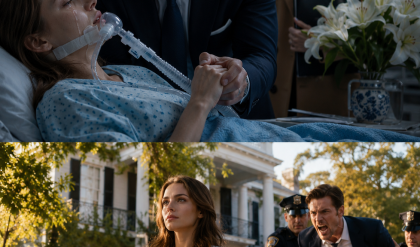
Another tear gathered anyway.
By 4:05, the EEG technician arrived with equipment and a resentful expression that vanished when Dr. Hart said, “Potential covert consciousness under imminent withdrawal pressure.”
The technician stopped complaining.
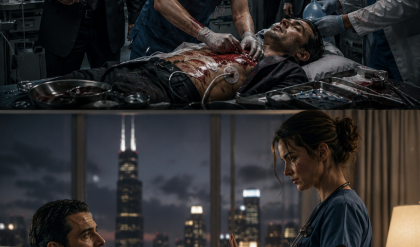
Electrodes were placed. Data crawled across screens. Dr. Hart ran a structured command protocol. The second neurologist, Dr. Owen Feld, arrived halfway through and began asking questions with the cautious skepticism of a man determined not to be pulled into hospital politics without proof.
He got his proof slowly.
Not perfectly. Not dramatically. Not the kind that made television doctors throw open doors and announce miracles. But enough.
Nathan Whitaker showed reproducible signs of auditory processing. He showed command-specific brain activity. He was not able to move, speak, or open his eyes on request, but some part of him was receiving the world and trying to answer from inside the dark.
At 4:51, Dr. Feld looked at Dr. Hart and said, “Withdrawal this morning would be indefensible.”
Grace gripped the end of the bedrail.
The first battle had been won.
The war arrived at 6:07.
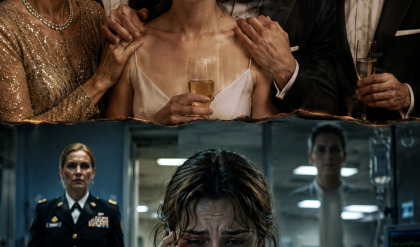
Preston Whitaker walked into the ICU with two attorneys, his mother, and his sister.
Eleanor Whitaker looked fragile beneath her perfect coat, as if grief had hollowed her out and money had taught her to make the hollowing tasteful. Julia, Nathan’s younger sister, wore sunglasses despite the hour. Preston carried himself like a man entering a room he already owned.
He stopped when he saw Dr. Hart, Dr. Feld, the ethics officer, and a security guard near the door.
“What is this?” he asked.
Dr. Hart did not soften her voice. “A medical review.”
“At six in the morning?”
“Your timeline made it necessary.”
Preston’s eyes moved to Grace. For one brief second, his expression lost all polish. Then he recovered.
“My family has made a decision,” he said. “Nathan would not want to live like this.”
Dr. Feld stepped forward. “Your brother has demonstrated signs of covert awareness. He is not brain-dead. He has not been declared medically futile. Withdrawal of support is suspended pending further review.”
Eleanor put a hand over her mouth. “Aware?”
Julia whispered, “What does that mean?”
Preston spoke before the doctors could answer. “It means nothing certain. It means machines and frightened staff are giving you false hope.”
Grace looked at Eleanor then. Not at Preston. Not at the lawyers. At the mother.
“He cried after your son said Nathan was worth more dead,” Grace said.
The room snapped silent.
Preston’s head turned slowly toward her.
“Excuse me?”
Grace’s throat tightened, but she did not look away. “I was in the bathroom restocking supplies. I heard what you said.”
One of the attorneys moved quickly. “This is inappropriate.”
“No,” Dr. Hart said. “Rushing withdrawal before proper review was inappropriate. Documented staff intimidation is inappropriate. This is now an ethics matter.”
Preston smiled then. It was a small smile, controlled and almost pitying.
“Young lady,” he said to Grace, “you are confused, exhausted, and clearly emotionally involved.”
“I’m a nurse,” Grace replied. “Exhausted is normal. Confused is not.”
Julia lowered her sunglasses.
Eleanor stared at Preston as if seeing him through a crack in glass.
Preston turned to his mother. “Mom, don’t let strangers turn this into a circus. Nathan is suffering.”
Dr. Hart said, “We do not know that. We also do not know his wishes well enough to justify what you were attempting.”
“He is my brother.”
“He is my patient.”
The sentence landed like a door locking.
By 7:30, the withdrawal order was formally halted. By 8:00, security had been assigned to Nathan’s room. By 8:15, Preston’s private access had been revoked pending review. By 8:45, the hospital’s legal department had become extremely interested in every piece of paper Preston’s attorneys had brought.
Grace should have felt safe.
Instead, she felt the specific dread that came when powerful people were not defeated, only inconvenienced.
Because Preston did not rage. He did not collapse. He did not beg.
He watched.
And men who watched that calmly were usually deciding where to cut next.
The twist came from a woman nobody in the family had bothered to invite.
At 11:26 that morning, a red-haired woman in a wet trench coat appeared at the ICU doors and demanded to see Nathan Whitaker. Security stopped her. She said her name was Lily Grant. Grace recognized the name because she had seen it in one of Nathan’s old interviews: former chief operating officer of Whitaker Systems, forced out six months earlier after a public dispute Nathan had refused to explain.
“I know he’s not dead,” Lily said. “And I know Preston is trying to make him dead before he can talk.”
That got Dr. Hart’s attention.
Lily was brought into a private conference room with Grace, Dr. Hart, the ethics officer, and hospital counsel. She looked exhausted, angry, and terrified in the way people are terrified when they have spent too long carrying evidence alone.
“Nathan called me the night before the crash,” Lily said. “We hadn’t spoken in months because he thought I betrayed him. I didn’t. Preston framed me.”
Hospital counsel folded his hands. “Framed you how?”
“Fake vendor contracts. Offshore licensing fees. Money routed through shell companies tied to Preston’s charity foundation. Nathan thought I approved them. When I realized what was happening, I tried to warn him, but Preston got there first. I was fired, publicly humiliated, and threatened with criminal exposure if I talked.”
Grace glanced toward the ICU hallway.
Lily opened her bag and pulled out a sealed envelope inside a plastic sleeve.
“Nathan didn’t trust easily,” Lily said. “But he trusted systems. He built fail-safes into everything. Two weeks ago, he came to my apartment and gave me this. He said if he died, disappeared, or was declared unable to make decisions while Preston was pushing for control, I should take it to a lawyer named Alan Pierce.”
“Why didn’t you?” Dr. Hart asked.
Lily’s face tightened. “Because the morning after the crash, Preston called me and told me if I surfaced, he’d make sure the fraud landed on me. Then I saw the news saying the family might withdraw support, and I realized silence was exactly what he needed.”
The envelope contained a notarized directive.
Nathan had named Alan Pierce, an independent attorney, as emergency medical proxy in the event of family conflict. He had explicitly stated that no withdrawal of life support could proceed based solely on family request if there was any evidence of awareness, coercion, or unresolved criminal investigation involving a family member.
There was also a flash drive.
And a handwritten note.
If Preston tries to end my care quickly, he is not grieving. He is cleaning up.
Grace read the line twice.
The room seemed to shrink around it.
By noon, Alan Pierce had been reached. By one, a judge had been contacted for emergency clarification. By two, the hospital had no choice but to treat Preston not as a grieving family member but as a potential threat to the patient. By late afternoon, Seattle police detectives had entered the building.
The story Preston had built began to crack.
And Nathan, silent in the ICU, remained trapped inside the center of it.
For the next four days, Grace spoke to him as if he could understand every word because now she knew he might.
She told him Lily had come. She told him his directive had been found. She told him his brother no longer had the power to decide whether he lived through the night. She told him Dr. Hart was impossible to scare, which she suspected he would appreciate.
Sometimes his heart rate changed.
Sometimes tears appeared.
Once, when Grace told him Preston’s foundation was being audited, the monitor jumped so sharply that she looked at Nathan’s face and said, “That better not be you laughing, because I am not explaining sarcasm to neurology.”
Dr. Hart, standing at the chart station, almost smiled.
Nathan’s progress came in fragments so small that people who did not understand critical care would have missed them.
His breathing became more stable. His sedation was reduced. His eyes opened for seconds at a time, unfocused at first, then drifting toward voices. His right hand twitched once when Dr. Hart asked him to imagine squeezing. It was not enough for speech. It was not enough for television miracles. It was enough to keep going.
The first reliable yes came on day six.
A speech therapist named Monica created a blink system. One blink for yes. Two for no. At first, Nathan’s eyelids were too heavy and inconsistent. He grew exhausted quickly, and frustration made his blood pressure rise. Grace had to remind the room twice that being desperate for answers did not give anyone the right to torture a patient with questions.
Finally, after twenty minutes of careful pacing, Monica asked, “Do you know you are in the hospital?”
One blink.
“Do you remember the crash?”
One blink.
“Was it an accident?”
Nathan’s eyes stayed open.
Then he blinked twice.
Grace felt the air leave her lungs.
Monica looked toward Dr. Hart.
Dr. Hart said, “Ask again later. Different phrasing.”
They did.
The answer remained no.
By the end of the session, using an alphabet board that nearly exhausted him, Nathan spelled two words:
CAR TAKEN
The police came back before dinner.
It turned out Nathan’s car had been moved from his private garage to a service facility forty-eight hours before the crash. The service had been arranged by Preston’s assistant through a contractor connected to one of the shell vendors Lily had identified. The official reason was a software calibration issue. The technician listed on the paperwork could not be found at the address provided.
The detective assigned to the case, Mara Ellison, did not look impressed by rich-family grief.
“Money makes people think they invented doors,” she told Grace after interviewing her. “Mostly it just buys them better hiding places.”
Over the next two weeks, hiding places opened.
Emails surfaced. Shell accounts surfaced. A draft board resolution surfaced that would have allowed Preston to assume emergency control of Whitaker Systems upon Nathan’s death. A private message from Preston to one attorney referred to the hospital situation as “time-sensitive” and “financially unrecoverable if prolonged.”
Then investigators found footage from the garage.
The image was grainy, but clear enough: Nathan leaving his office the night of the gala, pausing beside his car, arguing with Preston near the driver’s door. Preston smiling. Nathan shoving a folder against Preston’s chest. Preston picking it up after Nathan walked away.
The next camera showed an unknown man accessing the car later that evening.
Rain had covered many sins on the bridge, but not all.
The news broke on a Thursday.
BILLIONAIRE CEO’S COMA SPARKS CRIMINAL PROBE INTO BROTHER.
Reporters camped outside St. Bartholomew by sunset. The hospital tried to issue a statement about patient privacy and ethical care, which was a polished way of saying they had almost let a donor’s family rush a man into death before a nurse made it inconvenient.
Grace’s name leaked two days later.
She hated it.
Her phone filled with messages. Some were kind. Some were strange. Some asked for interviews. A morning show producer wrote that America needed “heroes like her,” which made Grace want to throw her phone into the laundry bin. Her landlord suddenly became friendly. A cousin she had not seen in nine years asked whether the billionaire had given her a house yet. The hospital’s communications director suggested a controlled media appearance. Grace declined so firmly Dr. Hart later told her she had never been prouder.
“I’m not a mascot,” Grace said.
“No,” Dr. Hart replied. “You’re worse for them. You’re a witness.”
Nathan’s recovery was not beautiful.
It was humiliating, painful, slow, and often ugly. When the ventilator tube came out, his voice was a shredded whisper. When he tried to lift a spoon, it slipped from his fingers. When physical therapy sat him upright, sweat soaked through his shirt in minutes. He had headaches that made light feel violent. His right side lagged behind his left. His temper returned before his strength did, which would have been funny if it had not made him miserable.
The first time he knocked a water cup off the tray in frustration, everyone in the room went still.
Grace picked up the cup, wiped the floor, and said, “That may have scared people in boardrooms, but it does nothing for linoleum.”
Nathan stared at her.
His mouth twitched.
It took him three tries to rasp, “Noted.”
The man coming back was not the man the magazines had sold.
He was thinner. Quieter. Stripped of performance by pain. He still had the sharp intelligence in his eyes, but arrogance did not sit on him as comfortably anymore. It had survived the crash, yes, but it no longer looked invincible. It looked tired.
One afternoon, after Lily visited, Nathan asked for a notepad.
His handwriting was nearly unreadable at first, jagged and drifting down the page. Grace stood beside the bed while he fought through the effort of forming one sentence.
Did I ruin her life?
Grace looked at the words.
“You helped Preston do it,” she said honestly. “Whether you knew the truth or not, you let him make her the villain because it was easier than admitting someone close to you could be corrupt.”
Nathan closed his eyes.
His throat worked. “I was sure.”
“You were wrong.”
A long silence followed.
Then he whispered, “I was cruel.”
Grace leaned against the counter. “You were.”
There was no dramatic forgiveness in the room. No sudden redemption. No soft music. Just a damaged man learning that survival did not erase accountability.
“I thought,” he whispered, each word scraped raw, “being feared kept me safe.”
Grace looked at the scar near his hairline, the tremor in his hand, the bruise yellowing along his collarbone.
“How did that work out?”
His eyes opened.
For one second, she thought he might be offended.
Then he gave the smallest, bleakest laugh she had ever heard.
Preston was arrested three weeks after the crash.
He did not run. Men like Preston rarely imagined consequences catching them fast enough to justify running. He walked out of his downtown office in a tailored coat while cameras flashed and his attorneys shouted about misunderstanding, stress, and an unfortunate family tragedy exploited by outsiders.
Nathan watched the footage from his hospital bed.
His mother sat beside him, weeping silently. Eleanor Whitaker had aged ten years in three weeks. She had believed Preston because believing him had allowed her to avoid knowing her family was a battlefield. Now she sat with that knowledge folded in her lap like a sentence.
“I signed,” she whispered.
Nathan turned his head slowly toward her.
She covered her mouth. “I signed because he told me you were already gone.”
Nathan lifted his left hand with difficulty.
It took him a long time to reach hers.
When he did, he did not squeeze hard. He could not.
But Eleanor broke.
“I’m sorry,” she sobbed. “I am so sorry.”
Nathan’s voice was faint. “You were lied to.”
“I should have asked more.”
“Yes,” he whispered.
The honesty hurt her, but it also steadied something. Grace saw it happen. Forgiveness, real forgiveness, did not pretend harm had not occurred. It simply refused to let harm be the only thing left standing.
Preston’s case became bigger than anyone expected.
Financial fraud. Attempted coercion in medical decision-making. Conspiracy related to vehicle tampering. Obstruction. The crash investigation was complicated, and not every charge was clean enough for easy headlines, but the pattern was clear. Preston had been stealing from the company, framing Lily, positioning himself to take control, and racing against Nathan’s possible recovery.
Nathan’s near-death had not been tragedy to him.
It had been opportunity.
As the case moved toward trial, Nathan moved from ICU to rehab.
Grace was no longer his assigned nurse every shift, but she saw him often enough. Sometimes he asked for her because he trusted her to tell the truth without decorating it. Sometimes she avoided his room because she had other patients and refused to become part of the mythology forming around him.
One evening, she found him in the rehab gym, standing between parallel bars, sweat on his forehead, jaw clenched hard enough to crack teeth.
“Again,” he said to the therapist.
“You need rest,” the therapist replied.
“Again.”
Grace folded her arms from the doorway. “Still trying to bully gravity?”
Nathan looked up. “Gravity is persistent.”
“So are medical professionals who know when you’re being stupid.”
The therapist smiled behind her clipboard.
Nathan lowered himself into the wheelchair, furious but obedient.
That was progress too.
A month after the crash, Nathan asked to meet with Diego Morales, the assistant he had fired the morning before the gala.
Diego had worked for Nathan for five years. According to everyone, Nathan had once thrown a cold latte against the wall because Diego brought almond milk instead of oat milk before a board call. Diego had not visited earlier. Grace did not blame him.
When Diego finally entered the rehab room, he looked like a man returning to a house after a fire, unsure whether he wanted memories or ashes.
Nathan sat upright in bed with a blanket over his legs and a notepad on the tray.
Diego stayed near the door. “You asked for me?”
Nathan nodded.
His hand trembled as he wrote.
I treated you like you were furniture with a pulse.
Diego read it. His expression did not change, but his throat moved.
Nathan wrote again.
You kept my life running while I made yours smaller.
Grace looked away, pretending to adjust an IV pole that did not need adjusting.
Diego laughed once, bitterly. “You were a nightmare.”
Nathan whispered, “Yes.”
“You made people afraid to make mistakes.”
“Yes.”
“You paid well, so everyone acted like that made it fine.”
Nathan looked down.
Then he wrote one final sentence.
It was not fine.
Diego stared at the words for a long time.
“I don’t forgive you yet,” he said.
Nathan nodded once.
“But I’m glad you’re not dead.”
Nathan’s eyes shone.
Diego added, “Mostly because Preston would have enjoyed that too much.”
Nathan gave a weak sound that might have become laughter if his ribs had allowed it.
That meeting changed something in the room. Not because it fixed the past, but because it named it. Sometimes naming harm was the first honest act after years of polished abuse.
The trial began seven months later.
By then Nathan could walk with a cane. His speech had improved, though long conversations still exhausted him. Whitaker Systems had survived but shrunk. Half the old board resigned under pressure. Lily returned as interim CEO, then permanent CEO after Nathan publicly refused to take back command until he could prove he had learned the difference between control and leadership.
That statement alone shook the tech world more than the scandal had.
Men who had praised Nathan’s cruelty as “focus” now wrote thoughtful essays about workplace culture. Grace suspected most of them had simply learned new vocabulary for self-preservation.
Preston entered court every morning in immaculate suits.
He looked calm. He looked saddened. He looked like a man prepared to forgive the world for misunderstanding him.
Then the evidence spoke.
The shell companies spoke.
The emails spoke.
The garage footage spoke.
The forged vendor contracts spoke.
The hospital paperwork spoke.
Grace spoke too.
On the witness stand, she described the night she overheard Preston. She described the tear. She described the physiological responses, her documentation, Dr. Hart’s evaluation, the halted withdrawal, and Preston’s threat about staff being replaceable.
Preston’s attorney tried to make her look emotional.
“Miss Miller, you were working a double shift, correct?”
“Yes.”
“You were tired?”
“Yes.”
“Under stress?”
“I work ICU. Stress is part of the furniture.”
A few people in the courtroom shifted.
The attorney smiled thinly. “Is it possible you misinterpreted a grieving brother’s words?”
Grace looked at Preston.
He held her gaze with the same cold confidence he had shown in Room 1208.
Then she looked back at the jury.
“No,” she said. “Grief asks how to save someone. He asked how soon my patient could die.”
The courtroom went completely still.
Nathan testified on the third week.
He walked to the stand slowly, with a cane in his left hand and Dr. Hart watching from the back row as if she might personally strike down anyone who rushed him. His voice was rough but clear enough.
The prosecutor asked what he remembered.
Nathan took a breath.
“I remember my brother in my hospital room,” he said. “I could not move. I could not open my eyes. But I heard him.”
Preston stared straight ahead.
Nathan continued. “He said I was useful dead.”
The prosecutor asked, “What did you feel?”
Nathan looked down at his hand, the one that still trembled when he was tired.
“I had spent my life making people feel powerless,” he said. “In that bed, I learned what powerlessness actually was. I heard my brother planning to end my life, and I could not even say no.”
Grace felt her throat tighten.
The jury listened as if the room itself had leaned forward.
When the verdict came, it was not as dramatic as people expected. There was no screaming. No collapse. No confession shouted across the courtroom. Just the foreperson reading guilty again and again while Preston’s face slowly emptied of expectation.
Consequence did not roar.
It clicked into place.
Preston was led away looking smaller than he had ever looked in the ICU. Not sorry. Grace did not believe that. But reduced. For a man who had worshipped control, reduction was its own punishment.
A year after the crash, St. Bartholomew looked the same from the street.
Same glass tower. Same valet loop. Same expensive lobby flowers. Same donor wall with names in brushed metal. But inside, some things had changed.
There was now an independent patient advocacy office on the second floor, funded by a trust Nathan created but forbidden from carrying his name. Nurses could escalate family pressure without going through donor-facing administrators. Ethics reviews had new emergency triggers. Staff education included covert consciousness, medical proxy conflicts, and the danger of treating wealth as authority.
The changes were not perfect.
Hospitals did not become brave overnight.
But they became a little harder to bully.
Grace’s mother got better insulin coverage through a private medical trust Nathan established quietly, though Grace had argued with him for nearly an hour before accepting it.
“This is not payment,” Nathan told her.
“It has a dollar amount,” Grace replied. “That usually makes something payment.”
“It’s repair.”
“You didn’t hurt my mother.”
“No,” he said. “But I benefited from a world where people like you carry impossible burdens quietly while people like me mistake that silence for consent.”
Grace had no quick answer for that.
He also created a scholarship for ICU nurses from working-class families and a legal defense fund for hospital staff who reported coercion in end-of-life decisions. Grace liked those better. They did not feel like charity. They felt like weapons placed in the right hands.
On the anniversary of the crash, Grace worked another double shift because symbolism did not pay rent.
Near midnight, she walked into the break room and found a small cardboard box on the table with her name written across the top in careful black marker.
Inside was a ceramic mug.
It was not fancy. No gold rim. No diamond nonsense. Just a deep blue mug with one line printed in white:
I’M STILL HERE.
Grace laughed before she could stop herself.
There was a note beneath it.
Grace,
You once told me that hearing the truth creates a responsibility. I hated that sentence when you said it because I knew it applied to me too.
I am still here because you listened.
Other people will be too because you spoke.
—Nathan
Grace sat down slowly.
The break-room coffee was as terrible as ever. It tasted like cardboard had been frightened by a coffee bean at some point in its childhood. She poured it into the mug anyway and held it between both hands.
For a while, she thought about Room 1208.
She thought about the tear on Nathan’s cheek. The attorneys with their folders. Preston’s voice turning death into a business plan. Eleanor’s grief. Lily’s envelope. Dr. Hart’s refusal to be rushed. Diego standing in a doorway and hearing an apology that came too late but not never.
She thought about the most unsettling lesson of all.
Nathan Whitaker had not been saved by money.
Money had nearly killed him.
He had been saved by ordinary acts performed by people the powerful often overlooked: a nurse who stayed, a doctor who questioned, a former executive who returned with evidence, an assistant who refused to let bitterness make him useless, a mother who finally admitted she should have asked more.
There was no magic in it.
Only attention.
Only courage.
Only the decision to speak while speaking still mattered.
Grace took another sip of awful coffee and stood. Somewhere down the hall, a monitor alarm began its urgent call. A family needed an update. A patient needed suctioning. A frightened old man in room 1211 had been asking for his daughter every ten minutes because dementia stole morning before it stole love.
The night was not finished.
It never was.
Grace rinsed the mug, set it carefully in her locker, and stepped back into the corridor.
The machines kept blinking. The rain kept tapping against the windows. Behind every closed door was a life that depended on someone noticing the difference between silence and surrender.
This time, Grace already knew what she would do.
THE END