“Why?” I asked. “Why pay for him and let Nico take credit?”
Roman leaned back in his chair, studying me. “Because your father saved my wife’s life long enough for me to say goodbye. That kind of debt doesn’t belong in a press release.”
“And Nico?”
“My son took something that wasn’t his.”
“Your son took everything that wasn’t his.”
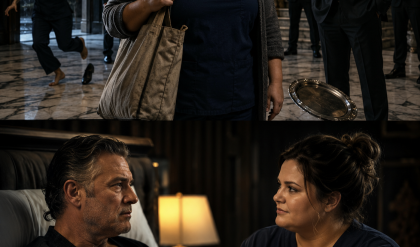
I walked to the desk before I could lose my nerve. Up close, Roman was more intimidating, not because he was loud, but because he was perfectly still. Nico had always performed confidence. Roman possessed it.
“I was going to sleep with him tonight,” I said.
His eyes darkened.
The words should have embarrassed me. They did not. Shame had burned off in the hallway.
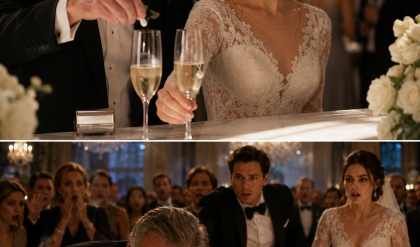
“I bought this dress for him. I bought champagne I couldn’t afford. I was going to give him my first time because I thought he had saved my father and because I thought maybe gratitude could become love if I tried hard enough.”
Roman stood.
Slowly.
The room seemed to shrink around him.
“Avery,” he said, his voice lower now. “Go home.”
“No.”
“You’re hurt.”
“Yes.”
“You’re angry.”
“Yes.”
“And that makes this the worst possible moment to make a decision you can’t take back.”
I looked up at him. “For the first time in eight months, I think I’m seeing things clearly.”
His mouth tightened. “No, you’re bleeding. There’s a difference.”
I hated that he sounded reasonable. I hated that he did not look at me like Nico had looked at me, like a prize almost won. Roman looked at me like a match held too close to gasoline.
Dangerous.
Seen.
“You paid my father’s bills,” I said. “You never asked me for a thing.”
“I still don’t.”
“That’s the problem.”
His eyes narrowed.
“I have spent almost a year feeling owned by the wrong man,” I whispered. “Tonight I found out the debt was real, but the man I owed was not my boyfriend.”
“You owe me nothing.”
“Don’t say that.”
“It’s true.”
“No.” My voice cracked. “It can’t be true. Because if it’s true, then I gave Nico all that gratitude for nothing. I made myself small for nothing. I let him touch me, lie to me, laugh at me, for nothing.”
Roman came around the desk, not touching me, just close enough that I could feel the force of him.
“You want revenge,” he said.
“I want to stop feeling stupid.”
“That is not the same thing.”
“I want him to know he lost something.”
Roman’s eyes dropped briefly to my mouth, then back up.
“You are not something,” he said. “And I will not use you to teach my son a lesson.”
The refusal should have humiliated me. Instead, it split something open.
Because Nico would have taken.
Roman, who everyone called a monster, was refusing.
I stepped closer. “What if it isn’t about him?”
“It is.”
“What if I want you?”
His breath changed. Barely. But I heard it.
“You don’t know me,” he said.
“I know you paid for my father and never put your name on it. I know you could have let me keep believing Nico was good, but you didn’t lie when I asked. I know you just told me to go home when another man would have taken advantage of me before I could think twice.”
“That does not make me good.”
“No,” I whispered. “It makes you honest.”
For a long second, the only sound was the ice settling in his glass.
Then Roman lifted one hand. I thought he might touch my face. Instead, he stopped himself with visible effort and let his hand fall.
“Last warning,” he said. “If you stay in this room, you do it as a grown woman making a choice. Not as Nico’s victim. Not as my debtor. Not as a girl trying to burn down her pain with a match she doesn’t understand.”
“I understand enough.”
“No, you don’t.” His voice turned rough. “Men like me don’t love gently, Avery. We protect too hard. Hold too tight. Mistake fear for strategy and possession for safety. I am old enough to know better and selfish enough to want you anyway.”
My heart hammered so hard it hurt.
“Then be better,” I said.
His eyes locked on mine.
“What?”
“If you want me, be better than that.”
Something moved through his expression then, something I could not name.
Respect, maybe.
Or hunger learning restraint.
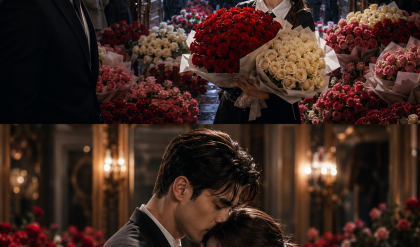
He leaned down slowly, giving me every chance to step away. I did not. His mouth touched mine, not taking, not claiming. Asking.
That was what undid me.
Not force. Not fury.
Permission.
I kissed him back.
The world did not explode. It narrowed. To his hand hovering near my waist until I caught his wrist and placed it there myself. To his breath catching when I rose onto my toes. To the quiet sound he made when I said his name, not Mr. Mercer, not Nico’s father.
“Roman.”
His control broke at the edges.
He kissed me again, deeper this time, and my grief changed shape. It did not disappear. It became fire. It became decision. It became the terrifying knowledge that I had walked into the wrong wing of the penthouse and found the first man all night who treated my choice like something sacred.
When he finally pulled back, his forehead rested against mine.
“You can still leave,” he said.
“I know.”
“Say it.”
“I can leave.”
“Do you want to?”
I closed my eyes.
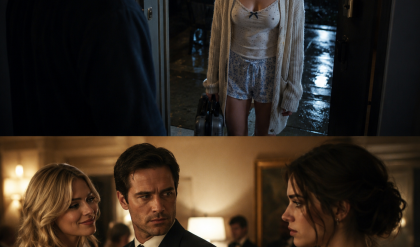
Behind me was Nico’s laughter. Tessa’s betrayal. A red dress bought for a lie.
In front of me was a dangerous man with honest hands.
“No,” I whispered. “I don’t.”
That night, Roman did not take anything from me.
I gave.
And because he understood the difference, I stayed.
Morning came too bright.
Sunlight poured through floor-to-ceiling windows, turning the harbor silver and cruel. I woke in Roman Mercer’s private bedroom wrapped in white sheets, my crimson dress folded over a chair instead of discarded on the floor. For a few seconds, I did not remember where I was.
Then memory returned.
Nico.
Tessa.
Roman.
My first time.
My choice.
My stomach twisted anyway.
Choice did not erase consequences.
I sat up, clutching the sheet to my chest, and found Roman standing near the window in a fresh charcoal suit, phone pressed to his ear. His hair was damp from a shower. He looked composed, powerful, impossible.
“Yes,” he said into the phone. “No public statement. Not yet. Keep Nico in the building until I speak with him.”
My pulse jumped.
He ended the call and turned.
“You were going to leave while I was asleep,” he said.
I looked at the door.
“Maybe.”
“I didn’t lock it.”
“I know.”
That made it worse somehow.
He crossed the room but stopped several feet away, as if he had drawn an invisible line and refused to cross it without permission.
“Your father’s treatment continues,” he said.
My throat tightened. “I didn’t ask.”
“I’m telling you so you don’t spend the next five minutes wondering whether last night changed that. It didn’t. It was never payment. It never will be.”
Tears burned my eyes before I could stop them.
“Then what happens now?”
Roman looked older in the morning. Not weaker, but more human.
“That depends on you.”
I laughed once, bitterly. “You say that like I can go back to my old life.”
“You can.”
“Can I?” I threw back the sheet and stood, dragging it with me. “Nico is going to tell everyone. Tessa will help. By lunch, I’ll be the girl who slept with her boyfriend’s father. By dinner, my coworkers will whisper. By tomorrow, my landlord will know. My mother will hear it from someone at church before I can explain. My sister is seventeen. Kids at her school will turn it into a joke.”
Roman did not interrupt.
That made my voice shake harder.
“And the worst part? Nico will still be Nico Mercer. Rich. Forgiven. Drunk at another party by Friday. I’ll be the scandal.”
Roman’s eyes went cold.
“He will not be forgiven.”
I believed him, and that scared me.
“What are you going to do?”
“What I should have done a long time ago.”
“Roman.”
His name stopped him.
“I don’t want blood on this.”
A faint, humorless smile touched his mouth. “You think I solve every problem with blood?”
“I think people think that for a reason.”
“Fair.”
The honesty almost made me laugh.
He walked to the chair and picked up my dress. “Francesca is bringing clothes. Breakfast too, if you can eat.”
“I need to go home.”
“I’ll have a car take you.”
I stared at him.
“You’re letting me leave?”
His expression tightened. “I told you. The door was never locked.”
I wanted relief.
Instead, I felt something more complicated.
“Then why does it feel like I’m not free?”
Roman was quiet for a long moment.
“Because freedom isn’t the same as safety,” he said. “And right now, you have one but not the other.”
He handed me the dress.
“There is another option.”
Every instinct in me sharpened. “What option?”
“My name.”
I froze.
“No.”
“You haven’t heard the terms.”
“I don’t need to.”
“You do.” He stepped back, giving me space as if discussing marriage with a near stranger in the aftermath of betrayal was a reasonable morning activity. “Nico will try to turn you into a joke because that is what weak men do when they lose control of the story. If you leave here as Avery Rhodes, former girlfriend, he can do damage. If you leave here as Avery Mercer, my wife, he becomes a man who insulted my household.”
“That’s insane.”
“Yes.”
“At least you admit it.”
“I rarely lie.”
I clutched the dress. “You want to marry me because of gossip?”
“No. I want to marry you because last night you walked into my office broken and still demanded truth. Because you looked at a man everyone fears and told him to be better. Because my son spent eight months beside you and never understood what he had, and I understood in one conversation.”
Heat rose to my face.
“That’s not love.”
“No,” he said. “Not yet.”
The words struck me silent.
Not yet.
He moved to the desk near the window and picked up a folder.
“This is a contract,” he said. “One year. Separate room if you choose. Your father’s care guaranteed whether you sign or not. Your apartment stays in your name. Your job stays yours unless you decide otherwise. You finish your degree. You have access to security, legal protection, and my resources. At the end of twelve months, you can annul the marriage and leave with a settlement large enough that no man’s gratitude will ever own you again.”
I stared at the folder as if it were alive.
“And if I say no?”
“I take you home. I deal with Nico. Your father continues treatment. You owe me nothing.”
“Then why offer this?”
His face changed.
Just a little.
Loneliness, I realized.
Not weakness. Never that.
But a loneliness so old it had learned to stand like pride.
“Because I have spent seven years building walls high enough to keep everyone out,” Roman said. “And last night, for reasons I am too old and too honest to romanticize, you walked through them.”
I should have said no.
Any sensible woman would have.
But sensible women did not stand in borrowed sheets after sleeping with their boyfriend’s father because the world had cracked open and shown them the machinery underneath.
Sensible women did not have fathers whose hospital bills could bury three generations.
Sensible women did not know what it felt like to be publicly ruined before the first rumor had even been posted.
I opened the folder.
The contract was real.
So were the signatures from his attorneys.
So was the clause guaranteeing my father’s medical care regardless of my answer.
That clause made the decision harder, not easier.
Because it meant Roman was not trapping me.
He was offering a cage with the door open and asking whether I wanted to turn it into armor.
“I have conditions,” I said.
His eyes sharpened.
“Name them.”
“No touching me unless I ask.”
“Done.”
“No decisions about my father without me.”
“Done.”
“My mother and sister never get threatened, watched, or manipulated.”
A muscle moved in his jaw. “Protected, but not controlled.”
“Roman.”
“Done.”
“I keep my name professionally.”
“Done.”
“If I ask for the truth, you give it to me.”
That one made him pause.
“All right,” he said. “But don’t ask questions you want pretty answers to.”
“I stopped wanting pretty answers last night.”
For the first time, Roman smiled.
Not kindly.
Not softly.
Proudly.
The wedding happened forty-eight hours later in a stone chapel on Beacon Hill during a rainstorm.
I wore cream, not white. Roman had chosen it, and I hated that he had been thoughtful enough to avoid pretending I was something untouched by consequence. There were only six witnesses: his attorney, his priest, Francesca, two guards, and my mother, who held my hand in the bridal room and cried without asking the questions I was not ready to answer.
My father could not leave the rehab facility yet, but Roman had arranged a private video call before the ceremony.
Dad looked thinner than before the shooting. His left hand trembled in his lap, but his eyes were clear.
“You don’t have to do anything for my sake, Ave,” he said.
“I know.”
“Do you?”
I swallowed. “Yes.”
He studied me through the screen.
“Are you afraid of him?”
I thought about Roman’s hands stopping themselves. Roman’s contract. Roman telling me the door had never been locked.
“No,” I said. “I’m afraid of what my life becomes if I keep letting other people decide my worth.”
Dad was quiet.
Then he nodded.
“Then stand up straight when you say your vows.”
So I did.
Roman waited at the altar in a black suit, his face unreadable to everyone but me. When I reached him, he leaned slightly closer.
“Last chance,” he murmured.
My mouth almost curved.
“Still saying that?”
“Always.”
The priest spoke of covenant, patience, loyalty, and mercy. Words too holy for the mess that had brought us there. Yet when Roman slid the ring onto my finger, his hand was steady. The diamond was not as large as I expected. It was an antique emerald-cut stone, elegant and heavy without screaming.
A warning, yes.
But also a promise.
When the priest told him he could kiss the bride, Roman waited.
In front of everyone, he waited for me.
So I rose on my toes and kissed him first.
That was the first rumor Nico could not control.
The second was the photograph Roman released the next morning: my hand in his, my ring visible, my mother beside us smiling through tears.
The caption was simple.
Mrs. Avery Rhodes Mercer.
No explanation.
No apology.
Nico posted ten minutes later.
Then deleted it.
Tessa posted a crying story about betrayal and fake friends.
Then deleted that too.
I learned later why.
Francesca.
Francesca DeLuca was Roman’s chief of security, advisor, and, as far as I could tell, the only person alive who could call him an idiot to his face and remain employed. She was in her fifties, with silver-black hair, sharp cheekbones, and the patience of a loaded gun.
On my third morning as Mrs. Mercer, she placed a tablet in front of me at breakfast.
“Your friend had three burner accounts ready,” she said. “Nico had a podcast interview scheduled. Both canceled.”
I stared at the tablet. “What did you do?”
“Nothing permanent.”
“That is not comforting.”
“It wasn’t meant to be.”
Roman, seated at the other end of the table with coffee and financial reports, did not look up.
“You asked that your family not be controlled,” he said. “You said nothing about people trying to destroy you.”
“I don’t want you ruining Tessa.”
Francesca arched a brow. “Generous.”
“No,” I said. “Tired. There’s a difference.”
Roman looked up then.
“What do you want?”
The question should have been simple. It wasn’t. For most of my life, what I wanted had been smaller than what was needed. Rent was needed. Dad’s medication was needed. My sister’s school fees were needed. Want was a luxury I visited in store windows.
“I want to know how the world works,” I said.
Roman set down his coffee.
“The real world?”
“Yes.”
His eyes held mine.
“Then learn the numbers.”
That was how my apprenticeship began.
Not with guns or secrets whispered in dark rooms, but with spreadsheets.
Shipping manifests. Payroll records. Foundation grants. Construction bids. Port schedules. Legal entities nested inside holding companies like dolls inside dolls. Roman did not explain gently. He slid files across his desk and said, “Find the lie.”
At first, I hated him for it.
Then I found one.
A two-percent discrepancy in overtime allocations on a warehouse expansion project in South Boston. Small enough to hide. Large enough to steal from men who clocked in before sunrise.
Roman stared at the page I marked in red.
“How did you see that?”
“My dad worked union jobs,” I said. “Overtime never rounds clean unless someone is shaving it.”
His expression shifted with that same quiet pride I was beginning to crave.
“Again,” he said, handing me another file.
So I learned.
Self-defense at ten. Financial review at noon. College coursework in the afternoon. Dinner with Roman when he was home, alone when business pulled him away.
He kept his promise. He did not touch me unless I asked.
That should have made things easier.
It made them unbearable.
Because Roman Mercer asking was more dangerous than Roman Mercer taking could ever have been.
Some nights he sat across from me in the library, reading glasses low on his nose, one hand resting near a glass of whiskey. I would look up from my textbooks and find him watching me. Not hungrily, though sometimes that was there. Not possessively, though that was always there.
Carefully.
As if I were something he wanted badly enough to fear mishandling.
Three weeks after the wedding, he called me into his office during a thunderstorm.
A man sat opposite his desk, sweating through his shirt.
“Elliot Vance,” Roman said. “Chief financial officer for Mercer Port Logistics.”
I recognized the name from reports.
I also recognized the numbers in the folder Roman handed me.
“You found the leak,” Roman said.
My stomach tightened. “The overtime theft?”
“And equipment invoices. And medical insurance deductions that never reached the provider.”
Elliot Vance turned gray.
“It was temporary,” he stammered. “Cash flow issue. I was going to pay it back.”
Roman looked at me.
“What should happen?”
The room went still.
It was a test.
Not of cruelty.
Of judgment.
I looked at Elliot. He was maybe forty, soft-handed, expensive watch, wedding band, panic in his eyes.
“How many workers lost coverage?” I asked.
He blinked. “What?”
“How many families had claims denied because you stole the deductions?”
He did not answer.
I looked at Roman.
“Get the number.”
Roman’s mouth curved faintly. He nodded to Francesca, who stood by the door. She checked a tablet.
“Seventeen families,” she said. “Four major claims denied.”
My anger became calm.
That frightened me.
“Liquidate what he bought with stolen money,” I said. “House, cars, investments. Pay back every worker with interest. Cover the denied claims personally. Then fire him.”
Elliot sagged with relief.
I was not finished.
“And send the file to federal prosecutors.”
His head snapped up. “Mrs. Mercer, please—”
“You stole health care from working families,” I said. “My father is alive because someone paid a bill he could not. I know exactly what you stole.”
Roman watched me in silence.
“No quiet cleanup,” I told him. “No Mercer solution in a back room. If we’re building legitimate businesses, then we use legitimate consequences.”
For a long moment, I thought Roman would refuse.
Then he leaned back.
“Do it,” he said to Francesca.
Elliot began to cry.
I felt no pleasure in it.
That night, Roman poured two drinks in the library and handed one to me.
“I expected you to bury him privately,” he said.
“I know.”
“You chose court.”
“I chose proof.”
He studied me. “Why?”
“Because fear makes people careful only when they’re being watched. Systems make them careful when no one is watching.”
Roman’s eyes warmed.
“You’re better at this than Nico ever was.”
I flinched at the name.
Roman noticed.
“He called today,” he said.
“What did he want?”
“Money. Forgiveness. Access to the trust I froze.”
“And?”
“I told him no.”
A strange sadness moved through me. Not for Nico exactly. For the version of myself who would have been devastated by his downfall.
“Do you miss him?” I asked.
Roman’s gaze dropped to the glass in his hand.
“I miss the boy I thought I raised,” he said. “But I am beginning to think that boy existed because I paid other people not to tell me the truth.”
The honesty sat between us.
I reached across the space and touched his hand.
He went very still.
It was the first time I had touched him since the chapel without necessity or anger between us.
His eyes lifted to mine.
“Avery.”
“I’m not asking for anything,” I whispered.
“No?”
“No.”
My thumb moved once over his knuckles.
“I’m just here.”
Something in his face broke open, just briefly, before he controlled it again.
But I had seen it.
And after that, I could not unsee him.
The gala came at the end of October.
The Mercer Foundation hosted it every year at the Isabella Stewart Gardner Museum, raising money for trauma care, rehabilitation, and families of injured first responders. My father had been shot outside that same event seven years before, back when I was fifteen and still thought rich people lived in a different species of weather.
Now I arrived as Roman’s wife.
The dress was midnight blue this time, not red. Sleek, long-sleeved, open at the back. Francesca fastened a diamond necklace around my throat and met my eyes in the mirror.
“Armor,” she said.
“It feels heavy.”
“Good armor does.”
Roman waited downstairs.
When he saw me, his expression changed so quickly I almost missed it. Hunger first. Then restraint. Then something softer that frightened me more than both.
“You look,” he began, then stopped.
I smiled faintly. “Careful.”
“You asked me to be better.”
“And?”
His gaze moved over me again, slower this time. “You make it difficult.”
That warmed me for the rest of the drive.
The gala was all chandeliers, string music, polished donors, and women who smiled like knives. The whispers began before we reached the first champagne tray.
“That’s her.”
“Nico’s ex.”
“Roman married the girl?”
“She’s twenty-two.”
“God, the scandal.”
Roman’s hand rested at my lower back.
“Breathe,” he murmured. “They’re only dangerous when you believe they matter.”
“Easy for you to say. You scare them.”
“So will you.”
I almost laughed.
Then I saw Nico.
He stood near the bar in a wrinkled tuxedo, eyes bloodshot, jaw tight. Tessa was beside him in a silver dress, but she looked less triumphant than exhausted. When our eyes met, she looked away.
Nico did not.
He crossed the room with the reckless confidence of a man who had never suffered consequences long enough to respect them.
“Avery,” he said.
Roman’s hand stilled at my back.
“Nico,” I replied.
“You look expensive.”
“And you look drunk.”
A few nearby donors turned.
Nico’s face flushed. “You think this is funny? You ruined my life.”
“No,” I said. “I stopped participating in the lie that made your life comfortable.”
His mouth twisted. “You married my father.”
“You slept with my best friend for a bet.”
The silence around us widened.
Tessa’s face went white.
Nico lowered his voice. “You don’t want to do this here.”
“For once, you’re right.” I stepped closer, keeping my tone calm. “I don’t want to do this anywhere. I don’t want your apologies, your explanations, or your anger. I don’t want your name attached to mine any longer than necessary.”
“You think he loves you?” Nico hissed, glancing at Roman. “He collects debts, Avery. That’s all you are.”
Roman moved.
I touched his wrist.
He stopped.
Not because he wanted to.
Because I asked.
That was when the room changed.
People noticed.
So did Nico.
I looked at the man I had once planned to give my first time to and felt, finally, nothing sharp enough to call heartbreak.
“Your father paid my father’s medical bills because my dad earned his respect,” I said. “You took credit because you had none of your own.”
Nico flinched.
“You used gratitude like a leash. You made my vulnerability into a wager. You laughed at me with someone I trusted. So no, Nico, I don’t care whether Roman loves me in a way this room understands. He has never once pretended my debt belonged to him.”
Tessa made a small sound.
Nico’s eyes shone with anger.
“You think you won?”
“No,” I said. “I think I learned.”
Roman’s voice came then, quiet enough that people leaned in to hear.
“Leave.”
Nico looked at him. “Dad—”
“No.”
One word.
Final.
Nico’s face cracked.
“You raised me.”
“I did,” Roman said. “And I failed you by confusing rescue with character.”
The cruelty of that truth hit everyone.
Even me.
Tessa began crying silently.
Nico looked around the room, searching for allies. He found curiosity. Judgment. Pity. No rescue.
Francesca appeared beside him.
“This way,” she said.
He left because refusing would have been worse.
Tessa lingered.
For a moment, I thought she might apologize.
Instead, she whispered, “I didn’t know about the bet at first.”
The old Avery would have asked what that meant. Would have given her time. Would have made room for an excuse because losing a friend hurt too much.
The woman in diamonds did not.
“But you knew before I did,” I said.
Tessa’s tears fell.
“Yes.”
“That’s the part that matters.”
She nodded as if I had struck her.
Then she followed Nico out.
I expected triumph.
It never came.
Only grief, clean and quiet.
Roman turned me gently toward him.
“You should not have had to do that,” he said.
“I know.”
“Are you all right?”
“No.”
His eyes softened.
I took a breath. “But I will be.”
Later that night, on the balcony overlooking the museum courtyard, Roman found me alone.
Music drifted from inside. The October air smelled like rain and leaves.
“I’m proud of you,” he said.
I did not turn. “Don’t.”
“Why?”
“Because I like it too much.”
He came to stand beside me.
“That isn’t a sin.”
“With you, everything feels like one.”
Roman was quiet.
Then he said, “Do you regret marrying me?”
The question entered me slowly.
A month earlier, I would have said yes because it was the answer a sensible person should give.
Now I thought of my father’s improving hand. My mother sleeping through the night for the first time in years. My sister applying to colleges without asking whether we could afford the application fees. Workers getting their stolen insurance restored because I had found the lie. Roman waiting in doorways. Roman stopping when I touched his wrist. Roman trying, with visible difficulty, to be better because I asked.
“No,” I said.
His breath left him.
“But I’m still angry sometimes.”
“You should be.”
“I’m still confused.”
“That too.”
“I don’t know when this stopped feeling like a contract.”
Roman looked down at me.
“When did it?”
I met his eyes.
“Tonight. When you stopped because I touched your wrist.”
Something in him changed.
Not victory.
Relief.
“I would stop for you anywhere,” he said.
My throat tightened.
“Roman.”
“Yes?”
“Kiss me.”
He did.
Slowly. Carefully. Like the first night, but without grief between us. His hand cupped my face, and mine curled into the lapel of his tuxedo. The city moved around us, cold and bright and indifferent.
But for once, my choice felt simple.
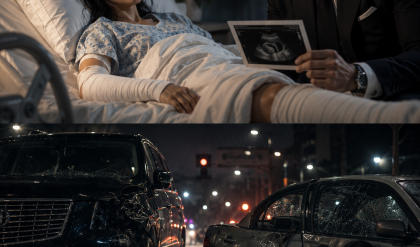
The attack happened two weeks later.
It was not dramatic at first. That was the terrible part.
No thunderstorm. No midnight ambush. Just a bright Thursday afternoon while I was in the penthouse dining room reviewing a port expansion proposal with Francesca.
A delivery cart arrived from a florist Roman used often. White roses. My mother’s favorite. I smiled because I thought he had sent them for her; she was visiting Dad that evening.
Francesca did not smile.
She looked at the delivery man’s shoes.
Then his hands.
Then the way his eyes avoided the cameras.
“Down,” she said.
I obeyed before I understood.
The vase exploded.
Not from a bullet. From the device hidden inside it.
The blast knocked me sideways. Glass and water sprayed across the table. My ears rang. Francesca was already moving, gun drawn, shouting orders. Smoke filled the room. The delivery man ran for the service hall, but two guards tackled him before he reached the elevator.
I pushed myself up, coughing.
Blood dripped from my forearm where glass had cut me.
Francesca grabbed my face. “Look at me.”
“I’m okay.”
“Say your full name.”
“Avery Rhodes Mercer.”
“Good.”
Roman arrived seven minutes later.
I knew because Francesca checked the time and muttered, “Reckless bastard broke every traffic law in Boston.”
He came through the doors like a storm breaking loose, tie gone, eyes wild in a way I had never seen. Not controlled. Not strategic.
Terrified.
His gaze found the blood on my arm.
Then my face.
He crossed the room and pulled me against him so hard I could feel his heart hammering.
“I’m okay,” I whispered.
He did not let go.
“Roman, I’m okay.”
His hand cradled the back of my head.
“I thought I lost you.”
There it was.
The truth, stripped of power.
The man everyone feared was shaking.
For me.
The old instinct rose in me: soften, comfort, forgive anything because someone needed me.
This time, I did not disappear inside it.
I pulled back and touched his face.
“Then don’t become someone I have to fear.”
His eyes searched mine.
“Who sent it?” I asked.
Francesca’s expression hardened. “The delivery man works for the Moretti crew.”
Roman went still.
The Morettis had been circling Mercer territory for months, angry about Roman cleaning up the ports, angry that legitimate contracts were replacing the old arrangements that made men rich without paperwork.
Francesca hesitated.
“What?” Roman snapped.
“The delivery schedule was changed this morning from inside Nico’s old account.”
The room went cold.
Roman’s face emptied.
That frightened me more than rage.
“Find him,” he said.
“Roman.”
He did not look at me. “Francesca, find him.”
“No.”
The word cracked across the room.
Everyone froze.
Roman turned slowly.
I stepped closer, blood still sliding down my arm.
“No bodies,” I said. “No dockside lesson. No disappearing him into whatever version of justice your old world wants.”
“He tried to kill you.”
“Maybe. Or someone used his account. Or he was stupid. Or desperate. Or guilty. We don’t know yet.”
“I know enough.”
“No,” I said. “You know fear. You told me once I was bleeding and called it clarity. Now it’s your turn.”
His jaw flexed.
The guards looked away.
Roman’s eyes burned into mine.
“What would you have me do?”
“Prove the truth. Then choose consequences you can explain to our children someday without lying.”
The word children stunned us both.
I had not meant to say it.
Roman heard it anyway.
His anger did not vanish. But it changed direction.
“Francesca,” he said quietly, “bring me proof.”
They found Nico in Providence that night.
Not hiding with criminals. Hiding in a motel off I-95 with Tessa, two burner phones, and a bruise along his jaw.
The truth came out ugly.
The Morettis had approached Nico after Roman cut him off. They offered money, sympathy, and the illusion of revenge. Nico gave them old access codes, thinking they would embarrass Roman’s security team by sneaking into the building.
He claimed he did not know about the bomb.
I believed him.
Not because he was innocent.
Because Nico had always wanted applause, not blood.
Tessa had known more. She had seen messages mentioning “the wife” and “a permanent message.” She had tried to leave, she said. Then Moretti men threatened her younger brother, who owed them money.
It was not enough to excuse her.
It was enough to explain the terror in her face at the gala.
Roman wanted prison for Nico.
Federal, public, humiliating.
I agreed.
For once, justice and mercy could share a room.
Nico signed a statement against the Morettis in exchange for protection custody and later served time for conspiracy, fraud, and obstruction. Tessa testified too. Her brother entered treatment through a program funded anonymously by the Mercer Foundation.
When Francesca asked if I wanted Tessa punished further, I thought for a long time.
“No,” I said finally. “She has to live with knowing she almost got me killed. That’s heavier than anything I could add.”
Roman said nothing.
But later that night, he found me in the library.
“You changed the outcome,” he said.
“I stopped you from doing something you couldn’t come back from.”
“I’ve done many things I can’t come back from.”
“I know.”
He stood in front of me, shadows cutting across his face.
“Does that matter?”
“Yes.”
Pain flashed through his eyes before he could hide it.
I rose and went to him.
“It matters because if you pretend your past is nothing, then becoming better is just another performance.”
His voice was rough. “And if I can’t become better?”
“Then I leave.”
He closed his eyes.
I had never said it so plainly.
When he opened them, there was no anger. Only fear.
“And if I try?”
“Then I stay while you do.”
He lowered his forehead to mine.
“I love you,” he said.
No flourish. No demand. No claim.
Just the truth, offered with both hands open.
I cried then, because some part of me had been waiting to hear it without a cage around it.
“I love you too,” I whispered. “But I need you to understand something.”
“Anything.”
“I don’t love the monster people fear. I love the man who fights him.”
Roman’s breath trembled.
Then he kissed me, and for the first time, it felt like neither of us was trying to win.
Six months later, my father walked without a cane for twelve steps.
He cried afterward, furious about it, while my mother pretended not to cry harder.
Roman stood in the corner of the rehab room with his hands in his coat pockets, looking uncomfortable with gratitude aimed directly at him.
Dad noticed.
“You,” he said, pointing at Roman with his weaker hand. “Come here.”
Roman obeyed, which amused me more than it should have.
Dad looked up at him.
“I know what people say about you.”
Roman’s mouth tightened. “Most of it is earned.”
“Maybe.” Dad’s eyes sharpened. “But my daughter stands taller now than she did before you. So whatever else you are, keep being the man who helps that happen.”
Roman swallowed.
“Yes, sir.”
I had never heard Roman Mercer call anyone sir.
That spring, Mercer Port Logistics announced its full transition into a publicly audited corporation. The old crews grumbled. Some left. Some tried to fight and discovered that Roman still knew how to win, only now with lawyers, contracts, regulators, and evidence.
I became director of compliance first.
Then chief operating officer.
The newspapers called me a surprising choice.
The men in the boardroom called me Mrs. Mercer until the day I looked over a quarterly report and said, “You can use my title, or I can use the evidence I found in your expense account.”
After that, they called me Ms. Rhodes Mercer.
Roman laughed for ten full seconds when I told him.
A year after our first chapel wedding, we held another ceremony.
This one had flowers my mother chose, music my sister hated but tolerated, and my father walking me down the aisle slowly, stubbornly, proudly. There was no contract waiting afterward. No one-year clause. No scandal to outrun.
Only Roman at the altar, older than the man I had imagined for myself and more flawed than any fairy tale should allow.
But real.
When we reached him, my father took Roman’s hand and placed mine in it.
“She is not a debt,” Dad said.
Roman’s eyes did not leave mine.
“I know.”
“She is not your redemption either.”
“I know that too.”
Dad nodded. “Good. Then love her like a man, not like a king.”
Roman’s mouth curved faintly.
“I’ll spend the rest of my life learning how.”
This time, when I said my vows, my voice did not shake.
“I used to think love was something owed,” I told him in front of everyone. “That if someone saved you, you had to hand them whatever pieces of yourself they wanted. Then I learned the difference between debt and devotion. Debt keeps score. Devotion keeps showing up. You showed up for my father before I knew your name. You showed up for me when I hated you. You showed up for the woman I was becoming, even when that woman challenged you, refused you, and demanded better from you.”
Roman’s eyes shone.
“So today,” I said, “I’m not choosing you because I have nowhere else to go. I’m choosing you because I do.”
When Roman spoke, his voice was low and rough.
“I spent most of my life mistaking control for care. Then you walked barefoot into my office wearing a red dress and carrying a broken heart, and you asked me to be better as if better was something I still had a right to become. I don’t deserve that kind of faith. But I will honor it. I will protect your freedom as fiercely as I once protected my power. I will tell you the truth even when it costs me. And I will love you without turning love into a cage.”
By the time he finished, Francesca was looking at the ceiling like it had personally offended her.
After the ceremony, Roman and I stepped outside into the garden behind the estate we had bought in Maine, far from Boston Harbor and its ghosts. The ocean spread gray and endless beyond the cliffs. My father laughed with my mother near the tent. My sister danced badly with a cousin. Francesca threatened a caterer with elegance.
Roman took my hand.
“Do you ever think about the red dress?” he asked.
I smiled.
“Sometimes.”
“Do you regret that night?”
I looked toward the water.
I thought of a girl outside a bedroom door, holding champagne she could not afford, about to give herself to a boy who had turned her gratitude into a bet. I wished I could go back and hold her. Tell her humiliation was not the end of her story. Tell her rage could become wisdom if she did not let it choose all her roads. Tell her the most dangerous man she would meet was not the one people feared, but the version of herself who believed being saved meant being owned.
“No,” I said. “But I don’t romanticize it either.”
Roman nodded slowly.
“That sounds like you.”
“It was messy. Painful. Reckless. I made choices from hurt.”
“And now?”
I turned to him.
“Now I make them from strength.”
He lifted my hand and kissed my ring.
Not the old diamond from the contract year. That one rested in a box in my closet, not because I hated it, but because it belonged to a woman learning armor.
The ring I wore now was simpler. Gold, with a small emerald set between two diamonds from my mother’s earrings.
A crown did not need to be heavy to be real.
“What happens next, Mrs. Rhodes Mercer?” Roman asked.
I leaned into him, watching the people we loved beneath the white tent.
“Next, we build clean things.”
His arm slid around my waist.
“And if the past comes knocking?”
I smiled.
“Then we answer with receipts.”
Roman laughed, full and startled, and the sound warmed something in me that had once been cold enough to survive anything.
I had thought my life changed the night I found Nico with Tessa.
But betrayal only opened the door.
The real change came after, in every moment I chose not to become cruel just because cruelty had touched me first. In every room where I asked for truth. In every ledger where I found the lie. In every day Roman chose restraint when power would have been easier. In every bill paid without making someone kneel. In every apology that came with action behind it.
People would always whisper about how we began.
Let them.
They did not know the whole story.
They knew the scandal, not the work.
They knew the red dress, not the woman who outgrew it.
They knew Roman Mercer’s name, not the man who learned to unclench his fists.
And they knew nothing about the quiet kind of love that does not erase the past, but stands beside you while you turn it into something that can shelter other people.
Years later, when the Mercer Foundation opened a rehabilitation wing in my father’s name, I stood at the podium and saw Nico in the back row.
He looked older. Thinner. Sober.
Tessa stood beside him, hands folded tightly in front of her. They had both been released by then. Not forgiven by everyone. Not welcomed back into the circles they had once abused. But alive. Working. Trying, maybe.
After my speech, Nico approached me alone.
Roman noticed from across the room.
He did not move.
That was how I knew he trusted me.
“Avery,” Nico said.
“Nico.”
He swallowed. “I’m sorry.”
For once, he sounded like he understood the size of the words.
I studied him, searching for the boy I had loved and the man who had humiliated me. I found traces of both. But neither had power over me anymore.
“I hope you mean that,” I said.
“I do.”
“Good.”
He waited, maybe for forgiveness, maybe for punishment.
I gave him neither.
“Build a life that proves it,” I said.
Then I walked away.
Roman met me near the windows.
“Are you all right?”
I looked back once.
Nico was still standing there, crying quietly while Tessa touched his arm.
“Yes,” I said. “I think I finally am.”
Roman’s hand found mine.
Outside, Boston Harbor glittered in the late afternoon sun. The same water Roman’s empire had once ruled through fear now carried ships under contracts I had rewritten, with workers whose insurance cleared, whose overtime posted correctly, whose families were not invisible in the margins.
My father’s laughter echoed from down the hall.
My mother called my name.
Roman squeezed my hand.
And I realized the strangest truth of all.
The debt had been real.
The gratitude had been misplaced.
The betrayal had been devastating.
But none of it had owned me forever.
Not Nico.
Not Roman.
Not even the girl I used to be.
I owned the story now.
And I chose to make it mean something better.
THE END