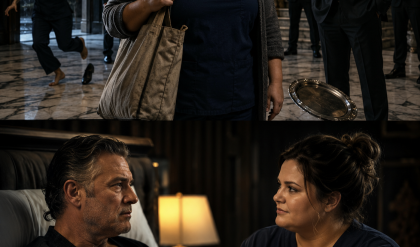
Daniel blinked. “Which buildings?”
“All three. The properties where his shops operate.”
“Sir.”
“Did I stutter?”
“No. I was hoping you had.”
Archer leaned back. “Make generous offers. Close quickly.”
Daniel studied him carefully. “Is there a business reason?”
“Potential redevelopment.”
“Into what?”
“Silence.”
Daniel nodded slowly. “Understood.”
After he left, Archer rubbed his jaw hard and looked out over downtown Seattle, where clouds pressed low over the glass towers. He told himself he was protecting the Whitmore name from staff drama. He told himself he disliked disorder. He told himself many things.
None of them explained why Nora’s smile had kept him awake.
Archer Whitmore had built his entire adult life around not needing anyone.
People called him cold because it was easier than calling him frightened.
At sixteen, he had watched love humiliate his mother in front of the entire city. His father, Harrison Whitmore, had been a celebrated real estate titan with a beautiful wife, two children, and a talent for lying gently. The affair began as rumors, then photographs, then a public scandal that turned Archer’s mother into a headline.
Reporters waited outside their gates. Talk shows debated her appearance. Business magazines wrote about “the cost of personal distraction.” Harrison apologized publicly, privately begged forgiveness, then left anyway for the younger woman who made him feel “alive.”
Archer still remembered his mother sitting at the breakfast table three months later, wearing pearls and silence like armor, while his father’s engagement news played on television.
Love, Archer learned, did not make people noble.
It made them beg.
It made them weak.
It made them stay in rooms where they were unwanted.
So he grew into a man who mocked romance before romance could make a fool of him. He dated carefully, briefly, and never twice if a woman looked at him with hope. He told interviewers love was a distraction. He told Lila marriage was an expensive legal hallucination. He told himself loneliness was simply the price of discipline.
Then Nora Bell came into his house and made loneliness visible.
She treated everyone as if they were real.
Drivers. Kitchen staff. Executives. Lila on days when she would not leave her room. Archer when he had a fever and insisted it was “a minor system malfunction.” Nora noticed small things. She remembered how people took coffee, when they were lying about being fine, which staff members sent money home, which flowers made Lila smile.
She did not flatter Archer. That unsettled him.
She did not fear him enough. That irritated him.
She saw too much. That became dangerous.
Nora had grown up in South Chicago with a mother who cleaned houses for families whose children never learned her name. As a little girl, Nora sat in laundry rooms and back hallways waiting for her mother’s shift to end, listening to wealthy people talk about kindness while underpaying the women who kept their lives running.
Her mother used to say, “Rich people are kind until kindness costs them something.”
Nora hated that sentence as a child.
By twenty-seven, she understood it too well.
She came to Seattle after her mother died, took work wherever she could, and eventually landed at Whitmore House. The mansion was cold at first. Beautiful, controlled, emotionally dead. Then, slowly, she found places to plant warmth. Lila began leaving her room. The chef started playing music softly during prep. Mrs. Keller stopped pretending she hated birthdays.
Even Archer, though he would never admit it, came downstairs more often when Nora was there.
A week after the roses, gifts began arriving.
A bracelet.
Imported tea.
A rare first edition of a novel Nora had once mentioned liking.
Each came without a signature.
Lila found the tea in the kitchen and screamed, “He’s competing!”
Nora stared at the package. “This is ridiculous.”
Across the hall, Archer pretended to read emails.
Lila turned slowly toward him. “Archer.”
He did not look up. “What?”
“Did you send Nora tea?”
“I send many things to many people.”
“You sent me a humidifier for my birthday.”
“You complained about dry air.”
Nora folded her arms. “Mr. Whitmore.”
His eyes lifted.
“Did you send these?”
“No.”
Lila grinned. “That means yes in emotionally constipated billionaire.”
“I will cut you out of my will.”
“You already threatened that when I adopted a rescue ferret.”
“It bit Daniel.”
“Daniel forgave him.”
“Daniel bills hourly.”
Nora tried not to smile.
Archer saw it anyway.
That night, unable to sleep, he opened a browser and searched flower meanings.
Red roses: love.
White roses: reverence.
Pink roses: admiration.
Yellow roses: friendship.
He frowned at the screen.
Why did flowers have a language? Who had authorized that? More importantly, which flower meant stop smiling at another man before I buy the sun to block his light?
He searched: flowers that mean choose me.
The results were useless.
Downstairs, in a small room near the staff quarters, Nora sat cross-legged on her bed with her laptop open. Her pen name, Mira North, glowed at the top of a draft document.
No one in Whitmore House knew she wrote novels at night.
Not Lila. Not Mrs. Keller. Definitely not Archer.
Her online serial had gained a following over the past year—stories about damaged men who mistook control for safety and women who loved themselves enough to walk away. Readers loved the male leads. They also hated them. Nora understood both reactions.
Lately, every cold, arrogant, emotionally terrified hero she wrote had begun sounding like Archer.
She typed: The cruel ones are usually the loneliest.
Then she stopped.
Her fingers hovered over the keyboard.
With a frustrated sigh, she deleted the line.
Upstairs, Archer opened the latest chapter of a novel by Mira North, an author he had discovered during a sleepless night and now followed with the secrecy of a man committing financial crimes.
The male lead was insufferable. Cold. Jealous. Unable to apologize. Always ruining tender moments by saying something unforgivable.
Archer frowned.
“This idiot again,” he muttered.
Then he kept reading until 3:00 a.m.
The next time Caleb Hart sent flowers, they were not dramatic.
That made it worse.
A small bouquet of white roses arrived on a Thursday afternoon, wrapped in brown paper and tied with twine. Nora carried them into the kitchen carefully.
Archer saw her from the doorway.
“You smile differently around him,” he said.
Nora looked up. “Excuse me?”
“The florist.”
Her expression cooled. “Why do you care?”
“I don’t.”
“Then stop bringing him up every three business days.”
“I dislike men who use flowers as emotional weapons.”
“You bought three buildings because you were jealous.”
“That was a real estate decision.”
“That explanation gets more embarrassing every time you repeat it.”
His jaw tightened. “You seem very comfortable accepting things from another man.”
Nora laughed once. “Are you my father?”
“That is not what I said.”
“No, but it is what you sound like.”
Archer stepped closer before he could stop himself. “Does he make you happy?”
The question landed too intensely.
Nora’s face shifted.
“He’s kind,” she said.
Kind.
Not rich. Not powerful. Not impressive.
Kind.
The word struck Archer harder than any insult.
He reached for anger because anger was easier than fear.
“Then go to him,” he said sharply. “Why are you still here?”
The kitchen went silent.
Nora stared at him.
For one second, Archer looked less cold than wounded. That was worse. Nora could handle arrogance. She could handle cruelty. She did not know what to do with pain in a man who denied feeling it.
He turned and left before she could answer.
That evening, Nora helped Caleb close the Pike Place shop. Rain trembled against the windows. Buckets of flowers lined the floor in soft colors.
“You know he bought my buildings,” Caleb said mildly while trimming stems.
Nora winced. “I’m sorry.”
“I reopened pop-up stands nearby.”
“You’re not angry?”
Caleb smiled. “He’s trying very hard not to panic.”
“You say strange things about him.”
“People get strange when they finally care about something.”
Before she could answer, Caleb turned away and coughed violently into a handkerchief. His shoulders shook. When he lowered the cloth, he folded it too quickly.
But Nora saw the blood.
“Caleb.”
“I’m fine.”
“That was blood.”
“It was dramatic lighting.”
“This is not funny.”
His smile faded.
“No,” he said softly. “It isn’t.”
But he would not explain.
The annual Whitmore Foundation dinner took place two weeks later at a luxury hotel downtown. Politicians, donors, tech founders, old-money families, and social climbers filled the ballroom with expensive laughter.
Nora coordinated staff movement near the side entrance. Archer stood near the center of the room, speaking to investors and failing to stop looking at her.
He noticed she had skipped dinner. He noticed her left hand pressed briefly against her stomach when she thought no one was watching. He noticed a guest bumped into her and she apologized first.
Every detail entered his head without permission.
An older donor at Archer’s table followed his gaze and smirked. “You’ve been watching that girl all evening.”
Archer looked away. “I’m watching the room.”
“Of course.”
A woman beside them laughed. “Isn’t she the one from the flower story? The maid with the thousand roses?”
Another man chuckled. “Social media makes staff bold these days.”
Nora heard enough to understand.
She kept working.
She had learned young that humiliation often wore perfume.
The woman continued, “These situations become messy. Servants forget their place when wealthy people treat them too kindly.”
Archer’s expression hardened.
“That’s enough,” he said.
The table quieted.
The woman blinked. “I was joking.”
“It wasn’t funny.”
For one dangerous second, Nora looked at him, and something in her face softened.
Archer felt it like a hand around his throat.
Need.
The one thing he had spent his life refusing.
A man at the table laughed awkwardly. “You’re defending her like she’s family.”
Archer panicked.
He reached for distance and found cruelty.
“She works for me,” he said coldly. “That’s all.”
The words spread through the table.
Nora stopped moving.
Archer heard himself continue, unable to stop because fear had already taken the wheel.
“People are acting like she cured disease because a florist bought flowers. She’s staff. Stop romanticizing it.”
The ballroom noise dulled around Nora.
Suddenly she was not in Seattle anymore. She was twelve years old, sitting in a laundry room in Chicago while wealthy women laughed about her mother’s shoes. She was sixteen, watching her mother accept an envelope short two hundred dollars because arguing might cost the job. She was twenty-one, holding her mother’s hand in a hospital room and realizing hard work did not protect poor women from being forgotten.
Rich people are kind until kindness costs them something.
Nora finished the event without speaking to Archer again.
Back at Whitmore House, she entered her room, closed the door, and sat on the floor.
The tears came quietly at first.
Then harder.
The humiliation hurt, but the worst part was not the humiliation. The worst part was realizing why it had cut so deep.
Somewhere between the arguments, the jealousy, the late-night glances, and the way Archer noticed when she had a headache, she had fallen in love with him.
And he had reminded her exactly where she stood.
Downstairs, Archer sat alone in the dining room with untouched whiskey before him.
Lila found him there near midnight.
She took one look at his face. “What did you do?”
He said nothing.
Her expression changed. “Archer.”
Still nothing.
“Oh my God,” she whispered. “You hurt her.”
He stood abruptly.
“Don’t.”
“No, you don’t get to ‘don’t’ me. What did you say?”
“I said the truth.”
Lila’s face went pale with anger. “The truth, or the thing you use when you’re terrified someone matters?”
He walked out.
At 3:00 a.m., Archer stopped in the dark hallway outside Nora’s room. Twice he lifted his hand to knock. Twice he lowered it.
His chest tightened. His breath shortened. One hand pressed against the wall as his heartbeat turned uneven.
For the first time since he was sixteen years old, Archer Whitmore had a panic attack.
Completely alone.
Distance changed the mansion.
Nora remained polite. Efficient. Calm.
But something warm in her had closed. She no longer argued with Archer. No longer looked at him unless necessary. No longer smiled when he entered a room.
He had thought silence was control.
Now he learned silence could be punishment.
A week later, Nora visited Caleb’s shop after work. He was sitting behind the counter, pale beneath the warm lights, arranging white roses with careful hands.
“You’re working too late,” she said.
“You sound like an angry wife.”
“I sound observant.”
He smiled, then coughed.
This time he could not hide the blood.
Nora’s face changed. “How long?”
Caleb looked away.
“How long, Caleb?”
After a long silence, he said, “Eight months since the diagnosis.”
Her knees nearly weakened. “Diagnosis of what?”
“Pulmonary fibrosis. Aggressive. Complicated. The doctors have longer words, but none of them change the ending.”
“You’re dying.”
“Yes.”
The bluntness of it broke something in the room.
Nora sat across from him slowly. “And you sent me a thousand roses while dying?”
“I wanted to.”
“That’s insane.”
“I know.”
Her eyes filled, anger and grief mixing together. “Were you ever going to tell me?”
“No.”
“That wasn’t your choice to make.”
“It was the only choice I had that didn’t ask you to grieve early.”
She looked at him helplessly.
Caleb’s voice softened. “Nora, I didn’t send those roses because I expected you to love me back.”
She opened her mouth.
He shook his head. “Don’t. I knew where your heart was going before you did.”
“That’s not true.”
“It is. You talk about him like you’re trying to solve a locked door.”
Nora looked down.
Caleb smiled sadly. “You spent your whole life around people who made love feel conditional. I just wanted you to experience being loved loudly once. Even if it wasn’t forever.”
The words hurt more than she expected.
Because suddenly the roses were no longer romantic.
They were goodbye.
Two nights later, Archer found Caleb Hart waiting in the underground garage beneath Whitmore Tower. Caleb held flowers wrapped in brown paper.
Archer stopped beside his car. “You’re persistent.”
Caleb smiled faintly. “You bought my buildings.”
“That was business.”
“No, it wasn’t.”
“I don’t have time for philosophical florist conversations.”
“Then I’ll be direct.” Caleb looked at him steadily. “Do you love her enough to stop hurting her when you’re afraid?”
Archer’s face hardened. “I’m not afraid.”
“That wasn’t the question.”
Silence stretched between them.
For once, Archer had no elegant answer.
Caleb nodded as if the silence confirmed something. “You love her very much.”
“I don’t need relationship advice from a florist.”
“No,” Caleb said. “You need therapy. But I’m dying, so this is the best you’re getting.”
Archer froze.
The sentence registered slowly.
“What?”
“Terminal illness. Very dramatic. Zero stars. Would not recommend.”
Archer stared at him properly for the first time—the pale skin, the thinness beneath his coat, the exhaustion no kindness could disguise.
Caleb continued, “After I’m gone, she’ll pretend she’s fine. She’ll isolate. She’s good at surviving quietly.”
“Why are you telling me this?”
“Because despite all your damage, you would protect her if she was hurting.”
Shame hit Archer so hard he looked away.
Caleb adjusted the flowers in his hands. “Don’t make her earn gentleness from you.”
He left the bouquet on the hood of Archer’s car and walked away.
Two weeks later, Nora received the call while preparing breakfast at Whitmore House.
The plate in her hand slipped.
“What hospital?” she whispered.
Lila stood immediately. “Nora?”
Archer entered the kitchen just in time to hear Nora say, “No. I’m coming now.”
She grabbed her coat.
“It’s Caleb,” she said.
Hours later, Archer found her sitting outside a hospital room.
She was not crying.
That made it worse.
“He died before I got here,” she said when he sat beside her. “His lungs failed. He apologized last week for leaving first.”
Then she folded forward, covering her mouth, and broke.
Archer froze.
He wanted to comfort her. Touch her shoulder. Hold her. Say something useful.
But no one had ever taught him how to hold another person’s pain without fearing it would swallow him too.
So he stayed beside her.
Silent.
Helpless.
But he stayed.
Three days later, Caleb’s final bouquet arrived at Whitmore House.
White roses. Small. Simple. A handwritten card.
Thank you for letting me love you honestly.
Lila cried openly. Mrs. Keller turned away. Even Daniel, who had come to deliver papers, stood silent in the foyer.
The funeral took place under gray rain at a cemetery north of the city. Nora stood beside Caleb’s coffin until her strength failed. When she finally sobbed, “I wasn’t ready. You promised me more time,” Archer felt jealousy disappear from him forever.
Caleb had loved her gently until the end.
Archer had loved her fearfully and called it control.
That night, Nora returned to Whitmore House, packed one suitcase, and left a note on her bed.
Thank you for everything. Please take care of Lila.
Nora.
No goodbye for Archer.
No accusation.
Just absence.
The mansion became unbearable after she left.
The kitchen quieted first. Then the library. Then the dining room, where Lila stopped appearing for meals. Flowers wilted in vases because Nora had always been the one to replace them. Staff moved carefully through rooms, as if laughter might be disrespectful now.
Archer entered Nora’s room a week later.
He found a storage box beneath the desk.
Inside were notebooks, drafts, printed chapters, and the name Mira North.
His stomach tightened.
He sat on the edge of her bed and began reading.
The male lead hated dependence. He insulted the heroine publicly because he was terrified she mattered privately. He learned flower meanings at 3:00 a.m. He waited in hallways and pretended he was passing through. He noticed headaches, skipped meals, hidden exhaustion.
Every detail was him.
Nora had seen him long before he understood himself.
And despite everything cruel in him, she had loved him anyway.
For months, Archer did not see her.
Then Daniel entered his office one morning holding a tablet.
“You asked me to monitor Mira North’s publishing updates.”
Archer looked up instantly.
Daniel handed him the screen. “She revealed her identity last month. Her book hit the national bestseller list yesterday.”
A photograph showed Nora at a Seattle bookstore, smiling behind a signing table while readers lined up around the block.
She looked different.
Steady.
Free.
“She looks fine,” Archer said quietly.
Daniel hesitated. “Yes, sir.”
That night, Archer drove himself to her public reading in Capitol Hill. He stood in the back wearing a dark coat and a baseball cap pulled low.
Nora spoke to readers with warmth and confidence. When a young woman asked why her male leads always felt so lonely, Nora paused.
“Lonely people are usually easier to recognize than they think,” she said.
Archer felt the sentence strike him across the room.
After the event, he waited near the curb while she carried a box of books toward her car.
She stopped when she saw him.
For a long moment, neither spoke.
Finally, Nora sighed. “You look tired.”
The familiar concern nearly ruined him.
“I haven’t slept properly,” he admitted.
“That’s unfortunate.”
Months ago, she would have softened. Now she only looked calm.
He deserved that.
“You left without saying goodbye,” he said.
“You humiliated me in public,” she answered.
Direct. Clean. No room for escape.
Archer lowered his eyes. “I know.”
Wind moved through the street.
“The estate feels dead without you,” he said.
“That sounds dramatic.”
“It’s true.”
Her expression shifted, but only slightly.
Hope hurt him more than despair.
At first, he tried too hard.
Flowers arrived at her publishing office. Rare books appeared at her apartment. He attended readings and pretended coincidence. Once, when Lila mentioned Nora was sick, he waited outside her building in the rain with soup.
Nora stared at the container. “You know delivery apps exist.”
“Yes.”
“You are a billionaire.”
“I wanted to bring it personally.”
“That’s worse.”
But she smiled after she closed the door.
He noticed.
Still, she did not return to him.
One evening, after he asked her to dinner for the fifth time and she refused, Archer’s old fear rose sharply.
“You’re punishing me forever over one mistake,” he said.
Nora went still.
“One mistake?” Her voice cracked for the first time in months. “You humiliated me in front of people exactly like the ones who humiliated my mother her entire life.”
He went silent.
She stepped closer. “You don’t get to panic after hurting people and call it love.”
The sentence tore through him.
All the arrogance left his face.
“I kept trying to win against Caleb,” he said quietly. “But you were never a prize.”
Nora’s expression changed.
Archer looked down at his hands. “I don’t know how to be loved properly.”
There it was.
No performance. No cruelty. No cold joke to hide behind.
Just the truth.
After that, Archer stopped trying to overwhelm her.
No grand gestures. No pressure. No expensive distractions pretending to be apologies.
He became consistent.
Coffee appeared outside her apartment before early meetings. No notes. No demands. Just coffee made exactly the way she liked it. When critics attacked her second book online, he did not threaten lawsuits. He read the reviews, printed the useful ones, and handed them to her awkwardly.
“This reviewer is an idiot,” he said, “but this one has a point about pacing.”
Nora stared. “You read six hundred comments?”
“I was angry.”
“That is deeply unhealthy.”
“I know.”
She laughed for the first time without guarding it.
Trust returned slowly.
Not magically.
Sometimes she remembered the ballroom and pulled away. Each time, Archer forced himself not to defend his fear. He apologized like a man learning a language late in life.
Lila noticed first.
“You apologize like a normal human now,” she told him.
“I always apologized.”
“You once sent me a watch instead of saying sorry.”
“It was expensive.”
“That’s my point.”
A year after Caleb’s funeral, Nora held a reading at a packed theater near the waterfront. Archer sat in the back row, no disguise this time.
During the Q&A, someone asked, “Do you believe difficult people can really change?”
Nora looked toward Archer.
“Yes,” she said. “But only when they stop treating love like a competition.”
Afterward, they walked beside the water. Seattle lights shimmered across Elliott Bay. The night smelled like salt and rain.
Nora stopped first.
“You’ve changed,” she said.
“Good or bad?”
“Uncomfortable answer?”
“Yes.”
“You stopped trying to win every conversation.”
He laughed softly. “I’m still competitive.”
“You argued with a bookstore employee because she recommended another romance author to me.”
“She insulted your talent.”
“She was twelve.”
“She lacked vision.”
Nora shook her head, smiling.
Then Archer’s expression softened. “I still think about him.”
She knew who he meant.
“Caleb?”
He nodded. “I used to hate him because I thought if you chose him, I lost something.”
Nora looked out at the water.
“He loved you honestly,” Archer said. “I’m grateful he existed.”
That sentence broke the final wall between them.
The Archer Whitmore she had met would never have said it. The man beside her had learned that love was not proven by possession, jealousy, or noise.
It was proven by gentleness when fear arrived.
Nora touched his face.
This time, when she kissed him, neither of them pulled away.
Years later, Whitmore House no longer felt like a museum built for lonely people.
Fresh flowers filled the rooms. Staff laughed in the kitchen. Lila hosted chaotic Sunday dinners. Mrs. Keller pretended to hate the noise and secretly planned the menus three weeks in advance.
Nora wrote in the sunroom overlooking the lake.
Archer interrupted too often.
Once, she looked up from her laptop to find him standing in the doorway with tea.
“You were here twenty minutes ago,” she said.
“I was passing by.”
“With tea?”
“I became thirsty on your behalf.”
“You need help.”
“I have you.”
“That is not a clinical plan.”
He came behind her chair and kissed the top of her head anyway.
One afternoon, a florist arrived with roses for the foyer. Archer inspected the arrangement critically.
“The stems are uneven.”
The florist paled. “Sir?”
“These are leaning left. Flowers should not collapse before entering the building.”
Nora walked into the foyer.
Archer’s entire expression changed.
Every trace of irritation disappeared so fast the staff looked down to hide their smiles.
“Nora,” he said softly, “come here.”
She raised an eyebrow. “Are you bullying another florist?”
“I am protecting artistic standards.”
“You are jealous of flowers.”
“I am respectful of their emotional history.”
She laughed, and the sound filled the house the way sunlight fills a cold room slowly, then all at once.
Archer looked at her as if he still could not believe she had chosen him.
Not because he was rich.
Not because he was powerful.
But because he had finally learned how to love without making fear louder than tenderness.
Outside, rain began to fall over Lake Washington.
Inside, roses bloomed everywhere.
And the man who once bragged that he would never fall in love stood in the middle of his own mansion, holding his wife’s hand like it was the only fortune he had ever been afraid to lose.
THE END