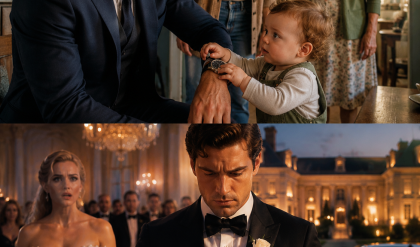
“Did you know this was in your pocket?”
She shook her head, trembling. “No, sir. I only brought my mom’s paper. I promise.”
Lucas believed her.
That was the problem.
He believed her instantly, uncomfortably, almost angrily. Because if Emma did not know she was carrying a photograph, then someone had placed it on her. Someone had used her eight years, her rain, her fear, and her mother’s apron as a vehicle.
Lucas opened the bag carefully. He did not tear the plastic. He did not touch the photograph directly. He took it by one wet corner with the precision of a man lifting evidence from a crime scene.
On the back, nearly faded, were four numbers.
11:12.
Nothing else.
Lucas turned the photograph over.
It showed a young woman beside a back door. Dark hair stuck to her face. Cheap coat. Purse clutched against her body.
Clara Carter.
It had to be.
But she was not alone.
Beside her stood a man from the Blackwood house, a man Lucas had seen that morning setting coffee on his desk and lowering his eyes with perfect respect.
Harold Pike made a strangled sound.
“Sir…”
Lucas did not look at him.
He held the photograph where Emma could see it. “Is this the man who gave your mother the address?”
Emma stared at the image. Her eyes moved from her mother’s face to the man beside her. Slowly, she nodded.
“He said if Mom came, you would have to listen to her.”
Harold leaned against the doorframe. All the color had drained from his face.
Lucas saw it.
And stored it away.
In Lucas’s world, loyalty was not proven over years. It was proven in seconds. And in that second, Harold did not look like a man surprised by betrayal.
He looked like a man recognizing a sentence finally being read aloud.
“When was this taken?” Lucas asked.
Emma wiped her face with her wet sleeve. “I don’t know. My mom didn’t tell me. She just cried when she got home.”
“Cried?”
“But not like when she’s sad. Like when she’s scared and doesn’t want me to see.”
The sentence took something out of the room.
One guard looked down. The other went stiff.
Lucas studied the photograph under the lamp. The back door in the picture was not any back door. It was the service entrance to the east wing, the one that had been locked after the bombing. The one that, according to internal reports, no outsider had used the night the bomb was planted.
No outsider.
The security camera covering that entrance had gone blind at 11:08.
It had come back at 11:19.
Eleven blind minutes.
Enough time to open a door. Enough time to admit the wrong man. Enough time to place a package under a car.
Lucas felt a cold calm climb his spine. It was not rage yet. Rage was loud. This was more dangerous.
This was clarity.
“Close the door,” he told Harold.
Harold did not move.
Lucas lifted his eyes. “Now.”
The old house manager shut the study door with painful slowness. The latch clicked too loudly.
Emma took one step backward.
Lucas saw it and softened his voice. “You are not in trouble.”
She tried to nod, but her hands kept shaking. “My mom only wanted work.”
“I know.”
“She didn’t do anything bad.”
Lucas looked at the photograph again.
Clara Carter at the back door. Harold beside her. The time written on the back.
11:12.
The night of the bombing, the camera had gone out at 11:08 and returned at 11:19.
“Harold,” Lucas said.
“Sir.”
“Who was assigned to the east service entrance the night of the bombing?”
Harold swallowed. “The staff rotated by your order.”
“I did not ask about rotation.”
Silence stretched thin.
“I asked who was assigned.”
Harold opened his mouth.
Then Lucas’s private phone began vibrating inside the top drawer of his desk.
Not his regular cell. Not the business line. The small black phone that sat face down in a drawer, attached to a number not listed under any official account.
Only three people had that number.
One was dead.
One was missing.
And the third had just appeared in a photograph inside a child’s pocket.
The vibration repeated against the wood.
Once.
Again.
Again.
Emma’s silent crying turned into a small broken breath.
Harold looked as though he was standing by habit alone.
Lucas crossed to the desk, opened the drawer, and took out the phone.
Blocked number.
He looked at Harold.
Then at Emma.
The child clutched the oversized apron in both hands as if it were the only thing preventing the world from swallowing her.
Lucas answered.
He did not say hello. He did not ask who it was.
He only lifted the phone to his ear.
On the other end, a man breathed slowly.
“If the girl reached you alive,” the voice said, “then you still have a chance.”
Lucas’s hand tightened around the phone. “Eli.”
Harold closed his eyes.
Elias Moore had been Lucas’s driver for twelve years. He had vanished the night of the bombing. Every report said he had either planted the device or been killed for refusing. Lucas had not believed either version completely. Eli was one of the few men who had once pulled Lucas out of a burning warehouse with two broken ribs and a bullet in his own shoulder.
“Listen to me,” Eli said. His voice was hoarse, as if he was calling from inside a moving car or a room with bad pipes. “Don’t trust the first thing you see.”
Lucas looked at the photograph. “You mean Harold.”
“I mean the photograph was meant to make you look at Harold.”
Lucas did not move.
Eli continued, “Look behind Clara. In the glass. Right side.”
Lucas carried the photograph back to the lamp and tilted it. The old paper caught light unevenly. At first he saw Clara’s frightened face, Harold beside her, the wet black shine of the service door.
Then he saw the reflection in the narrow pane of glass behind them.
A man standing several yards away.
Half hidden.
Not enough face to identify him, but enough of his hand.
A gold ring with a black onyx center.
Lucas felt the room go quiet in a way that had nothing to do with sound.
Only four men had ever worn that ring.
His father.
Lucas.
His late uncle.
And Adrian Crowe.
Adrian was Lucas’s closest adviser, his chief financial strategist, and the man who had sat beside him for the last seven days whispering that the O’Sullivans had crossed a line and had to be erased from Boston by morning.
Lucas closed his eyes once.
When he opened them, his voice was calm. “Where are you?”
“Not safe enough to tell you.”
“Why send the girl?”
“I didn’t. Clara did. She knew you wouldn’t open your door for her alone, not after the bomb. But she thought no one would kill a child.”
“She was wrong,” Lucas said.
“Yes,” Eli whispered. “She was. Adrian had men watching the apartment. I pulled one off her block, but not both. If Clara is sick, it’s not fever. It’s whatever they gave her.”
Emma made a sound.
Lucas looked at her. Her eyes were huge now.
“My mom?” she whispered.
Lucas covered the phone for one second. “We are going to get her.”
Then he spoke into the phone again. “Why was Clara at my back door?”
“Because she saw Adrian the night of the bomb. Because she knows what he has been hiding from you for eight years. And because Emma Carter is not just a cleaner’s daughter.”
The world narrowed to the phone in Lucas’s hand.
“What did you say?”
Eli’s breath shook.
“You heard me.”
Lucas’s voice dropped. “Say it.”
There was a pause. When Eli spoke again, the words came carefully, as if he knew each one would cut.
“Emma is Grace Walker’s child.”
Harold made a sound like a man taking a blow.
Lucas did not breathe.
For a moment, the study was gone. The rain was gone. The guards, the bourbon, the Glock, the photograph, all of it fell away.
Grace Walker.
Nine years earlier, she had been a nursing student from South Boston with laughing brown eyes and a refusal to be impressed by money. She had called Lucas “Mr. Scary Suit” the first night they met because he had come into the emergency room after a fight and refused anesthesia while she stitched his eyebrow.
He had loved her.
That was the word he never allowed himself to use.
Loved.
Then she had vanished.
A letter had arrived three days later saying she had taken money from his father and wanted no part of the Blackwood life. Lucas had believed it because believing it was easier than admitting he had failed to protect the only clean thing that had ever touched him.
A month later, her car had been found in the Charles River.
No body.
No answers.
Just silence.
Lucas looked at Emma.
Blue-gray eyes.
Honey-brown hair.
A small, stubborn chin.
Grace’s stubborn chin.
The child stared back at him, not understanding why the room had changed.
Lucas spoke into the phone, but his eyes stayed on Emma. “Where is Clara?”
“Roxbury. Same apartment. Third floor. Green door. Hurry.”
The line went dead.
Lucas lowered the phone.
No one moved.
Emma’s voice came tiny. “Is my mom going to die?”
Lucas crossed the room and knelt in front of her again. He did not touch her. He wanted to, but wanting had never given him permission.
“No,” he said. “Not if I can reach her first.”
She searched his face with the naked desperation of a child who did not know whether to trust a stranger but had no other adult left standing.
“You promise?”
Lucas Blackwood had made promises that moved money, started wars, and ended careers. None of them had ever frightened him like this one.
“I promise.”
He stood. “Vince.”
One guard stepped forward.
“Take six men. No sirens. No uniforms. Clara Carter, Roxbury, third floor, green door. Bring her alive. If anyone is waiting for her, you do not kill unless you have to. I want names.”
“Yes, sir.”
“Rebecca.”
The second guard looked surprised. “Ms. Hale is downstairs with the legal files.”
“Bring her up.”
Harold was still standing by the door, pale and silent.
Lucas turned to him. “And you.”
Harold lifted his eyes.
Lucas held out the photograph. “Start talking before I decide Eli is wrong.”
The old house manager straightened, but the dignity was cracked now. “Sir, I never betrayed you.”
“No. You only hid a child from me.”
Harold flinched.
Emma looked between them. “What child?”
Lucas felt the words like broken glass in his throat.
Harold answered before he could. “You, Miss Emma.”
The girl stared at him.
Lucas closed his hand around the photograph.
Harold stepped away from the door as if his legs had aged ten years in ten minutes. “Your father ordered me never to tell you, Mr. Blackwood. Before he died, he made me swear on my wife’s grave. He said Grace Walker had chosen to disappear. He said the child was not yours.”
Lucas’s voice was flat. “And you believed him?”
“No.”
The answer came so fast that even Lucas blinked.
Harold swallowed. “No, sir. I did not. That was why I kept sending money to Clara Carter. Quietly. Not from your accounts. From mine.”
Lucas stared at him.
Harold’s mouth trembled once before he mastered it. “Grace did not take your father’s money. She ran because your father told her you had chosen the family over her and would take the baby when it was born. She went to Mercy General under a different name. Clara was not a nurse then. She cleaned operating rooms at night. She found Grace after the delivery, bleeding, terrified, begging that the baby not be handed over to any man in a Blackwood car.”
Emma’s face had gone blank with confusion.
Lucas forced himself to remain still.
Harold continued, “Grace died two days later from complications your father’s doctor should have treated sooner. Clara took the baby. She said she had already lost a son and she would not hand an infant to men who discussed children like property.”
Lucas’s jaw tightened until pain shot behind his ear.
“My father knew?”
“Yes.”
“And Adrian?”
Harold’s silence answered.
Lucas laughed once. It had no humor in it.
Of course Adrian knew.
Adrian Crowe had been Silas Blackwood’s favorite weapon: polished, patient, invisible in rooms where violent men made loud mistakes. After Silas died, Adrian slid into Lucas’s organization like a shadow claiming its shape.
“Why come now?” Lucas asked.
Harold’s eyes moved to Emma. “Because Clara saw Adrian at the service entrance the night the bomb was planted. She came to me two days later with that photograph. She wanted to tell you everything. I told her to stay hidden until I could get her in safely.”
Lucas stepped toward him. “And instead she was poisoned.”
Harold’s face broke. “I thought I was protecting them.”
“You thought wrong.”
Emma suddenly spoke. “My mom isn’t a liar.”
Everyone turned to her.
Her small hands balled around the apron. Her face was wet, but her voice found a thin line of strength. “She says lies make your stomach sick even if nobody catches you. She didn’t steal me. She didn’t do anything bad. She’s my mom.”
Lucas looked at her.
There it was.
The line he had no right to cross.
Whatever blood said, whatever Grace had been, whatever papers existed, Clara Carter had raised this child. Clara had fed her, held her through fever, walked her to school, taught her not to steal, and somehow made her brave enough to cross a city in the rain for a job.
Lucas could burn Boston down, but he could not erase that.
“No,” he said softly. “She did not do anything bad.”
Emma’s lower lip shook. “Are you going to take me away from her?”
The question went through him cleanly.
Harold looked down.
Lucas crouched again, ignoring the ache in his knees. “No.”
Emma blinked. “But he said—”
“I know what he said.”
“Then why did he say I’m a child from before?”
Lucas breathed slowly. Every instinct he had told him to lock the truth away until he controlled the room, the people, the danger. But children who crossed cities in storms deserved more than half-answers from dangerous men.
“Because I knew your birth mother a long time ago,” he said. “Her name was Grace. She was very important to me. Your mom, Clara, protected you when people around me were not safe.”
Emma stared at him, trying to hold too many grown-up facts in two small hands.
“So I had two moms?”
Lucas’s throat tightened.
“Yes,” he said. “I think you did.”
Emma looked down at the apron. “Is that why my mom cries on my birthday sometimes?”
Lucas had no answer. Harold did. His voice was barely above a whisper.
“Yes, Miss Emma. I believe it is.”
Before anyone could speak again, the study door opened and Rebecca Hale entered.
Rebecca was thirty-eight, sharp-eyed, and the only lawyer Lucas trusted because she had once told him in open court that his money did not make him less guilty, only better dressed. She took in the room quickly: the soaked child, Harold’s pale face, the photograph, Lucas’s expression.
“What happened?”
Lucas handed her the résumé and the photograph. “Adrian.”
Rebecca’s eyes narrowed at once. “I knew I hated that ring.”
Lucas almost smiled. Almost.
“Find everything on Grace Walker, Mercy General, Clara Carter, and any trust documents my father created in the year Emma was born. Quietly.”
Rebecca looked at Emma. Something softened in her face, but only for a second. “And Adrian?”
“He stays comfortable until I’m ready.”
“That is not a legal strategy.”
“It will become one.”
Rebecca held his gaze. “Lucas.”
He knew that tone. It was the one she used when she was trying to keep him from becoming his father.
Lucas glanced at Emma, who was shivering now. The rain had soaked her through, and shock was doing the rest.
“Harold,” he said, “get her dry clothes, soup, and a doctor.”
Harold straightened. “Yes, sir.”
Emma grabbed the apron. “I want to keep this on.”
Lucas understood before Harold did. The apron was not clothing. It was proof that she had come for Clara. It was armor.
“You can keep it,” Lucas said. “But we need to get you warm.”
Emma looked toward the door. “I want my mom.”
“You will see her as soon as she is here.”
“What if your men can’t find her?”
Lucas turned toward the window. Beyond the rain, the city glowed faintly, full of men who thought they could poison poor women, use children, plant bombs, and hide behind expensive watches.
“They will find her,” he said. “Because if they don’t, I will.”
Forty minutes later, Lucas stood in the medical room beneath the east wing while Clara Carter was carried through the service entrance on a stretcher.
She was younger than he expected, maybe thirty-four, with hollow cheeks, cracked lips, and dark hair plastered to her temples. A bruise colored one side of her jaw. Her hands were red and raw, the hands of a woman who had scrubbed other people’s dirt until it became part of her skin. She was conscious only in pieces, fighting the paramedic’s oxygen mask, trying to say one word.
“Emma.”
Emma broke from Harold and ran toward her.
Lucas caught her gently before she could reach the stretcher. “Let the doctor work.”
“That’s my mom!”
“I know.”
Clara’s eyes opened at the sound. Fever-bright and unfocused, they found Emma first. Then they moved to Lucas.
Fear changed her whole face.
“No,” Clara rasped. “Don’t take my daughter.”
Lucas felt every armed man in the room go still.
He stepped closer but stayed outside the doctor’s path. “I won’t.”
Clara tried to sit up. The doctor held her down.
“You don’t understand,” Clara said, her voice tearing. “I didn’t take her. Grace asked me. She asked me. I have the letter. I kept everything. I was going to tell you before he—”
Her eyes rolled slightly.
Lucas leaned in. “Before who?”
Clara’s hand clawed weakly at the blanket. “Crowe.”
The name landed like a verdict.
Rebecca, standing near the wall, closed her eyes for one second.
Lucas looked at Vince, whose coat was wet from the rescue. “Report.”
Vince’s jaw tightened. “Two men in the apartment when we arrived. One had gasoline. The other had a syringe kit. We took both alive. They had Boston PD badges in the glove compartment, but I don’t think they were cops.”
“They weren’t,” Rebecca said.
Vince continued, “Apartment was tossed. Mattress cut open. Cabinets emptied. They were looking for something.”
Lucas looked back at Clara. “Where is it?”
Clara’s eyelids fluttered. “Apron.”
Everyone looked at Emma.
Emma clutched the oversized apron with both hands.
Harold whispered, “The seam.”
Rebecca moved first. She crouched in front of Emma. “May I look at your apron, honey?”
Emma looked at Lucas.
He nodded. “It is still yours.”
Only then did Emma loosen her grip.
Rebecca turned the hem carefully. Along the inside seam, beneath a line of uneven white stitches, something narrow and hard had been hidden. Not the photograph. Something else.
A small flash drive.
Clara had not sent her daughter into the storm empty-handed.
She had sent the truth wrapped around her waist.
Rebecca held the drive up under the light. “Lucas.”
Clara sobbed once, either from pain or relief. “She didn’t know. Don’t blame her. I couldn’t trust a mailbox. I couldn’t trust a lawyer. I couldn’t trust Harold after the picture. I didn’t know who was still yours.”
Lucas looked at Harold.
The old man looked devastated, but he did not defend himself.
That mattered.
Lucas turned to Rebecca. “Can you open it safely?”
“Not on any Blackwood system.”
“Use the clean laptop in the panic room.”
Rebecca nodded once and left.
Emma was still staring at her mother. “Mommy, I came because you were sick.”
Clara’s cracked lips trembled. “Baby, you shouldn’t have.”
“I wore your apron.”
“I see that.”
“I told him you were serious.”
Clara tried to smile and failed. “You always do too much for me.”
Emma began crying again, this time with sound. Lucas stepped back because the moment did not belong to him. Clara reached weakly. The doctor allowed Emma close enough to touch her fingers.
Lucas watched the child place both small hands around Clara’s one battered hand.
His daughter.
No. Not yet.
A child with his blood, maybe. A child Grace had carried. But daughter was not a title a man could seize because biology finally became convenient. Clara had earned that word in rent payments, lunch boxes, fevers, nightmares, and birthday candles Lucas had never seen.
He turned away before the grief showed.
In the panic room twenty minutes later, the flash drive opened on an offline laptop.
Rebecca, Lucas, Harold, and Vince stood around the screen. Emma had fallen asleep in a chair outside the medical room, still wearing the apron over dry pajamas. Clara was sedated but stable. The doctor had identified a powerful infection, dehydration, and traces of a sedative that could have stopped her breathing if Emma had waited until morning.
The first file on the drive was labeled GRACE.
Rebecca clicked.
A scanned letter filled the screen.
Lucas did not touch the laptop. He read standing perfectly still.
Lucas,
If this reaches you, then I either trusted the right person or I am already gone.
Your father told me you chose his world over us. I wanted to hate you for it. I tried. But hate is hard when you remember someone holding your hand in a hospital stairwell and saying he wished he had been born ordinary.
I do not know if our baby is a boy or a girl yet. I only know that your father wants this child because Blackwoods treat blood like property. If you are the man I loved, you will protect this baby without owning it. If you have become like him, then please never find us.
Clara Carter helped me when nobody else would. Trust her before you trust anyone with your last name.
Grace
Lucas read the letter twice.
The room said nothing.
Then Rebecca clicked the next file.
Birth records. Mercy General. A baby girl born under the name Emily Grace Walker. Mother deceased two days after delivery. Emergency guardian affidavit signed by Clara Carter. A sealed DNA packet. A handwritten note from a night nurse. A photograph of Grace in a hospital bed, pale and smiling faintly, holding a newborn wrapped in a pink blanket.
Lucas had been threatened, shot at, betrayed, and burned. Nothing had ever emptied him like that photograph.
Grace looked exhausted.
Grace looked dying.
Grace looked happy.
Harold’s voice broke. “I am sorry.”
Lucas did not look at him. “Not now.”
Rebecca opened the final folder.
This one was labeled BACK DOOR.
The first file was a short video, shaky and dark, filmed through rain from behind a service shed. The timestamp was seven days earlier, 11:10 p.m.
The east service door opened.
Harold appeared first.
Then Clara.
Lucas felt Harold tense beside him.
On the video, Harold was not sneaking Clara in. He was pushing her out, urgently, one hand raised in warning. Clara turned back, frightened, holding up her phone as if trying to show him something. Then another figure crossed into view.
Adrian Crowe.
Expensive coat. Black gloves. Gold onyx ring.
He struck Harold in the side with something short and hard. Harold folded against the wall. Clara gasped and stepped back. Adrian grabbed her wrist. The video blurred as whoever filmed it moved behind the shed.
Eli’s voice came faintly from behind the recording. “No, no, no…”
Then the camera angle caught Adrian turning toward the garage.
In his other hand was a black case.
The bomb.
The video ended.
No one spoke.
Rebecca’s face was white with fury. “That is enough to arrest him.”
Lucas shook his head. “Not enough to stop him.”
“Lucas.”
“He has police. Judges. Men in my own house. If we move too soon, he disappears and takes half the evidence with him.”
Vince nodded grimly. “He has been pushing for a strike on the O’Sullivans all week. If we go to war tonight, bodies bury the paperwork.”
Rebecca looked at Lucas. “Then what is your plan?”
Lucas turned toward the monitor, where Adrian Crowe’s gloved hand held the black case that should have killed him.
“My father liked to say men show their real face when they think they have already won.”
Harold looked at him. “And Adrian thinks he has?”
Lucas’s mouth hardened. “He thinks a soaked little girl walked into my study and made me suspect the wrong old man.”
Rebecca understood first. “You want him to believe it worked.”
“I want him comfortable enough to come inside.”
At 11:30 p.m., Lucas Blackwood called a war council in the dining room.
The room was long, old, and built for men who liked to hear their own voices under chandeliers. Portraits of dead Blackwoods watched from the walls. Silverware gleamed beside untouched plates. At the far end of the table, Lucas sat with a glass of water, not bourbon.
Adrian Crowe arrived last.
He was fifty-two, elegant, gray at the temples, with the patient smile of a man who always let others rush first. His suit was dry despite the storm. His gold onyx ring caught the light as he removed his gloves.
Lucas noticed.
He had always noticed the ring.
He had simply never hated it before.
“Lucas,” Adrian said, lowering himself into a chair. “I came as soon as Harold called. I understand there has been an incident with a child.”
Harold stood behind Lucas’s chair, face blank again.
Rebecca sat to the right, a legal pad in front of her. Vince stood by the door. Four other men lined the walls.
Lucas let silence stretch until Adrian’s smile faded a fraction.
“A girl came to the gate,” Lucas said.
“So I heard. Reckless of the guards to let her in.”
“She had a photograph.”
Adrian’s eyebrows rose perfectly. “Of what?”
Lucas slid a copy across the table.
Adrian looked at it.
He did not react. That was his mistake.
An innocent man would have studied the wrong details first: Clara’s face, the back door, Harold. Adrian’s eyes flicked for half a second to the glass reflection.
Half a second was enough.
“Harold,” Adrian said softly, sounding wounded. “My God.”
Harold did not move.
Lucas leaned back. “You think he did it?”
Adrian sighed. “I think grief makes fools of loyal men. Harold knew your father’s systems better than anyone. If he had debts, if someone pressured him—”
“I asked if you think he planted the bomb.”
Adrian held Lucas’s gaze. “I think you cannot afford sentiment tonight.”
Rebecca’s pen stopped moving.
Lucas almost admired him. Adrian had always understood the right poison. Sentiment. Weakness. Mercy. Words Lucas had been trained to fear.
“And the girl?” Lucas asked.
Adrian’s expression softened into something expensive and false. “A child should not be in this house. Not tonight. The safest thing is to turn her over to child services before whoever sent her uses her again.”
Lucas tapped one finger against the table. “Her mother is in my medical room.”
This time Adrian reacted.
Barely.
But he reacted.
“Alive?” he asked.
Lucas smiled without warmth. “Interesting first question.”
Adrian recovered. “I assumed she was ill.”
“She was.”
“Then I am glad she is receiving care.”
“Are you?”
The room tightened.
Adrian folded his hands. “Lucas, I know you are under strain. The O’Sullivans tried to kill you. Now someone sends a sick woman and a child to your door with a photograph meant to fracture your household. This is classic misdirection.”
Lucas nodded slowly. “Yes. It is.”
Adrian relaxed by one degree.
Lucas continued, “That is why I invited Patrick O’Sullivan here.”
For the first time all evening, Adrian’s mask cracked.
“What?”
The dining room doors opened.
Patrick O’Sullivan walked in with two of his men and no visible weapons. He was sixty, broad, red-faced, and dressed in a rain-dark overcoat. Lucas had hated him since he was fourteen, mostly because their fathers had taught them to. Patrick stopped near the table and looked around with open disgust.
“Always hated this room,” he said. “Looks like a funeral home married a bank.”
Lucas said, “Sit down.”
Patrick sat.
Adrian stood. “This is insane.”
“No,” Rebecca said. “It is a meeting.”
Adrian turned on her. “You are a lawyer, not family.”
“And yet I know when to stay seated.”
Patrick grunted, almost amused.
Lucas looked at Adrian. “For seven days, you told me Patrick bombed my car.”
“Because he did.”
Patrick slammed a hand on the table. “I did not plant a bomb under your overpriced hearse.”
Adrian snapped, “Of course you deny it.”
Patrick leaned forward. “Crowe, I have buried cousins because of Blackwoods. If I wanted Lucas dead, I would send a man with a gun and accept the consequences like a Catholic. I would not crawl under a Bentley like a raccoon.”
Despite everything, one of the guards nearly laughed.
Lucas did not.
He looked at Adrian. “Patrick also received an anonymous message three days before the bombing.”
Patrick pulled a folded paper from his coat and threw it onto the table.
Rebecca opened it with gloved fingers.
It read: Blackwood will strike first. Move your family.
Adrian’s face went still.
Lucas said, “Someone wanted both houses afraid.”
Patrick’s voice was rough. “Someone wanted war.”
Lucas nodded. “Because war burns records. War kills witnesses. War lets men with clean shoes walk away from dirty rooms.”
Adrian looked toward the door.
Vince shifted, blocking it fully.
Lucas saw the calculation in Adrian’s eyes. The exits. The guards. Harold. Rebecca. Patrick. The invisible lines of loyalty.
Then Adrian smiled.
It was small and sad.
“You sound like your father,” he said.
Lucas’s expression did not change, but the words hit their mark.
Adrian knew it too.
“Silas understood what you refuse to accept,” Adrian continued. “A name like Blackwood survives because someone is willing to make ugly choices. You sit here pretending you can polish blood off the marble. You cannot. You were born into this.”
Lucas said, “And Grace Walker?”
Adrian’s smile disappeared.
Patrick looked between them. “Who the hell is Grace Walker?”
Lucas kept his eyes on Adrian. “A woman my father had no right to touch.”
Adrian gave a quiet laugh. “Your father did many things he had no right to do.”
“And you helped.”
“I cleaned up after him. There is a difference.”
“Not to the people buried under the cleaning.”
For the first time, Adrian’s voice sharpened. “You think Clara Carter is innocent? She hid a Blackwood heir in a Roxbury apartment for eight years.”
Patrick sat back. “A what?”
Rebecca’s eyes stayed on Adrian. “You just confirmed knowledge of a sealed birth record.”
Adrian looked at her.
A long silence passed.
Then he laughed again, but this time the sound was tired.
“Do you know what your father said when Grace gave birth?” Adrian asked Lucas. “He said, ‘If it is a boy, bring him. If it is a girl, bury the problem.’”
Harold’s hand tightened on the back of Lucas’s chair.
Lucas’s body went cold.
Adrian leaned closer. “I did not bury the child. I let Clara run. I told myself that made me merciful.”
Lucas stood so quickly the chair scraped back.
Every man in the room moved, but no one drew a weapon.
Adrian raised both hands. “Careful. The little girl is sleeping two doors from a medical room with a mother who may not survive the night. If I were you, I would consider what happens if my people stop receiving updates.”
Lucas walked around the table slowly.
Rebecca said, “Lucas.”
He heard her.
He kept walking.
Adrian watched him come, and for one shining second Lucas saw fear under the polished surface. It would have been easy. Terribly easy. One hand. One order. One bullet. Men like Adrian expected violence because violence gave their lives a language they understood.
Lucas stopped behind Adrian’s chair.
Then he reached past him, picked up Adrian’s phone from the table, and handed it to Rebecca.
“Unlock it,” he said.
Adrian smiled again. “You do not have the code.”
Rebecca held the phone near Adrian’s face. Face ID opened it.
Patrick laughed. “Fancy little coffin you brought yourself there, Crowe.”
Rebecca moved quickly. “Recent messages. Encrypted app open. Contact named M.”
Adrian lunged.
Vince hit him once in the ribs and pinned him against the table.
Lucas did not move.
Rebecca read from the screen. Her voice was controlled, but rage burned underneath.
“‘Cleaner alive. Child missing. Awaiting instruction.’ Reply from Adrian: ‘If child reaches B, use H photo. If mother talks, burn apartment.’”
The dining room went silent.
Patrick swore under his breath.
Harold closed his eyes.
Lucas looked down at Adrian, who was breathing hard against the table.
Rebecca continued, “There is more. Payments to two officers. Transfers through shell companies. A draft motion to have Lucas declared incapacitated if the O’Sullivan conflict escalated.”
Lucas tilted his head. “Incapacitated?”
Adrian spit blood onto the polished wood. “Dead men do not sign.”
“And Emma?”
Adrian looked up at him with hate now fully visible. “A complication.”
Lucas thought of Emma in the apron. Emma on the bus. Emma leaving a note beside her sick mother. Emma asking if he would take her away.
A complication.
Lucas put one hand on Adrian’s shoulder and leaned close enough that only those nearest could hear.
“My father would kill you in this room,” he said. “He would call it justice. He would sleep afterward.”
Adrian’s eyes flickered.
Lucas continued, “I want you alive. I want you in court. I want every judge, cop, banker, and coward who took your money to hear an eight-year-old girl’s name read into the record. I want the world to know you were beaten by a child in a cleaning apron.”
Adrian’s face twisted.
That hurt him more than a bullet would have.
Rebecca was already calling federal contacts she trusted more than local police. Patrick O’Sullivan, who had arrived expecting either a trap or a truce, sat very still at the table and watched Lucas Blackwood choose not to become Silas Blackwood.
Outside, the rain began to thin.
By dawn, federal agents had taken Adrian Crowe from the Blackwood estate in handcuffs. Two fake officers were arrested in Roxbury. Three real officers were suspended before breakfast. A judge’s clerk fled Logan Airport and was caught in the security line with forty thousand dollars in cash taped inside a laptop case.
Boston woke to rumors before it had coffee.
By noon, every news station in the city was saying the same careful words: billionaire developer Lucas Blackwood, long rumored to have ties to organized crime, was cooperating in a federal investigation involving attempted murder, public corruption, and financial fraud.
They did not mention Emma.
Lucas made sure of that.
Clara Carter woke fully the next evening.
Lucas was standing outside the medical room when the doctor came out and said, “She is asking for her daughter.”
Emma had not left the hallway except to sleep in a chair. She ran inside before anyone could stop her.
Lucas stayed at the threshold.
Clara lay pale against white pillows, an IV in her arm and bruises blooming along her jaw. Emma climbed carefully onto the edge of the bed and wrapped herself around her mother without touching the injured places.
“I got the job,” Emma whispered through tears.
Clara blinked. “What?”
Emma looked back at Lucas. “Didn’t I?”
For the first time in many years, Lucas Blackwood did not know what to say.
Clara saw his face and gave a weak, broken laugh that turned into a cough. “Baby, I think maybe we got something else.”
Emma frowned. “Better than a job?”
Clara stroked her hair. “Maybe. Scarier too.”
Lucas stepped inside. “Only if you want to talk.”
Clara looked at him for a long time.
“You have her eyes,” she said.
Lucas stopped.
“I used to hate that,” Clara continued softly. “When Emma was a baby, she would look at me with those gray-blue eyes, and I would think, he should know. Then I would remember the men outside the hospital. Your father’s car. The way Grace begged me not to let them take her. So I kept moving. Different apartments. Different jobs. Different names on forms when I had to.”
Lucas’s voice was low. “You saved her.”
“I raised her.”
“Yes,” he said. “You did.”
Clara’s eyes filled with tears. “I need to hear you say it again.”
Lucas understood.
He deserved that.
He deserved to stand there and say it as many times as she needed, because power had taken enough from this woman already.
“You raised her,” he said. “You are her mother. Nothing I learned changes that.”
Clara turned her face away, crying silently.
Emma looked confused and frightened. “Mommy?”
Clara pulled her closer. “It’s okay.”
Lucas approached the bed slowly. “Emma, there are things adults should have told each other a long time ago. They did not. Some of them were scared. Some were selfish. Some were cruel. But none of that is your fault.”
Emma looked at him. “Are you my dad?”
The room held its breath.
Lucas felt the question strike every empty year.
He could have said yes. Blood gave him that. Grief demanded it. His heart, newly awake and untrained, wanted it so badly it frightened him.
But Grace’s letter lay in his pocket.
If you are the man I loved, you will protect this baby without owning it.
Lucas knelt beside the bed so Emma could see him without looking up.
“I think I am your father,” he said. “But being a dad is something a man has to earn. Your mom has been here every day. I have not. So if you want to call me Lucas, you call me Lucas. If one day you want something else, we will talk about it then. No one will make you choose.”
Emma studied him with serious eyes.
Then she said, “Would you still help my mom if I only call you Lucas?”
Clara made a small wounded sound.
Lucas almost smiled.
“Yes,” he said. “Even then.”
Emma considered this. “Would you still let her have the job?”
Clara closed her eyes. “Emma.”
“What? We still need rent.”
Lucas looked at Clara. “No, you do not.”
Clara’s face hardened despite her weakness. “Do not buy us.”
“I am not buying you.”
“That is what rich men call it when they want it to sound nicer.”
Lucas accepted the blow because it was fair.
“You are right,” he said. “Then let me say it differently. Adrian tried to kill you because you protected my child and carried evidence against him. That makes you a witness under federal protection, and it makes me responsible for ensuring you are safe. Separately, Grace’s estate, which my father illegally buried, belongs in part to Emma. Rebecca is already working to restore it. You will have your own attorney. Not mine. Yours.”
Clara stared at him.
Rebecca, standing just outside the door, said, “I have three names. All women. All meaner than me.”
Clara gave another weak laugh, this one almost real.
Emma looked at Lucas. “Do they have cookies here?”
Lucas blinked. “Cookies?”
“At rich houses,” Emma said, “people always have cookies in tins.”
Harold, who had been hovering in the hall like a ghost waiting for judgment, stepped forward. “Miss Emma, this house has six tins of cookies and no one in it worthy of them.”
Emma looked at Clara. “Can I?”
Clara nodded.
Harold offered his hand.
Emma hesitated, then took it. Before she left, she turned back to Lucas. “Don’t talk about sad stuff the whole time. It makes her tired.”
Lucas nodded solemnly. “Yes, ma’am.”
Emma left with Harold.
For a while, Lucas and Clara were alone.
Rain tapped softly now, no longer violent.
Clara looked toward the window. “Grace loved rain.”
“I know.”
“She said you once bought every umbrella from a street vendor because one broke over her head.”
Lucas remembered. Grace had laughed at him for a week. “It seemed practical at the time.”
“She said you were ridiculous.”
“She was right.”
Clara’s expression softened, then turned cautious again. “Adrian said if I told you, you would take Emma and bury me in paperwork. He said men like you don’t lose blood twice.”
Lucas looked down at his hands.
Men like you.
There it was again. The inheritance he had never asked for and had too often accepted.
“He was not wrong about the kind of men I come from,” Lucas said. “But I am trying to be wrong about the kind I become.”
Clara watched him.
“That sounds pretty,” she said.
“It is not meant to.”
“Good. Pretty lies are the worst kind.”
Lucas nodded. “Then here is an ugly truth. I cannot undo eight years. I cannot give Grace her life back. I cannot make Emma trust me because a test says she should. I can only stand close enough to protect her and far enough not to steal what you built.”
Clara’s eyes shone.
After a long moment, she said, “She likes pancakes with chocolate chips.”
Lucas listened as if receiving instructions for defusing a bomb.
“She hates carrots unless they’re in soup. She reads the last page of books first because she says surprises are rude. She gets nightmares when people slam doors. She sings when she’s scared but pretends she isn’t. And every year on her birthday, she asks why I look sad after she blows out the candles.”
Lucas could not speak.
Clara wiped one tear with the back of her hand. “I told her once that happy things can hurt if you know what it cost to keep them.”
Lucas looked toward the hall where Emma’s voice drifted faintly, asking Harold whether rich people had rules about crumbs.
“Thank you,” he said.
Clara closed her eyes. “Don’t thank me yet. Keep her safe when she hates you. That’s the hard part.”
Three months later, the Blackwood estate no longer looked like a fortress pretending to be a home.
The cameras remained. The gates remained. Lucas was not foolish enough to confuse redemption with carelessness. But the east service door had been replaced with glass, not steel, because Emma said dark doors looked like they were hiding monsters. The dining room portraits had been moved to storage because Clara said no child should eat breakfast under the judgment of dead criminals.
Harold resigned twice. Lucas refused both times. On the third attempt, Emma told him he was not allowed to leave until he taught her how to make tea “the fancy guilty way.” Harold cried in the pantry and claimed it was onion vapor, though no onions were present.
Patrick O’Sullivan kept his distance but honored the ceasefire. When reporters asked why two old rival houses had stopped shooting at each other, Patrick said, “A little girl walked through a storm. Makes grown men look stupid, doesn’t it?”
Adrian Crowe’s trial became the kind of scandal Boston pretended to hate and secretly devoured. Rebecca made certain the evidence was clean, documented, and boring enough to survive every appeal. The video from the back door played in court. The messages were read aloud. The payments were traced. The judge, who had not been one of Adrian’s, denied bail after hearing the words burn apartment.
Lucas testified for six hours.
The tabloids wanted a monster. The prosecutors wanted a cooperative witness. The old Blackwood loyalists wanted a king who would never bow in public.
Lucas gave them a man who looked tired and told the truth.
Yes, his family had built wealth through fear.
Yes, he had benefited from that fear.
Yes, he was turning over ledgers that would cost him money, allies, and possibly years of immunity negotiations.
No, he was not doing it because he had become good overnight.
He was doing it because a child had walked into his house wearing a cleaning apron and reminded him that innocence did not stay innocent by accident. Someone had to stand between it and the men who called it a complication.
By the end of summer, Clara had her own apartment in Brookline, paid through a witness protection fund and restored Walker estate money that Rebecca’s recommended attorney controlled so fiercely Lucas did not dare interfere. Clara did not become his housekeeper. She did not move into the mansion as a grateful woman rescued by a powerful man. She took classes in hospital administration, because she said she was done cleaning rooms where men in suits made decisions about women they never looked in the eye.
Emma split time carefully and slowly.
At first she visited the Blackwood estate on Saturdays. Then Wednesday dinners. Then one overnight, during which she made Lucas check every closet for monsters and asked why his house had so many rooms if nobody laughed in them.
“I didn’t know it was allowed,” Lucas said.
Emma stared at him. “That’s the saddest rich-person thing I’ve ever heard.”
So he learned.
He learned that pancakes could burn on one side and still be eaten if enough syrup was involved. He learned that school art projects required more emotional commitment than corporate mergers. He learned that a child could ask forty-seven questions in a car ride and remember which ones he avoided. He learned that Clara and he could sit in the same school auditorium, not as rivals for Emma’s love, but as two adults humbled by how much love a child could need and give.
The first time Emma called him Dad, it was not cinematic.
It happened in a grocery store.
A man bumped his cart into theirs and muttered that people should watch where they were going. Lucas turned with the calm expression that once made rooms empty. Emma grabbed his sleeve.
“Dad, don’t do the scary face. We need cereal.”
Lucas froze.
Emma froze too, realizing what she had said.
Clara, standing beside the apples, looked at both of them and pretended very hard to inspect a pear.
Lucas looked down at Emma. His voice, when it came, was rough.
“What cereal?”
Emma’s shoulders relaxed. “The one with marshmallows.”
“Your mother said no.”
Emma sighed. “You’re both impossible.”
Clara put the pear down and walked past Lucas. Under her breath, she said, “Good answer.”
That night, after Emma fell asleep in the guest room she had redecorated with glow-in-the-dark stars, Lucas stood outside the door with Clara.
“She said it,” Clara said.
Lucas nodded.
“You didn’t make a big speech.”
“I wanted to.”
“I know.”
He looked at her. “Thank you for not hating me.”
Clara leaned against the wall, tired but no longer fragile. “I did hate you for a while. It was easier than hating a dead man, a powerful family, a broken hospital, and myself for being scared.”
“You had every right.”
“I know.” She looked through the half-open door at Emma sleeping under a ridiculous purple comforter. “But hate is heavy, and I carried her enough years without carrying that too.”
Lucas followed her gaze.
Emma’s apron hung on the back of the chair. Clean now. Mended. Too small for the legend it had become and too large for any child who should have had to wear it.
Lucas had once believed power meant no one could enter your house without permission.
He knew better now.
Power was a little girl crossing a city in the rain because her mother needed help. Power was a poor woman saying no to men who owned judges. Power was an old servant breaking a dead man’s command too late but not never. Power was choosing court over bullets when every ghost in your blood demanded blood back.
Months earlier, Emma had stood under his chandelier and said, “My mom couldn’t come today.”
Lucas had thought she was bringing danger into his home.
He had been wrong.
She had brought the truth.
And the truth, small and soaked and shaking in an oversized apron, had done what bombs, bullets, and rival families never could.
It had brought the house of Blackwood to its knees.
Not to destroy it.
To teach it how to become a home.
THE END