“Shiny?”
“People polish him too much. He’s starting to believe the reflection.”
I laughed. “That sounds like something you’d put on a church sign.”
“It should be on his bathroom mirror.”
“He’s busy.”
“So are you. You still know how to be human.”
I snapped a towel and tossed it at her. “Don’t make me into a sermon.”
“You’re not a sermon,” she said, catching it. “You’re evidence.”
“Of what?”
“That love can be exhausted and still be real.”
I looked away then, because Nora had a gift for saying things I could not safely hear while standing up.
The year Nora turned thirty-nine, she was diagnosed with an aggressive form of ovarian cancer.
Illness entered her life like a thief wearing gloves. Quietly at first. Then everywhere.
Preston paid for everything. Specialists in Houston. Consultations in Boston. Experimental treatment in New York. He threw money at the disease like money had always solved problems for him before, and for a while, I think he believed it would.
Nora knew better.
She appreciated what he did, but she understood the difference between buying time and owning it.
During her final months, she asked to spend as many Sundays as possible at my house. She said it was because my kitchen chairs were more comfortable than hers. That was a lie. My kitchen chairs were terrible. She came because my house was noisy, and Nora did not want to leave the world in silence.
Lily painted her nails pale blue. Noah sketched beside her on the couch. Caleb brought her ridiculous facts from the internet.
“Did you know a group of flamingos is called a flamboyance?” he asked one afternoon.
Nora, wrapped in a yellow blanket, gasped. “Finally, a word worthy of them.”
Preston came sometimes, but not enough. When he did, he looked frightened by the evidence of decline. He wanted updates, plans, next steps. Nora wanted him to sit still.
One Sunday evening, after Preston left early for a call with investors in Denver, Nora asked me to make tea. When I returned, she was sitting at my kitchen table with several envelopes in front of her.
“Nora,” I said carefully, “why do you look like you’re about to assign homework from beyond the grave?”
“Because I am.”
“Absolutely not.”
“Grace.”
“No.”
“I’m dying. I’m allowed to be bossy.”
“You were bossy when you had seasonal allergies.”
She smiled. Then the smile faded, and I knew joking would not save either of us from the conversation.
She touched the top envelope.
“This one is for Preston.”
I folded my arms. “Give it to him yourself.”
“I have given him versions of it for years. He hears me, but he doesn’t always listen. There’s a difference.”
“What do you want me to do?”
“If there comes a day when he builds a life so polished there’s no room for real family, I want you to make sure he reads it.”
“I am not interrupting his life with a ghost letter.”
“You won’t be interrupting. You’ll be delivering the part of me he forgot to keep.”
I sat across from her.
“Nora, he doesn’t listen to me.”
“He will if your children are standing behind you.”
The words unsettled me.
“What does that mean?”
She smiled faintly. “It means you keep underestimating what you’ve built.”
I looked toward the hallway where my children were arguing over whether popcorn counted as dinner if you ate enough of it.
“I built chaos.”
“You built loyalty,” Nora said. “That is rarer.”
She slid the envelope toward me.
On the front, in her looping handwriting, she had written: For Preston, when success starts making him stupid.
I laughed and cried at the same time.
“That’s rude.”
“That’s accurate.”
Nora died six weeks later.
The church overflowed for her funeral. Preston gave the eulogy in a black suit that probably cost more than my mortgage payment. He spoke beautifully, because Preston could speak beautifully when words had witnesses. He called Nora his compass, his conscience, his first defender.
I believed him.
Grief can be sincere even when it is incomplete.
After the funeral, he hugged me hard in the parking lot.
“Thank you for loving her,” he said.
“Thank you for being her brother.”
He pulled back, eyes red, and looked at my children. “You all meant everything to her.”
Lily cried silently. Noah stared at his shoes. Caleb asked if heaven had Wi-Fi because he had facts Nora still needed to know.
Preston laughed through tears.
For a few months after that, he called. He invited us to dinner twice. He sent Christmas gifts that were too expensive and strangely impersonal. Then the calls became texts. The texts became holiday cards. The cards became nothing.
Life kept moving because life is merciless that way.
Lily grew into a young woman who could detect hypocrisy faster than smoke. Noah entered high school and began winning small local art competitions for architectural sketches. Caleb became louder, funnier, and more convinced that every room needed his commentary.
I kept working.
I became assistant manager at a neighborhood bookstore in East Nashville and did bookkeeping for a landscaping company on weekends. We were not wealthy. We were not effortless. But our home had a rhythm, and rhythm can be a kind of wealth if you stop comparing it to other people’s music.
Then, one rainy Thursday afternoon in March, the invitation arrived.
Cream envelope.
Gold embossing.
My name written in calligraphy so elegant it looked like it had never paid a bill.
Inside was a thick card announcing the marriage of Preston James Westfield and Caroline Elise Beaumont.
Caroline Beaumont.
Even if you had never met her, the name sounded expensive.
She came from a Charleston family with old money, charitable boards, summer homes, and portraits of ancestors who looked disappointed by electricity. Her father owned a private equity firm. Her mother, Evelyn Beaumont, chaired committees with names like Preservation League and Women of Civic Grace. Caroline herself had a lifestyle brand that sold linen dresses, candles, and the idea that peace could be purchased in neutral colors.
I had met her once.
It was at an engagement brunch at the Hermitage Hotel in Nashville, in a room full of flowers that looked too perfect to be alive.
Preston spotted me near the coffee and came over with Caroline beside him.
“Grace,” he said. “I’m glad you could come.”
Caroline extended a hand. Her nails were pale pink, her diamond ring bright enough to signal aircraft.
“So lovely to finally meet you,” she said.
Finally.
That word did strange work. It suggested I had been mentioned often enough to require an introduction. I doubted that.
“You too,” I said.
Preston glanced around the room. “Grace was Nora’s closest friend.”
Caroline’s smile remained steady.
“Of course. Nora.” She said the name softly, like touching antique glass. “Preston has told me she was wonderful.”
Was.
Again, the past tense.
I nodded. “She was. And is, in the ways that matter.”
Caroline tilted her head, not sure what to do with that.
Then her eyes dropped briefly to my left hand, to the absence of a wedding ring, then returned to my face.
“Will your family be attending the wedding?”
“My children would like to.”
Her smile tightened almost invisibly.
“How many do you have?”
“Three.”
“Three,” she repeated, as if I had said livestock.
Preston looked down at his drink.
“They were very close to Nora,” I added.
Caroline’s mother, Evelyn, appeared beside us before anyone could respond.
“Preston, darling, Senator Whitcomb is leaving early. You must say hello before he escapes.”
Then she looked at me with professional warmth.
“And you are?”
“Grace Holloway.”
Something passed across her face. Recognition, maybe. Or calculation.
“Oh yes,” she said. “Nora’s friend.”
It is an impressive trick, making a relationship of twenty-nine years sound like a footnote.
After the brunch, I told myself not to think too much about it.
Two weeks later, the wedding invitation arrived.
One seat.
No plus-one.
No children.
The reception card listed my table as “assigned upon arrival,” which is a polite way of saying someone did not know where to put me and did not care enough to decide.
I stood in the kitchen holding the invitation while rain tapped the window.
Lily came in first, carrying a laundry basket.
“That looks fancy.”
“It is.”
She took the card and read it. Her expression changed.
“We’re not invited.”
I exhaled. “Apparently not.”
Noah looked up from the table, where he was drawing the front elevation of a house he had invented.
“Maybe they forgot.”
Lily gave him a look.
He shrugged. “I said maybe.”
Caleb opened the fridge, removed a string cheese, and said, “Rich people do not forget chairs. They count them like treasure.”
“Caleb,” I said.
“What? Am I wrong?”
I wanted to tell him he was too young to sound so accurate.
Instead, I took the invitation back and placed it on the counter.
“I’ll probably just send a gift.”
Lily crossed her arms.
“No.”
“Lily.”
“Aunt Nora would have wanted you there.”
The room went quiet.
Noah stopped drawing. Caleb stopped peeling the string cheese.
Lily continued, more gently. “She would have wanted someone in that chapel who actually knew Preston before everyone started acting like he was a building with a pulse.”
Caleb nodded. “A rich building.”
I sat down.
“I don’t want to go where my children were intentionally excluded.”
“Then don’t go for them,” Lily said. “Go for Nora.”
That was unfair because it was right.
The wedding was scheduled for the first Saturday in June at St. Matthew’s Chapel outside Franklin, Tennessee, followed by a reception at Beaumont Hall, an estate Caroline’s family had renovated into the sort of venue where people could pretend history had always been well-lit.
For weeks, the invitation stayed on the kitchen counter.
Every time I passed it, I heard Nora’s voice.
When success starts making him stupid.
The envelope she had given me years earlier sat in a blue storage box in my closet. I had never opened it. I had never needed to. Preston had become distant, yes, but distance was not the same as betrayal. Or so I told myself.
Then, three days before the wedding, a second envelope arrived.
This one came from the wedding planner.
Inside was a printed schedule for family photographs.
Westfield Family Portraits: immediate family only.
A handwritten note at the bottom said: Ms. Holloway, you are welcome to wait in the garden during this portion.
The garden.
I laughed once, not because anything was funny, but because the alternative was throwing the paper hard enough to frighten the dog we did not own.
That evening, after the kids went to bed, I opened the closet and took out Nora’s box.
It smelled faintly of paper and lavender sachets. Inside were old photos, birthday cards, ticket stubs from concerts we could barely afford, and the envelope.
For Preston, when success starts making him stupid.
I traced the handwriting with my finger.
Then I put the envelope in my purse.
I still planned to go alone.
That was the part my children ignored.
On the morning of the wedding, Lily helped me zip the green dress.
“You look beautiful,” she said.
“I look like I’m going to court.”
“Sometimes weddings are court.”
Noah appeared in the doorway with my bracelet.
“The clasp sticks,” he said. “I fixed it a little.”
“Thank you.”
Caleb came in wearing basketball shorts and a T-shirt that said Future CEO, which he had bought at a school fundraiser.
“If anyone disrespects you,” he said, “text pineapple.”
“Pineapple?”
“It means we ride.”
“You are twelve.”
“And mobile.”
“You are staying home.”
He looked offended. “I have never felt less trusted.”
I kissed all three of them goodbye and drove to St. Matthew’s alone.
Or so I thought.
The chapel looked like something from a Southern wedding magazine: limestone walls, stained-glass windows, magnolia trees heavy with white blossoms, and a walkway lined with lanterns even though it was still afternoon. Luxury cars curved along the drive. Valets opened doors for women in silk and men in summer suits. I parked at the far end of the gravel lot because the closer spaces seemed to belong to people who expected proximity as a birthright.
At the entrance, an usher checked his tablet.
“Name?”
“Grace Holloway.”
He scanned, paused, then smiled the trained smile of someone who had been instructed not to react.
“Yes, ma’am. Single seat. Left side, row twelve.”
Row twelve.
Not family.
Not even close enough to pretend.
I walked down the aisle with every step sounding louder than it was.
People turned.
Some recognized me from Nora’s funeral. Some probably knew my name only as a category: the friend, the single mother, the woman with children Preston did not invite.
A woman in pearls whispered, “Is that Nora’s Grace?”
Another whispered, “I think so. She came by herself.”
Poor thing, I heard without anyone saying it.
I sat in row twelve and folded my hands in my lap.
The chapel was painfully beautiful. White hydrangeas spilled from urns near the altar. Candles flickered inside glass cylinders. A string quartet played a soft arrangement of a hymn Nora used to hum while washing dishes.
That almost undid me.
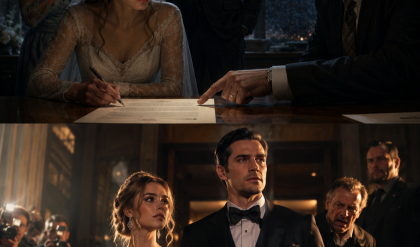
Preston stood near the front in a black tuxedo, handsome and composed, his hair touched with silver at the temples though he was only thirty-eight. He looked like the man on magazine covers: Preston Westfield, billionaire developer, philanthropist, visionary. But when he glanced toward row twelve and saw me, something flickered in his face.
Recognition.
Regret.
Then Caroline appeared at the back of the chapel, and the room rose.
She was stunning.
There is no point pretending otherwise. Caroline Beaumont knew how to be looked at. Her gown was sleek and architectural, her veil long enough to require management, her bouquet white and immaculate. She moved down the aisle like a woman entering a future that had already been arranged to flatter her.
Halfway down, her eyes found me.
Sitting alone.
No husband.
No children.
No visible claim to anyone important.
That was when she smiled.
“Did you really come alone?”
I saw the words.
So did Preston.
His jaw tightened.
For one wild second, I thought Nora might knock over a candle from heaven.
But the ceremony began.
The minister spoke about covenant and devotion. Preston and Caroline faced each other under the arch of flowers. The room leaned into the familiar rhythm of vows, rings, promises, and tears.
I tried to listen.
I tried to be gracious.
I tried to let the day pass without becoming another quiet humiliation I would later fold neatly and store inside myself.
Then the chapel doors opened.
Not loudly.
Just enough.
Light from the entrance spilled across the aisle, and my daughter stepped through it.
Lily did not rush. She walked with the steady dignity of a woman twice her age, her navy dress simple, her expression calm. Noah followed her, clutching his sketchbook. Caleb came last, wearing the gray suit he had worn to his middle school awards ceremony, holding Nora’s envelope.
My breath stopped.
They had not stayed home.
They had followed me.
A rustle moved through the chapel.
The minister paused.
Caroline turned, still holding Preston’s hands.
Preston stared as if memory had become flesh and walked down the aisle.
My children stopped beside row twelve.
Lily touched my shoulder.
“We decided,” she whispered, “you shouldn’t have to sit alone while people pretend not to know what they did.”
I started to stand. “Lily, this is not—”
“No,” she said softly. “Don’t apologize for us.”
There are sentences a mother waits a lifetime to hear without knowing it.
That was one of them.
Caleb looked toward the altar.
“Uncle Preston,” he said, louder now, “this is from Aunt Nora.”
A gasp moved through the room.
Preston stepped down from the altar.
“Caleb,” he said carefully, “what are you holding?”
Caleb’s fingers tightened around the envelope. “Aunt Nora gave it to Mom before she died. She said if you got too rich to remember family, we should make sure you read it.”
Caroline’s face changed.
The word rich had landed hard, not because anyone in the room disliked wealth, but because they disliked hearing it named without decoration.
Evelyn Beaumont rose halfway from the front pew.
“Preston,” she said in a low, urgent voice, “perhaps this can wait.”
Preston did not look at her.
He looked at me.
I could have stopped it. I could have shaken my head. I could have protected him, protected the ceremony, protected the beautiful lie that everyone in that room had treated Nora’s memory with care.
But I thought of the garden note in my purse.
I thought of Caroline’s smile.
I thought of Lily’s hand on my shoulder, Noah’s quiet courage, Caleb’s trembling grip on an envelope written by a woman who had loved us all before money complicated the seating chart.
So I nodded.
Caleb walked forward and handed the envelope to Preston.
The chapel held its breath.
Preston opened it.
Nora’s handwriting appeared.
His face changed before he had read three lines.
That was how I knew her voice was still alive on the page.
At first, he read silently. Then his shoulders dropped. He turned slightly away, pressing his thumb against the corner of the letter as if the paper might vanish if he held it too loosely.
Caroline whispered, “Preston, what is happening?”
He closed his eyes.
When he opened them, the billionaire was gone.
For the first time all day, he looked like Nora’s little brother.
He turned toward the room.
“My sister wrote this,” he said.
His voice was not loud, but the chapel carried it.
“She wrote it before she died. She told Grace to give it to me when I forgot what family means.”
No one moved.
Preston looked down and read aloud.
“Preston, if this letter has found you in a room full of expensive flowers and uncomfortable truth, then congratulations, you have probably become exactly as impressive and foolish as I feared.”
A shocked laugh broke from somewhere in the back.
Preston swallowed hard.
“She always knew how to begin,” he said.
Then he continued.
“I do not care how much money you make. I do not care what buildings carry your name. I do not care how many people call you brilliant if you become too small-hearted to recognize the people who loved you before you were useful.”
His voice cracked on useful.
Caroline lowered her bouquet.
Evelyn Beaumont’s face had gone rigid.
Preston read on.
“Grace Holloway is not a charity case, not a sad story, not an extra chair to be found if convenient. She is the woman who taught me more about family than most married people ever learn. She raised Lily, Noah, and Caleb with grit, humor, discipline, and a kind of daily courage that does not photograph well but holds the world together.”
My eyes burned.
Lily’s hand tightened around mine.
Noah looked at the floor, blinking quickly.
Caleb stood straighter.
Preston’s voice steadied.
“If you ever host a family table and Grace and her children are not welcome at it, you have misunderstood the word family. If you ever let someone make her feel small because she arrives without a man beside her, you have confused appearance with honor. And if success makes you forget the shape of home, look behind Grace. Her children will remind you.”
He stopped.
The chapel was silent except for Caroline’s uneven breathing.
Preston folded the letter with both hands, then looked at me.
“Grace,” he said, and now everyone could hear the shame in his voice, “I am sorry.”
I did not know what to do with a public apology. Women like me become skilled at surviving private wounds. Public repair is more difficult. It asks you not only to forgive or refuse, but to be seen while deciding.
He turned to my children.
“Lily, Noah, Caleb, I am sorry to all three of you. You should have been invited. Not as a favor. Not because Nora said so. Because you are family.”
Caleb nodded once with grave authority.
Lily said, “Then why weren’t we?”
A sound moved through the room, half discomfort, half admiration.
Preston accepted the question like a blow he deserved.
“Because I let other people decide what looked appropriate,” he said. “And because I was cowardly enough to let neatness matter more than loyalty.”
Caroline flinched.
Her mother stood fully now.
“That is unfair,” Evelyn said. “The guest list was complicated. There were capacity limits, family considerations—”
Caleb looked around the huge chapel. “There are like four hundred chairs.”
Several people coughed to hide laughter.
Evelyn’s mouth tightened.
Caroline turned to her mother. “Mom.”
Evelyn lowered her voice. “Darling, not now.”
Caroline looked at me then. Really looked. Not at my dress or my empty ring finger or the place where a man might have stood. At me.
Something in her expression shifted, and I realized the first twist of the day was not that my children had arrived.
It was that Caroline was not as certain as her smile had made her seem.
She stepped down from the altar and faced me.
“Grace,” she said. “I owe you an apology.”
I nearly said, It’s fine.
The words were ready.
Women are trained to keep rooms comfortable even when we are the ones bleeding into the carpet.
But Lily’s hand on my shoulder reminded me that my daughter was watching what I taught the room to expect from me.
So I said, “Yes, you do.”
Caroline took that in.
Then she nodded.
“I laughed when I saw you come in alone,” she said, voice trembling slightly. “I made an assumption about you. I let my mother’s version of the guest list become mine because it was easier than asking Preston who mattered before I arrived. That was cruel.”
The word cruel struck the room harder than any excuse would have.
Preston looked at her, surprised.
Caroline continued.
“I cannot undo it. But I can say it clearly. I was wrong.”
That mattered.
Not enough to erase the wound.
But enough to stop pretending there was no wound.
The minister stood awkwardly near the altar, holding his book.
Preston turned to him.
“Reverend, we need a moment.”
Then he looked at the ushers.
“Bring four chairs to the front row.”
Evelyn inhaled sharply. “Preston, the front row is reserved.”
“For family,” he said.
His voice had changed.
It was quiet, but it was no longer negotiable.
The ushers moved quickly, grateful for instructions. Chairs appeared beside the Westfield family pew. People shifted. Programs rustled. Evelyn sat down as if sitting were a concession forced upon her by gravity.
Lily helped me stand.
We walked forward together.
Not as intruders.
Not as poor relations.
Not as a single mother and her inconvenient children.
As a family entering the place love had already earned.
When I passed Caroline, she lowered her eyes. Not in defeat. In humility. There is a difference.
The ceremony resumed.
It was not perfect after that.
Thank God.
Perfect had been the problem.
Preston’s voice shook during his vows. Caroline’s did too. But the words sounded less like performance now. They sounded like two people standing in the wreckage of an assumption and deciding whether to build honestly from there.
When they were pronounced husband and wife, the applause came slowly at first, then warmly. Not everyone approved. You could feel that. Some people prefer elegance over truth because elegance does not ask them to change.
But Nora would have loved it.
She would have called it a blessed mess.
The reception at Beaumont Hall was supposed to be seamless.
It was not.
That became the second twist.
The estate sat on forty acres of rolling Tennessee green, with a white-columned main house, manicured gardens, and a ballroom built entirely for the kind of people who say intimate gathering when they mean two hundred guests.
Everything was beautiful.
White tablecloths.
Gold-rimmed plates.
Crystal glasses.
Hundreds of candles reflecting in tall windows.
A cake so elaborate Caleb whispered, “That thing has a retirement account.”
Normally, I would have corrected him.
After the chapel, I let him have it.
Near the ballroom entrance stood a framed seating chart in gold script.
Guests gathered around it, searching for their names beneath table numbers.
I did not need to look.
I already knew.
One seat for Grace Holloway.
Table nineteen.
Back corner.
No Lily.
No Noah.
No Caleb.
Truth may interrupt a ceremony, but calligraphy does not update itself.
A wedding coordinator wearing black hurried toward us with a tablet clutched like a shield.
“Ms. Holloway,” she said, breathless, “we are making adjustments.”
Caroline appeared behind her, veil removed, shoulders squared. Without the veil, she looked younger. More human. Less like a portrait someone else had arranged.
“The chart is wrong,” she said.
It was an interesting sentence.
Not unfortunate.
Not confusing.
Wrong.
I looked at her.
She continued. “I approved it without asking enough questions. That is on me.”
Evelyn Beaumont arrived with the expression of a woman who had never met a problem she could not suffocate with manners.
“Caroline,” she said softly, “the guests are entering. This should be handled discreetly.”
Caroline did not turn away from me.
“It should have been handled decently.”
Evelyn’s eyes flashed.
Preston joined us then. He had changed from shaken groom to something steadier. He looked at the seating chart, then at the coordinator.
“Move the donor table to nineteen. Put Grace and her children at table one.”
The coordinator’s fingers flew over the tablet.
Evelyn stepped closer. “Table one is full.”
Preston looked at her. “Then it will become fuller.”
“That table was arranged carefully.”
Lily spoke before I could stop her.
“So was the insult.”
Silence snapped across the entrance hall.
My first instinct was to say her name in warning.
But Lily had not shouted. She had not been rude. She had simply refused to wrap the truth in lace.
Caroline looked at my daughter with something like respect.
“You’re right,” she said.
Evelyn stared at Lily as if only now realizing teenagers could be dangerous when raised by women who told them the truth.
Two guests were moved from table one with professional apologies and visible resentment. One elderly Beaumont aunt muttered that weddings had become “social experiments.” Caleb whispered, “At least this one has cake.”
“Caleb,” I murmured.
“What? I’m supporting the arts.”
We sat at table one.
For the first time that day, I saw the ballroom from the front.
It is strange how geography can alter dignity.
The candles were no brighter at table one than at table nineteen. The plates were no cleaner. The food would taste the same. And yet, after years of being placed near exits, kitchens, back pews, overflow rooms, and the emotional margins of other people’s lives, there was healing in being seated where no one had to look over their shoulder to find us.
Preston came around the table before dinner.
He crouched beside Caleb.
“Thank you for bringing the letter.”
Caleb shrugged, trying to appear casual. “Aunt Nora said important things should be delivered in person.”
Preston smiled through sadness.
“She said that?”
“She also said if you acted rich-weird, Lily would know.”
Lily lifted her chin. “I did know.”
Preston looked at her. “You did.”
Then he turned to Noah.
“You came too.”
Noah nodded.
“Mom looked small in that row,” he said quietly. “She isn’t small.”
Preston’s face changed.
“No,” he said. “She isn’t.”
I had spent years wondering what my children had seen.
Had they noticed the panic I swallowed? The bills I hid? The times I sat in the car before work and counted to thirty because thirty seconds was all I could afford to fall apart? Had they felt deprived? Embarrassed? Shortchanged by a life where love was abundant but money was always late?
Then Noah said my life was not small.
And something inside me finally believed that maybe the rooms I built with tired hands had been bigger than I knew.
Dinner began awkwardly.
Of course it did.
There are few things more uncomfortable than sharing salad after a public moral correction.
Caroline’s father, Richard Beaumont, attempted small talk about the weather, because people often discuss weather when emotional storms are already indoors.
“Beautiful June evening,” he said.
Caleb said, “It was more intense in the chapel.”
Lily closed her eyes.
Noah passed Caleb a roll in what appeared to be a peace offering or a distraction.
To my surprise, Richard laughed.
“Yes,” he said. “I suppose it was.”
That laugh loosened the table.
Not entirely.
But enough.
Caroline asked Lily about school. Lily told her she wanted to study law.
Caroline said, “That suits you.”
Lily replied, “Because I’m argumentative?”
“Because you notice language,” Caroline said. “And because you don’t let people hide inside it.”
Lily studied her for a moment, then nodded as if Caroline had passed the first gate.
Preston asked Noah about the sketchbook. Noah hesitated, then opened it.
I watched Preston turn the pages with genuine attention. There were bridges, libraries, houses with wide porches, a chapel doorway drawn from memory, and a detailed concept for a community center Noah said he would build someday “for people who need somewhere to go without having to prove they deserve help.”
Preston stopped on that one.
“You understand space,” he said.
Noah looked down. “I just draw.”
“No,” Preston said. “You think about who gets welcomed and who gets left outside. That is architecture before it becomes drawing.”
Noah looked at him quickly.
No one had ever said that to him before.
Not specifically.
Not like it mattered.
My son sat taller for the rest of dinner.
Caleb, meanwhile, somehow got Richard Beaumont to explain how wedding cakes were structurally supported. Within ten minutes, Richard was drawing tiers and dowels on the back of a menu while Caleb asked whether a cake could technically be classified as a building.
“If it needs columns,” Caleb said, “I feel like Noah should inspect it.”
By the time the salads were cleared, Richard had laughed three times.
Evelyn had not laughed once.
She sat beside Caroline with perfect posture and a dangerous calm. She was not rude. Rudeness would have been too obvious. She was worse. She was gracious in a way that denied any need for grace.
After dinner, the speeches began.
Richard spoke first. He welcomed everyone to Beaumont Hall and told a charming story about Caroline organizing her dolls by “social compatibility” when she was six. The room laughed. Caroline covered her face, embarrassed.
Then Preston’s best man told stories from Vanderbilt, including one about Preston trying to impress investors at twenty-four while accidentally wearing two different shoes. The room laughed again.
Then Caroline stood.
The ballroom quieted.
She held the microphone with both hands.
“I had a speech prepared,” she began. “It was polished, brief, and unlikely to offend anyone.”
Soft laughter moved through the room.
Caroline looked toward her mother.
“My mother would have liked it.”
This time the laughter was nervous.
Evelyn’s smile did not move.
Caroline turned toward our table.
“But today did not go as planned. And I think that may be the first honest gift my marriage has received.”
The room shifted.
“Earlier today,” Caroline said, “I saw a woman enter the chapel alone, and I thought I understood what I was seeing. I thought I was seeing someone without a place. Someone outside the center of the story. I was wrong.”
Lily’s hand found mine under the table.
“I was seeing Grace Holloway,” Caroline continued, “a woman who raised three children with more loyalty and courage than many people bring to their most celebrated moments. I was seeing someone my husband’s sister loved deeply. I was seeing family. And I laughed because I was too shallow, too protected, and too afraid of disorder to recognize dignity when it walked in quietly.”
No one spoke.
The apology was no longer private. It had become testimony.
Caroline’s voice trembled, but she did not stop.
“Grace, Lily, Noah, Caleb—I am sorry. Not only for the missing chairs. For the assumption behind them. I cannot promise I will never be foolish again. But I can promise this: I will not build a marriage that requires people to make themselves smaller so the picture looks cleaner.”
She turned to Preston.
“And Preston, I promise to ask who belongs before I assume I know. I promise to listen when the answer complicates the table. I promise not to confuse elegance with kindness.”
Preston’s eyes were wet.
The applause began softly.
Then it grew.
Warm.
Real.
Evelyn clapped too, though each clap looked personally negotiated.
Preston stood next.
He took the microphone and looked at the letter in his hand.
“My sister Nora used to say some people collect houses, and some people make homes,” he said. “I have collected a lot of houses.”
Gentle laughter moved through the ballroom.
“But Grace made a home. She made one when money was tight, when help was unreliable, when exhaustion would have given her every excuse to become bitter. She made one for her children. She made one for Nora. And, though I was too proud to admit it, she made one I could have returned to when success started making me lonely.”
His eyes moved to me.
“I mistook distance for sophistication. I mistook busyness for importance. And today, a twelve-year-old with better timing than most adults handed me my sister’s last correction.”
Caleb gave a modest nod.
The room laughed.
Preston lifted his glass.
“To the people who show up before they are invited, because love was never supposed to wait for permission.”
Glasses rose across the ballroom.
This time, when people looked at us, I did not feel exposed.
I felt witnessed.
There is a difference.
After the toasts, music filled the room.
Couples moved onto the dance floor. The tension loosened into conversation. Caroline danced with her father. Preston danced with Evelyn because the program required it, though her face remained unreadable.
Then Preston walked toward me.
“Grace,” he said, “would you dance with me for one song?”
The old instinct said no.
Not because I did not want to.
Because being honored publicly can feel dangerous when you have spent years surviving without applause. It asks you to stand in the open and accept that you mattered all along.
Lily leaned toward me.
“Go.”
Noah nodded.
Caleb said, “I’ll protect your purse and your cake.”
“I don’t have cake.”
“Then I’ll get cake.”
I stood.
Preston led me to the dance floor as the band began an old song Nora had loved, a slow country ballad she used to sing badly on purpose while doing dishes.
For a few moments, neither of us spoke.
Then Preston said, “I should have called more.”
“Yes.”
A sad smile touched his face. “You’re not going to make this easy.”
“Nora didn’t leave me instructions to make things easy.”
He looked down.
“I avoided you after she died.”
“I know.”
“Not because I didn’t care.”
“I know that too.”
He swallowed.
“You reminded me of the version of myself she expected me to be. And I was tired of disappointing dead people.”
That was honest enough to hurt.
I said, “The dead are not the only ones who noticed.”
His eyes closed briefly.
“I know.”
We swayed under the lights.
“I told Caroline about Nora,” he said. “But I told her the safe parts. The funny parts. The brave parts. I didn’t tell her how Nora would sit at your kitchen table because she felt more alive there than in any hospital suite I paid for. I didn’t tell her your kids were the last children Nora ever bought Christmas presents for. I didn’t tell her Nora trusted you with the truth because she trusted you more than me.”
I looked at him.
“Why not?”
“Because then Caroline would have understood that some relationships outranked the life I was trying to build.”
“No,” I said. “She would have understood the life you were trying to build was missing load-bearing walls.”
He laughed once through tears.
“That sounds like something Noah would draw.”
“It sounds like something Nora would say badly until it became true.”
He nodded.
When the song ended, he hugged me.
Not for the cameras.
Not for the guests.
Like family.
Over his shoulder, I saw Evelyn watching from near the dessert table.
Her expression was tight, but beneath it something else moved.
Fear, maybe.
Or recognition.
Later, while Lily and Caroline spoke near the garden doors and Noah showed Preston another sketch, Evelyn approached me.
“Ms. Holloway,” she said.
I turned. “Mrs. Beaumont.”
“May I speak with you?”
I braced myself.
People like Evelyn often wait until public emotion fades before privately restoring hierarchy.
But she surprised me.
“You have remarkable children,” she said.
“Thank you.”
“They are very direct.”
“They were raised around adults who often weren’t.”
Her lips parted.
Then, unexpectedly, she laughed.
A real laugh.
Small, but real.
“I suppose I earned that.”
I said nothing.
She looked toward Caroline, who was listening intently while Lily spoke.
“When Caroline was young, I wanted every door open for her,” Evelyn said. “Every advantage. Every protection. I taught her how to enter rooms, how to speak, how to sit, how to be chosen.”
“That sounds exhausting.”
“It was,” she admitted.
The admission made her more human than anything else she had said.
“I thought presentation would protect her from being dismissed,” Evelyn continued. “Somewhere along the way, I began dismissing anyone who did not fit the presentation.”
I looked at her carefully.
“That is a costly habit.”
“Yes.”
Her hands tightened around her champagne flute.
“I did not ask Preston enough about Nora. Or about you. I assumed the important people would be obvious.”
“They rarely are.”
She nodded.
“I am sorry.”
The words did not heal everything.
But they landed honestly.
“For the seating?” I asked.
“For the seating,” she said. “For the garden note. For calling exclusion logistics because it sounded nicer. For teaching my daughter to fear disorder more than unkindness.”
I studied her face.
She was still Evelyn Beaumont. Still polished. Still controlled. Still probably capable of making a florist cry with one raised eyebrow.
But she was trying.
That mattered.
Not as much as people think.
More than cynics allow.
“Someday,” she said, “if you are willing, I would like to hear about Nora.”
Someday.
The word gave me room.
I could respect that.
“Someday,” I said.
Evelyn nodded. “Thank you.”
The reception continued.
Not perfectly.
Peacefully.
Perfect had already failed, and everyone was better for it.
Lily danced with Caleb and let him spin her so badly that two bridesmaids applauded from a safe distance. Noah sat in the courtyard sketching the chapel doorway from memory. Caroline found him there and asked whether she could sit beside him. I watched from inside as he hesitated, then nodded.
She did not offer empty praise.
She asked real questions.
“Why did you draw the doors open instead of closed?”
“Because closed doors are boring,” Noah said.
Caroline smiled. “And the light?”
He looked at the page. “It looked like it was coming from behind us.”
“Was it?”
He thought about that.
“No,” he said. “But it felt that way.”
Caroline stayed with him for fifteen minutes, listening.
Later, Noah told me, “She actually looked at it.”
That mattered to him.
So it mattered to me.
Caleb became friends with a retired pastry chef who had designed the wedding cake. By the end of the night, he had secured a promise for a buttercream recipe and announced that his future company would be called Caleb’s Emotional Cupcakes.
“Why emotional?” Richard Beaumont asked.
“Because people buy desserts with feelings,” Caleb said. “Sir, that’s business.”
Richard looked at me. “He may be right.”
“He usually thinks he is.”
Near the end of the reception, Preston found the four of us by the garden steps. The night air smelled of magnolia and summer rain. Fireflies blinked over the lawn.
He held out Nora’s letter.
I shook my head. “No. That belongs to you.”
“I made a copy,” he said. “This one is yours.”
My hands closed around the envelope.
For a moment, I could not speak.
Preston looked at my children.
“She wrote about all of you.”
Caleb’s eyes widened. “Me?”
“You especially.”
“What did she say?”
Preston smiled. “She said you were trouble with dimples and would either become president or get banned from a homeowners association.”
Caleb nodded thoughtfully. “Both are possible.”
Lily laughed.
Noah smiled.
Preston turned to Lily.
“She said you would grow up with eyes sharp enough to cut through nonsense.”
Lily lifted one brow. “She was correct.”
“And Noah,” Preston said gently, “she said you saw homes where other people saw walls.”
Noah looked down, deeply touched.
“She noticed that?”
Preston’s voice softened. “Nora noticed everything.”
That was true.
Nora noticed when someone’s laugh was too loud to be happy. She noticed when children needed a second serving but were too polite to ask. She noticed when pride was fear wearing expensive shoes. She noticed me when I thought survival had made me invisible.
I held the letter against my chest.
“Thank you,” I said.
Preston shook his head.
“No. Thank you for keeping her alive in the way you raised them.”
The old version of me would have deflected the compliment.
I would have said I only did my best.
I would have said I had no choice.
I would have said any mother would have done the same, which was not true and never had been.
But that day had taught me something.
Minimizing your own labor does not make you humble.
It trains people to undervalue the miracle you carried with bleeding hands.
So I said, “I worked very hard to do that.”
Preston looked at me with tears in his eyes.
“I know.”
The night ended with a sparkler exit down the front steps of Beaumont Hall.
Guests lined the walkway, holding tiny lights against the dark. Caroline and Preston stood at the top of the stairs, ready to leave. Before they walked through the sparklers, Caroline came to me.
She hugged me.
Not dramatically.
Not for attention.
A little awkwardly, like someone practicing sincerity without the safety of polish.
“I hope this is not the last time we see each other,” she said.
I looked at her.
“I hope next time begins better.”
She laughed softly.
“So do I.”
Then she turned to my children.
“Thank you for coming.”
Caleb said, “Technically, we were not invited.”
“Caleb,” Lily warned.
Caroline nodded seriously.
“You’re right. Thank you for coming anyway.”
That answer earned her more ground with my children than any polished apology could have.
Preston and Caroline ran through the sparklers while guests cheered. At the end of the walkway, Preston turned back and lifted one hand.
Not to the crowd.
To us.
We waved back.
All four of us.
A family that had entered after being excluded and left knowing we had never needed permission to belong to each other.
On the drive home, Caleb fell asleep within ten minutes, still clutching a napkin with buttercream notes on it. Noah rested his head against the window, quiet and full of thoughts. Lily sat in the passenger seat, watching the dark road unwind ahead of us.
After a while, she said, “Are you okay?”
“Yes.”
“Really?”
I smiled. “Really.”
She nodded.
“I hated her when she laughed.”
“I know.”
“But I liked her when she apologized.”
“I know that too.”
Lily leaned back.
“People are complicated.”
“Very.”
“Do you think Aunt Nora planned that?”
“The letter?”
“The timing.”
I laughed softly.
“Nora planned everything and pretended she believed in spontaneity.”
Lily smiled.
“She would have loved today.”
“She would have complained loudly, then cried privately.”
“That sounds like her.”
We drove in comfortable silence.
Then Lily said, “Mom?”
“Yes?”
“I’m glad we followed you.”
I reached over and squeezed her hand.
“Me too.”
When we got home, it was almost midnight.
Caleb woke just enough to ask if rich weddings gave leftovers to emotionally significant guests. When I told him we had no cake, he declared the evening “morally successful but logistically flawed” and stumbled upstairs.
Noah placed his sketchbook on the kitchen table before going to bed.
“Look,” he said.
I opened it.
The drawing showed the chapel doors wide open. A woman stood inside the aisle, turned slightly as if she had just heard something behind her. Three figures entered through light. The girl’s head was high. The older boy held a book. The youngest held an envelope.
Around them, the pews were shadowed.
Behind them, the door was bright.
“Noah,” I whispered, “this is beautiful.”
He shrugged, embarrassed.
“It felt important.”
“It was.”
He left the sketch on the table.
Lily hugged me last. She held on longer than usual.
“You never made us feel like we were missing a family,” she said.
That sentence nearly broke me.
Because I had worried about it for years.
Worried the absence of their father had become a shadow I could not outlove. Worried tight budgets and tired dinners had carved lack into their memories. Worried that one exhausted mother, no matter how devoted, could never stretch far enough to cover every empty space.
I held my daughter tightly.
“You three made my life full.”
She pulled back.
“It was already full because of you.”
Then she went upstairs.
I sat alone at the kitchen table.
Nora’s letter lay beside Noah’s drawing.
The house was quiet, but not empty.
It had never been empty.
Even on the hardest nights, when I thought I was standing alone in the doorway of my life, there had been three little hearts behind me, watching, learning, becoming.
I opened Nora’s letter and read it from the beginning.
Preston,
If you are reading this at an inconvenient time, good. Important truths are rarely considerate.
I laughed through tears.
She continued.
You were always ambitious. I loved that about you before ambition started wearing cologne and pretending it invented oxygen. I am proud of what you have built. But listen carefully: money can buy a long table. It cannot teach you who deserves a seat.
Grace deserves a seat.
Lily, Noah, and Caleb deserve seats.
Not because they suffered. Do not reduce them to that. They are not symbols of hardship. They are evidence of love repeated daily. Grace raised them with discipline, laughter, sacrifice, and a refusal to become cruel even when life gave her opportunities. If you forget that, you have not become successful. You have become decorated.
I stopped reading.
Decorated.
Nora would choose that word. Beautiful and brutal.
I kept going.
If you let anyone treat Grace as less because no husband stands beside her, remember this: some women are not alone. They are simply the first ones through the door because they spent years making sure everyone behind them had shoes, courage, homework, and breakfast.
Do not mistake the order of arrival for the size of the family.
I pressed my hand against my mouth.
The final line blurred.
Wait before you judge an entrance. Love may be walking in behind it.
I looked at Noah’s drawing again.
Four figures.
Open doors.
Light.
Months passed.
At first, I was cautious when Preston called.
Guilt can look a lot like renewed love in the beginning. It sends invitations, makes gestures, overcorrects, and hopes the past will accept a gift basket.
But Preston remained consistent after the drama faded.
He invited us to ordinary dinners, not performances. Pizza in his kitchen. Sunday chili during football games. A backyard cookout where Caleb spilled lemonade on a city councilman and somehow left with a recommendation for a youth entrepreneurship program.
Caroline changed too.
Not instantly.
People rarely do.
But steadily.
She asked questions without making them sound like interviews. She sent Lily an article about a women’s legal mentorship program. She found a used book on sustainable architecture for Noah and wrote inside, For the doors you will open. She mailed Caleb a baking kit after he sent her three pages of cupcake business projections.
Caleb opened it and said, “She respects the empire.”
Even Evelyn tried.
Slowly.
One afternoon, she invited me to tea at Beaumont Hall.
I almost declined.
Then Lily said, “Mom, people can’t practice being better if no one lets them into a room where better is required.”
I stared at her.
“When did you become seventy-five?”
She shrugged. “Emotional maturity is my burden.”
So I went.
Tea at Beaumont Hall was exactly as intimidating as expected. Real china. Tiny sandwiches. A silver teapot that looked more valuable than my car. Evelyn noticed me handling the cup carefully and said, “They are sturdier than they look.”
“So are people,” I replied.
She looked at me.
Then she nodded.
We spoke politely at first. Then honestly.
She told me she had spent her life believing that if Caroline appeared flawless enough, no one could wound her.
“I thought I was giving my daughter armor,” she said.
“Maybe you were,” I answered. “But armor makes it hard to hug people.”
She looked down at her tea.
“That is painfully true.”
I told her a little about raising my children. Not everything. Some stories belong first to the people who lived them. But enough.
By the end, she said, “I misjudged you.”
“Yes,” I said.
She smiled faintly. “You do not soften the truth much.”
“I raised three children on a budget. Efficiency matters.”
She laughed.
That was the beginning of respect.
Not friendship.
Not yet.
Respect was enough.
A year later, Lily graduated from high school.
Preston, Caroline, Evelyn, and Richard all came.
Not out of obligation.
Because Lily invited them.
When her name was called, our entire row stood.
Me.
Noah.
Caleb.
Preston.
Caroline.
Richard.
Even Evelyn, clapping with the determined posture of a woman making up for every time she had applauded the wrong things.
After the ceremony, Lily hugged me first.
Always first.
Then Preston handed her a small velvet box.
Inside was Nora’s fountain pen.
Lily stared at it.
“She wrote letters with this,” Preston said. “She would want you to have it.”
Lily’s eyes filled.
“Thank you.”
That night, she used the pen to write the first line in her college journal.
I come from women who show up.
She showed it to me months later.
I cried then, not because she was leaving, but because she understood what I had spent her whole life trying to teach without turning my pain into a lesson.
Noah applied to architecture programs the following year. Preston introduced him to a community housing architect who cared more about dignity than luxury. Noah came home glowing after a shadowing day, talking about sunlight, accessibility, and how buildings could either welcome people or quietly reject them.
Caleb started selling cupcakes at school events with permission and alarming confidence. Richard helped him build a spreadsheet.
“Your profit margins are emotional,” Richard told him.
“My cupcakes are emotional,” Caleb replied.
No one could argue.
Life became fuller.
Not easier exactly.
But richer.
The wedding that began with a smirk became a doorway none of us expected.
That does not mean the smirk did not matter.
It did.
Small humiliations matter. They reveal how people see you when they think kindness is optional. A laugh behind a bouquet can carry years of assumptions. A missing chair can say what no one is brave enough to write. A seating chart can become a map of who is valued and who is merely tolerated.
But what happens next matters too.
Caroline chose to apologize when pride would have been easier.
Preston chose to remember when forgetting had made him comfortable.
Evelyn chose, slowly and imperfectly, to question the world she had polished.
My children chose to stand behind me.
And I chose not to shrink in order to preserve a false peace.
That last part mattered most.
For years, I had believed dignity meant endurance. Quiet endurance. Smile and move on. Take the back row. Accept the single seat. Do not make trouble. Do not embarrass the children. Do not ask for what should have been offered freely.
Sometimes dignity does mean silence.
But sometimes dignity means allowing the truth to stand in the doorway with your children and an old letter in its hand.
I did not shout in that chapel.
I did not insult the bride.
I did not demand a place.
My children simply walked in.
And their presence told the truth better than any speech I could have given.
Years later, when people ask about that wedding, Caleb tells it dramatically.
“The bride laughed,” he says, “and then we entered like the final scene of a legal thriller.”
Lily tells him that is not how weddings work.
Noah says nothing, but he still has the drawing.
I tell the story more gently.
I say that a woman walked into a room where people thought she was alone, and then the life she had built walked in behind her.
Because that is what families are sometimes.
Not matching last names.
Not perfect portraits.
Not seats assigned correctly the first time.
Families are the people who refuse to let you be misread in silence. They are daughters who tell you not to apologize for existing. Sons who carry old letters. Children who understand loyalty before adults learn humility. Friends whose love remains loud after death. Even flawed people who choose repair over performance.
A mother’s value does not come from who stands beside her.
It does not come from marriage, money, approval, or whether a seating chart knows what to do with her.
She has value already.
But sometimes the world forgets to look closely.
Sometimes it sees an empty chair and thinks it sees absence.
Sometimes it sees a woman entering first and thinks she came with nothing.
If that has ever been you, remember this:
Not every family enters at the same time.
Not every love is visible at the doorway.
Not every support system arrives on schedule.
Some love stories are not romances. Some are three children walking behind their mother because they know she deserves to be seen. Some are friends who leave letters sharp enough to cut through pride. Some are apologies spoken into microphones by people brave enough to become better in public.
And sometimes, the people who laugh when you enter alone are about to learn that you were never alone at all.
You were simply the first one through the door.
THE END