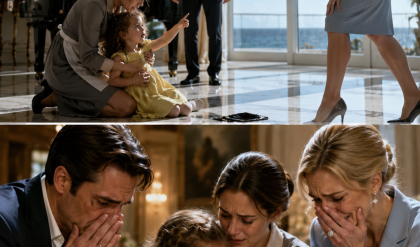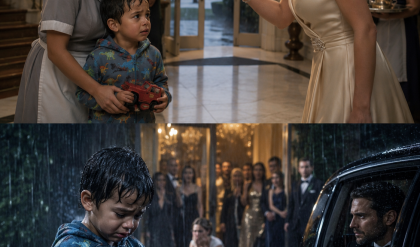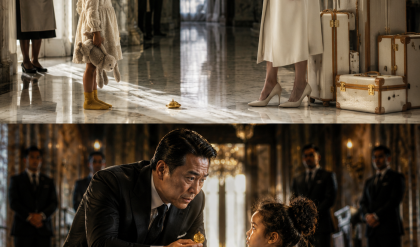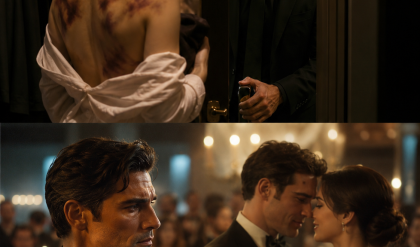
“Mr. Avery,” she said quietly, “is this necessary?”
“I want to observe how she behaves when she doesn’t know who is watching.”
Helen’s expression did not change, which meant she disapproved profoundly. She had worked for his family since Caleb was six. She had known Evelyn well enough to cry in the pantry after the funeral and pretend she had allergies when Julian walked in.
“People behave differently when power hides from them,” Helen said.
Julian looked at her. “Exactly.”
“No,” Helen replied. “Not exactly the way you mean.”
He ignored the warning.
For the first three days, Amara gave him no reason to suspect anything except that she was better at the job than anyone before her. She did not photograph the house. She did not ask whether the paintings were original. She did not gossip with the kitchen staff beyond basic friendliness. She learned routines quickly and corrected mistakes without dramatizing them. She spoke respectfully to Helen, kindly to the groundskeepers, and with easy humor to the younger maid who kept dropping folded towels whenever Julian passed in his fake uniform.
To him, she was polite but not deferential.
That unsettled him more than he wanted to admit.
“Morning, Ellis,” she said on her second day, finding him by the back staircase.
He nearly forgot to answer.
“Morning.”
“You always stand like you’re guarding a bank vault.”
“I’m security.”
“Still,” she said, carrying a basket of linens past him. “Even vaults get lonely.”
She did not wait for a reply. Julian stood there longer than necessary, irritated by the fact that a woman who had known him for forty-eight hours under a false name had described him better than most people who sat on his board.
Her first encounter with Caleb happened on a Friday afternoon.
The weather had turned bright after a week of rain, and sunlight filled the west corridor where Evelyn’s photographs still hung. Julian had ordered most of them moved after the funeral, not destroyed, not hidden exactly, but relocated to less central walls so Caleb would not be hurt by seeing his mother everywhere. That was what he told himself. The truth was that Julian could not survive being watched by Evelyn’s smile in every room.
Caleb came down the corridor with a book tucked under one arm. He walked slowly, one hand brushing the wall. Amara emerged from the library carrying a vase of dead flowers. When she saw him, she did not freeze the way new employees often did. She did not soften her face into pity. She simply shifted the vase to her other arm so there was room for him to pass.
Caleb’s sleeve caught on the edge of a console table. A silver frame fell. Glass cracked against the floor.
The house seemed to stop breathing.
Caleb stared at the broken frame. Inside it was a photograph Julian had forgotten existed: Evelyn laughing in the garden, Caleb at nine years old beside her, both of them covered in dirt from planting tulips.
Two maids at the end of the corridor turned pale. One glanced toward the security camera, as if expecting punishment to arrive through the lens.
Amara set down the vase. She knelt, picked up the photograph carefully, and checked Caleb’s hands for cuts without grabbing him.
“Glass is rude,” she said quietly. “Always making a bigger announcement than it needs to.”
Caleb blinked.
Amara looked at the photograph. “She had a good laugh.”
Caleb’s face changed so quickly Julian almost missed it. Pain moved through him, but so did recognition. Most people avoided mentioning Evelyn. Amara had spoken of her as if she were not a ghost but a person who had once laughed in a garden.
Amara placed the photograph on the console, away from the glass. “I’ll clean this up. You don’t have to stand in the sharp part.”
Caleb stepped back.
That was all. No miracle. No music swelling. No word. Yet Julian, watching from the end of the hall in the guard uniform, felt something loosen and tighten at once.
That evening, Caleb came downstairs for tea.
He did not drink it. He sat at the kitchen island while Amara wiped counters and Helen pretended not to stare from the pantry. Julian saw it on the monitor and left his study so fast he knocked over a stack of contracts.
By the time he reached the service hall, Caleb was still there. Amara was humming, something old and slow. Not a hymn exactly, not a pop song. A melody with the shape of comfort. Caleb watched steam rise from the mug in front of him.
Amara did not look at him.
“You don’t have to drink it,” she said. “Sometimes holding something warm is the whole point.”
Caleb’s fingers moved around the mug.
Julian stepped closer to the doorway, heart beating in an unfamiliar rhythm.
Then Caleb looked up, saw the guard uniform, and left.
Amara glanced toward Julian with mild accusation. “You walk heavy for security.”
He should have apologized then, though not for walking. He should have taken off the cap, told her who he was, accepted her anger while the lie was still young enough to cut cleanly. Instead, he folded his arms.
“I’ll try to float next time.”
She studied him for a moment. “Don’t strain yourself, Ellis.”
For the next week, Julian found reasons to be where Amara worked. He told himself he was observing her effect on Caleb, and that was partly true. Caleb began appearing in shared spaces more often. He sat in the library while Amara dusted shelves. He stood at the garden doors while she watered the herbs Evelyn had once planted and Julian had paid someone to maintain without looking at them. He listened when she hummed. Once, he followed her from room to room at a distance of twelve feet, like a wary animal pretending not to be tame.
Amara never pushed. She never asked Caleb to speak. She never said, “Your father loves you,” which would have been both true and useless. She created a world in which no answer was demanded. That, Julian slowly realized, was a kind of invitation.
With everyone else, Caleb had been treated like a locked door. People arrived holding keys. Amara sat beside the door and let him decide whether he wanted to open it.
One afternoon, Julian found her in the laundry room repairing a torn pillowcase by hand.
“House has machines for that,” he said.
Amara did not look up. “Machines don’t fix everything.”
He leaned against the doorframe. “That wisdom come free, or do I have to pay extra?”
“Depends who’s asking.”
“Ellis.”
“No,” she said, tying a knot in the thread. “That’s the name on your shirt. I asked who’s asking.”
Julian felt the first clean stab of danger. “A guard.”
Amara raised her eyes. “No, you’re not.”
The room seemed to shrink.
He kept his face still. “Excuse me?”
“I said you’re not just a guard.” She clipped the thread with small scissors. “You don’t talk like the others. You don’t know where the extra trash bags are. You looked personally offended yesterday when the delivery guy put a box on that antique bench. And every time someone says Mr. Avery, you get a little still.”
Julian said nothing.
Amara stood and folded the pillowcase. “I don’t know what you are, Ellis. But I know you’re hiding something.”
She walked past him, close enough that he smelled clean soap and rain on her coat.
He should have stopped. He should have confessed.
Instead, he became more careful.
By then, he was not merely suspicious of Amara. Suspicion had become a cover for fascination, and fascination had become something more dangerous because it included gratitude. She had changed the air in his house. Staff laughed more quietly but more often. Helen stopped moving like a soldier on a battlefield. Caleb came downstairs four days in a row. Julian ate dinner in his study while watching his son sit silently in the kitchen with Amara and felt both grateful and ashamed, because another person had found the courage to be near Caleb in ways his own father had avoided.
Julian had believed he gave Caleb space. Now he wondered whether he had abandoned him and called it respect.
The answer came on the terrace at dusk.
Amara sat on the stone wall overlooking the river, her shoes beside her, a paper cup of coffee warming her hands. Julian came upon her during one of his unnecessary patrols. The autumn air smelled of wet leaves and chimney smoke from houses down the hill.
“You can sit,” she said without turning. “Unless standing dramatically is in your job description.”
He sat, leaving three feet between them.
For a while, neither spoke. The river below caught the last light in broken strips of silver.
Finally, Amara said, “Caleb is not empty.”
Julian’s throat tightened. “I didn’t say he was.”
“No, but people in this house move around him like he’s made of glass or already gone. He’s neither.”
Julian looked at her profile. “How do you know?”
“Because he listens. People who are gone don’t listen. He notices which staff member is tired. He notices when the flowers are changed. He noticed I switched coffee brands in the staff room even though he never drinks coffee.” She smiled faintly. “He’s in there. He just learned that coming out hurts.”
The words entered Julian like weather through a cracked window.
“What if he never comes back?” he asked before he could stop himself.
Amara turned then. In the fading light, her expression was not pity. It was something firmer.
“Then somebody keeps a porch light on,” she said. “Every night. Without making him thank them for it.”
Julian looked away.
The river blurred.
He had not kept a porch light on. He had installed floodlights around the property. He had hired guards. He had built systems. But he had not sat outside his son’s door. He had not said, I’m here, and you can ignore me as long as you need. He had been too afraid Caleb’s silence would accuse him if he got close enough to hear it.
Amara seemed to understand that she had struck something true. She did not soften it. Mercy, Julian would learn, did not always arrive gently. Sometimes mercy told the truth and stayed anyway.
“Some grief,” she said, “turns people mean. Some turns them quiet. Some turns them rich and busy.”
He gave a humorless laugh. “That last one sounds specific.”
“It usually is.”
“Speaking from experience?”
She looked back at the river. “My little brother stopped talking after our mother died. He was eleven. People said he was stubborn. Teachers said he was disrespectful. Doctors said wait lists were long. I was nineteen, working two jobs, and I didn’t know anything except that everybody kept asking him to perform being okay. So I stopped asking. I sat with him. Cooked near him. Watched bad TV near him. Read library books out loud until he threw one at me.”
Julian almost smiled. “Did that help?”
“The throwing? Not my favorite stage. But yes. It meant he trusted me enough to be angry.”
“What happened to him?”
“He talks now. Too much, some Sundays. Works at a library in Baltimore. Owns a cat named Professor Pancake.”
This time Julian did smile, and it surprised him enough that he looked down at his hands.
Amara noticed. “There he is.”
“Who?”
“Whoever you are under the uniform.”
The smile disappeared.
The moment could have become confession. It opened between them with painful clarity. Julian felt it, knew it, feared it.
Then his phone buzzed. A board member. A crisis. A convenient escape disguised as responsibility.
He stood. “I have to take this.”
Amara’s face closed just a little. “Of course you do.”
He walked away, and the lie walked with him.
The unraveling began because of a red scarf.
Evelyn had owned it, a cashmere scarf she wore every October because she claimed the color made gray days less arrogant. After her death, Julian packed most of her clothes into cedar trunks and stored them in a locked room off the east wing. He did not tell Caleb where the key was. He told himself the boy did not need to live inside a shrine. The truth was uglier: Julian could not bear the possibility of seeing Caleb hold one of Evelyn’s sweaters and cry while Julian had no idea how to comfort him.
On Amara’s nineteenth day at Avery House, Helen asked her to help sort old linens in the east storage rooms. A mislabeled key opened the wrong door. Amara stepped into Evelyn’s preserved room and froze.
It was not the clothes that held her. It was the corkboard on the desk.
Photographs. Charity schedules. Handwritten notes. A program from the children’s mental health center Evelyn had funded quietly in Poughkeepsie. And in the center, pinned beneath a brass thumbtack, was a family photograph clipped from a magazine profile: Julian Avery in a tuxedo, Evelyn beside him, Caleb between them, all three standing under the same portrait that hung in the main hall.
Amara stared at Julian’s face.
Not Ellis. Not a guard. The owner. The billionaire. The man whose grief she had sat beside on the terrace while he let her believe they occupied the same side of the house’s invisible line.
Helen found her there moments later and stopped in the doorway.
Amara did not turn. “How long?”
Helen closed her eyes briefly. “Since the beginning.”
A long silence passed.
“Did you know?”
“Yes.”
“And you let me talk to him.”
Helen’s voice was soft. “I advised him against it.”
“That wasn’t my question.”
Helen accepted the rebuke. “Yes. I knew.”
Amara took one slow breath. “Where is he?”
“In the security corridor, I believe.”
“Of course he is.”
She found Julian near the monitor room, still wearing the uniform, cap in hand. When he saw her face, he knew before she spoke. Shame arrived first as heat, then as cold.
“Who are you?” she asked.
He did not pretend. That, at least, he managed.
“My name is Julian Avery.”
“No,” she said. “That’s your name. I asked who you are.”
He deserved that.
“I own this house.”
“You own this house,” she repeated. Her voice stayed quiet, which made the words more dangerous. “You own my schedule. You sign my checks. You have cameras in every hallway. And you decided that wasn’t enough power, so you put on a costume and let me think you were safe.”
Julian flinched.
Amara saw it and did not care.
“You watched me speak to your son. You watched me eat lunch. You watched me sit on that terrace and tell you about my brother while you knew I would not have told my employer those things. You let me believe I was talking to another worker in this house.”
“I was trying to protect Caleb.”
“No,” she said, stepping closer. “You were trying to protect yourself from trusting a Black woman you hired to clean your house.”
The sentence landed with such force that Julian had no defense ready. He could have said race had nothing to do with it. He almost did. But even in his cowardice, he recognized the old, polished lie in that answer. Race had lived in the room whether he named it or not. Class had lived there too. Power had been in the uniform, in the cameras, in the paycheck, in the fact that his curiosity could disguise itself as caution while her honesty became something he collected without permission.
“You’re right,” he said.
That seemed to anger her more.
“Don’t make being right another thing I have to carry.”
He lowered his eyes. “I’m sorry.”
“You’re sorry because I found out.”
“No.”
“You don’t get to decide that for me.”
He looked at her then, and there was nothing of the billionaire in his face. Only a man caught doing something small after years of believing himself large.
“You’re right,” he said again, helplessly.
Amara laughed once, without humor. “There it is. The famous Julian Avery strategy. Admit enough truth to avoid the whole truth.”
He had used that strategy in congressional hearings. In depositions. In negotiations. Hearing it named by a woman in a housekeeper’s uniform hurt more than any public accusation ever had.
She stepped back. “I won’t abandon Caleb because of what you did. That boy has been abandoned enough by adults hiding behind good intentions. But don’t come near me unless it concerns his care or my work.”
“Amara—”
“Miss Reed,” she said. “You bought the right to call me by my last name. You lost the rest.”
She walked away.
For two days, the house returned to its old coldness, but now it had a new shape. Caleb felt it immediately. He did not know the details, but grief had made him fluent in tension. He stopped coming to the kitchen. He stood at the garden doors once, saw Amara and Julian at opposite ends of the terrace, and turned back upstairs.
Julian slept badly. When he closed his eyes, he saw Amara’s face as she said, You let me think you were safe. He had spent three years believing himself Caleb’s protector. Now he saw how often his protection resembled control. He had protected his son from photographs, from questions, from tears, from memories, from human messiness. He had protected him into isolation.
On the third night after Amara learned the truth, Julian sat on the floor outside Caleb’s bedroom.
He did not plan it. He had walked there after dinner, intending only to knock. Instead, he found himself lowering his back against the wall, expensive suit folding awkwardly at the knees.
“Caleb,” he said through the door.
No answer.
“I’m not going to ask you to talk. I’m not going to ask you to open the door. I just…” He stopped, because honesty still felt unnatural in his mouth. “I just wanted to sit here for a while.”
Silence.
Julian stayed.
After thirty minutes, his legs went numb. After forty-five, he removed his tie. After an hour, he heard movement inside the room. Not the door opening, not speech. Just the sound of Caleb shifting closer to the other side.
Julian bowed his head.
“I miss her too,” he whispered.
The movement stopped.
“I don’t say that enough. I thought if I didn’t say it, I was being strong for you. But I think maybe I was asking you to live in a house where nobody was allowed to miss her out loud.”
On the other side of the door, Caleb breathed.
Julian pressed his palm to the wood. “I’m sorry.”
No answer came. But Caleb did not move away.
The next morning, Julian found Amara in the breakfast room placing fresh flowers in a vase. They were red tulips, Evelyn’s favorite. The sight almost undid him.
“Miss Reed,” he said.
She continued arranging the stems. “Mr. Avery.”
“Thank you for not leaving.”
“I didn’t stay for you.”
“I know.”
She cut one stem shorter than the others. “Do you?”
He deserved that too.
“Caleb heard us,” Julian said. “Or felt it. He’s retreating.”
Amara’s hands paused.
“I sat outside his door last night.”
She looked up then.
“I didn’t fix anything,” he said. “But he stayed near the door.”
Some of the hardness in her face shifted, though it did not disappear.
“That matters,” she said.
“I want to do better.”
“Wanting is easy in big houses.”
“Yes,” he said. “It is.”
“And apologies are easy when nobody has to give anything up.”
He nodded slowly. “What should I give up?”
“Control,” she said at once.
The word frightened him more than he expected.
Amara placed the last tulip in the vase. “Start with the cameras in the private family rooms. Start with telling your staff they are not props in your grief. Start with asking Caleb what he wants to remember about his mother instead of deciding what memories are too dangerous for him. Start with never putting on another uniform that makes someone think you have less power than you do.”
Julian listened.
“And if you want to apologize to me,” she continued, “don’t do it where I work. Don’t do it while I’m holding flowers for your table. Write it down. Sign it. Not because paper fixes anything, but because men like you are used to words disappearing after they leave your mouth.”
“I’ll do that.”
“Good.”
She lifted the vase. “And Mr. Avery?”
“Yes?”
“The apology doesn’t buy forgiveness.”
He looked at her with something like relief. “I know.”
For the first time since the confrontation, Amara looked almost satisfied. “Maybe you’re learning.”
That evening, Julian removed cameras from the family bedrooms, the private hall outside Caleb’s room, and Evelyn’s storage room. His security chief objected. Julian overruled him. He called a full staff meeting and stood in the service dining room under fluorescent lights he had never noticed before. Without excuses, he admitted that he had disguised himself as security and that it had been wrong. He apologized to the staff for creating a workplace where power had hidden itself.
Some employees stared at the floor. Others looked shocked. Helen watched him with unreadable eyes. Amara stood near the back, arms folded.
“I can’t undo it,” Julian said. “Anyone who wants reassignment or severance will receive it without penalty. Anyone who stays will work under clear boundaries that apply to me as much as anyone else.”
A young footman named Luis raised his hand halfway. “So… are we supposed to call you Ellis or Mr. Avery?”
For one suspended second, nobody moved.
Then Helen made a sound suspiciously close to a laugh. Amara covered her mouth. The room loosened.
“Mr. Avery,” Julian said, and for the first time in weeks the name felt less like armor and more like a responsibility.
Later, Amara found a sealed envelope outside her room.
Inside was a handwritten apology. Not elegant. Not strategic. It named what he had done. It named the power imbalance. It named race, class, and deceit without asking her to comfort him for naming them. It ended with: You owed me nothing except honest work, and I took more than I had any right to take. I am sorry.
Amara read it twice. Then she folded it and placed it in the drawer beside the photograph of her brother and Professor Pancake.
She did not forgive him that night.
But the next morning, when Caleb came into the kitchen and hovered near the island, Amara looked at him and said, “Your dad sat outside your door so long he stood up like an old man.”
Caleb’s mouth twitched.
Julian, pouring coffee, nearly dropped the pot.
Amara continued as if nothing remarkable had happened. “I’m not saying we should make fun of him. I’m saying if we did, we’d have material.”
Caleb looked down at the counter. His shoulders moved once, silently.
It was not a laugh. Not fully.
But it was the first visible piece of joy Julian had seen in his son in three years.
The storm came a week later.
All day, the sky had pressed low over the river. By late evening, wind bent the trees and rain ran down the windows in sheets. Caleb had been unsettled since lunch. He kept touching his left wrist, where he wore an old braided bracelet Evelyn had bought him at a county fair. Julian noticed but did not comment. Commenting too quickly had become one of his old mistakes.
At dinner, Caleb sat with them for twelve minutes, then left without eating. Amara watched him go.
“Anniversary?” she asked Julian quietly.
“No. That’s next month.”
“What happened today?”
Julian thought. “Nothing.”
Amara waited.
He closed his eyes. “Evelyn’s last charity gala was three years ago tonight. She wore red. Caleb helped her choose the dress.”
“Does he know?”
“I don’t know.”
“Then he knows.”
The power went out at 11:43.
The generator should have started in ten seconds. It did not. Later they would learn lightning had struck a transformer down the hill and tripped a fault in the estate’s backup system. In the moment, the mansion went black with a suddenness that felt physical. Somewhere upstairs, glass broke.
Julian was out of his chair before Helen reached the flashlight drawer.
Another crash came from Caleb’s room.
Then a sound Julian had not heard since the hospital. Not speech. Not crying. A raw, tearing noise that made Helen put a hand to her chest.
Julian ran.
He reached Caleb’s door as something heavy hit the wall inside. He grabbed the handle, then stopped. Old Julian would have entered like command itself. New Julian, terrified and shaking, knocked once.
“Caleb, I’m here.”
The sound inside grew worse.
Amara appeared beside him, breathless from the stairs, flashlight in hand.
Julian looked at her. “Please.”
There was no pride left in him. No disguise. No billionaire. Only a father asking for help.
Amara opened the door slowly and entered with the flashlight pointed down.
Caleb was on the floor beside the bed, surrounded by broken pieces of the lamp. He had dragged Evelyn’s red scarf from somewhere and wrapped it so tightly around his wrist his fingers had begun to redden. His eyes were open but unfocused, fixed on something not in the room.
Amara knelt several feet away.
“Caleb,” she said. “It’s Amara. I’m going to sit right here. I won’t touch you unless you say it’s okay.”
He rocked, breath scraping.
Julian stood in the doorway, every instinct screaming at him to rush forward. Helen touched his arm from behind. Not restraint exactly. A reminder.
Amara lowered herself to the carpet. “That scarf is doing a lot of work tonight.”
Caleb’s fingers tightened.
“Sometimes we hold on to something because we think letting go means losing the person. But love doesn’t work like a scarf, baby. It doesn’t fall off because your hand opens.”
The word baby was not childish in her mouth. It was shelter.
Caleb shook his head violently.
Amara’s eyes moved to the desk. A small digital recorder lay there, one Julian recognized with a shock that made his knees weak. Evelyn had used it for reminders, speeches, grocery lists, songs she wanted Caleb to learn. Julian had packed it away in the storage room.
The recorder’s tiny red light blinked.
Amara saw Julian’s face and understood enough.
“Did you listen to something?” she asked Caleb.
He squeezed his eyes shut.
The recorder crackled.
Evelyn’s voice filled the room, warped by age and poor speakers, but unmistakable.
Hey, Jules, I know you’re in another meeting you’ll pretend was unavoidable. I’m not mad. Well, I’m a little mad. Caleb helped me pick the red dress, and you should have seen his face when I told him he has better taste than you. I’m leaving in ten. Don’t wait up, but please don’t work all night. And tell our boy I saw him hide my scarf. I know he thinks it’s funny. I’ll steal it back tomorrow.
The message ended.
Julian could not breathe.
He had never heard that recording. He had known about a voicemail Evelyn left on his phone that night, the one he avoided for six months, then listened to alone in a parking garage. But this was different. This was a recorder message. This was Evelyn alive inside the room, teasing him, loving Caleb, naming an ordinary future that never arrived.
Caleb made that torn sound again.
Amara’s eyes filled, but her voice remained steady. “You kept this alone?”
Caleb’s whole body shook.
“You thought the scarf mattered because she said she’d steal it back tomorrow.”
His head jerked once. Yes, though no word came.
“And tomorrow didn’t come.”
He folded forward as if struck.
Julian stepped into the room, tears already on his face.
Caleb saw him and panicked harder, pulling the scarf tighter.
Amara raised one hand toward Julian without looking at him. Stop.
Julian stopped.
Then Amara leaned closer to Caleb and whispered the words that would split the house open.
“You can stop punishing yourself now. That was never your job. Your mama loved you before that night. She loved you during that night. And she loves you past it. A child does not keep a mother alive by staying silent.”
Caleb’s mouth opened.
“Dad,” he said. “I heard Mom’s last message.”
Julian grabbed the doorframe.
Caleb sobbed, the word Dad seeming to tear three years of silence behind it.
“I stole her scarf,” he choked out. His voice cracked, unused and young. “I hid it so she’d come to my room when she got home. I thought if I hadn’t… if I didn’t… she wouldn’t have said tomorrow. She wouldn’t have—”
“No,” Julian said, moving forward, then stopping himself again. “No, Caleb.”
“She said tell our boy,” Caleb cried. “But you didn’t know. You didn’t know she said it, and I couldn’t tell you because then you’d know I hid it, and maybe she was thinking about it when she—”
“No.” Julian’s voice broke. “Listen to me. Look at me if you can, but you don’t have to. Nothing you did killed your mother. Nothing. She loved that you hid the scarf. She was laughing. Caleb, she was laughing.”
Caleb shook his head, crying so hard the words dissolved.
Amara reached toward the scarf. “Can I help your hand?”
After a moment, Caleb nodded.
She loosened it gently. Blood returned to his fingers. She placed the scarf between them on the carpet, not taking it away, not making it a symbol too quickly. Julian lowered himself to the floor several feet from his son.
“I heard her voicemail,” Julian said. “The one she left me. I let it sit unheard for six months because I was a coward. I thought if I listened, she would be gone all over again. When I finally played it, I punished myself for missing her call. I thought if I had answered, maybe she would have stayed somewhere longer, left later, lived.”
Caleb looked at him then.
Father and son stared across the broken lamp, both caught in the same cruel mathematics of grief, each believing love could be measured backward into blame.
Julian wiped his face with both hands. “I think we both made prisons out of things she said with love.”
Caleb’s face collapsed.
This time, when Julian opened his arms, he did not command, did not rush, did not assume.
Caleb moved first.
He crossed the carpet on his knees like a child much younger than seventeen and fell into his father’s arms. Julian held him with a sound that was almost pain. Caleb sobbed against his shoulder, speaking in broken pieces now, too many words and not enough breath. Julian answered the only way he finally understood how to answer.
“I’m here. I’m here. I’m here.”
Amara sat beside them until the worst of the storm passed. When Caleb’s crying quieted, she rose carefully.
Julian looked up. “Please stay.”
She shook her head, but not unkindly. “This part is yours.”
Then she left them with the scarf, the recorder, and the first honest night the house had known in years.
By morning, Avery House had changed.
Not fixed. Changed.
Grief did not vanish because a boy spoke. Trauma did not dissolve because a father apologized. But silence no longer ruled uncontested. Caleb came downstairs wrapped in a blanket and sat at the kitchen table. His voice, when it came, was hoarse and uneven.
“Tea?” he asked Amara.
She turned from the stove with no dramatic surprise, no tears, no applause. “Mint or ginger?”
He considered. “Ginger.”
“Good choice. Mint was getting arrogant.”
Caleb’s mouth curved.
Julian stood in the doorway, afraid to enter the scene too loudly. Caleb looked at him.
“Dad,” he said.
“Yes?”
“Sit down before you start hovering.”
Helen, passing behind him with a tray, whispered, “Excellent advice.”
Amara laughed into the kettle.
Julian sat.
In the weeks that followed, Caleb’s voice returned the way spring returns to trees: not all at once, not evenly, but with small signs that accumulated until denial became impossible. He spoke first in practical requests. Water. Notebook. Can we move the piano bench? Then memories came, cautiously. Mom hated that painting. Mom said you only danced when threatened. Mom burned pancakes and blamed the stove.
Julian listened to every memory like a man being handed pieces of a sacred object he had once hidden because he feared breaking it.
He unlocked Evelyn’s storage room. Not alone. He asked Caleb whether he wanted to go in. Caleb asked Amara to come too, then looked embarrassed by the request. Amara said, “I’m excellent at standing near doors,” and came without making it heavy.
Together, they opened the cedar trunks. Caleb cried into one of Evelyn’s sweaters. Julian cried too. Neither apologized. They hung photographs back in the main hallway, not all at once, but enough that Evelyn returned to the house as a person loved rather than a wound avoided.
Julian also kept changing.
He met with employees in rooms where they sat at the same table. He raised wages without press releases. He hired an outside workplace consultant who was not impressed by his wealth and said so. He transferred Helen into a chief operations role for all his residences because she had been doing the work for years without the title. When she read the new contract, she looked at him over her glasses.
“Evelyn would call this overdue.”
“I know.”
“She would also be insufferably pleased.”
“I know that too.”
Amara remained housekeeper for exactly six more weeks.
Then Julian made an offer he expected her to refuse.
He had begun funding a youth mental health initiative in Evelyn’s name, but after visiting clinics in Yonkers, Baltimore, and Newark, he realized money alone would repeat the old mistake. Money could build rooms. It could not teach people how to sit inside them with children who had forgotten safety. Amara knew things his consultants did not. She knew waiting without making abandonment feel polite. She knew how poverty complicated grief, how race affected whose pain got diagnosed and whose got punished, how silence in Black children was too often mistaken for attitude until it hardened into survival.
He asked her to become director of community care for the Evelyn Avery Foundation.
They met in the garden because offices made everything feel like a contract before it was a conversation. The red tulips had finished blooming. Lavender had begun to lift its purple heads along the stone path.
“I’m not offering this as repayment,” Julian said. “And I’m not asking because of Caleb alone. I’m asking because you understand the work.”
Amara studied him. “Do I get actual authority, or do I get my picture taken beside your money?”
“Authority.”
“Hiring decisions?”
“Yes.”
“Program design?”
“Yes.”
“Ability to tell you when you’re wrong?”
“You already exercise that freely.”
“Professionally,” she said.
He almost smiled. “Professionally, yes.”
She looked toward the river. “And if I say no?”
“Then I’ll ask if you’re willing to recommend someone. And I’ll thank you for considering it.”
“No wounded billionaire routine?”
“I’m trying to retire that character.”
This time, she did smile.
She took three days to decide. On the fourth, she gave him a list of conditions so detailed his attorneys called it unusually assertive. Julian told them that was the point. Amara accepted the role with a salary that made her blink once and then pretend she had not. Her first hire was her brother Jonah, part-time, to design library partnerships for teens who needed quiet public places to exist without being chased away.
Caleb insisted on meeting Professor Pancake over video call. The cat ignored him. Caleb declared him wise.
By December, the foundation had opened its first pilot program in a converted community center in Yonkers. No marble. No donor wall with Julian’s name. Just warm rooms, trained counselors, peer mentors, food that tasted like someone expected you to eat, and a policy Amara wrote herself: No child is required to speak in order to be welcomed.
At the opening, reporters came anyway. Julian hated that, but Amara told him transparency was not the same thing as performance. Caleb stood beside him, nervous but present. When a journalist asked Julian what inspired the foundation, he looked at his son, then at Amara, then back at the cameras.
“My wife believed care should arrive before crisis,” he said. “My son taught me silence is not emptiness. And Miss Reed taught me that showing up without demanding gratitude can save a life.”
The reporter turned to Amara. “Miss Reed, is it true you started as a housekeeper in Mr. Avery’s home?”
Amara’s expression did not change. “It is true I did honest work in a house that needed more than cleaning.”
Caleb coughed to hide a laugh.
Julian deserved that and smiled.
What happened between Julian and Amara happened slowly enough that neither could later identify the exact beginning. Trust did not return as a lightning strike. It grew through repeated choices. He stopped trying to impress her. She stopped assuming every kindness from him concealed a strategy. They argued about program budgets, staff training, whether Julian’s habit of solving discomfort with donations was improving or merely wearing better shoes.
He asked once, months later, whether she had forgiven him.
They were in the foundation office after a long day, eating takeout from paper containers because Amara had refused to let him cater a staff meeting with “billionaire sandwiches.”
She considered his question while mixing hot sauce into noodles.
“I forgave you enough to keep working with you,” she said. “I forgave you enough to believe you can grow. I don’t know if I forgive you enough to forget it.”
“I’m not asking you to forget.”
“Good. Forgetting is overrated. Remembering correctly is better.”
He nodded. “And personally?”
She looked up.
The air shifted.
Julian had not meant to ask it like that, but the question had been living under many conversations. Amara set down her fork.
“Personally,” she said, “I like who you are when you stop auditioning for control.”
“That sounds conditional.”
“It is.”
“What’s the condition?”
“That you keep stopping.”
He laughed softly. “I can try.”
“No,” she said, though her eyes warmed. “Trying is what people say when they want credit before the work. You can practice.”
So he practiced.
He practiced with Caleb by making breakfast badly every Sunday because Evelyn had once done it and because Caleb found his father’s inability to flip pancakes hilarious. He practiced by attending therapy and not firing the therapist when she asked whether wealth had allowed his grief to avoid witnesses. He practiced by listening when Amara said the foundation did not need his face at every event. He practiced by entering rooms as himself, with all the awkwardness that required.
A year after Amara first entered Avery House, the mansion no longer sounded like a museum. Caleb played piano again. Not perfectly. Not for audiences. But in the evenings, music moved through the halls, sometimes classical pieces Evelyn loved, sometimes jazz Amara recommended, sometimes strange unfinished melodies Caleb wrote himself. Helen claimed the houseplants improved because of it.
On the anniversary of Evelyn’s death, Julian and Caleb did something they had never done. They drove to the curve on Route 9 where the accident happened. Amara did not come; she told them some journeys should not have witnesses unless invited. Father and son stood beside the new guardrail while cars rushed past in cold October light.
Caleb brought the red scarf.
For a while, neither spoke.
Then Caleb tied the scarf loosely around a small roadside marker they had placed with permission from the county. Not tight. Not like a punishment. Like a ribbon.
“I thought keeping it meant keeping her,” Caleb said.
Julian placed a hand on his shoulder. “I thought avoiding it meant surviving her.”
“Did it?”
“No.”
Caleb breathed in slowly. “I miss her.”
“I do too.”
They stood there until the wind lifted the scarf and made it look, just for a second, like something waving.
That night, they returned to Avery House and found Amara in the kitchen making soup because, as she put it, “grief burns calories even when men pretend it doesn’t.” Caleb hugged her without warning. She froze for half a second, then hugged him back.
Julian watched from the doorway, no uniform, no lie, no camera between him and the people in front of him.
Amara looked over Caleb’s shoulder at him. Her expression held everything that had brought them there: anger remembered correctly, mercy offered carefully, trust still growing, and something else neither had rushed to name.
Months later, in the garden where Evelyn’s tulips came up red every spring, Julian asked Amara to have dinner with him somewhere that was not his house, not his office, not a foundation event, and not a crisis.
She narrowed her eyes. “Are you asking like a man or scheduling like a billionaire?”
“Like a nervous man.”
“Good,” she said. “Nervous men choose better restaurants.”
He took her to a small place in Beacon with scratched wooden tables and candles that leaned in their holders. No private room. No security spectacle. No wine selected to prove knowledge. They talked about Jonah, Caleb, bad school cafeteria food, Evelyn’s foundation, Amara’s childhood in Baltimore, Julian’s first failed company, and whether Professor Pancake possessed emotional intelligence or merely contempt.
At the end of the night, walking beside the river, Amara took his hand.
Julian did not speak for several steps because he knew some moments broke when men rushed to own them.
Finally, she said, “You’re quiet.”
“I’m paying attention.”
She squeezed his hand once. “About time.”
Their relationship did not erase the past. It did not make the lie charming in hindsight. Amara never allowed anyone, especially Julian, to turn betrayal into a romantic anecdote. When people later asked how they began, she would say, “Badly.” Then, if they deserved more, she would add, “But he learned the difference between being sorry and becoming different.”
Two years after the night of the storm, Avery House hosted a foundation dinner in the garden. Not the kind of gala Evelyn used to attend in ballrooms full of crystal and speeches, but a long-table supper for counselors, teenagers, families, staff, and donors who were warned in advance that if they wanted their names engraved on something, they should buy their own benches.
Caleb, nineteen now, spoke briefly at the dinner. His voice still roughened when emotions ran high, but he no longer feared it.
“For a long time,” he told the guests, “people thought I wasn’t talking because I had nothing to say. I had too much to say. That was the problem. I needed people who could sit with me before the words came back.”
He looked at Amara.
“She did that.”
Then he looked at his father.
“He learned to.”
Julian bowed his head, smiling through tears he no longer tried to hide.
Amara sat beside him, her hand resting near his, not performing affection for the crowd but not hiding it either. Helen cried openly and threatened anyone who noticed.
After dinner, when lanterns glowed over the garden and teenagers roasted marshmallows near a fire pit Julian had almost made too expensive until Amara stopped him, Caleb found his father by the herb beds.
“I’m going to ask Maya to the winter concert,” he said.
Julian tried to appear calm. “Maya from the program?”
“Don’t make it weird.”
“I’m not making it weird.”
“You’re making the face.”
“What face?”
“The billionaire background-check face.”
Julian deliberately relaxed his jaw. “I hope she says yes.”
Caleb smiled. “Me too.”
He walked away, taller than Julian remembered him being, alive in his own life.
Amara came to stand beside Julian. “You okay?”
“No,” he said honestly. “But in a good way.”
She laughed. “That might be parenting in one sentence.”
He looked at her in the lantern light. “Marry me.”
The words surprised them both.
Amara blinked. “That was not a question.”
Julian turned fully toward her, panic and tenderness colliding in his face. “You’re right. That was terrible. I had a plan.”
“You had a plan?”
“Not a billionaire plan. A normal nervous man plan. There was going to be a walk tomorrow, and a ring, and probably a speech you would have interrupted halfway through.”
“I still might.”
“I know.” He took a breath. “Amara Reed, you walked into my house when it was full of expensive silence. I lied to you. You told me the truth about it. You stayed for my son when you had every right to leave. You made care bigger than charity and forgiveness harder than apology. You did not save us by needing us. You saved us by refusing to let us confuse love with control.”
Her eyes shone, but she did not rescue him from the difficulty of saying it.
He continued, voice unsteady. “I love you. Not because you fixed my life. Because you insisted I live it honestly. I would like to spend whatever time I have practicing that with you. Will you marry me?”
Behind them, Caleb’s voice called from near the fire pit, “Please say yes, but only if he used the word practice.”
Laughter moved through the garden. Amara covered her face with both hands, laughing and crying at once.
Julian turned. “This is a private moment.”
Caleb shrugged. “Then don’t do it in a garden full of people.”
Amara lowered her hands. “He has a point.”
Julian looked back at her, helpless and hopeful.
She stepped closer. “I am not marrying the man who put on that uniform.”
“I know.”
“I am not marrying the man who thought suspicion was wisdom.”
“I know.”
“I am marrying the man who took it off and kept taking it off every day after.”
Julian could barely speak. “Is that a yes?”
Amara smiled. “That is a yes with footnotes.”
He laughed through tears. “I accept the footnotes.”
When he slipped the ring onto her finger, Caleb clapped first, then Helen, then the teenagers, then everyone under the lanterns until the garden filled with sound. Not the polished applause of galas or boardrooms, but the messy kind made by people who had eaten together, cried together, and believed, at least for one evening, that broken things could grow if given patience, truth, and enough light.
Later, after the guests left and the lanterns dimmed, Julian, Amara, and Caleb sat on the terrace steps looking over the dark river. Caleb sat between them, not because anyone arranged it, but because life had placed him there and he no longer seemed afraid of taking up space.
“Mom would’ve liked tonight,” he said.
Julian looked at the garden, at the tulips sleeping under the soil, at the red scarf folded now in Caleb’s room instead of hidden like evidence.
“Yes,” he said. “She would have loved it.”
Amara reached across Caleb and took Julian’s hand.
No one spoke for a while. They did not need to. The silence had changed. It was no longer a locked room, no longer a punishment, no longer a mansion holding its breath. It was the quiet after truth has done its painful work. It was the pause between music notes. It was a porch light left on without demanding thanks.
And inside that quiet, the house finally felt inhabited by the living.
THE END