Her hand tightened around the dish towel. “What about him?”
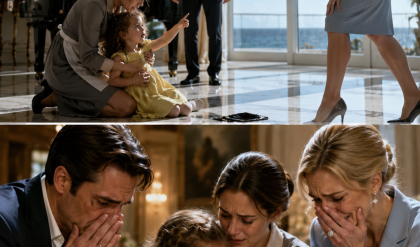
“He looked like me.”
“Lots of people look alike.”
“No,” Ethan said.
Not loud. Not rude. Certain.
He pointed at his own cheek. “He has this.”
Olivia looked at the dimple she had kissed a thousand times when he was asleep. The dimple she had first seen in the delivery room and cried over, because she knew exactly whose face it came from.
“And his eyes,” Ethan said. “And he looked sad.”
Olivia turned away before her son could see what that sentence did to her.
“Finish your soup. Then bath.”
Ethan studied her with the patience of a child who knew adults lied badly when they were afraid. “You knew him.”
It was not a question.
Olivia forced herself to breathe. “Bedtime soon.”
He did not push. Ethan rarely pushed when he sensed he had reached the edge of something painful. That made Olivia feel worse. A five-year-old should not know how to protect his mother from grief.
Later, after pajamas, teeth brushing, and one chapter from his dinosaur book, Olivia tucked him into bed. Ethan touched the silver falcon at his neck.
“Do you think he saw my necklace?”
Olivia froze.
The pendant glinted in the soft light from his nightstand. She had given it to Ethan on his first birthday, not because she wanted to keep Julian alive in their home, but because she could not bear to throw away the only honest thing he had ever given her. Back then, she had believed he had abandoned her, but the necklace had still meant one impossible truth: once, before everything broke, she had been loved.
“I don’t know,” she whispered.
Ethan yawned. “He looked like he saw a ghost.”
Olivia smiled despite the ache in her chest. “Go to sleep, Dr. Ethan.”
“I’m not a real doctor yet.”
“Not yet.”
She kissed his forehead and turned off the lamp.
The moment she reached her bedroom, the past came back with cruel clarity.
Six years earlier, she had waited for Julian in a small café three blocks from Mercy Meridian. She had been eight weeks pregnant. She had carried the first ultrasound picture inside a white envelope and had practiced telling him in the bathroom mirror until she could say the words without crying.
Julian, we’re having a baby.
Julian, I know this is sooner than we planned.
Julian, I’m scared, but I’m happy.
Julian never came.
Malcolm Pierce did.
He had entered the café wearing a charcoal suit and the sympathetic expression of a funeral director. He was not Julian’s father, but he had been with the Whitmore family long enough to feel like part of the architecture. He handled contracts, scandals, staff disputes, family emergencies, and the invisible doors rich people used when they wanted someone gone without leaving fingerprints.
“Olivia,” he had said, sitting across from her. “Julian asked me to speak with you.”
She had known something was wrong before he said another word.
“He chose his family. He chose the company. There are obligations you don’t understand.”
“I need to hear that from him.”
“He won’t see you.”
“That’s not true.”
Malcolm had looked at her then with something that almost resembled pity. “He knows about the pregnancy.”
Olivia remembered the way sound disappeared from the café.
“How?”
“He has resources. That isn’t the point.”
“No,” she had said, gripping the envelope beneath the table. “No, you’re lying.”
“He asked me to make this easier for you.”
Then Malcolm had slid a check across the table.
Two hundred thousand dollars.
Not enough to buy a billionaire’s conscience, but more money than Olivia had ever seen in one place.
She had stared at it until the numbers blurred.
“He said this should cover medical costs,” Malcolm said. “And relocation, if you choose that.”
“He said that?”
Malcolm’s expression did not change. “He said you should move on.”
A weaker woman might have taken the check. A colder woman might have thrown it in Malcolm’s face. Olivia had done neither. She had stood, left the ultrasound envelope on the table, and walked out before the first tear fell.
For months, she tried to reach Julian. Calls failed. Emails bounced. Messages sat unanswered. Once, desperate and humiliated, she went to the Whitmore building and was stopped in the lobby by security before she could reach the elevators.
“Mr. Whitmore has requested no contact,” the guard said, unable to meet her eyes.
After Ethan was born, she stopped trying.
Not because the pain ended. Because babies do not care if their mothers are heartbroken. They still need feeding at three in the morning. They still need clean onesies, pediatric visits, lullabies, rent money, and a mother who can stand upright even when her world has collapsed.
So Olivia stood upright.
Now, six years later, Julian’s face in the elevator would not leave her alone.
He had looked shocked.
Not guilty. Not smug. Not caught.
Shocked.
The way a man looks when a locked room inside his life suddenly opens and a child walks out wearing his eyes.
Olivia sat on the edge of her bed and pressed both hands against her mouth.
For six years, she had built her anger into a wall because walls were safer than questions.
But now one question had found a crack.
What if Malcolm Pierce had lied to both of them?
Across Chicago, Julian sat alone in his penthouse office with Ethan’s photo on the desk.
He had not turned on the lights. Lake Michigan reflected the city in broken silver below him, and somewhere behind his closed door, three executives were still waiting for decisions he no longer cared about.
Julian stared at the boy’s face.
Ethan Bennett.
The name was printed on the kindergarten form Olivia had dropped. Five years old. Emergency contact: Olivia Bennett. No father listed.
No father listed.
The phrase hit harder each time he looked at it.
He thought about the birthdays. Five of them. The first steps. The first words. Fever nights. Christmas mornings. Scraped knees. Bedtime stories. The first time the boy asked why other children had dads at school pickup.
Julian pressed his fingers against his eyes until sparks flashed in the darkness.
Then a memory surfaced.
The night before Olivia disappeared, they had stood in her apartment kitchen eating takeout from cardboard containers. She had been nervous all evening. He remembered that now. The way she kept touching the pocket of her cardigan. The way she started sentences and abandoned them. The way she finally smiled and said, “I have something important to tell you tomorrow.”
“Tomorrow?” he had teased. “That sounds official.”
“It is official.”
“Should I be scared?”
She had touched the silver falcon at her throat. “Maybe.”
He had kissed her and said, “Then I’ll be there.”
But he had not been there.
A crisis had hit the company before dawn. Malcolm had called him to the executive office. By the time Julian arrived at the café, Olivia was gone, and Malcolm was waiting with the story that destroyed them.
Julian leaned back slowly.
If Olivia had planned to leave him, why schedule tomorrow?
If she had chosen another man, why keep the necklace?
If she wanted no contact, why tell him to ask Malcolm?
At 6:12 the next morning, Julian walked into Malcolm Pierce’s office without an appointment.
Malcolm’s secretary stood so quickly her chair rolled backward.
“Mr. Whitmore, he’s on a call—”
“Not anymore.”
Julian opened the door.
Malcolm looked up from behind a walnut desk older than most startups. He was sixty-three, elegant, silver-haired, and polished in the way only lifelong proximity to wealth could polish a man. Nothing about him ever seemed accidental. Not his cuff links, not his pauses, not his concern.
“Julian,” he said, lowering his phone. “This is unexpected.”
Julian crossed the room and dropped Ethan’s photo on the desk.
It slid across the wood and stopped beneath Malcolm’s hand.
For half a second, Malcolm’s face changed.
Half a second was enough.
“Who is he?” Julian asked.
Malcolm glanced down. “A child.”
“Don’t insult me.”
Malcolm sat back. “Where did you get this?”
“At the hospital.”
A beat.
Malcolm recovered quickly, but Julian saw the calculation move behind his eyes.
“I don’t know what Olivia told you,” Malcolm said, “but reopening this will only hurt you.”
“Who is he?”
“You already know what happened six years ago.”
“No,” Julian said. “I know what you told me happened.”
Silence.
Malcolm folded his hands. “Olivia made her choice.”
“Did she tell you that herself?”
“She was emotional.”
“That’s not an answer.”
“She was pregnant.”
“With whose child?”
Malcolm’s jaw tightened almost imperceptibly. “She said it wasn’t yours.”
“Did she say those words?”
Malcolm looked away.
There it was.
The tiniest fracture in a six-year lie.
Julian leaned forward, palms flat on the desk. “Did Olivia Bennett ever sit in front of you and tell you that child belonged to another man?”
Malcolm’s voice cooled. “You are grieving your father’s condition and looking for someone to blame.”
Wrong answer.
Julian picked up the photo.
“The boy has my pendant around his neck. He has my eyes. He has my dimple. He is five years old, Malcolm.”
“Coincidences exist.”
Julian laughed once, without humor. “You should have chosen a better lie.”
Malcolm’s face hardened. For the first time in Julian’s life, the older man looked less like a trusted adviser and more like what he had always been: a gatekeeper.
“Be careful,” Malcolm said quietly. “You don’t know what you may damage.”
Julian slipped the photo into his jacket pocket.
“If you kept my son from me,” he said, “there won’t be enough careful left in the world to protect you.”
He walked out before Malcolm could answer.
The door closed behind him, and Malcolm Pierce sat perfectly still.
Ten seconds passed. Then twenty.
Finally, his hand moved toward the phone.
For six years, Olivia Bennett had been a solved problem. A nurse with no family connections, no money, no standing, and no place in the future Malcolm had designed for Julian Whitmore. She had vanished from the Whitmore world as neatly as a name erased from a guest list.
Then Harrison Whitmore had suffered a stroke.
Then Julian had started visiting Mercy Meridian every day.
Then fate, that incompetent fool, had placed Olivia and the child in the same lobby.
Malcolm scrolled through his contacts until he found the name he wanted.
Jenna Lawson.
A nurse manager in rehabilitation. Friendly. Ambitious. Occasionally useful.
She answered on the fourth ring.
“Mr. Pierce?”
“I need a favor,” he said.
A pause. “What kind of favor?”
“Tell me everything you know about Olivia Bennett. And her son.”
Jenna liked Olivia.
Almost everyone at Mercy Meridian did. Olivia did not flatter doctors, did not gossip cruelly, did not pretend exhaustion was nobility. She worked hard, kept her promises, and brought cookies to night-shift nurses even when she was clearly broke enough to keep them for herself.
But Ethan was the real reason people loved her.
Three weeks before the lobby incident, Ethan had wandered into the rehabilitation wing while Olivia was finishing a double shift. A volunteer had been watching him near the nurses’ station, but Ethan, armed with a toy stethoscope and dangerous confidence, had followed the sound of an argument into Harrison Whitmore’s therapy room.
The argument was one-sided.
Harrison Whitmore, founder of Whitmore Health Systems and one of the richest men in Illinois, was refusing to take six steps between parallel bars.
“I said I’m done,” Harrison snapped.
His physical therapist, a patient woman named Maria, folded her arms. “You said that yesterday.”
“And I meant it yesterday too.”
That was when Ethan appeared in the doorway.
He looked at Harrison. Harrison looked at him.
“Are you the patient?” Ethan asked.
Maria covered her mouth.
Harrison glared. “Who are you?”
“Dr. Ethan.”
“You’re five.”
“Almost six.”
“That doesn’t make you a doctor.”
Ethan walked in anyway, placed his toy stethoscope against Harrison’s knee, listened carefully, then moved it to his elbow.
“You’re sick,” Ethan announced.
Harrison raised an eyebrow. “Am I?”
“Yes. You have grumpy bones.”
Maria made a strangled sound.
Harrison stared at the child for a long moment. Then, to everyone’s shock, he laughed.
Not politely. Not for show. He laughed like a man who had forgotten he knew how.
From that day on, Ethan visited “Hospital Grandpa” whenever Olivia’s schedule allowed. Harrison complained less when Ethan watched therapy. He ate more lunch if Ethan scolded him. He practiced squeezing the rubber ball because Ethan said, with grave medical authority, “Hands have to remember their job.”
No one told Olivia who Hospital Grandpa really was. She knew he was important because of the private room and security, but Mercy Meridian had plenty of wealthy patients. She never imagined the grumpy old man her son adored was Julian Whitmore’s father.
Harrison never knew Ethan was his grandson.
Not at first.
But two days after the lobby incident, Ethan arrived carrying a drawing pad.
“Hospital Grandpa!” he called from the doorway.
Harrison, halfway through a therapy exercise, turned his head. His face changed before he could stop it.
“You’re late,” he grumbled.
Ethan gasped. “You noticed?”
“I’m old, not blind.”
“I had homework.”
“Convenient excuse.”
Ethan marched in, pulled the toy stethoscope from around his neck, and pressed it against Harrison’s chest. “Medical inspection.”
“Must we?”
“Yes.”
The staff watched, smiling. Ethan listened to Harrison’s heart, then his shoulder, then his forehead.
“Good news,” Ethan said finally.
Harrison sighed. “What?”
“You’re still alive.”
The room burst into laughter.
Harrison tried not to smile and failed.
Later, when Maria left to get paperwork, Ethan climbed into the chair beside Harrison’s bed and opened his drawing pad. “I made you something.”
Harrison accepted the page. It showed a hospital bed, a smiling old man, a small boy, a woman with long hair, and a tall man near the edge of the paper.
Harrison pointed. “Who is that?”
“The hospital man.”
“What hospital man?”
“The one from the lobby.” Ethan looked up. “He looks like me.”
Harrison’s hand stilled.
Ethan smiled.
The dimple appeared.
Harrison Whitmore had faced hostile takeovers, Senate hearings, lawsuits, market crashes, and two heart attacks without flinching. But that small dimple on a five-year-old boy’s face made the old man go cold.
He had seen it every morning in the mirror for eighty-two years.
“Ethan,” he said carefully, “what is your mother’s name?”
“Olivia.”
Harrison’s mouth went dry.
“Olivia what?”
“Bennett.” Ethan tilted his head. “Do you know her?”
Harrison looked toward the hallway where the child had come from, and six years of certainty began to crack.
That night, Harrison requested the old files.
The request moved through the Whitmore machine like a tremor. When Harrison Whitmore asked for documents, people did not ask why. By morning, two archive boxes sat beside his hospital bed.
He opened them alone.
The first thing he noticed was not a lie.
It was an absence.
There was not a single message from Olivia Bennett.
No letter. No email. No signed statement. No voicemail transcript. Nothing.
Every update from six years ago came through Malcolm Pierce.
Malcolm reported Olivia had left.
Malcolm reported she was pregnant by another man.
Malcolm reported she wanted no contact.
Malcolm reported Julian should be protected from further humiliation.
Harrison read the memos twice, then a third time. For thirty years, he had trusted Malcolm so completely that he had mistaken confidence for proof.
Then he found the prenatal records.
Mercy Meridian had acquired a smaller clinic in Lincoln Park seven years earlier. Its old records had been absorbed into the hospital system, archived poorly, and forgotten. Olivia Bennett had visited that clinic three weeks after Malcolm claimed she had left Chicago.
Then again five weeks later.
Then again two months later.
She had not disappeared.
She had been right there.
Pregnant, alone, and less than eight miles from the Whitmore building.
Harrison closed his eyes.
A different kind of stroke seemed to pass through him then. Not medical. Moral.
He had built hospitals across the country. He had funded neonatal units, cancer centers, rehabilitation labs, scholarships for nurses, clinics for families who could not pay. His name was carved into buildings as if stone could prove decency.
But a child with his blood had grown up fatherless in the same city because Harrison Whitmore had trusted a man and never asked a woman.
At seven that morning, he called Julian.
“Come to the hospital,” Harrison said.
“Is something wrong?”
“Yes.”
Julian arrived in twenty-three minutes.
Harrison handed him the file.
“Read.”
Julian opened it and went still.
Olivia’s prenatal appointment. Lincoln Park. Three weeks after she had supposedly left. Another appointment. Another date. Same clinic. Same city.
“She was here,” Julian said.
“Yes.”
“She didn’t leave.”
“No.”
Harrison gave him the second folder.
Julian turned the pages slowly. No direct communication. No message from Olivia. No proof. Malcolm’s name on every memo.
By the time Julian finished reading, his face had changed in a way Harrison had never seen before. Not anger. Not yet. Something worse.
Grief becoming knowledge.
“She was pregnant,” Julian said.
Harrison nodded.
“She was alone.”
“Yes.”
“She thought I left her.”
The old man looked away.
“And I believed she left me,” Julian said. His voice broke on the last word, barely, but Harrison heard it.
For several seconds, neither man spoke.
Then Harrison said the most difficult words of his life.
“I failed you.”
Julian looked up.
“I failed Olivia,” Harrison continued. “And I failed that child. I believed Malcolm because it was convenient to believe him. Because he spoke the language of our world, and she did not. Because I thought protecting the family meant keeping discomfort outside the gate.”
Julian stared at him.
Harrison had apologized to shareholders. He had apologized to senators. He had apologized through attorneys in settlement agreements. He had never apologized to his son like this.
“I am sorry,” Harrison said.
Julian looked back down at Ethan’s photo.
Five years old.
Five years gone.
“What are you going to do?” Harrison asked.
Julian slid the photo into his coat pocket.
“I’m going to ask Olivia for permission to know my son.”
Harrison nodded slowly.
It was the right answer. Not demand custody. Not send lawyers. Not purchase forgiveness with a trust fund.
Ask permission.
Because money could open doors, but it could not repair the years behind them.
Olivia agreed to meet Julian the next day at a public park near the hospital.
“My choice,” she wrote. “My rules.”
Julian replied immediately. “Anything.”
She arrived fifteen minutes early because she wanted the advantage. She wanted to see him before he saw her. She wanted room to leave if panic overruled reason.
The park was busy enough to feel safe but not crowded enough to feel theatrical. Office workers ate lunch on benches. A father pushed a stroller near the fountain. Somewhere, a dog barked at a squirrel with doomed optimism.
Julian arrived exactly at noon.
No driver. No assistant. No security.
Just him.
He stopped several feet away from Olivia, far enough to respect her space.
“Thank you for coming,” he said.
“Say what you need to say.”
He held out a folder. “Please read this.”
She almost refused. Pride rose first. Then fear. Then the memory of his face in the elevator.
She took the folder.
The first page stopped her.
Prenatal appointment. Lincoln Park Clinic. Date: three weeks after Malcolm had told Julian she was gone.
She turned the page.
Another appointment.
Another date.
Her hand began to shake.
Julian handed her a second folder. “There’s more.”
No calls completed. No letters received. No emails from Olivia in the Whitmore archive. Every summary written by Malcolm Pierce. Every conclusion filtered through him.
Olivia looked up.
“He told me you didn’t want us,” she said.
Julian’s face tightened. “He told me the baby wasn’t mine.”
The sentence landed between them with six years of ruin attached.
“I never said that.”
“I know that now.”
“I waited,” Olivia said, and hated that the words escaped. “For months, I waited. I kept thinking you would call. Then Ethan was born, and waiting became a luxury I couldn’t afford.”
Julian lowered his eyes.
“I looked for you,” he said.
“Not hard enough.”
The honesty of it struck him like a slap because she was right.
He had looked through the channels rich men use: lawyers, assistants, investigators approved by Malcolm, reports delivered to his desk. He had not slept in his car outside clinics. He had not knocked on every door. He had not stood in the rain and refused to leave until she spoke to him.
“I believed the wrong person,” he said.
Olivia laughed once, bitterly. “So did I.”
They stood in silence while the city moved around them.
Finally, Julian said, “I’m not asking you to forgive me.”
“Good.”
“I’m not asking to walk into Ethan’s life like I earned a place there.”
“Also good.”
“I’m asking for the chance to show up. Slowly. However you allow it. If you allow it.”
Olivia studied him for a long time.
The Julian she remembered had been handsome, arrogant, brilliant, impatient, and unexpectedly tender in private. This man was older. Not by years, though those showed too. He was older in the way grief ages people who do not admit they are grieving.
“I need time,” she said.
“I know.”
“You don’t contact Ethan without my permission.”
“I won’t.”
“No lawyers.”
“No lawyers.”
“No press. No Whitmore machine. No gifts that make him feel bought.”
Julian nodded. “Agreed.”
Olivia gathered the folders against her chest. “And if you disappoint him—”
“I won’t.”
“You don’t get to say that yet.”
He accepted the correction. “Then I’ll prove it.”
She turned to leave.
Then a small voice behind her said, “Mommy?”
Olivia froze.
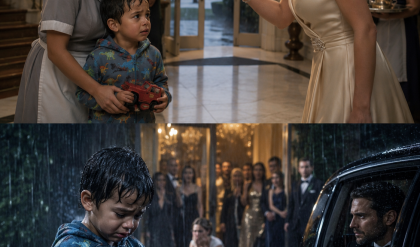
Ethan stood near the park entrance beside Jenna Lawson, who looked horrified. She had clearly brought him from the hospital cafeteria, probably thinking Olivia’s meeting had ended. Ethan’s eyes moved from Olivia to Julian, then back again.
He had heard enough.
Children always did.
“Is the tall man my father?” he asked.
No accusation. No tears. Just one clear question, carrying the weight of every absence he had never known how to name.
Olivia knelt in front of him. She took his small face in both hands and found, for the first time in his life, that she had no easy way to protect him.
“Not here,” she whispered.
Ethan’s eyes filled, but he did not cry.
That was worse.
“Is he?” he asked again.
Olivia looked over his shoulder at Julian, who stood motionless, every instinct in him visibly fighting the urge to step forward.
Then she looked back at her son.
“Yes,” she said softly. “He is.”
Ethan turned toward Julian.
Julian crouched, because standing over that question felt wrong.
“Hi, Ethan,” he said, his voice rough.
Ethan stared at him.
Then he touched the silver falcon at his neck.
“Did you give this to Mommy?”
Julian nodded. “A long time ago.”
“Why did you leave?”
Olivia closed her eyes.
Julian did not look away from his son.
“Someone told me a lie,” he said. “And I believed it. That was my mistake. I should have found the truth.”
Ethan thought about this. “Was it a bad lie?”
“The worst one.”
“Did you want me?”
Julian’s face changed. Whatever restraint he had left nearly broke.
“Yes,” he said. “I just didn’t know you existed.”
Ethan considered that with the terrible seriousness of five.
Then he said, “That’s sad.”
Julian nodded. “Yes. It is.”
Ethan stepped closer and pressed his toy stethoscope against Julian’s chest.
Olivia blinked. “Ethan—”
“I’m checking something.”
Julian stayed perfectly still.
Ethan listened, frowned, moved the stethoscope slightly, and listened again.
“You’re sick,” he announced.
Julian almost smiled through the pain. “What’s wrong with me?”
Ethan looked up at him.
“You sound lonely.”
Olivia turned away, but not before Julian saw her wipe her eyes.
The first meeting was one hour, in public, with Olivia sitting close enough to intervene.
Ethan chose the same park because he liked the ducks, although there were no ducks, only aggressive pigeons with confidence problems. Julian arrived ten minutes early with no gifts, because Olivia had said no gifts. He brought apple slices and peanut butter because Ethan had told him, very formally through Olivia, that snacks were not gifts if everyone ate them.
Ethan ran the meeting like an interview.
“What’s your favorite dinosaur?”
“Triceratops.”
“Wrong. It’s stegosaurus.”
“I’ll remember.”
“Do you know how to make pancakes?”
“Badly.”
“Mommy makes them shaped like clouds.”
“I’ll need lessons.”
“Do you live in a castle?”
“No.”
“Mommy said billionaires have too many houses.”
Olivia made a strangled sound from the bench.
Julian looked at her, and for one brief second, something almost like their old laughter passed between them.
“I have an apartment,” Julian said. “And my father has a house that is too large.”
“Hospital Grandpa?”
Julian went still. “You know Hospital Grandpa?”
“He’s my patient,” Ethan said proudly. “He has grumpy bones.”
Julian looked toward Olivia.
Olivia stared back, equally stunned.
Neither of them had known until then that Ethan’s beloved hospital friend was Harrison Whitmore. The coincidence was too strange to be called coincidence. It felt, uncomfortably, like life had been trying to put their family in the same room long before the adults were brave enough to enter.
After exactly one hour, Olivia stood.
Ethan frowned. “Already?”
“One hour,” she said.
“But we just started.”
Julian crouched. “Your mom set a rule. We keep rules.”
Ethan studied him. “Are you coming back?”
“If your mom says I can.”
Ethan turned to Olivia.
She hesitated. Then nodded once.
“Yes,” Julian said. “I’m coming back.”
Ethan grabbed his sleeve briefly, not with desperation, but with decision.
“Bring snacks again.”
“I will.”
“And learn stegosaurus.”
“I will.”
Trust did not return in a thunderclap. It returned in small, inconvenient, ordinary ways.
Julian showed up.
That was all at first. He arrived at parks, school pickup, Saturday library hour, and once at an urgent care clinic when Ethan had a fever and Olivia was too frightened to admit she wanted him there. He did not bring photographers. He did not bring lawyers. He did not introduce Ethan to wealth like a magic trick.
He learned the name of Ethan’s teacher, Mrs. Palmer, whose hair Ethan insisted looked “like a friendly cloud.” He learned Ethan hated peas but tolerated carrots if ranch dressing was involved. He learned Ethan asked questions when nervous and sang softly when tired. He learned Olivia worked too many shifts and never complained until someone offered help, at which point she complained about the offer.
He also learned that fatherhood was not a title biology handed him.
It was a debt paid in presence.
Meanwhile, Malcolm Pierce’s world narrowed.
Jenna had stopped answering his questions. Harrison had requested communication archives. Julian had gone quiet, and Julian quiet was far more dangerous than Julian angry. Quiet meant he was building a case.
The final piece came from Mercy Meridian’s old server.
Jenna found it by accident while helping Olivia request copies of her employment records. A message Olivia had sent to Julian five years earlier—three weeks after Ethan was born—had been marked delivered in the hospital network’s external relay system.
Julian had never received it.
The override field listed one administrator.
M. Pierce.
Jenna photographed the screen and sent it to Julian without commentary. None was necessary.
By the next afternoon, Harrison summoned Malcolm to Conference Room B.
No formal board notice. No agenda. No assistants.
Malcolm arrived at two o’clock wearing a navy suit and the calm expression of a man prepared to survive discomfort. He walked in and found Harrison seated at the head of the table in his wheelchair, Julian standing by the window, Jenna beside a laptop, and Olivia sitting near the far wall with her hands folded in her lap.
That was when Malcolm’s confidence faltered.
“You asked to see me,” he said.
Harrison gestured to the chair. “Sit.”
They presented the evidence without speeches.
Prenatal records proving Olivia remained in Chicago after Malcolm claimed she left.
Malcolm called them clerical confusion.
Emails Olivia sent over eight months.
Malcolm called them system irregularities.
Seventeen intercepted messages.
Malcolm said nothing.
Jenna turned the laptop toward him. “This one was sent after Ethan was born.”
The message appeared on the screen.
Julian, his name is Ethan. I don’t know if you’ll ever read this, but he has your eyes. I’m done begging you to love us. I only wanted you to know he exists.
Julian looked away.
Olivia pressed her fingers against her mouth.
Harrison’s voice was quiet. “Explain.”
Malcolm stared at the screen for a long time.
Then he exhaled, and the performance finally ended.
“She was going to destroy him.”
Julian turned from the window.
Malcolm looked directly at Harrison, not Julian. That revealed everything. Even now, he answered to the old power in the room.
“She had no background. No understanding of this family. No protection against the press, the board, the donors, the politicians. Julian was about to take over the company. There were negotiations with Caldwell Medical. A scandal involving a pregnant nurse would have cost billions.”
Olivia flinched at the word scandal.
Julian’s voice was low. “She was not a scandal.”
“She was a liability,” Malcolm snapped.
The room went silent.
There it was. The truth stripped of manners.
Malcolm continued, as if finally allowed to say what he had believed for years. “I did what you hired me to do. I protected the family.”
“No,” Harrison said. “You protected an image.”
Malcolm’s face tightened. “Sometimes that is the same thing.”
“Not when a child pays the price.”
Malcolm looked at Olivia then, and for one moment she saw the man from the café six years ago. Smooth. Certain. Convinced that her pain was an administrative inconvenience.
“You could have taken the money,” he said.
Julian moved so quickly Olivia almost stood.
Harrison’s voice cut through the room.
“Julian.”
Julian stopped, but his hands were fists.
Olivia rose slowly.
She walked to the table, picked up the printed copy of her message, and looked at Malcolm.
“You told me he didn’t want my baby,” she said. “You told him my baby belonged to someone else. You watched me leave that café with an ultrasound picture in my purse and let me believe the father of my child had thrown us away.”
Malcolm said nothing.
“You didn’t protect anyone,” Olivia continued. “You stole choices from all of us because you thought people like me were too small to matter.”
For the first time, Malcolm looked uncomfortable.
Harrison opened the final folder.
“There is one more matter.”
Malcolm’s eyes flickered.
Julian noticed. “What is it?”
Harrison slid the folder toward him.
Inside were foundation expense reports from six years earlier. Olivia recognized the format immediately. Before everything collapsed, she had worked briefly in a Mercy Meridian outreach program and had noticed invoices that did not make sense: mobile clinics billed on dates they never operated, donor funds routed through consulting accounts, signatures copied from old approvals.
She had planned to tell Julian the morning she told him about the pregnancy.
Her “important secret” had been two secrets.
Julian read the documents, his face darkening.
“You knew she had found this,” he said to Malcolm.
Malcolm did not answer.
Harrison’s expression turned colder than Olivia had thought an old, sick man could look.
“You separated them,” Harrison said, “not only because you disliked Olivia, but because she had found your theft.”
“I moved funds temporarily,” Malcolm said. “For strategic reasons.”
Jenna stared at him. “You stole from free clinics.”
“I maintained flexibility during a merger.”
“You stole from children who needed asthma medication.”
That landed.
Even Julian looked shaken. The betrayal was no longer private. It was institutional. Malcolm had not merely stolen six years from a family. He had stolen from the very patients whose names the Whitmores carved into charity brochures.
Harrison closed the folder.
“You are terminated immediately,” he said. “Your access is revoked. Legal will receive this within the hour. So will the attorney general’s office.”
Malcolm’s face went pale.
“Harrison,” he said. “After thirty years—”
“After thirty years,” Harrison interrupted, “you should have known the difference between loyalty and ownership.”
Security escorted Malcolm Pierce out of the building twenty minutes later.
There was no shouting. No dramatic confession for reporters. No satisfying crash of thunder. Just an old man in a wheelchair, a son with tears he refused to shed, a nurse who had survived the lie, and evidence that finally knew where to point.
Afterward, Harrison asked to speak with Olivia alone.
Julian began to object, then stopped. Olivia noticed. It was a small thing, but small things were how new trust announced itself.
Harrison’s private room overlooked the lake. For several seconds, he said nothing.
Then he looked at Olivia with eyes Ethan had inherited.
“I never met you six years ago,” he said. “I never called. Never asked what happened. Never wondered why every fact came through Malcolm. I believed one man’s account of your character because it was easier than confronting my own prejudice.”
Olivia stood near the window, arms folded.
“I failed you,” Harrison said. “I failed Julian. And I failed a grandson who spent five years visiting me in this hospital without either of us knowing the truth.”
The word grandson changed the air.
Olivia looked away.
“I am sorry,” Harrison said.
She had imagined this moment many times in anger. In those fantasies, she delivered perfect speeches. She made powerful men feel small. She walked away untouched.
Reality was messier.
Harrison Whitmore looked old. Not weak, exactly, but human in a way wealth had hidden from him. His apology did not give her back the nights she cried beside Ethan’s crib. It did not pay the rent she had juggled, the fevers she had handled alone, the Father’s Day crafts she had quietly hidden in a drawer because Ethan did not know what to do with them.
But it mattered that he said it.
“Ethan needs consistency,” Olivia said. “Not guilt. Not grand gestures. Not a trust fund dropped on his head like an apology.”
Harrison nodded. “I understand.”
“If you say you’ll come, you come. If you make a promise, you keep it. If this family gets bored because fatherhood is harder than a reunion scene, I will take him away from all of you.”
Harrison almost smiled. “You should.”
She looked at him sharply.
“I mean that,” he said. “Protect him from us if we deserve it.”
That was the first thing Harrison Whitmore said that Olivia fully believed.
Three months later, Ethan chose the restaurant.
It had to have good pancakes even though it was dinner. It had to have booths because booths were “more private for family business.” It had to be bright but not too bright. It had to be close enough to the hospital that Grandpa Harrison would not complain about traffic, although Grandpa Harrison complained about everything anyway.
They ended up at a family-owned diner in Lincoln Park where the waitress knew Olivia by name and pretended not to recognize Julian from magazine covers.
Ethan arrived first with Olivia, wearing a button-down shirt he had chosen himself and the silver falcon pendant over the collar because, as he explained, “important necklaces should not hide.”
Julian came two minutes later, carrying no gifts, only a book about dinosaurs because Ethan had specifically declared educational materials exempt from the gift rule.
Harrison arrived last, walking with a cane instead of using his wheelchair. Ethan saw him from across the diner and stood on the booth seat.
“Hospital Grandpa!”
Half the diner turned.
Harrison closed his eyes. “We discussed this.”
Ethan grinned. “You lived there when I met you.”
“I was recovering.”
“At the hospital.”
Julian covered his mouth.
Olivia looked out the window.
Harrison pointed his cane at both of them. “Cowards.”
Ethan slid into the booth between Olivia and Julian like he had been doing it all his life. No one told him where to sit. Children knew the geography of love better than adults. He placed himself in the middle.
Dinner was not perfect. Real families rarely are.
Harrison criticized the coffee. Olivia told him he was welcome to make his own. Julian spilled syrup on his sleeve. Ethan explained stegosaurus plates for eleven uninterrupted minutes and then accused everyone of not listening, even though they had listened with the focused devotion of people who knew time could be stolen.
At some point, Ethan leaned against Julian’s arm without thinking.
Julian went very still.
Olivia saw it. She saw the effort it took for him not to make the moment too big. Not to ruin it by reacting. He simply stayed there, steady, letting Ethan’s small weight rest against him.
That was when Olivia felt something inside her loosen.
Not forgiveness. Not yet.
But perhaps the beginning of peace.
After dinner, Ethan pulled his drawing pad from under the table.
“I made something.”
He slid the page toward Harrison.
Four figures stood in front of a hospital. A boy in the middle. A woman on one side. A tall man on the other. An old man with a cane at the end. Above them, Ethan had drawn a falcon with wings spread wide.
No question marks.
No empty spaces.
Just names written in careful kindergarten letters.
MOMMY.
DAD.
GRANDPA.
ME.
Harrison looked at the drawing for a long time. When he spoke, his voice was rough.
“This is very good.”
Ethan beamed. “I know.”
Julian laughed first. Olivia followed. Harrison shook his head, but his eyes were wet.
Then Ethan reached under the table with both hands. One found Olivia’s. The other found Julian’s.
He did not say anything.
He did not need to.
For years, adults had made decisions above him, around him, before him. They had lied, hidden, judged, protected themselves, and called it wisdom. But Ethan, with his toy stethoscope and crooked drawings, had done what none of them could do.
He had recognized family by the sound of loneliness.
A lie had stolen six years.
The truth could not return them.
But truth, when handled gently, could still build something out of what remained.
Ethan looked from Olivia to Julian, then to Harrison, wearing the thoughtful expression he always wore before causing trouble.
“Mommy?”
“Yes?”
“When you and Dad get married, can I carry the rings?”
The table froze.
Olivia nearly dropped her water glass.
Julian stopped breathing.
Harrison became intensely interested in cutting a pancake he had already finished.
Ethan blinked at them. “What?”
No one answered at first.
Then Harrison laughed.
It began quietly, then grew until his shoulders shook. Julian laughed next, helplessly, then Olivia, despite herself, because the future had just been announced by a five-year-old with syrup on his sleeve and absolute confidence in happy endings.
Ethan looked offended. “I asked a serious question.”
Julian wiped his eyes and looked at Olivia.
Not asking.
Not assuming.
Just hoping.
Olivia looked back at him for a long moment.
Then she squeezed Ethan’s hand.
“One miracle at a time, Dr. Ethan.”
Ethan considered that.
“Okay,” he said. “But I’m still practicing.”
Outside the diner, Chicago moved on in its usual loud, indifferent way. Cars passed. Snow began to fall lightly against the windows. Somewhere in the city, Malcolm Pierce was answering for what he had done. Somewhere behind them, six years remained lost.
But inside the booth, beneath warm lights and the smell of coffee and pancakes, Ethan sat between both his parents exactly where he had always drawn himself.
In the middle.
Exactly where he belonged.
THE END