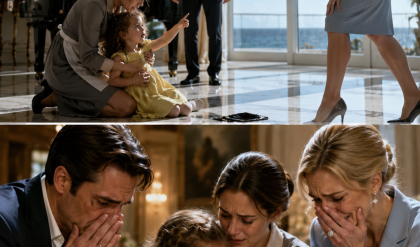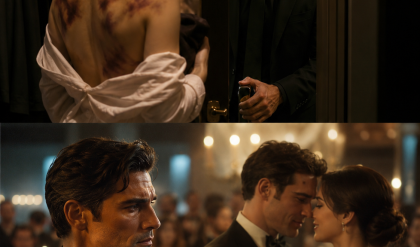
“No.” Victoria walked closer. Her perfume was sharp and expensive. “But trust me, you’ll hear a lot about me.”
Damian appeared from the hallway behind her. “Victoria, leave.”
Her smile flickered.
“Still giving orders like they make you less lonely?” she asked.
“Now.”
Victoria’s eyes slid back to Zara. “Enjoy the guest room.”
Then she walked out like the house still belonged to her.
That night, Zara lay awake beneath Egyptian cotton sheets in a guest room larger than her mother’s apartment. She stared at the ceiling and told herself six months was not forever.
Six months to keep her mother safe.
Six months to survive rich people.
Six months to remember that none of this was real.
The next morning, she woke before dawn, restless and unable to breathe in the silence. She wandered into the kitchen and found it empty except for stainless steel appliances and a bowl of green apples no one had touched.
Cooking had been her mother’s language before illness stole her strength. So Zara cooked because she did not know what else to do with her fear.
Eggs with chives. Buttermilk biscuits. Crispy potatoes. Cinnamon oatmeal. Coffee.
By seven, the kitchen smelled like home.
An older housekeeper paused in the doorway, hand at her chest. “Lord have mercy.”
Zara turned. “I’m sorry. Was I not supposed to use the kitchen?”
The woman’s eyes shone. “Nobody cooks like that in this house anymore.”
“I can clean it up.”
“What’s your name, honey?”
“Zara.”
“I’m Mrs. Hattie Cooper. I run this house, though Mr. Whitmore likes to pretend he does.”
Zara smiled for the first time in days.
At breakfast, Damian entered wearing a charcoal suit and the expression of a man already angry at three meetings that had not happened yet.
He stopped.
His gaze moved from the food to Zara.
“You cooked?”
“I was awake.”
Mrs. Cooper set a plate in front of him before he could refuse. “Sit down and eat like a human being for once.”
To Zara’s surprise, he obeyed.
He took one bite of the potatoes, then went still.
Zara waited for criticism.
Instead, he said quietly, “My mother used to make these.”
Mrs. Cooper’s face changed.
Damian put down his fork. “Who taught you?”
“My mom.”
His eyes lifted. For a moment, the cold billionaire disappeared, and Zara saw a boy standing in a kitchen that no longer existed.
Then his phone rang.
He stood. “Colin will take you to the hospital this afternoon if you want to visit your mother.”
“That’s not in the contract.”
“Consider it an amendment.”
And just like that, he was gone.
Zara told herself not to mistake decency for tenderness.
But by the end of the first week, the Whitmore mansion had begun to change in small ways no one could deny. Fresh flowers appeared in rooms that had been empty for years. Staff lingered in the kitchen because Zara remembered how they took their coffee. Mrs. Cooper laughed louder. Bell brought her seed packets for the neglected garden. Even Damian came home earlier twice, though he claimed it was because traffic downtown had been impossible.
Then came the family luncheon.
And Victoria Sloan’s first move.
Part 2
The Whitmore family arrived on a Sunday afternoon in coats that cost more than Zara’s car and smiles sharp enough to cut ribbon.
Aunt Lorraine kissed Damian on both cheeks and inspected Zara like a piece of furniture delivered in the wrong color.
“So this is the wife.”
Damian’s hand rested lightly at Zara’s lower back. It was the first time he had touched her in public. His palm was warm through the fabric of her dress.
“This is Zara,” he said.
“How sudden,” Aunt Lorraine replied.
Uncle Grant, red-faced and already holding bourbon, laughed. “Sudden is one word for it. Convenient is another.”
Zara smiled politely because her mother had raised her not to bleed where sharks could smell it.
Lunch was served in the formal dining room beneath a chandelier that looked like frozen lightning. Victoria arrived fifteen minutes late in a red dress and kissed Aunt Lorraine as if she were the rightful daughter-in-law returning from war.
“Zara,” Victoria said sweetly, “you look very simple.”
“Thank you,” Zara replied. “You look very expensive.”
Damian coughed into his water.
Mrs. Cooper nearly dropped a serving spoon.
Victoria’s smile tightened.
The questions began with dessert.
Where was Zara from?
“Chicago.”
Which part?
“South Side originally. My mom and I moved around a little.”
What did her parents do?
“My mother taught third grade for almost thirty years. My father died when I was seven.”
How had she met Damian?
Zara felt every eye turn.
Damian answered before she had to. “Through a private introduction.”
Victoria leaned back in her chair. “How romantic.”
“Not every marriage begins as a performance,” Damian said.
Victoria’s eyes flashed.
Aunt Lorraine set down her fork. “Well, I think it’s fair to say we were all surprised. One week no one has heard her name. The next week she’s living here as your wife.”
“I did not invite myself,” Zara said softly.
The table went quiet.
Victoria tilted her head. “Of course not. Nobody said you did.”
But her tone said everything else.
Twenty minutes later, Victoria stood in the hallway outside the powder room and let out a scream that stopped the house.
“My bracelet!”
Everyone rushed toward her.
Victoria clutched her bare wrist. “My diamond bracelet is gone.”
Aunt Lorraine gasped. “The Cartier one?”
“My grandmother’s,” Victoria said, eyes already shining. “I had it before lunch.”
Damian’s jaw tightened. “Where did you last see it?”
“Upstairs.” Victoria looked around the hallway. Her gaze landed on Zara with perfect timing. “Who was upstairs today?”
Mrs. Cooper stepped forward. “Staff cleaned the guest wing this morning.”
Victoria’s voice trembled. “I want the rooms searched.”
Zara felt cold spread through her. “Excuse me?”
Victoria turned wounded eyes on Damian. “I’m sorry, but that bracelet is irreplaceable.”
Aunt Lorraine crossed her arms. “If no one has anything to hide, there should be no issue.”
Zara looked at Damian.
He looked back at her, unreadable.
“Fine,” Zara said. “Search mine first.”
They climbed the stairs together like a funeral procession.
Zara stood in the doorway while Colin opened drawers and Mrs. Cooper checked the closet with shaking hands. Zara’s suitcase sat neatly beside the wardrobe, half-empty because she owned so little.
Then Aunt Lorraine reached behind a stack of folded sweaters and froze.
“Oh my God.”
In her hand was Victoria’s diamond bracelet.
The room erupted.
“I knew it,” Victoria whispered.
Zara stared at the bracelet as if it might turn into something that made sense.
“I didn’t put that there.”
Aunt Lorraine stepped back as though poverty were contagious. “It was in your wardrobe.”
“I didn’t steal it.”
Victoria laughed once, broken and cruel. “A thief and an actress. Impressive.”
Zara turned to Damian. Everyone else disappeared.
“Look at me,” she said. “In one week, have I given you a reason not to trust me?”
His face was pale. His eyes were full of something close to conflict, but his mouth stayed shut.
Victoria moved closer to him. “Damian, the bracelet was found in her room.”
Mrs. Cooper spoke sharply. “I don’t believe it.”
Aunt Lorraine snapped, “Belief is not evidence.”
Zara kept staring at Damian. “Say something.”
He looked at the bracelet.
Then at his family.
Then at the woman he had paid to be temporary.
“Pack your things,” he said.
The words hit harder than any slap could have.
Mrs. Cooper made a sound. “Mr. Whitmore—”
“Enough,” Damian said.
Zara did not cry. Not in front of them.
She walked to the bed, picked up her suitcase, and folded her few things with hands so steady they no longer felt like hers.
At the door, she stopped beside Damian.
“I didn’t do it,” she said.
His jaw flexed, but he did not answer.
Outside, Bell was waiting near the SUV. His face fell when he saw her suitcase.
“Mrs. Whitmore?”
“Not anymore.”
His eyes moved past her toward the house. “Who did this?”
“It doesn’t matter.”
“It matters to me.”
Zara looked up at the mansion. From an upstairs window, Victoria watched with one hand raised in a little goodbye.
Zara smiled at her.
Not because she was happy.
Because one day, she wanted Victoria to remember that the woman she tried to bury had looked her in the eye before the dirt fell.
The ride back to Chicago felt longer than the train rides of her whole life. Zara sat in silence while the city swallowed her again.
Her mother knew the moment she walked into the apartment.
“Oh, baby.”
That was all it took.
Zara broke.
She cried into her mother’s lap like she was seven years old again, like her father had just died, like the world had proved once more that poor people could tell the truth and still lose.
“They said I stole,” Zara whispered. “They searched my things in front of everyone. And he just stood there, Mama. He looked at me and said nothing.”
Linda stroked her hair with weak fingers. “This is not the end of your story.”
“It feels like it.”
“No,” her mother said. “This is just the part that hurts.”
The next morning, the hospital called.
“Miss Brooks, we’re calling to confirm that the standing payment arrangement from Whitmore Holdings has been canceled.”
Zara gripped the kitchen counter. “Canceled?”
“Yes, ma’am. Your mother’s next medication course is due in four days. We’ll need alternative payment.”
“I’ll handle it,” Zara said, though she had no idea how.
Across town, in a house that suddenly felt colder than marble, Damian Whitmore stood in his study while Colin delivered the same news.
“The hospital arrangement was canceled automatically when the contract termination was processed.”
Damian looked up slowly. “Who told you to terminate all related payments?”
“It’s standard procedure.”
“Reinstate them.”
Colin hesitated. “Sir—”
“Her mother is sick. Reinstate the payments.”
“Yes, sir.”
After Colin left, Damian walked through the house. He had meetings waiting, calls waiting, lawyers waiting. But everywhere he looked, Zara was there.
The flowers in the foyer had begun to droop.
The kitchen smelled like nothing.
The garden beds she had watered every morning looked dry and foolish beneath the winter sun.
In the dining room, he remembered her saying, You look very expensive, and against his will, he almost smiled.
Then he remembered her face in the guest room.
Look at me. In one week, have I given you a reason not to trust me?
He had known.
That was the worst part.
He had not believed she stole the bracelet. Not really. Zara Brooks had looked more offended than afraid, more wounded than guilty. But in that hallway, with his family watching and Victoria crying and the company’s future tangled around his throat, Damian had done what he always did when emotion threatened control.
He chose silence.
Three days after Zara left, his father’s watch disappeared.
It was a plain gold watch, old and scratched, worth less than half the items Victoria wore casually to brunch. But it had been his father’s. The only thing Damian kept on his nightstand.
When Colin told him it was gone, Damian felt the floor tilt.
“Search the house,” he said.
They did.
Nothing.
That evening, Bell asked to see him.
Damian was at his desk, staring at nothing, when the old guard stepped in and removed his cap.
“Mr. Bell?”
“I need to speak, and I need you to listen.”
Damian gestured to the chair.
“I’ll stand.”
Damian’s chest tightened.
Bell looked him straight in the eye. “The morning of the family lunch, I saw Taryn go upstairs.”
“Taryn?”
“Miss Sloan’s assistant. The one always carrying bags.”
Damian went still.
“She went into Mrs. Whitmore’s room empty-handed. Came out with one hand in her coat pocket. I didn’t say anything because I didn’t know what I saw. But now your father’s watch is gone, and that girl you threw out is back in Chicago trying to keep her mother alive.”
Damian stood slowly.
Bell’s voice hardened. “What if she was telling the truth?”
Zara’s voice returned like punishment.
I didn’t do it.
Look at me.
Say something.
Damian closed his eyes.
When he opened them, the man who had built an empire out of control was gone.
In his place stood a man facing the cost of cowardice.
“Colin,” he called.
His chief of staff appeared within seconds.
“I want Victoria and Taryn in my study. Now.”
Victoria arrived in a silk robe, annoyed more than concerned. Taryn came behind her, pale and trembling.
“Damian,” Victoria said. “This is dramatic, even for you.”
He placed the empty watch box on the desk.
“My father’s watch is missing.”
Victoria blinked. “I’m sorry?”
Damian looked at Taryn. “Were you upstairs the morning of the family luncheon?”
Taryn’s eyes shot toward Victoria.
Damian saw it.
“Yes,” Taryn whispered.
“Did you enter Zara’s room?”
Victoria snapped, “What is this?”
“Answer,” Damian said.
Taryn began to cry.
“I’m sorry,” she said. “I’m so sorry. It wasn’t my idea.”
Victoria went white.
Damian’s voice dropped. “What wasn’t your idea?”
“The bracelet.” Taryn covered her face. “Victoria gave it to me. She told me to hide it in Zara’s wardrobe. She said Zara was stealing her future.”
“That is a lie,” Victoria hissed.
Taryn sobbed harder. “She paid me. She said if I didn’t do it, she’d ruin me.”
Damian turned to Victoria.
For once, she had nothing ready.
“So this was your plan?” he asked quietly. “Destroy an innocent woman. Humiliate her in front of my family. Make me throw her out.”
Victoria’s face twisted. “Innocent? She was a nobody you bought because you were too afraid to marry a woman who actually knew your world.”
“She knew enough not to love my money.”
Victoria laughed bitterly. “You think she didn’t want the money? That’s why she signed.”
“She signed to save her mother.”
“And I was supposed to watch her take my place?”
“You never had a place,” Damian said.
The room went silent.
Victoria recoiled as if he had struck her.
He pointed toward the door. “Pack what belongs to you and leave.”
Her mouth fell open. “You can’t throw me out.”
“I can.”
“This house, those events, your family—everyone expected me.”
“And that,” Damian said, “was everyone’s mistake.”
Victoria spun toward the door, then stopped when Colin entered with two security guards.
Damian’s voice was colder now. “The handbags, jewelry, car keys, designer clothing purchased through my accounts stay here.”
Victoria’s eyes widened. “You’re joking.”
“No.”
“You would strip me like this over her?”
“No,” Damian said. “I’m doing this because of you.”
By nightfall, Victoria Sloan left the Whitmore estate with one suitcase, no diamonds, and the public dignity of a woman who had learned too late that manipulation was not ownership.
But Damian felt no victory.
The woman who deserved the truth was gone.
And he had been the one to send her away.
Part 3
Zara was slicing carrots for soup when she heard the knock.
Her mother was asleep in the bedroom. The apartment smelled like broth, cheap detergent, and the lavender candle Zara lit when she needed to pretend things were peaceful.
She opened the door and found Damian Whitmore standing in the hallway with no bodyguards, no driver, no expensive arrogance wrapped around him like armor.
Just a man in a dark coat holding regret with both hands.
Zara stared at him.
“No,” she said, and began to close the door.
“Zara.”
She stopped because his voice cracked on her name.
“I found out the truth.”
Her hand tightened on the door. “Congratulations.”
“Victoria planted the bracelet. Taryn confessed.”
Zara laughed once, empty and sharp. “So I’m innocent now because somebody rich admitted it?”
He flinched.
“I was innocent when I said it,” she continued. “I was innocent when your aunt looked at me like trash. I was innocent when Victoria called me a thief. I was innocent when I looked at you and asked you to say something.”
“I know.”
“No, you don’t.” Her voice shook now, and she hated it. “You stood there. That is what I remember. Not the bracelet. Not the room. Not even being thrown out. I remember your face. You knew me enough to doubt it, and you still chose them.”
Damian lowered his eyes.
From inside the apartment, Linda called weakly, “Zara? Who is it?”
Zara closed her eyes. “No one, Mama.”
Damian’s face changed. “May I speak to her?”
“Absolutely not.”
But Linda had already appeared in the bedroom doorway, wrapped in a robe, one hand against the wall.
“Let him in,” she said.
“Mama.”
“Baby, if a man drives from Lake Forest to the South Side with that much shame on his face, either hear him out or let me enjoy watching him suffer in the hallway.”
Despite everything, Zara almost smiled.
Damian stepped inside.
He looked too large for their small apartment, too polished for the worn rug and thrift-store table. Yet somehow, he seemed less powerful here.
Linda lowered herself into the armchair. “Sit down, Mr. Whitmore.”
“I’d rather stand, ma’am.”
“Good. Then you can answer faster.”
Zara folded her arms.
Linda studied him. “When my daughter looked at you that day, did you believe she stole?”
Damian’s throat moved. “No.”
The truth landed heavier than a lie.
Zara looked away.
Linda’s voice softened, which somehow made it worse. “Then why did you let them do that to her?”
Damian stood there with his hands at his sides.
“Because I was a coward,” he said.
Zara looked back at him.
“I told myself I was protecting the company. Protecting the will. Protecting the family name. But the truth is, I was afraid of choosing someone with no power in a room full of people who had plenty.”
Linda leaned back, exhausted. “At least you know the name of your sin.”
“Mama,” Zara whispered.
“No, let him hear it.” Linda’s eyes did not leave Damian. “My daughter sold her father’s car when I first got sick. Did she tell you that?”
Damian looked at Zara.
She did not speak.
“She was nineteen,” Linda continued. “That car was the only thing she had left of him. She got a scholarship later, full housing included. She stayed in a cheaper room and used the refund for my treatments. She has spent years choosing me over herself. So when she agreed to your contract, it was not because she wanted your house. It was because she was afraid of burying her mother.”
Damian’s face tightened with pain.
“I’m sorry,” he said.
Linda sighed. “Sorry is a start. It is not payment.”
“I’ve reinstated the hospital arrangement,” he said. “Permanently. No contract. No conditions. Your treatment will be covered for as long as it’s needed.”
Zara shook her head. “You can’t buy your way out of this.”
“I’m not trying to.”
“You bought your way into it.”
He accepted that like he deserved worse.
“I came to apologize,” he said. “And to ask what you need to heal from what I did. Not what I need. Not what makes me feel less guilty. What you need.”
Zara stared at him for a long time.
Outside, a siren wailed somewhere down the block. In the kitchen, the soup simmered. Her mother breathed carefully from the chair, pretending not to be tired.
“What I needed,” Zara said, “was for you to believe me when it cost you something.”
Damian nodded once.
“I know.”
“You don’t get to ask me to come back.”
“I know.”
“You don’t get to say we start over like the first version didn’t hurt.”
“I know.”
Her eyes burned. “Then why are you here?”
“Because the flowers died.”
Zara blinked. “What?”
He looked embarrassed, almost human. “In the garden. The ones you watered every morning. Three days after you left, they started dying. Mrs. Cooper yelled at everyone. Bell blamed the soil. Colin ordered a specialist. But I knew.”
“Knew what?”
“That the house was going back to what it was before you.” He took a breath. “Cold. Expensive. Empty.”
Zara’s anger faltered, not gone, but confused by the shape of his honesty.
Damian continued, “Before you came, my life was meetings and signatures and people wanting things. Then suddenly there was breakfast in the kitchen. Mrs. Cooper was laughing. Bell was planting seeds. My staff stopped looking like ghosts. I came home and could smell cinnamon and coffee. I thought I hired a wife for six months, but you made that house feel like people lived there.”
Linda wiped at her eye and pretended it was dust.
Zara whispered, “That doesn’t erase what happened.”
“No,” Damian said. “Nothing does.”
For once, he did not try to control the silence.
Linda finally pushed herself up. “I need to take my medication, and both of you are making my blood pressure disrespectful. Go downstairs. Walk. Talk. Do not come back until nobody is crying in my living room.”
“Mama.”
“I said what I said.”
Ten minutes later, Zara and Damian walked along the cracked sidewalk outside her apartment building. The late afternoon was cold, but sunlight stretched between the buildings in thin gold lines.
For a while, neither spoke.
Then Damian said, “Victoria is gone.”
“I don’t care where she is.”
“She confessed through Taryn. My family knows. The staff knows. I told my aunt the truth myself.”
Zara looked at him. “Did she apologize?”
“No.”
“Of course not.”
“But she is no longer welcome in my home.”
“Your home,” Zara repeated.
“Our contract is void,” he said carefully. “The lawyers will handle whatever protects you best. You’ll receive the full payment.”
“I don’t want it.”
“You earned it.”
“I was there one week.”
“You were humiliated because of me.”
She stopped walking. “Money is not justice, Damian.”
“No,” he said. “But unpaid suffering is not dignity either.”
That silenced her.
He reached into his coat and pulled out an envelope.
She stepped back. “No.”
“It’s not a check.”
“What is it?”
“A written statement. Signed by me, Colin, Taryn, and my attorney. It says you were falsely accused. It says you did not steal anything. It says the accusation was fabricated. Use it however you want. Send it to employers. Burn it. Frame it. I just wanted you to have proof in writing, because people with money use paper to destroy lives, and I thought paper should help repair yours for once.”
Zara took the envelope slowly.
Her fingers trembled.
“Thank you,” she said, though the words were stiff.
“I also arranged interviews,” he added. “Only if you want them. Not with my company. Not under my control. Three nonprofits that need operations managers. Good salaries. Health insurance. Your degree fits.”
She looked up. “You checked my degree?”
“You left your résumé in the folder.”
“That was for a fake marriage.”
“I know.”
“Stop saying that.”
He almost smiled. “I know.”
Despite herself, she smiled too.
It vanished quickly, but he saw it.
Weeks passed.
Zara did not return to the Whitmore mansion. Not at first.
She took one of the interviews and got the job on her own merit, though Damian’s written statement helped when old gossip tried to follow her. Her mother’s treatments continued. Linda gained weight. Color returned to her cheeks. On good days, she walked to the corner store and called it “tourism.”
Damian sent flowers once.
Zara sent them back.
He sent soup from a restaurant.
She sent back a note: My soup is better.
The next week, he arrived at her building with a grocery bag and stood awkwardly in the doorway.
“I brought carrots,” he said.
Zara stared at him.
“Why?”
“You said your soup was better.”
“And you thought you were invited?”
“No.”
“Good.”
She took the carrots and closed the door in his face.
Behind the door, Linda laughed so hard she had to sit down.
But healing is rarely one grand moment. More often, it is a door that closes a little softer each time.
By spring, Zara agreed to meet Damian for coffee.
By early summer, she visited the Whitmore estate because Mrs. Cooper claimed the kitchen “had lost its soul” and Bell insisted the flowers were “being dramatic.”
When Zara walked through the front doors again, the memory of humiliation rose in her throat. For a second, she was back in that guest room with strangers digging through her clothes.
Damian noticed.
“We can leave,” he said immediately.
She shook her head. “No. I’m not letting that day own every room.”
In the garden, the flowers were indeed struggling.
Bell handed her a watering can like a sacred object. “They’ve been waiting on you.”
Zara laughed. “Flowers don’t wait, Bell.”
“These did.”
Damian watched her kneel beside the garden bed, sunlight catching in her hair, and understood something his grandfather’s will had failed to teach him.
Marriage could not make a man accountable.
Love could.
But love was not a contract. It could not be demanded, scheduled, purchased, or inherited. It had to be earned in the small places after trust broke.
So Damian did the work.
He went to therapy because Zara once told him apologies without change were just performances with better lighting. He learned to listen without preparing a defense. He visited Linda without bringing expensive gifts, because Linda said she wanted conversation, not bribery. He hired an outside ethics firm to investigate his family office, then removed three relatives from positions they had used like personal kingdoms.
And Zara kept living.
That was what surprised him most. She did not orbit him. She did not wait for him. She built a life with a job she loved, a mother getting stronger, friends who teased her mercilessly, and a little apartment full of plants that somehow never died.
Six months after the courthouse wedding, the original contract end date arrived.
Damian asked Zara to meet him at the same courthouse.
She came wearing a blue dress and suspicion.
“If this is dramatic, I’m leaving,” she said.
“It’s paperwork.”
“Your paperwork usually ruins lives.”
“I’m trying a new genre.”
Inside, in front of the same family attorney, Damian signed the dissolution papers first. Then he placed another document beside them.
“What’s that?” Zara asked.
“A postnuptial release confirming you owe me nothing, now or ever. No nondisclosure agreement. No repayment. No conditions. The fifty thousand is yours. Your mother’s medical trust is separate and irrevocable. It cannot be canceled by me, my company, or my family.”
Zara read every page because trust was not the same as foolishness.
When she finished, she looked at him. “You really let me walk away clean.”
His eyes met hers. “That’s what I should have done from the beginning.”
She signed.
The attorney left them alone.
For a moment, neither moved.
“So,” Zara said softly, “we’re officially unmarried.”
“Yes.”
“Congratulations.”
He gave a small, sad smile. “You too.”
She looked down at the ring she had worn out of legal necessity and slowly slid it off. Damian’s face tightened, but he said nothing.
Zara placed it in his palm.
Then she reached into her purse and pulled out a small velvet box.
Damian frowned. “What is that?”
“Open it.”
Inside was a simple silver ring. Not expensive. Not impressive. A thin band with tiny engraved flowers around the edge.
“I bought it myself,” Zara said. “With my first paycheck from the new job.”
Damian stared at it.
Zara took a breath. “I am not your contract wife anymore. I’m not your charity case. I’m not the woman you saved, and I’m not the woman you failed. I’m just Zara.”
His voice was rough. “Zara is enough.”
“I know.” She smiled faintly. “That’s the point.”
He looked from her to the ring.
She continued, “I forgive you. I forgave you before I trusted you. Those are different things.”
“I know.”
“And I’m not promising forever.”
“I’m not asking for it.”
“But I am willing to start with coffee. Real coffee. No lawyers. No contracts. No family wills written by dead men with control issues.”
Damian laughed, surprised and quiet.
Zara picked up the silver ring and placed it in his hand. “This is not an engagement ring. It’s a reminder.”
“Of what?”
“That if you ever stand silent while someone innocent is being destroyed, I will walk away and take every flower in your garden with me.”
He closed his fingers around it. “Understood.”
One year later, Zara stood in the Whitmore garden beneath strings of warm lights, watching her mother dance with Bell to an old Motown song.
Mrs. Cooper cried into a napkin and denied it.
Colin gave a toast so dry and emotional everyone pretended not to notice his voice breaking.
Damian stood beside Zara, not as her owner, not as her rescuer, not as the man who had bought six months of her life, but as the man who had spent a year earning one honest yes.
This time, there had been no contract.
No deadline.
No hidden condition in a will.
Just a small ceremony in a garden that had finally learned how to bloom.
When the officiant asked Zara if she took Damian Whitmore as her husband, she looked at him for a long moment.
He looked back without fear, without pride, without the cold mask that had once cost him the truth.
“I do,” she said.
Damian’s eyes filled.
The guests cheered, but Zara barely heard them.
She thought of the hospital hallway. The nine thousand dollars. The bracelet in her wardrobe. The door she almost closed in his face. The soup. The flowers. The long, painful road between being used and being loved.
Then she thought of her mother’s words.
This is not the end of your story. This is just the part that hurts.
Zara smiled through tears as Damian took her hand.
Because her mother had been right.
The part that hurt was not the ending.
It was the turning point.
And this time, when Zara looked at Damian in front of everyone, he did not look away.
THE END