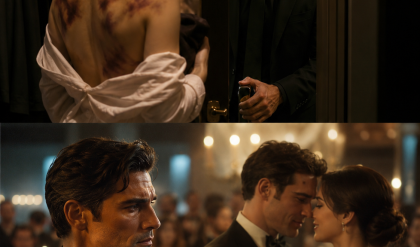
“Who gave you that?” she asked.
“Salvatore Moretti.”
The mug slipped from Rose’s hand and hit the rug. It did not break, but tea spread darkly through the fibers. For a few seconds neither woman moved.
“No,” Rose whispered.
Ella’s throat tightened. “You know him.”
Rose closed her eyes, and her hand moved to her chest. Not to cough. To hold something inside. “Tell me exactly what you said.”
“I saw his ring.”
Rose opened her eyes. The fear there was not confusion. It was recognition.
“I told him you had one like it,” Ella said. “The hawk and the rose.”
Rose stood too quickly and swayed. Ella rushed forward on instinct, catching her elbow. For a second the habit of care overpowered anger, but then anger returned, hotter because it had been interrupted by love.
“Why are you looking like that?” Ella demanded. “Why does a mob boss have the same ring you screamed at me for touching when I was ten?”
Rose pulled away and went to the bedroom. Ella followed her to the old dresser with the chipped brass handles. From the bottom drawer, Rose lifted the wooden jewelry box, opened it, removed a tray of cheap necklaces, and unfolded a black silk cloth. The ring lay inside, heavy and dark.
Ella had remembered it correctly. Black onyx. White gold. Double-headed hawk. Thorned rose. On the inside of the band, two letters had been engraved so small they looked like scratches: R.M.
“Rose Miller,” Ella said, though even as she spoke, she knew it was wrong.
Her mother shook her head. “No.”
The apartment changed around them. It remained the same cheap couch, the same unpaid bills, the same damp ceiling. But the life Ella thought she knew was no longer sitting inside it.
“What does it stand for?” Ella asked.
Rose closed her fingers around the ring. “Rosalia Moretti.”
Ella stared at her. “Moretti.”
“That was my married name.”
The room seemed to tilt. Ella gripped the dresser. “Married.”
Rose’s eyes filled. “I was Salvatore Moretti’s wife.”
“No.” The denial came out flat because there was no room in Ella’s body for drama. “No, my father was Daniel Miller. You told me he died before I was born.”
“Daniel Miller was a name I used on a form because I needed the world to stop looking for you.”
“For me?”
Rose sat on the edge of the bed as if her legs could no longer support the truth. “Salvatore is your father.”
Ella backed away until her shoulder struck the wall. For twenty-two years she had carried a dead father like a quiet fact. Daniel Miller had been an empty space her mother filled with vague kindness: he would have loved your stubbornness; he had gentle hands; he died before he could hold you. Ella had never had a grave to visit, no photograph, no stories with dates. She had accepted the emptiness because children accept the shape of the bowl they are given. Now the bowl had shattered, and inside it was Salvatore Moretti.
“You lied to me every day,” Ella said.
Rose flinched. “I protected you every day.”
“Don’t do that. Don’t put a clean word on it before I even understand what happened.”
Her mother nodded, tears slipping down her face. “You’re right.”
That was worse than an argument. Ella wanted denial, excuses, something to push against. Instead Rose gave her the one thing that made anger harder to hold neatly.
Rose began with what she could say without breaking. Her real name was Rosalia Bennett before marriage, born in Queens to a family that had long since scattered or died. She met Salvatore when she was twenty, back when he was not yet the undisputed head of the Moretti empire but the heir trapped between old men who believed cruelty was tradition and young men who wanted to turn crime into corporations. He was dangerous, yes, but he was also brilliant, ambitious, and weary of blood he had not ordered but was expected to honor. Their relationship began in secret because everything around the Moretti name became leverage. The ring had not been a mistress’s gift. It was a private marriage seal, given before a ceremony only a handful of people witnessed. Salvatore wore one. Rose wore the other. The hawk was the old family crest. The rose was added for her.
“I was pregnant when everything collapsed,” Rose said.
“With me.”
“Yes.” She rubbed the ring as if its edges could cut the past open. “There was an attack at a Moretti warehouse near Red Hook. Men died. Money disappeared. Federal files vanished. Someone planted evidence that made it look like I had sold information to an Albanian crew and to a federal agent. The same night, I received a recording. Salvatore’s voice, or what I believed was his voice, saying a traitor wife could not be allowed to live, pregnant or not.”
Ella felt sick. “You believed he wanted you dead.”
“I was twenty-two, terrified, and carrying you. I had already seen what powerful men did when pride became fear. I ran because I felt you move inside me and understood that if I stayed to prove I was innocent, you might never be born.”
“Did you try to tell him?”
“Once. I wrote a letter. The courier disappeared. Two days later, a police officer I trusted told me the courier had been pulled from the East River.”
Ella sat slowly on the bed across from her. “Who helped you disappear?”
Rose did not answer quickly enough.
“Mom.”
“A family attorney,” she said. “Elias Crane.”
The name meant nothing to Ella at first, and then it meant too much. Elias Crane was not merely an attorney. He was a billionaire legal strategist, philanthropist, hospital donor, and the polished public face of half the city’s charitable boards. His name appeared on the wing of the clinic where Rose had been treated twice. His firm handled real estate, trusts, private security mergers, and political campaigns. He was the kind of man newspapers called “respected” because no one with proof had lived loudly enough to correct them.
“You trusted him?” Ella asked.
“I trusted the man who told me Salvatore had signed my death warrant.”
“And if he lied?”
Rose looked at the ring in her palm, and the possibility moved between them like a delayed explosion. “Then he didn’t help me escape. He stored me.”
At 2:46 in the morning, someone knocked on the apartment door. Two knocks, a pause, then one more. Rose went white. Ella crossed to the kitchen and took the biggest knife from the block.
“Don’t open it,” Rose whispered.
“If they found us, the door isn’t the thing protecting us.”
Ella moved to the peephole. Salvatore Moretti stood alone in the hallway, rain darkening the shoulders of his overcoat. There were no visible bodyguards, no theatrical menace, no weapon in his hand. He looked, impossibly, like a man afraid of what waited behind a cheap apartment door.
Ella opened with the chain still latched. “How did you find us?”
Salvatore did not answer. His gaze moved past her and landed on Rose. The man who allegedly controlled judges, ports, police captains, unions, restaurants, and streets stopped breathing.
“Rosalia,” he said.
Rose gripped the back of a chair. “Salvatore.”
His name in her voice did not sound like fear. It sounded like grief recognizing its own reflection.
Ella kept her hand on the door. “You don’t come in.”
Salvatore lowered his eyes to her face. He studied her cheekbones, her mouth, the shape of her stare. Something in him shifted, and Ella hated that she noticed because it felt too intimate for a stranger. “I won’t come in unless she allows it.”
Rose’s voice trembled. “Did you send men to kill me?”
Salvatore closed his eyes. Pain crossed his face with such force that for a moment it made him look older than power. “I searched for you for nine years.”
“They told me you wanted my head.”
“They told me you sold my men to a rival and died in a fire before I could find you.”
“There was no fire where I was.”
“I know that now.”
Ella felt the knife become ridiculous in her hand and necessary at the same time. “Who told both of you those things?”
Salvatore opened his eyes. “Elias Crane.”
The chain still held the door, but nothing held back the past anymore.
Rose did not invite him in. Ella did, because someone had to control the scene before the scene controlled them. “Five minutes,” she said. “Sit where I can see your hands.”
Salvatore looked at her, and for one brief second something like pride ruined his grief. “Fair.”
He sat in the kitchen chair beneath the flickering light, the billionaire mob boss in a third-floor apartment with peeling paint and a sink full of tea mugs, facing the wife he thought dead and the daughter he never knew had existed. He placed his phone on the table, screen up, as if surrendering a weapon.
“After Ella mentioned the ring, I ordered sealed files pulled,” he said. “Not by my usual people. By a forensic accountant outside the family. Someone Elias never used. We found old transfers, altered trust documents, a life insurance policy paid out through a false identity, and recent medical records under the name Rose Miller.”
Rose’s hand tightened around the ring. “Medical records?”
Ella stepped closer. “What do you mean, medical records?”
Salvatore looked at Rose, then at Ella, and the hesitation told her she would hate the answer. “A private laboratory has been processing some of your blood work before results reach your doctors. That lab is owned by a chain of shell companies connected to Elias Crane.”
“No,” Rose said.
Ella’s mouth went dry. “Are you saying someone has been changing her test results?”
“At minimum,” Salvatore said. “Possibly more.”
Rose stood so abruptly the chair scraped backward. “No. I’ve been sick for years. I felt it. I felt my body fail.”
“I am not saying you imagined it,” Salvatore said carefully. “I am saying someone may have made sure it continued.”
The cruelty of it did not land all at once. It arrived in layers. The coughing. The dizziness. The mystery bills. The specialists who contradicted one another. The medication bottles lined above the sink. The nights Ella worked past midnight because her mother needed another appointment that never produced answers. If Salvatore was right, their poverty had not been an accident of illness. It had been part of the cage.
Rose sat down again. Her face changed in a way Ella had never seen. The frightened patient disappeared. In her place sat Rosalia Moretti, a woman who had once worn a hawk and rose on her hand and survived long enough to become dangerous to the man who had hidden her.
“Elias kept me alive,” Rose whispered, “because dead women cannot be used twice.”
Salvatore’s jaw tightened. “I will handle him.”
“No,” Rose said.
He looked at her.
“No,” she repeated, and the second time the word filled the room. “If you kill him, you bury my answers with him. You do not get to turn my life into another Moretti debt paid in blood.”
Salvatore leaned back as if the order physically struck him. “Rosalia—”
“For twenty-two years, men wrote my story over my body. You will not be another man deciding the final chapter because rage feels cleaner than patience.”
Ella stared at her mother. Pride and heartbreak tangled in her chest.
Salvatore lowered his gaze. When he spoke again, the gravel in his voice had softened into something almost obedient. “Then we do it with proof.”
Rose nodded once. “Proof first.”
Ella laughed bitterly. “That’s adorable. Now we’re all evidence technicians?”
Rose turned to her. “Do not mock evidence. Evidence is the only thing that can take power from a liar without making you into him.”
That sentence stayed with Ella long after the night ended. It was the bridge between terror and action. Without it, Salvatore’s men would have swept them into his world and the truth would have become another weapon. With it, they had a plan. Not trust. Not forgiveness. A plan.
Before dawn, Salvatore moved them out of the apartment and into a secured brownstone on Staten Island that Rose refused to call a safe house. “Safe house is what men call a cage when the locks are expensive,” she said. Salvatore accepted the correction without argument, which unsettled Ella more than if he had shouted. The brownstone had reinforced windows, two exits, a kitchen too clean to feel lived in, and a security team that kept far enough away after Ella threatened to leave through a bathroom window if anyone stood outside her bedroom door. Salvatore wanted ten guards inside. Ella allowed two on the street and one in the lobby. Their first negotiation as father and daughter ended with him looking as if he had swallowed a nail and her realizing he did know how to lose, if forced carefully enough.
At 7:30 that morning, Dr. Lydia Marsh arrived. She was an internist from Boston with steel-gray hair, direct eyes, and no visible fear of Salvatore Moretti. She examined Rose for two hours, reviewed medication bottles, ordered blood work through three separate labs, and stopped at one orange prescription bottle that Rose had been taking for eight months.
“Who prescribed this?” Dr. Marsh asked.
“Dr. Heller,” Rose said. “My pulmonologist.”
Dr. Marsh turned the bottle in her hand. “This dose is unusual.”
“Unusual how?” Ella asked.
“I won’t accuse without lab confirmation.” The doctor’s tone was careful in the way responsible people become careful when irresponsibility has already done damage. “But combined with two of her other medications, this could worsen fatigue, tremors, shortness of breath, confusion, and inflammatory markers. It would make a patient look consistently ill while confusing the diagnosis.”
Ella felt heat rise behind her eyes. “So she was being poisoned?”
Dr. Marsh looked at Rose. “I need proof before I use that word.”
Salvatore was already standing.
Rose did not even look at him. “Sit down.”
He sat.
Ella almost laughed from shock. The most feared man in New York sat because her mother told him to.
The test results took forty-eight hours. During that time, the world outside the brownstone began moving against them. Henderson called Ella thirteen times. She ignored the first twelve because she did not have enough strength to explain to a restaurant manager that she might be the hidden daughter of a mob boss whose wife had been medically controlled by a billionaire attorney. On the thirteenth call, she answered.
“I’m sick,” she said.
“No kidding,” Henderson replied, voice low and strained. “There’s a man here asking about you.”
Ella straightened. “What man?”
“Older. Navy suit. Very polite. Looks like he could buy the building and evict us for sport. Says he’s a friend of your mother.”
Rose, sitting across the room, looked up sharply. Salvatore was already reaching for his phone.
“Did he give a name?” Ella asked.
“Elias Crane.”
The room became silent.
Ella gripped the phone. “Mr. Henderson, listen to me carefully. You don’t know me. You don’t know my schedule. You don’t know where I live. You lost my application. You never saw my emergency contact. Do you understand?”
Henderson did not argue. That frightened her almost as much as the call. “I understand.”
“And don’t take anything from him.”
“I may be a coward,” Henderson said, “but I am not stupid.”
After she hung up, Salvatore made three calls, each shorter than the last. When he finished, he looked at Rose. “Elias knows the ring spoke.”
Rose stared through the window at the wet street. “No. He knows the girl wearing my face can talk.”
The test results confirmed what decency had been trying not to imagine. Rose had not been dying of one mysterious disease. She had been kept in a state of chronic illness through manipulated medication, falsified lab processing, and deliberate misdirection between specialists. Some symptoms were real because the drugs had made them real. Some underlying conditions had gone untreated because every chart had been nudged toward confusion. The laboratory handling key results traced back to a medical services company funded by one of Elias Crane’s philanthropic trusts. Dr. Heller, the pulmonologist, had received “research consulting” payments from the same trust for six years.
Ella broke a glass against the kitchen wall when she heard. No one scolded her. Salvatore looked as if he wanted to break the building. Rose sat with the report in her lap and said, very quietly, “He stole my trust in my own body.”
That sentence changed the nature of the crime for Ella. It was not only about a mafia feud, stolen money, or a hidden marriage. It was about making a woman doubt the one place she should have been allowed to live without permission: herself.
The deeper investigation revealed the design. Elias Crane had not acted out of simple loyalty to the Moretti family. He had been the architect of the original betrayal. Twenty-two years earlier, he had forged audio using fragments of Salvatore’s recorded calls, diverted money from Moretti-controlled port redevelopment funds, sold information to a rival crew, and framed Rosalia as the informant. He convinced Rose to run, then created the paper trail that made Salvatore believe she had died. Keeping her alive under the name Rose Miller gave him insurance. If Salvatore ever discovered the theft, Elias could produce the supposedly traitorous wife and her child as leverage, witnesses, or hostages, depending on what the future required.
But there was another layer, the one that turned Salvatore from furious to cold. The Moretti fortune was divided between legal businesses and an old family trust created by Salvatore’s grandfather. A portion of that trust, now worth nearly two billion dollars because of waterfront real estate, required dual authentication for certain transfers: Salvatore’s seal and the seal given to his legal spouse. Elias had managed the trust for decades by claiming Rosalia’s seal had been lost in the fire that supposedly killed her. He used court filings, emergency trusteeships, and forged affidavits to siphon control of assets piece by piece. Rose’s ring was not sentimental evidence. It was legal evidence. Proof that the widow was not dead, the seal was not lost, and the man celebrated as a philanthropic billionaire had built part of his public empire on a woman he kept sick in Brooklyn.
“So I’m not just your daughter,” Ella said when the explanation finally ended. “I’m a threat to paperwork.”
Salvatore’s face tightened. “You are my daughter.”
“Not the point.”
“It is to me.”
“That’s convenient,” she snapped. “You got to discover that after I paid the bills.”
He accepted the blow because it was true enough to bruise. “Yes.”
Ella hated his yes. She hated how often he refused to defend himself when defense would have given her something easier to fight. “Don’t agree like that makes you noble.”
“It doesn’t.”
“Then stop sounding calm.”
“I am calm because if I stop being calm, I will do exactly what your mother told me not to do.”
Rose, from the couch, said, “Good. Keep practicing.”
The trap for Elias Crane was not set in an alley, a warehouse, or a dark dock where men in crime stories liked to confess under flickering lights. Rose insisted on a room with cameras, lawyers, and a federal prosecutor who had already been investigating Crane’s medical trusts from another angle. Salvatore hated involving federal authorities. Ella, who had spent her life watching the poor beg institutions to care, did not trust them either. But Rose understood something both of them resisted: Elias had survived because he moved between worlds. To destroy him in only one world would leave him alive in another. If Salvatore handled him privately, Elias would become a missing man and half the evidence would vanish. If they used only the courts, Elias might bury the truth under procedure. They needed both pressure and record. They needed him comfortable enough to speak and cornered enough to reveal why.
The meeting took place above a closed Italian restaurant in Queens that Salvatore owned through three companies and never visited. Behind one wall, federal agents monitored audio. Behind mirrored glass, Rose and Ella sat together with Dr. Marsh, the prosecutor, and a forensic accountant whose entire personality seemed built from spreadsheets and caffeine. Salvatore sat alone at a polished table with a folder in front of him. Ella watched him through the glass and tried to reconcile the man in the expensive suit with the stranger who had sat under their broken kitchen light asking permission to enter.
“You don’t have to watch,” Rose said.
“Yes, I do.”
“He hurt me, not you.”
Ella turned to her. “Mom.”
Rose closed her eyes briefly. “I know. That was foolish.”
Ella took her hand. “He hurt both of us differently. That means we both get to look.”
Elias Crane arrived exactly on time, which somehow made Ella hate him more. He was seventy but carried age like a tailored accessory. His white hair was cut close, his navy suit immaculate, his hands smooth and narrow. He looked like a man who had spent his life signing things other people bled from. When he entered, he smiled with practiced regret.
“Salvatore,” Elias said. “This is unusual.”
“Many things are,” Salvatore replied.
Elias sat. “Your message said there was an emergency with the trust.”
“There is.”
“Then I hope you’ve brought more than theatrics. You know how I feel about impulsive decisions.”
Salvatore opened the folder and placed a photograph on the table. Rose at twenty-two, visibly pregnant, laughing at something outside the frame, the onyx ring on her hand.
Elias’s smile thinned so quickly that someone less angry might have missed it. Ella did not.
“A painful memory,” Elias said.
“A living one,” Salvatore replied.
Elias looked at the photograph again. “Impossible.”
“That is an interesting word. Not sad. Not miraculous. Impossible.”
“My meaning is obvious. Rosalia died.”
“No,” Salvatore said. “She became Rose Miller and spent twenty-two years being treated by doctors connected to your trusts.”
Elias folded his hands. “Grief has made you vulnerable to manipulation.”
Salvatore added another page to the table. “Transfers from the Moretti waterfront trust to Crane medical charities. Shell companies. Lab contracts. Payments to Dr. Heller. Altered blood work. Forged death affidavits.”
“I advise you to be very careful.”
“You always did.”
Elias sighed, performing disappointment. “Rosalia was unstable. You knew it then. Everyone did. She was frightened, emotional, easily influenced. When the warehouse attack happened, I tried to protect the family from scandal and protect you from making a sentimental mistake.”
Rose’s hand tightened around Ella’s behind the glass.
Salvatore’s voice remained even. “What sentimental mistake?”
“Chasing a woman who had already betrayed you.”
“Pregnant women make poor fugitives,” Salvatore said. “Unless someone gives them a map.”
Elias’s jaw shifted. “I saved your life. Had the old council known you intended to keep her after what she had done, they would have removed you.”
“She had done nothing.”
“You say that now because she has returned with a daughter and a story.”
Salvatore leaned forward slightly. “Say that again.”
Elias paused.
Salvatore repeated, softer, “A daughter.”
The old lawyer understood too late that he had stepped onto the exact stone they wanted. For twenty-two years, Salvatore had no confirmed proof Ella was his child beyond resemblance, timing, and Rose’s word. Elias had just spoken of her as fact.
“I assumed,” Elias said.
“No, you didn’t.”
“Do not mistake a careless phrase for evidence.”
Salvatore placed a final document on the table. “This is a recording analysis of the message Rosalia received the night she ran. Your firm kept the original source clips in archived litigation storage. You built my death sentence against my own wife from my voice.”
Elias did not confess all at once. Men like him rarely jump from cliffs. They descend by denying the height until the ground is gone. First he said he had acted under pressure. Then he said Rosalia had become a liability. Then he said the child complicated succession. Then, when Salvatore asked what right he had to decide whether a child lived with her father, Elias’s mask cracked.
“You were becoming weak,” Elias snapped. “You wanted to marry mercy into a family that survived by never apologizing for necessity. That girl would have given your enemies a cradle to aim at and your wife would have made you hesitate. I preserved the empire you were too lovesick to protect.”
Behind the glass, Rose stood. The prosecutor reached to stop her, but Ella shook her head. “Let her.”
Rose entered the room before anyone could turn the moment into policy. Salvatore rose, panic flashing across his face for the first time that night. Not fear of Elias. Fear for Rose having to breathe the same air.
Elias stared at her as if insulted by her survival. “Rosalia.”
She walked to the table and stopped across from him. Illness had thinned her, and recovery had only begun, but her voice carried. “You told me my husband wanted me dead.”
“I kept you alive.”
Rose slapped him.
The sound was clean, sharp, and final.
“No,” she said. “You kept me useful.”
Elias’s cheek reddened. His eyes hardened with something colder than anger: inconvenience. “You have no idea what I prevented.”
“I know exactly what you prevented,” Rose said. “A woman from telling the truth before men like you could profit from her silence.”
The door opened. Federal agents entered with the prosecutor. Elias stood, already rearranging his face into outrage. “This is absurd.”
The prosecutor lifted a folder. “Elias Crane, you’re being taken into custody on charges including conspiracy, obstruction, wire fraud, witness intimidation, and medical fraud. We’ll add more as your documents continue helping us.”
Elias looked at Salvatore. “You think this makes you clean?”
Salvatore did not move. “No.”
That answer seemed to disturb Elias more than any threat would have.
Rose stepped back toward Ella. She was shaking now. Ella put an arm around her mother and felt the tremor not as weakness, but as a body finally releasing twenty-two years of forced stillness.
Elias Crane was arrested that night. Not for every sin, because justice rarely arrives with hands large enough to carry the full weight of what people deserve. But he was arrested for enough to break the public version of him. The newspapers that once photographed him at hospital galas now printed diagrams of shell companies, falsified lab reports, forged death filings, and trust transfers. Commentators called it a scandal, then a conspiracy, then a citywide reckoning when other patients came forward with suspicious treatment patterns linked to Crane-funded clinics. The story was no longer only about a mob boss’s lost wife. It became about respectable cruelty, the kind that wears tailored suits and speaks softly at charity dinners while deciding whose suffering can be monetized.
Salvatore kept Ella’s name out of the first wave of coverage. Rose insisted on it. “She is not a prop in a war,” she said.
“No,” Salvatore agreed.
Ella noticed the agreement. Not romantic. Not healed. But real. For the first time, she saw her parents united by something that did not require them to pretend the past had been simple. They agreed not to use her. For a family built around power, that was not a small beginning.
Rose’s recovery was uneven. Once the harmful drug combinations stopped and real treatment began, some symptoms improved quickly. Others remained, because the body does not forgive fraud just because a lab report has been corrected. She slept longer. She coughed less. Her hands stopped trembling enough that she could thread a needle again. One morning, Ella found her in the kitchen making coffee in the brownstone, hair messy, robe crooked, face turned toward the weak winter sun.
“I forgot you knew how to make coffee without burning it,” Ella said.
Rose smiled. It was small, but it reached her eyes. “I raised you on discount coffee and fear. I’m experienced with one of those.”
Ella laughed before she could decide whether she was ready to. The sound surprised them both. Rose’s eyes filled, and Ella hugged her carefully, still angry, still hurt, still grateful to have arms around someone alive.
With Salvatore, nothing came easily. He wanted to repair twenty-two years in a week, which meant he kept making billionaire mistakes. He sent clothes. Ella sent them back. He arranged a private college advisor. Ella canceled the appointment. He offered a car. She asked if it came with invisible chains or just the regular kind. He listened badly at first, then better.
“You need transportation,” he said one afternoon.
“I need control over my own life.”
“I can provide both.”
“People who say that usually provide one and rename it as both.”
He stared at her for a moment, then nodded slowly. “What would help?”
The question disarmed her because it sounded learned, not natural. “Ask before doing things.”
“I thought I just did.”
“One correct answer does not make you a graduate.”
His mouth moved almost into a smile. “Understood.”
“Don’t look proud. This is kindergarten.”
“I was never allowed kindergarten.”
Ella looked at him, expecting manipulation, but found only fact. It did not soften everything. It softened one inch. Sometimes that was all a day could hold.
She returned to the Velvet Room once to resign in person. Salvatore waited in a car half a block away because she had ordered him not to enter and turn her resignation into a scene. Henderson met her by the bar, nervous and trying to hide it behind managerial irritation.
“You alive?” he asked.
“Apparently.”
“Good. Are you quitting because of the whole… whatever the hell that was?”
“I’m quitting because I don’t want to serve steak to men who think fear is ambience.”
Henderson looked offended, then thoughtful. “Fair.”
Ella placed her apron on the bar. “Also, you owe Hector two weeks of overtime. He’s afraid to ask.”
Henderson blinked. “You’re leaving and still creating problems?”
“I’m expanding my brand.”
He almost smiled. “Take care of yourself, Miller.”
She paused at the door. For the first time in her life, the name Miller felt both false and earned. False because it had been built as cover. Earned because she and Rose had survived inside it. “You too, Henderson. Try being less awful. It’ll confuse people.”
Outside, Salvatore got out of the car but did not approach until she looked at him. That was progress. He opened the passenger door.
“I could have sent someone to collect your final check,” he said.
“I know.”
“You wanted to walk out yourself.”
“Yes.”
He nodded. “Good.”
“You don’t get credit for understanding obvious things.”
“I am beginning to suspect fatherhood is mostly not getting credit.”
Ella got in the car. “Don’t push it.”
He did not. That was also progress.
Rose chose not to return publicly to the name Rosalia Moretti right away. “Rosalia was my name before fear,” she told Ella. “Rose Miller was my name during survival. I won’t let Elias decide which one deserves to live.” Salvatore accepted the decision with difficulty but without argument. He met Rose in quiet places, always with her consent, sometimes with Ella nearby, sometimes not. They spoke about the night she ran, the years he searched, the lies he believed because the lies fit too neatly into the violent world he inhabited. Sometimes they shouted. Sometimes Rose cried. Once Salvatore did, silently, which made Ella leave the room because not every wound between parents belonged to a child.
They did not resume a marriage like a paused film. Twenty-two years had happened. Rose was no longer the young woman who fled with a ring hidden under her blouse. Salvatore was no longer the young man who believed power could protect love if he gained enough of it. Both had been reshaped by absence, guilt, compromise, and survival. What remained was not simple romance. It was recognition, which was harder and perhaps more honest.
Ella had to decide what to do with the Moretti name. The press eventually found her, of course. They called her the lost heiress, the mob princess, the waitress who brought down a billionaire lawyer with one sentence. She rejected every interview until a reporter from a serious investigative magazine agreed to her terms: no princess, no glamorizing Salvatore, no pretending her mother’s suffering became meaningful because it exposed powerful men. When asked what she wanted people to understand, Ella said, “My story did not begin when a rich man recognized me. It began when my mother survived long enough for me to ask a question. We were not hidden treasure. We were people.”
That quote became famous. Salvatore told her he was proud. Ella told him not to take credit for her trauma producing good copy. He replied, “I can be proud without taking credit.” She had no answer, so she changed the subject. Later, alone, she admitted to herself that the sentence mattered.
Elias Crane’s trial lasted longer than Ella wanted and revealed less than he deserved. Still, the evidence held. Dr. Heller cooperated to reduce his sentence. Accountants traced shell companies. Former employees from Crane-funded labs testified about altered protocols and unusual private instructions. The forged death affidavit was admitted. The audio experts explained the fake recording. Rose testified for two hours. She began with shaking hands and ended with her voice steady.
“My name is Rose Miller,” she told the court, “and I was born Rosalia Bennett. I was also Rosalia Moretti before a man at that table decided my life was more useful as a lie. Elias Crane took my name, my marriage, my health, and my daughter’s right to grow up without fear. He did not do it with a gun. He did it with documents, doctors, and respectable rooms. That does not make it less violent.”
Ella testified after her. She looked at Elias only once. He did not look back.
“I grew up believing my mother was alone,” Ella said. “Now I know she was isolated by design. I worked to pay medical bills created by the same network that kept her sick. I cannot recover my childhood. But I can say under oath that we existed. We were not clerical errors. We were not collateral damage. We were people used to protect a man’s power.”
When she stepped down, Salvatore waited near the aisle. He did not reach for her. He asked, “May I?”
Ella nodded.
The hug was awkward, brief, and real. Rose cried into a tissue. Salvatore let go first, perhaps because he understood that love offered too tightly can feel like another form of control.
Elias was convicted on enough counts to ensure he would never again walk freely into a charity gala and be thanked for his generosity. It was not perfect justice. Perfect justice would have returned twenty-two years, restored Rose’s health fully, given Ella birthdays with the truth, and forced every doctor who dismissed Rose to sit with the consequences of their convenience. The court could not do that. But it could name the harm. It could strip Elias of the dignity he had used as camouflage. It could make a record no one could politely misplace.
After the conviction, Rose moved into a small apartment in Brooklyn with wide windows, ordinary locks, and a kitchen she chose herself. Not a Moretti mansion. Not a guarded estate. Not a secret address owned by a man who believed security and love were the same word. Ella lived with her for the first few months, then slowly began spending nights in her own studio near campus. She enrolled in forensic accounting and criminal justice courses, not because she wanted to inherit Salvatore’s world, but because she wanted to understand how lies became systems. Paperwork, seals, lab reports, trusts, signatures—those were the weapons that had shaped her life. She wanted to learn how to read them before they cut someone else.
Salvatore paid for part of her education after she insisted on a written agreement reviewed by an independent attorney. Rose paid for books with money she earned sewing custom alterations again.
“I want something of yours to come from my hands,” Rose said, sliding cash across the table for Ella’s first semester of textbooks, “not from his guilt.”
Ella accepted because she understood. Healing required practical rituals. Some families passed down jewelry. Some passed down recipes. Rose passed down fifty-dollar bills folded from honest work and the stubborn refusal to let guilt buy everything.
Years later, Ella kept three objects in a small wooden box of her own: the black card Salvatore had left at the Velvet Room, a copy of her first tuition receipt, and a photograph of Rose standing in her new kitchen, smiling with flour on her cheek. She did not keep them because they proved she belonged to power. She kept them because they proved a night could change shape. A drop of wine could become evidence. A forbidden question could become a door. A hidden ring could become less a symbol of ownership than a witness that had waited long enough.
Rose never wore her ring again. She had it mounted in a small shadow box beside a handwritten note: What we hide to survive must not stay hidden forever. Salvatore wore his after a long time, but not the way he had before. One afternoon, Ella noticed it on his hand while they sat on a bench near the Brooklyn Promenade. Rose was arguing with a doctor on the phone because she refused to undergo another unnecessary test without a clear explanation. Salvatore listened with an expression that was half admiration and half fear.
“You’re wearing it again,” Ella said.
He looked down at the onyx. “Yes.”
“What does it mean now?”
He watched Rose end the call triumphantly. “Before, I thought it meant power.”
“And now?”
“Now it reminds me what I lost when I mistook power for control.”
Ella considered that. “Better.”
“Only better?”
“Don’t get emotional. I’m being generous.”
Salvatore smiled. For the first time, Ella saw something of herself in his face. Not the crime. Not the empire. Not the blood-soaked history attached to his name. Just a crooked, tired, almost tender expression that looked like it had been waiting twenty-two years for permission.
The rain continued to fall on Brooklyn many times after that November night. The city did not become clean. Men still lied in expensive rooms. Restaurants still filled with people pretending not to fear the powerful. Salvatore Moretti did not become harmless because he had suffered. Rose did not become unbroken because the truth was named. Ella did not become a princess because newspapers liked fairy tales with crime in them. Their ending was not perfect enough for legend, which made it human enough to keep.
What changed was smaller and stronger. Rose could say both of her names without disappearing inside either. Salvatore could ask before reaching. Ella could look at a man everyone feared and demand an explanation instead of lowering her eyes. She could love her mother and still be angry. She could know her father and still refuse his world. She could accept help without surrendering judgment. She could build a life from truth, even when truth arrived late and carrying damage.
Sometimes people asked her when everything began. They expected her to say it began with Salvatore Moretti, or Elias Crane, or the Moretti trust, or the forged recording that made a pregnant woman run. Ella always thought of the Velvet Room instead: garlic, expensive cologne, rain on glass, a white tablecloth, a black ring, and her own exhausted voice crossing a line her mother had spent a lifetime warning her not to cross.
Sir, my mother has a ring like yours.
Seven words. That was all.
Sometimes the truth does not enter shouting. Sometimes it arrives as a waitress too tired to keep obeying silence. Sometimes it sits inside a poor woman’s jewelry box for twenty-two years, waiting for one careless sleeve to move under chandelier light. Sometimes it looks like danger because danger has been holding its missing piece.
And sometimes, if a daughter is brave enough to ask and a mother is alive enough to answer, a ring stops being a secret and becomes the first honest sentence of a family.
THE END