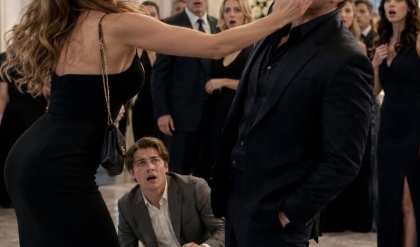
Eleanor lifted her eyes. “How did you know?”
Ava’s lips parted.
Nathan said, “Ava.”
Too late.
Eleanor turned to him. “You told her.”
His throat moved. “I was upset.”
“When?”
Neither answered.
Eleanor looked back at Ava.
Ava whispered, “Last night.”
After the discharge papers. After the apology texts. After calling Ava a mistake. He had gone back to the woman whose voice had met Eleanor in the hospital corridor and asked to be comforted.
Ava rushed forward, words tumbling now. “He was devastated. He didn’t know what to do. He said you two had been over emotionally for a long time. He said the marriage was mostly appearances, that you were distant, that he was alone.”
“Did he tell you I was pregnant?”
Ava’s face changed.
Not enough to excuse her. Enough to locate the lie.
“No,” she whispered.
Eleanor nodded slowly. “Why are you here?”
Ava opened her handbag with shaking fingers and removed a folded packet. “Vivian called me before dawn. She said you would destroy Nathan unless I told the truth first. She sent a car. Her attorney was waiting.”
Nathan stepped forward. “What is that?”
Ava looked at him then, and for the first time anger cut through her fear. “You really don’t know?”
He stopped.
She handed the packet to Eleanor.
Confidential Relationship Statement Prepared for Whitcomb Family Office.
Eleanor read the first page. The document described Nathan and Ava’s relationship as a mutual emotional bond that began only after the functional end of the Whitcomb marriage. It claimed Eleanor had become volatile, medically private, emotionally withholding, and unwilling to support Nathan during corporate crisis. It included a line suggesting the pregnancy had been uncertain and that Nathan had been excluded from relevant information.
Eleanor’s hand went very still.
Ava whispered, “Vivian said if I signed it, she would protect me.”
“From what?”
Ava’s voice broke. “From you.”
Eleanor called her attorney at 9:12 a.m. By 10:05, Marianne Vale sat in the front sitting room with silver-rimmed glasses, a navy suit, and the calm expression of a surgeon who had long ago stopped being surprised by blood.
Marianne read the packet once, then again.
“This,” she said, placing it on the table, “is amateur cruelty wearing professional letterhead.”
Nathan sat across the room with his elbows on his knees and his hands locked together. He had asked to stay. Eleanor had allowed it because watching him discover the architecture of his mother’s rescue attempt was useful.
Ava sat beside an independent attorney Marianne had called for her. The attorney’s name was Priya Mason, and she looked at Ava with the protective severity of someone who had seen frightened women sign documents that ruined their lives.
Marianne tapped the packet. “This statement attempts to preframe Eleanor as unstable, noncommunicative, and medically unreliable. It reframes an affair as a post-marital transition and tries to make the pregnancy loss sound ambiguous enough to reduce sympathy.”
“It was not ambiguous,” Eleanor said.
“No,” Marianne replied. “It was not.”
Nathan looked up. “I didn’t ask my mother to do this.”
Marianne turned to him. “Did you ever tell her Eleanor was unstable?”
He opened his mouth.
Closed it.
Eleanor looked at him.
There it was. Not the whole crime. The seed.
“I said she had been distant,” Nathan said. “I said grief changed her. I said she made me feel like a stranger in my own house.”
Marianne’s gaze did not soften. “And your mother turned your self-pity into a legal strategy.”
Nathan lowered his head.
That was what powerful families did, Eleanor realized. They rarely created cruelty from nothing. They took careless words from sons, polished them into narratives, and handed them to attorneys.
Priya asked Ava, “What did Mrs. Whitcomb offer in exchange for signing?”
“A severance package. Six months’ rent. A reference. She said if I refused, Nathan would abandon me and Eleanor would sue me into bankruptcy.”
Nathan stared at Ava. “I never said that.”
Ava’s expression hardened. “You didn’t have to. Your mother speaks like she owns the consequences.”
Eleanor looked from one to the other. The triangle was not romantic anymore. It was procedural.
That helped.
Marianne closed the packet. “We preserve everything. Hospital records. Call logs. Texts. Hotel invoices. Cloud backups. This document. We file for legal separation, exclusive occupancy, emergency financial protections, and a conduct order. We also notify the board of Whitcomb Meridian.”
Nathan’s head snapped up. “The board?”
Eleanor finally spoke to him directly. “Your assistant was asked to sign a false statement about my medical condition and our marriage. Company resources appear to have been used to hide your affair. Your mother’s office is attempting to influence a witness. The board will care.”
“That could destroy the company.”
“No,” Eleanor said. “It could stop the company from being used as your alibi.”
Whitcomb Meridian was not Nathan’s alone.
That was the fact he had spent years forgetting.
He had founded it with charm, appetite, and a pitch deck that made older investors believe he could see around corners. But Eleanor had made the numbers work. Her family office, Ashford House, had provided early capital through a private vehicle called Harborlight Partners. Nathan believed Harborlight was an outside investor with unusually patient terms. Eleanor had allowed that belief at first for his pride, then for the marriage, then because each year made the truth harder to reveal.
Her father had warned her before the wedding.
“A man who resents your ladder,” Harrison Hart had said, “will call it a cage once he reaches the balcony.”
Eleanor had thought him cynical.
Now she wondered whether he had simply been experienced.
By noon, Marianne had contacted Harborlight counsel. By two, Whitcomb Meridian’s board received a preservation notice. By four, Nathan’s CFO called him so many times his phone vibrated across the sitting-room table like an insect.
He finally answered in the hall, but his voice carried.
“Martin, no. This is personal.” A pause. “What do you mean Harborlight froze the release?” Another pause. “Do not call an emergency meeting without me.”
Eleanor watched rain bead on the window.
For years, Nathan had called her calm his greatest comfort. Then, when calm stopped serving him, he called it coldness. Praise a woman’s restraint when it protects you. Question her humanity when it protects her.
Nathan returned to the room.
“Harborlight froze the capital release,” he said.
Eleanor nodded.
His eyes narrowed. “Did you know?”
“Yes.”
“How?”
She waited.
Understanding came slowly, and with it humiliation.
“Harborlight is yours.”
“Controlled by Ashford House.”
“You hid that from me.”
“You hid an affair from me.”
“That’s different.”
“Yes,” Eleanor said. “Mine kept your company alive.”
The room went silent.
Nathan’s face flushed. “You let me think I built this alone.”
“No,” she said. “You insisted on thinking that. I stopped correcting you.”
There were few humiliations more painful to a proud man than discovering the invisible hand he dismissed had been holding the floor.
Vivian arrived at 5:40 p.m. with two attorneys and no apology. Owen stopped her in the vestibule until Eleanor approved entry. That alone hardened Vivian’s face into something close to hatred.
She entered the sitting room and saw Nathan, Eleanor, Ava, Marianne, Priya, and the unsigned packet on the table.
Her gaze moved first to Ava. “You brought this to her.”
Ava sat straighter. “You asked me to lie.”
“I asked you to clarify.”
Eleanor stood. “You asked her to sign a statement saying my pregnancy was medically uncertain and that I withheld information from my husband.”
Vivian looked at her. “Did you not?”
Nathan said, “Mother.”
Vivian ignored him. “You went to the hospital alone.”
“Because Ava answered Nathan’s phone and said he was in the shower.”
Vivian looked at Ava, then Nathan. For the first time, uncertainty flickered across her face. She had known about the affair. She had not known about the call. That mattered only a little.
She recovered quickly. “Even if mistakes were made, you are turning private grief into corporate warfare.”
Eleanor’s voice remained level. “You used the family office to draft a false medical narrative about me before my body had even recovered enough to sleep.”
Vivian stepped closer. “From the first day, you believed quiet judgment made you morally superior.”
Eleanor almost smiled. The real dislike had finally found language.
“I did not judge you, Vivian. I learned you.”
Vivian’s eyes sharpened.
“You do not protect family,” Eleanor continued. “You protect image. Family is only the word you use when someone else’s silence is required.”
Marianne placed a document on the table. “Mrs. Whitcomb, you and your counsel should review this preservation notice. It covers family office communications, witness contact, employment records, medical statements, and any attempt to influence Miss Mercer’s testimony.”
Vivian did not pick it up.
Eleanor did. She held it out.
Vivian stared at the paper as if accepting it meant accepting defeat. Then she took it.
The board meeting happened the next morning at nine sharp on the forty-second floor of Whitcomb Meridian’s headquarters. Eleanor wore a black suit, her hair pinned low, her face pale but exact. Nathan sat beside his attorneys. Vivian sat behind him despite having no official role. Martin Hale, the CFO, looked like a man who had not slept. Three independent directors opened tablets with careful neutrality.
Ava attended by video with Priya beside her.
That alone made Nathan flinch.
Helena Cross, the board chair, began with a voice like polished stone. “We are here to review Harborlight Partners’ capital freeze, potential executive misconduct, and allegations of witness interference.”
Nathan leaned forward. “This is a marital dispute being inflated beyond proportion.”
Eleanor looked at him.
He did not look back.
Harborlight counsel presented the evidence in order. Hotel suites charged as executive crisis lodging. Car services to Ava’s apartment coded as client retention. Spa expenses billed under hospitality. Call logs showing Eleanor’s repeated attempts to reach Nathan from the hospital. Hospital discharge records timestamped before Ava answered his phone. The family office packet. And then a recovered text exchange from 7:05 p.m.
Ava: Was that her?
Nathan: Yes.
Ava: I told her you were in the shower.
Nathan: Damn.
The conference room stopped breathing.
Not Where is she?
Not Is she okay?
Damn.
Eleanor had not seen that message before. Marianne had warned her there were recovered texts, but not the exact words. Now the final piece clicked into place with such clean cruelty that Eleanor felt almost calm.
Helena turned to Nathan. “Did you send this while your wife was in the hospital experiencing a pregnancy loss?”
Nathan’s jaw tightened. “I didn’t know the severity.”
Eleanor’s voice was quiet. “So was I.”
No one spoke.
Then Ava appeared larger on the screen. Her face was pale, but her voice was steady.
“Vivian Whitcomb asked me to sign a false statement. She offered severance, housing, and a reference if I said my relationship with Nathan began after his marriage had effectively ended. That was not true. I did answer Eleanor’s call. I said Nathan was in the shower. I did not know Eleanor was pregnant, but I understand that does not erase what I did.”
Vivian rose. “This is outrageous.”
Helena looked at her. “Sit down.”
The room changed.
Vivian was not used to being addressed as someone without authority.
Slowly, she sat.
By noon, the board suspended Nathan from executive authority pending investigation. Harborlight maintained the capital freeze but offered release under independent oversight. Martin would become interim operating lead. A governance committee would audit company expenses, executive conduct, and family office interference. Vivian was barred from contacting employees or witnesses connected to the review.
When the decision was read, Nathan turned to Eleanor.
“You are destroying what we built.”
She was so tired the sentence nearly passed through her without impact.
“No,” she said. “I am separating it from what you did.”
Vivian’s face was pale with fury. “Your father would be ashamed.”
Eleanor turned slowly.
Her father had taught her to read contracts, plant roses, and never sign anything offered during panic. He had also warned her about Nathan’s hunger.
“My father,” Eleanor said, “would ask why your son needed my hidden capital to build a company he now claims I’m destroying.”
Helena looked sharply toward Harborlight counsel. “Hidden capital?”
Counsel answered, “Harborlight Partners is controlled by Ashford House, Mrs. Whitcomb’s family office. The ownership was disclosed to independent counsel during the original financing.”
The directors went still.
Nathan closed his eyes.
Vivian stared at Eleanor as if the wife she had dismissed had just stepped out from behind the walls carrying the foundation.
“You let us believe you were merely Nathan’s wife,” Vivian said.
“No,” Eleanor replied. “You insisted on believing merely was possible.”
The legal separation was filed within a week. Exclusive occupancy was granted. Nathan moved into a serviced apartment near the financial district. Ava resigned from Whitcomb Meridian, issued a sworn statement, and disappeared from Boston society with the speed of a woman discovering that powerful men do not fall alone, but they do land softer.
Reporters began circling.
Marianne prepared a short statement.
Mrs. Eleanor Whitcomb will not discuss private medical details. Ongoing legal and corporate reviews concern documented conduct, misuse of resources, and attempted false statements. Grief will not be used as an alibi for misconduct.
The last sentence was Eleanor’s.
Nathan came to the townhouse the night the statement ran. Owen stopped him at the door. Eleanor watched through the security feed as rain silvered his hair.
“Ellie,” Nathan said toward the camera. “Please. Five minutes.”
She almost answered.
Then she remembered the hospital corridor. Ava’s breath on the phone. Nathan’s text.
Damn.
Eleanor pressed the intercom. “Send any request through counsel.”
Nathan closed his eyes. “I loved you.”
Her thumb hovered over the button. She wanted to say she knew. She wanted to say it mattered. She wanted to say love, if it had ever been real, had become impossible to distinguish from hunger.
Instead, she released the button.
The gate remained locked.
The divorce hearing three months later began without drama, as expensive disasters often did. People sat beneath fluorescent courthouse lights while lawyers arranged binders and assistants whispered over tablets. Nathan wore a charcoal suit and a face designed for regret. Vivian sat behind him in cream wool, her lips pressed thin.
Nathan’s attorney no longer denied the affair. That door had burned down. Instead, he framed Nathan as a flawed husband, grieving father, pressured executive, and private man punished by a wife with disproportionate financial power.
Disproportionate.
Eleanor almost admired the word. It made her sound like weather instead of the person who owned the capital structure he had stood on.
Marianne let him speak for eighteen minutes. Then she stood.
“This case is not about punishing grief,” she said. “It is about the defendant’s repeated effort to convert his wife’s medical emergency, pregnancy loss, and private assets into tools for his own protection.”
She displayed the timeline. Emergency admission. Outgoing calls. Ava answering from the hotel suite. Nathan’s text: Damn. Nathan’s return home and accusation. Vivian’s false statement packet. The society column Vivian had quietly fed two weeks later, describing a “powerful wife” punishing an “emotionally abandoned husband.” Board suspension. Financial records. Witness contact.
Then Marianne played a deposition excerpt.
Ava’s recorded voice filled the courtroom.
“Mrs. Whitcomb did call. I answered. I told her Nathan was in the shower. I understood later that she was calling from the hospital. I regret my role, but I will not say she failed to reach him. She did not fail. We failed her.”
Eleanor closed her eyes.
We failed her.
It did not repair the night. But it told the truth in a room where truth had once been treated like an inconvenience.
The judge ruled steadily. The townhouse remained Eleanor’s separate property. Nathan’s claim to enhanced marital value failed. His equity was reduced under misconduct and clawback provisions. Ashford House and Harborlight remained separate from his obligations. Nathan, Vivian, and the family office were barred from contacting medical providers, employees, or witnesses outside counsel.
Outside the courtroom, Vivian waited near the marble wall.
For once, she did not speak first.
Eleanor stopped in front of her.
Vivian looked toward the courtroom door where Nathan still stood with his attorney. “It sounded worse in order.”
Eleanor nodded. “It usually does.”
Vivian’s face tightened. “The judge was fair.”
“Yes.”
“I came because I helped build the lie. I needed to hear it dismantled.”
There were apologies that asked for comfort. This was not one. Vivian was still too proud to request mercy and too tired to perform power.
Eleanor said, “Then you heard it.”
Vivian nodded once and walked away.
Nathan resigned from Whitcomb Meridian two months later. The official statement was elegant: Nathaniel Whitcomb would step away from all operational and advisory responsibilities to allow the firm to complete governance renewal under independent leadership.
The private reason was less elegant.
Investors no longer trusted him with clean lines. Employees stopped laughing at his jokes. Martin Hale discovered the company could function without Nathan’s charisma, which proved charisma had been less essential than Nathan believed.
After the final board vote, Nathan found Eleanor near the elevator.
“You were right,” he said.
She looked at him. “About what?”
A faint, painful smile touched his mouth. “That is a long list.”
The elevator doors opened. Neither moved.
“I thought the company was mine because people let me stand in front of it,” Nathan said. “I thought the marriage was mine because you kept making room for me inside it. I thought forgiveness was something I could ask for after damage, not something I spent every time I chose myself first.”
It was a good sentence.
Eleanor hated that some part of her still recognized good sentences from him.
“Are you in therapy?” she asked.
“Twice a week.”
“Good.”
“It’s terrible.”
“Also good.”
For a moment, something old and almost gentle passed between them. Not romance. Not forgiveness. Recognition, perhaps, of two people who had once built a life and now stood among its ruins with better vocabulary.
“I would like to volunteer someday,” Nathan said. “For whatever you build from this. Not soon. Not publicly. Not if it harms you.”
“Someday is not a promise,” Eleanor said.
“I know.”
“It is a door that may remain closed.”
“I know that, too.”
The elevator began to close. Eleanor stepped inside.
Nathan stayed where he was.
That was how she knew he had begun to learn.
Healing did not arrive like a verdict. It came in humiliating fragments.
Some mornings Eleanor woke with rage already waiting at the foot of the bed. Some afternoons grief folded her in half because she found the tiny socks she had bought too early and hidden behind towels. She did not throw them away. She placed them in a small box with the ultrasound image and the hospital bracelet.
Not evidence.
Memory.
That distinction mattered.
Her therapist, Dr. Marin Cole, asked in their first session, “What are you most angry about?”
“The affair,” Eleanor answered quickly.
Dr. Cole waited.
Eleanor looked down. “No. The call. Ava answering. Nathan coming home angry that I did not call. I was in a hospital losing our baby, and he came home furious that I had failed him.”
Dr. Cole did not rush to comfort her. That helped. Comfort sometimes tried to cover a wound before the wound had testified.
“You were abandoned,” Dr. Cole said gently, “then accused.”
Eleanor cried then. Not beautifully. Not quietly. She cried until her face hurt and her breath came apart.
Abandoned, then accused.
She wrote the phrase down when she got home.
One year after the miscarriage, Eleanor returned to the hospital, not as a patient but as a donor. The emergency obstetric unit needed private discharge transportation funds for women leaving after pregnancy loss or complications. A nurse admitted, quietly, that too many women waited alone because no one could come, or because the person who should come was not safe to call.
Eleanor funded the program through Ashford House.
No gala. No photograph. No giant check.
Just transport vouchers, overnight support, counseling referrals, privacy protocols, and a rule that no patient would be asked twice whether someone could pick her up after she said no.
The nurse cried when the paperwork was signed.
Eleanor did not.
She cried later in the parking garage.
Healing, she learned, often waited until useful work was done.
The program was called The First Ride Home.
It grew because need rarely stays small once someone finally measures it. Transportation became secure phones. Secure phones became legal referrals. Legal referrals became hospital training. The most popular training slide said:
Do not assume the person who should come is safe to call.
Eleanor wrote that line herself.
At the first staff meeting, a young advocate named Lena asked why the program also offered legal support.
“Because abandonment rarely travels alone,” Eleanor said. “Sometimes it brings financial control, reputation management, and someone else’s story about your grief.”
No one asked a follow-up question.
They understood.
Two years later, The First Ride Home operated in five hospitals across Massachusetts. Eleanor read anonymized reports every month. A woman whose husband refused to leave a work dinner. A teenager whose boyfriend took her phone. A mother of three whose in-laws called her dramatic after a stillbirth. A corporate attorney whose partner sent flowers but not himself.
Different details.
Same wound.
Abandoned, then accused.
Eleanor made sure the intake forms never asked a woman to prove she was deserving of care. Loss was proof enough.
Ava wrote once through Priya. The letter was formal, specific, and late. She admitted she had entered a relationship with a married man, accepted Nathan’s story without demanding proof, answered his phone, and nearly signed Vivian’s statement because she was afraid of losing access to his protection.
At the end, she wrote, I am sorry I answered the phone like I had a right to your life.
Eleanor sat with that sentence for a long time. Then she placed the letter in a file.
She did not reply.
Some apologies deserved to exist without becoming a bridge.
Six months later, Ava asked to donate the severance money Vivian had offered her. Eleanor accepted only after counsel confirmed it came with no public statement, no conditions, and no request for absolution. The money funded private phone kits for patients whose partners controlled accounts or tracked calls.
Eleanor named it the Safe Line Fund.
Years later, Ava sent one more note.
I answered the wrong phone once. I hope this helps someone reach the right person.
Eleanor placed that note in the restricted archive.
Reparation was not redemption. It could still be useful.
Vivian requested a meeting one winter afternoon, eleven months after the divorce. Marianne advised refusing. Eleanor almost did. Then she saw the attached note.
I will come without Nathan. I owe you words I cannot make useful through lawyers.
Eleanor allowed ten minutes in the front sitting room.
Vivian arrived in a black coat, no pearls, no handbag large enough to hide documents. She looked older, not weaker. Vivian Whitcomb would probably remain formidable in a hospital gown, but the certainty had thinned.
Owen remained within earshot. Vivian noticed and did not object.
“Thank you for seeing me,” she said.
Eleanor said nothing.
Vivian folded her gloves in her lap. “I asked about viability.”
The sentence entered the room without cover.
Eleanor’s hand tightened once on the arm of the chair.
“That was the first thing I asked after learning you had lost the pregnancy,” Vivian continued. “Not whether you were in pain. Not whether you had been alone. I asked whether it had been viable.”
Eleanor looked at her. “Why?”
Vivian closed her eyes briefly. “Because I was already building a defense for my son.”
The honesty landed hard.
“I have spent my life protecting Whitcomb men from consequences and calling it family,” Vivian said. “My husband. My father-in-law. Nathan. I thought if the story could be managed, the damage would become manageable.”
“For whom?”
“For us.”
“Not for me.”
“No,” Vivian said. “Not for you.”
Rain moved softly against the windows.
“I am sorry,” Vivian said.
Eleanor had imagined those words many times. In fantasy, they had brought satisfaction. In reality, they arrived small, insufficient, and human.
“Thank you for saying it,” Eleanor replied.
Vivian looked up, almost hopeful.
Eleanor continued, “It does not restore access.”
The hope disappeared. Vivian nodded. “I understand.”
At the door, Vivian paused. “I hope you build a life no one in my family can enter without permission.”
Eleanor studied her. “I already have.”
Years moved.
The townhouse changed.
The guest room that had once been the planned nursery became a reading room with sage green walls, two deep chairs, shelves, a small piano, and a framed print of the harbor in fog. Eleanor’s mother, Adelaide Hart, came for one winter and filled the house with soup, music, and the blunt kindness of a woman who had never trusted Nathan but loved her daughter enough not to say I told you so until it became useful.
One night, Adelaide found Eleanor holding the little box.
“I thought I was done crying,” Eleanor said.
“That is not how crying works.”
“It should be.”
“Many things should be.”
They sat together until the rain eased.
Then Adelaide said, “Do you know what your father told me after the first time he met Nathan?”
“No.”
“He said Nathan had the hunger of a man who would either build something beautiful or eat the table.”
Despite herself, Eleanor laughed.
Then she cried again.
Adelaide put an arm around her. “Your father also said you had a terrible habit of mistaking being needed for being loved.”
Eleanor covered her face. “That sounds like him.”
“It was annoying then, too.”
The house softened after that. Soup simmered. Old photographs came out of boxes. The garden was planned for spring. Eleanor began sleeping without waking at 3:00 a.m. to check whether her phone had missed a call.
The First Ride Home became a foundation, then a center.
Five years after the divorce, Eleanor bought a small brick building near the hospital. It had once been a dental office, then a failed design studio, then nothing. The roof leaked. The floors sloped. Owen called it a money pit with charming bones.
Eleanor loved it immediately.
The first floor held intake offices, a warm waiting room, lockers for emergency clothing, and a kitchen that always smelled faintly of cinnamon. The second floor held counseling rooms and legal consultation spaces. The third floor had temporary rest suites for women who could not safely go home after discharge but did not need shelter placement.
Every suite had two exits.
Every door locked from the inside.
Every phone was independent.
No one was asked to explain the whole story before receiving a ride.
At the opening, Eleanor refused a ribbon cutting because she disliked giant scissors and gratitude performances. Instead, the first patient advocate unlocked the front door and held it open.
That was the ceremony.
Nathan, by then permitted to volunteer only in logistics after months of training and clear boundaries, assembled shelves in the storage room and did not attend the public program. Some people thought his presence strange. Eleanor thought it structured. He did not work with patients. He did not tell his story. He did not give speeches. He stacked phone chargers, managed inventory, and made late-night supply runs.
Once, a new volunteer asked why a former CEO was labeling coat bins.
Nathan answered, “Because they need labels.”
The story reached Eleanor and made her smile despite herself.
One evening after a snowstorm, she found him in the storage room sorting winter boots.
“I used to think apology meant saying the right thing,” Nathan said.
Eleanor counted chargers. “And now?”
“Now I think it means becoming less likely to repeat the harm, even when no one is watching.”
She looked at him.
He kept sorting boots.
It was a good answer.
She did not say so.
He did not ask.
That was why he remained allowed in the building.
The first woman to sleep in the new rest suite was named Hannah, a thirty-two-year-old school administrator who had lost a pregnancy at thirteen weeks. Her husband was unreachable. His mother answered his phone and said he was too upset to talk.
That detail made Eleanor leave her office and come downstairs.
Hannah sat in the waiting room with a paper cup of tea, eyes swollen, hair still tangled from a hospital pillow.
“I’m Eleanor,” she said.
Hannah looked up. “Are you the founder?”
“Yes.”
“I’m sorry. I don’t know what I’m supposed to do.”
“Right now, drink tea. After that, sleep if you can. Tomorrow, someone can help you make calls.”
Hannah’s face crumpled. “He’ll say I didn’t try hard enough to reach him.”
The sentence entered Eleanor like an old echo.
She kept her voice steady. “Then we will preserve the call log.”
Hannah stared. “You believe me?”
“Yes.”
“You don’t even know me.”
Eleanor looked at the young woman holding tea like it was the only warm thing left. “I don’t need to know everything to know you should not be alone tonight.”
Hannah cried then.
Eleanor did not touch her without asking. When Hannah nodded, Eleanor held her hand.
Later, after Hannah slept upstairs, Eleanor stood in the dark waiting room and let the old night and the new one exist side by side. The foundation could not undo what happened in her kitchen. It could answer the next call better.
Ten years after the night Nathan came home furious, Eleanor returned to the Bellamy Hotel. Not to punish herself. The foundation was hosting a medical privacy summit there because the conference rooms were accessible, the staff was well trained, and Eleanor refused to let one hotel suite own an entire building in her memory.
The keynote was titled Who Answers the Phone?
Doctors, lawyers, nurses, social workers, hospital administrators, donors, and women who had once gone home alone filled the hall. Ava attended quietly, now working for a nonprofit focused on workplace power abuse. She looked older, less polished, more present in her own body.
Before the session, Ava approached Eleanor in the lobby.
“Thank you for allowing me to come.”
“You registered like everyone else.”
“Still.”
Eleanor studied her. The anger was not gone, but it had changed texture. It no longer needed to stand between them with a weapon.
“Are you well?” Eleanor asked.
Ava seemed surprised. “I’m trying to be useful.”
“That is different from trying to be forgiven.”
“I know.”
They did not hug. They did not become friends. They stood for a moment in a hotel that had once held betrayal and now held a summit. Then Ava went inside.
Eleanor followed a few minutes later.
Changing.”
“That is the meaning of a room, she had learned, was not the same as erasing what happened there. It was refusing to leave the room to the worst thing it had witnessed.
At the podium, Eleanor did not begin with statistics.
“My husband came home furious that I never called,” she said.
The room went still.
“I had called from the hospital more than once. Another woman answered his phone and told me he was in the shower.”
No one moved.
“That is the shape of many harms. First abandonment, then accusation. The question for institutions is not only who should a patient call. It is who is safe to call, who controls the phone, who answers, who filters access, and who later rewrites the attempt as silence.”
Pens moved.
“A missed call can be evidence. A hospital note can be evidence. A taxi receipt can be evidence. A woman’s memory can be evidence, too, even before paperwork catches up.”
She paused.
“We cannot undo every night a woman went home alone. But we can make sure she is not asked to carry loneliness as proof that she did something wrong.”
The room stood.
Eleanor accepted the applause without letting it become the point. The point was the woman in the back row crying quietly while a colleague put an arm around her. The point was the hospital administrator already writing notes. The point was the phone on the podium, silent and powerless.
Years later, Vivian died.
Nathan called to tell Eleanor. His voice was quiet.
“She left something for you,” he said.
Eleanor nearly refused.
“It’s a letter,” he added. “Nothing else.”
The letter arrived through Vivian’s attorney two weeks later. Eleanor opened it in the reading room.
Eleanor,
I spent most of my life believing family was something women protected by absorbing pain quietly. I taught my son the same lesson without knowing I was teaching him to create pain and expect women to manage it.
I am sorry for the question I asked in your kitchen. I am sorry I treated your loss as a variable. I have donated to The First Ride Home anonymously for three years. I did not tell you because apology should not require an audience.
You were right. Family is not image. It is who is safe to call.
Vivian
Eleanor checked the donor records.
It was true.
Vivian had funded three transport vans, two counseling contracts, and a hospital privacy training program.
Eleanor cried then, not because all was forgiven, but because people were complicated, and sometimes the people who harmed you still managed to do one useful thing before leaving the world.
She placed Vivian’s letter in the foundation archive under a restricted file labeled Lessons from Harm.
Eleanor eventually fell in love again.
Not with Nathan.
That surprised some people and annoyed others who preferred circular stories. Forgiveness, reconciliation, family restored. The old comforting shape.
Eleanor’s life chose a different architecture.
His name was Marcus Bell, an architect who volunteered to redesign the center’s third floor after a pipe burst. He listened more than he spoke, asked where patients might feel trapped, and designed hallways with natural light because, as he put it, grief already had enough corners.
On their third dinner, Eleanor told him the whole story in plain terms, not as a test, but as a door.
He listened without interrupting.
When she finished, he said, “I’m sorry no one safe answered.”
That was the sentence that made her cry.
He did not touch her until she reached for his hand.
They moved slowly. Months, then years. Marcus never called her healing inspirational. He knew better. Healing was not a personality trait. It was maintenance, like roofs, like foundations, like making sure doors opened from the inside.
When he eventually moved into the townhouse, he signed an occupancy agreement without ego.
“Romantic,” Eleanor said.
“Structurally sound,” he replied.
She laughed for a long time.
On Eleanor’s fiftieth birthday, a call came into the center from a hospital social worker. A woman had been discharged after pregnancy complications. Her partner was unreachable. His sister had answered his phone and said he was busy. The patient had no safe ride.
The room shifted into motion.
Lena took details. A driver was dispatched. A phone kit was prepared. A rest suite opened.
No panic. No performance. No woman begging a silent phone to become mercy.
Just people answering.
Marcus touched Eleanor’s shoulder. “You okay?”
Eleanor watched the system she had built do exactly what it was meant to do.
“Yes,” she said.
A real yes.
That night, after cake and flowers and too many affectionate speeches, Eleanor walked home through light rain. The townhouse glowed when she reached it. In the kitchen, the old drawer that once held hospital papers now held batteries, tape, grocery lists, and ordinary things sacred in their own way.
She opened the drawer, smiled softly, and closed it again.
Before bed, she wrote in the foundation journal she kept for herself.
There are nights that divide a life. Before the hospital. After the hospital. Before the call. After the call. Before the accusation. After the answer.
For years, I thought the sentence that changed me was: He is in the shower.
Then I thought it was: I did call.
Now I know the sentence was quieter.
I believe me.
She put down the pen.
The phone on the counter was charging, silent and ordinary. Rain moved gently over the roof.
Eleanor no longer hated the night Nathan came home furious. She hated what he did. She hated what Ava accepted. She hated what Vivian tried to turn into strategy. But the night itself had become part of the road that led to every woman who now had a ride, a room, a phone, and a better question.
Pain did not become good because something useful grew from it.
Pain remained pain.
But Eleanor had learned that what grew afterward could still be beautiful.
Twenty years after the hospital call, The First Ride Home had provided more than eighty thousand rides, forty-two thousand safe phones, hundreds of hospital partnerships, and thousands of nights in which women did not have to explain twice why they could not call the person everyone expected.
Eleanor did not mark the anniversary on purpose.
In fact, she forgot to dread it.
That morning, Marcus found her staring into her coffee and asked, “You’re far away.”
She checked the date, then laughed softly.
“What?” he asked.
“I forgot to dread today.”
Marcus kissed her temple. “Congratulations.”
“It feels rude to the trauma.”
“Trauma can file a complaint.”
She laughed again.
They spent the day doing ordinary things. Groceries. A foundation call. Lunch with Adelaide, now ninety and still insulting soup she did not make herself. A walk through the Public Garden. Dinner at home.
That night, Eleanor left her phone charging on the kitchen counter and went upstairs.
After midnight, it rang once.
A wrong number.
No one answered.
In the morning, Eleanor saw the missed call, deleted it, and made coffee.
That was all.
That was freedom, too.
The final lesson Eleanor taught new advocates was not about phones. It was about tone.
“Women in crisis are often asked to sound perfect,” she told them. “Calm enough to be believed, but not so calm they seem cold. Emotional enough to seem human, but not so emotional they seem unstable. Detailed enough to prove harm, but not so detailed they seem obsessed. That standard is impossible, so do not enforce it.”
The trainees always grew quiet there.
“A woman may whisper. She may rage. She may forget dates. She may remember the color of the floor but not the doctor’s name. She may sound numb while describing the worst night of her life. None of that decides whether she deserves help.”
Years earlier, Eleanor had stood in her kitchen and spoken softly because soft was all she had left.
I did call, but the woman who answered said you were in the shower.
People later called that sentence powerful.
They were wrong, partly.
It had not felt powerful. It had felt like the only piece of truth she could lift without breaking.
That was what she wanted every advocate to understand.
Sometimes a survivor’s first truth did not arrive like thunder. Sometimes it arrived barely above a whisper.
Their job was to hear it anyway.
And if the first sentence was messy, shaking, incomplete, or surrounded by silence, they were taught to stay. Not to rush the woman toward a cleaner story. Not to polish her pain for paperwork. Just to stay long enough for the next true sentence to arrive safely and fully heard.
On the wall of the training room, beneath the foundation logo, one sentence was printed in black letters.
Ask a better question tomorrow.
Eleanor looked at it every time she passed.
Then she would glance toward the front desk, where the phones waited, charged and ready, ordinary and miraculous.
Somewhere, someone would call.
This time, someone safe would answer.
THE END