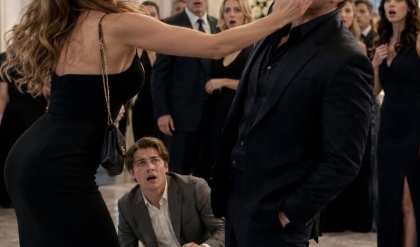
“What is your name?”
“Lydia Monroe.”
At the sound of her last name, something crossed his face so quickly she almost believed she imagined it.
Almost.
Vincent turned toward Gregory. “Miss Monroe is finished serving tonight.”
Gregory’s mouth opened. “Mr. Hayes, company policy—”
“Do I look like a man who came here for your policies?”
“No, sir.”
“She sits at this table. She translates until our business is concluded. Whatever she was making tonight, add three zeros. Bill it to my account.”
Lydia’s heart slammed once, hard. “I can’t do that.”
Vincent turned back to her. “You already did.”
The chair to his right stood empty. It had belonged to his second in command before Gideon stepped back to the wall. In another life, Lydia would have said no and walked out. But that was a fantasy for women who had not just revealed a forbidden skill to a room full of armed criminals.
She untied her apron with slow fingers, folded it over the service station, and sat beside the most dangerous man in Chicago.
Vincent poured her a glass of Bordeaux himself.
The gesture made the room hold its breath.
“Let us begin again,” he said.
For the next forty minutes, Lydia became the thin line between greed and gunfire.
Dominic demanded forty percent of the Southport import tariff, unmonitored access to Warehouse 4B, and recognition of his boss, Rocco Cavallaro, as the controlling authority for local trucking. He spoke like a man trying to sound stronger than he felt. Lydia softened nothing that mattered, but she stripped the stupid insults out of his demands before they reached Vincent’s ears.
Vincent noticed.
“You protect him,” he murmured in Louisiana French after one particularly ugly demand.
“I protect the negotiation,” Lydia replied. “If you kill him over tone, Rocco retaliates on Interstate 90. Trucks burn, drivers die, police attention doubles, and both sides lose money. Pride is expensive. Businessmen are supposed to count.”
Gideon inhaled sharply behind Vincent.
No one corrected Vincent Hayes in front of outsiders.
Vincent did not punish her. He smiled.
“Tell the dog he gets twenty percent,” Vincent said. “He will not step inside Warehouse 4B. If he tries, his hands will arrive at Rocco Cavallaro’s house in a velvet box.”
Lydia turned to Dominic. “Mr. Hayes will agree to twenty percent. Warehouse 4B remains restricted due to proprietary assets and internal security. Any unauthorized entry will be treated as a hostile breach.”
Dominic slammed one palm onto the table. “Twenty is an insult.”
“It is an upgrade,” Lydia said. “Your current east dock volume does not come close to what his corridor moves in a week. Twenty percent of a river is better than forty percent of a puddle. You came here for profit, Mr. Rossi. Take it.”
Dominic stared at her.
She was not only translating anymore, and everyone knew it. She was weighing egos, consequences, numbers, and threats, then turning them into terms the room could survive.
At last, Carmine leaned toward Dominic and whispered, “She’s right. The math works.”
Dominic looked as if he wanted to break the table in half. Instead, he grabbed the pen Vincent slid toward him and signed the embossed agreement.
Lydia let herself exhale.
Then she saw the van.
It appeared in the rain-streaked reflection of the window, half-hidden in the alley beside the restaurant. Black. Unmarked. Headlights off. Its side window lowered three inches, just enough for the barrel of a rifle to emerge.
Lydia’s mind split into old, terrible clarity.
The angle bypassed the restaurant’s stone columns. The glass was thick, but not bulletproof. The barrel was aimed not at Dominic, not at the guards, but directly at Vincent’s chair.
Dominic had not come to negotiate.
He had come to keep Vincent still.
“Down!” Lydia screamed in Louisiana French.
She threw herself sideways against Vincent’s chest.
The impact knocked him out of the chair half a second before the window exploded.
Automatic fire tore through the Obsidian Room. Crystal became rain. Wood splintered. Men shouted over the roar of bullets. The chandelier swung wildly, throwing fractured light across faces twisted by panic and fury.
Vincent hit the carpet with Lydia beneath him, then rolled with stunning speed, placing his body between her and the flying glass. His hand was already at his waist. The civilized billionaire vanished. What remained was colder, faster, and far more honest.
“You saw it,” he said.
“Alley,” she choked. “Black van. Dominic stalled you.”
Vincent’s jaw tightened.
Across the shattered table, Dominic was yelling in Italian, but his men were not shooting at the van. They were shooting at Vincent’s people.
Gideon took a bullet through the upper arm and returned fire with terrible precision. Angelo dropped behind an overturned chair. Felix vaulted over the service station and collided with Carmine in a blur of steel and fists.
Vincent rose into the chaos as if the bullets were weather.
Dominic saw him too late.
“Rocco sends his regards,” Dominic spat, lifting his gun.
“I’ll return them personally,” Vincent said.
Two shots ended Dominic Rossi’s career, his ambition, and his last mistake.
The gunfire from the alley stopped. Tires screamed on wet pavement as the van fled into the Chicago night.
Sirens began wailing somewhere beyond the restaurant.
For several seconds, Lydia heard nothing but her own breath. The Obsidian Room was destroyed. Bordeaux bled into the carpet like a joke too cruel to laugh at. The white tablecloth was shredded. Gregory was crouched near the service door, alive but shaking. Gideon pressed a napkin against his bleeding arm. Felix stood over Carmine, breathing hard, his suit torn at the shoulder.
Vincent turned back to Lydia.
She was on her knees amid broken glass, her palms cut, her uniform stained with soot and water. Now that the danger had passed, her body began trembling so violently she could barely stay upright.
Vincent crouched in front of her. He took her face between both hands, not gently exactly, but carefully, as if she was something he had no intention of letting fall apart.
“You saved my life twice tonight,” he said in Louisiana French. “Once with your mind. Once with your body.”
“I reacted.”
“No.” His thumb brushed a streak of dust from her cheek. “You remembered.”
Lydia wanted to deny it, but the sirens were louder now, and denial had become useless.
Vincent stood, pulling her with him. “Gideon. She comes with us.”
Lydia jerked back. “No. I have an apartment. I have a job.”
Vincent glanced around the ruined room. “You had a job.”
“You don’t own me.”
His eyes returned to hers. “No. But Rocco Cavallaro will want you dead before sunrise. The security tapes will show you saved me. Dominic’s survivors will say you ruined the hit. The police will ask how a waitress knew enough to interfere in a mob negotiation. Your invisible life ended the moment you spoke.”
The truth landed harder than the bullets.
Vincent lowered his voice. “Front door, you take your chances with the Italians and the police. Back door, you come with me and live long enough to choose what happens next.”
Lydia looked at the shattered glass, the blood on the carpet, the rain beyond the broken window. Then she looked at Vincent Hayes, the man her father had warned her about without ever saying his name.
“Fine,” she whispered. “But I choose. You don’t choose for me.”
A faint smile touched his mouth. “We’ll argue about that somewhere safer.”
They disappeared through the service corridor two minutes before the police reached the Obsidian Room.
Vincent’s safehouse was not a mansion.
That surprised Lydia more than it should have.
She expected marble floors, armed statues, and gold fixtures. Instead, his convoy slipped through rain-darkened streets to a converted printing warehouse in Fulton Market. Inside, the building was all exposed brick, steel beams, locked doors, and quiet men who moved without asking questions. The top floor had been turned into an apartment that looked more like a war room with a kitchen attached: maps on one wall, shipping routes on another, a long table covered with files, and windows tinted so deeply the city became a smear of light.
A woman named Dr. Mara Voss cleaned the cuts in Lydia’s hands while Vincent stood across the room speaking in low tones to Gideon and Felix. Gideon’s arm had been bandaged, but his anger was still bleeding through his expression.
“She’s a liability,” Gideon said. “She knows too much.”
“She saved my life.”
“That doesn’t make her family.”
Lydia flinched at the word family.
Vincent noticed. Of course he noticed. He missed almost nothing.
When Mara finished wrapping Lydia’s palms, Vincent dismissed everyone but Felix, who remained by the door like a shadow. Gideon lingered half a second too long before obeying.
The moment the door shut, Lydia spoke first.
“I’m not joining your syndicate.”
“I haven’t asked.”
“You told them I was coming with you.”
“That was extraction, not recruitment.”
“That sounds convenient.”
Vincent leaned against the table and folded his arms. “Who taught you our language?”
“It’s not yours.”
His eyes narrowed slightly.
Lydia looked at her bandaged hands. “My father. William Monroe.”
This time, Vincent did not hide his reaction.
The name struck him like a hidden blade. His shoulders remained still, but his eyes changed. The cold calculation disappeared for one unguarded second, replaced by recognition and something Lydia did not expect.
Regret.
“You’re William’s daughter,” he said.
Lydia stood so quickly the chair scraped behind her. “You knew him.”
“Yes.”
“Then you know he wasn’t what people called him.”
Vincent’s silence was answer enough.
The room seemed to tilt. For seven years, Lydia had lived with rumors that arrived in fragments: her father had stolen money, betrayed a powerful family, sold port records, run from men who trusted him. William Monroe had denied all of it, but he had denied it like a man too tired to fight the whole world. Then he died of a sudden heart attack in a cheap apartment outside Cicero, and Lydia buried him with three mourners, two unpaid bills, and one sealed envelope he told her never to open unless the past found her first.
The past had found her tonight.
“What was he to you?” Lydia asked.
Vincent’s jaw worked once. “The best accountant the Crescent ever had. More than that, he was the only man who ever told my father no and lived.”
“Your father?”
“Not by blood. The man who raised me in New Orleans. Auguste Boudreaux.”
Lydia remembered the name from whispered arguments behind closed doors, from her father’s nightmares, from the way he once turned off every light in their apartment because a black Cadillac had parked across the street.
“Auguste Boudreaux framed my father,” she said.
“No,” Vincent replied. “Someone framed them both.”
The answer robbed her of speech.
Vincent crossed to the map wall and tapped the line marking the route from the Gulf Coast to Chicago. “Seven years ago, eighteen million dollars vanished from a port trust used to pay drivers, longshoremen, and freight contractors. William was accused because every number wore his signature. Auguste believed him guilty. Before I could prove otherwise, your father disappeared with you. Three months later, Auguste was killed in a car bombing in Baton Rouge.”
Lydia gripped the back of the chair. “My father said Auguste sent men after us.”
“He did. At first. Then he changed his mind.”
“Why?”
“Because he received a ledger page only William could have written. It said the theft was not money laundering. It was cover.”
“For what?”
Vincent’s eyes went to the words Warehouse 4B on the map.
Lydia felt the cold return.
“People,” Vincent said. “Undocumented workers, debt-trapped drivers, girls moved between private clubs, men forced through shipping jobs they could never repay. Someone used the port trust to hide transportation routes for human cargo. William found it. Then he ran because the people involved were not only ours.”
“Rocco Cavallaro,” Lydia said.
“And someone inside my own house.”
Felix shifted by the door. “Boss.”
Vincent did not look away from Lydia. “Warehouse 4B may contain the last sealed records your father hid before he died. Tonight’s treaty was supposed to bring Rossi close enough for me to squeeze information out of him. I did not know Rocco would risk an open hit.”
Lydia’s throat tightened. “My father didn’t die of a heart attack, did he?”
Vincent said nothing.
That silence was crueler than a lie.
Lydia turned away because if she kept looking at him, she might scream. She saw her reflection in the dark window: pale face, torn uniform, bandaged hands, a waitress who had tried to become nobody and failed.
“My father left me an envelope,” she said. “I never opened it.”
Vincent went very still. “Where is it?”
“My apartment.”
“Then we go now.”
“No.” Lydia faced him again. “Not with an army. Not with guns. If Rocco has people watching me, they’ll expect you to rush there.”
Vincent’s gaze sharpened. “What do you suggest?”
“That I go.”
Felix laughed once, humorless. “Absolutely not.”
“I lived hidden longer than any of you knew I existed,” Lydia said. “I know how to move without being seen.”
Vincent studied her, and for once, Lydia could not tell whether he was angry or impressed.
“No,” he said.
“You said I choose.”
“I said you would live long enough to choose. Walking into a trap is not choosing. It’s bleeding.”
Lydia stepped closer to him. “My father died because powerful men kept deciding what risks were acceptable for other people. You want his ledger? You want the truth? Then you stop treating me like cargo you rescued from your own dock.”
For a moment, Vincent Hayes looked like a man unused to being cornered by words.
Then he reached into his jacket, removed a small black phone, and placed it on the table.
“You go with Felix two blocks behind you. No visible escort. You carry this. One press connects to me. Two presses triggers every man I have within a mile. If you deviate, I drag you out myself.”
“That sounded almost like compromise.”
“Don’t get used to it.”
Lydia took the phone.
Before she could turn away, Vincent spoke again, softer.
“William once told me a person’s first language is not the one they learn earliest. It’s the one they cry in when they are alone.”
Lydia looked back.
Vincent’s face revealed nothing now, but his voice had changed.
“He cried in English when Auguste accused him,” Vincent said. “That was when I knew he was telling the truth.”
Lydia swallowed. “You should have helped him.”
“I know.”
There was no excuse in his answer. Only the weight of a debt that had waited seven years to come due.
Lydia’s apartment was exactly as she had left it, which meant someone had already searched it and tried to put everything back.
The difference would have fooled a stranger. It did not fool her. The framed print above the radiator leaned half an inch too far left. The flour jar in the kitchen had been turned with the label facing forward, something Lydia never did because the lid stuck on one side. The spare blanket on the couch had been folded military-neat instead of shoved into the corner after her morning coffee.
She stood in the doorway and felt her father’s old rules wake inside her.
Never enter a room just because the door opens.
She stepped backward.
A shadow moved inside the bedroom.
Lydia pressed the phone once.
Then she spoke into the dark apartment in English. “You can come out, or I can let the man downstairs guess where you’re hiding.”
Silence.
Then a woman emerged from the bedroom with both hands raised.
She was in her sixties, Black, sharply dressed, with silver hair pinned at the nape of her neck and eyes that had seen too much to be easily frightened.
“Lydia Monroe,” the woman said. “You have your father’s nerve.”
Lydia’s hand tightened on the phone. “Who are you?”
“Helen Ortega. Retired Assistant U.S. Attorney. Your father saved my life once. I have been waiting seven years for you to open the envelope.”
Lydia stared.
Behind Helen, the bedroom window was open three inches. Not for entry. For escape.
“You broke into my apartment.”
“I arrived before the men who were coming to do worse.”
“What men?”
“Cavallaro’s, I assume. Or the traitor’s. These days, the distinction is mostly paperwork.”
Felix appeared in the hall behind Lydia, gun low at his side. Helen looked past Lydia and sighed.
“Tell Vincent Hayes if he plans to shoot me, he should at least let me make coffee first. Your father always said the boy was dramatic.”
Lydia almost laughed because the alternative was collapsing.
They found the envelope inside the one place Lydia had never been able to touch: the hollow back of her father’s old wall clock. William Monroe had carried that clock from Louisiana to St. Louis, from St. Louis to Chicago, and then into every cheap apartment they could afford. Lydia had hated its uneven ticking after his death, but she had kept it because grief is sometimes just the refusal to throw away noise.
The envelope contained three things: a brass key, a photograph of Lydia at age eleven standing beside a shipping container painted blue, and a letter written in her father’s careful hand.
My darling Lydia,
If you are reading this, then hiding failed, or I failed you. I pray it is the first, because the first means you are alive.
There is a room inside Warehouse 4B that was built to look like a refrigeration office. It is not. The key opens the lower cabinet. Inside is the copy no one knows exists.
Do not trust Gideon Cole.
He was the first man to smile after Auguste died.
Lydia read the last line three times.
Felix was already calling Vincent.
Helen Ortega’s face went grim. “So it was Cole.”
“You know him?”
“I know his type. Loyal in public. Hungry in private.”
Lydia folded the letter with shaking hands. “My father knew.”
“He knew enough to die,” Helen said gently. “Now the question is whether the rest of us know enough to live.”
Warehouse 4B stood on the Southport industrial strip, where Chicago’s beauty gave way to chain-link fences, sodium lights, and the endless groan of freight. By the time Lydia arrived with Vincent, Felix, and Helen Ortega, the rain had thinned into mist. Vincent’s men had sealed the outer roads. No police lights flashed. No sirens announced help. Everything depended on people who had spent their lives avoiding the law deciding, for one night, to invite it in.
Lydia insisted Helen call federal contacts before they entered.
Vincent objected.
Lydia stared him down.
“You can either expose the truth,” she said, “or bury more bodies and call it justice. My father wanted evidence, not revenge.”
Vincent looked toward the warehouse, where Gideon Cole was supposedly waiting with six loyal men.
“My world does not forgive weakness,” he said.
“Then stop mistaking mercy for weakness.”
That landed. Lydia saw it.
Vincent gave one sharp nod to Felix. “No one fires unless fired upon.”
Felix looked startled but obeyed.
Inside Warehouse 4B, rows of stacked containers created narrow corridors of steel. The air smelled of oil, damp concrete, and old cold. Gideon stood near the central office, his wounded arm in a sling, his face pale but controlled.
“You shouldn’t have brought her,” Gideon said.
Vincent’s voice was quiet. “You searched her apartment.”
Gideon’s eyes flicked to Lydia for half a second.
That was enough.
Vincent’s hand moved toward his gun, but Lydia stepped forward first.
“My father said you smiled after Auguste died,” she said.
Gideon laughed softly. “Your father was a thief who got sentimental.”
“He also said you never learned the second half of the blessing.”
Gideon’s smile thinned.
Lydia spoke in old Louisiana French, the words her father had whispered to her whenever they crossed a parish line at night.
“May the river hide your footprints.”
For a moment, Gideon said nothing. Then he answered, “And may the saints forget your name.”
Vincent’s eyes went cold.
Lydia shook her head. “Wrong.”
The real second half was: And may the child behind you reach morning.
It was not a gangster’s blessing. It was a refugee’s prayer, born from people hiding families in cane fields and fishing shacks long before men like Gideon turned old language into theater.
Gideon realized too late what he had revealed. He had learned the phrases of power. He had never learned the mercy underneath them.
Vincent drew his gun.
Gideon’s men drew theirs.
Helen Ortega shouted from behind a forklift, “Federal agents are three minutes out! Anyone alive when they arrive gets to explain themselves in court. Anyone dead becomes Vincent Hayes’s problem forever.”
The absurdity of a retired prosecutor scolding armed criminals in a warehouse might have been funny in another life. In this one, it bought three seconds.
Lydia used them.
She ran to the refrigeration office.
“Lydia!” Vincent shouted.
Gideon lunged after her. Felix intercepted him, and the warehouse erupted into motion. Men shouted. A shot cracked against the concrete ceiling. Vincent fired into the floor at Gideon’s feet, not at his chest, and the choice was so unexpected that even Gideon stumbled.
Lydia reached the lower cabinet and jammed the brass key into the lock.
Inside was a metal case wrapped in oilcloth.
She dragged it out with both hands.
Gideon saw it and changed.
All his polish vanished. His face twisted into raw panic.
“Destroy it!” he screamed. “Burn the case!”
That was when the first federal vehicles smashed through the outer gate.
Floodlights blasted through the warehouse windows. Voices thundered through bullhorns. Vincent’s men froze, trapped between instinct and command. Vincent raised one hand and shouted, “Weapons down!”
Some obeyed immediately. Some hesitated.
Felix tackled one who did not.
Gideon grabbed Lydia from behind and pressed a gun beneath her jaw.
Everything stopped.
Vincent turned slowly.
The floodlights cut across his face, making him look carved from bone and shadow. For the first time all night, Lydia saw fear in him. Not panic. Not weakness. Fear with a target.
“Let her go,” he said.
Gideon dragged Lydia backward. “You always were soft where strays were concerned. Auguste saw it. William used it. Now this waitress bats her eyes, speaks a little porch French, and you hand her the house.”
Lydia could feel the tremor in Gideon’s injured arm. He was losing blood. Losing control. Losing the story he had spent years writing.
“You killed my father,” she said.
Gideon’s mouth brushed her ear. “Your father killed himself when he decided dock trash mattered more than family.”
Vincent’s eyes shifted to Lydia’s.
She understood before Gideon did.
Vincent was not looking at her fear. He was asking whether she trusted him.
Lydia had no good reason to.
He was a criminal. A violent man. A man who had built power in the same shadows that swallowed her father.
But tonight, twice, he had chosen not to fire when firing would have been easy. He had chosen evidence when revenge called his name. He had chosen to lower guns in a world that mocked lowered guns.
So Lydia stopped trembling.
She drove her bandaged palm hard into Gideon’s wounded arm.
He screamed. The gun jerked away from her jaw.
Vincent shot once.
The bullet struck Gideon’s wrist, not his heart. The gun clattered across the concrete. Felix hit Gideon from the side and drove him to the ground.
Federal agents poured into the warehouse.
Helen Ortega reached Lydia first and took the metal case from her hands like it was a newborn child.
Inside were ledgers, photographs, bank transfers, names, dates, container numbers, payoffs, and routes. There were records connecting Rocco Cavallaro, Gideon Cole, two private security firms, three trucking contractors, and a county judge who had dismissed missing-person complaints for years. There were also lists of victims: not numbers, not categories, but names. Men from Guatemala promised construction jobs. Women from Mississippi trapped through fake debts. Teenagers who ran from foster homes and were moved through private clubs under new names.
At the very bottom of the case was a final page written by William Monroe.
Do not let them say this was about money.
It was always about who they believed no one would miss.
Lydia sat on a crate and cried for the first time that night.
Not prettily. Not quietly. She cried like the child she had been when her father woke her at two in the morning and told her to pack only what fit in her backpack. She cried for William Monroe dying with the truth hidden in a clock. She cried for the people in the ledger. She cried because survival had kept her alive but had also kept her lonely for too long.
Vincent stood several feet away and did not touch her.
That was the first truly kind thing he did.
The arrests began before dawn.
Rocco Cavallaro was taken from his Oak Brook house in a robe, shouting for attorneys who could no longer save him. Two trucking executives were arrested at O’Hare before boarding a flight to Miami. A county judge resigned by noon and was indicted by dinner. Gideon Cole survived surgery and woke up handcuffed to a hospital bed with Helen Ortega sitting beside him, smiling like judgment in sensible shoes.
The newspapers called it the Southport Trafficking Scandal.
They called Lydia a heroic waitress.
They called Vincent Hayes an unnamed cooperating witness until someone leaked his name, and then they called him everything else: crime lord, informant, hypocrite, monster, savior. Depending on the paper, he was either cleaning his conscience or saving his empire.
Lydia knew the truth was uglier and more human than that.
Vincent did not become a saint.
Men like him did not step out of darkness clean. He had blood in his history and power built from fear. But when the moment came, he handed over the ledgers. He gave testimony that burned half his own organization to the ground. He surrendered accounts used to pay corrupt officials and redirected millions into a restitution fund Helen Ortega forced into existence with the ferocity of a woman making up for seven lost years.
He also disappeared from Chicago for three months.
Lydia returned to The Wellington only once.
The Obsidian Room was closed for renovation, but Gregory met her in the main dining room with tears in his eyes and an envelope containing back pay, hazard pay, and a formal apology from ownership written by a lawyer who had clearly been terrified while drafting it.
“Your position is still available,” Gregory said carefully.
Lydia looked toward the hallway where she had carried water into a room full of men who believed invisible people had no power.
“No,” she said. “It isn’t.”
Six months later, a narrow storefront opened on the West Side beneath a blue sign that read MONROE LANGUAGE AND WORKER ADVOCACY CENTER. It offered translation services, legal referrals, emergency shelter placement, and help for people whose bosses kept their documents locked in office drawers. Helen Ortega chaired the board. Dr. Mara volunteered twice a week. Felix, to Lydia’s continued disbelief, quietly paid for a new security system and pretended he had no idea who installed it.
On the first cold evening of November, Lydia was locking the front door when a black car stopped at the curb.
Vincent Hayes stepped out.
He looked thinner. Less polished. There was no entourage behind him, no visible weapon, no tailored army waiting in the street. Just Vincent in a dark coat, his hands bare, his blue eyes fixed on the sign above her door.
Lydia folded her arms. “Are you allowed to be here?”
“My attorney says I’m allowed to walk on public sidewalks.”
“That must be difficult for you. Following rules.”
A faint smile touched his mouth. “Painful.”
She did not invite him inside.
He did not ask.
For a while, they stood in the cold, watching their breath turn white.
“Gideon pled guilty,” Vincent said. “Rocco is negotiating. The judge is pretending his memory failed. Helen is eating him alive.”
“She enjoys her work.”
“She told me to tell you the restitution fund cleared its first disbursement.”
Lydia looked down, emotion rising before she could stop it. “Good.”
Vincent reached into his coat and removed a small envelope. “This is not money.”
“I wasn’t going to take it if it was.”
“I know.”
She accepted it carefully. Inside was a photograph.
Her father, younger than she remembered him, stood beside Auguste Boudreaux on a dock in Louisiana. Between them stood a teenage Vincent Hayes, unsmiling and stiff in a suit too formal for the heat. William had one hand on Vincent’s shoulder. On the back, in her father’s handwriting, were the words: Even the hardest boys are still boys before the world finishes lying to them.
Lydia stared at the picture until the street blurred.
“He believed in you,” she said.
Vincent’s voice was low. “He was wrong about many things.”
“No.” She looked up. “He was early.”
That hurt him. She could tell.
Good, she thought. Some pain was useful if it opened the right door.
Vincent looked past her into the center, where a young woman was helping a tired man fill out a wage theft form. “You built something better than revenge.”
“I had help.”
“You had a choice.”
“So did you.”
He nodded once.
The silence that followed was not empty. It was full of everything they were not ready to say and everything they might never be able to be. Lydia had no illusions. A man’s single good decision did not erase his past. Gratitude was not love. Chemistry was not trust. And danger, no matter how beautifully dressed, was still danger.
But the world had shifted because one waitress refused to stay invisible.
That mattered.
Vincent stepped back. “Good night, Lydia Monroe.”
She watched him turn toward the car.
Then she called after him in the old Louisiana French her father had given her, the language that had saved a life, exposed a killer, and unlocked a warehouse full of ghosts.
“May the river hide your footprints.”
Vincent stopped.
Slowly, he looked back.
Lydia finished the blessing properly.
“And may the child behind you reach morning.”
For a moment, Vincent Hayes did not look like a mob boss, a witness, a sinner, or a legend. He looked like a man hearing the difference between power and mercy for the first time and understanding, at last, which one her father had died protecting.
He bowed his head.
Then he got into the car and disappeared into the Chicago night.
Lydia locked the center door, turned off the front light, and stood beneath the blue sign bearing her father’s name. Tomorrow, more people would come needing papers translated, wages recovered, shelters called, and fear explained to someone who would not laugh at it. Tomorrow, there would still be men like Gideon, men like Rocco, men who believed the powerless were easy to erase.
But tomorrow, there would also be records. Witnesses. Lawyers. Safe rooms. Names written down where no one could pretend they had never existed.
And there would be Lydia Monroe, no longer invisible, no longer hiding, speaking every language her father had taught her.
Especially the one that meant: you are not alone.
THE END