“Are they kind?”
Addie smiled because there are lies told from cowardice and lies told from mercy, and this was the second kind. “Kind enough.”
Clara studied her daughter with the weary suspicion of a woman who had survived too much to believe in easy answers. But she wanted to believe Addie was safe. A mother can sometimes recognize a lie and still choose it because the truth would break what little sleep she has left.
“You keep that locket on,” Clara said, as she always did when Addie rose to leave.
Addie touched the tortoise pendant. “I know.”
“Your father gave it to me.”
Addie’s face hardened before she could stop it. “The rich man who threw you away.”
Clara looked down. “That is what I told you.”
“You said he abandoned us.”
“I said what I needed to say.”
Addie frowned. “What does that mean?”
But Clara only shook her head and reached for a tissue as the coughing began again. The conversation ended there, as it always did, behind the locked door of her mother’s silence.
Back at the Whitmore estate, small mercies kept Addie from breaking completely. Della sometimes left an extra container of food in the staff refrigerator with Addie’s name on it, then claimed she had miscounted. The night guard, Luis, let her sit in the warm booth for five minutes when winter wind cut through her coat. Everett, strangely, began saying good morning.
At first Addie thought she had imagined it.
Then he started asking if she had eaten.
One afternoon, he found her in the kitchen eating a heel of bread with peanut butter because she had sent most of her paycheck home and was saving on groceries. The next day, Della informed her with raised brows that Mr. Whitmore had issued a standing instruction: Addie Quinn was to eat full meals from the family kitchen, no exceptions, and anyone who interfered would answer to him.
Addie was grateful. She was also uneasy.
So was Vanessa.
By the time of the broken plate dinner, Vanessa’s suspicion had grown into something sharp enough to need a wound.
She did not sleep that night after Everett knelt for Addie. She stood in her bedroom overlooking Lake Michigan, the city lights glittering far away, and understood what the scene had meant to every important person at that table. Everett had not simply defended a maid. He had humiliated his niece to protect her.
An old man who protected a maid in public might change a will in private.
And Vanessa knew too much about what an outside review of the family accounts might reveal.
At 1:13 in the morning, she called Preston Vale, the Whitmore family attorney.
Preston had been in expensive suits for so long that even his conscience, if he had one left, would have worn silk. He had managed Everett’s trusts, corporate filings, private acquisitions, charitable foundations, and estate documents for fifteen years. He knew which signatures mattered and which doors stayed locked. He also knew that for the past three years, money had been moving through shell vendors connected to Vanessa’s lifestyle foundation, and both their names appeared in places they should not.
“The maid is a problem,” Vanessa said.
Preston was silent for a moment. “Your uncle has many employees.”
“Do not play stupid. He is attached to this one.”
“Attached how?”
“Enough to kneel on the floor in front of thirty guests.” Vanessa’s voice tightened. “I want her gone.”
“Fire her.”
“I do not want her fired. Fired people come back with stories. I want her disgraced. I want her name so dirty that if Uncle Everett says it again, people question his judgment.”
Preston exhaled slowly. “That is a different kind of request.”
“You should be grateful I’m only making requests.” Vanessa turned from the window. “Because if my uncle ever brings in outside auditors before revising his estate plan, what do you think they will find, Preston?”
His silence changed shape.
Finally he said, “An accusation of theft works best when the object is sentimental.”
Vanessa smiled for the first time that night.
Three days later, Everett’s late mother’s diamond ring disappeared from the safe in his bedroom.
The ring had belonged to Margaret Whitmore, the formidable woman who had turned a family construction business into a private fortune before Everett expanded it into an empire. It was old, valuable, and wrapped in enough family mythology to make its theft unforgivable. Vanessa did not merely report it missing. She performed the loss like a grieving daughter in a play.
She first told two staff members in trembling whispers that something sacred had vanished. She let the rumor travel. By dinner, fear had moved through the service hall like smoke. Then Vanessa gathered the household near the back staircase, one hand pressed to her chest.
“I hate doing this,” she said, dabbing at dry eyes. “But Grandmother’s ring is gone. It was in Uncle Everett’s safe, and now it is not. We owe it to this family to search every room, including staff quarters. Whoever is innocent has nothing to fear.”
Addie felt the trap before she saw it.
Some fears do not need evidence. The body recognizes them first.
Della stepped forward. “Miss Vanessa, staff rooms are private.”
Vanessa’s face cooled. “In my uncle’s house, privacy does not outrank theft.”
They searched the laundry room, pantry lockers, Luis’s guard cabinet, Della’s office. Then they came to Addie’s small room over the garage, where her duffel bag sat under a narrow bed and her mother’s medical bills were folded in a shoebox.
Vanessa knelt with the confidence of someone who already knew where the snake had been placed.
She reached beneath the bed and pulled out Addie’s wooden keepsake box.
Addie’s stomach dropped.
Vanessa opened it.
Inside, wrapped in one of Addie’s scarves, was the diamond ring.
The room seemed to tilt. Addie stared at the ring, then at the scarf, then at the faces around her. The gardener looked away. One of the cooks covered her mouth. Luis frowned, confused. Della went very still.
“I did not take that,” Addie said.
Her voice was quiet, but not because she doubted herself. It was quiet because she had just watched the world decide.
Vanessa lifted the ring as if it physically hurt her to touch evidence of such betrayal. “We gave you work. We gave you shelter. We fed you. And you repay my uncle by stealing from his dead mother?”
“I didn’t take it.”
“Then it walked under your bed by itself?”
“Someone put it there.”
“Of course.” Vanessa turned to the staff. “That is always the answer, isn’t it? When people like her get caught, suddenly everybody else is lying.”
Della’s voice shook when she spoke. “I have worked beside this girl for two years. She has never taken so much as a bottle of water that wasn’t hers.”
Vanessa’s eyes snapped to her. “Be careful, Della. Loyalty to a thief can start to look like partnership.”
Della closed her mouth.
Addie did not blame her. Poverty teaches even brave people the exact price of truth.
“Call the police,” Vanessa said. “A thief belongs in a cell.”
That might have been the end of Addie Quinn’s life as she knew it: one planted ring, one police report, one rich woman’s tears, and a poor woman’s denial swallowed by a system that had already chosen who sounded believable.
But Vanessa had miscalculated two things.
The first was Ethan Cole.
Ethan was Everett’s godson, the child of his oldest friend, raised partly in the Whitmore house after his father died. He was thirty, worked in the company’s operations division, and possessed a quality rare among wealthy young men: he knew the names of the people who made his life convenient.
He had been in Denver for two months overseeing a warehouse acquisition. He returned that afternoon, dropped his bags in the foyer, and walked into the servants’ hall just as Vanessa demanded the police.
“Wait,” Ethan said.
Everyone turned.
He looked at Addie, pale and shaking. He looked at the ring. Then he looked at Vanessa, and his expression sharpened.
“Where was the ring taken from?”
“The bedroom safe,” Vanessa said. “Obviously.”
“The bedroom safe with the digital keypad?”
“Yes.”
“The one only three people know the code to? You, Everett, and me?”
Vanessa’s jaw tightened. “Codes can be watched.”
“Sure,” Ethan said. “But that safe is also in direct view of the security camera above the bedroom door. The camera that records to the private server I installed after the museum fundraiser break-in last year.”
The room changed.
Ethan let the silence do some work before continuing. “So if Addie opened that safe, took the ring, and hid it in her room, we do not need guesses. We can watch it happen.”
Vanessa’s face slipped for half a second. It was a tiny thing, almost invisible. But Addie saw it because invisible people survive by reading faces.
“The cameras have been unreliable,” Vanessa said.
“Have they?” Ethan asked. “Then let’s go check how unreliable.”
Before he could turn toward the study, a sound came from the back of the room.
Everett stood in the doorway, one hand pressed against his chest.
His eyes found Addie first, then the ring in Vanessa’s hand, then the tortoise locket at Addie’s throat. The color drained from his face so completely that Ethan moved before anyone else understood what was happening.
“Everett?”
The billionaire folded to the floor.
Chaos swallowed the accusation. Vanessa screamed. Della shouted for someone to call 911. Ethan knelt beside Everett, checking his pulse, barking orders with a calm that came from fear held on a leash. Addie stood frozen until the paramedics came, until they lifted Everett onto a stretcher, until his eyes opened halfway and reached past everyone else to find her.
His hand rose weakly.
Not toward Vanessa.
Toward Addie.
Toward the locket.
His lips moved without sound. Addie leaned closer, but the paramedic pulled the stretcher away.
She saw the shape of the word anyway.
Clara.
Her mother’s name.
By nightfall, Everett Whitmore was in a private room at Northwestern Memorial Hospital, stable but exhausted, with doctors warning of stress, blocked arteries, and the kind of blood pressure that rich men pretend not to have until their bodies stop pretending with them.
Vanessa wasted no time finishing what the heart attack had interrupted.
“He collapsed because of that girl,” she told the household when she returned from the hospital. “The theft. The stress. The betrayal. I want her gone tonight.”
Della protested. Ethan was still at the hospital. Everett was sedated. Vanessa held the ring, the accusation, and the authority of a woman everyone had been trained to obey.
At 10:40 p.m., Addie’s duffel bag was placed outside the iron gate.
No police came. Vanessa had decided a scandal could wait. But the result was the same. Addie stood in the cold with no job, no reference, no savings, a sick mother, and a theft accusation hanging over her head like a storm cloud.
She had every reason to walk away from the Whitmore family forever.
Any sensible person would have gone home, packed what little she owned, and disappeared before Vanessa changed her mind about pressing charges.
But Addie kept seeing Everett on his knees in the dining room. She kept hearing him say, “You are not the one who should be on the floor tonight.” She kept seeing his hand reach toward her locket and his lips form her mother’s name.
So she did something Vanessa, who measured everyone by self-interest, could never have predicted.
Addie went to the hospital.
She could not afford a ride all the way there. She took the train until service thinned, then walked blocks through cold wind, then took a bus with a driver who glanced twice at her uniform coat and tired face. At the hospital entrance, security would not let her up because she was not family and had no employee badge, no appointment, no polished explanation.
So Addie waited outside.
She sat on a concrete bench near the ambulance bay with her duffel at her feet and her bleeding thumb wrapped in tissue. Twice, a security guard told her she could not sleep there. Twice, she moved just far enough to obey him, then returned when he went back inside.
At dawn, Ethan found her there.
He had come out for air, hair rumpled, tie loose, eyes red with a sleeplessness that had stripped him of all polish. He stopped when he saw her.
“Addie?”
She stood quickly. “I’m sorry. I’m not trying to cause trouble. I just wanted to know if Mr. Whitmore is all right.”
“They threw you out.”
“Yes.”
“And you came here anyway?”
She looked embarrassed, as if kindness were something she had done without permission. “He was kind to me when he didn’t have to be. I couldn’t just leave without knowing.”
Ethan stared at her for a long moment. Something in him shifted then, quietly and permanently. He had known decent people. He had admired strong people. But he had never seen someone with every reason to hate a house still walk across a city to sit outside a hospital for the only person inside that house who had treated her like she mattered.
“Come with me,” he said.
“I’m not allowed.”
“You are now.”
Everett was awake when Addie entered the room.
Machines hummed softly around him. He looked smaller in the hospital bed, stripped of suit and office and empire. But when he saw Addie, his eyes filled with tears so suddenly that she stopped near the door.
“You came,” he whispered.
“I wanted to know if you were all right.”
“After what happened?”
“You knelt for me,” she said. “No one in a house like that had ever done that before.”
Everett closed his eyes as if the words hurt him.
“Addie,” he said, “where did you get that locket?”
Her hand went to the tortoise automatically. “My mother gave it to me.”
“What is your mother’s name?”
She hesitated. “Clara Quinn.”
Everett’s breath caught.
Ethan, standing near the window, noticed the monitor numbers climb.
“Clara,” Everett whispered. “Clara Quinn from Pilsen. She worked in my mother’s house.”
Addie’s skin prickled. “How do you know that?”
Everett lifted a shaking hand to the chain at his wrist. It was an old pocket watch chain, one Addie had seen many times but never paid attention to. With difficulty, he opened the small round case attached to it.
Inside was a faded photograph.
A young woman stood laughing in sunlight, her face softer but unmistakable.
Clara.
Around her neck was a tortoise pendant identical to Addie’s.
Addie stepped backward. “No.”
“I gave her that locket,” Everett said, his voice breaking. “I gave her the first one, and I kept its twin. I told her the tortoise meant patience. Survival. Finding home no matter how long the road was.”
“My father gave this to her.”
“I know.”
“No,” Addie said again, because denial was the only wall that rose fast enough. “My father abandoned us. My mother said he was a rich man who threw her away.”
Everett covered his face with one hand. When he lowered it, tears had reached his jaw.
“I was the rich man,” he said. “But I swear to you, I did not throw her away.”
The truth did not come out cleanly. Truths buried for twenty-four years rarely do. They came in fragments at first, then in a long, painful confession that made Ethan sit down and made Addie hold the bed rail because the room seemed determined to move beneath her.
Before Everett was a billionaire, before Whitmore Global, before the magazine covers and political fundraisers, he had been the only son of Margaret Whitmore, a woman whose pride was sharper than her diamonds. Clara Quinn had worked in the Whitmore house as a young maid while studying nights at community college. She was clever, stubborn, and kind in a way that embarrassed Everett because he had grown up among people who performed generosity but rarely practiced it when no one watched.
He fell in love with her.
At twenty-nine, he was old enough to know the cost. He proposed anyway.
Margaret Whitmore found out within a week.
While Everett was away in New York on a business deal his mother had arranged with suspicious urgency, Margaret discovered Clara was pregnant. She fired her, paid her enough money to look like mercy, and threatened enough danger to make it clear mercy had nothing to do with it.
“She told your mother that if she ever came near me, if she ever told me about the baby, she would destroy her life and take the child,” Everett said. “My mother had judges at her table, police commanders at Christmas parties, lawyers who owed her favors. Clara was twenty-three, pregnant, poor, and alone. She ran because she thought running was the only way to keep you safe.”
When Everett returned, Margaret told him Clara had taken money and left with another man. He did not believe it, not fully. He searched. He hired investigators. But Clara had changed apartments, changed jobs, avoided hospitals when she could, and hidden inside a city large enough to swallow the poor without making a ripple.
Years hardened the lie. Grief hardened with it. Everett never married. He built an empire because building was easier than mourning. He took in Vanessa after his brother died and tried to turn duty into family.
“I spent years looking for your mother,” Everett said. “Then I spent years pretending I had stopped. The picture on my desk is the only one I had. I saw your locket the first week you worked in my house. I told myself it was coincidence because hope felt like madness. I watched you. I wondered. I was a coward. I should have asked.”
Addie could not speak.
Her life rearranged itself around the hospital bed. Every insult, every floor scrubbed, every night in the staff quarters, every Sunday lie told to protect her mother from worry—all of it now stood beside a new and unbearable fact.
She had been cleaning her father’s house.
Everett reached for her hand, then stopped, giving her the choice.
That choice, small as it was, broke something in her.
Addie took his hand.
“I don’t know how to feel,” she whispered.
“You do not owe me forgiveness on my schedule.”
“My mother suffered.”
“Yes.”
“I suffered.”
“Yes.”
“You were in that house the whole time.”
Everett’s face crumpled. “Yes.”
Addie looked at their joined hands. His fingers were older, heavier, nothing like the villain she had imagined as a child when Clara said her father had been rich and cruel. That imaginary man had been easy to hate. This one was harder. This one had knelt for a maid he did not yet know was his daughter.
“All those mornings,” Addie said slowly, “when you said good morning. When you told them to feed me. When you took the broken plate from my hands. You didn’t know for sure.”
“No.”
“But you did it anyway.”
Everett nodded.
Addie’s tears came then, not like a storm, but like something frozen finally thawing. Everett cried too, and Ethan turned toward the window, giving them the dignity of not being watched while they began to mourn twenty-four stolen years.
There was no instant happiness. Real wounds do not close because a secret opens. But something began in that hospital room, something fragile and necessary: a father learning to see his daughter not as a miracle returned to him, but as a person with anger, loyalty, grief, humor, and a future she had the right to name herself.
Over the next two weeks, Addie stayed nearby. Not as staff. Not as family in any legal sense yet. Simply because Everett asked her to and because she wanted answers too badly to leave.
Vanessa came once a day, stayed fifteen minutes, spoke mostly about company matters, and looked at Addie as if she were a disease the doctors should have contained. Ethan stayed longer. He brought paperwork, coffee, and food Addie forgot to eat. He also brought the security footage on a hard drive and a face that told Addie the ring had not been forgotten.
“We have it,” he said one evening in the hospital cafeteria.
Addie’s spoon stopped halfway to her mouth. “The footage?”
He nodded. “It shows Vanessa entering Everett’s bedroom after midnight. Preston Vale is with her.”
Addie shut her eyes.
She had known, but knowing and proof are not the same. Proof has weight. Proof can stand in rooms where poor girls’ voices are not allowed.
“What happens now?” she asked.
“Everett wants outside auditors brought in. Not just for the ring. For everything.”
“Everything?”
Ethan leaned closer. “Vanessa and Preston have been stealing. I suspected irregular vendor payments before I left for Denver, but I didn’t have enough to take to Everett. Now we have a reason to open the books.”
Addie thought of Vanessa holding the ring with fake tears. “She called me a thief.”
“Yes.”
The simple agreement had more compassion than any long comfort might have.
Addie looked down at her tray. “That is what hurt most. Not just that she lied. It was how quickly everyone believed her.”
Ethan’s expression softened. “Not everyone.”
“Enough.”
He had no answer for that, because there was none.
When Everett was strong enough to leave the hospital, he did not return home the same man who had left it on a stretcher. He returned with a daughter beside him, a private DNA report in his briefcase, forensic copies of security footage in Ethan’s possession, and a fury so controlled it frightened the people who knew him best.
He did not confront Vanessa in the hallway. He did not shout across the breakfast room. He invited the company’s board, his senior legal team, Della, Ethan, Vanessa, and Preston Vale into his study on a gray Friday morning while rain moved over the lake like a curtain.
Vanessa arrived in a cream suit and diamonds, calm enough to seem innocent to anyone who had never watched a snake warm itself in sunlight. Preston stood near the bookshelves, smooth and grave, the family attorney ready to manage family confusion.
Addie stood beside Everett.
Vanessa laughed when she saw her.
“This is ridiculous,” she said. “Are we really doing this? Uncle Everett, you had a health scare and now you’re letting a maid with a sad story manipulate you.”
Everett did not react. “Sit down, Vanessa.”
“I will not sit while that girl stands there like she belongs.”
“She belongs more than you understand.”
Vanessa’s eyes sharpened. “A cheap locket is not a bloodline.”
“No,” Everett said. “It is not.”
He opened the folder in front of him and slid one page across the desk.
Vanessa looked at it. Her face did not change at first. Then the color began to drain from beneath her makeup.
“It is a DNA report,” Everett said. “From a certified laboratory. It confirms with greater than 99.9 percent probability that Adeline Clara Quinn is my biological daughter.”
The room went silent.
Della covered her mouth. Ethan watched Vanessa. Preston’s eyes moved toward the door.
Everett’s voice did not rise. It did not need to.
“She is my child. She was taken from me before she was born by my mother’s cruelty and my own failure to question the story I was given. She came into my house as an employee because poverty left her no better choice. And while she was here, under my roof, she was mocked, overworked, underprotected, and finally framed.”
Vanessa stood so quickly her chair scraped the floor. “You cannot prove that.”
Ethan connected his laptop to the screen.
“Yes,” he said. “We can.”
The footage appeared clear as daylight. Everett’s bedroom. The safe. The timestamp glowing in the corner. Vanessa entering the code. Preston standing behind her. The ring removed. The scarf taken from Addie’s laundry basket earlier that evening. Preston carrying the wrapped bundle out of frame toward the staff wing.
No one spoke.
Ethan clicked to the next file. “The original recording has been verified by an independent digital forensics firm. Their report is in your folders. No edits. No breaks. No faulty cameras.”
Vanessa’s mouth opened, then closed.
But Everett was not finished.
“The auditors also completed their preliminary review this morning,” he said. “Over the last three years, more than eighteen million dollars has been moved out of Whitmore Global through shell vendors and fraudulent consulting contracts. The entities trace back to Preston Vale and to a nonprofit controlled by Vanessa Whitmore.”
Preston took one step toward the door.
It opened before he reached it.
Two FBI agents entered with a representative from the Illinois Attorney General’s office. They did not shout. They did not make speeches. Real consequences often arrive quietly, carrying folders.
Vanessa looked at Everett then, and for the first time in Addie’s life, there was no performance left in her.
“You would do this to me?” Vanessa whispered.
Everett’s face was lined with grief, but not hesitation. “You did it to yourself when you decided other people were objects you could use.”
“They’ll destroy me.”
“You tried to destroy my daughter.”
Vanessa turned slowly to Addie. Something like hatred flickered there, then exhaustion, then a strange hollow wonder.
“Two years,” Vanessa said. “I made you miserable for two years, and you still went to the hospital to check if he was alive.”
Addie met her eyes. “That was never about you.”
Vanessa flinched as if the words had slapped her.
Maybe because cruelty needs to believe it is central. It wants to be the sun around which another person’s pain revolves. Addie denying Vanessa that importance was the first revenge she ever took, and it was not revenge at all. It was freedom.
As the agents led Vanessa and Preston from the study, Della began to cry quietly. Everett reached for Addie’s hand but stopped again, still learning. Addie took it because she chose to, not because he reached first.
In the weeks that followed, the newspapers turned the story into a scandal. They called Addie “the maid heiress,” “the hidden Whitmore daughter,” and “the Cinderella of Lake Forest,” as if a woman’s suffering becomes charming when there is money at the end of it. Cameras gathered outside the gate. Commentators argued about inheritance, corporate ethics, domestic workers, and whether Everett Whitmore had been a victim or a negligent man saved by biology.
Addie ignored most of it.
She had more important things to do.
The first was bringing Clara home.
Everett did not arrive at Clara’s apartment with cameras. He came with Addie, a doctor, and flowers he held like a man unsure whether he had earned the right to carry anything beautiful. Clara opened the door thinner than Everett remembered, older than the laughing girl in his photograph, but her eyes were the same.
For a moment, neither of them spoke.
Then Clara looked at Addie and understood.
The years between them seemed to enter the room all at once: the threat, the running, the baby, the poverty, the lies told for protection, the man searching in the wrong places, the woman hiding because she believed love would get her child taken.
Everett’s voice broke first. “Clara.”
She gripped the doorframe. “I thought if I came back, she would take my baby.”
“My mother is dead,” he said. “But what she did lived longer than she did.”
Clara began to cry then, not delicately, not like a woman in a movie, but with the full-body grief of someone who had held fear in her lungs for twenty-four years and could finally put it down. Everett did not ask to touch her. He only stood there crying too until Clara stepped forward and let him hold her hands.
“I told her you threw us away,” Clara whispered. “I am sorry.”
Everett shook his head. “You kept her alive.”
“She hated you because I made it easier than missing you.”
“I would rather she hated me and lived.”
Addie stood between them, no longer a secret, no longer an accusation, but not yet fully healed. That would take time. She was beginning to understand that love could be real and still leave wreckage when fear had been given too much power.
Clara entered a proper hospital that week. Her illness, long treated as a slow death sentence by poverty and delay, was serious but not hopeless. Specialists found what overworked clinic doctors had missed. Treatment began. Good food helped. Rest helped. Not being afraid helped most of all.
The second thing Addie did was refuse the empire.
Everett called her into his study a month after Vanessa’s arrest. The room looked different now, though nothing physical had changed. The photograph of Clara still sat on the desk, but beside it was a newer picture Ethan had taken at the hospital: Clara, Addie, and Everett sitting close together, awkward and tearful and alive.
Everett had estate documents prepared. He did not hide them.
“You are my only child,” he said. “I want you protected. I want what is mine to be yours.”
Addie looked at the pen.
There had been a time when money seemed like the answer to every wound. Rent. Medicine. Tuition. Safety. Heat in winter. Food without calculation. A name people did not spit.
Now all of that sat in front of her, and she felt not greed, but caution.
“Dad,” she said.
Everett went still. She had only recently begun using the word, and every time it left her mouth, it changed the room.
“Yes?”
“I need you to hear me all the way through.”
He set the pen down.
“All my life, people decided what I was before asking who I wanted to become. To Vanessa, I was trash. To the staff, sometimes, I was a risk. To the world, I was a maid, then a thief, then suddenly a secret heiress. Even you, with love, are trying to hand me a name big enough to cover everything that hurt me.”
Everett lowered his eyes.
“I know you mean it as protection,” Addie continued. “But I do not want another life handed to me. Not even a golden one.”
“What do you want?”
“I want to go back to school.”
His face changed. “Law?”
She smiled a little. “Law.”
Everett leaned back, and for the first time since she had known him, his smile reached his eyes.
“Of course.”
“I want my mother treated. I want her safe. I want tuition, but not a throne. I want to work in the legal department from the bottom, with people who know I am learning, not pretending. I want to understand the company before anyone expects me to inherit it. And if one day I carry part of it, I want it to be because I became someone capable of carrying it.”
Everett’s eyes filled again. “Your mother said something like that to me once. I tried to give her a credit card, an apartment, everything I could think of. She told me a gift was not the same as a life.”
“She was right.”
“She usually was.”
Addie laughed, and Everett laughed with her. It was not a grand sound, but it was real, and in that house real things had become more precious than expensive ones.
So Addie Quinn returned to school.
Not as a fairy-tale princess stepping into a spotlight, but as a twenty-four-year-old woman with too much life behind her and a stack of textbooks in front of her. She attended classes in Chicago, worked evenings in Whitmore Global’s legal office, and spent Sundays with Clara, who grew stronger slowly. Ethan helped her study for exams when she let him, which was not often at first because Addie had a deep suspicion of help that looked too much like rescue.
Their friendship became something else the same way honest things often do, gradually.
He never treated her like a miracle. He treated her like a person who preferred coffee too strong, hated being interrupted, remembered every careless sentence, and could destroy him at cards if he underestimated her. He loved her without making her smaller. That mattered.
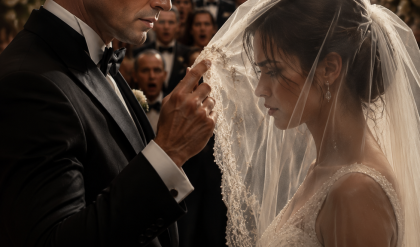
Years later, when they married in a small ceremony by the lake, Clara sat in the front row wearing blue, Everett cried openly, Della dabbed her eyes with a handkerchief, and Addie wore the old brass tortoise locket against her wedding dress.
Everett had once tried to replace it.
After Vanessa’s conviction and Preston’s plea agreement, he melted down Margaret Whitmore’s diamond ring, the same ring used to frame Addie and the same family symbol tied to so much pride and harm. From the gold, he commissioned two small tortoise pendants: one for Clara and one for Addie. Clara accepted hers with tears. Addie held the new pendant in her palm, admired it, thanked her father, and put it carefully back in its box.
“I’ll keep it,” she said. “But I won’t wear it instead of this one.”
Everett looked at the old locket at her throat. “Because it was your mother’s?”
“Because it found me when I had nothing,” Addie said. “It knew who I was when no one else did. I won’t trade the thing that stayed loyal in the dark for a prettier thing now that I’m safe.”
Everett nodded, understanding.
That was the story the newspapers never got right. They wanted a poor maid who became rich. They wanted revenge, diamonds, scandal, and a mansion reclaimed. But Addie’s real victory was quieter and far more difficult.
She did not become worthy when the DNA report arrived.
She had been worthy the first morning she stood at the gate with one bag and fear in her chest. She had been worthy when she cleaned floors, when she sent money home, when she cried into towels and still woke up to work, when she was accused and did not become the lie people told about her. The bloodline changed what others could deny. It did not create her dignity. It only exposed the blindness of those who had refused to see it.
Everett learned that too late, but not too late to change.
He restructured the household staff contracts first. Real wages. Overtime. Health insurance. Written grievance procedures. Private rooms with locks. Outside audits not only of corporate accounts but of domestic labor practices in every property he owned. He created the Clara Quinn Scholarship for working-class students pursuing law, social work, nursing, and education. Addie insisted the scholarship not require recipients to write essays about suffering.
“Poor people should not have to perform their pain for help,” she told the board.
No one argued.
Years later, when Addie stood in court for the first time as an attorney, representing a group of underpaid domestic workers against a wealthy employer who had called them “family” while stealing their wages, she touched the tortoise locket before rising.
Her voice was calm.
Her argument was clear.
She did not raise her voice because she did not need to. She put the truth where nobody could step around it.
In the back row, Everett sat beside Clara with his hands clasped tightly and tears in his eyes. Ethan sat on Addie’s other side of the aisle, smiling like a man watching someone become exactly who she had always been.
And Addie, once called “just the maid” in her own father’s mansion, looked at the judge, looked at the workers waiting behind her, and began.
“Your Honor,” she said, “this case is about a simple question. When a person is paid to serve, does the law still see a person standing there?”
The courtroom stilled.
Addie smiled faintly.
She already knew the answer.
The lesson of her life had never been that a poor girl might secretly belong to a billionaire. That was only the twist, the headline, the thing people repeated because it sparkled. The real lesson was harder and more ordinary. Every cleaner, every driver, every waitress, every security guard, every tired woman carrying a tray through a room full of people who do not look up—each one is already somebody before the world discovers a reason to respect them.
If you need proof of importance before you offer dignity, you have not learned respect.
You have only learned to fear being wrong about someone powerful.
Real respect is what you give when you still think the person in front of you has nothing to give back.
Addie Quinn knew that because she had lived both sides of the door. She had entered the mansion as a nobody, left it as a thief in the eyes of liars, returned as a daughter, and finally walked out as herself.
Not a maid.
Not an heiress.
Not a princess.
A woman who had survived, studied, chosen, forgiven carefully, loved wisely, and built a life no one could hand her because no one else had the right to name it.
THE END