“For who?”
“For me and Victoria.”
Lily tilted her head. “Is Victoria nice?”
Marcus looked across the shining room, at the flowers, the candles, the empty chair beside his own. The pause before his answer was small, but honest.
“She can be,” he said.
At 7:15, Victoria arrived as if the party had been holding its breath for her. Her silver gown caught the chandelier light and scattered it in cold sparks. Diane Callaway appeared beside her within seconds, followed by two women with identical smiles and identical instincts for attaching themselves to power. Preston Hargrove stood near the bar, watching the room more than he joined it.
Victoria moved beautifully. That was the truth. She kissed cheeks, touched arms, remembered titles, praised charities, and made each guest feel chosen for exactly the length of time required. Marcus watched her and felt pride braided with unease. This was the woman everyone admired. This was the woman who knew how to enter a room. But he kept remembering the Victoria who had sat on a curb in an evening gown beside a crying intern after a donor insulted her, refusing to go back inside until the girl could breathe.
That woman seemed very far away.
For the first forty minutes, Lily behaved with the gravity of a child entrusted with important public duties. Marcus had asked a hotel employee to bring a coloring book and crayons from the gift shop, and Lily worked near the windows, occasionally holding up a page for his approval. Each time, he gave her a thumbs-up.
Then Victoria noticed her.
Marcus saw the change in his fiancée’s face from across the room. It was small, but he knew it. A tightening around the eyes, a faint compression of the mouth, the expression she wore when life failed to arrange itself according to her expectations. She excused herself from a conversation with a city official and walked toward him.
“Marcus,” she said warmly, because people were watching. She kissed his cheek, then looked down at Lily. “What is this?”
“Maria had an emergency downstairs. Lily is staying with me for a little while.”
“Maria,” Victoria repeated, her smile still present and entirely false, “is the housekeeper.”
“I know who Maria is.”
“Then you understand why having her child in the middle of our engagement party is inappropriate.”
“She’s sitting quietly with crayons.”
Victoria’s eyes sharpened. “We will discuss this later.”
“No,” Marcus said softly. “We won’t.”
For a moment, something dangerous flashed across her face. Then she turned away with a smooth laugh for the benefit of the guests, as if Marcus had said something charming instead of drawing a line.
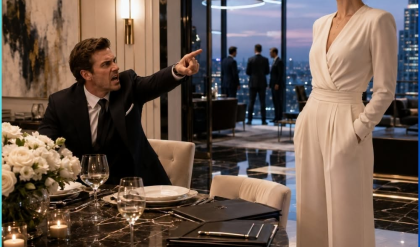
Dinner began at eight. Marcus had a small chair placed beside his own for Lily, and she climbed into it with her coloring book and a bread roll. Victoria said nothing, but her silence had weather in it. Marcus felt the storm coming before the first course was cleared.
Halfway through the main course, Lily finished her purple horse. She studied it, decided it was worthy, and slid down from her chair. Marcus was speaking to an older investor on his left and did not catch her in time. She walked the two feet to Victoria and tugged gently at the silver fabric of her gown.
Victoria flinched.
It was quick, but the table saw it. So did Marcus.
“Don’t touch my dress,” Victoria said.
Lily froze, drawing still lifted. “I drawed a horse. You can have it.”
Victoria stared at the paper. For one heartbeat, Marcus saw a flicker of something almost tender, some buried instinct struggling toward air. Then Diane, seated two places away, gave the smallest cough into her napkin, and Victoria’s face hardened again.
“I don’t want your drawing,” she said. “And you should not be here.”
The conversations nearest them thinned.
Lily’s brows pulled together. “My mama said be good.”
“Then your mother should have kept you downstairs.”
Marcus pushed back his chair. “Victoria.”
But Victoria was no longer speaking only to the child. She was speaking to the room, to Diane, to the invisible judges she had invited into her own head and mistaken for truth.
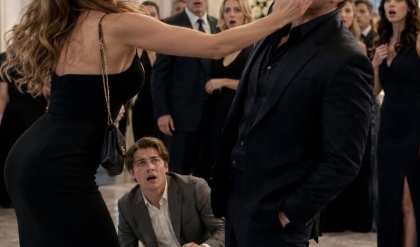
“Get that child away from me right now,” she said. “Do you have any idea who I am? This is a two-hundred-thousand-dollar engagement party. It is not a daycare for the help’s little brats.”
The word brats landed harder than a slap.
Marcus stood. But Lily moved first. She looked up at Victoria, not with fear, but with the heartbreaking curiosity of a child trying to understand pain in an adult’s face. Then she lifted her hand and touched Victoria’s cheek.
“You look sad inside,” Lily said.
Victoria’s mouth parted.
No one rescued her from the truth. Not Diane. Not Preston. Not the guests with their expensive manners. The sentence hung there, innocent and merciless, and for the first time that night, Victoria Hargrove looked less like a woman in control than a woman who had been caught drowning in shallow water.
She stood so abruptly her chair scraped against the carpet.
“Excuse me,” she whispered, and walked out.
Marcus followed Victoria into the hallway because leaving her alone after that would have been punishment, and whatever else he felt, he had not yet become cruel. The corridor outside the private dining room was dimmer, quieter, lined with framed black-and-white photographs of old Chicago streets. At the far end, a narrow window looked down at the city, where headlights moved like restless sparks.
Victoria stood before the glass with her arms crossed tightly over her waist. From behind, she looked almost like the woman Marcus had first loved, slender and strong and strangely lonely. Her shoulders were trembling, though she would have denied it if asked.
“I am not going to lecture you,” Marcus said.
“Good,” she replied, but her voice cracked on the word.
He stopped beside her. For a long moment, neither of them spoke. The muted sound of the party leaked through the closed doors, a low murmur of people pretending not to discuss them.
“She wanted to give you a drawing,” Marcus said at last.
“I know that.”
“She’s three.”
“I know how old she is.”
“Then why?”
Victoria closed her eyes. “Because I heard Diane’s voice in my head before I heard my own.”
The honesty startled him more than an excuse would have.
She turned, and in the corridor light Marcus saw what Lily had seen: sadness, yes, but also exhaustion, fear, and shame so raw it had stripped the polish from her face. “I don’t know when I became this person,” Victoria said. “I keep trying to find the exact moment so I can blame it on something. The wedding. The social pressure. Diane. My family. Your money. But I can’t find one moment, Marcus. I just kept making little choices, and one day I looked up and I was someone I would have hated.”
Marcus leaned against the wall, careful not to soften too fast. “You called a child a brat.”
Her eyes filled. “I know.”
“You called Maria the help.”
“I know.”
“Maria has worked for me longer than you’ve been in my life.”
Victoria flinched, not because he was loud, but because he was right.
“I know,” she said again, and the third time the words broke. “I’m sorry. God, I’m so sorry.”
There had been a time when an apology from her would have been followed by immediate action. A note. A phone call. A repair. Somewhere along the way, apologies had become decorative, part of the performance of being good rather than the labor of becoming better. Marcus studied her, trying to tell which kind this was.
“What happened to you?” he asked.
Victoria laughed once, bitter and small. “You happened. Your world happened. My family realizing you weren’t just rich but powerful happened. Diane telling me every week that softness is how women get erased happened. Preston warning me that if I married you without protecting myself, I’d be the stupid girl in the Hargrove family forever. Every room I walked into, someone was measuring me. Was I pretty enough? Elegant enough? Useful enough? Ruthless enough to stand beside Marcus Elliot?”
“I never asked you to be ruthless.”
“No,” she said, wiping at her face. “That’s what makes it worse. You asked me to be real, and I chose impressive instead.”
Behind the dining room doors, James Whitfield had begun doing what James always did when the floor shifted under his friend’s life. He observed.
James had known Marcus since they were twenty-two and broke, when Elliot Systems was not yet a company but a half-written idea on a borrowed laptop. James was tall, calm, and patient in the way of men who never needed to rush because they were usually three moves ahead. He had never trusted Diane Callaway. He had also never trusted Preston Hargrove, though Preston’s greatest talent was making distrust seem impolite.
When Victoria left the room, James noticed two things. Diane did not look shocked. Preston looked relieved.
Relief, James knew, was an odd reaction to humiliation unless humiliation had been expected.
He crossed the room with a champagne glass in hand and sat beside Preston as if seeking shelter from the awkwardness. Preston was twenty-nine, handsome in the soft, unfinished way of a man who had never had to become useful quickly. His tie was perfect. His hands were not. They kept moving, straightening the edge of his napkin, touching his jacket pocket, tapping the stem of his glass.
“Strange night,” James said.
Preston gave a thin laugh. “That’s one word for it.”
“You don’t seem surprised.”
His hand went again to his jacket pocket. “Why would I be surprised?”
“Because most people are when a child quietly detonates an engagement party.”
Preston looked toward Diane. Diane looked away too quickly.
James smiled without warmth. “What’s in your pocket?”
“Excuse me?”
“Marcus is my oldest friend. I know when people around him are nervous, and I know when nervous people carry paper like it might save them. So I’ll ask once more politely. What is in your pocket?”
Preston’s face paled. “This is none of your business.”
“Anything that harms Marcus becomes my business.”
Across the table, Diane set her glass down. “James, don’t be dramatic.”
He did not look at her. “Diane, if drama bothered you, you would have chosen a different hobby.”
A few nearby guests pretended not to hear and failed completely.
Preston swallowed. For a moment, James thought he would refuse. Then the younger man reached into his jacket and placed a folded document beneath the edge of his plate.
“I didn’t write it,” Preston muttered. “I just thought someone should know before she ruined everything.”
James unfolded it.
By the second paragraph, he stopped breathing normally.
It was a prenuptial agreement, but not the one Marcus and Victoria had been reviewing with their attorneys. This one was dated three weeks earlier and bore Victoria’s signature. It guaranteed her a settlement of one hundred forty million dollars from Marcus’s personal assets in the event of divorce within five years, regardless of fault. That was ugly enough. But the attachment behind it was worse.
Buried in the dense language was a business transfer schedule designed to move certain patent rights and proprietary systems from Elliot Global into a new holding company after the marriage. The holding company, disguised behind layers of other entities, traced back to Preston Hargrove and two investors James recognized as competitors who had been trying to buy pieces of Marcus’s company for years.
James read it twice, then looked at Preston.
The younger man whispered, “It wasn’t supposed to go that far.”
“When someone says that, it usually means it already did.”
“Diane pushed it. She said Victoria needed leverage. She said Marcus would never miss a few intellectual property transfers if the lawyers handled it right.”
James felt cold anger settle into him. “And you brought this tonight because?”
Preston looked toward the hallway. “Because Victoria was supposed to sign the final authorization after the party. Diane wanted to pressure her before she lost nerve. But when that kid said what she said…” He ran a hand through his hair. “Victoria looked like she might back out.”
“So you were going to expose her only when your theft stopped working?”
Preston had no answer.
James stood, document in hand. On his way to the hallway, he passed Diane, who caught his sleeve.
“You don’t understand this world,” she said quietly. “Men like Marcus always protect themselves. Women like Victoria have to do the same.”
James looked down at her fingers on his jacket until she removed them. “Protecting yourself is a prenup. Stealing someone’s company is a crime with better stationery.”
He found Marcus and Victoria still by the window. Marcus had just asked what happened to her. Victoria was crying silently now, her makeup ruined in a way she would once have found unforgivable.
“Marcus,” James said.
Marcus turned. “Not now.”
“Yes. Now.”
James handed him the papers. He hated doing it in front of Victoria, and he hated more that he had no choice. Marcus read the first page with confusion. The second with disbelief. The attachment with a stillness so complete it scared James more than shouting would have.
When Marcus looked up, the hallway seemed to narrow around him.
“What is this?” he asked Victoria.
She saw the document. Every bit of color left her face.
“Marcus—”
“Do not start with my name like it’s a door you can still open.”
Her mouth trembled. “Preston said it was only protection.”
“Against what?”
“I don’t know. Against being powerless. Against looking foolish. Against ending up as the woman everyone whispered about after you moved on.”
“Moved on?” Marcus said. “We weren’t even married yet.”
“I know.”
“You signed something that would drain my personal assets and move pieces of my company to your cousin.”
“I didn’t understand the attachment.”
James stepped in. “Did you read it?”
Victoria looked at the floor.
Marcus closed his eyes.
That hurt worse than if she had admitted understanding everything. Because Marcus knew what it meant to sign without reading. It meant she had trusted the wrong people more than she trusted him. It meant she had handed his life’s work to people who smiled at him across dinner tables.
“Was any of it real?” Marcus asked.
Victoria’s head snapped up. “Yes.”
“The gala? The kindness? The woman who talked to Terrence about his GED?”
“She was real.”
“Then where is she?”
Victoria covered her mouth and sobbed. Not delicately. Not beautifully. It was an ugly sound, human and humbling. James looked away, not to spare her pride but because some collapses were private even when they happened under hotel lighting.
“I got scared,” Victoria said when she could speak. “That’s the honest answer. I got scared that you were too good for me in all the ways money couldn’t fix. Diane said you would outgrow me. Preston said I needed leverage. My mother said men who build fortunes from nothing always love the building more than the wife. And every time I felt afraid, instead of telling you, I tried to become someone nobody could hurt.”
“So you hurt other people first,” Marcus said.
“Yes.”
The word was small, but it did not dodge.
Marcus looked toward the dining room doors. Somewhere behind them, Lily was probably coloring again, unaware that she had opened a room full of locked doors. Maria was downstairs finishing work, not knowing her child had just become the moral center of a crisis involving fortunes, reputations, and betrayal. Fifty guests waited, hungry for scandal and uncertain whether they had witnessed the end of an engagement or the beginning of something stranger.
Marcus folded the document.
“James,” he said, “find Preston and keep him here until I decide whether hotel security or my legal team should speak to him first.”
James nodded. “And Diane?”
Marcus’s eyes shifted toward the doors. “She doesn’t leave either.”
Victoria wiped her cheeks. “Marcus, I’ll undo it. I’ll sign anything. I’ll give testimony against Preston if I have to. I’ll—”
“Stop.”
She did.
“I believe you’re sorry,” he said.
Her face crumpled with desperate relief.
“But sorry is not repair. Sorry is the receipt that proves you know something broke.”
She nodded, crying harder.
“I need to ask you one question, and I need the first honest answer you have. Not the polished one. Not the strategic one. Do you love me? Me. Not the money, not the magazine photographs, not the access, not the version of yourself you imagined becoming beside me.”
Victoria looked at him for a long time. Beyond the glass, Chicago glittered like something expensive and indifferent.
“Yes,” she said. “I love you. And I think I have been punishing you for making me feel loved in a way I could not control.”
Marcus absorbed that. It was the kind of sentence that could be true and still not be enough.
“I love you too,” he said.
Victoria shut her eyes as if the words hurt.
“But I will not marry the woman who humiliated Lily. I will not marry the woman who signed this. I will not marry someone who thinks kindness is a weakness she needs to recover from in public.”
“I know.”
“If there is still a woman inside you who knows better, she has to walk back into that room and prove it. Not to them. Not for their approval. To Lily. To Maria. To yourself.”
Victoria looked terrified. “In front of everyone?”
“Especially in front of everyone.”
For a moment, she looked toward the elevators as if escape had a shape. Then her shoulders lowered. She nodded.
“All right,” she whispered. “No performance.”
“No performance,” Marcus repeated.
When they opened the dining room doors, conversation died again. James was standing near the bar with Preston, who looked like a boy waiting outside a principal’s office. Diane stood nearby with her arms crossed, her smile gone sharp and useless.
Marcus walked to the head of the table. Victoria walked beside him, not touching him, not hiding behind him. The room waited for the kind of announcement wealthy people were used to hearing: an elegant lie, a graceful excuse, a schedule adjustment for a disaster.
Marcus gave them none of that.
“Tonight has gone badly,” he said.
The bluntness moved through the room like a cold wind.
“I invited you here to celebrate my engagement to Victoria. Instead, many of you witnessed a child being treated with cruelty she did not deserve. That child is Lily Delgado. Her mother, Maria, works for me, and she has more dignity than half the people I’ve met in rooms like this.”
A few guests shifted uncomfortably.
Marcus continued. “Victoria and I also discovered that people close to her have been involved in arranging documents that affect my personal assets and my company without my knowledge. That matter will be handled legally, not socially.”
Diane’s face went white.
Preston sank into a chair.
Victoria stepped forward. Her hands trembled, but she did not clasp them to hide it.
“I need to say something,” she said.
Her voice was not loud, but the room listened because it was finally real.
“I was cruel to a little girl tonight. I spoke about Maria as if her work made her less worthy of respect. I let fear, pride, and the opinions of people I should never have trusted turn me into someone I did not recognize. None of that excuses what I said. Lily tried to give me a drawing, and I answered with humiliation.”
She turned toward the side table near the windows, where Lily sat with a crayon in her fist, watching with serious attention.
Victoria crossed the room slowly. Every eye followed her. The silver gown whispered over the carpet. When she reached Lily, she did not bend from above like a queen granting mercy. She lowered herself carefully onto the carpet, sitting in her designer dress at the feet of a child.
The room seemed to lean forward.
“Lily,” Victoria said, her voice breaking, “I am sorry I hurt your feelings.”
Lily looked at her for a moment. “You was loud.”
“Yes. I was.”
“And you said brat.”
Victoria swallowed. “That was wrong.”
“My mama says don’t say mean words at people.”
“Your mama is right.”
Lily studied her, then held up the purple horse drawing. One corner had bent in her small fist. “You can still have it if you be nice.”
Something passed through Victoria’s face then, something painful and almost beautiful. She accepted the drawing with both hands as if it were a fragile inheritance.
“Thank you,” she whispered.
Lily reached for another piece of paper. “I can draw you smiling.”
Behind them, someone let out a breath that sounded almost like a sob.
Maria Delgado came upstairs ten minutes later because Marcus called for her, not because she knew the world had shifted. She arrived through the service entrance still wearing her navy dress and a white apron, with a dish towel folded over one arm. Her face held the guarded worry of a mother who had spent the last hour imagining every way her child might be inconveniencing important people.
Then she saw Lily sitting at a small table with Victoria Hargrove on the carpet beside her, both bent over a sheet of hotel stationery, discussing the correct color for a smile.
Maria stopped so abruptly the server behind her nearly walked into her back.
“Lily?”
Lily looked up. “Mama! I’m teaching Miss Victoria how to be happy on paper.”
Victoria rose immediately, not gracefully but sincerely, one hand still holding the purple horse. Her mascara was smudged. Her silver gown had creased at the knees. In that room, among people who had spent whole lives avoiding visible imperfection, she looked ruined. She also looked more human than she had all evening.
“Maria,” Victoria said, “I owe you an apology.”
Maria’s expression closed with confusion. “Miss Hargrove?”
“No. Please don’t make this formal. I spoke disrespectfully about you and cruelly to your daughter. I called Lily a word no child should hear, and I referred to you in a way that reduced your work and your dignity. I was wrong. I am deeply sorry.”
Maria looked from Victoria to Marcus, unsure whether this was some social ritual she did not know how to answer.
Marcus stepped closer. “She means it.”
Maria’s eyes returned to Victoria. “Did Lily do something?”
“No,” Victoria said at once. “Lily did something kind. I did something ugly.”
Lily slid off her chair and ran into her mother’s arms, suddenly sleepy now that the emotional weather in the room had cleared. Maria held her tightly, her hand moving over the child’s curls. Marcus saw her eyes shine and looked away because he remembered his mother being apologized to too late or not at all by people whose names nobody remembered.
Diane Callaway chose that moment to laugh softly.
It was a mistake.
The laugh was not loud, but in a room that had grown honest, falseness had become easy to hear. “This is very moving,” Diane said, her voice sugared with contempt, “but perhaps we’re all being a little theatrical over a child’s misunderstanding.”
Marcus turned slowly.
Diane seemed to realize, a second too late, that she was standing in the wrong story now.
James appeared at Marcus’s side with Preston behind him and two hotel security managers waiting discreetly near the doors. “Preston has decided to cooperate,” James said. “Diane has not.”
“I don’t know what Preston told you,” Diane said, lifting her chin, “but Victoria is an adult woman. If she signed something, she signed it.”
Victoria faced her former friend. The fear was still there, but something steadier had joined it. “You told me Marcus would never respect me unless I had leverage.”
“I told you to protect yourself.”
“You told me to become harder every time I felt guilty. You told me Maria was getting too comfortable. You told me kindness was a liability.”
Diane’s mouth twisted. “And you believed me. Don’t hand me your conscience now because a toddler embarrassed you.”
The words were vicious, but they failed to land the way Diane intended. Victoria looked hurt, yes, but not hypnotized. Marcus realized then that Diane had held power over Victoria only as long as Victoria preferred blame to responsibility.
“You’re right,” Victoria said. “I believed you. That part is mine. And because it is mine, I can choose differently now.”
Diane’s eyes flicked toward the guests, looking for allies. She found curiosity, discomfort, and, in a few faces, recognition. Rooms like that were full of people who had been bullied by social power and called it friendship because the alternative was loneliness.
Marcus looked at security. “Please escort Ms. Callaway out. Mr. Hargrove can stay until my attorneys arrive, unless he prefers to make this more difficult.”
Preston dropped into a chair and put his head in his hands.
Diane’s composure finally cracked. “You are making a terrible mistake, Marcus.”
“No,” he said. “I’ve been making one slowly. Tonight I stopped.”
Security guided her out while the room watched. There was no dramatic struggle, no shouted confession, no shattered glass. Just a woman who had mistaken influence for importance discovering that influence vanished the moment people stopped fearing her opinion.
Afterward, the party did not resume. It transformed into something stranger. The quartet stopped playing. The servers cleared plates quietly. Some guests left early with awkward hugs and careful expressions. Others stayed, not because scandal held them there, but because the night had become too real to abandon.
Marcus asked the hotel to bring coffee, sandwiches, and hot chocolate. Lily fell asleep in Maria’s lap with one black shoe dangling from her foot. Victoria sat beside them, not too close, not demanding forgiveness. When Maria’s arms tired, Victoria quietly offered to hold the hot chocolate so Maria could shift Lily’s weight. It was a small gesture, almost nothing. For Marcus, it mattered because it asked for no audience.
Near midnight, after the last guest had gone and the room looked exhausted by its own beauty, Marcus and Victoria stood again by the windows.
“I don’t know what happens now,” Victoria said.
“Neither do I.”
“Are we still engaged?”
Marcus looked at the city below. The ring on her finger caught the light. Earlier that evening, it had looked like a promise. Now it looked like a question.
“I don’t know,” he said again. “I know I love you. I know I don’t trust you the way I did yesterday. Both are true.”
Victoria nodded, tears filling her eyes but not falling. “What do I do?”
“Start where you broke things.”
“With Lily?”
“With yourself first. Then Lily. Then Maria. Then me. Then the legal mess. In that order.”
She gave a shaky laugh. “That sounds like a long list.”
“It is.”
“Will you wait while I work through it?”
Marcus turned to her. “I will not pause my life for a performance of change. But I will stand near the truth if that’s where you’re going.”
Victoria absorbed the answer. It was not soft, but it was merciful because it was honest.
The next week was not romantic. It was humiliating, practical, and necessary. Victoria met with Marcus, James, and independent attorneys to dismantle every document Preston had arranged. She gave a full written account of Diane’s involvement and Preston’s explanations. Preston, terrified of criminal exposure, surrendered emails, drafts, and corporate diagrams that showed the plan had been more advanced than Victoria had understood but less complete than Marcus had feared. The intellectual property transfer had not yet occurred. Damage had been aimed, not fired.
That distinction saved Preston from immediate ruin, though not from consequences. He lost his position at the law office where his family name had protected him too long. Two investors received legal notices that froze their involvement. Diane disappeared from Chicago social calendars with astonishing speed, which taught Victoria that many people who smiled at Diane had been waiting years for permission to stop inviting her.
But the harder work happened away from lawyers.
Victoria went to Maria’s apartment on a Saturday afternoon with no cameras, no assistant, no gift basket expensive enough to become another insult. She brought a wooden box of crayons, paper, and a child’s art frame. Maria opened the door cautiously. Lily peeked from behind her mother’s skirt.
“I came to apologize again,” Victoria said. “Not because Marcus asked me to. Because I wanted to say it in your home, where Lily is safe and I am the guest.”
Maria studied her for a long time, then stepped aside.
The apartment was small, warm, and bright with the careful order of a woman who respected what little time she had. Lily’s drawings were taped along the refrigerator. A pot of soup simmered on the stove. On the kitchen table sat a stack of bills beneath a ceramic mug.
Victoria noticed them, then made herself look away. Pity, she was learning, could become another form of arrogance when it stared too long.
Lily accepted the crayons with immediate forgiveness. Maria did not. She offered coffee but not comfort.
“I have worked in houses where people like you apologize,” Maria said after Lily went to draw in the living room. “Sometimes they mean they feel bad. Sometimes they mean they want me to help them feel good again. Which one is this?”
Victoria held the mug with both hands. “I don’t want you to make me feel better.”
“Good. Because I cannot.”
“I know.”
Maria sat across from her. “My daughter remembered what you said. She asked me that night what ‘the help’ means.”
Victoria closed her eyes.
“I told her it means people who help. People who make things work. People who keep rooms clean and food warm and children safe. I did not tell her some people use it when they want to pretend we don’t have names.”
“I am sorry,” Victoria whispered.
“I believe that.” Maria’s voice softened slightly, but not enough to remove the truth. “Now decide what your sorry does.”
That sentence stayed with Victoria longer than any insult Diane had ever delivered.
In December, Victoria began volunteering twice a week at a childcare assistance nonprofit on the West Side. At first, Marcus distrusted it. It seemed too convenient, too symbolic. But she did not tell anyone from her social circle. She did not post photographs. She did not put her name on a donor wall. She sat in a back office helping mothers fill out forms for emergency daycare grants, and when she did not understand something, she asked. When she cried in her car afterward, she did not call Marcus to be praised for feeling guilty. She went back the next week.
Marcus watched from a distance because love, he was learning, could not be proofread for someone else. Either Victoria would become real again, or she would become good at imitating realness. Time would tell the difference.
Lily helped, though she had no idea. Every Thursday when Maria brought her to Marcus’s office, Lily delivered drawings to the corkboard as before. One day she brought one for Victoria: a woman in a silver dress standing next to a tiny girl under a sun.
Victoria looked at it and smiled. “Do I still look sad inside?”
Lily considered this with the seriousness of a judge. “A little. But not mean sad.”
Victoria laughed, and then cried, and Lily patted her knee because children accept complicated weather if nobody lies about the rain.
By January, Marcus had made his decision. Not because everything was fixed, but because the direction had changed. Victoria had signed a new prenuptial agreement drafted with both attorneys present and every clause read aloud. She had insisted on including language that separated Marcus’s company entirely from marital claims. Marcus had resisted at first, suspecting guilt. Victoria had shaken her head.
“I don’t want to protect myself with your life’s work,” she said. “I want to stand beside it without touching what your mother’s sacrifices built.”
That was the first time Marcus felt trust return not as a flood, but as a small green thing pushing through frozen ground.
They did not hold a grand wedding. There was no ballroom, no social magazine, no five-hundred-person guest list pretending intimacy could be purchased by the plate. They married in Marcus’s backyard in Lincoln Park on a cold Saturday afternoon with thirty guests, a rented tent, heaters humming softly, and white lights strung through bare branches.
Victoria wore an ivory dress from a small boutique, simple enough that she looked like herself instead of an advertisement. Marcus wore a navy suit. James stood beside him. Maria sat in the third row with Lily in her lap, both of them wrapped in wool coats. Lily wore the red velvet dress again because she called it her “important dress.”
Before the vows, Victoria asked to speak.
Marcus looked at her, surprised. She squeezed his hand once, then turned to the small gathering.
“I spent a long time believing that being loved by a good man meant I had to become impressive enough not to lose him,” she said. “I hurt people because I was afraid of being seen as weak. A little girl showed me that I was not powerful. I was sad. And then her mother showed me that an apology is only the beginning of repair.”
Maria looked down, blinking fast.
Victoria continued. “So today, before I promise Marcus anything, I want to promise that I will not confuse status with worth again. Not perfectly. I will fail sometimes. But I will not make a home where kindness has to ask permission.”
Marcus felt his throat close.
The vows were simple. Lily fell asleep halfway through, her cheek pressed against Maria’s shoulder, unaware that she had changed the architecture of several adult lives.
At the small reception afterward, Marcus announced the Rosa Elliot Childcare Fund, created jointly by him and Victoria to help working parents in Chicago cover emergency childcare costs without risking their jobs. The first recipient was Maria, though Maria accepted only after insisting the fund could not be named after her and could not become charity gossip. Victoria agreed immediately.
By spring, the corkboard in Marcus’s office had grown crowded. Lily’s drawings filled every inch, and among them was the framed purple horse, the one Victoria had nearly rejected on the worst night of her life. Beneath it, Victoria had taped a small handwritten note.
Thank you for telling the truth before I forgot how to hear it.
On a rainy April afternoon, Marcus found Victoria alone in his office, looking at that note. She did not hear him come in.
“Still sad inside?” he asked gently.
She turned. There was sadness in her face, yes, but it no longer looked hidden or poisonous. It looked like part of being human, like something she had stopped decorating and started carrying honestly.
“Sometimes,” she said. “But not lost.”
Marcus crossed the room and took her hand.
Below them, Chicago moved as it always had, full of ambition, fear, money, hunger, kindness, cruelty, and thousands of people deciding every day who they were willing to become. Somewhere downstairs, Maria was finishing her shift early because she had a childcare grant appointment to attend, not for herself this time, but to help another mother apply. Lily was in the kitchen office drawing a family of purple horses, all smiling.
The world did not become fair because a toddler touched a woman’s face. Rich people did not stop being careless. Proud people did not all become humble. Every wound did not close simply because someone finally said sorry.
But in one bright room above Chicago, in front of fifty people who thought they had gathered to witness a perfect engagement, a child had exposed a broken heart hiding under a silver gown. A proud woman had been given the terrible mercy of seeing herself clearly. A powerful man had chosen truth over spectacle. And a working mother had watched her daughter’s innocence command more respect than money ever could.
Years later, people would still tell the story of that engagement party, though they often got the details wrong. They would exaggerate the cost, the guest list, the scandal with the cousin, the socialite escorted out by security. They would make Marcus sound colder than he was and Victoria sound either more wicked or more saintly than any real person ever is.
But Marcus remembered it simply.
A little girl held out a drawing.
A woman forgot how to be kind.
Then the little girl touched her face and said, “You look sad inside.”
And somehow, because truth sometimes arrives in the smallest voice in the room, everybody finally listened.
THE END