Grief had hardened him. Money had polished the hardness until people mistook it for charm.
“And Miss Crawford?” Mrs. Ruth asked. “Has she started the day by torturing anyone yet?”
“Not yet.”
“Then enjoy this sacred moment.”
Rachel laughed softly, and for one fragile second she felt almost young.
The afternoon destroyed that peace.
Florists filled the ballroom with white roses and towering branches of orchids. A catering team crowded the service hall. The hired orchestra arrived before three and began tuning under the chandeliers, sending stray notes through the mansion that made Rachel’s stomach twist. She avoided the ballroom when she could. The sound of strings reached into places inside her she kept locked.
Tommy almost dropped a tower of china plates near the dining room.
“Rachel, help me before I die young,” he gasped.
She took half the stack from him easily. “You always carry too much.”
“In this house, you get punished for one trip and punished for two,” he said, stumbling away.
Rachel was still smiling when Jessica’s voice cut through the corridor.
“You. Green eyes.”
Rachel stopped.
Jessica Crawford stood at the foot of the grand staircase wearing a silk robe and a smile that did not reach her face. She had been a guest at the estate for six months, though every servant knew she intended to leave as the future Mrs. Anderson. She came from money, but not enough to satisfy her hunger. She treated Maxwell’s mansion as if she were already mistress of it.
“Go to my suite,” Jessica ordered. “My ivory gown is on the bed. Press it carefully. If I find one wrong crease, I will make sure you never work in a respectable house again.”
“Yes, ma’am.”
“How obedient.” Jessica glanced toward two women passing behind her. “Some people do understand their place.”
Rachel carried the gown upstairs and spent forty minutes pressing the silk while Jessica’s perfume smothered the room. When she finished, she caught sight of herself in the floor-length mirror.
A maid stared back.
Pale face. Tired mouth. Dark shadows beneath green eyes that once appeared in newspaper photographs under headlines about miracles.
“Where did you go?” Rachel whispered.
Eight years earlier, she had not been a maid.
She had been Rachel Sullivan, daughter of Ethan Sullivan, the violin teacher who raised her alone in a narrow Boston apartment above a bakery. He discovered her gift when she was four and humming back melodies after church. By seven, she was playing pieces adults feared. By twelve, she stood on professional stages. By nineteen, critics called her “the miracle of the strings,” though Ethan always told her not to trust critics too much.
“Play for the people who came in from the cold,” he would say. “Play for the ones who lost someone. Play for the ones too proud to cry anywhere except in the dark.”
Her future had been bright enough to frighten her.
Then one rainy night outside Providence, a truck lost control on a slick highway. Ethan turned the wheel to shield her side of the car. Metal screamed. Glass burst. The world became headlights, rain, blood, and her father’s final shout.
Rachel survived with a shattered right hand.
Her father did not survive at all.
Surgeons repaired the bones. Therapists taught her to hold a bow again. But every time she placed a violin under her chin, the crash returned. She heard twisted metal in every note. She felt her father’s absence in every silence.
Medical bills swallowed their savings. Debt collectors called. The prestigious world that had praised her sent flowers, then invitations, then nothing. Rachel sold her custom violin to a private collector and vanished from every stage that had once claimed to love her.
She buried Rachel Sullivan because Rachel Sullivan had belonged to Ethan.
Without him, she did not know how to exist.
The Anderson estate hired her under a shortened work history and no questions from a housekeeper who needed reliable hands more than references. Rachel became quiet, useful, invisible.
Until now.
In the ballroom, she closed her eyes and drew the bow across the strings.
The first note was not ugly.
It was long, pure, and devastatingly alive.
It rose above the guests like a single silver thread pulled through the room, vibrating against crystal, silk, bone, and memory. The laughter died so abruptly that the silence afterward seemed almost violent.
Rachel heard the violin’s voice tremble at first, not from weakness, but from age. She adjusted without thinking, her left hand finding the pitch, her right hand softening the pressure. The instrument responded like something waking from a long sleep.
Then she began to play.
It was Massenet’s Meditation, the piece she had performed the night before the accident. She did not choose it. Her grief chose it for her.
The melody poured out of her not as a performance, but as confession.
Every phrase carried eight years of silence. Every shift of her fingers remembered hospital rooms, unpaid bills, the smell of rain on asphalt, the empty chair at breakfast, the cardboard box of press clippings she could not bring herself to throw away. Her cheap uniform blurred in the minds of the audience. The maid vanished. Something older and truer stood in her place.
A woman near the fireplace pressed a gloved hand to her mouth.
An elderly man by the piano lowered his head as tears slipped into the deep lines of his face.
Even the hired waiters stood frozen, trays forgotten.
Maxwell did not move.
At first, he simply stared. Then his expression changed in a way no one in Newport had seen before. The arrogance cracked, and beneath it came shock, then shame, then a grief so naked that Rachel might have stopped playing if her eyes had been open.
His mother’s violin had not sung since Evelyn Anderson died.
He had locked it away because he could not bear the sound of what he had lost. He had built a life of noise to keep silence from hurting him. Parties. Deals. Horses. Women who laughed when he laughed. Men who praised his instincts. Houses so large that loneliness could echo without being called by its real name.
Now the voice of that violin filled the ballroom again.
For the first time in eighteen years, Maxwell remembered his mother not as a portrait, not as a grave, not as the hole that made him cruel, but as warmth on the edge of his childhood bed while music drifted through the door.
Jessica Crawford watched his face and knew, with a cold stab of panic, that she was losing him.
The music swelled.
Rachel felt the old terror rise as the final passage approached. Her right hand tightened. For one breath, rain and headlights flashed behind her eyes.
Then another memory came.
Her father in the front row of a theater, wiping his eyes with a handkerchief, whispering his rule when she had been too young to understand it.
Play for those who are gone, my girl. Music is the only language brave enough to cross over.
Rachel breathed.
The final note trembled high above the room, delicate and bright, then descended gently into silence.
No one clapped.
For three full seconds, two hundred wealthy people stood stripped of performance, manners, and cruelty.
Then the applause erupted.
It was not polite applause. It was thunder. Chairs scraped backward. Men shouted. Women wept openly. Arthur Belmont, an elderly patron of the Manhattan Philharmonic who had spent sixty years listening to the greatest musicians in the world, hammered his cane against the floor.
“I know that sound,” he whispered. “I know that girl.”
By the kitchen doors, Mrs. Ruth sobbed into her apron.
“That is my girl,” she said. “I knew there was magic in her.”
Rachel lowered the violin. Her breath came too fast. The applause did not feel like victory. It felt like exposure. She had spent years hiding from the world, and in four minutes she had made herself impossible to ignore.
Maxwell stepped toward her.
The applause faded into eager silence.
Everyone remembered his promise.
If you can play this violin, I will marry you right here, right now.
He stopped in front of her, his face pale, his eyes fixed on hers with something that looked dangerously close to reverence.
“Rachel,” he began.
“Wait one minute.”
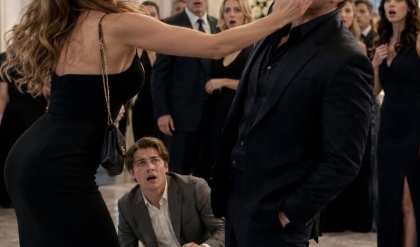
Jessica’s voice sliced through the moment.
She marched forward, ruined gown and all, wearing a smile so sharp it could cut skin.
“Before anyone does something romantic and absurd,” Jessica said, “perhaps we should ask how a simple maid plays like a trained master.”
Murmurs stirred.
Maxwell turned on her. “Jessica.”
“No, darling. I think everyone deserves to know whether this girl is what she pretends to be.” Jessica pointed at Rachel. “No maid randomly plays like that. She is hiding something.”
Rachel’s fingers tightened around the violin.
Maxwell’s jaw hardened. “Enough.”
But Jessica had seen fear flicker across Rachel’s face, and she smiled.
“There it is,” she said softly. “The look of a liar.”
“Shut your mouth,” Maxwell said, cold enough to silence half the room.
Jessica recoiled, stunned more by his tone than his words.
Maxwell faced Rachel again. This time, when he spoke, his voice was gentler.
“What is your real name? The name you had before this house.”
Two hundred pairs of eyes pressed against Rachel like hands.
She could say it. She could give them Rachel Sullivan, the lost prodigy, the miracle who vanished after the crash. She could watch curiosity turn into pity and pity into headlines. She could become public property again, her father’s death polished into a dinner story.
Her throat closed.
“I am just Rachel,” she whispered. “I am the maid. I do not want your money, your attention, or your marriage proposal. Please let me go back to the kitchen and pretend this never happened.”
Never in Newport had a woman rejected Maxwell Anderson in front of a full ballroom and begged to return to work.
His pride flinched. But fascination overpowered it.
“Put the violin back in its case,” he said quietly. “Then go rest. We will speak tomorrow.”
Rachel returned the instrument with trembling care and fled through the kitchen doors.
Mrs. Ruth caught her before her knees gave out.
“Oh, child.”
“It felt like opening his grave,” Rachel sobbed. “It felt like losing him all over again.”
Mrs. Ruth held her tightly. “No. It felt like letting him breathe.”
Down the hall, behind the library door, Jessica Crawford began planning her revenge.
By morning, the mansion had changed.
Servants whispered. Guests lingered longer than necessary at breakfast. Two newspapers called about rumors that a maid had performed a concert-level piece at Maxwell Anderson’s birthday party. Arthur Belmont sent a handwritten note addressed not to Maxwell, but to Rachel, requesting the honor of speaking with her.
Rachel refused to read it.
For two weeks, she tried to rebuild her invisibility, but it no longer fit.
Maxwell began finding excuses to cross her path. He requested that she bring coffee to his study, though footmen had always done it. He came to the kitchen to ask Mrs. Ruth about menus he had never cared about before. He lingered near staircases when Rachel carried laundry and stood too close to the music room door when she passed it.
At first, Rachel answered him with cautious politeness.
“Yes, sir.”
“No, sir.”
“Excuse me, Mr. Anderson.”
But grief recognizes grief. It did not take long for her to see that his arrogance was not strength. It was a locked room.
One rainy Tuesday, she found that room.
She had been carrying folded linens when she noticed the door to the east music room slightly open. It had always been locked. Dust sheets covered the furniture inside. The air smelled of cedar, old paper, and time.
Rachel knew she should keep walking.
Instead, she stepped inside.
A grand piano sat beneath a white sheet, its outline ghostly in the dim light. Framed photographs lined the mantel. Evelyn Anderson stood in one of them, young and smiling, holding the same violin Rachel had played.
Rachel touched the edge of the piano sheet.
“Do you miss it too?” she whispered.
“You can uncover it.”
She spun around.
Maxwell stood in the doorway, his hands in his pockets, no smirk on his face.
“I am sorry,” Rachel said quickly. “I should not be here.”
“Neither should I, probably.” He stepped inside and closed the door softly behind him. “I locked this room after my mother’s funeral. I thought if I kept the music out, I could keep the pain out too.”
Rachel looked at the covered piano. “That never works.”
“No,” he said. “I am beginning to understand that.”
He pulled the sheet from the piano, sending dust into the air. Rachel sat on the bench before she could convince herself not to. Her fingers hovered above the yellowed keys.
“My father used to hum a lullaby when I was scared,” she said. “He thought he had a terrible voice, but I loved it.”
“Play it,” Maxwell said.
She looked at him.
“Please,” he added.
So Rachel played.
It was simple. Nothing like the piece in the ballroom. Just a quiet melody, tender and almost fragile. But inside that locked room, it felt sacred.
Maxwell sat in his mother’s old chair. Halfway through the song, a tear slid down his cheek. He did not wipe it away.
When the final chord faded, Rachel turned toward him.
“My father died in a car accident,” she said softly. “I was with him.”
Maxwell closed his eyes.
“My parents died over the water,” he said. “For years, people told me I was lucky I was not on the plane. I hated them for saying it. I wanted to ask what kind of luck leaves a boy alone in a house this big.”
Rachel understood him then, and because she understood, she became less afraid.
That was the beginning of the fragile bridge between them.
Jessica saw it forming and decided to burn it down.
Her cousin Richard Vale arrived three days later, pretending to visit Newport for the weekend. He was a polished man with slippery charm and eyes that never rested. Jessica locked herself with him in the library while the house prepared for Maxwell’s private dinner with fifty corporate partners from Boston, New York, and Providence.
Richard spread old newspaper clippings across the mahogany desk.
“Rachel Sullivan,” he said, tapping a photograph of a teenage girl holding a violin. “Child prodigy. Father killed eight years ago. Vanished after medical debt and a canceled tour. Your maid is famous, or she used to be.”
Jessica stared at the photograph.
Rachel’s younger face looked out from the paper, bright and alive and adored.
Hatred crawled through Jessica like poison.
“She lied to get into this house,” Jessica said.
“She used a shortened work record, not exactly a false name. But yes, there is enough mystery to make people uncomfortable.”
“Uncomfortable is not enough.”
Richard’s smile thinned. “What do you want?”
Jessica opened her handbag and removed a velvet box.
Inside lay Evelyn Anderson’s emerald and diamond necklace, an heirloom worth more than most homes on the coast.
Richard stiffened. “Where did you get that?”
“Maxwell keeps his safe combination in a leather notebook. Men who believe the world worships them are very careless with locks.”
“This is dangerous.”
“No,” Jessica said. “This is necessary.”
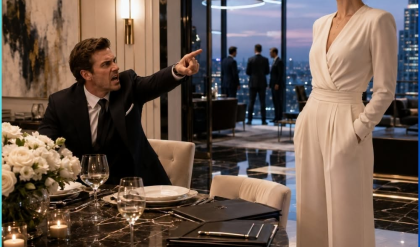
That evening, the dining room glowed with candlelight. Fifty corporate partners sat around the long mahogany table while rain tapped against the windows. Rachel moved quietly along the wall, pouring wine, avoiding Maxwell’s eyes whenever his gaze found her.
Jessica sat to his right in a red dress, her throat deliberately bare.
She waited until dessert.
Then she gasped.
“My heavens.”
Conversation stopped.
Jessica touched her collarbone with both hands. “The emerald necklace.”
Maxwell frowned. “What about it?”
“It is gone.”
His expression sharpened. “That is impossible. I locked it in the wall safe myself.”
“No, darling. We took it out this afternoon to admire it, remember? I placed it in the parlor, and now it is gone.” Jessica’s voice trembled perfectly. “The only people moving through the upstairs rooms today were servants.”
Rachel felt cold spread through her body.
Jessica turned her head slowly.
“And that maid lied about who she was.”
Mrs. Ruth burst through the kitchen doors. “Do not you dare.”
Maxwell rose. “Ruth, stay out of this.”
“No, sir, I will not. That girl has scrubbed your floors with bleeding hands and never taken so much as a spoonful of sugar that was not offered to her.”
Jessica’s eyes flashed. “How touching. The servants defend each other.”
Maxwell signaled security.
“Search the staff quarters,” he said.
Rachel stared at him.
He would not meet her eyes.
Ten minutes later, the guard returned with the velvet box.
He placed it on the dining table and opened it.
Emeralds glittered under the chandelier like green fire.
“I found it in the maid’s room,” he said. “Hidden in a cardboard box under her bed.”
Gasps moved around the table.
Rachel’s tray slipped from her hands and crashed to the floor, glass exploding across the marble.
“No,” she whispered. “No, I did not take it.”
Jessica rose with theatrical horror. “You ungrateful little thief.”
“I swear I did not touch it.” Rachel looked at Maxwell. “Please. You know I would not.”
Maxwell stared at the necklace.
Then at his partners.
Then at Rachel.
Pressure closed around him. Family name. Corporate reputation. Fifty men watching for weakness. Jessica’s voice whispering poison into the wound he had never healed.
“You lied about your past,” he said slowly.
Rachel’s face drained of color.
“Why should I believe you now?”
The question hit harder than the accusation.
For a moment, she could not breathe.
Then something in her broke cleanly instead of shattering.
“I told you my deepest truth in the music room,” she said, her voice quiet but steady. “I gave you the most broken part of my life, and the moment believing me costs you something, you choose doubt.”
Maxwell flinched.
Jessica seized the moment. “Throw her out before I call the police.”
“I will not call the authorities,” Maxwell said, still not looking at Rachel. “But I cannot have a suspected thief in this house. Pack your belongings and leave tonight.”
Mrs. Ruth made a sound like a wounded animal.
Rachel untied her apron.
Every person in the room watched as she folded it once and placed it over the back of a velvet chair.
“I will leave,” she said. “Not because I am guilty, but because I refuse to stay where I am not believed. I hope your cold jewels keep you warm at night, Mr. Anderson.”
She walked out through the service hall into the freezing rain with one small suitcase, her father’s photograph, and eight years of silence finally burning behind her.
She walked until her shoes filled with water.
By dawn, she was on a bus to Boston.
Back at the Anderson estate, Maxwell did not sleep.
Mrs. Ruth found him in the security office at seven in the morning, watching footage with a face ashen enough to frighten her.
On the screen, Jessica Crawford moved through the service stairs with a velvet box in her hand.
She entered Rachel’s room.
She left without it.
Maxwell rewound the footage twice, as if truth might become less damning if watched again.
Mrs. Ruth stood beside him, arms crossed.
“You saw her heart,” she said. “And when the room got loud, you listened to cowards.”
Maxwell closed his eyes. “I know.”
“No, you do not. Not yet. Knowing is not feeling guilty in a private room. Knowing is saying the truth where you said the lie.”
By noon, Maxwell called everyone back.
The fifty partners. The remaining birthday guests still in town. The staff. The security guard. Jessica and Richard, who arrived expecting a quiet triumph.
Instead, Maxwell stood at the front of the ballroom beside a projection screen and played the footage.
No one laughed this time.
Jessica went white.
Richard tried to leave and was stopped by security.
Maxwell faced the room.
“Rachel Sullivan was falsely accused in my house,” he said. “She was humiliated by a woman I allowed too close to my family and abandoned by a man who should have known better. I was that man.”
Jessica’s mouth twisted. “Maxwell, darling, this is being misunderstood.”
“No,” he said. “For once, it is being understood perfectly.”
He turned to the crowd.
“Miss Crawford stole my mother’s necklace, planted it in Rachel’s room, and lied in front of all of you. Her cousin assisted by investigating Rachel’s private tragedy and helping weaponize it. They will never enter this house again.”
Within twenty-four hours, Newport knew.
Jessica Crawford’s invitations vanished. Richard’s business contacts stopped returning calls. The society that had once fed on Rachel’s humiliation now devoured Jessica’s scandal with the same elegant appetite.
But none of that brought Rachel back.
For three days, Maxwell searched quietly. Not with newspaper announcements. Not with rewards. He knew enough, finally, not to make her pain public property again.
Arthur Belmont helped him.
“She sold a violin eight years ago,” the old patron said over the phone. “If you want to apologize, do not arrive empty-handed.”
It took Maxwell twelve days and a humiliating amount of begging to locate the collector who owned Rachel Sullivan’s custom violin. The man refused at first. Maxwell offered money. The collector still refused. So Maxwell told him the truth.
“I helped silence someone who should have been heard,” he said. “I am trying to undo one inch of the damage.”
The collector was quiet for a long time.
Then he said, “Come tomorrow.”
Maxwell found Rachel in a small repair shop in Boston, seated behind a counter with a cracked violin in her lap. She looked thinner, tired, but not broken. Sunlight fell through the dusty window across her hands.
She saw him and stood.
“If you came to offer money, leave.”
“I did not.”
“If you came to ask me to return to Newport, leave faster.”
“I am not asking.”
He placed a worn black violin case on the counter.
Rachel stared at it.
Her breath caught before she opened it. Some part of her already knew.
Inside lay her violin.
Not a replacement. Not a gift chosen by a rich man who thought all beautiful things were interchangeable.
Hers.
The small scar near the lower bout from when she dropped it at twelve. The initials E.S. carved discreetly inside by her father. The wood darkened by years against her neck.
Rachel touched it with two fingers and began to cry without making a sound.
Maxwell’s voice was rough. “I am sorry. Not because I was fooled. Because I was weak. Because you asked me to believe you, and I chose the room instead of the truth.”
Rachel did not look up. “You humiliated me.”
“Yes.”
“You made me leave in the rain.”
“Yes.”
“You do not get forgiven because you found something expensive.”
“I know.”
“What do you want from me?”
“Nothing,” he said. “That is the first decent thing I can offer you. Nothing. I only wanted you to have back what should never have been lost.”
Rachel lifted the violin from its case. Her hands shook, but not from fear this time.
The shop owner, an old man pretending not to listen, quietly closed the front door and turned the sign to closed.
Rachel tucked the violin beneath her chin.
For a moment, she heard rain. Metal. Her father’s last shout.
Then she heard something else.
Her father humming in their Boston kitchen. Mrs. Ruth saying the dead were honored by living. Maxwell admitting his shame without asking her to soften it for him.
She drew the bow across the strings.
The sound was not perfect.
It was better than perfect.
It was alive.
Six months later, the concert hall in Manhattan sold out in nine minutes.
The program did not call her a miracle. Rachel had refused that word. Miracles sounded too much like things people admired without understanding the cost.
It called her Rachel Sullivan, violinist.
Mrs. Ruth sat in the second row wearing a navy dress and crying before Rachel even walked onstage. Tommy sat beside her, gripping the program like a sacred document. Arthur Belmont occupied his usual aisle seat, cane across his knees, eyes bright with victory.
Maxwell sat in the front row.
Not beside her. Not as her owner, rescuer, or public romance.
Just as a man who had spent six months learning patience.
He had sold the birthday yacht he never used and established a foundation in his mother’s name to fund medical care for injured musicians. He had opened the locked music room twice a week for free lessons taught by local instructors. He had apologized publicly, privately, repeatedly, and without demanding that forgiveness arrive on his schedule.
Rachel noticed.
She did not rush to trust him. Trust, once broken, was not a chandelier that could be replaced by writing a check. It was more like a violin damaged in a storm. It had to be repaired slowly, by skilled hands, with humility and time.
That evening, she stepped onto the stage in a deep green gown that Mrs. Ruth said made her eyes look like spring after a hard winter.
For one second, the old fear returned.
Then she saw Maxwell.
He did not smile as if he had won something.
He simply placed one hand over his heart.
Rachel lifted her bow.
The first note rose into the hall, pure and strong.
She played for her father.
She played for the girl who had hidden in pantry rooms because grief convinced her silence was safer than living.
She played for every servant who had ever been mocked by people too rich to recognize dignity.
She played for Maxwell’s mother, whose violin had awakened a house.
And she played for herself.
When the final note faded, the audience rose as one.
Rachel lowered her violin and looked toward the front row. Maxwell was crying openly now, unashamed. Mrs. Ruth was clapping with both hands over her heart. Tommy was shouting her name until Arthur Belmont told him, through tears, to shout louder.
Rachel smiled.
Not the careful smile of a maid trying to survive.
Not the broken smile of a woman apologizing for existing.
A real smile.
Months later, when Maxwell asked if he might court her properly, Rachel made him wait on the porch of Mrs. Ruth’s cottage while she finished tea. Mrs. Ruth inspected him through the screen door as if he were a suspicious delivery.
“You hurt my girl once,” she told him.
“I know.”
“If you hurt her again, I have cast-iron pans older than your fortune and better aim than your security team.”
Maxwell nodded solemnly. “I believe you.”
Rachel laughed from inside the kitchen, and that laugh did more for him than any yes could have done.
Years later, people still told the story of the night a millionaire mocked a maid with his dead mother’s violin and accidentally introduced Newport society to the woman who would silence them all.
But Rachel never told it that way.
She said it was the night she learned humiliation could become a doorway if you refused to crawl through it.
She said it was the night Maxwell Anderson learned that wealth could fill rooms but not empty hearts.
She said it was the night a violin came out of a glass case, and two people who had mistaken grief for strength finally heard the truth.
Love did not begin with a wager.
It began after the apology.
It grew in the patience that followed.
And Rachel Sullivan, who had once believed her music was buried with her father, spent the rest of her life proving that the dead are not honored by our silence.
They are honored every time we find the courage to sing again.
THE END.