“Thirty-eight.”
“Applications?”
“Rejections.”
Maya winced. “Viv.”
Vivian clicked submit on another one. “Then I’m due.”
The offer came six weeks later from a company called Northstar Civic Systems in Seattle. They built technology for cities, hospitals, and public agencies, the kind of invisible infrastructure that kept vulnerable people from falling through cracks. Vivian had submitted a proposal with her application about redesigning emergency intake systems for low-income clinics.
The email subject line read, We would like to discuss a senior strategy role.
By the end of the call, they had offered relocation, a signing bonus, and a salary that made Vivian check twice to make sure she had not misunderstood the number.
She called her mother first.
Denise cried so hard Vivian had to laugh.
“Seattle,” her mother said. “That’s far.”
“I know.”
“You scared?”
“Terrified.”
“Good,” Denise said. “That means it’s big enough.”
Maya helped her pack. On Vivian’s last night in Boston, they sat on the floor eating takeout noodles from cartons, surrounded by half-taped boxes.
“Do you think he’ll hear you left?” Maya asked.
Vivian twisted noodles around her fork. “Probably.”
“Do you want him to?”
Vivian thought about it.
The honest answer surprised her.
“No,” she said. “I want to go so far that whether he hears or not stops mattering.”
Seattle did not welcome her gently.
It rained for eleven straight days after she arrived. Her apartment had a radiator that clanked like a ghost dragging chains through the walls. She got lost twice on her way to work the first week and once cried in a grocery store because she could not find the brand of coffee her mother liked.
At Northstar, she was younger than most senior hires and lacked the polished pedigree people expected in executive meetings. She noticed the pauses when she introduced herself. Ohio State, not Harvard. Public scholarship, not family trust. Strategy talent, not legacy referral.
But Vivian had survived humiliation in a room full of strangers.
A conference table did not scare her.
She listened more than she spoke at first. Then she spoke with precision. She arrived early, stayed late, learned every system, every client, every weakness in the product pipeline. She built models no one had requested, solved problems before they became public, and refused to apologize for taking up space.
One year in, she led a failing municipal health project back from cancellation.
Two years in, she became director of civic innovation.
Three years in, she was invited to speak at conferences where people who had once ignored her now lined up afterward to shake her hand.
By the fourth year, Vivian began building something of her own.
The idea came from her mother.
Denise called one evening after a twelve-hour shift at the clinic, exhausted and frustrated because three patients had missed follow-up care after being discharged from the ER.
“They didn’t understand the paperwork,” Denise said. “One woman thought her appointment was next month. It was tomorrow. Another never got the referral because the system sent it to an email she doesn’t use.”
Vivian sat up slowly.
“What?” Denise asked.
“Say that again.”
“People don’t read their email?”
“No. The system doesn’t meet people where they are.”
That sentence became the seed.
Vivian left Northstar nine months later with a business plan, a small team of five, and enough savings to terrify any reasonable person. She called the company BridgePoint Access, a platform that helped hospitals, clinics, shelters, and public agencies coordinate care in plain language, across text, phone, and community networks.
Investors were polite until they realized she was serious.
One man in a navy vest smiled through her pitch and said, “This is admirable, but not exactly a billion-dollar idea.”
Vivian smiled back. “That’s what people say when they don’t understand the size of the problem.”
He passed.
Someone else didn’t.
Then another.
Then a hospital network signed.
Then a state agency.
Then three more.
BridgePoint grew quietly at first, then suddenly. Journalists started calling. Vivian’s name appeared on lists with words like visionary and disruptive and founder to watch. She hated the attention until she realized attention could open doors for the work.
Six years after Ethan Harrow told her she did not belong in rooms like his, Vivian Parker walked onto a stage in New York City to accept the Ellery Prize for Social Innovation while an audience of CEOs, governors, investors, and philanthropists stood to applaud her.
She looked out at the lights and thought of The Marlowe.
Not with pain.
With distance.
That was when she understood that some wounds do not heal because someone apologizes.
They heal because the person who was wounded becomes too large for the wound to hold.
Part 2
Vivian met Caleb Monroe on a Tuesday in October, in the least romantic place imaginable.
A hotel service hallway.
She had just finished giving the closing keynote at the National Future Cities Forum in Chicago. The ballroom had been packed. Her speech had gone well enough that three people cried, two investors requested meetings, and one mayor from Arizona hugged her without warning.
Vivian was trying to escape through a side corridor when she realized she was lost.
Her heels clicked against concrete. Somewhere nearby, staff rolled carts of empty champagne flutes toward an elevator. She turned a corner and nearly collided with a man holding two cups of coffee.
He saved both cups with reflexes so smooth she actually noticed.
“Impressive,” Vivian said.
He looked at the coffee, then at her. “I’ve had years of practice preventing disasters in expensive suits.”
He was tall, broad-shouldered, and calm in a way that did not ask permission. His dark hair was slightly mussed, as if he had run one hand through it too many times. He wore no visible logo, no flashy watch, nothing that announced wealth. Still, everything about him suggested the world moved differently around him.
Vivian recognized him after three seconds.
Caleb Monroe.
Founder of Monroe Infrastructure Group. Self-made billionaire. Known for buying failing logistics, energy, and construction companies and turning them into essential systems that cities depended on. He avoided publicity, disliked interviews, and had once walked out of a televised panel after someone called poverty an efficiency problem.
Vivian had admired him from a safe professional distance.
Now he was standing in front of her with coffee on his sleeve.
“I’m sorry,” she said. “I didn’t see you.”
“I saw you,” he said.
It was not flirtatious. Not exactly. It was direct enough to make her still.
He cleared his throat and offered one cup. “This was for a senator who has been explaining procurement law to me for forty minutes. I think you’ve earned it more.”
Vivian looked at the cup. “That feels like a federal crime.”
“Probably a misdemeanor.”
She took it.
They ended up sitting on two stacked crates beside a loading dock while the conference continued without them. For twenty minutes, they talked about hospital data gaps, rural broadband, bad grant design, and the strange moral theater of wealthy people applauding solutions they had no intention of funding.
Then twenty minutes became an hour.
Then someone from Vivian’s team called and asked where she was.
“Somewhere between the ballroom and an existential crisis,” Vivian answered.
Caleb laughed then, a real laugh that changed his whole face.
That laugh stayed with her.
He emailed the next morning. Not with a vague “great meeting you” note or a polished assistant-written invitation. A real message. Three paragraphs about her work, two questions that proved he had listened, and one sentence at the end that made her pause.
I don’t meet many people who build as if dignity is part of the blueprint.
Vivian read it twice.
She responded.
For three months, their relationship lived in messages, calls, and the occasional dinner when their schedules collided in the same city. Caleb never rushed her. Never pushed. Never treated her time as less valuable than his. If she said she had a board meeting, he wished her luck and asked afterward how it went. If she challenged his view on infrastructure investment, he listened and sometimes changed his mind.
The first time he visited her office in Seattle, the staff panicked.
“Vivian,” her COO whispered, appearing in her doorway with wide eyes, “there is a billionaire in the kitchen making tea.”
Vivian looked up from a contract. “Is he doing it wrong?”
“I don’t know. He asked where we keep the honey.”
“Top cabinet.”
“That is not the point.”
Caleb won over the office by remembering names, asking interns what they were building, and fixing the loose leg on the break room table with a screwdriver someone found in a drawer.
Later, when Vivian walked him to the elevator, she said, “You know, most men in your position don’t repair furniture on first visits.”
“I’m trying to appear useful.”
“You already are.”
His gaze softened. “Good.”
That was the thing about Caleb. He did not make grand speeches about seeing her. He simply did. In every room. In every silence. In every moment when other people tried to interrupt her and found his eyes settling on them like a warning.
But love, for Vivian, was no longer something she fell into blindly.
It was something she studied.
She watched how Caleb treated servers. How he spoke to his sister on the phone. How he responded when a deal collapsed. How he acted when he was tired, disappointed, inconvenienced, contradicted.
He was not perfect. He could be stubborn. He forgot to eat when he worked. He had a habit of staring out windows when something bothered him instead of saying it directly.
But he was kind in the places where kindness cost something.
One snowy evening in New York, nearly a year after the service hallway, Caleb walked with Vivian through Central Park after a fundraiser. She wore a long wool coat. He wore no scarf because he claimed he never got cold, which Vivian considered both false and dramatic.
They stopped near a bridge dusted white with snow.
Caleb was quieter than usual.
Vivian looked at him. “You’re doing the window thing, except there’s no window.”
He smiled faintly. “I’m thinking.”
“Dangerous.”
“Very.”
She waited.
He turned toward her. Snow caught in his hair. For all his wealth, all his power, all the headlines that tried to make him seem untouchable, he looked almost nervous.
“I love you,” he said.
Vivian’s breath caught.
He did not rush to fill the silence.
“I love the woman you are when rooms underestimate you,” he continued. “I love the woman you are with your mother. I love how you build things that outlive applause. I love your temper when systems fail people. I love your laugh when you forget to guard it.”
Vivian’s eyes burned.
“And I know love isn’t a rescue,” Caleb said. “You already rescued yourself. I’m not asking to become your story. I’m asking to stand beside it.”
For a moment, all Vivian could hear was the hush of snow and the distant sound of traffic.
Then she said, “I love you too.”
His face changed with such relief that she laughed through her tears.
He kissed her gently under the falling snow, and for the first time in years, Vivian let herself believe love could feel like peace instead of proof.
Six months later, Caleb proposed in her mother’s backyard in Ohio.
He had asked Denise’s blessing, not permission.
“She doesn’t belong to anyone but herself,” Denise told him, standing beside a tray of lemonade on the porch.
“I know,” Caleb said. “That’s one of the reasons I love her.”
Denise studied him for a long moment.
Then she nodded. “Good answer.”
The proposal happened at dusk, after dinner, beneath the maple tree Vivian used to climb as a girl. Maya was there, pretending she had flown in just because she missed Denise’s cooking. Vivian noticed the fairy lights too late. She turned and found Caleb on one knee, holding a ring that looked elegant and old-fashioned and impossibly beautiful.
“I have negotiated mergers worth more than small countries,” he said, voice unsteady, “and none of them scared me as much as asking you this.”
Vivian covered her mouth.
“Vivian Parker, will you marry me?”
She knelt too, because standing over him felt wrong, and took his face in both hands.
“Yes,” she whispered. “Yes.”
Maya screamed. Denise cried. A neighbor’s dog barked like it had also been waiting for this moment.
The wedding should have been in Seattle, or maybe at Denise’s church in Ohio, or on some private island people expected billionaires to rent. Instead, Vivian chose Boston.
Caleb asked only once.
“Are you sure?”
They were sitting in his kitchen in New York, barefoot, surrounded by venue folders and half-eaten Thai food.
Vivian traced the rim of her wineglass. “I’m sure.”
“Because of him?”
“Because of me.”
Caleb waited.
Vivian looked toward the window, where the city burned gold below them. “For a long time, Boston was the place where I became small. I left because I had to. But I don’t want any city on earth to feel like it owns the worst version of me.”
Caleb reached across the counter and took her hand.
“I want to go back as myself,” she said. “Not to prove anything to Ethan. Not even to show him what he lost. I want to stand there and feel nothing but my own life.”
“Then Boston it is.”
Caleb’s family estate outside the city, a restored stone mansion overlooking the water in Manchester-by-the-Sea, became the venue. His team handled security. Vivian insisted on warmth over spectacle, but wealth had a way of making even restraint look cinematic. White roses, candlelit glass, live music, long tables under a clear tent facing the Atlantic.
Because Caleb was famous and private, the announcement became a storm.
Caleb Monroe is getting married.
No one knew to whom.
His office released only a short statement saying he would marry a respected American entrepreneur in a private ceremony in Massachusetts. No photos. No full biography. No interviews.
The speculation became ridiculous within hours.
A news site guessed an actress.
A finance blog suggested an heiress.
A gossip account claimed it was the daughter of a senator, then deleted the post when the senator’s daughter publicly announced she was single and in Portugal.
Vivian found the whole thing absurd.
Caleb found it annoying.
“We could release your name,” he said one evening.
“No,” Vivian said, reading an article that described her as mysterious. “This is the most entertained I’ve been all year.”
He looked over her shoulder. “They think you’re a former Olympic skier.”
“I’ve been called worse.”
The invitations went out three weeks before the wedding.
Among the guests was Ethan Harrow.
Caleb had not invited him personally. Ethan’s invitation came through the Harrow Foundation, which had recently partnered with one of Caleb’s charitable infrastructure initiatives. Richard Harrow was invited. Richard was recovering from surgery and sent Ethan in his place, along with Ethan’s fiancée.
Caroline Westlake.
Six years had passed since The Marlowe.
Ethan had not become the titan his father imagined. He was successful, certainly. He sat on boards, appeared in society pages, and spoke with great confidence about deals other people mostly executed. But he had not built anything original. He had inherited momentum and mistaken it for speed.
His engagement to Caroline had lasted, paused, resumed, and lasted again. They were a good match on paper, which was where most of their relationship seemed to live.
When the invitation arrived, Ethan was pleased.
“A Monroe wedding,” he told Caroline over breakfast, turning the thick cream envelope in his hand. “Do you know what kind of room this will be?”
Caroline looked up from her coffee. “A wedding, presumably.”
“A strategic room.”
She gave him a tired smile. “How romantic.”
Ethan ignored the tone. Caleb Monroe was notoriously difficult to access. If Ethan could speak to him, even briefly, about the redevelopment fund his firm was chasing, the evening could become professionally valuable.
He did not care much about the bride.
No one knew who she was anyway.
On the morning of the wedding, Vivian woke before her alarm.
For a few minutes, she lay still in the bridal suite, watching pale light move across the ceiling. The ocean murmured beyond the windows. Somewhere down the hall, Maya was already awake; Vivian could hear the faint clatter of hangers and whispered instructions.
Her dress hung near the window.
It was not the kind of dress she would have imagined at twenty-six when she was trying desperately to be accepted by people who valued price over beauty. This gown was simple from a distance, ivory silk with a clean neckline and long sleeves, but up close, thousands of tiny hand-sewn pearls shimmered like morning light on water.
Denise entered quietly in a robe, carrying two mugs of coffee.
“You awake?”
“No.”
Denise smiled. “Liar.”
She sat on the edge of the bed and handed Vivian a mug.
For a while, they drank in silence.
Then Denise said, “I thought about that night.”
Vivian looked at her.
“The night you called me from Boston,” her mother said. “I wanted to get on a plane and slap that boy so hard his ancestors felt it.”
Vivian laughed softly. “Mom.”
“I didn’t. Growth.” Denise took a sip of coffee. “But I remember your voice. How broken you sounded.”
Vivian looked down at the ring on her finger.
“I was broken.”
“No,” Denise said. “You were hurt. Broken means beyond repair. You were never that.”
Vivian swallowed.
Denise reached out and brushed hair from her daughter’s face, the way she had when Vivian was small and feverish.
“Today isn’t revenge,” her mother said. “Don’t let anybody, even in your own heart, make it that small.”
Vivian’s eyes filled.
“It’s not,” she whispered.
“I know.” Denise smiled. “But sometimes we have to say true things out loud so the old lies know they’re not welcome.”
By noon, guests began arriving.
Cars rolled up the long drive. Men in tailored suits and women in silk dresses stepped onto the stone path beneath a sky so blue it looked polished. Inside the tent, candles waited unlit in glass cylinders. White flowers climbed the beams. The Atlantic flashed beyond the lawn.
Ethan arrived with Caroline at 3:40.
He wore a charcoal suit and the expression of a man expecting to be recognized. Caroline looked beautiful in a pale blue dress, her blond hair pinned neatly at the nape of her neck. She seemed calm, though a little bored.
“This is lovely,” she said.
“It’s Monroe,” Ethan replied. “Of course it is.”
They moved through the crowd. Ethan shook hands, exchanged names, collected information. He saw senators, investors, media executives, tech founders, museum trustees. A perfect room. A room his father would have called useful.
Still, something bothered him.
There was a charge in the air that felt larger than a social event. People whispered about the bride. Not with the usual dismissive curiosity reserved for women marrying rich men, but with anticipation. Respect, even.
“Do you know anything about her?” Ethan asked a man from a private equity firm.
“Only that Monroe looks at anyone who asks too many questions like he might buy their company and dissolve it.”
Ethan laughed politely.
Caroline touched his sleeve. “You’re tense.”
“I’m focused.”
“On someone else’s wedding?”
“It’s important to pay attention in rooms like this.”
She looked at him for a moment, then turned away. “You always do.”
The ceremony began at five.
Guests took their seats facing the ocean. A string quartet played beneath the soft rush of waves. Caleb stood at the front in a black tuxedo, his posture straight, his face composed except for his hands.
They kept opening and closing.
Ethan noticed because he was trained to notice weakness.
Then the music changed.
Everyone stood.
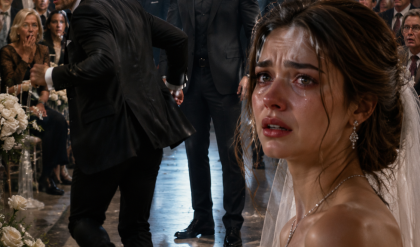
At the far end of the aisle, the doors of the estate opened.
And Vivian Parker stepped into the light.
Part 3
For one suspended second, Ethan Harrow did not understand what he was seeing.
The woman at the end of the aisle was poised, luminous, and utterly calm. Sunlight caught the pearls on her gown and scattered across the silk like sparks. Her hair was swept back from her face, revealing the elegant line of her neck, the quiet confidence in her expression, the kind of beauty that did not ask to be approved.
The guests reacted before Ethan could.
A murmur moved through the rows.
Then another.
Someone whispered, “That’s Vivian Parker.”
Someone else said, “BridgePoint Vivian Parker?”
The name traveled faster than the music.
Vivian Parker.
Founder. CEO. Award winner. Speaker. Builder of one of the most important public access platforms in the country.
Ethan had read about her.
Of course he had. Everyone in his circles had. He had seen her name in business magazines, heard it in boardrooms, nodded thoughtfully while older men discussed whether BridgePoint would become the next essential civic technology company. Once, at a dinner, someone had called her “the rare founder who understands both money and mercy,” and Ethan had said, “Impressive,” without realizing he was talking about the woman he had left sobbing in a taxi.
Now she was walking toward Caleb Monroe.
Not as a guest.
Not as a curiosity.
As the bride.
The mysterious woman no one could identify.
The woman the billionaire had protected from public consumption because he valued her peace more than the world’s curiosity.
Ethan’s hand tightened around the back of the chair in front of him.
Caroline glanced at him. “Ethan?”
He did not answer.
Vivian passed row after row, her eyes fixed on Caleb. She did not scan the crowd. She did not search for reactions. She did not know yet, or did not care, that Ethan was standing less than twenty feet away with his carefully chosen fiancée and his carefully constructed life coming apart behind his ribs.
Caleb’s face transformed when he saw her.
That was the second blow.
Ethan had expected Caleb Monroe to look proud. Men like Monroe collected rare things. Companies. Land. Influence. A brilliant wife would be another form of victory.
But Caleb did not look like a man showing the world what he had won.
He looked humbled.
As if Vivian walking toward him was not an addition to his life, but a mercy he could barely believe had been granted.
When she reached him, Caleb took her hand with such care that Ethan felt heat rise in his face.
He remembered his own hand around Vivian’s wrist years ago, tugging her away from a conversation with his mother’s friends because she had laughed too loudly. He remembered correcting her pronunciation of a French wine in front of strangers. He remembered telling himself these things were refinements, not cruelties.
He remembered the restaurant.
You don’t belong here.
You never did.
The officiant began speaking, but Ethan heard almost none of it.
He watched Vivian smile.
He watched Caleb lean closer when she spoke her vows.
He watched the entire audience hold its breath at the quiet force of her voice.
“I used to think love was a door someone else had to open for me,” Vivian said, looking at Caleb. “Then life taught me to build my own house. You never asked me to leave it. You knocked gently. You waited. And when I opened the door, you treated everything inside as sacred.”
Maya cried openly in the front row. Denise held a handkerchief to her mouth.
Caleb’s eyes shone.
When it was his turn, his voice was low but steady.
“Vivian, I have stood in towers, boardrooms, factories, and cities before dawn. I have watched bridges rise and companies return from ruin. But the strongest thing I have ever seen is you choosing tenderness after the world gave you reasons not to. I promise to honor the life you built before me, the woman you are beside me, and every dream still waiting ahead of us.”
Vivian’s face trembled.
Ethan looked away.
But there was nowhere safe to look.
Everywhere around him, powerful people were watching Vivian Parker become Vivian Parker Monroe. Not because she needed the name. Anyone could see that. She stood beside Caleb as an equal, not an accessory. That made it worse.
The officiant pronounced them married.
Caleb kissed her.
The crowd rose in applause so thunderous the gulls lifted from the rocks below.
Ethan stood because everyone stood. He clapped because not clapping would have drawn attention. But inside, something old and ugly twisted.
He had not simply lost her.
He had misjudged her.
There was a difference.
Losing her could be blamed on timing, family pressure, youth, fear.
Misjudging her had no elegant excuse.
The reception began under the clear tent as sunset turned the ocean copper and rose. Glasses chimed. Music swelled. Waiters carried trays of lobster rolls, short rib, tiny crab cakes, and champagne that probably cost more per bottle than Vivian’s first monthly rent in Boston.
Ethan drank too quickly.
Caroline noticed.
“You know her,” she said.
It was not a question.
He looked at her. “Who?”
Caroline’s gaze was cool. “Don’t insult me.”
Ethan set down his glass. “We dated. Years ago.”
“How many years?”
“Six.”
“How long did you date?”
He hesitated.
Caroline laughed once, softly. Not amused. “That long.”
“It ended before you and I were serious.”
“That isn’t what I asked.”
Ethan looked toward the dance floor.
Vivian was dancing with Caleb. Not the stiff, choreographed dance of society weddings. Something slower. Closer. He said something near her ear and she laughed, her head tipping back, her whole face unguarded.
Ethan had seen that laugh before.
Once, he had believed it belonged to him.
“She’s changed,” he said.
Caroline followed his gaze. “No. I think she became harder for you to misunderstand.”
That struck too close.
He turned. “What’s that supposed to mean?”
“It means I’ve watched you all evening. You don’t look like a man surprised by an old girlfriend. You look like a man offended that someone you placed beneath you climbed out of the box.”
Ethan’s face flushed. “That’s unfair.”
“Is it?”
He had no answer.
Caroline looked at Vivian again, then at Caleb. Something in her expression shifted. A decision, maybe. Or the beginning of one.
“I’m going to get some air,” she said.
“Caroline.”
But she was already walking away.
Ethan told himself not to approach Vivian.
He told himself it would be inappropriate. He told himself weddings were emotional, that the shock would pass, that he should leave with dignity and speak to Caleb some other time through proper channels.
Then he saw Vivian step away from Caleb near the terrace doors.
She was alone for the first time all evening.
Ethan moved before wisdom could stop him.
Outside, the terrace overlooked the darkening water. The air smelled of salt, roses, and candle smoke. Vivian stood near the stone railing with a glass of water in her hand, her veil removed now, the pearls in her gown catching stray light from the tent.
She turned when she heard footsteps.
For the first time in six years, their eyes met.
Ethan expected anger.
He expected shock.
He expected some flicker of the girl from The Marlowe, wounded and trembling beneath the weight of what he had said.
Instead, Vivian looked at him with polite recognition.
As if he were someone she had once met at a conference and could not immediately place.
That hurt more than hatred.
“Vivian,” he said.
“Ethan.”
Her voice was calm.
He tried to smile. It felt unfamiliar on his face. “Congratulations.”
“Thank you.”
“You look…” He stopped. Every word sounded inadequate, or worse, opportunistic. “You look very happy.”
“I am.”
The simplicity of it left no opening.
He glanced back toward the tent, where Caleb was speaking to an older woman in emerald silk but watching Vivian from the corner of his eye. Not possessively. Attentively.
“I didn’t know,” Ethan said.
Vivian tilted her head. “Didn’t know what?”
“That it was you. The bride.”
“No one did.”
“No,” he said quickly. “I mean, I didn’t know what you had become.”
Something changed in her eyes then. Not pain. Not anger. A faint disappointment, perhaps, like he had confirmed something she had stopped needing to prove.
“What I had become,” she repeated.
Ethan heard it then. The mistake.
“I didn’t mean it like that.”
“How did you mean it?”
He swallowed.
The ocean moved below them, dark and restless.
“I mean I knew you were successful,” he said. “I’d heard your name. I just didn’t realize…” He laughed once, helplessly. “I didn’t realize Vivian Parker was you.”
“She was always me.”
The words landed quietly.
He looked down.
For years, Ethan had imagined apologies in abstract ways. Not because he intended to offer one, but because guilt sometimes rehearsed itself in private. In those imagined moments, Vivian cried. Or forgave him. Or admitted he had hurt her. Or said she understood the pressure he had been under.
None of those fantasies had prepared him for this calm woman in pearls who seemed to need nothing from him at all.
“I was cruel,” he said.
“Yes.”
No softening. No rescue.
He deserved that.
“I was cowardly too.”
“Yes.”
He flinched.
Vivian set her glass on the railing. “Ethan, why are you here?”
The question was not unkind. That made it worse.
“I wanted to say I’m sorry.”
“For which part?”
He looked at her.
She continued, voice even. “For ending a relationship in the cruelest way you could find? For saying my mother’s job like it was something dirty? For letting me spend three years trying to earn basic respect from people who had already decided I wasn’t worth learning? For telling me I didn’t belong in front of an entire restaurant?”
Each sentence was a door opening onto a room he had locked and left behind.
“Yes,” he said, voice rough. “For all of it.”
Vivian studied him.
Then she looked out at the ocean.
“When I was younger,” she said, “I thought the worst thing you did was leave.”
Ethan said nothing.
“But it wasn’t. The worst thing you did was make me believe, for a while, that love was something I had to qualify for. That if I dressed correctly, spoke correctly, smiled at the right moments, swallowed enough insults, maybe I would become acceptable.”
Her voice did not shake.
“That was never love.”
“No,” he whispered. “It wasn’t.”
“I know that now.”
The music inside shifted to something slower. Guests laughed. Somewhere, Maya shouted Vivian’s name, probably looking for her for photos.
Ethan forced himself to ask the question that had been burning since she appeared at the end of the aisle.
“Do you hate me?”
Vivian looked back at him.
For a moment, she seemed almost surprised.
“No.”
He should have felt relief.
He didn’t.
“Hating you would require me to keep you closer than you deserve,” she said gently. “I don’t hate you, Ethan. I don’t think about you enough for that.”
The sentence was not cruel.
It was clean.
Final.
Ethan felt it pass through him like cold water.
“I thought seeing you tonight would feel different,” Vivian admitted.
He searched her face. “Different how?”
“I thought maybe some part of me would want you to see me and regret it.”
His mouth went dry.
“Do you?”
She smiled then. A small, honest smile.
“No. That’s how I know I’m free.”
Behind them, the terrace doors opened.
Caleb stepped out.
He did not interrupt immediately. He looked between them, reading the air with the quiet intelligence that had made him dangerous in a thousand negotiations and safe in the only ways Vivian needed.
“Everything okay?” he asked.
Vivian turned toward him, and her entire face warmed.
“Yes,” she said. “Everything is okay.”
Caleb came to her side. Ethan watched him place a hand lightly at her back, not claiming, not steering, just there.
Vivian looked at Ethan one last time.
“I hope you become better than the man who hurt me,” she said. “Not for me. For yourself. For whoever stands beside you next.”
Ethan thought of Caroline alone somewhere in the dark garden, probably already understanding more than he had admitted.
Vivian took Caleb’s hand.
“Goodnight, Ethan.”
Then she walked away with her husband.
Not hurriedly.
Not dramatically.
She simply returned to her life.
And Ethan was not in it.
Inside the tent, Caleb leaned close as they reentered the warmth and music.
“Are you sure you’re alright?”
Vivian squeezed his hand. “I am.”
“Do I need to dislike him more actively?”
She laughed. “No.”
“I can be very efficient.”
“I know.”
They paused just inside the entrance. Across the room, Denise watched her daughter with wet eyes. Maya lifted both thumbs. The band began calling guests back to the dance floor.
Vivian looked at all of it. The flowers. The lights. The ocean beyond the glass. Her mother alive and proud. Her best friend glowing with joy. Her company’s team laughing at a table near the back. Caleb beside her, warm and real and steady.
For years, she had imagined triumph as noise.
Applause. Recognition. The right people finally knowing they were wrong.
But standing there, Vivian realized triumph was quieter than that.
It was peace in a place that once held pain.
It was returning without shrinking.
It was hearing an old lie spoken in memory and feeling nothing answer inside you.
Caleb held out his hand. “Dance with me, Mrs. Monroe?”
She pretended to consider. “I’m still professionally known as Parker.”
“I am aware. I signed the paperwork.”
“Good.”
“But in this specific romantic context?”
She smiled and placed her hand in his. “Then yes, Mr. Monroe.”
He led her onto the dance floor.
The crowd parted naturally, not because of Caleb’s money or Vivian’s fame, but because there are moments people instinctively understand they are lucky to witness.
As they danced, Vivian caught sight of Ethan near the edge of the tent.
He stood alone.
For half a second, their eyes met.
This time, there was no restaurant around them. No marble floor. No chandelier. No young woman trying not to cry while a man mistook cruelty for honesty.
There was only Vivian, held by a man who knew her worth had never depended on being held at all.
She looked away first.
Not to punish Ethan.
Not to prove a point.
Because the song was beautiful, her husband was smiling, and the rest of her life was waiting.
Later that night, long after the last toast, after Denise gave a speech that made half the room cry, after Maya danced barefoot with a venture capitalist’s shy teenage son because he was too nervous to ask anyone else, after Caleb’s sister stole the microphone and revealed he had practiced his vows on a confused golden retriever, Vivian stepped outside alone for one final breath of air.
The moon hung over the Atlantic.
Her dress brushed the stone terrace.
She thought of the girl in the green satin dress.
The girl who had walked out of The Marlowe shaking.
The girl who believed leaving with dignity meant she had somehow lost because nobody chased her into the street.
Vivian wished she could go back and hold her.
She wished she could say, He is not the door. He is not the room. He is not the world.
She wished she could say, One day, you will stand under lights brighter than that restaurant ever had, and you will not need him to see you.
But maybe that girl had known enough.
Maybe that was why she walked out.
Maybe the first act of becoming was not the winning, not the building, not the applause, not the love that came later.
Maybe it was simply refusing to remain where someone tried to make you small.
Caleb found her there a few minutes later.
“Cold?” he asked.
“A little.”
He took off his jacket and draped it around her shoulders.
She smiled. “You know this is how rumors start.”
“We’re married. I’m hoping rumors are allowed.”
Vivian leaned into him, looking out at the water.
“Do you ever think about all the versions of us that almost didn’t make it here?” she asked.
Caleb was quiet for a moment.
“Yes,” he said. “Then I feel grateful to the versions that did.”
She closed her eyes.
Inside, music rose again. Laughter spilled through the open doors. Someone called for the bride.
Vivian turned toward the sound.
The night was not an ending, not really.
It was a threshold.
Tomorrow there would be emails, flights, board meetings, breakfast with family, thank-you notes, and the ordinary work of loving someone after the beautiful pictures were taken. There would be hard days. There would be disagreements. There would be storms neither money nor success could prevent.
But Vivian was not afraid of storms.
She had survived the one that came disguised as rejection.
She had built a life from the wreckage.
And when the man who humiliated her watched a billionaire take her hand, the greatest victory was not that he regretted it.
It was that she no longer needed him to.
THE END