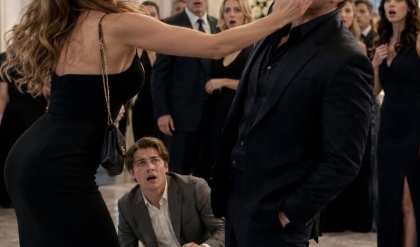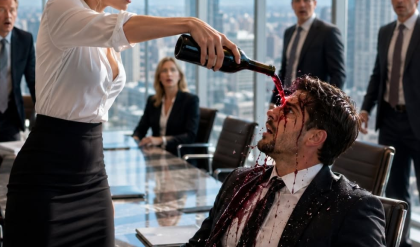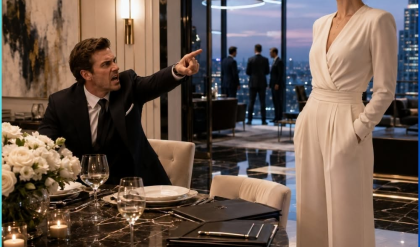
Norah stared at the glass doors where Declan’s shape disappeared into the night.
“No,” she whispered. “I think I finally made him angry.”
Tessa touched her hand.
“Is that bad?”
Norah did not know how to answer.
Because somewhere deep in her chest, beneath the fear and humiliation and rage, something else had stirred awake.
Not hope.
Something more dangerous.
Proof.
Part 2
Declan did not speak to her on the ride home.
That was the worst part.
Norah sat on one side of the armored Lincoln while he sat on the other, the dark leather between them feeling like the last narrow bridge over a canyon. Streetlights slid across his face in brief flashes. His jaw was clenched. One hand rested on his knee. The other held his phone so tightly his knuckles had gone white.
She waited for the explosion.
It did not come.
When the car passed the river, Norah finally said, “You embarrassed me.”
Declan did not look at her.
“No.”
“No?”
“I stopped myself from embarrassing you.”
She turned fully toward him.
“You walked into that gallery like you owned the air.”
“I do own half the air in that neighborhood.”
“That’s not funny.”
“I wasn’t joking.”
Norah laughed in disbelief and looked out the window.
“Eighteen months of silence, Declan. Eighteen months of treating me like a painting you bought at auction and forgot to hang. Then one man touches my arm and suddenly you remember I exist?”
His eyes cut to her.
There it was again.
That dark, focused heat.
“I never forgot you existed.”
“Could have fooled me.”
His mouth tightened.
The rest of the drive passed in a silence that felt less empty than before. Not peaceful. Not safe.
Charged.
At the estate, Donovan opened the door. Norah stepped out first, gathering her dress. She expected Declan to vanish into his study, as he always did.
Instead, he followed her up the stone steps.
Inside, the foyer lights glowed soft gold against marble floors. A housekeeper appeared and disappeared like a frightened ghost.
Norah removed her earrings with shaking fingers.
“I’m going to bed.”
“No,” Declan said.
She turned.
“Excuse me?”
“We’re going to talk.”
“Now you want to talk?”
His eyes flashed.
“Yes.”
Norah should have walked away. She should have gone upstairs, locked her bedroom door, and left him to choke on all the words he had denied her.
Instead, she said, “Fine.”
Declan led her into his private study.
She had been inside only twice before. Once to sign tax documents. Once when a florist needed approval for a charity dinner arrangement and Declan was in Detroit. The room smelled of leather, paper, and old whiskey. Books lined the walls, but Norah knew the real business of the room happened at the massive desk, where maps of ports and warehouses lay beneath contracts that looked legitimate until you knew how to read between the lines.
Declan shut the door.
He did not lock it.
That surprised her.
He poured himself a drink, then looked at the glass and set it down untouched.
“What do you want me to say?” he asked.
Norah stared at him.
“For once? The truth.”
His laugh was quiet and humorless.
“The truth is dangerous.”
“So is living with a stranger.”
That landed.
Declan turned away, bracing both hands on the desk. For several seconds, he looked less like the man who commanded Chicago and more like a man holding a door shut against a storm.
“You were never supposed to matter,” he said.
Norah’s breath caught.
He continued without turning around.
“Your father wanted protection. I wanted the South Docks. You were the cleanest way to make the deal hold. A marriage makes men hesitate before breaking terms. That was all it was supposed to be.”
“I know what I was sold for.”
Declan flinched.
It was small, but she saw it.
“You weren’t sold.”
“Don’t insult me by dressing it up.”
He turned then, eyes dark.
“I gave your father three options. War. Exile. Or marriage. He chose marriage because he knew I would keep you alive.”
Norah’s voice dropped.
“Alive is not the same as living.”
“No,” he said. “It isn’t.”
The honesty was so unexpected that it silenced her.
Declan crossed the room slowly, stopping a few feet away.
“I kept my distance because I did not trust your father, and I did not trust myself.”
Norah swallowed.
“What does that mean?”
“It means I knew what would happen if I let you become real to me.”
“I am real, Declan.”
“I know.”
“No, you don’t. You know my schedule. You know what car I take. You know how many guards follow me to lunch. You don’t know me.”
His gaze moved over her face.
“I know you drink black coffee because sugar makes you feel like people are trying to make bitterness polite. I know you sleep with the window cracked even when it’s freezing because you hate feeling trapped. I know you give the housekeepers Christmas bonuses in cash because you think my payroll department watches too closely. I know you read old trial transcripts when you can’t sleep. I know you cried in the greenhouse last March after your father forgot your birthday, and you told Maria it was allergies.”
Norah went still.
He looked away first.
“I know more than you think.”
Her voice came out barely above a whisper.
“Then why did you leave me alone?”
Declan’s face hardened, but not with anger.
With pain.
“Because everyone I have ever loved has been used against me.”
The room changed.
Norah had heard rumors. In her world, rumors were a second language. Declan’s mother killed in a car bomb meant for his father. His younger brother found in a burned-out warehouse at twenty-one. A fiancée once, maybe, though nobody knew her name and nobody dared ask.
But rumors were one thing.
Declan saying the words was another.
He walked to the window, looking out at the black lawn.
“When my brother died, my father told me grief was a luxury stupid men couldn’t afford. He was wrong. Grief is not a luxury. It’s a debt. It collects interest in silence.”
Norah stared at his back.
For the first time, the mansion did not seem cold because Declan was heartless.
It seemed cold because he had built it like a tomb and mistaken survival for control.
“That doesn’t excuse what you did to me,” she said.
“No.”
He turned.
“It doesn’t.”
The apology was not spoken, but it stood there between them, rough and unfinished.
Norah folded her arms around herself.
“Colin is nobody.”
“I know.”
“Do you?”
Declan’s mouth twisted.
“I had him checked before we got home.”
“You what?”
“He is thirty-six, divorced, owns a lighting company with his sister, pays taxes late, has one speeding ticket, and no connection to your father or any rival family.”
Norah stared at him in outrage.
“You ran a background check on a man because he touched my arm?”
“I ran a background check on him because you smiled at him.”
The confession should have made her angrier.
It did.
But it also stripped the last lie from the room.
Declan was jealous.
Not politically concerned. Not strategically alert.
Jealous.
Norah stepped closer.
“You don’t get to want me only when someone else reminds you I can still be wanted.”
His eyes lowered to her mouth, then forced themselves back up.
“I know.”
“Say something better.”
His throat worked.
“I want you when you come down to breakfast in silence. I want you when you ignore the flowers I send because you know I had my assistant choose them. I want you when you stand at charity dinners and make senators feel cheap with one sentence. I wanted you before tonight.”
“Then why did you let me think I was nothing?”
He looked wrecked for one unguarded second.
“Because wanting you was the first thing in years I couldn’t control.”
Norah’s anger faltered, but it did not disappear.
She thought of the empty bedroom. The lonely dinners. The way she had started measuring herself by the lack of his attention.
“No,” she said.
Declan went still.
“No?”
“No. You don’t get to turn eighteen months of neglect into romance because you were scared.”
His eyes sharpened, but he did not interrupt.
“I am not a reward for you finally having feelings. I am not a prisoner you can move from one wing to another because you’ve decided the marriage is real now.”
“What do you want?”
The question was quiet.
It was the first useful thing he had said all night.
Norah lifted her chin.
“I want choices.”
His face changed.
“Choices.”
“Yes. I want access to my own money. I want to leave this house without feeling like a package being transferred. I want to know what danger I’m actually in instead of being told where to stand and when to duck. And if you want a wife, Declan, then you will speak to me like one. Not like property. Not like leverage. Not like a ghost.”
For a long moment, he only looked at her.
Then he nodded once.
“All right.”
Norah blinked.
“All right?”
“Yes.”
“You agree?”
“I’m not stupid enough to argue when you’re right.”
She almost laughed.
Almost.
Declan moved to the desk, opened a drawer, and removed a slim black folder. He held it out.
Norah hesitated before taking it.
Inside were account documents, property titles, security summaries, and a printed map of the South Docks. Several areas were circled in red.
“What is this?” she asked.
“The truth.”
She looked up.
Declan’s expression had turned grim.
“Your father has been speaking to men he shouldn’t. We intercepted calls last week. At first, I thought he was trying to undermine the merger. Now I think it’s worse.”
Norah’s blood chilled.
“My father retired.”
“Your father never retired from anything in his life. He just stopped paying for his own mistakes.”
Norah looked down at the map.
The red circles marked three warehouses along the river.
“I know these places,” she whispered.
“I know you do.”
“How?”
“Because before your father decided daughters were useful only for marriage, you ran half his logistics better than his lieutenants.”
Norah looked up sharply.
Declan watched her with something that felt dangerously close to respect.
“I told you,” he said. “I notice everything.”
The folder trembled in her hands.
“What is he planning?”
“We don’t know yet. But there’s a meeting tomorrow morning with dock foremen still loyal to him. I was going alone.”
“And now?”
Declan’s gaze held hers.
“Now I’m asking if you want to come.”
The question settled over the room.
Norah thought of breakfast that morning. The woman she had been then, waiting to be noticed by a man who had built his life around not needing anyone. She thought of Colin’s hand on her arm. Declan’s eyes across the gallery. The door he had finally opened.
She should have been afraid.
She was.
But fear had lived with her for eighteen months and called itself comfort.
Norah closed the folder.
“I’ll come.”
Declan nodded slowly.
“Then you should know something before you say yes completely.”
“What?”
“If you walk into that room with me, your father will hear about it by lunch. He will know you chose a side.”
Norah’s smile was sad.
“My father chose my side for me when he handed me over like collateral.”
Declan’s jaw tightened.
“I am sorry.”
This time, he said it aloud.
Two words.
Too late to fix everything.
Enough to begin.
Norah turned toward the door.
“Good night, Declan.”
He looked like he wanted to stop her.
He didn’t.
That mattered.
She made it halfway down the hall before his voice followed her.
“Norah.”
She turned.
He stood in the study doorway, one hand braced against the frame.
“I didn’t come to the gallery because Donovan called.”
Her heart tripped.
“Then why?”
His eyes held hers across the long, quiet hall.
“Because I saw you leave in that dress, and for the first time in eighteen months, I understood what kind of fool lets his wife walk into the world believing she is unwanted.”
Norah could not speak.
Declan did not move toward her.
He only said, “Sleep with your door locked if that makes you feel safer. No one will open it. Not even me.”
Then he closed the study door.
Norah stood alone in the hall, her heart aching in a way that had nothing to do with loneliness.
Part 3
The next morning, Declan was waiting at the bottom of the staircase.
Not reading his phone.
Not issuing orders.
Waiting.
Norah came down in a cream wool coat, dark trousers, and the kind of calm her mother had once called dangerous. Her hair was pulled back. Her lipstick was the same deep red from the night before.
Declan’s eyes moved over her once.
Not possessive.
Aware.
“You look ready for war,” he said.
“I thought this was a meeting.”
“In my world, they’re usually the same thing.”
“In mine too.”
Something like approval touched his mouth.
Donovan opened the front door. The winter air came in sharp and clean. At the bottom of the steps, the armored Lincoln idled.
This time, Declan opened the car door himself.
Norah paused.
“I’m not doing this as decoration.”
“I know.”
“I’m not there to make your men respect the merger because I smile beside you.”
“I know.”
“If you talk over me, I leave.”
Declan leaned one hand on the open car door.
“If I talk over you, you should leave.”
Norah searched his face.
Then she got in.
The South Docks looked nothing like the Hayes estate. No marble. No imported rugs. No polite silence. Just steel gates, rusted cranes, men in heavy jackets, and the restless slap of black water against concrete.
Norah had grown up around places like this. Her father had taken her to warehouses before he ever took her to a ballet. She knew the smell of diesel, lake wind, wet rope, and fear. She knew which men carried guns because they wanted to be seen and which men carried them because they knew how fast a conversation could turn.
When she stepped from the Lincoln, heads turned.
Some men looked surprised.
Some amused.
Some insulted.
Declan came around the car and stood beside her, but he did not touch her back. He did not guide her. He let her stand on her own.
A heavyset man in a navy peacoat approached with two others behind him.
“Mickey Doyle,” Declan said quietly. “Foreman. Loyal to your father.”
Norah remembered Mickey. He used to sneak her peppermints when she was nine and waiting in cold offices while her father shouted behind closed doors.
Mickey stopped in front of them.
His eyes flicked to Declan, then Norah.
“Well, I’ll be damned,” he said. “Little Norah Gallagher.”
“Hayes,” she corrected.
The men behind him shifted.
Mickey’s eyebrows rose.
“That so?”
“That’s so.”
He looked at Declan.
“Didn’t realize this meeting included family counseling.”
Declan’s expression did not change.
Norah smiled before her husband could answer.
“Good. Then you won’t waste time pretending you’re here for business.”
Mickey’s smile faded.
A few men nearby chuckled under their breath, then stopped when Mickey glanced back.
Norah stepped closer.
“You’re moving containers off schedule through Pier 14.”
Mickey’s face shut down.
“I don’t know what you’re talking about.”
“Yes, you do. My father used the same trick in 2016 when federal inspections tightened. Mark them as refrigerated produce, move them through at 3:00 a.m., pay the night crew cash, and make sure the paperwork goes missing before noon.”
Declan was watching her now.
So was everyone else.
Mickey spat onto the concrete.
“You shouldn’t talk about your father’s business in front of outsiders.”
Norah’s voice sharpened.
“My father made me business when he traded my life for a dock lease. So let’s not get sentimental.”
The wind moved off the river.
No one laughed now.
Declan stepped beside her.
“What’s in the containers?” he asked.
Mickey looked at him, then back at Norah.
“Ask your wife. She seems to know everything.”
Norah looked past Mickey toward Warehouse 6.
A man stood half-hidden near the loading bay, phone to his ear. He turned away too quickly when she noticed him.
Norah’s stomach tightened.
She knew that nervous posture.
“Declan,” she said softly.
He heard the change in her voice immediately.
“What?”
“That man by the bay. Gray cap. He worked for my father’s courier crew.”
Declan did not look right away. Smart. Instead, he reached into his coat pocket and tapped his phone once.
Donovan moved without being told.
The man in the gray cap saw him coming and ran.
The dock exploded into motion.
Men shouted. Engines revved. A gull screamed overhead. Donovan sprinted across the concrete with two guards behind him.
Mickey cursed and reached inside his jacket.
Declan moved first.
He caught Mickey’s wrist, twisted, and slammed him against the side of a parked truck hard enough to rattle the metal.
Norah did not flinch.
She was looking at Warehouse 6.
The loading bay door was cracked open.
Inside, between stacked pallets, she saw the red blink of a timer.
Her blood went cold.
“Bomb,” she said.
Declan’s head snapped toward her.
“What?”
“In the warehouse. There’s a device.”
For one heartbeat, the entire dock seemed to freeze.
Then Declan roared, “Clear it out!”
His voice carried like a gunshot.
Men ran. Trucks reversed. Someone hit an alarm. Donovan tackled the gray-capped courier near the fence as two guards dragged workers away from Warehouse 6.
Declan grabbed Norah’s arm.
This time, she pulled free.
“Don’t drag me.”
His face was hard with panic.
“Norah, move.”
“Not yet.”
She ran toward the warehouse.
Declan swore and followed.
Inside, the air smelled of dust and gasoline. Norah moved between pallets, heart hammering, following the faint blinking light. The device sat behind a stack of crates wired to several fuel drums.
Not sophisticated.
Ugly.
Effective.
Her father had always preferred simple violence.
Declan grabbed her waist from behind.
“We’re leaving.”
“No. If that goes, half the dock goes with it.”
“I don’t care.”
She turned on him.
“Yes, you do. That’s the difference between you and him.”
The words stopped him.
Norah looked back at the device. Her hands shook, but her mind steadied. She had seen enough of her father’s methods to know the pattern. He liked fail-safes. He liked cheap timers and cheaper men. He liked making people afraid of cutting the wrong wire.
“There should be a remote trigger,” she said.
Declan stared at her.
“How do you know that?”
“Because my father is a coward. He never trusts a bomb he can’t set off himself.”
Declan pulled out his phone.
“Jammers,” he snapped into it. “Now.”
Outside, a guard shouted. Tires screeched. The timer kept blinking.
Norah spotted the receiver taped beneath the table.
“There,” she said.
Declan moved fast, ripping it free and crushing it under his heel.
The blinking continued.
“Timer’s still live,” Norah said.
Declan grabbed her hand.
“Then we go.”
This time, she went.
They ran.
They had barely cleared the warehouse when the explosion punched the world white.
Heat slammed into Norah’s back. The shock wave threw her forward. Declan twisted midair, taking the worst of the impact as they hit the concrete. For a few seconds, Norah heard nothing but a high ringing whine.
Then sound returned all at once.
Shouting. Metal groaning. Fire roaring behind them.
Declan was over her, one arm braced near her head, his body shielding hers from falling debris.
His forehead was bleeding.
“Norah,” he said, voice rough. “Look at me.”
She blinked up at him.
“I’m fine.”
“You’re bleeding.”
“So are you.”
His laugh came out breathless and furious.
“That was not the agreement.”
“We didn’t actually make one.”
He stared at her for half a second, then lowered his forehead to hers.
In the middle of smoke, sirens, and chaos, Declan Hayes closed his eyes like a man who had almost lost the only thing he had been stupid enough to pretend he did not love.
Norah touched his face.
“I’m here.”
His hand covered hers.
“I know.”
By noon, the docks were crawling with police, firefighters, and men who knew how to hide what needed hiding before official questions began. Mickey Doyle had disappeared in the confusion, but Donovan had caught the courier with two phones, fifty thousand dollars in cash, and a voicemail from Liam Gallagher.
Norah’s father.
Declan listened to the recording in the back of the Lincoln while a paramedic cleaned the cut above his brow.
Liam’s voice crackled through the speaker.
“Make sure my daughter is nowhere near the blast. I don’t want her dead. I just want Hayes weak enough to remember who gave him the docks.”
Norah sat very still.
There it was.
A father’s love, Gallagher style.
Do not kill my daughter.
Just ruin her life.
Declan turned off the recording.
“I’ll handle him,” he said.
Norah looked at him.
“No.”
His eyes narrowed.
“Norah.”
“No,” she repeated. “If you move on my father tonight, this becomes a blood feud. Men will die because Liam Gallagher cannot stand being irrelevant. That’s what he wants. He wants you angry. He wants you reckless.”
“He tried to blow you up.”
“He tried to blow you up. I was an acceptable complication.”
Declan’s face went murderous.
Norah took his hand.
His fingers were cold.
“Listen to me. You said attachments are liabilities. You were wrong.”
He looked at her sharply.
“Attachments are leverage,” she said. “But they’re also the reason we don’t become people like him.”
The words settled between them.
Declan looked out at the ruined warehouse, smoke rising into the pale sky.
“What do you want to do?”
Norah looked at the phone with her father’s voice trapped inside it.
“I want to end it without giving him the war he thinks he deserves.”
That evening, Liam Gallagher arrived at the Hayes estate expecting a private negotiation.
He found Norah waiting in the dining room.
No Declan at the head of the table.
No armed display.
Just Norah, seated where she had spent eighteen months feeling invisible, with a recorder, a folder of documents, and her wedding ring catching the chandelier light.
Her father stopped in the doorway.
“Where’s Hayes?”
“Nearby.”
Liam’s face hardened.
“You shouldn’t be involved in this.”
Norah smiled sadly.
“That sentence is eighteen months too late.”
He stepped inside, older than she remembered and smaller than her fear had made him. His silver hair was neatly combed. His expensive coat smelled of cigar smoke and winter. Once, Norah had believed him capable of protecting her from monsters.
Then he taught her monsters could have your eyes.
“I did what I had to do,” Liam said.
“You gave me away.”
“I secured your future.”
“You secured your exit.”
His jaw tightened.
“You have no idea what men like Hayes do to women like you.”
Norah stood.
“I know exactly what men like Declan do. They build walls. They mistake silence for mercy. They hurt people by trying not to need them.”
Liam’s eyes flickered.
“But you know what he didn’t do? He didn’t plant a bomb in a warehouse and call it strategy. He didn’t sell his daughter and call it protection. He didn’t look me in the eye and ask me to be grateful for surviving him.”
Her father’s face darkened.
“You sound like your mother.”
“Good.”
That hit harder than she expected.
Liam looked away.
For a moment, the old grief moved through him. Norah saw it and hated that it still affected her.
“Your mother wanted you out of this life,” he said quietly.
“Then why did you push me deeper into it?”
“Because I was losing.”
The honesty came too late, but it came.
Liam sat heavily.
“I was losing men. Money. Territory. Hayes was going to take everything.”
“So you offered him me.”
“I thought he would keep you safe.”
Norah’s voice broke.
“You never asked if I wanted safe. You never asked what I wanted at all.”
Liam had no answer.
Declan entered then.
Not with a gun in hand. Not with threats.
He simply walked in and stood beside Norah.
For once, he did not stand in front of her.
Liam looked between them and seemed to understand something that made him uneasy.
Declan placed a folder on the table.
“Your accounts are frozen by morning. The men who still answer to you have already been paid to retire, relocate, or testify. The recording from today is with three attorneys, two reporters, and one federal contact who owes my wife a favor from her father’s old bribery files.”
Liam stared at Norah.
“You did this?”
Norah held his gaze.
“Yes.”
“You would destroy your own father?”
“No,” she said softly. “You did that. I’m just refusing to burn with you.”
Liam’s mouth trembled with rage, then grief, then something that might have been shame if he remembered how to hold it.
Declan spoke quietly.
“You leave Chicago tonight. You keep enough money to live quietly. You contact Norah only if she chooses to contact you first. If you come near her, the deal disappears.”
Liam looked at his daughter.
“And is that what you want?”
Norah’s throat tightened.
This was the moment the child in her had dreaded. The moment she stopped waiting for her father to become the man she needed.
“Yes,” she said. “It is.”
Liam nodded once.
He stood.
At the doorway, he turned back.
“I did love you, Norah.”
She believed him.
That was the tragedy.
“I know,” she said. “But you loved power more.”
He left without another word.
The front door closed.
For a long time, Norah did not move.
Then her knees weakened.
Declan caught her before she fell.
Not like property.
Not like a possession.
Like someone afraid and honored to be trusted with the weight of her.
She pressed her face against his chest and let herself cry.
He held her through it without speaking.
Months later, people in Chicago still whispered about the night Liam Gallagher vanished from the city and the Hayes organization changed without a single body in the river.
They said Declan Hayes had gone soft.
They said his wife had bewitched him.
They said a woman who had been ignored for eighteen months had somehow walked into the center of the most dangerous room in Chicago and come out wearing the crown.
Norah let them talk.
The Hayes estate changed slowly.
The music room had music now. The library had books open on tables. The breakfast room no longer felt like a courtroom. Some mornings, Declan still read the paper, but never before asking his wife how she slept. Some nights, Norah still woke with the old fear in her throat, and Declan would reach for her in the dark, not to claim her, but to remind her she was not alone.
They fought.
Often.
Declan was still controlling when frightened. Norah was still sharpest when hurt. Love did not make them gentle overnight.
But it made them honest.
One spring evening, they returned to the West Loop gallery where everything had begun. Tessa had another opening. The walls were covered in bright, chaotic paintings full of color and movement.
Colin Mercer was there too.
He saw Norah, then Declan beside her, and froze like a deer deciding whether the approaching headlights were fatal.
Norah laughed softly.
“Be nice.”
Declan looked offended.
“I’m always nice.”
“You once investigated his tax history.”
“He should pay quarterly.”
“Declan.”
He sighed.
Colin approached carefully.
“Norah. Mr. Hayes.”
“Colin,” Norah said warmly. “It’s good to see you.”
Declan extended his hand.
Colin stared at it for a second before shaking.
“Good lighting,” Declan said.
Colin blinked.
“Thank you?”
Norah bit back a smile.
Later, she stood before the same red and black painting that had once felt like the portrait of her marriage. It had been moved to a quieter corner, less dramatic than she remembered.
Declan came up beside her.
“Still looks like an argument,” he said.
Norah tilted her head.
“No.”
He looked at her.
“What does it look like now?”
She studied the red, the black, the places where the colors bled into each other and made something neither could have become alone.
“It looks like two people who didn’t know how to speak without hurting each other.”
Declan was quiet.
Then he said, “And now?”
Norah slipped her hand into his.
His fingers closed around hers, careful and warm.
“Now they’re learning.”
Outside, Chicago glittered beyond the gallery windows, all steel, riverlight, traffic, and secrets. A city full of men who mistook fear for respect and women who had been told survival was the same as silence.
Norah Hayes knew better now.
For eighteen months, she had believed she was the forgotten wife of a dangerous man.
But she had never been forgotten.
She had been waiting behind a locked door with the key in her own hand.
And when the door finally opened, she did not step into Declan’s shadow.
She brought him into the light.
THE END