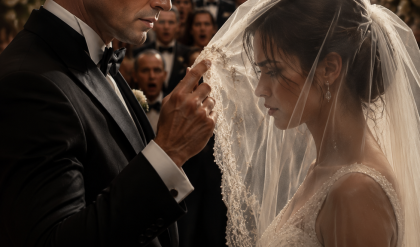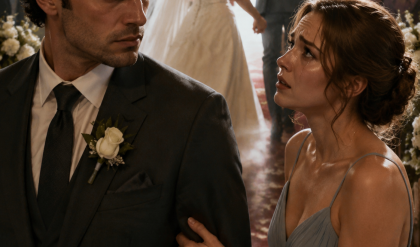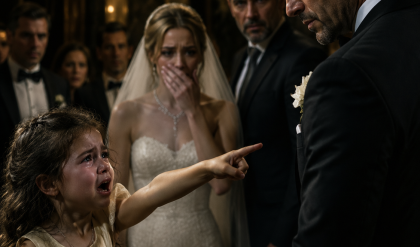
“That pin.” He pointed with his glass. “Looks like something from a pawn shop.”
“It was my father’s.”
Conrad leaned back.
For one passing second, something moved behind his eyes. Not recognition exactly. More like the irritation of a memory he had paid good money to bury.
“Family,” he said, “is an expensive weakness.”
Evelyn lowered her gaze because she had to.
But inside, the case shifted.
Until then, the evening had been about a suspicious transfer expected before ten o’clock. The bank’s compliance team was ready. The court order had been prepared but required final probable cause tied to active witness intimidation and current movement of funds. Agents waited in unmarked cars near the loading dock, not for drama, but for the law to catch up with what everyone already knew.
Then Leonard Cross opened the black folder.
Too quickly.
Too comfortably.
When Conrad rose to take a call, Evelyn moved past him with a tray of wine glasses.
His shoe slid out just enough.
Not a kick.
Not obvious.
Just enough to send the tray tilting.
Red wine spilled across his tuxedo cuff and splashed onto the marble floor.
The music played three more notes before the room understood it was supposed to stop breathing.
Peter rushed in first.
Not to help Evelyn.
To protect Conrad Vale’s sleeve.
“Mr. Vale, I am so sorry. We’ll remove her right away.”
Conrad lifted his stained cuff and studied it like a judge reviewing evidence.
“How much does she make?” he asked.
Peter blinked. “She’s temporary staff, sir. Day rate.”
“So if she worked here for a year,” Conrad said, “she still couldn’t buy the button she ruined.”
Someone chuckled.
Mia took one step forward.
The banquet captain grabbed her wrist.
“Don’t,” the woman whispered. “You need this job.”
Leonard Cross already had a document in his hand.
That was the part Evelyn needed.
He slid it onto the edge of the table.
“She can sign an incident statement,” Leonard said. “Admission of negligence, agreement to reimburse damages, waiver of claims against the hotel and guest. Then we avoid police involvement.”
Evelyn took the paper.
Her eyes moved over the lines.
The wording was clean.
Corporate.
Polite.
Deadly.
I voluntarily acknowledge my actions and waive any future claim.
Her father had signed a sentence almost exactly like it ten years earlier.
She looked at Leonard.
He looked back.
For one second, only one, he knew that she knew.
Then Conrad dropped the napkin on the floor.
“Clean it first,” he said. “In front of everyone.”
And now, at 9:47 p.m., Evelyn Carter stood at the edge of the trap her father had died inside.
Only this time, she had built the door behind them.
Part 2
Evelyn lowered herself slowly to one knee.
The room exhaled in relief.
Not because they felt sorry for her.
Because obedience makes cowards comfortable.
Peter turned his face away as if not watching meant not participating. The woman in emerald satin pretended to check her earring. A developer from Oak Park stared at his dessert plate. The young man with the phone kept recording, but now his hand shook.
Mia’s eyes filled with tears.
“Don’t,” she whispered, though no one heard her except the banquet captain.
Conrad Vale stood over Evelyn with the easy satisfaction of a man who believed height was proof. He had stood over city inspectors, accountants, subcontractors, council aides, tenants begging for repairs, and widows asking why their savings had vanished into unfinished buildings. He had learned that most people could be pushed to their knees if you made the floor feel safer than standing.
Evelyn did not pick up the napkin.
She reached beside it and picked up Leonard Cross’s pen.
Conrad’s smile faded slightly.
Evelyn placed the document on the low cocktail table beside her, still kneeling, and set the pen to the signature line.
“There you go,” Peter breathed.
Leonard watched her hand.
Conrad watched her face.
The whole ballroom watched the performance and mistook it for surrender.
Evelyn wrote two words in large, steady letters.
Daniel Carter.
For three seconds, no one understood.
Then Leonard Cross moved.
He lunged for the paper, but Evelyn held it between two fingers and lifted it out of his reach.
“Interesting,” she said, still calm. “Ten years ago, another man was pressured to sign almost the same language.”
Leonard’s face tightened.
Conrad’s expression went still.
Not angry. Not frightened. Still.
Like a door had opened in a house he thought he had burned down.
Evelyn rose from one knee.
The wine stain on her apron looked dark under the chandelier light.
“You were in the room then too, Mr. Cross,” she said.
Leonard recovered first. “This is absurd.”
“Is it?”
Conrad’s voice dropped. “Who are you?”
Evelyn did not answer him.
She looked at Margaret Hensley.
The older woman sat rigid at table twelve, both hands clenched around her small black purse. Her lips had gone pale. Ten years of silence had trained her body to stay seated even while the truth tried to stand.
Conrad followed Evelyn’s gaze.
His jaw shifted.
“Get her out,” he said to Peter.
Peter hesitated.
Conrad turned on him. “Now.”
Two private security guards near the ballroom doors started forward.
At the same moment, the service door opened.
Four people in dark coats entered without hurry.
They did not look dramatic. They did not carry guns in their hands or shout for attention. They looked like tired professionals who had spent too many evenings waiting for rich men to finally do the thing their lawyers insisted they were too smart to do.
One of them, a square-faced woman with cropped gray hair, showed Conrad an ID.
“Mr. Vale,” she said, “I’m Deputy Financial Examiner Ruth Bell from the state fraud unit. Please instruct your security to step back.”
Conrad stared at her badge, then laughed once.
The sound landed badly.
“This is a private charitable event,” he said.
Ruth Bell did not blink. “We know.”
Leonard inserted himself between them. “My client will not be answering questions without counsel.”
“Your client is not being questioned,” Ruth said. “He is being served.”
Another man approached the table and placed a sealed envelope beside the black folder.
Conrad’s phone rang.
He glanced at the screen with irritation and answered it like a man preparing to punish the caller.
“Not now.”
His eyes changed.
Across the table, Leonard’s phone rang too.
Then a third phone rang near the column, where Conrad’s assistant, Graham Pike, had been pretending all evening not to listen.
Graham answered, turned away, then turned back with his face drained.
“Mr. Vale,” he whispered.
Conrad held up a hand, still listening to his own call.
Graham swallowed. “Meridian Trust is refusing the wire.”
Conrad’s head snapped toward him.
“What?”
“They said there’s an emergency restraint order. Harborline operating account, Vale Urban Development, the foundation accounts tied to the transfer, and three associated entities. They froze movement pending review.”
For the first time that night, the ballroom saw fear touch Conrad Vale’s face.
It came and went fast.
But it came.
Evelyn saw it.
So did Mia.
So did every guest who had looked away when he told a waitress to kneel.
Conrad ended the call slowly.
“You have no idea what you’re doing,” he said to Ruth Bell.
“Actually,” Ruth replied, “we know exactly what we’re doing. The order was signed at 8:56 p.m. The bank was notified at 9:03. We waited because your counsel indicated a new certification document might be executed tonight under questionable conditions.”
Leonard’s eyes flickered.
Evelyn noticed.
Conrad did too.
“Lenny,” Conrad said quietly.
Leonard did not look at him.
Ruth turned to Leonard’s black folder. “That folder stays on the table.”
Leonard placed his hand over it. “Privileged material.”
“Not anymore,” said the man beside Ruth. “Not if it contains instruments used to facilitate coercion or fraudulent certification.”
Peter Latham looked as though he might faint.
Guests began putting phones away. The same people who had been brave enough to watch a waitress be degraded suddenly became very busy not existing.
Conrad scanned the room, searching for control.
His gaze landed on Evelyn again.
“Who are you?” he repeated.
This time, she answered.
But not fully.
“Someone whose father signed your paper.”
Conrad’s eyes moved to the silver bird pin.
Then to the name on the document.
Daniel Carter.
The memory completed itself.
He smiled, but the smile had lost its skin.
“Carter,” he said. “The crooked accountant’s daughter.”
A murmur broke across the room.
Mia’s tray lowered slowly.
Peter looked at Evelyn as if she had transformed in front of him from a scheduling inconvenience into a human being.
Evelyn’s throat tightened once, but she did not let him hear it.
“My father was not crooked.”
Conrad’s face hardened. “Your father stole from me.”
“No,” Evelyn said. “My father found out you were stealing from everyone else.”
Leonard snapped, “Enough. This is defamatory and staged.”
Ruth Bell looked at him. “Mr. Cross, the only staging I’ve seen tonight involved a waitress, a planted trip, and a waiver document you produced before anyone asked for one.”
“That is standard liability procedure.”
“Then you won’t mind leaving it where it is.”
Conrad stepped toward Evelyn.
The nearest investigator moved half a step into his path.
Not touching him.
Not needing to.
Conrad stopped, but the rage in him kept moving.
“You think you can walk into my event in an apron and take my life apart?” he said.
Evelyn held his gaze.
“No. I think you took your life apart years ago and made other people carry the pieces.”
For a moment, the ballroom was so quiet that the storm outside sounded like sand against glass.
Then Margaret Hensley spoke.
“Daniel didn’t steal.”
It was not loud.
It did not need to be.
Conrad turned slowly.
Margaret’s hands shook as she gripped her purse.
The man beside her, an investment partner with a gold watch and no courage, leaned close. “Margaret. Don’t.”
She looked at him with tired eyes.
“I have done don’t for ten years.”
She stood.
The room shifted again, not toward Conrad this time, but toward her.
Evelyn felt something in her chest loosen and hurt at the same time.
Margaret opened her purse. First came a folded tissue. Then reading glasses. Then a brown envelope worn soft at the edges, the kind people keep in kitchen drawers with old tax returns and funeral programs.
Conrad’s face changed before anyone opened it.
He knew.
Leonard knew too.
“Margaret,” Leonard said, softer now. “You’re confused.”
She laughed, and it almost broke. “No. That’s the sad thing. I remember everything.”
Ruth Bell stepped forward. “Mrs. Hensley, do you understand what you’re offering?”
Margaret nodded.
“Copies,” she said. “Daniel gave them to me two days before he was arrested. He said if anything happened to him, I should find someone who wasn’t afraid to read numbers.”
Her eyes moved to Evelyn.
“I’m sorry,” Margaret whispered. “I was afraid.”
Evelyn could barely breathe.
Conrad’s voice cut through the moment.
“Convenient. A bitter old woman with a mystery envelope appears at a gala. Very moving. Did she rehearse that with you, Miss Carter?”
Evelyn turned toward him.
“You always do that,” she said. “You make the truth sound emotional so people stop treating it like evidence.”
Ruth accepted the envelope using gloves from her coat pocket. She opened it carefully on the table while half the city’s most polished people watched in silence.
Inside were copies of payment authorizations, contractor lists, internal memos, and handwritten notes. Some pages were faded. Some had coffee stains. Some bore initials that had appeared in the new Harborline files. On three sheets, Evelyn recognized her father’s handwriting immediately.
His sevens had a little slash through the middle.
When she was a child, she used to tease him that even his numbers wore seat belts.
She had not remembered that in years.
The sight of it nearly dropped her back to her knees for a different reason.
Margaret spoke as Ruth reviewed the documents.
“I worked with Daniel in compliance. He found transfers to companies that didn’t exist anywhere but invoices. He was going to report them. Then Mr. Vale and Mr. Cross called him upstairs. When he came back, he looked sick. He said if he signed, they would leave Evelyn and her mother alone.”
“That’s a lie,” Conrad said.
But the word had no weight.
Too many people were now staring at Leonard’s fresh waiver.
The same structure.
The same trap.
The same polite language designed to turn victims into authors of their own ruin.
Ruth’s colleague read from the emergency order. His voice was dry, legal, almost boring. It listed entities, accounts, restricted transfers, probable cause, witness pressure, document manipulation, and suspected laundering through development subsidiaries.
To Conrad, each plain word hit harder than a shout.
Because Conrad had built his life on the belief that plain words could always be bought, delayed, buried, or renamed.
Graham’s phone rang again.
He answered with shaking fingers.
“Mr. Vale,” he said. “The jet is grounded at Midway. They won’t clear the flight plan.”
Conrad closed his eyes for half a second.
When he opened them, the fear was gone.
Only venom remained.
He looked at Evelyn.
“You think this gives him back to you?”
The question struck where he meant it to.
For a moment, Evelyn saw her father at the kitchen table in their old apartment, sleeves rolled up, calculator beside a chipped mug, silver bird pin on his blazer because he had come home from court and forgotten to take it off. She saw him trying to smile for her mother. She saw the newspaper folded face down so no one had to look at his name.
She saw the hospital bed.
The machines.
The silence after.
“No,” Evelyn said. “Nothing gives him back.”
Conrad’s mouth twitched, satisfied that he had hurt her.
Then she took off the wine-stained apron.
Under it, she wore a dark navy suit.
The badge clipped inside her jacket was simple. Official. Real.
She took it out, not dramatically, not triumphantly, but with the steady hand of someone who had waited ten years to let the truth stand without trembling.
“My name is Evelyn Carter,” she said. “I’m a special investigator assigned to the state financial crimes task force. Mr. Vale, tonight you confirmed an active pattern of coercion tied to an ongoing fraud investigation.”
The ballroom seemed to inhale all at once.
Mia covered her mouth.
Peter whispered, “Oh my God.”
Leonard Cross went gray.
Conrad stared at the badge.
Then he began to laugh.
At first, it was low. Then louder. But no one joined him this time.
“You wore an apron,” he said. “You let me spill wine on you. You let these people watch you crawl.”
Evelyn folded the apron and placed it on the back of a chair.
“I let you show them who you were.”
Conrad’s laughter stopped.
Ruth Bell nodded to the officers at the door.
“Mr. Vale,” she said, “you need to come with us.”
Conrad looked around the ballroom as if expecting someone to object.
No one did.
The councilman studied the floor.
The donors stared into empty glasses.
The reporter, pale and wide-eyed, finally raised her phone again.
Peter Latham stepped backward.
That was when Conrad understood the worst part.
His money had not disappeared.
His friends had.
As he was led toward the service door, he leaned close enough to Evelyn that the officers tightened their grip.
“You’ll never wash my name off your family,” he said.
Evelyn looked at him with a sadness that surprised even her.
“You’re right,” she said. “But tomorrow, my father’s name won’t be under yours anymore.”
Conrad Vale was taken out through the same hallway where temporary servers carried dirty plates.
No one applauded.
That would have been too easy.
The silence he left behind was not the same silence he had commanded earlier. This one had weight. Shame. Witness.
Mia finally moved.
She crossed the ballroom, ignored the banquet captain’s warning hiss, and picked up the napkin from the floor.
“Do you need this?” she asked Evelyn.
Evelyn looked at the white cloth, still clean except for the corner where it had touched the wet marble.
“Yes,” Ruth said gently. “Evidence.”
Mia handed it over.
Then she looked at Evelyn, tears still caught in her lashes.
“You were never really a waitress?”
Evelyn glanced at the trays, the stained floor, the exhausted staff watching from the walls.
“For tonight,” she said, “I was.”
Mia nodded like that answer mattered.
Because it did.
Part 3
By sunrise, Chicago had turned gray and wet.
The snow from the night before had melted into dirty slush along the curbs. Delivery trucks hissed through puddles. Office workers hurried under umbrellas. The city looked ordinary in the cruel way cities do after someone’s life changes forever.
The Crystal Harbor Hotel was already being reset for a breakfast conference.
By seven-thirty, the marble floor had been scrubbed. The wine stain was gone. The ivory roses had been replaced. The tables were stripped, the chairs aligned, the glassware polished until no one could have guessed that a billionaire had lost his empire in that room while a waitress stood with wine on her apron and her dead father’s name on a liability form.
But evidence does not care what a ballroom looks like in daylight.
In a sealed plastic bag at the task force office lay the linen napkin Conrad Vale had thrown at Evelyn’s feet.
Beside it lay Leonard Cross’s waiver document.
Beside that, the brown envelope Margaret Hensley had carried for ten years like a stone in her purse.
Evelyn sat in an interview room with a cup of coffee she had not touched.
Her supervisor, Martin Reyes, stood by the window, reading through a preliminary report.
“You did what you were sent to do,” he said.
Evelyn stared at the coffee.
“That’s one way to describe it.”
Martin looked at her over the file. He was a patient man, old enough to have seen good cases fall apart and bad men walk smiling through courthouse doors. He had warned Evelyn not to make the investigation about grief. She had told him grief was not the same thing as confusion.
Now he set the report down.
“You held your line.”
“I almost didn’t.”
“When?”
“When he asked if I thought this brought my father back.”
Martin said nothing.
The best people in her life had learned not to rush into the places where pain was still speaking.
Evelyn rubbed her thumb over the faint mark the silver pin had left on her palm. The pin itself was back in an evidence envelope for the moment because it had recorded the audio of Conrad’s threat. She missed its small weight.
“He knew exactly where to hit,” she said.
“Men like Vale survive by studying bruises.”
Through the glass, Evelyn could see Margaret Hensley sitting with an investigator. The older woman looked smaller in daylight, her navy dress wrinkled, her hair loosened at the temples. But her back was straight.
Mia Santos sat in another room, giving her statement with both hands wrapped around a paper cup. Peter Latham had arrived with a lawyer and the expression of a man who had discovered that cowardice also leaves fingerprints.
The guests were harder.
Some claimed they had seen nothing.
Some said the music had been too loud.
Some insisted they thought Evelyn had tripped.
But by noon, videos began arriving.
A shaky clip from near the bar.
Another from the young man by the window.
A third from the reporter, who had captured Conrad dropping the napkin and Leonard producing the waiver before Peter even asked for paperwork.
People who had not been brave in the ballroom became braver once Conrad Vale’s accounts were frozen.
Evelyn did not know whether to be grateful or tired.
Maybe both.
At eleven-fifteen, Martin opened the interview room door.
“Your mother is here.”
Evelyn stood too quickly.
Her mother, Laura Carter, waited in the hallway wearing the same beige winter coat she had owned for twelve years. She had tied a scarf under her chin even though no one under seventy did that anymore, and she held her purse close to her stomach the way she always did when entering government buildings.
For ten years, Laura had avoided places with metal detectors.
Courthouses.
Police stations.
Anything with forms and waiting rooms and people who called your name like they owned it.
When she saw Evelyn, she did not ask about Conrad Vale. She did not ask about the news alerts already spreading online. She did not ask why her daughter’s eyes looked like she had slept a thousand years badly.
She reached out and touched Evelyn’s cheek.
“Did he say your father’s name?”
Evelyn nodded.
Laura closed her eyes.
For a moment, she seemed to sway.
Evelyn took her arm. “Mom.”
“I’m all right.” Laura opened her eyes again, but they were wet. “I just waited so long to hear someone say it without spitting on it.”
Evelyn had imagined this moment for years.
She had imagined triumph.
Relief.
Maybe tears that cleansed everything.
Instead, she felt hollow and full at the same time.
“They’re reopening the old findings,” she said. “Not everything at once. It’ll take time. But Dad is being reclassified in the state file as a witness connected to the fraud scheme, not the principal offender.”
Laura pressed a hand to her mouth.
No sound came out.
Her shoulders folded inward, and for one terrible second Evelyn thought she had hurt her by saying it too plainly.
Then Laura began to cry.
Not loudly.
Not dramatically.
Just with the exhausted trembling of a woman who had carried a heavy bag for ten years and had finally been allowed to put it down.
Evelyn did not hug her right away.
Some tears need room before they need arms.
When Laura finally reached for her, Evelyn stepped in.
Her mother felt smaller than she remembered.
“I’m sorry,” Laura whispered into her daughter’s shoulder.
Evelyn pulled back. “For what?”
“For asking you to stop looking. For telling you we had to live. For being afraid every time you said his name.”
“You were trying to survive.”
“So was he.”
That sentence broke something open between them.
Evelyn thought of Daniel Carter’s last months. How he had become quieter. How he smiled too carefully. How he once sat at the kitchen table and told her to finish college no matter what people said. How she had been too young and angry to understand that he was not ashamed of himself. He was ashamed that he could not protect them from other people’s lies.
Laura opened her purse and took out a folded photograph.
It was the same one Evelyn knew by heart. Daniel at the kitchen table in his gray blazer, silver bird pin on his lapel, one hand resting near a calculator.
“I brought this,” Laura said. “I don’t know why.”
Evelyn took the photo.
The corner was bent.
Her father’s smile was tired.
But it was his.
“He hated that picture,” Laura said through tears. “Said his hair looked like a frightened squirrel.”
Evelyn laughed.
It came out broken, but it came.
Laura laughed too.
For the first time in years, Daniel Carter existed between them as a man, not a wound.
That afternoon, Conrad Vale’s name appeared across financial news sites.
The headlines were sterile.
Major developer faces asset restrictions amid fraud inquiry.
Vale-linked entities under emergency review.
Harborline Renewal accounts frozen pending investigation.
There was no mention of a napkin.
No wine on marble.
No waitress on one knee.
No dead accountant’s daughter standing up in a navy suit.
News has a way of removing the human parts so the powerful can pretend the story is only about numbers.
But inside the city, the human parts spread faster.
Hotel staff told cousins.
Cousins told coworkers.
Someone posted a blurred clip of Conrad saying, “Clean it.”
By evening, the video had been shared thousands of times. People argued in comments. Some defended him. Some called it fake. Some said rich men had always treated workers that way and the only difference was this one got caught.
Mia Santos sent Evelyn a message through Ruth Bell.
I don’t know if you can answer this, but I just wanted to say I gave my statement. Also I quit. Also I’m scared. Also thank you.
Evelyn read it three times before responding.
You were brave before you quit. That matters more.
Three dots appeared.
Then Mia replied.
I didn’t feel brave.
Evelyn looked through the office window at the city lights coming on, one by one, in buildings Conrad Vale had wanted to own.
She typed back.
Most brave people don’t.
Two days later, Margaret Hensley came to the task force office to sign her formal statement.
She wore a gray cardigan and carried a grocery tote instead of the black purse. Without the envelope inside it, she looked lighter and older.
When she finished, she found Evelyn near the elevators.
“I need to say something,” Margaret said.
Evelyn braced herself.
People had been saying things all week.
Excuses.
Regrets.
Carefully worded versions of I would have helped sooner if helping had cost me nothing.
Margaret gripped the strap of her tote.
“I’m sorry I waited until your father was gone.”
The hallway hummed with fluorescent light.
Evelyn wanted to say it was all right.
But it was not.
She wanted to say forgiveness was simple.
But it was not.
She thought about her mother crying into her coat. About her father’s slashed sevens. About the ten years Margaret had slept in a home with evidence hidden somewhere between utility bills and medical paperwork.
“You were late,” Evelyn said.
Margaret flinched.
Then Evelyn continued, “But late is when nobody speaks at all. You spoke.”
Margaret’s eyes filled.
“I was afraid of him.”
“I know.”
“That doesn’t excuse it.”
“No,” Evelyn said. “But it tells the truth about him.”
Margaret nodded slowly.
Before she left, she reached into her tote and pulled out a small envelope.
“I found this with Daniel’s papers. It wasn’t evidence. It was personal. I think it belongs to you and your mother.”
Evelyn opened it after Margaret was gone.
Inside was a note in her father’s handwriting.
Lena,
If you are reading this, I probably failed to make people listen in time. Do not let my name become a locked room in your life. Open windows. Eat breakfast. Love someone honest. Laugh when you can. The truth matters, but so do you.
Dad
Evelyn sat down on a bench outside the elevators.
For ten years, she had chased the truth like it was a place she could reach and finally rest.
But her father had known something she had not.
Truth was not only for the dead.
It was for the living they left behind.
The following week, the Crystal Harbor Hotel issued a public statement about dignity, respect, cooperation, and internal review. Peter Latham resigned before the statement finished circulating. The banquet captain stayed. Mia did not come back.
Evelyn heard later that Mia took a job at a neighborhood legal aid clinic as a receptionist, then started night classes in paralegal studies. When Evelyn sent her a short congratulations, Mia replied with a picture of a cheap office mug that said, in crooked letters, Ask me where the files are.
Conrad Vale’s attorneys fought everything.
They called the investigation political.
They called Evelyn biased.
They called Margaret unreliable.
They called the videos misleading.
But the money did what people often will not.
It told the truth in sequence.
Transfers connected to shell firms.
Shell firms connected to old subcontractors.
Old subcontractors connected to Daniel Carter’s notes.
Daniel Carter’s notes connected to Harborline.
And Harborline connected to the wire Conrad had tried to push through that night while laughing beneath chandeliers at a gala supposedly meant to house working families.
Leonard Cross tried to distance himself.
That lasted until investigators matched old document templates from Daniel’s case to the waiver Evelyn had been handed in the ballroom. Same phrasing. Same internal code at the bottom margin. Same habit of leaving just enough blank space above the signature line for fear to do the rest.
He stopped giving interviews after that.
Three months later, Evelyn and Laura attended a small court hearing on a rainy Thursday morning.
No cameras waited outside.
No crowd gathered.
The judge did not make a speech.
He simply approved the motion acknowledging that Daniel Carter’s original conviction had been built on compromised evidence, coerced statements, and material omissions now under active review.
The language was careful.
The law is often careful when it is late.
But then the judge looked over his glasses at Laura and Evelyn.
“I understand this does not repair what was lost,” he said. “But the record will no longer describe Mr. Carter as the architect of the fraud.”
Laura gripped Evelyn’s hand so hard it hurt.
Evelyn welcomed the pain.
Outside the courthouse, the rain had stopped.
They stood on the steps beneath a sky the color of steel.
Laura held Daniel’s photograph against her chest.
“What now?” she asked.
Evelyn looked out at the city.
For years, that question had frightened her more than any threat Conrad Vale could make. Revenge gives life a terrible kind of structure. Grief can become a calendar. Anger can become a job. But after the name is cleared, after the account is frozen, after the man who hurt your family is no longer untouchable, you still have to wake up the next morning and decide who you are without the fight.
Evelyn touched the silver bird pin on her jacket.
This time, it was not hidden.
“Now,” she said, “we open windows.”
Laura smiled through tears.
That night, Evelyn returned to the old apartment where her mother still lived. The hallway smelled like laundry soap and someone’s cabbage soup. The elevator still jerked between floors. The kitchen table still wobbled unless you folded a napkin under one leg.
Laura made tea because important things in their family always began and ended with tea.
They placed Daniel’s photograph on the table between them.
For a while, they did not talk about cases or courts or Conrad Vale.
They talked about how Daniel burned pancakes every Sunday but insisted the dark edges had character. How he sang along to old country songs with the confidence of a man who knew no one would hire him as a singer. How he used to leave notes in Evelyn’s lunch bag that said things like Do not trust vending machine tuna and Your mother is right about your coat.
Laura laughed until she cried.
Evelyn cried until she could breathe.
Near midnight, she stepped to the window and opened it.
Cold air moved into the kitchen.
Not gentle.
Real.
Laura wrapped her cardigan tighter. “You’ll freeze us both.”
Evelyn smiled. “Just for a minute.”
Below, Chicago moved on. Cars passed through wet streets. A siren rose and faded. Somewhere, people were eating late dinners, arguing over bills, rocking babies, closing restaurants, mopping floors, counting tips, trying to survive men who mistook money for permission.
Evelyn thought of the ballroom.
The napkin.
The knee.
The silence.
And then she thought of Mia stepping forward. Margaret standing up. Her mother asking if Daniel’s name had been spoken without shame.
The world did not change all at once.
But sometimes one room did.
Sometimes one person stopped lowering her head.
Sometimes one old envelope opened.
Sometimes the man who believed everyone could be bought discovered that fear had an expiration date.
Evelyn closed the window and returned to the table.
Laura poured more tea.
Daniel’s photograph rested between them, no longer evidence, no longer a wound, no longer a locked room.
Just a man who had loved them.
Just a name returned to its rightful place.
And somewhere across the city, in a sealed evidence bag, a white linen napkin waited for trial as proof that Conrad Vale had once ordered a waitress to clean his shoes in front of everyone.
He had thought the whole room was watching her fall.
He never understood they were watching the truth stand up.
THE END