Emma blinked. “What?”
“Most people don’t even look at me.”
“Then most people need better manners.”
He looked down, smiling.
“I’m serious,” she said. “My mama says the way you treat people who can’t do anything for you is the way God knows who you really are.”
Jack’s throat tightened.
“My dad says something similar.”
“Smart man.”
“He can be.”
Emma stood, brushing crumbs from her uniform. “I have to get back. Rooftop deck won’t clean itself.”
“Emma.”
She turned.
“Thank you.”
This time she did not brush it off.
“You’re welcome, Jack.”
From the thirty-second floor, behind glass walls and imported orchids, Victoria Sloane watched them.
She had noticed Jack on his first day.
Not because she thought he was poor.
Because she did not believe he was.
Victoria had built her career on reading people. Shoes could be fake. Clothes could be cheap. Posture could not. Jack stood like a man who had never needed permission to enter a room. He spoke carefully. He listened before answering. Even in a security uniform, he carried silence like authority.
There had been whispers in the executive lounge.
“William Harlan’s son is supposed to be joining soon.”
“I heard he’s doing some leadership rotation.”
“No photos online from the last few years.”
“Wouldn’t it be wild if he was already here?”
Victoria did not believe in wild.
She believed in opportunity.
And then she saw Emma Whitaker handing him half a sandwich like she had the right to be near something Victoria had already decided might belong to her.
Her fingers tightened around her coffee cup.
“Who is that cleaner?” she asked her assistant.
The assistant followed her gaze. “Emma Whitaker. Facilities. Been here a couple years, I think.”
Victoria watched Emma walk away.
“Pull her file.”
“Is there a problem?”
Victoria smiled.
“Not yet.”
That evening, Emma got off the bus near a row of aging duplexes on the west side of Charlotte. The sun was sinking orange behind power lines. She could hear her father laughing before she reached the porch.
Ray Whitaker sat in a lawn chair with two neighbors, a beer balanced on his knee.
“There’s my girl,” he called. “Hardest-working woman in North Carolina.”
Emma’s shoulders sank before she could stop them.
“Hey, Daddy.”
“You got a few dollars? Just until Friday.”
“No.”
His smile faded. “No?”
“I bought groceries yesterday. Mom’s shift got cut. Caleb needs field trip money. I don’t have extra.”
Ray looked embarrassed in front of his friends, which always made him mean.
“You talk to me like I’m some stranger begging on the road.”
Emma stood still.
“I’m not trying to disrespect you.”
“I raised you.”
“Mama raised me.”
The porch went quiet.
Ray’s face changed.
For a moment, Emma thought he might shout. Instead, he looked away, grabbed his beer, and muttered, “Everybody thinks they’re better than me.”
Emma stepped inside.
The house smelled like fried potatoes and laundry soap. Maddie was helping Noah with spelling words at the kitchen table. Caleb was drawing a monster truck on the back of a bill envelope. Denise stood at the stove with her diner shoes still on.
“You eat?” Denise asked.
“I had lunch.”
“That means no.”
Emma kissed her mother’s cheek. “I’m okay.”
Denise looked at her daughter’s face and knew everything she did not say.
Later, after dishes, homework, baths, and prayers, Emma sat on the edge of her bed with twenty-three dollars in cash and a decision she could not shake.
Jack’s shoes.
She could ignore many things. Hunger, exhaustion, her father’s drinking, her own postponed dreams. But once Emma saw someone hurting, she could not unsee it.
On Saturday morning, she went to a thrift store near Wilkinson Boulevard.
The shoe rack smelled faintly of leather, dust, and old rain.
She found them after twenty minutes.
Men’s size eleven. Brown work shoes. Worn, but solid. The soles were intact. The leather had creases, but no holes. The price tag said $18.99.
Emma held them in both hands.
That money was supposed to help with Caleb’s field trip.
She closed her eyes.
Then she bought the shoes.
On Monday, she waited until lunch.
Jack was at the service entrance again, one foot tucked behind the other.
Emma walked up with a plastic thrift-store bag.
“I got you something.”
His face shifted. “Emma—”
“Don’t make it weird.”
“I don’t even know what it is.”
“You will in two seconds.”
He opened the bag.
For a long moment, he did not move.
“They’re secondhand,” she said quickly. “I know they’re not new. But they’re better than what you have. And if they don’t fit, I can return them for store credit, so don’t feel bad.”
Jack lifted one shoe from the bag.
He had owned Italian loafers handmade in Florence. He had worn custom boots from his own company’s luxury line. He had a closet full of shoes worth more than Emma’s monthly rent.
None of them had ever humbled him like that scuffed brown pair from a thrift store.
“You bought me shoes,” he said.
“Yes.”
“Why?”
“Because yours are broken.”
“That’s it?”
“That’s enough.”
Jack looked at her.
The world seemed to narrow until the noise of trucks, badge scanners, and elevators disappeared.
“Emma,” he said softly, “I want to give you something.”
“No.”
“You don’t know what it is.”
“If it’s money, absolutely not.”
“It’s not money.”
He reached under the collar of his cheap uniform shirt and pulled out the pendant.
The gold caught the afternoon light.
Emma stepped back. “Jack, no.”
“It’s just a little necklace.”
“That is not little.”
“It’s old.”
“It looks expensive.”
“It’s not about price.”
“Exactly. Which is why I can’t take it.”
He held it out anyway.
“Please. As a friendship gift.”
She stared at him. “For thrift-store shoes?”
“For seeing me.”
Emma did not understand why those three words made her chest ache.
“I really shouldn’t.”
“Please.”
There was something in his eyes she could not name. Not pressure. Not pity. Something vulnerable.
So Emma turned around, lifted her hair, and let him fasten the pendant around her neck.
Neither of them saw Victoria Sloane standing near the upper service window.
But Victoria saw everything.
And by the time Emma walked back inside, Victoria had already decided the cleaner would be gone by Friday.
Part 2
Victoria Sloane did not destroy people loudly.
She preferred paperwork.
Noise created sympathy. Paperwork created doubt. A file note here. A missing timestamp there. A policy violation discovered at exactly the right moment. People rarely questioned a clean report, especially when it came from a woman with a corner office and a reputation for excellence.
By Tuesday morning, Emma’s name was sitting in Victoria’s private notebook.
Emma Whitaker. Facilities. Rooftop/pool access. Service entrance. Locker row B.
Under it, Victoria wrote three words.
Remove with cause.
The plan came together almost too easily.
Harlan & Rowe had a company mascot, a golden retriever named Stitch, who belonged to the founder’s wife and spent weekdays wandering the executive floors like a beloved employee. Stitch had his own badge, his own bed near reception, and more friends than most managers.
Victoria did not hurt the dog. Even she knew where the line was.
But she knew how to make it look like someone had tried.
On Wednesday evening, after most of the building had emptied, she called Brandon Pike from security systems into her office.
Brandon was twenty-seven, nervous, and had a gambling problem Victoria had discovered through expense reports and careless browser history.
“I need footage from the rooftop service hallway between five and six tomorrow morning to disappear,” she said.
His face went pale.
“I can’t do that.”
Victoria opened a folder and slid a printed page across the desk.
Brandon stared down at screenshots from a betting site.
“You used company equipment,” she said. “Company time. Company network. Do you want HR to see that?”
He swallowed. “What are you doing?”
“Correcting a problem.”
“This is illegal.”
“No, Brandon. Stealing company time to gamble is illegal. I am offering you a chance to keep your job.”
He looked like he might throw up.
“Delete the footage,” she said. “And forget this conversation happened.”
Next, she visited payroll records.
The payroll coordinator, Amy Bell, owed Victoria a favor after Victoria had covered for a costly vendor mistake three months earlier.
“I need you to temporarily archive an employee profile,” Victoria said.
“Whose?”
“Emma Whitaker.”
Amy frowned. “Facilities?”
“Internal review.”
“What kind of review?”
“The kind you do not want attached to your login history.”
Amy stopped asking questions.
By dawn Thursday, Victoria entered the building through the private executive garage with a brown paper bag in her hand. Inside was a small piece of hamburger meat dusted with harmless white cleaning powder from a maintenance closet. It looked terrible. It was designed to.
She slipped it behind cleaning supplies in Emma’s locker.
Then she walked away.
At 9:12 a.m., Stitch sniffed near the executive lounge, sneezed twice, and vomited on the white rug after eating too many unauthorized bacon treats from the CFO.
At 9:18, Victoria gasped loudly enough for half the floor to hear.
“Someone check what he ate.”
By 9:40, the facilities lockers had been searched.
By 9:47, Emma Whitaker was standing in a conference room with her supervisor, HR, building security, and Victoria Sloane.
The brown paper bag sat on the table.
Emma stared at it.
“That is not mine.”
Her supervisor, Karen, looked heartbroken. “Emma…”
“I have never seen that before in my life.”
Victoria folded her hands.
“Emma, your badge accessed the rooftop service corridor this morning before six.”
“I clean the rooftop every morning.”
“And this was found in your locker.”
“I didn’t put it there.”
“Do you expect us to believe someone planted it?”
Emma looked around the room.
Nobody met her eyes.
That was when she understood how fragile a good name could be.
Two years of arriving early. Two years of staying late. Two years of never stealing so much as a paper towel. Two years of being invisible in the best way, dependable in the way people only noticed when something went wrong.
Gone in one paper bag.
“Check the cameras,” Emma said.
Brandon Pike shifted near the wall.
Victoria sighed. “Unfortunately, there was a system issue with that hallway feed this morning.”
Emma’s stomach dropped.
“Of course there was.”
Karen lowered her voice. “Emma, don’t make this harder.”
“I didn’t do this.”
HR slid a form toward her.
“Effective immediately, your employment is terminated pending further investigation. Because this involves a potential safety threat, you are not permitted to return to the premises unless contacted by legal.”
Emma looked at the paper.
Terminated.
One word.
One blade.
Victoria watched her sign with the faintest trace of satisfaction in her eyes.
Emma walked out of Harlan & Rowe carrying her locker contents in a cardboard box. Her sandwich was still wrapped in a paper towel. Her bus pass was tucked beneath her siblings’ photograph. The pendant Jack had given her rested beneath her uniform collar, warm against her skin.
At the front gate, Jack was not at his post.
His supervisor had sent him to monitor deliveries at the north dock.
So Emma left without saying goodbye.
She made it three blocks before her legs gave out.
There was a small city park between the office district and the bus stop. Emma sat on a bench beneath a willow oak and set the cardboard box at her feet.
For a few minutes, she was too shocked to cry.
Then she remembered rent.
Then Caleb’s field trip.
Then Maddie’s shoes, which were too tight.
Then Noah’s inhaler.
Then her mother’s tired hands.
Then her father on the porch asking for money she no longer had.
A sound broke out of her chest before she could stop it.
She covered her mouth with both hands and bent forward, sobbing so hard her shoulders shook.
People walked past.
A man in a suit glanced at her and kept going.
A woman pushing a stroller slowed down, then looked away.
A delivery cyclist swerved around the bench.
Emma did not blame them. Pain made people uncomfortable. She had learned that too.
She pulled the pendant from beneath her collar and held it in her palm.
It was beautiful.
For one desperate second, she thought about selling it.
Then she closed her fingers around it.
“No,” she whispered. “Some things you don’t sell just because you’re scared.”
She bowed her head.
“God, I don’t understand this. I have tried to do right. I have tried to take care of everybody. I don’t know how we’re going to make it now. But please… please don’t let a lie be the end of me.”
A shadow fell across the path.
An older woman in a cream cardigan had stopped a few feet away, watching Emma with concern. She had silver hair, elegant posture, and the kind of eyes that looked kind because they had survived things.
For a moment, it seemed she might speak.
Then her phone rang.
She hesitated, answered it, and walked on.
Emma wiped her face and looked away.
Five minutes later, she heard a sharp gasp.
The older woman was near the curb, one hand pressed to her chest, the other reaching blindly for a lamppost. Her purse slipped from her shoulder. Her knees buckled.
Emma ran.
“Ma’am!”
She caught the woman before she hit the pavement and eased her onto the grass.
“Can you hear me?”
The woman’s lips moved, but no sound came.
Emma grabbed the phone from the grass and dialed 911.
“This is an emergency. I’m at Fourth Ward Park near Poplar Street. Older female, possible cardiac event, conscious but weak. Send an ambulance now.”
She checked the woman’s breathing, loosened her scarf, kept her calm, and stayed beside her until the ambulance arrived.
“You’re going to be okay,” Emma said. “Just keep looking at me.”
The woman’s eyes filled with tears.
“I walked past you,” she whispered.
“What?”
“You were crying. I walked past you.”
Emma brushed hair from the woman’s face.
“Don’t worry about that right now.”
“I’m sorry.”
“You’re forgiven. Save your strength.”
The paramedics arrived within four minutes. Emma gave them clear details, handed over the woman’s purse, and stepped back.
But the woman caught her wrist.
“Your name.”
“Emma.”
“Emma what?”
“Emma Whitaker.”
The woman breathed through pain. “I’m Margaret Caldwell. I’m an attorney. Don’t leave.”
Emma blinked.
“What?”
“Please. Wait.”
At the hospital, Emma sat in the waiting room with her cardboard box on her lap, feeling like she had stepped into someone else’s life. Margaret Caldwell was not just any attorney. Her name appeared on awards in the lobby. Caldwell & Pierce. Civil litigation. Labor law. Corporate misconduct.
When Margaret was stable, she insisted Emma be brought into her room.
“You saved my life,” Margaret said.
“I did what anyone should do.”
“But not everyone does.”
Emma looked down.
Margaret studied her face. “Why were you crying in the park?”
Emma shook her head. “It doesn’t matter.”
“It mattered when I saw you.”
“I lost my job.”
“Tell me.”
“It’s complicated.”
“I’m a lawyer, sweetheart. Complicated is where I live.”
So Emma told her.
At first, she tried to keep it short. Then Margaret asked questions. Precise questions. What time did you arrive? Who had access to the lockers? Which hallway cameras existed? Who reported the incident? Who benefited from your dismissal? Was there anyone at work who had reason to target you?
Emma thought of Victoria.
She thought of the window.
She thought of the pendant.
“I don’t want to accuse someone without proof.”
Margaret’s eyes sharpened.
“That answer tells me you already know who did it.”
Emma swallowed.
“There was an executive. Victoria Sloane. She saw me talking to Jack.”
“Who is Jack?”
“A security guard.”
“And this executive cared because?”
“I don’t know. She warned him to stay away from me.”
Margaret sat very still.
“She warned him?”
Emma nodded. “He told me not to worry about it.”
“And then you were framed.”
Emma looked down at her hands.
Margaret reached for a notepad.
“Emma, listen to me. I have spent thirty years watching powerful people count on good people being too tired, too poor, or too scared to fight back. You are not fighting alone.”
“I can’t afford—”
“I didn’t ask you for money.”
Emma’s eyes filled.
“I don’t even have my job anymore.”
“Then we will get your job back. And your name.”
Friday morning at Harlan & Rowe began like any other day until Margaret Caldwell walked into the lobby at 8:03 with a leather briefcase and a face that made receptionists sit up straighter.
“I am here to see General Counsel,” she said. “Immediately.”
By 8:19, she was in a conference room with the company’s legal team.
By 8:31, Brandon Pike was sweating through his shirt.
Margaret placed one document on the table.
“This is a preservation demand. If any footage, digital logs, access records, badge data, or personnel files related to Emma Whitaker have been altered, deleted, or concealed, the company will have a far larger problem than wrongful termination.”
The general counsel, a tired man named Douglas Reeve, removed his glasses.
“Ms. Caldwell, perhaps we should slow down.”
“No.”
He blinked.
She turned to Brandon.
“Mr. Pike, the rooftop service hallway feed went missing during a window relevant to my client’s termination.”
“I don’t know anything about that.”
Margaret opened her briefcase and removed another page.
“Interesting. Because your login credentials accessed the system at 6:12 a.m. and deleted that camera segment. Fortunately, cloud redundancy is not as easy to erase as nervous young men believe.”
Brandon’s face collapsed.
Victoria, seated near the end of the table, went perfectly still.
Margaret looked at her next.
“And Ms. Sloane, you entered the building through the executive garage at 5:38 a.m. Your badge placed you two corridors away from the facilities lockers.”
Victoria laughed lightly.
“This is absurd.”
“Is it?”
Margaret connected a drive to the screen.
The first video loaded.
It showed Victoria Sloane walking into the locker area with a brown paper bag.
No one breathed.
The footage showed her opening Emma’s locker.
It showed her placing the bag inside.
It showed her closing the locker and walking away.
Margaret paused the video.
“There is your safety threat.”
Victoria’s face had gone white beneath her makeup.
Douglas Reeve turned slowly toward her.
“Victoria.”
She stood. “This is being taken out of context.”
Margaret clicked again.
The second file played.
Audio.
Victoria’s voice filled the room.
“You will stop talking to that cleaner girl immediately.”
Then Jack’s voice.
“I can’t be anyone’s secret friend.”
Then Victoria.
“Nobody says no to me.”
The room changed.
Corporate rooms have a smell when power flips. Coffee. Paper. Fear.
Douglas removed his glasses again, but this time his hand shook.
“Ms. Sloane, your employment is terminated effective immediately. Security will escort you out. We will be referring this matter to law enforcement.”
Victoria looked around, searching for one ally.
She found none.
“You’re all making a mistake,” she said.
Margaret smiled without warmth.
“No. You made one. You targeted the wrong woman.”
While Victoria was escorted out, Jack arrived at his gate post after a delivery check and noticed people whispering. He scanned the employee entrance.
No Emma.
At lunch, she still had not come.
By two, worry had become a stone in his stomach.
He found Karen from facilities near the service elevator.
“Excuse me,” he said. “Do you know where Emma Whitaker is?”
Karen’s face softened. “She was terminated yesterday.”
Jack stared at her.
“What?”
“It was a mistake. A terrible one. But I heard legal cleared her this morning.”
“Cleared her?”
Karen lowered her voice. “She was framed.”
Something cold moved through Jack.
“By who?”
Karen glanced around.
“Victoria Sloane.”
Jack’s hands curled.
He wanted to take off the cap, walk into the executive floor, and end the game right there.
Instead, he remembered his father’s rule.
One month.
Learn before you lead.
But that evening, in his rented room, he called William Harlan from the cheap phone.
“Dad.”
“You all right, son?”
“No.”
William went quiet.
Jack told him everything.
The lunch. The shoes. The pendant. Victoria. Emma’s firing. The restored footage. The lawyer. The way a woman with almost nothing had given from what little she had and nearly lost everything because of it.
William did not interrupt once.
When Jack finished, his father said, “What is her name?”
“Emma Whitaker.”
“And you love her?”
Jack closed his eyes.
“Yes.”
William exhaled slowly.
“Then your mother and I need to meet her.”
Part 3
Emma returned to Harlan & Rowe on Monday morning with her head high and her hands shaking.
Margaret Caldwell had called Sunday night.
“Your record is cleared,” she said. “You will receive a formal apology, back pay, and a written correction. They want you back.”
Emma sat at the kitchen table while her mother cried quietly into a dish towel.
Ray stood in the doorway, sober for once.
“They really lied on you?” he asked.
Emma looked at him.
“Yes, Daddy.”
He rubbed a hand over his face.
For the first time in years, he looked ashamed instead of defensive.
“I’m sorry,” he said.
Emma had imagined many things in her life. Winning the lottery. Going back to school. Buying her mother a house. She had not imagined her father saying those words and meaning them.
“I know.”
“No,” Ray said, voice breaking. “You don’t. I let you carry what I should have carried. I sat on that porch while you broke your back for this family. And when you got hurt, I couldn’t even help you.”
Denise turned away, crying harder.
Emma stood.
“Daddy—”
“I’m not asking you to fix me,” Ray said. “I’m telling you I see it now.”
That night, for the first time Emma could remember, her father did not leave the house after dinner.
On Monday, when she walked through the company gate, Jack was there.
He saw her and forgot how to breathe.
She wore the same navy uniform, the same work shoes, the same tight bun. But the pendant rested openly at her throat now, catching the light.
“Morning,” she said.
His smile came slowly.
“Good morning, Emma.”
No grand speech. No dramatic embrace. Just two people standing where everything had changed and pretending they were not both relieved enough to cry.
At lunch, he waited near the service entrance with two sandwiches from a deli.
Emma raised an eyebrow. “Fancy.”
“I got paid Friday.”
“Security must be treating you well.”
“Not exactly.”
She sat beside him.
For a while, they talked about small things. Her siblings. His rented room. The horrible coffee from the vending machine. The way Stitch was doing fine and had been placed on a strict no-bacon diet.
Then Jack grew quiet.
“My parents want to meet you.”
Emma nearly dropped her sandwich.
“Your parents?”
“Yes.”
“Why?”
“Because I told them about you.”
“That sounds serious.”
“It is.”
She looked at him.
“Jack, I like you. You know I do. But my life is complicated.”
“I know.”
“No, I mean really complicated. My mother works two jobs. My father is trying, but he has a long road. My siblings need me. I don’t have savings. I don’t have a degree. I live in a house with cracks in the ceiling and a bathroom door that doesn’t close unless you lift it.”
“I know.”
“And you’re a security guard.”
Jack was quiet for a second.
“Would that be enough for you?”
Emma looked offended.
“That’s not what I meant.”
“I’m asking.”
She studied him.
“If you were honest, kind, hardworking, and faithful? Yes. It would be enough.”
Jack’s eyes softened.
“Then I need to tell you something soon.”
Her stomach tightened.
“What kind of something?”
“The kind that may make you angry before it makes sense.”
Emma put her sandwich down.
“I don’t like secrets.”
“I know.”
“Then don’t keep one too long.”
“I won’t.”
The next evening, William and Caroline Harlan came to the Whitaker house in an ordinary sedan, wearing ordinary clothes, carrying a peach pie Caroline had baked herself.
Emma opened the door and saw a silver-haired couple who looked kind, nervous, and humble.
“You must be Emma,” Caroline said.
“Yes, ma’am.”
“I’m Caroline. This is my husband, William. We’re Jack’s parents.”
Emma stepped aside quickly.
“Please come in. I’m sorry, the house is small.”
William looked around at the worn sofa, the mismatched chairs, the homework papers on the table, the laundry basket near the hall.
“It feels like a home,” he said.
Emma’s throat tightened.
Denise welcomed them with sweet tea. Ray came in from the porch looking uncomfortable but sober. Maddie, Caleb, and Noah peeked from the hallway until Caroline invited them to help cut pie.
Emma brought out the best plates they owned.
One had a chip. She turned it toward herself.
William noticed.
So did Caroline.
They asked Emma questions, but not the kind rich people asked when they were pretending not to judge. They asked about her siblings. Her mother’s work. Her hopes. Whether she still wanted to finish school.
“I do,” Emma said. “Someday.”
“Why cleaning?” William asked gently.
“Because it was honest work and they were hiring.”
He nodded. “That is a good answer.”
Ray shifted in his chair.
“My daughter has done more for this family than any child should have had to do.”
Emma looked at him, startled.
Ray stared at the table.
“I’m trying to be better.”
William’s voice was quiet. “A man can start again if he is willing to tell the truth about where he has been.”
Ray looked up.
Something passed between the two fathers that Emma did not understand.
Later, when William and Caroline left, Caroline hugged Emma tightly.
“You are a remarkable young woman.”
Emma laughed nervously. “I’m just tired most days.”
“Most remarkable people are.”
In the car, Caroline wiped her eyes.
“She’s the one,” she said.
William nodded.
“Yes. She is.”
The next day, Jack asked Emma to walk with him after work.
They stopped at the same park bench where she had cried after losing her job.
The sun was low. The city windows glowed gold. Traffic hummed beyond the trees.
Jack removed his security cap and held it in both hands.
“Emma, my name is not Jack Miller.”
She went still.
He continued before fear could stop him.
“My name is Jackson Harlan. William Harlan is my father.”
Emma stared at him.
“Harlan as in…”
“Yes.”
“The company.”
“Yes.”
She stepped back.
“The whole company?”
“My family owns it.”
Her hand went to the pendant.
Jack’s voice roughened. “My father sent me to work undercover for one month. No money. No name. No privilege. He wanted me to learn what life looked like from the bottom. Nobody knew. I should have told you sooner.”
Emma looked down at the pendant like it had become heavy.
“This isn’t cheap.”
“No.”
“How much is it worth?”
“It belonged to my great-grandmother. I don’t think of it that way.”
“But it’s worth a lot.”
“Yes.”
“And you gave it to me for a pair of secondhand shoes?”
“No.” He stepped closer. “I gave it to you because you were the first person in that building who saw me when you thought I had nothing. I gave it to you because you fed me when you barely had enough. Because you bought shoes for a man you thought could never pay you back. Because I was already falling in love with you and didn’t know how to say it.”
Emma’s eyes filled, but her voice hardened.
“You let me think you were someone else.”
“I did.”
“You came into my house. Your parents came into my house.”
“They came as my parents, not as billionaires.”
“That doesn’t make it less humiliating.”
Jack flinched.
“I never wanted you to feel humiliated.”
“But I do.” She wiped her cheek angrily. “Do you know what it feels like to tell someone your whole life and then find out they had a whole other life hidden behind them?”
“Yes,” he said quietly. “Not the way you do. But yes.”
She turned away.
The park bench sat between them like a witness.
“I need time,” she said.
“I understand.”
“No, Jack. I need you to really understand. My whole life, people with power have made decisions around me and expected me to be grateful for whatever fell to the floor. I can’t start something with you if I feel like another decision was made around me.”
He nodded, eyes wet.
“You’re right.”
She looked at him then.
He did not defend himself. Did not explain again. Did not make his love a demand.
That mattered.
“I’m not saying no,” she whispered. “I’m saying I need to breathe.”
“I’ll wait.”
“I don’t know how long.”
“I’ll wait anyway.”
The next morning, the month ended.
At 10 a.m., every employee at Harlan & Rowe was called to the main atrium.
Rumors spread like fire.
William Harlan stood on the central staircase in a charcoal suit. Beside him stood Caroline. Behind them, members of the board gathered in uneasy silence.
Emma stood near the back with the facilities team, the pendant hidden beneath her uniform.
William stepped to the microphone.
“For the past month, my son has worked in this building as an entry-level security guard.”
The room erupted in whispers.
Emma closed her eyes.
“His assignment was simple,” William continued. “To learn how people behave when they believe no one important is watching.”
Jack walked forward from the side entrance.
Not in the brown security uniform.
In a navy suit.
Clean-shaven. Shoulders squared. Still Jack, but suddenly not invisible to anyone.
Gasps moved through the atrium.
“That’s the guard.”
“He opened the gate for me every morning.”
“I thought he looked familiar.”
“Oh my God, I ignored him.”
Jack stood beside his father.
William looked over the crowd.
“This company was built by people whose names never appeared on office doors. Warehouse workers. Stitchers. Drivers. Cleaners. Guards. Clerks. People who carried weight quietly while others took credit loudly. If this month has taught us anything, it is that dignity does not come from a title.”
His eyes moved briefly to Emma.
Jack’s did too.
“But we also learned something painful,” William said. “A member of senior leadership abused power, targeted an employee, manipulated records, and nearly destroyed an innocent woman’s livelihood. That employee has been cleared. The people responsible are gone. And policies will change because apologies without action are just public relations.”
The atrium was silent.
Emma’s supervisor wiped her eyes.
William stepped back.
Jack took the microphone.
“I came here thinking I was learning about work,” he said. “But I learned about people. I learned how quickly some look away. I learned how easy it is for a company to call someone essential until defending them becomes inconvenient. And I learned that one act of kindness can expose the truth of an entire room.”
His voice trembled once.
“A woman in this building bought me shoes when she thought I had nothing. She did not know my name. She did not know my family. She saw torn shoes and decided that was enough reason to help.”
Emma’s hand flew to her mouth.
Jack did not say her name.
He protected her even while honoring her.
“That is the kind of person this company should be worthy of employing.”
He handed the microphone back to his father.
The announcement ended, but the lesson stayed.
All day, employees who had ignored Jack avoided his eyes. Executives who had spoken sharply to cleaning staff suddenly discovered manners. Brandon Pike and Amy Bell were gone. Victoria Sloane faced charges and a lawsuit she could not charm her way out of.
Emma worked quietly.
At five, she found Jack waiting by the service entrance.
He held the brown security shoes in one hand.
The secondhand pair.
“I kept them,” he said.
Emma looked at them.
“They look better than the ones you had.”
“They are the best shoes I own.”
Despite herself, she smiled.
“Don’t insult my thrift-store taste.”
“I wouldn’t dare.”
The smile faded into something tender and uncertain.
“I’m still hurt,” she said.
“I know.”
“But I believe you.”
He let out a breath.
“And I believe your apology.”
“I’m sorry, Emma.”
“I know.”
He looked down.
“My parents want to formally meet your family again. As who they are this time. Only if you’re ready.”
Emma thought of her mother’s tired hands. Her father’s new silence. Maddie’s careful hope. Caleb and Noah running through the house with pie crumbs on their shirts after the Harlans’ visit.
“Come Sunday,” she said. “After church.”
Jack smiled.
“Yes, ma’am.”
Sunday came bright and warm.
This time, the Harlans arrived with no disguise. Not flashy, but honest. William wore a suit. Caroline wore pearls. A driver waited by the curb, and neighbors peeked through blinds all along the street.
Ray opened the door.
For one terrible second, he looked like he might faint.
Then he straightened.
“Mr. Harlan,” he said. “Mrs. Harlan. Welcome to our home.”
William shook his hand.
“Thank you for receiving us.”
They sat in the same worn living room. The chipped plate came out again, and Caroline took it before Emma could hide it.
“This one has character,” she said.
Denise laughed through tears.
William spoke first.
“We love our son. He loves your daughter. We are not here to buy anything, fix anything without permission, or make promises that disrespect the life you built. We are here to ask for your blessing for them to continue seeing each other properly.”
Ray’s eyes filled.
“I don’t deserve to answer for a daughter I failed to provide for.”
Emma whispered, “Daddy.”
Ray shook his head.
“But I can tell the truth. She is the best of us. If your son loves her, he had better understand he is receiving a treasure.”
Jack looked at Emma.
“I do, sir.”
Ray nodded, crying openly now.
“Then you have my blessing.”
Denise gave hers with both hands wrapped around Emma’s.
Months passed.
Ray joined a recovery group at a church basement and found part-time work repairing cabinets. He fell twice, then stood up three times. Denise stopped working nights. Maddie got braces. Caleb went on every field trip. Noah’s inhaler was refilled before it ran out.
Emma returned to school part-time with tuition assistance from a foundation William created in her name, though she insisted the foundation help all employees, not just her.
“Don’t make me a charity story,” she told him.
William smiled. “Then help me make it a policy.”
So she did.
Harlan & Rowe launched the Whitaker Fund for employees facing emergency hardship. Quiet grants. Childcare help. Transportation support. Legal aid. No shame attached.
Emma kept cleaning for six more months, not because she had to, but because she refused to leave her team in the middle of a staffing shortage.
Jack worked every department from warehouse logistics to retail complaints. He wore suits now, but he kept the secondhand shoes in his office on a shelf where he could see them.
When anyone asked, he said, “Those are the shoes that taught me who I was.”
A year later, on a spring afternoon, Jack brought Emma back to the park bench.
The same bench.
The same willow oak.
The same place where a lie had broken her and grace had found her.
He got down on one knee.
Emma laughed and cried at the same time.
“Jack.”
“I know,” he said. “Very dramatic.”
“You picked the park bench?”
“Of course I picked the park bench.”
He opened the ring box.
The diamond was beautiful, but Emma’s hand went first to the pendant at her neck.
Jack saw and understood.
“I loved you before I could give you that,” he said. “But I think I loved you most when you tried not to take it.”
Emma wiped her tears.
“You lied to me.”
“I did.”
“You apologized.”
“I will keep apologizing as long as you need.”
“You waited.”
“I would have waited longer.”
She looked at the man kneeling before her. Not the billionaire’s son. Not the security guard. Not the heir to Harlan & Rowe.
Jack.
The man whose torn shoes had brought him to her.
“Yes,” she whispered.
He froze. “Yes?”
“Yes.”
He slipped the ring onto her finger with shaking hands.
People nearby clapped. Emma laughed against his shoulder. Somewhere beyond the trees, traffic moved through the city like life continuing.
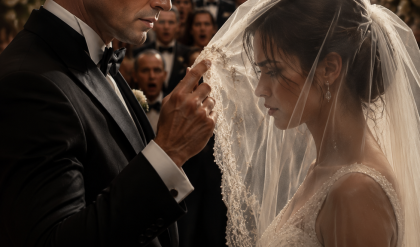
Their wedding was held six months later in a white chapel outside Charlotte, with oak trees lining the drive and sunlight pouring through stained glass.
Emma stood in the bridal room wearing an ivory gown Caroline had helped her choose. Denise fastened the last button with trembling fingers. Maddie cried before the ceremony even began. Caleb and Noah argued over who got to walk straighter down the aisle.
Ray stood in the doorway in a dark suit.
For a moment, nobody spoke.
Then he broke.
“My little girl,” he said.
Emma crossed the room and hugged him.
“I’m proud of you, Daddy.”
He shook his head, crying hard.
“No. I’m proud of you. And I’m sorry it took me so long to become the father you deserved.”
“You’re here now.”
He nodded.
“I’m here now.”
At the altar, Jack waited in a cream suit, the secondhand shoes polished and placed discreetly near the front pew in a small glass case Caroline had insisted on.
Emma had laughed when she saw it.
“That is ridiculous.”
William said, “No, my dear. That is history.”
When the chapel doors opened, everyone stood.
Jack saw Emma and cried without shame.
She walked toward him slowly, holding her father’s arm, the pendant shining at her throat.
The girl who had once cleaned rooftop pools before sunrise walked down the aisle with her head high. The man who had once stood at the gate in torn shoes waited for her with a heart finally worthy of being seen.
After the vows, after the kiss, after the cheers, after the photographs and dinner and dancing, Emma slipped away for one quiet moment.
She found Jack standing on the chapel porch, looking out at the trees.
“What are you thinking?” she asked.
He took her hand.
“That my father sent me to learn how to run a company, and God used a pair of broken shoes to teach me how to love.”
Emma leaned her head against his shoulder.
“I almost didn’t buy them.”
“I’m glad you did.”
“They were eighteen ninety-nine.”
“I know.”
“You gave me a priceless family pendant for eighteen-dollar shoes.”
“No,” Jack said, smiling. “I gave a priceless family pendant to a priceless woman. The shoes were just how I found her.”
Inside, music swelled. Their families were laughing together. Ray was dancing badly with Denise. William and Caroline watched the room with the peace of parents who had seen their son become a man.
Emma looked down at her wedding ring, then touched the pendant, then looked at Jack.
For most of her life, she had believed love meant carrying everyone until her own knees shook.
Now she understood something different.
Love could also be someone seeing your burden and saying, “Let me carry this with you.”
And far away, in the office where people had once ignored a guard and overlooked a cleaner, a pair of secondhand shoes sat behind glass—not as a symbol of poverty, but as a warning.
Never measure a person by what they appear to lack.
Sometimes the man in torn shoes owns the building.
Sometimes the woman buying them is the richest soul in the room.
THE END