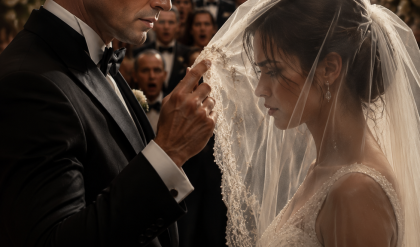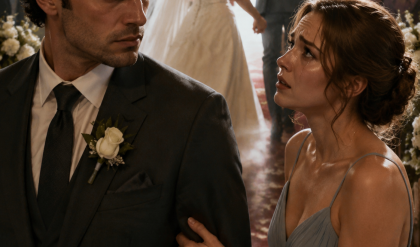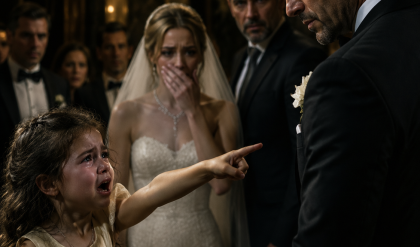
Clara could barely speak. “No, sir.”
His jaw tightened at the sir.
“Did any of it get in your eyes?”
“I don’t think so.”
Dorothy was already beside her, pressing a clean cloth into Clara’s hand. Her own face was pale with anger.
Damian turned to Miles, the young server still frozen near the broken champagne glasses.
“Miles,” Damian said, “tell me the truth.”
Miles looked terrified. His gaze flicked to Priscilla, then back to Damian.
“It was me,” he whispered. “I dropped the drinks. Clara wasn’t near the table.”
A rustle moved through the room.
Priscilla’s face turned the color of ash.
Damian looked at her then.
“Why did you do that?”
Priscilla’s mouth opened. “Damian, I—”
“No. Answer the question.”
“I was embarrassed. I was upset. The whole night has been under so much pressure, and she was standing there, and I thought—”
“You thought what?”
Priscilla’s eyes filled, but the tears came too late to look innocent.
“I thought she had made a mistake.”
“So you threw paint in her face?”
“She works here,” Priscilla said, then seemed to hear herself and stopped.
The silence that followed was merciless.
Damian’s voice dropped lower.
“Yes. She works here. She is an employee in my home. A human being in my home. Someone who has done nothing but serve this household with more discipline than half the people in my boardroom.”
Priscilla shook her head. “You’re making this bigger than it is.”
A woman near the champagne tower gasped softly.
Damian looked around the ballroom.
“Is that what everyone thinks?” he asked. “That this is small?”
Nobody answered.
He let the silence stretch until it became unbearable.
“This is not about spilled drinks,” he said. “This is not about paint. This is not even about tonight.”
Priscilla whispered, “Please don’t do this here.”
“You did this here.”
The words were quiet.
They destroyed her anyway.
Damian stepped closer, not enough to intimidate, only enough to make escape impossible.
“For months, I watched you speak to the staff as if their dignity were optional. I told myself you were stressed. I told myself wedding pressure changes people. I told myself the small things were small because admitting otherwise meant admitting I was planning to marry a person I did not understand.”
“Damian—”
“I heard you correct Dorothy in front of vendors for using the wrong brand of tea. I heard you tell my driver his accent made him sound unprofessional. I heard you call Clara invisible last Thursday when you thought I had left the room.”
Clara closed her eyes.
She had not known he heard that.
Priscilla’s lips trembled. “I didn’t mean—”
“You meant all of it. You only regret being seen.”
That sentence moved through the crowd like a blade.
Damian lifted his hand.
For one wild second, Priscilla looked relieved, as if she thought he meant to touch her face, soothe her, save her from the ruin she had made.
Instead, he took her left hand gently.
He slid the engagement ring from her finger.
Priscilla stopped breathing.
“Character,” Damian said, his voice carrying to the far corners of the ballroom, “is not revealed in how you treat people who can elevate you. It is revealed in how you treat people who can do nothing for you.”
He placed the ring in his jacket pocket.
“And tonight, Priscilla, you introduced yourself to me.”
The ballroom remained silent.
Then Damian turned to the guests.
“This party is over.”
Nobody moved at first.
He looked to his security director, a broad-shouldered man named Ethan Rowe standing near the entrance.
“Ethan, please see Ms. Kingsley’s guests out. Anyone who laughed may leave first.”
That was when the shame became visible.
Faces flushed. Eyes dropped. A man who had laughed behind his glass suddenly became fascinated by his shoes. Priscilla’s college friend Simone gathered her clutch with shaking hands. Damian’s aunt Margaret crossed the room, took Dorothy’s arm, and said, “Tell me where I can help.”
Priscilla stood alone in the center of all that beauty, ringless.
Clara wanted to disappear.
Dorothy guided her toward the service hallway, but Clara paused when Priscilla spoke behind her.
“This is because of her?” Priscilla asked, her voice cracking into something bitter. “You’re ending our engagement because of a maid?”
Damian’s expression changed then.
For the first time, anger showed plainly.
“No,” he said. “I’m ending it because you still think that word explains why she deserved it.”
Priscilla flinched as if struck.
Clara did not look back again.
In the service bathroom, Dorothy helped her rinse paint from her hair and skin. Blue water swirled down the sink. Clara scrubbed gently at her cheek until Dorothy took her wrist.
“Stop. You’ll hurt yourself.”
“I’m okay.”
“No, baby,” Dorothy said, voice breaking. “You don’t have to be okay right this second.”
Clara looked at herself in the mirror.
Her serving jacket was ruined. Paint had stained the edges of her hair. Her eyes looked huge in her pale face. She thought of Nora at home, probably asleep with her algebra book open beside her. She thought of the electric bill due Monday. She thought of every time she had swallowed an insult because survival had seemed more important than pride.
Then she began to shake.
Dorothy pulled her close.
For five minutes, Clara cried like a person who had not allowed herself to cry in years.
Outside, the mansion emptied.
Cars rolled down the long driveway beneath bare oak branches. Guests carried the story with them, some ashamed, some thrilled by scandal, all certain they had witnessed something that would not stay private.
Priscilla refused to leave at first.
She followed Damian into the library, her ruined composure dragging behind her like torn lace.
“You humiliated me,” she said.
Damian stood near the window, looking out at the dark lawn.
“I did not pour paint on anyone.”
“You could have handled it privately.”
“Clara was humiliated publicly.”
“I am your fiancée.”
“You were.”
The word struck.
Priscilla gripped the back of a leather chair. “You’re going to throw away four years because I lost my temper one time?”
Damian turned.
“One time?”
She looked away.
He crossed to his desk and picked up a folder Ethan had delivered earlier that week, one he had not wanted to believe mattered until tonight made disbelief impossible.
“There is something else you should know,” he said.
Priscilla froze.
“I had my office review the vendor accounts for the wedding events. Not because I suspected crime. Because three separate vendors called my assistant in tears after dealing with you.”
“That is normal wedding stress.”
“No. Not paying people after demanding extra work is not stress. Threatening to ruin a florist’s business because she refused to provide eighty additional arrangements for free is not stress. Calling a staffing agency to request younger, prettier servers because the original ones looked too tired is not stress.”
Priscilla’s face hardened. “Those people exaggerate.”
Damian opened the folder.
“Then I suppose the invoices exaggerate too.”
She stared at the papers.
He continued. “Tomorrow morning, my legal team will pay every vendor you shorted, every staff member you overworked, and every temporary employee whose overtime your planner tried to erase. Then we will recover those costs from the Kingsley event account, which you control.”
“You can’t do that.”
“I can. Your signature is on the authorization.”
“My father will—”
“Your father called me twenty minutes ago. Ethan sent him the security footage.”
The room changed.
Priscilla seemed to shrink inside her gown.
“He saw it?” she whispered.
“Yes.”
Her eyes filled again, but now the tears looked real. Not kind, not redeemed, but frightened.
“You sent it to my father?”
“I sent it to the man whose family name you used all night as a shield.”
Priscilla sank into the chair.
Damian’s voice softened, but not enough to become mercy.
“The wedding is canceled. The prenuptial negotiations are over. Cross Meridian will not be funding the Kingsley Foundation’s winter gala. The funds I had set aside for that event will go to a new employee education trust, beginning with the staff who worked tonight.”
She looked up sharply.
“Because of her.”
“Because of all of them.”
Priscilla laughed once, broken and ugly. “You think Clara Bennett is some saint? You think she doesn’t like being noticed by you?”
Damian stared at her for a long moment.
“Do you know what Clara asked me for last Christmas?”
Priscilla said nothing.
“She asked whether the leftover food from the staff dinner could be boxed for a family shelter. Not for herself. Not for attention. For strangers. And when my assistant offered to send something nicer, Clara apologized for being inconvenient.”
Priscilla’s face twisted.
“You never saw her,” Damian said. “That was the problem. You saw a uniform and decided there was no person inside it.”
For the first time all night, Priscilla had no answer.
By midnight, she left through the side entrance with her mother’s driver, her gown still perfect except for the champagne at the hem and the absence of the ring on her hand.
The next morning, the story reached every drawing room, office, country club lounge, and private group chat that had once treated Priscilla Kingsley like royalty.
But stories change depending on who tells them.
At first, her friends softened it.
Priscilla had a breakdown.
The maid provoked her.
Damian overreacted.
Then the vendors began talking.
A florist from Bridgeport posted a careful statement about wealthy clients who believe exposure is payment. A staffing agency confirmed that workers from the party had been compensated after an incident. A violinist wrote, without naming names, that the richest rooms were often where she had seen the poorest manners.
No one released the security footage publicly.
Damian would not allow Clara’s humiliation to become entertainment.
But enough people had been there.
Enough people had looked away.
And guilt has a way of making witnesses talk.
By Monday morning, Priscilla’s world had begun to close.
Her lunch invitation from the Hawthorne Arts Circle was postponed indefinitely. A charity board asked her to step back “until the situation settled.” Her wedding planner resigned by email, citing personal reasons. Two magazines canceled planned features on the Kingsley-Cross wedding. Her father, Charles Kingsley, called her into his office and said, with a coldness she had never heard from him before, “You have damaged more than yourself.”
For Priscilla, that was the real tragedy.
Not Clara’s pain.
Not her own cruelty.
The damage.
Meanwhile, Clara woke before dawn as usual, even though Dorothy had told her to take the day off. Habit pulled her out of bed. Fear pushed her toward the closet.
Their apartment was quiet. The radiator clicked. Rain tapped lightly against the window.
Nora stood in the kitchen in oversized pajamas, making toast.
“You’re not going to work,” Nora said.
Clara tried to smile. “Good morning to you too.”
“I heard you crying last night.”
Clara stopped.
Nora was fourteen, thin and bright-eyed, with Clara’s brown hair and their mother’s stubborn chin. She had learned too young how to read adult silence.
“I’m fine,” Clara said.
Nora crossed her arms. “That’s the sentence you use when you’re not.”
Clara sat at the small kitchen table.
For a moment, she considered lying. Then she looked at her sister and saw the future she had been trying to protect. Not a future without pain. That was impossible. A future where Nora knew pain did not have to be swallowed alone.
“Someone was cruel to me at work,” Clara said.
Nora’s face changed. “Who?”
“It’s being handled.”
“That’s not an answer.”
“It’s the only one you’re getting before school.”
Nora sat beside her. “Did you let them?”
The question was young. Honest. Impossible.
Clara looked at the rain on the glass.
“Sometimes surviving looks like letting someone think they won,” she said. “But that doesn’t mean they did.”
Nora was quiet for a long time.
Then she reached across the table and took Clara’s hand.
“I hate rich people,” she said.
Despite everything, Clara laughed.
“Don’t hate rich people. Hate cruel people. They exist in every tax bracket.”
Nora frowned. “Fine. I hate cruel people with chandeliers.”
“That’s fair.”
At nine o’clock, Clara’s phone rang.
It was Dorothy.
“Mr. Cross would like to speak with you today,” Dorothy said gently. “Only if you feel ready.”
Clara’s stomach tightened. “Am I being fired?”
Dorothy made a sound halfway between outrage and sadness.
“Oh, Clara. No.”
But fear does not leave just because someone opens the door.
By eleven, Clara was back at the estate, wearing her spare uniform, hair still faintly stained blue near the ends no matter how much she had washed it. The mansion looked different in daylight after the party. The roses had been removed. The champagne tower dismantled. The ballroom floor gleamed again.
But Clara could still see herself standing there.
Dorothy walked her to Damian’s study.
“He’s waiting,” she said. “And for once in your life, let someone be kind without apologizing for needing it.”
Clara nodded.
Inside the study, Damian Cross rose from behind his desk the moment she entered.
That alone nearly undid her.
Men like him did not stand for women like her.
Except he did.
“Clara,” he said. “Thank you for coming.”
She folded her hands in front of her. “Mr. Cross.”
“Please sit.”
She sat on the edge of the leather chair as if it might reject her.
Damian remained standing for a moment, then seemed to realize his height might make the conversation feel like a judgment. He sat too.
“I owe you an apology,” he said.
Clara looked up quickly. “You don’t. You didn’t do anything.”
“I employed the person who did. I invited her into this house. I ignored signs I should have addressed sooner. That makes part of it my responsibility.”
“You were always kind to me.”
“Kindness without protection is sometimes just politeness.”
The sentence settled between them.
Clara did not know what to do with a man who could indict himself so quietly.
Damian opened a folder, then closed it again, as if deciding the documents mattered less than the person in front of him.
“What happened last night will not be treated as an unfortunate misunderstanding,” he said. “Your wages for this month will be doubled. You will receive paid leave for as long as you need. If you want to remain in the household, you can. If you would rather transfer away from the estate, I will arrange that. If you want a recommendation elsewhere, you will have the strongest one I have ever written.”
Clara stared at him.
“And,” he continued, “there is a role opening at Cross Meridian in our facilities operations department. It involves staff coordination, vendor communication, and employee support across several properties. Dorothy tells me you already do half of that unofficially here.”
Clara blinked. “Dorothy said that?”
“She said if I had any sense, I would stop wasting your brain on polishing silver.”
A laugh escaped Clara, small and startled.
Damian smiled faintly. “Her words were sharper. I’m editing.”
Clara looked down. “I don’t have a degree.”
“You have competence.”
“Those aren’t the same thing.”
“No. Sometimes competence is rarer.”
Her throat tightened.
He slid a second envelope across the desk.
“This is separate. Nora Bennett has been accepted into Whitcomb Preparatory School for the spring term. Full tuition covered through graduation, if you agree.”
Clara stopped breathing.
Whitcomb Prep was the kind of school Nora’s classmates whispered about the way other children whispered about castles. Science labs. Debate teams. College counselors. A library with skylights. A place where futures were assumed instead of begged for.
Clara pushed the envelope back with shaking fingers.
“I can’t accept that.”
“You can.”
“No, Mr. Cross, I can’t. That’s too much.”
“It is not enough.”
“You don’t owe us a life.”
Damian leaned forward.
“No. But I have the means to remove an obstacle from a child’s path, and I would like to do that. Not as charity. As an investment in someone who deserves room to become who she is.”
Clara’s eyes burned.
“She’s smart,” she whispered.
“I know.”
“She wants to build bridges. Last year she made one out of popsicle sticks that held twenty-seven pounds.”
“Then I hope she builds them.”
Clara covered her mouth.
For years, she had carried hope like contraband, hidden deep where disappointment could not confiscate it. Now someone had placed it on a desk in front of her like a legal document.
“I don’t want revenge,” she said, tears finally slipping down her cheeks. “I don’t want anyone destroyed because of me.”
Damian’s expression gentled.
“Clara, Priscilla is not facing consequences because you were harmed. She is facing consequences because she chose to harm you.”
Clara closed her eyes.
“I only wanted respect.”
“I know.”
Outside the study, Dorothy stood just beyond the door, pretending not to cry.
Part 3
The first week after the canceled engagement felt like the city holding its breath.
Damian did not give interviews. He did not release statements beyond one sentence from his office saying the wedding had been canceled and all private matters would remain private. He refused every request from society pages, business columns, and scandal blogs.
“Clara is not a headline,” he told Ethan when the third reporter called the estate pretending to be a florist.
Ethan nodded. “Already blocked the number.”
But silence did not stop consequences.
Priscilla Kingsley had built her life inside rooms where approval was currency. Now the doors that once opened at the sound of her name became strangely heavy. People still answered her calls, but briefly. They still invited her places, but not the places that mattered. They still smiled, but with the careful pity reserved for a woman whose mask had slipped in public.
At first, she tried to fight it.
She told one friend the maid had been manipulative.
She told another Damian had been emotionally distant for months.
She told her mother the staff had always resented her.
But every version of the story failed against the simple fact that too many people had watched her throw paint at someone who could not throw anything back.
Three days after the party, Priscilla arrived at the Cross estate in a charcoal coat and dark glasses.
Damian agreed to see her in the sunroom, not the library. The library held too many memories. The sunroom, with its glass walls and winter light, allowed no shadows large enough for lies to hide.
Clara did not know Priscilla was there.
She was in the staff office, helping Dorothy review new scheduling software Damian had asked her to test. The promotion was not official yet. Clara had requested two weeks to think, though everyone except Clara knew she would be remarkable at the job.
Priscilla sat across from Damian with both hands wrapped around a cup of tea she had not touched.
“I came to apologize,” she said.
Damian waited.
She swallowed. “I behaved horribly.”
“Yes.”
“I was under pressure.”
His face did not change.
She looked down. “That is not an excuse.”
“No, it is not.”
Her fingers tightened around the cup. “I don’t know what happened to me.”
“I do.”
Her eyes lifted.
“You believed hierarchy was the same thing as worth,” Damian said. “That belief did not begin last Saturday.”
Priscilla’s lips parted, but no defense came out.
For once, she looked younger than her age. Not innocent. Just exposed.
“My father won’t let me chair anything now,” she whispered. “The foundation board wants me gone. People who used to beg for invitations won’t sit beside me at lunch.”
“Is that what you are sorry for?”
She flinched.
Damian did not enjoy asking it. That was clear. But mercy without truth would only give cruelty time to dress itself again.
Priscilla looked toward the glass walls. Outside, the lawn stretched pale beneath a hard blue sky.
“I don’t know,” she admitted.
That was the first honest thing she had said.
Damian leaned back.
“Then start there.”
She laughed weakly. “Start where? With everyone hating me?”
“With understanding why losing status frightens you more than becoming someone who deserved to lose it.”
Tears filled her eyes.
“I loved you,” she said.
“I believe you loved being chosen by me.”
“That’s cruel.”
“It is also true.”
For a long time, neither spoke.
Then Priscilla reached into her handbag and removed an envelope.
“This is for Clara.”
Damian did not touch it. “What is it?”
“A letter. And a check.”
“For what amount?”
“Fifty thousand dollars.”
He studied her.
Priscilla’s cheeks flushed. “Your lawyers said the vendor reimbursements and staff payments were coming from the event account. I know. This is separate.”
“Why?”
“Because I don’t know how to undo what I did.”
“You cannot buy forgiveness.”
“I know.”
“Do you?”
She lowered her eyes. “I’m trying to.”
Damian took the envelope at last.
“I will give her the letter. The check is her choice.”
Priscilla nodded.
At the door, she paused.
“Do you think she’ll ever forgive me?”
Damian thought of Clara standing beneath the chandelier, paint dripping down her face, refusing to let the room take her dignity. He thought of her crying in his study not because she had been hurt, but because someone had offered her sister a future. He thought of Priscilla’s question and how much of it still centered Priscilla’s need to feel absolved.
“I think,” he said carefully, “you should become someone who does not need her forgiveness in order to do better.”
Priscilla left quietly.
That afternoon, Damian gave Clara the letter.
They were in the small conference room off the east hallway, where Clara had been reviewing a binder of Cross Meridian properties. Her hair was pulled back, the faint blue stain now almost gone. She wore a navy sweater Dorothy had insisted looked “more like management and less like martyrdom.”
Damian placed the envelope on the table.
“Priscilla came by.”
Clara’s hands stilled.
“She wrote to you. There is also a check inside. You are under no obligation to read the letter, accept the money, respond, forgive, or feel anything specific.”
Clara stared at the envelope.
“What did she say?”
“I did not read it.”
She looked surprised.
“It is yours,” Damian said.
Clara picked it up slowly.
For a moment, he thought she might put it in her bag and leave it unopened for months.
Instead, she broke the seal.
The letter was two pages, handwritten in narrow, elegant script.
Clara read in silence.
Priscilla did not make excuses. Not exactly. She wrote that she had been jealous, that she had seen Clara’s quiet steadiness and hated it because she herself felt hollow under all her polish. She wrote that none of that justified what she had done. She wrote that Clara had deserved safety at work, dignity in public, and an apology not designed to purchase peace.
At the end, she wrote, I do not ask you to forgive me. I am sorry I needed witnesses before I saw you as a person.
Clara read that line twice.
Then she looked at the check.
Fifty thousand dollars.
More money than Clara had ever seen attached to her own name.
Enough to erase debt. Enough to fix Nora’s teeth. Enough to replace the old car she had been afraid to drive on highways. Enough to create breathing room.
Her first feeling was not joy.
It was anger.
Anger that money like this could sit in someone’s handbag as an apology while Clara had spent years choosing between prescriptions and groceries. Anger that Priscilla could wound someone and still have enough left over to soften her own guilt with a number. Anger that Clara’s humiliation had been measured, calculated, and signed.
Then came shame for feeling angry.
Then exhaustion.
Damian watched her face and said nothing.
Finally, Clara folded the letter.
“I want to accept the money,” she said.
“Then you should.”
“But not as payment for what happened.”
“No.”
She looked at him. “I want half for Nora’s future. The other half goes to Dorothy’s staff emergency fund.”
Dorothy, who had just entered with a stack of forms, stopped dead in the doorway.
“My what?”
Clara turned. “The fund you always wished existed.”
Dorothy stared. “Child, I said that once during a snowstorm while yelling at the furnace.”
“I remember.”
Damian leaned back, a faint smile touching his mouth.
Dorothy pointed at both of them. “I do not appreciate being ambushed with generosity.”
Clara smiled for the first time in days.
“It’s not generosity. It’s infrastructure.”
Damian laughed.
The sound surprised everyone, including him.
The staff emergency fund became official two weeks later.
Damian seeded it with ten times Clara’s contribution and placed Dorothy on the oversight committee. Clara, after three sleepless nights and two long talks with Nora, accepted the facilities operations role at Cross Meridian. She did not move into a glass office. She did not become magically polished overnight. On her first day, she got lost between the forty-second floor conference rooms and accidentally walked into a tax strategy meeting with a clipboard and a terrified apology.
But she learned.
She learned purchase orders and vendor contracts. She learned how to speak in meetings without making her sentences smaller. She learned that many people in expensive suits were simply guessing with better posture. She learned to ask questions without apologizing first.
Some employees remembered her from the estate and treated her with warmth. Others heard rumors and watched her too carefully, trying to decide whether she was a scandal, a charity case, or a secret favorite.
Clara gave them no performance.
She worked.
That had always been her answer.
At home, Nora started at Whitcomb Prep in January.
The first morning, she came out of her bedroom wearing the uniform and a look of panic disguised as sarcasm.
“I look like I’m about to solve a mystery on a private island,” she said.
Clara adjusted her collar. “You look brilliant.”
“I look expensive.”
“You are expensive.”
Nora groaned. “Don’t say that.”
Clara knelt to tie the younger girl’s shoe, though Nora was old enough to do it herself.
“Nora,” she said softly, “you do not owe anyone perfection because an opportunity costs money. You owe yourself effort. That’s all.”
Nora’s face shifted.
“What if they all know I don’t belong?”
Clara thought of marble floors, blue paint, and rooms full of people who had mistaken wealth for worth.
“Then you let them be wrong while you build bridges that hold twenty-seven pounds.”
Nora smiled.
“Thirty now,” she said. “I improved the design.”
“Of course you did.”
Winter loosened into spring.
The Cross estate changed too.
The staff moved differently. Not arrogantly. Not loudly. Just with the subtle relief of people who knew the person in charge would no longer confuse silence with consent. Damian instituted formal staff protections across his homes and offices. Anonymous reporting lines. Guaranteed overtime. Tuition assistance. Vendor conduct requirements. Dorothy called it “basic decency with paperwork.”
The phrase stuck.
Priscilla’s life changed as well, though not in the way gossip wanted.
She disappeared from society pages for several months. Rumor said her father had sent her to manage a struggling Kingsley property in upstate New York, a historic inn that had lost half its staff in one year because of poor treatment. Some said it was punishment. Others said it was exile.
Clara did not follow the rumors.
Then, in late April, a letter arrived at the Cross Meridian office.
It was addressed to Clara.
No check this time.
Only a short note from Priscilla.
The inn staff has been fully rehired under new contracts. Overtime is guaranteed. Two employees I once would have dismissed now run guest experience better than I ever did. I am not writing this for praise. I am writing because you once said you only wanted respect. I am beginning to understand that respect is not a feeling. It is a practice.
Clara read it twice.
Then she placed it in her desk drawer.
She did not forgive Priscilla that day.
But she no longer carried her like a stone.
One evening in May, Cross Meridian hosted a small reception for the launch of the employee education trust. It was not held in the grand ballroom. Damian chose the company atrium instead, a bright space filled with trees, glass, and ordinary employees standing beside executives as if that arrangement were natural because he intended to make it so.
Dorothy attended in a navy dress and complained about the height of the chairs.
Nora came too, carrying a geometry textbook because finals were apparently “a personal attack.”
Clara stood near the back of the room, watching a single mother from the night cleaning crew accept the first scholarship award for her son’s community college tuition.
The woman cried.
Her son cried.
Dorothy cried and denied it.
Damian stepped to the podium afterward.
He did not mention Priscilla. He did not mention paint. He did not turn Clara’s pain into a motivational anecdote. Instead, he spoke about work.
“The people who keep buildings running,” he said, “often become invisible because everything goes right when they do their jobs well. Tonight, this company makes a different promise. We will not wait for harm to notice value.”
Clara looked down.
Nora nudged her. “That’s you.”
“That’s everyone.”
“Yeah, but also you.”
Across the atrium, Damian’s eyes found Clara’s for one brief moment.
There was no fairy-tale music. No sudden confession. No billionaire sweeping the maid into a world where pain became romance and class disappeared because love made a better headline.
There was only respect.
Steady. Earned. Real.
After the reception, Clara stepped outside onto the terrace for air. The city glowed around her, windows lit like thousands of small chances. She could hear laughter inside. Nora was talking to Damian about bridge design with the fierce confidence of a girl who had discovered adults might actually listen.
Clara smiled.
Behind her, footsteps approached.
Damian joined her at the railing, leaving a careful distance.
“You did well tonight,” he said.
“I didn’t speak.”
“You stayed.”
She looked at him.
He rested his hands on the railing. “After everything that happened, you could have taken the job and hidden. No one would have blamed you. Instead, you helped build something that will outlast the scandal.”
Clara watched a line of headlights move along the avenue below.
“I spent a long time thinking survival meant staying invisible,” she said. “I’m trying to learn the difference between peace and hiding.”
“That’s a difficult lesson.”
“You sound like you know.”
His smile faded slightly.
“I spent years building a life no one could take from me. Then I almost married someone because she fit inside that life, not because I had truly looked at who she was.”
Clara considered him.
“At least you looked eventually.”
“Late.”
“But not too late.”
He turned toward her.
“Clara, I need you to know something. What I offered you was not guilt.”
She nodded slowly. “I know.”
“And it was not pity.”
“I know that too.”
He seemed relieved.
Below them, a siren passed in the distance and faded.
Clara looked back through the glass at Nora, who was now demonstrating something with two coffee stirrers while Damian’s chief financial officer listened like she was explaining national security.
“She’s going to be okay,” Clara whispered.
“Yes,” Damian said. “She is.”
For the first time in years, Clara believed it without needing to argue with fear.
Six months after the night of the engagement party, the Cross ballroom reopened for another event.
This one was smaller.
No champagne tower. No society photographers. No live painter arranged as a status symbol. The room was filled with employees, families, scholarship recipients, teachers, drivers, housekeepers, assistants, cooks, maintenance workers, and children running carefully because Dorothy kept warning them that marble was not a playground even though she smiled every time she said it.
At the west side of the ballroom, where the paint display had once stood, there was now a wall of framed photographs.
Not of donors.
Not of executives.
Of people at work.
Dorothy laughing in the linen room. Ethan holding an umbrella for a delivery driver during a storm. Miles, the young server who had dropped the tray, now training new staff with patient kindness. A night cleaner named Rosa standing proudly beside her daughter in a graduation cap. Nora in her school blazer, holding a model bridge.
And Clara.
In the photograph, she was not looking at the camera. She was reviewing a clipboard beside a vendor, one hand lifted mid-gesture, her face focused and calm. She looked capable. Present. Seen.
Clara stood before that picture for a long time.
Dorothy came up beside her.
“You hate it?” Dorothy asked.
Clara tilted her head. “I don’t recognize her.”
“I do.”
Clara swallowed.
From across the room, Miles approached with two glasses of sparkling cider.
“I never apologized properly,” he said.
Clara turned. “Miles, you did nothing wrong.”
“I froze.”
“You were scared.”
“So were you.”
She accepted the glass.
Miles looked at the floor. “I should’ve spoken faster.”
Clara thought of all the people who had looked away. All the times she had looked away from her own pain because there had been no time to tend to it.
Then she said, “Next time, speak faster.”
Miles looked up.
She smiled gently. “That’s how we make it matter.”
He nodded, eyes bright. “I will.”
Later that evening, Damian stepped onto the small stage at the front of the ballroom.
There was no dramatic hush this time. Just warmth. Conversation. Children whispering. Plates being set down.
Damian waited until the room quieted.
“A year ago,” he said, “I thought this house was well run because it was beautiful.”
Dorothy muttered, “It was well run because of me.”
Several people nearby laughed.
Damian smiled. “Because of Dorothy, yes.”
The room applauded. Dorothy waved them off with both hands and absolutely loved it.
Damian continued.
“I have learned that a house, a company, and a life are not judged by how they appear when the chandeliers are lit. They are judged by what happens when something breaks. Whether people look away. Whether someone is blamed because they are convenient. Whether dignity is protected when protecting it costs comfort.”
Clara felt Nora slip a hand into hers.
Damian’s gaze moved across the room, touching staff, guests, families, and finally Clara.
“This trust began because one person was harmed,” he said. “But it continues because many people chose to answer harm with repair. Not gossip. Not spectacle. Repair.”
Clara’s eyes burned.
He lifted a glass.
“To the people who keep the lights on. May they never again have to stand in the shadows to prove they belong.”
The room raised their glasses.
Clara raised hers too.
For a second, the ballroom blurred.
She remembered the cold paint. The laughter. The way her hands had trembled. She remembered wanting to vanish so badly she could barely breathe.
Then she looked around.
Dorothy standing tall. Miles smiling through tears. Nora beside her, safe and bright. Damian at the front of the room, not as a rescuer in a fairy tale, but as a man who had made a wrong thing matter by refusing to cover it up.
And Clara understood something she wished every tired, quiet, overlooked person could understand.
Humiliation was not the end of her story.
Cruel people often mistake silence for weakness because silence asks nothing from them. They do not realize that some people are silent because they are carrying whole families, whole histories, whole storms inside them and still choosing not to become cruel in return.
Priscilla had tried to make Clara disappear in front of everyone.
Instead, she had revealed her.
Not as a maid.
Not as a victim.
As a woman who had been bent by life but not broken by it. A woman who had every reason to become bitter and still chose to build something better. A woman who now stood beneath the same chandeliers that had once witnessed her shame, holding her sister’s hand, surrounded by people who knew her name.
Nora leaned against her shoulder.
“You okay?” she whispered.
Clara looked at the photograph on the wall again.
Then she looked at the room.
“Yes,” she said, and this time the word was not a mask. “I really am.”
Outside, the night settled gently over Hawthorne Hill. The mansion glowed against the dark trees, not like a palace anymore, but like a home with its doors finally opened wider than before.
And somewhere far from that room, Priscilla Kingsley was learning, slowly and painfully, that losing everything built on pride might be the first honest chance to build something else.
But Clara did not need to watch her fall.
She had her own life to rise into.
THE END