“How confidential?”
“The kind where I can’t talk about it.”
Brooke leaned against the counter. At twenty-two, she still had the round face of the kid who used to steal my lip balm, but her eyes had become older than they should have been. Caregiving does that. Poverty does it faster.
“Is it legal?”
I turned.
“I think so.”
“That is not the comforting answer you think it is.”
I almost laughed. Then Mom coughed again, and the sound traveled through the apartment like a bill collector knocking on bone.
Brooke heard it too. Her face softened first, then hardened, because love in our family had become practical.
“Just promise me,” she said, “if it gets weird, you leave.”
I promised.
I meant it at the time.
Quinn Executive Placement operated from the fourth floor of a renovated brownstone near Bryant Park with no sign outside and too much silence inside. Marjorie Quinn had silver hair, pearl earrings, and the calm expression of a woman who had watched many desperate people pretend they still had options.
She slid a nondisclosure agreement across her desk.
I read every page.
Absolute confidentiality regarding employer identity, business activities, schedules, locations, communications, associates, visitors, travel, and internal operations. Penalty for breach: more money than I would earn if I lived three lifetimes and became ruthless in all of them.
Only after I signed did Marjorie say his name.
“Dante Rosetti.”
I looked up.
Even I knew that name.
Rosetti Construction. Rosetti Hospitality. Rosetti Maritime Logistics. Restaurants, ports, hotels, concrete, unions, judges, rumors. In New York, his family name was printed on buildings and whispered in back rooms. Half the city called him a developer. The other half called him what he was.
A mafia boss with a corporate tax structure.
“No,” I said.
Marjorie did not blink. “You have not heard the offer.”
“I’ve heard enough.”
“Your mother’s cardiac clinic would be covered.”
That stopped me.
Marjorie opened a second folder. Inside was a benefits summary with numbers so precise it felt indecent.
“Your sister’s tuition arrears could also be handled as an advance.”
I stared at the page.
“What kind of assistant work requires buying my family first?”
“The kind where loyalty matters.”
“I don’t sell loyalty.”
“No,” Marjorie said. “You rent time. Loyalty is negotiated later.”
I should have walked out.
But my mother’s medication cost $687 a month after insurance, and our landlord had taped the last warning to the door with blue painter’s tape, as if kindness could make eviction less violent.
So I took the access card.
Rosetti Tower rose over Tribeca like a blade made of black glass. Forty-four floors. Private security. No lobby directory. No warmth. The guard at the desk checked my ID without expression and directed me to a private elevator that went straight to the fortieth floor.
The elevator walls were mirrored. I saw myself from every angle: navy blouse, black skirt, hair pinned low, chin lifted high enough to pass for confidence.
Dante Rosetti’s office took up half the floor.
He was standing by the window when I entered, looking down at the Hudson as if the river owed him money. Thirty-six, maybe thirty-seven. Dark hair. Sharp jaw. White shirt. Sleeves rolled to the forearm. A tattoo curled from wrist to elbow: a compass, a lion, and an old scar running through both like history refusing to stay covered.
He turned slowly.
His eyes were not black, exactly. Dark brown, almost gold near the center, the kind of eyes that did not look at people so much as take inventory.
“Claire Whitaker,” he said.
“Mr. Rosetti.”
“You were fired yesterday.”
“Yes.”
“For refusing your boss.”
“For refusing a dinner invitation that was not really about dinner.”
Something changed in his face. Not a smile. More like a lock noticing a key.
“Sit.”
I sat.
He remained standing.
“You know my reputation?”
“I know three versions of it.”
“Tell me the worst one.”
“He sleeps with every assistant he hires, never twice, and fires them before they can become inconvenient.”
The silence afterward was dense enough to lean on.
Then Dante laughed once.
Not because it was funny.
Because it was true, and he had not expected me to say it out loud.
“Do you scare easily, Miss Whitaker?”
“No.”
“Do you lie well?”
“When necessary.”
“Do you steal?”
“No.”
“Everyone steals.”
“Then ask better questions.”
His eyes sharpened.
For the next twenty minutes, he gave me rules. I would manage his calendar, read briefing folders, sit in meetings, take notes, speak only when addressed, and never answer a phone he had not approved. I would not ask about weapons, family matters, cash movements, port schedules, or men who entered without knocking.
When he finished, he finally sat behind his desk.
“Anything else?” I asked.
“Yes.”
He leaned back.
“Do not mistake proximity for importance.”
I closed my notebook.
“Then don’t mistake employment for obedience.”
His gaze held mine for five full seconds.
“You start tomorrow at seven.”
The first week taught me that Dante Rosetti’s world did not move on clocks. It moved on threats.
Men came in angry and left careful. Lawyers used soft voices. Politicians smiled too quickly. His younger brother, Nico, wandered through the tower as if it were a family kitchen, charming receptionists and stealing espresso pods from the pantry.
“You’re the new one,” Nico said on my third day, perching on the edge of my desk.
“I have a name.”
“Dangerous. Names make people harder to replace.”
“Then don’t learn mine.”
He grinned. “Claire Whitaker. Queens. Former compliance coordinator. Terrible at hiding annoyance.”
The office door opened behind me.
“Nico,” Dante said.
His brother slid off my desk with theatrical innocence.
“I was being welcoming.”
“You were being unemployed.”
“I own twelve percent of this building.”
“Then go haunt your twelve percent somewhere else.”
Nico winked at me before disappearing into Dante’s office.
That wink caused the first crack in Dante’s composure I ever saw. His jaw tightened, just slightly. Not jealousy. Not yet. Territorial irritation, maybe. The reflex of a man accustomed to owning every room he entered.
I noticed.
He noticed me noticing.
After Nico left, Dante stood in his doorway.
“My brother wastes time.”
“So do you, if you’re standing there to tell me that.”
A corner of his mouth moved.
“You always answer like that?”
“Only when underpaid.”
“You are not underpaid.”
“Then maybe I’m naturally difficult.”
“No,” he said. “You’re trained.”
I looked down at my notes.
That was the problem with Dante. He saw too much. Not emotionally, not generously, but strategically. He noticed pauses, bruises under makeup, unpaid bills folded too carefully, hunger hidden as discipline. He noticed because his survival had depended on noticing.
Mine had too.
The dinner happened the following Friday at a private restaurant in Little Italy called Belladonna, though everyone who mattered entered through the alley.
Mason, Dante’s security chief, briefed me in the car.
“You sit to his right. You write everything. If someone speaks to you, look at Mr. Rosetti before answering.”
“And if he doesn’t look back?”
“You don’t answer.”
Belladonna’s private room smelled of garlic, expensive wine, and polished old grudges. Eight men sat around a mahogany table. Dante at the head. Me beside him, notebook on my lap.
Across from us sat Victor Sloane, a port contractor with pale eyes and a pinky ring. He looked at me too long.
Dante noticed.
I wrote that down.
Victor noticed me writing it down.
Dante noticed that too.
The dinner passed in code. Shipments became “weather.” Bribes became “repairs.” Violence became “pressure.” By dessert, I had filled eleven pages with names, times, inconsistencies, and the kind of details men underestimate when a woman is quiet.
When we left, Dante guided me through a narrow service corridor.
He stopped suddenly.
I almost walked into him.
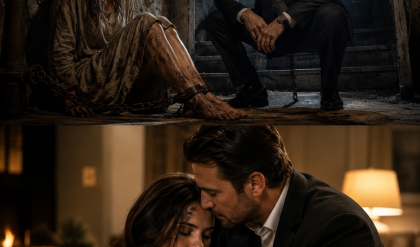
Before I could step back, his hand closed around my waist and he turned me toward the brick wall. Not violently. Calmly. As if he had performed this movement a hundred times with a hundred women who had already decided resistance was too expensive.
His arm braced beside my head.
“You wrote down Victor looking at you,” he said.
“It happened.”
“Why?”
“Because I write down things that happen.”
His face was close enough for me to smell wine and mint. Close enough to see the pale scar near his lower lip. Close enough to understand the reputation had not been exaggerated.
He was testing the old pattern.
Assistant. Dinner. Wall. Surrender. Dismissal.
My palm moved before fear could negotiate.
The slap cracked through the corridor.
Dante’s head turned slightly with the force of it.
Behind us, somewhere near the kitchen, a pan clattered.
I lowered my hand. My wrist burned.
“If you touch me again,” I said, “I leave tonight. Tomorrow morning, I call an attorney, a reporter, and every woman your agency sent here before me. I don’t care how many men you have. I don’t care how many judges answer your calls. Are we clear?”
He looked at me.
No rage.
No threat.
Just something worse.
Interest.
Then, slowly, Dante Rosetti laughed.
Low. Brief. Almost stunned.
“Mason,” he called, eyes still on me.
Mason appeared at the end of the corridor like he had grown out of the shadows.
“Take Miss Whitaker home.”
I walked past Dante without looking back.
In the car, Mason drove silently toward Queens.
“You’re thinking I’ll be dead by morning,” I said.
“No, ma’am.”
“What are you thinking?”
He met my eyes in the rearview mirror.
“I’m thinking nobody’s ever done that and left standing.”
The next morning, Mason was parked outside my building at 6:30.
That was how I knew I had not been fired.
Fired women take the train.
Fired women carry boxes.
Fired women do not have armored SUVs waiting under streetlights.
Dante was not in his office when I arrived. On his desk sat a three-page document and a yellow sticky note.
Read. Decide. Coffee in ten.
It was a contract addendum.
Clause One: No physical contact initiated by employer toward employee under any circumstance.
Clause Two: Employee may terminate contract with twenty-four hours’ notice and receive full severance.
Clause Three: No meetings outside professional scope without written agenda.
Clause Four: No romantic, sexual, or personal obligation shall be implied, requested, rewarded, punished, or negotiated during employment.
At the bottom, Dante had already signed.
I read it three times.
When he returned, I was standing by the window.
“I signed,” I said.
“I see that.”
“Why?”
He removed his coat and placed it over the chair.
“Because you were right.”
That was not an apology. Not exactly. But from a man like Dante, truth cost more than apology.
So I stayed.
The next weeks became a strange education. Dante did not touch me. He did not crowd me. He kept physical distance with such deliberate precision that I began to understand he was measuring every movement around me.
That should not have mattered.
It did.
I learned his habits. Black coffee until noon. Water after. No sugar. No small talk before ten. He read every document with a pen in his left hand, though Mason once told me he shot with his right.
I learned the business, too. Not all of it, but enough.
Enough to know Rosetti Construction won contracts no honest company could touch.
Enough to know Rosetti Maritime moved things through ports that never appeared on manifests.
Enough to know Dante was feared not because he was reckless, but because he was patient.
One Thursday, I handed him a folder on a subcontractor named Elias Crane who had been overbilling concrete deliveries through three shell companies.
Dante read it in the back of the SUV for twenty-seven minutes without speaking.
Then he closed the folder.
“You prepared this?”
“Yes.”
“Without being asked?”
“You were missing the pattern.”
His gaze met mine in the mirror.
“And you found it?”
“You weren’t looking at the wives.”
Mason made a sound from the driver’s seat that might have been a cough.
I continued. “The companies aren’t in Crane’s name. They’re in his ex-wife’s maiden name, his current wife’s sister’s name, and his daughter’s college roommate’s LLC. Men hide money badly when they think women are invisible.”
Dante looked down at the folder again.
Then he slid it inside his jacket.
That night, Mason drove me home alone. Halfway across the bridge, he said, “He’s never read an assistant’s memo before.”
I watched the city lights smear across the window.
“He should hire better assistants.”
“He just did.”
I hated how much that warmed me.
The first threat came in a plain envelope.
No return address.
Inside were six photographs.
Me leaving the subway.
Me buying coffee.
Me outside my building in Queens.
Me entering the pharmacy where I picked up my mother’s medication.
One photo showed my hand on our front door key.
I took the envelope straight to Dante’s office and threw it on his desk.
“Yours?”
He opened it. Looked once. Closed it.
“No.”
I believed him immediately, which annoyed me.
“Who?”
“Someone testing whether you matter.”
“And do I?”
The question came out sharper than I intended.
Dante looked up.
“Yes.”
The answer landed between us with no decoration.
For a second, neither of us moved.
Then he called Mason.
“Full coverage. Quietly. Her mother and sister too.”
“No,” I said.
Dante’s eyes did not leave mine. “Yes.”
“You don’t get to put guards on my family without asking me.”
“You want me to ask while someone has your front door photographed?”
“I want you to remember I am not property.”
That stopped him.
He turned to Mason. “Wait outside.”
Mason left.
Dante stood, but did not come closer.
“You’re right,” he said.
“You say that like it hurts.”
“It does.”
“Good.”
His mouth twitched.
Then his expression changed, and the man behind the boss showed through for half a second—tired, controlled, less arrogant than burdened.
“Claire, someone sent those to make a point. In my world, that point usually comes before blood.”
“My family is not your world.”
“No,” he said. “But your name is now being spoken inside it.”
I hated that logic.
I hated more that it was true.
So I agreed to protection under conditions. No men inside our apartment. No following Brooke onto campus unless there was an immediate threat. No frightening my mother. No lying to me about danger.
Dante listened to every condition.
Then he said, “Done.”
The second threat arrived a week later.
A 9mm bullet wrapped in navy ribbon, the exact shade of the blouse I wore the night I slapped him.
This time, Dante did not stay calm.
Not outwardly. His voice remained low. His orders remained precise. But I saw the change in his shoulders, the slight stillness that meant violence had moved from possibility to plan.
“You’re staying at the penthouse tonight,” he said.
“No.”
“Yes.”
“No.”
“Claire.”
“You do not get to command me because you’re scared.”
His eyes flashed.
“I am not scared.”
“Then stop acting like fear wearing a suit.”
The room went silent.
For a second, I thought he might shout.
Instead, he turned away and placed both hands on his desk.
When he spoke again, his voice was quieter.
“I am asking you to stay somewhere safer until I know who sent it.”
That word—asking—changed the air.
Dante Rosetti did not ask.
He ordered, bought, threatened, negotiated, punished.
But he did not ask.
I folded my arms.
“Brooke and my mother first.”
“Already handled.”
“I want names.”
He gave me names.
I stayed.
The penthouse occupied the top two floors of Rosetti Tower. It was beautiful in a way that made beauty feel lonely: dark stone, high glass, pale wood, Hudson River stretching silver below. Nothing personal except books and one framed photograph turned facedown on a shelf.
I noticed.
He noticed me noticing.
“My mother hates that picture,” he said.
“Then why keep it?”
“Because she’s right to hate it.”
I didn’t ask.
Not yet.
That night, I couldn’t sleep. I came downstairs at midnight and found a single sheet of paper on the low table.
One typed word.
WHITAKER.
My last name.
Behind me, Dante went completely still.
I turned.
The color had drained from his face.
“What is this?” I asked.
He didn’t answer.
“Dante.”
He picked up his coat from the chair and walked toward the private elevator.
“Stay here.”
“No.”
He turned back.
For the first time since I had met him, his mask had cracked enough for me to see fear underneath.
“Please.”
The elevator closed before I could decide whether to follow.
His brother Nico arrived around two in the morning carrying a pizza box and wearing the expression of a man who used humor the way other men used guns.
“Well,” he said, seeing me barefoot on Dante’s white couch, “this is either a hostage situation or Thanksgiving came early.”
“Where is he?”
“Working through feelings in a deeply illegal way.”
“Nico.”
He sighed and set the pizza down.
“If Dante doesn’t want to tell you, it’s because telling you makes him the villain.”
“He already runs a criminal empire.”
“Not that kind of villain.”
I stared at him.
Nico rubbed a hand over his jaw.
“Ask your mother about your father’s last case.”
“My father sold insurance.”
Nico’s expression softened.
“No, Claire. He didn’t.”
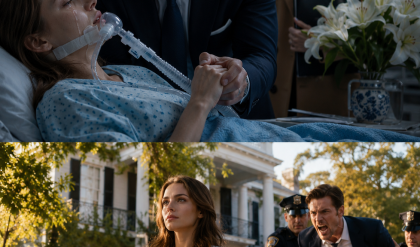
My mother was sitting by the clinic window the next morning, a blue blanket over her knees, the ocean gray beyond the glass.
When I asked about Dad, she closed her eyes.
Not surprised.
Tired.
That hurt more.
“Mom.”
She looked at me for a long moment.
Then she said, “Your father was an investigator for the State Attorney General’s office before you were old enough to remember.”
I sat down slowly.
“No.”
“Yes.”
“He sold insurance.”
“After he resigned.”
“Why?”
Her fingers tightened around the blanket.
“Because he found something inside the Rosetti organization. Not just gambling or union money. Something worse. A ledger connecting port shipments, judges, police officers, and two federal prosecutors.”
My mouth went dry.
“What happened?”
“He planned to testify. Then the ledger disappeared, and a witness died. Your father believed someone inside the state’s office was leaking information to the Rosettis. He resigned to keep us safe.”
“But he died in a mugging.”
Mom’s eyes filled.
“That was what I let you believe.”
The clinic room seemed to tilt.
I stood up because sitting still felt impossible.
“Dante knew?”
“I don’t know what Dante knew then. He was young when your father investigated his family. His father ran things in those days.”
“Why didn’t you tell me?”
“Because grief was already eating you alive, and I thought the truth would give it teeth.”
I walked to the window and pressed my hand to the cold glass.
Outside, winter light sat flat on the water.
“So my job wasn’t a coincidence.”
Mom said nothing.
That was answer enough.
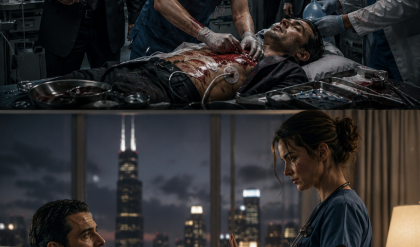
When I returned to the penthouse, Dante was waiting in the home office. His coat was torn. Blood darkened his sleeve from elbow to wrist.
“You’re bleeding,” I said.
“It’s handled.”
“You are bleeding on a rug that probably costs more than our apartment.”
That almost made him smile.
Almost.
I found the medical kit in a hallway drawer because men like Dante always had one nearby. The bullet had grazed his forearm, leaving a deep channel through skin and muscle. I cleaned it, stitched it, and felt his eyes on me the entire time.
“Stop looking at me like that,” I said.
“Like what?”
“Like pain is new because I’m watching it.”
He looked away.
I tied the last stitch.
“You hired me because of my father.”
“Yes.”
The thread snapped clean under the scissors.
“At least you didn’t lie.”
“I didn’t know at first.”
“Don’t insult me.”
His jaw tightened.
“I knew your name. I knew your father had been connected to an old investigation. I did not know what you were carrying until after you slapped me.”
A humorless laugh left my mouth.
“So the slap helped my résumé.”
“It helped me realize Marjorie had sent me a person, not a tool.”
I pressed gauze over the wound harder than necessary.
He did not flinch.
“My father was murdered because of your family.”
His face changed.
“Yes.”
One word.
No defense.
No excuse.
The room became too small.
“Say something else,” I whispered.
“My father ordered it.”
The silence afterward was absolute.
Dante looked at the bandage instead of me.
“I was fifteen. I heard the argument. My mother begged him not to. My brother was ten. I knew enough to understand a man named Whitaker had become a problem. I did nothing because I was a boy raised to believe doing nothing was survival.”
I stepped back.
“And now?”
“Now I have spent ten years trying to dismantle what he built without starting a war that would kill everyone near me.”
“That’s convenient.”
“Yes,” he said. “It would be, if it made me innocent.”
It didn’t.
We both knew that.
He stood slowly.
“In the ledgers your father hunted, there was a second record. My mother hid it before my father could destroy it. I found it six months ago.”
My breath caught.
“Where is it?”
“Split into three parts. One with my mother. One with Nico. One hidden by someone I did not know until last week.”
“Who?”
He met my eyes.
“Your mother.”
I shook my head.
“No.”
“She didn’t know what it was. Your father gave her a box of old insurance documents before he died. She kept it because grief keeps everything.”
I thought of the storage closet in our apartment. My father’s boxes. Tax records. Old coats. Christmas lights.
My knees felt weak.
Dante reached out, then stopped before touching me.
Good.
He was learning.
“Claire,” he said, “the people who sent your name know the ledger still exists. They think you can lead them to it.”
“Can I?”
“Yes.”
That should have terrified me.
Instead, something hard and clear settled in my chest.
For years, I had believed my father died because the city was cruel and random. Now I knew cruelty had worn names, signed orders, cashed checks, and kept breathing.
“What’s the plan?” I asked.
Dante stared.
“No.”
“Yes.”
“You are not getting deeper into this.”
“I was born into this. You’re the one who arrived late.”
His face tightened.
“My father put yours in the ground.”
“And I am not going to let either of them decide what I do next.”
That was when I saw it fully: the obsession people whispered about in Dante was not only lust, not conquest, not the old habit of wanting women because they wanted him first.
He was obsessed with the one thing he could not buy.
A choice.
Mine.
We found my father’s box in the back of our hall closet behind two broken fans and a plastic Christmas wreath.
Brooke watched from the kitchen doorway while Dante’s men stood outside in the hall.
“So,” she said, “we’re treasure hunting with the mafia now.”
“Don’t call it that in front of Mom.”
“Fine. Organized crime archaeology.”
Dante, who had come despite my telling him not to, stood near the door with his injured arm in a sling and his expression carefully neutral.
Brooke looked him up and down.
“You hurt her, I don’t care how many men you have. I will poison you with something untraceable from pharmacology lab.”
Dante nodded once.
“Fair.”
That surprised her enough to shut her up for nearly eight seconds.
Inside the box were old folders, insurance brochures, expired IDs, and a manila envelope taped beneath the cardboard flap. My hands shook when I pulled it free.
Inside was a flash drive, a key, and a note in my father’s handwriting.
Evelyn, if this ever finds daylight, trust no badge without proof. Trust no Rosetti without blood paid forward. Tell Claire I was trying to build her a safer city.
I read it twice before the letters blurred.
Dante stood very still.
“He knew,” I said.
“Yes.”
“That one day a Rosetti might come.”
“Yes.”
“And he still left a path.”
Dante’s voice was rough when he answered.
“Your father was braver than mine ever was.”
The flash drive contained encrypted files. Nico brought someone named June Park, a cybercrime lawyer who had once prosecuted half of Brooklyn and now looked at Dante like he was a disease she had learned to treat.
By dawn, we had names.
Judges. Cops. Contractors. Two city council members. A retired prosecutor. Victor Sloane from the restaurant. Paul Kemp, my former director, who had apparently been feeding staffing records to men connected to Rosetti rivals.
And Vanessa Vale.
The woman from Dante’s couch.
Her name sat inside a transaction log tied to witness intimidation and offshore accounts.
I looked at Dante.
He looked back.
There it was—the future betrayal waiting for its stage.
We did not know that then.
Or maybe some part of me did and refused to listen.
Over the next six weeks, Dante began moving pieces. He cut off money routes. Reassigned crews. Sent evidence anonymously to federal agents June trusted. Protected witnesses. Threatened men who deserved worse and spared men who did not.
I stayed because the files made sense to me faster than they did to anyone else.
Patterns. Dates. Women’s names hidden inside men’s crimes. Familiar.
Dante and I changed slowly, then all at once.
He brought coffee to my desk without asking how I took it because he knew.
I corrected his grammar in a threat letter, and he stared at me for ten full seconds before saying, “You understand that is not the point of the letter.”
“Then don’t split an infinitive while extorting someone.”
Nico laughed so hard he had to leave the room.
One night, after a meeting that nearly ended in gunfire, Dante found me on the penthouse terrace wrapped in a blanket.
“I haven’t touched anyone since the night you slapped me,” he said.
I kept looking at the river.
“I didn’t ask.”
“No.”
“Then why tell me?”
“Because I wanted you to know the difference between restraint and strategy.”
I turned.
“And which one is this?”
His eyes dropped to my mouth, then returned to my eyes.
“Both, if I’m honest.”
That was the first time he almost kissed me and didn’t.
The second time was after my mother’s clinic dinner, when she thanked him with such painful dignity that he left the room for five minutes and came back with red eyes he pretended were from smoke outside.
The third time, I stopped pretending.
It was an ordinary Wednesday, cold but clear. No bullets. No blood. No adrenaline. We were in his kitchen, arguing over whether my sister should accept a scholarship funded through one of his legitimate companies.
“It’s clean money,” he said.
“No money is clean around you. Some of it is just better laundered.”
“That is unfair.”
“That is accurate.”
He smiled despite himself.
I hated how much I loved that smile.
So I said, “Now.”
He went still.
“What?”
“My decision. Ordinary day. Clear head.”
His breathing changed.
“Claire.”
“Don’t make me say it twice.”
He crossed the kitchen slowly, giving me enough time to step back.
I didn’t.
The kiss was nothing like the hallway. No conquest. No test. No wall. His hand lifted to my face and waited there until I leaned into it.
Choice.
That was the difference.
And for a while, I let myself believe difference was enough.
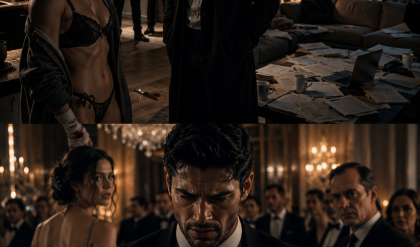
Three months later, Vanessa Vale was on his couch.
I left Rosetti Tower with my heart broken and my father’s flash drive in my coat lining.
That was not impulsive. I had carried a copy ever since I learned love did not make a woman stupid, but secrecy could.
Mason drove me to Queens without speaking. When we reached my building, he did not lock the doors. He did not ask me to reconsider.
He simply said, “It wasn’t what you thought.”
I laughed once.
“That sentence should be illegal.”
His face remained grim.
“Miss Whitaker.”
“No. If Dante wants to explain, he can bleed doing it.”
I went upstairs.
Brooke had already packed two bags and was helping Mom into her coat.
Mom looked at my face and understood enough not to ask.
We were about to leave through the back stairwell when Dante called.
I rejected it.
He called again.
I rejected it.
Then Vanessa called from an unknown number.
I answered.
“Claire,” she said, voice amused. “You really are disciplined. Most women scream.”
“Most women you meet have worse plans.”
Silence.
Then a soft laugh.
“There she is.”
“What do you want?”
“The flash drive.”
“Which one?”
That silence was better.
I smiled for the first time all night.
“You thought there was only one copy.”
“You’re making a mistake.”
“No,” I said. “I made one three months ago. This is correction.”
Her voice sharpened. “Dante won’t save you.”
“I’m not calling him.”
I hung up and turned to Brooke.
“Change of plan.”
Brooke blinked.
“Are we disappearing or destroying him?”
“Neither.”
I picked up my father’s old key from the envelope.
“We’re finishing Dad’s case.”
The key opened a safe-deposit box in a bank near Forest Hills. Inside was the third ledger component: printed pages, a cassette tape, and photographs of Dante’s father with men who had later become judges.
But the final piece was not evidence.
It was a letter addressed to me.
Claire, if you are reading this, I failed to come home with the truth. That means the truth will ask something of you one day. You do not owe it your peace. You do not owe it your life. But if you choose to carry it, carry it clean. Do not become like the people who made this necessary.
I sat in that little bank room and cried for the first time.
Not elegantly. Not quietly.
Brooke held my shoulders. Mom held my hand. For once, none of us pretended strength meant silence.
By morning, June Park had the full ledger.
By noon, three federal warrants were sealed.
By evening, Dante Rosetti walked alone into the lobby of the federal courthouse in Manhattan with two lawyers, one injured arm, and a signed cooperation agreement that would burn half his empire to the ground.
I watched from across the street in a gray coat, hidden among reporters.
He saw me anyway.
Of course he did.
Our eyes met through traffic, glass, camera flashes, and all the damage between us.
He did not cross the street.
That was how I knew he had finally learned something.
The truth about Vanessa came out two days later.
She had not been Dante’s lover.
She had been Victor Sloane’s courier, an old family associate, and the bait Dante used to confirm who inside his office was still leaking information. The scene on the couch had been staged for hidden cameras because Vanessa would only speak if she believed she had regained sexual leverage over him.
His hand on her thigh had covered the recorder taped beneath her skirt hem.
His mouth near hers had been close enough to make her whisper the name of the federal prosecutor she had bought.
It worked.
It also broke us.
When Dante finally came to see me, I met him in the small visiting garden outside my mother’s clinic. Snow sat on the hedges. The ocean beyond the road was iron gray.
He looked thinner. Human in a way power had once concealed.
“I should have told you,” he said.
“Yes.”
“I thought if you knew, you’d react differently and ruin the play.”
“Yes.”
His jaw tightened.
“You’re not going to argue?”
“No. You were probably right.”
That hurt him more than anger would have.
I continued, “You were right tactically. Wrong humanly.”
He looked down.
“I know.”
“You used the thing you knew would hurt me because it served the plan.”
“I did.”
“Did you touch her?”
“No.”
“Did you want to?”
His eyes came up, offended for one second, then ashamed because offense was too easy.
“No.”
I believed him.
That made everything harder.
I sat on the bench. After a moment, he sat beside me, leaving space between us.
“My cooperation agreement is accepted,” he said. “I’ll testify against Sloane, Kemp, Moretti, and the prosecutors. Some charges against me remain.”
“How long?”
“Maybe five years. Maybe less. Maybe more.”
The wind moved through the bare branches.
“Good,” I said.
He nodded slowly.
“Good?”
“You don’t get to walk away clean because you fell in love.”
His eyes closed briefly.
“No.”
“And I don’t get to pretend loving you fixes what your family did.”
“No.”
I looked toward the clinic window. My mother was inside, alive because his money had moved faster than my pride. My father was dead because his father’s fear had moved faster than justice. Both things were true. Love did not erase either.
“My dad wrote that I shouldn’t become like the people who made truth necessary,” I said.
Dante listened.
“So I’m not going to destroy you for hurting me.”
His throat moved.
“And I’m not going to save you from consequences because I love you.”
That word changed his face.
Love.
It stood there between us, bruised but alive.
“What are you going to do?” he asked.
“Live,” I said. “Take care of my mother. Watch Brooke graduate. Work with June on the witness fund. Build something that doesn’t need blood under the floorboards.”
A faint smile touched his mouth, then vanished.
“And me?”
“You’re going to testify. Serve whatever sentence comes. Tell the truth even when it makes you smaller. Especially then.”
He nodded.
I stood.
He did too.
For a moment, we faced each other in the snow-dim afternoon, two people tied together by grief, crime, choice, and one impossible tenderness neither of us had asked for.
“Claire,” he said.
I looked at him.
“I didn’t know how to love without control.”
“I know.”
“I’m learning.”
“I know that too.”
He gave a broken little laugh.
“Does knowing help?”
“Not today.”
He accepted that.
No reaching. No command. No plea dressed as concern.
Just acceptance.
That was the first honest gift he ever gave me.
As I walked back toward the clinic, he called my name once.
I turned.
Dante stood beside the bench, snow catching in his dark hair, the city behind him no longer looking like something he owned.
“Eyes open,” he said quietly.
I remembered the night I first kissed him. The promise inside those words. The warning too.
I nodded.
“Eyes open.”
One year later, Brooke graduated nursing school in a blue dress and cried before anyone else could.
My mother stood for the photograph with a cane in one hand and my father’s old watch on her wrist. She had started volunteering twice a week for families of witnesses entering protection, because my mother had never known how to survive anything without turning it into work.
June Park hired me as an operations director for a legal nonprofit that moved endangered witnesses before men like Dante’s father could reach them.
As for Dante, he testified for nineteen days.
He named names.
He did not soften his own.
That mattered.
The newspapers called him a fallen crime boss. A traitor. A reformer. A monster in a suit. A romantic antihero, because some journalists have no shame and worse imaginations.
I never read those articles twice.
Five years became three years and eight months after cooperation, asset forfeiture, and testimony that led to convictions in four states. Rosetti Tower was sold. The legitimate companies were placed under oversight. Nico took what remained clean and used it to fund housing projects in Queens under his mother’s supervision, which meant for the first time in recorded history, a Rosetti man was afraid of missing a budget meeting.
Dante wrote me letters.
I answered three.
Not romantic letters. Not promises.
Truthful ones.
He wrote about prison work, about books, about shame that no longer felt theatrical, about learning that silence could be discipline instead of strategy.
I wrote about Brooke’s first hospital job, Mom’s cornbread obsession, the nonprofit, the way ordinary days could still scare me because peace felt unfamiliar.
When he was released, I did not meet him at the gate.
That would have been too easy, and we had already paid too much for easy illusions.
I met him two weeks later in a public park near the Hudson, where children shouted near the water and nobody lowered their voice because of his name.
He wore jeans, a dark coat, and no expensive watch.
The scar on his forearm cut through the lion tattoo exactly as before.
But the man standing in front of me no longer looked like he expected the world to move aside.
“Hi, Claire,” he said.
“Hi, Dante.”
We walked for almost an hour before he asked.
“Is this forgiveness?”
“No.”
He nodded.
“Is it a beginning?”
I looked at the river.
The city was still hard. Still hungry. Still full of men who thought power could purchase absolution and women who had learned to price their silence too low.
But my father’s case was closed.
My mother was alive.
My sister was whole.
And Dante Rosetti, who had once thought every assistant had a price, had lost an empire because one woman refused to be bought—and then chose justice over revenge.
I took his hand.
Not because he deserved it.
Because I wanted to.
“Maybe,” I said.
His fingers closed around mine carefully, as if choice were something sacred.
This time, I did not pull away.
THE END