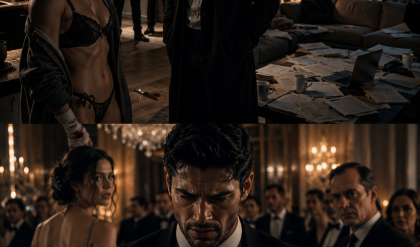
She smiled faintly. “Shouldn’t I be asking you that?”
Dominic poured bourbon into a glass. “Business is business.”
“That sounds like something men say when business is bad.”
His mouth tightened. “My business is never bad.”
Grace watched him drink.
There he was—the man who had kissed another woman, then come home and expected his wife to remain part of the furniture. He believed her silence meant ignorance. He believed her grace meant weakness.
That, more than the affair itself, almost amused her.
“Ethan is coming to Chicago next week,” she said lightly.
Dominic looked at her. “Your cousin?”
“Yes. He has some investment matters downtown.”
“Does he need a meeting?”
“He might appreciate your advice.”
Dominic relaxed. Business made sense to him. Family visits did not, unless they could be converted into negotiations.
“Have him call my office.”
“You’re generous.”
“I’m practical.”
Grace lowered her gaze to the book to hide the small, dangerous curve of her mouth.
“Yes,” she said. “You are.”
The first public crack appeared two days later.
Dominic was in a conference room with attorneys when his phone began vibrating across the table. First one message. Then another. Then five more.
The Coast Guard had flagged two Cross Harbor vessels for inspection.
Customs had frozen three containers.
A senator who had accepted Dominic’s money for six years suddenly canceled a private dinner through an assistant.
By noon, a union contact stopped answering calls.
By three, a bank delayed a routine credit extension for “enhanced review.”
Each issue was explainable alone. Together, they formed a pattern.
Someone had put a hand on the invisible machinery that made Dominic’s life possible and begun removing parts.
“Who has this kind of reach?” Caleb asked that evening, standing across from Dominic’s desk.
Dominic stared down at the reports. “Not Harrigan.”
“No.”
“Not the Irish crews on the South Side.”
“No.”
“Not the feds. If this were federal, we’d feel a different kind of pressure.”
Caleb folded his arms. “Then who?”
Dominic did not answer because he did not know, and not knowing enraged him more than the attacks themselves.
He had enemies. Many of them. But enemies had shapes, appetites, weaknesses. This was different. This was pressure without a face.
That night, Grace found him standing in the nursery.
He had not turned on the light. Moonlight silvered the crib, the rocking chair, the half-painted wall where Grace had chosen a soft blue-gray because she hated pink chosen out of laziness.
Dominic stood with his hands in his pockets, staring at the crib as if it accused him.
“Lost?” Grace asked from the doorway.
He turned. “No.”
“You rarely come in here.”
“I know.”
Grace stepped beside him. “She kicked twice today when Ethan called. I think she likes his voice.”
“She?”
Grace looked at him. “The doctor told me last week. You missed the appointment.”
Dominic’s face changed, just slightly.
There it was: a flicker of shame.
“I had a meeting,” he said.
Lie number nine.
Grace nodded. “Of course.”
He looked back at the crib. “A girl.”
“Yes.”
For a moment, the room softened around them. The child between them was not strategy, not betrayal, not power. She was simply a daughter waiting to enter a world already complicated by the failures of adults.
Dominic reached toward Grace’s stomach, then stopped before touching her.
Grace noticed.
So did he.
“May I?” he asked.
The question surprised her enough that she almost answered too quickly.
Instead, she took his wrist and placed his hand over the curve of her belly.
Their daughter kicked once.
Dominic went still.
The ruthless Dominic Cross, the man who could silence rooms without raising his voice, looked almost frightened.
Grace felt an ache move through her chest. Not forgiveness. Not even tenderness. Something older and more dangerous: memory. She remembered why she had once believed he could become more than the brutal architecture of his past.
Then his phone buzzed.
He looked at it.
Tessa’s name flashed across the screen before he turned it over.
Grace removed his hand from her stomach.
The moment ended because he had ended it.
“Business?” she asked.
Dominic’s jaw tightened. “Yes.”
Lie number ten.
Ethan Whitaker arrived in Chicago on a cold Thursday afternoon and met Grace at a hotel restaurant overlooking the river.
He looked like what he was: old money sharpened into a weapon. Navy suit, no visible logos, brown hair neatly combed, eyes that missed nothing. A stranger would have seen charm. A powerful person would have seen danger.
“You look tired,” he said after kissing Grace’s cheek.
“I’m pregnant and orchestrating the collapse of my husband’s arrogance. Tired seems fair.”
Ethan smiled despite himself. “Uncle Charles says you’re being too merciful.”
“My father thinks mercy is what you offer after victory. I think mercy can be the strategy.”
“And Dominic?”
Grace stirred her tea. “Dominic thinks he built an empire alone.”
“He did build something.”
“Yes,” she said. “But he built it inside weather we controlled. He never saw the roof because it never leaked.”
Ethan leaned back. “The roof is leaking now.”
“It needs to.”
“Grace.”
She looked up.
Ethan’s expression had softened. “You’re still in love with him.”
Grace’s fingers stilled on the spoon.
For a moment, she wanted to deny it. Pride made denial easy. Hurt made it easier.
But Whitakers were trained to face facts before making decisions.
“Yes,” she said quietly. “That’s the problem.”
“No. That’s the risk.”
Grace looked toward the river. “He slept with another woman while I was carrying his child.”
“I know.”
“He made me feel like a decorative piece in a life he had already designed.”
“I know.”
“I want him broken.”
Ethan nodded slowly. “And after?”
Grace did not answer right away.
Outside, boats moved along the water with slow precision. The city did not care about betrayal. It simply kept functioning, steel and glass and traffic and ambition, because cities were machines powered by human denial.
“After,” she said, “I want to see what he builds from the pieces.”
The gala took place at the Art Institute on a Saturday night, beneath vaulted ceilings and chandeliers bright enough to make every lie look expensive.
Dominic arrived with Grace on his arm.
She wore a silver dress that skimmed her pregnancy without hiding it. Her hair was swept back. Diamonds glinted at her ears. She looked serene enough to make men underestimate her and intelligent enough to punish them for it.
Dominic noticed the room’s temperature before they reached the first cluster of donors.
People who usually crossed rooms to greet him hesitated.
A judge looked away.
A developer who owed him three favors suddenly became fascinated by his champagne.
The Harrigan family’s patriarch, Brendan Harrigan, stood near the center of the room laughing with men who would not have taken his call a month earlier.
Dominic’s grip tightened on Grace’s hand.
“Something wrong?” she asked.
“No.”
“You’re holding my hand like you’re trying to break it.”
He loosened his fingers. “Harrigan is being treated like he matters.”
“Perhaps he does.”
“He doesn’t.”
Grace followed his gaze. “Situations change.”
“Not this fast.”
Then Dominic saw Ethan.
Grace’s cousin stood near the far windows with a senator, two bankers, a federal judge, and the kind of private security men who never needed to announce they were armed. Nobody was humoring him. They were listening.
Dominic frowned. “That’s Ethan?”
“Yes.”
“You said he was here for investments.”
“He is.”
“Those men don’t speak to investors that way.”
Grace looked at him with perfect innocence. “How do they speak to investors?”
“As if they want approval.”
“Then perhaps Ethan is a very good investor.”
Dominic looked at her.
For the first time in three years of marriage, he felt the edge of a thought he did not like.
Maybe Grace had not hidden because she was small.
Maybe she had hidden because she was deep.
“Introduce me,” he said.
Grace hesitated for half a second.
He saw it.
Then she smiled. “Of course.”
Ethan greeted Dominic with a handshake firm enough to be respectful and calm enough to be insulting.
“Mr. Cross,” Ethan said. “I’ve heard so much.”
“From Grace?”
“Among others.”
Dominic held his gaze. “I didn’t realize the Whitakers were so well-connected in Chicago.”
Ethan’s smile did not reach his eyes. “We’re connected where connection is useful.”
“That sounds expensive.”
“It is,” Ethan said. “But not as expensive as believing you have no need of anyone.”
Grace’s eyes flicked to Ethan.
Dominic saw it. A warning, perhaps. Or a shared amusement.
“What exactly does your family do?” Dominic asked.
Ethan tilted his head. “We protect our interests.”
“And am I one of them?”
Ethan looked at Grace before answering.
“You were.”
Dominic felt something cold move through him.
Before he could respond, the senator touched Ethan’s elbow and drew him back into conversation. Ethan excused himself politely, leaving Dominic with his wife and a question that now had teeth.
“You never told me your family had influence like this,” he said.
Grace’s expression did not change.
“You never asked.”
By morning, Caleb delivered a folder thick enough to alter the atmosphere in Dominic’s office.
“We missed it,” Caleb said.
Dominic opened the folder.
At first, the documents looked ordinary. Corporate holdings. Trust structures. Charitable foundations. University boards. Political donations. Then the connections began to form.
Whitaker money in logistics firms. Whitaker lawyers in federal agencies. Whitaker influence in banks, ports, energy contracts, defense committees, shipping insurance, private intelligence, media groups, and overseas trade corridors.
The Whitaker family did not run Chicago.
They did not need to.
They operated in the bloodstream beneath cities.
Dominic turned pages faster.
Grace Whitaker was not a sheltered heiress from a fading East Coast family. She had degrees from Georgetown and Wharton, yes, but those were decorative compared to her real education. At twenty-four, she had negotiated a truce between two rival organizations in Baltimore. At twenty-six, she had restructured a network of shell companies so cleanly that investigators spent eighteen months proving nothing. At twenty-eight, she had married Dominic Cross.
And for three years, Cross Harbor Logistics had enjoyed astonishing luck.
Investigations that dissolved.
Rivals that withdrew.
Inspectors who looked elsewhere.
Banks that extended credit at convenient moments.
Judges who delayed warrants.
Unions that remained cooperative.
Dominic stared at the last page until the words blurred.
“You’re telling me,” he said slowly, “my wife’s family has been protecting my empire.”
Caleb swallowed. “Yes.”
“And now?”
“Now they’ve stopped.”
Dominic closed the folder.
The office went silent.
He thought of Grace in the nursery. Grace reading by the window. Grace accepting his forehead kisses like a queen allowing tribute from a servant who did not know his place.
He thought of Tessa’s perfume.
Then understanding struck so hard he almost laughed.
“She knows.”
Caleb said nothing.
“She knows about Tessa.”
Still, Caleb said nothing.
Dominic stood and walked to the window.
Chicago lay beneath him, hard and bright and alive. He had believed the city belonged to him because people feared him. Now he understood that fear was local. The Whitakers dealt in dependency. They did not need men to tremble. They needed systems to obey.
And Grace—his quiet, pregnant wife—had been born inside that kind of power.
Humiliation burned through him first.
Then anger.
Then, beneath both, something unexpected.
Admiration.
She had beaten him completely.
No raised voice. No tears. No public scene. She had simply removed the invisible hand that had been holding up his world and waited for him to notice gravity.
That evening, Dominic came home early.
Grace was in the nursery, folding tiny white blankets into a drawer.
“We need to talk,” he said.
She did not turn around. “You found the folder.”
His throat tightened.
Not, What folder?
Not, What do you mean?
She knew exactly where he was in the game because she had designed the board.
“Yes,” he said.
Grace closed the drawer and faced him. “Then talk.”
“For three years,” Dominic said, “you let me believe you were just my wife.”
“No,” she replied. “For three years, you decided I was just your wife. I never forced that belief on you.”
His eyes flashed. “Your family used me.”
“My family invested in you.”
“You arranged our marriage to get access to my shipping network.”
“Yes.”
The honesty hit harder than denial would have.
Grace stepped past him into the living room, and he followed because for once she was leading and both of them knew it.
“The alliance was arranged,” she said. “The marriage was strategic. But what I felt for you was not part of the plan.”
Dominic’s voice lowered. “Felt?”
Grace turned at the window. “You came home smelling like another woman.”
The words stripped the room bare.
He looked away first.
“I should have told you.”
“You should not have done it.”
“Yes.”
She studied him. “That was easier than I expected.”
“I’m not stupid enough to defend the indefensible.”
“No,” Grace said. “You were only arrogant enough to do it.”
He flinched.
Good, she thought. Let truth land.
“Sophia—”
“Tessa,” she corrected.
Dominic closed his eyes briefly. “Tessa meant nothing.”
Grace laughed once, softly, without humor. “Men always say that as if it makes betrayal smaller. It doesn’t. It makes it cheaper.”
“I know.”
“Do you?” Her voice remained calm, which somehow made it more devastating. “You did not only betray me. You betrayed our daughter. You betrayed the alliance that kept your empire alive. You betrayed a woman who made herself small enough to fit inside your pride.”
Dominic swallowed. “What do you want?”
“The truth.”
“You have it.”
“No. I have facts. I want truth.” Grace stepped closer. “Why her?”
Dominic’s face hardened with old reflex, then changed. He looked tired. Human. “Because she made me feel powerful.”
Grace said nothing.
“You never needed me,” he continued. “You were always calm. Always composed. I mistook that for distance. Then you became pregnant and I felt even less necessary. Tessa looked at me like I was the center of the world.”
“And you preferred worship to partnership.”
“Yes.”
The admission cost him. Grace saw that. She also saw that cost did not equal repair.
“You have two choices,” she said.
Dominic’s gaze locked on hers.
“First, you keep the mistress and the pride that led you to her. My family completes what we started. Your allies vanish. Your routes fail. Your enemies divide the pieces. And I raise my daughter far from a father who taught her that loyalty is something men tattoo on their hands but not their lives.”
His face tightened.
“Second,” she said, “you end it. Completely. You accept that this marriage becomes a partnership of equals. You acknowledge publicly that the Whitakers stand beside Cross Harbor, and privately that I am not an accessory to your empire. I am the reason it survived.”
Dominic was silent for a long time.
Then he asked, “And forgiveness?”
“Forgiveness is not included in the offer.”
Pain moved through his eyes.
Grace almost softened. Almost.
“You can earn the chance to seek it,” she said. “That is all.”
Dominic looked toward the nursery.
“Our daughter,” he said quietly. “Will you keep her from me?”
“If you choose your ego, yes.”
“And if I choose you?”
Grace’s voice lowered. “Then become the kind of father she deserves to know.”
The room held its breath.
Finally, Dominic said, “I choose you.”
Grace did not move.
“Say it correctly.”
He looked back at her. “I choose our marriage. I choose our daughter. I choose to end Tessa, the lies, and the version of me that needed them.” His jaw flexed. “And I accept that you were always more powerful than I understood.”
Grace felt something inside her crack—not break, but open.
“Tomorrow,” she said, “you tell Tessa. I’ll be there.”
Dominic nodded once. “All right.”
That was the beginning.
Not the healing.
The beginning.
Tessa Lane’s apartment was in River North, all mirrored furniture, white rugs, and gold fixtures meant to look richer than they were. When she opened the door and saw Dominic, her face lit up.
Then she saw Grace behind him.
The light died.
“What is this?” Tessa asked.
Dominic stepped inside. “It’s over.”
Tessa laughed once, sharp and disbelieving. “No.”
“Yes.”
“You brought your wife here to punish me?”
Grace looked at her evenly. “He brought me here because I asked to watch him make the choice he should have made months ago.”
Tessa’s eyes filled with tears, then anger. “You think you’re better than me.”
“No,” Grace said. “I think I’m his wife.”
Tessa turned on Dominic. “You said you weren’t happy.”
“I wasn’t.”
“You said she was cold.”
Dominic’s face tightened. “I said a lot of things to justify what I wanted.”
“You used me.”
“Yes,” he said quietly. “And you used me.”
Tessa recoiled.
Dominic continued, voice controlled but not cruel. “You wanted proximity to power. I wanted someone who made me feel powerful without asking anything difficult of me. That was not love. It was weakness wearing expensive clothes.”
Tessa’s mouth trembled. “I loved you.”
Grace saw, with some surprise, that part of that might be true. Not the clean kind of love. Not the selfless kind. But a desperate, grasping attachment that had become real to the woman holding it.
Dominic saw it too.
“I’m sorry,” he said. “But I am not leaving my wife. I will not contact you again. You will be transferred out of my company with severance. If you try to reach me privately, my legal team will answer.”
Tessa stared at him as if he had slapped her.
Then she looked at Grace. “You’ll never trust him.”
Grace’s answer was calm. “That is between my husband and me.”
“He’ll get bored again.”
Dominic flinched.
Grace did not.
“Maybe,” she said. “And if he does, he knows what it will cost.”
Tessa’s anger faltered. For a second, she looked less like a rival and more like a young woman who had mistaken someone else’s brokenness for a door.
“I’m sorry,” Tessa whispered, though it was unclear which of them she meant.
Grace nodded once. “Then learn from it.”
They left together.
In the elevator, Dominic said, “Thank you for not destroying her.”
Grace watched the numbers descend. “Cruelty is not power. It’s usually insecurity with an audience.”
Dominic looked at her.
For the first time, he did not argue.
The weeks that followed were difficult in ways no strategy could simplify.
Dominic moved into the guest room. He attended every prenatal appointment. He began bringing Grace coffee in the mornings, then stopped when she told him the smell made her nauseous and learned to bring ginger tea instead. He met with Ethan and Whitaker advisors, enduring lessons in a world larger than the brutal Chicago chessboard he had mastered.
The Harrigans were not destroyed. Grace advised absorption.
“Dead enemies create martyrs,” she told Dominic one night over files spread across the dining table. “Useful enemies create structure.”
“My instinct is to make them afraid.”
“I know.”
“You disapprove?”
“I think fear expires,” she said. “Interest compounds.”
Dominic stared at her, then slowly smiled. “That’s terrifying.”
“That’s why it works.”
They were rebuilding the business, but the marriage moved more slowly.
Some nights they spoke until midnight. Other nights Grace closed herself in the bedroom because a memory returned without warning: the perfume, the missed appointment, the phone turned face down.
Dominic did not demand that she heal faster.
That mattered.
One month after the confrontation, Grace’s parents arrived from Virginia without warning.
Charles Whitaker was seventy-one, lean and silver-haired, his body weakened by illness but his gaze still sharp enough to cut glass. Margaret Whitaker was elegant, warm, and more dangerous than most men realized until too late.
Dominic came home to find them waiting in his living room.
Charles did not rise.
“Sit down, Mr. Cross.”
Dominic sat.
Grace watched from the side, one hand over her stomach.
Charles studied his son-in-law. “You betrayed my daughter.”
“Yes.”
“You humiliated her while she carried your child.”
“Yes.”
“You endangered an alliance worth more than your pride can calculate.”
Dominic’s jaw tightened. “Yes.”
“Do you have excuses?”
“No.”
Margaret’s expression softened slightly. Charles’s did not.
“My daughter has chosen to give you a chance,” Charles said. “That choice comes from her heart. If it came from mine, we would not be having this conversation.”
Dominic met his gaze. “I understand.”
“No, you don’t. But you are beginning to.” Charles leaned on his cane as he stood. “So I’ll offer advice you have not earned. Stop trying to be forgiven. Become a man who no longer needs to beg for forgiveness because his daily conduct speaks before he does.”
Dominic said nothing.
Charles moved toward the hallway, then paused. “Grace is not your shelter, Mr. Cross. She is not your decoration. She is not your reward for surviving violence. She is a woman with a mind sharper than yours and a heart more generous than mine. Treat that as the miracle it is.”
After her parents left three days later, Dominic found Grace on the terrace overlooking the lake.
“They hate me less than I expected,” he said.
“They hate you exactly as much as appropriate.”
“That’s comforting.”
She almost smiled.
He stepped beside her, leaving space between them. “Your father is right.”
“He usually is. It’s one of his more irritating qualities.”
“I spent my life thinking power meant never needing anyone.” Dominic looked out at the water. “Then I needed you without knowing it. Instead of being grateful, I resented the parts of you I couldn’t control.”
Grace was quiet.
“I don’t know how to become the man your father described,” he said. “But I want to.”
Grace turned to him. Moonlight caught the edge of his face, the tattoo at his throat, the eyes that had once seemed cold because coldness was safer than need.
“You can come back to our room tonight,” she said.
Hope moved across his expression so quickly it hurt to see.
“Are you sure?”
“No,” Grace answered honestly. “But I’m tired of making distance do the work of trust.”
That night, Dominic slept beside his wife without touching her until she reached for his hand in the dark.
It was not forgiveness.
But it was a bridge.
The final test came three weeks later, in the form of a message from Tessa.
I have information. It’s about Caleb. Please. He’ll kill me if he knows I contacted you.
Dominic showed Grace immediately.
She read it twice.
“What do you want to do?” she asked.
His answer came without hesitation. “We meet her together.”
Tessa looked thinner when they found her in the back booth of a diner outside Oak Park. No dramatic makeup. No silk. Just a frightened woman with a folder clutched to her chest and shadows under her eyes.
“I didn’t know who else to call,” she said.
Dominic’s voice was guarded. “You said this was about Caleb.”
Tessa slid the folder across the table. “He approached me before you did.”
Dominic opened the folder.
Grace watched his face change.
Inside were shipping manifests, encrypted payment trails, warehouse photographs, and messages linking Caleb Voss to illegal weapons shipments Dominic had never authorized. Caleb had been using Cross Harbor routes for eighteen months. Worse, he had been feeding information to the Harrigans after Grace pulled the Whitaker shield, using the chaos to position himself as the only man who could “save” the organization.
Dominic turned a page.
His voice dropped. “He planned to frame me.”
Tessa nodded, tears gathering. “And Grace.”
Grace looked up sharply.
Tessa swallowed. “He said if Dominic was distracted and you were scared enough, the Whitakers would overreact. He wanted a war. He thought if both families weakened each other, he could take what was left.”
Dominic’s hand closed into a fist.
LOYALTY pressed white across his knuckles.
“He sent you to me,” he said.
Tessa cried harder. “At first. Yes. He told me you were unhappy. He told me Grace didn’t love you. He said all I had to do was keep you close and tell him anything useful. Then I fell into it. I liked the apartment, the attention, being wanted by someone powerful. I’m not innocent.”
“No,” Grace said softly. “But you are here now.”
Tessa looked at her, startled by the lack of cruelty.
“Why bring this to us?” Grace asked.
“Because Caleb found out I kept copies. Because he has men watching my building. Because I did something ugly and stupid, but I don’t want to die for him.”
Grace closed the folder.
The shape of the whole game changed.
What began as punishment had exposed treason.
Dominic looked at Grace. “I have to deal with him.”
“Yes,” she said. “But not the way you used to.”
Caleb was waiting at the Cicero warehouse when Dominic arrived that night.
He had expected anger. Maybe violence. He had not expected Grace.
She stepped out of the car beside Dominic, flanked by Whitaker security and two federal agents whose presence made Caleb’s expression falter.
“What is this?” Caleb demanded.
Dominic walked toward him slowly. “The end.”
Caleb laughed. “You bring your pregnant wife and government pets to a family matter?”
Grace’s voice was calm. “You made it a federal matter when you moved weapons through interstate shipping lanes and tried to frame two families for your ambition.”
Caleb’s face hardened. “You think you’re better than us?”
“No,” Grace said. “I think you’re sloppy.”
Dominic almost smiled.
Caleb looked at him. “She made you weak.”
Dominic stopped a few feet away. “No. She made me honest.”
“I built this with you.”
“You stole from it.”
“You got soft,” Caleb snapped. “You started listening to her. Meetings, advisors, mercy for Harrigan. You forgot what made men fear us.”
Dominic looked at the man who had stood beside him for a decade. He remembered blood on Caleb’s shirt after old wars, laughter over whiskey, loyalty sworn in rooms that smelled like smoke and money.
Then he remembered Grace’s father.
Become the man who doesn’t need forgiveness.
“I remember exactly what made men fear us,” Dominic said. “I’m trying to build something better.”
Caleb sneered. “You won’t survive better.”
“Maybe not,” Dominic said. “But I’ll survive you.”
Caleb reached inside his jacket.
The federal agents moved faster.
No shots were fired.
Within seconds, Caleb was on the concrete, restrained, cursing Dominic’s name so violently that the words echoed against the warehouse walls.
Dominic watched him being taken away.
Grace stood beside him. “You wanted to kill him.”
“Yes.”
“Why didn’t you?”
Dominic looked at his hands.
For years, he had believed the tattoo there was a warning to other people. Now he understood it was a demand placed on himself.
“Because our daughter will ask one day what kind of man I became after I hurt her mother,” he said. “I want a better answer than revenge.”
Grace took his hand.
This time, she did not do it to comfort him.
She did it because she wanted to.
Their daughter was born on a rainy September morning at Northwestern Memorial, with Dominic holding Grace’s hand like it was the only solid thing in the world.
When the baby cried, Dominic cried too.
Grace, exhausted and glowing, laughed through tears. “You’re terrifying Chicago’s nurses.”
“I don’t care,” he whispered.
The nurse placed the baby against Grace’s chest.
Dominic stared down at the tiny face, the dark hair, the furious little mouth.
“What’s her name?” the nurse asked.
Grace looked at Dominic.
He nodded.
“Rose,” Grace said. “Rose Margaret Cross.”
Dominic touched one careful finger to his daughter’s hand. She grabbed it with impossible strength.
“She has your grip,” Grace murmured.
“She has your timing,” Dominic said. “Arriving in a storm.”
Grace smiled.
For the first time in many months, nothing in the room needed to be hidden.
One year later, the same gala glittered beneath the Art Institute’s chandeliers.
Dominic and Grace entered together.
This time, the room noticed them correctly.
Not Dominic Cross and his quiet wife.
Not Grace Whitaker and the man she had saved from his own arrogance.
Together, they were something more complicated and more formidable: a partnership built from betrayal, consequence, humility, and choice.
Ethan approached with champagne and a grin. “You two are making everyone nervous.”
Grace accepted a glass of sparkling water. “Good.”
Dominic looked around the room. Men who once feared him now measured him differently. Not smaller. Not weaker. Different.
A year ago, he would have needed their deference like air.
Now he looked at Grace and thought of Rose asleep at home under Margaret’s watchful eye, and the need was gone.
Later that night, they stood on their penthouse balcony above Chicago.
The same city. The same lake. The same height from which Grace had once decided to pull the ground out from under him.
Dominic took her hand.
“I never thanked you,” he said.
“For what?”
“For not destroying me completely.”
Grace leaned against the railing. “You destroyed yourself. I just made sure you noticed.”
He laughed softly. “That sounds like you.”
“I hope so.”
He turned serious. “I love you, Grace. Not because of what you protected. Not because of what you can destroy. Because you saw the worst version of me and still demanded the better one.”
Her eyes shone in the city light.
“I loved you even when I wanted not to,” she admitted. “That was the most inconvenient part.”
“Do you forgive me?”
Grace looked at him for a long time.
Forgiveness was not a single door. It was a house rebuilt room by room. Some rooms were warm now. Some still held shadows. But the foundation was no longer made of lies.
“I’m still building that answer,” she said. “Ask me again in fifty years.”
Dominic smiled and pulled her close.
Below them, Chicago moved in endless patterns of ambition, hunger, love, failure, and second chances. Above it, two people held each other in a home that had once been a battlefield and had slowly become something honest.
Dominic Cross had come home smelling like another woman.
It had cost him his pride, his illusions, his most trusted friend, and the false empire he thought he had built alone.
But it had also given him the truth.
The woman he betrayed had not been weak.
She had been the shield.
And when she finally lowered it, he learned that some men must fall before they can learn how to stand beside someone instead of above her.
THE END