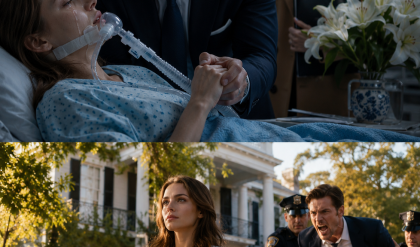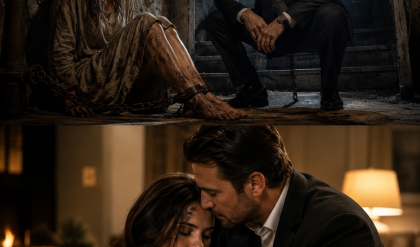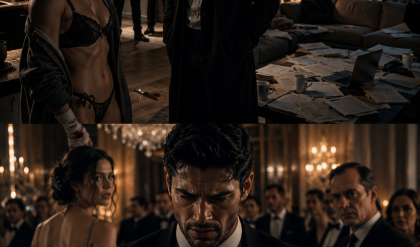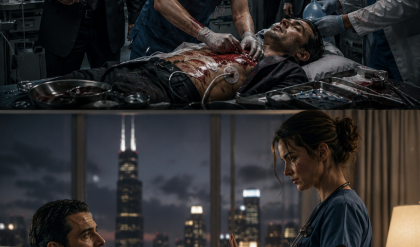
“How are you adjusting?” he asked on the third night, across a dining table long enough for a peace treaty.
“Fine, thank you.”
“Do you need anything?”
“No, thank you.”
He set down his fork. “Evelyn.”
She looked up.
“I asked if you needed anything. Not what answer sounds least inconvenient.”
The correction made her stomach twist.
“I don’t know,” she admitted.
That seemed to surprise him.
It surprised her, too.
Marco studied her for a moment, then nodded once. “That’s an honest answer. We can start there.”
She did not know what he meant by start.
Evelyn spent her days learning the estate. Survival had taught her that every place had a map beneath the map: who entered when, which doors locked automatically, which servants gossiped, which guards were bored, which windows opened. The DeLuca house was harder than the Mercer mansion. It was not chaotic. It breathed with discipline.
Kitchen staff arrived at six. Guards changed at seven and three. Rosa inspected rooms at ten. Marco’s office occupied the east wing and stayed locked unless he was inside. There was a library on the second floor overlooking the winter garden, and no one seemed to use it.
That became Evelyn’s refuge.
Books had never asked her why she flinched.
On the ninth night, Marco found her there.
She was curled in a leather chair, a mystery novel open in her lap, though she had read the same page six times.
“I wondered where you disappeared to,” he said from the doorway.
Evelyn jerked upright. The book fell.
“I’m sorry. I didn’t know this room was private.”
“It isn’t.”
“I can leave.”
“You don’t have to leave every place I enter.”
She swallowed. “Habit.”
Marco’s face changed at that. Not much, but enough.
He stepped into the room slowly, as if approaching a wounded animal. That should have insulted her. Instead, it made her breathe easier.
“My mother loved this library,” he said, glancing at the shelves. “She said a house without books was just a warehouse for expensive furniture.”
Evelyn picked up the novel. “She sounds sensible.”
“She was.” His mouth tightened. “She died when I was fourteen.”
“I’m sorry.”
“You say that like you mean it.”
“I do.”
He looked at her then, really looked at her, and she had the strange sense that both of them were standing at the edge of a door neither knew how to open.
Before either of them could speak again, Evelyn’s phone rang.
The sound made her go cold.
She looked at the screen.
Charles Mercer.
Her father.
Marco saw the name. “You don’t have to answer.”
That was ridiculous. Of course she had to answer. Men like her father did not call for conversation. They called to remind people where the walls were.
She accepted the call.
“Yes, Dad?”
“You’ve embarrassed me,” Charles Mercer said without greeting.
Evelyn’s spine locked.
Marco’s eyes narrowed.
“I don’t understand,” she said.
“Don’t play stupid. Adrian says DeLuca has been asking questions.”
At the name Adrian Vale, the world seemed to tilt.
Evelyn turned away from Marco, but too late. He had already seen her face.
Her father continued, cold and clipped. “Whatever story you’re feeding your husband, stop. The marriage is done. The alliance is done. Your job is to behave, smile, and keep DeLuca satisfied. Do you understand?”
Evelyn’s throat closed.
“Evelyn,” Charles snapped. “Answer me.”
“Yes.”
“Yes what?”
“Yes, I understand.”
“Good. And if Marco DeLuca becomes a problem because of your dramatics, I will handle you myself.”
The call ended.
Evelyn stood perfectly still.
Marco’s voice came quietly behind her.
“Who is Adrian Vale?”
“No one.”
“Try again.”
She clutched the phone with both hands. “He’s my father’s business partner.”
“That’s not what I asked.”
She turned around. “Please don’t do this.”
“Do what?”
“Notice things.”
The words came out so honestly that they nearly destroyed her composure.
Marco walked toward her, then stopped when she took one involuntary step back.
“Evelyn,” he said, “who put those bruises on you?”
Her heart pounded. Every lesson her family had beaten into her rose at once.
Deny.
Smile.
Protect the name.
Protect the business.
Protect everyone except yourself.
“No one,” she said.
Marco’s expression went flat. “That was the last lie I’m accepting tonight.”
Fear flared into anger because anger was easier to survive.
“You think because you gave me your last name, you own the truth?”
“No.”
“Then stop asking.”
“I can’t.”
“Why?”
“Because you begged me not to touch you on our wedding night like you expected me to break your bones. Because you apologize before anyone accuses you of anything. Because you haven’t eaten a full meal since you arrived. Because you look at closed doors like they might grow teeth.” His voice dropped. “And because when your father said Adrian Vale, you looked like someone had put a gun to your head.”
Silence filled the library.
Evelyn wanted to hate him for seeing her.
Instead, she sat down before her legs gave out.
Marco did not touch her. He lowered himself into the chair across from her.
“Tell me one true thing,” he said. “Just one.”
She stared at the carpet until it blurred.
Then she whispered, “Adrian hurt me.”
Marco did not move.
That made it worse.
“For how long?” he asked.
“Four years.”
His eyes darkened.
“And your family knew?”
Evelyn laughed once, brittle and hollow.
“My family arranged the rooms.”
The words hung between them like smoke.
Marco looked away, but not before she saw the violence flash across his face.
“Tell me everything,” he said.
So she did.
Not all at once. Not neatly. Trauma did not come out like a confession in a church booth. It came in pieces, broken and sharp. Adrian Vale had been a Mercer ally, a charming predator with polished shoes and a judge’s smile. He began with compliments when Evelyn was twenty. Then private jokes. Then a hand at her waist that stayed too long. When she told her mother, Patricia Mercer accused her of flirting. When she told her father, Charles said Adrian was too valuable to insult with childish accusations.
Then came the locked office.
The threats.
The bruises hidden beneath silk.
The photographs Adrian used as blackmail.
The doctor paid to write “anxiety episode” on medical forms.
The mother who said, “If you ruin this family, you will have no family left.”
Marco listened without interrupting. By the time she finished, the fire in the library had burned low.
His voice, when it came, was almost unrecognizable.
“Show me.”
Evelyn’s head lifted.
“What?”
“The bruises. The scars. Only if you choose to. But if I’m going to protect you, I need to know what he did.”
There it was.
A choice.
No one had given her one of those in years.
Her hands shook as she stood. She turned her back to him and pulled the collar of her robe aside, revealing the marks along her shoulder, then the older scars across her back. She heard Marco inhale sharply. He did not curse. Did not rush toward her. Did not make it about his rage.
That restraint did more to undo her than anything else.
She covered herself and turned.
Marco’s face was pale with fury.
“How is he still alive?” he asked.
“Because men like Adrian don’t get punished.”
Marco rose.
“They do now.”
Panic seized her. “No. If you go after him, there will be a war.”
His eyes met hers.
“Then there will be a war.”
“And what happens to me when everyone starts choosing sides?”
He stepped closer, careful but certain.
“You stay behind me until you’re ready to stand beside me.”
The answer should have frightened her.
Instead, it made her cry.
The first move came quietly.
Marco did not send men with guns. He sent accountants.
For two weeks, Chicago whispered.
Adrian Vale’s shipping company suddenly attracted federal interest. A judge who had blocked an old civil complaint against him took an abrupt leave of absence. A private clinic on the Gold Coast lost three servers in a burglary no one admitted to committing. Money trails appeared in places Adrian thought buried: payments to families, settlement wires disguised as consulting fees, hotel records, security logs, hush money.
Evelyn watched from the library as Marco built a case with terrifying patience.
“You could just kill him,” she said one night, standing in the doorway of his office.
Marco looked up from a stack of files.
“Yes.”
“Why don’t you?”
“Because dead men don’t lose everything first.”
She stepped into the room. “Is this justice or revenge?”
He leaned back.
“That depends on what you want.”
No one had asked her that.
She sat across from him.
“I want him afraid,” she said. “Not of being hurt. Of being known. I want every person who protected him to understand they chose a monster. I want him to walk into a room and see no allies. I want him alive long enough to realize I survived him.”
Marco nodded slowly.
“I can work with that.”
“You keep saying I.”
“You want to help?”
Her fear answered first.
Then something stronger followed.
“Yes.”
The next day, Marco took her to meet Claire Sutton.
Claire was twenty-seven, thin, dark-haired, and living in an apartment protected by two DeLuca guards who looked too large for the hallway. She did not trust Evelyn at first. Evelyn could not blame her. Rich women from crime families rarely arrived bearing salvation.
“He told me no one would believe me,” Claire said, fingers wrapped around a mug of coffee she had not touched. “He said I was replaceable.”
Evelyn’s voice shook, but she kept it steady enough.
“He told me I was ungrateful.”
Claire looked up.
“He told you that too?”
“Yes.”
That was the beginning.
They found five more women. Some were willing to testify. Some were too frightened. One hung up the moment Evelyn said Adrian’s name. Another screamed at her to leave the past buried. Evelyn understood every reaction because she had lived inside all of them.
A week later, Charles Mercer demanded a meeting.
Marco chose the restaurant: an old steakhouse in River North where the booths were private, the waiters discreet, and every entrance covered by DeLuca men.
Evelyn nearly vomited before they left.
Rosa helped her dress in a navy sheath that made her look older, sharper, less like a sacrificial bride.
“You look like trouble,” Rosa said approvingly.
“I feel like I’m going to pass out.”
“Trouble usually does.”
Marco waited downstairs. When he saw her, his expression softened for half a second before returning to steel.
“You ready?” he asked.
“No.”
“Good. Means you understand the room.”
In the car, he gave her one instruction.
“Do not apologize.”
She looked at him.
“No matter what they say,” he continued. “No matter how they look at you. Do not make yourself smaller to keep them comfortable.”
At the restaurant, her parents were already waiting.
So was Adrian.
Evelyn stopped walking.
Marco’s hand settled at the small of her back, not pushing, just grounding.
“You can leave,” he said quietly.
Adrian smiled from the booth.
“There’s the blushing bride.”
Evelyn wanted to run. She wanted to disappear. She wanted to become the obedient daughter who survived by becoming invisible.
Instead, she sat beside Marco.
Her mother’s eyes swept over her. “You look tired.”
“I am.”
Patricia’s mouth tightened at the honest answer.
Charles began without pleasantries. “These accusations stop tonight.”
Marco cut his steak calmly. “They aren’t accusations anymore. They’re evidence.”
Adrian laughed. “Evidence manufactured by a jealous husband who doesn’t like another man touching his property.”
Evelyn flinched.
Marco set down his knife.
“Say that again.”
Adrian’s smile widened. “Your property. That’s what she is, isn’t she? That’s what this marriage made her.”
“No,” Evelyn said.
Everyone looked at her.
Her voice trembled, but did not break. “I was never property.”
Her mother sighed. “Evelyn, don’t start.”
“I didn’t start this. Adrian did. And you let him.”
Patricia’s face hardened. “You always needed attention.”
There it was. The old blade.
Evelyn felt herself shrinking.
Then Marco’s hand found hers beneath the table.
Not a command.
A reminder.
She lifted her chin.
“You knew,” Evelyn said. “You saw the bruises. You saw me stop eating. You saw me stop sleeping. You saw him put his hands on me at dinner, and you looked away because his money mattered more than your daughter.”
Charles’s face turned red. “Enough.”
“No,” said a new voice.
Evelyn’s older brother, Nathan, stood at the end of the table.
She had not seen him in months. He looked thinner, strained, his tie loosened as if he had dressed in a hurry.
Their father’s eyes narrowed. “Nathan, sit down.”
Nathan looked at Evelyn.
“Is it true?”
Her chest hurt.
“Yes.”
He turned on their parents. “And you knew?”
Charles stood. “This is family business.”
Nathan’s voice went cold. “Then I’m ashamed to be family.”
For one stunned second, Evelyn thought he meant it.
Then Nathan looked at Adrian.
“You’re finished.”
Adrian’s smile vanished.
The dinner collapsed into threats. Charles called Marco reckless. Patricia called Evelyn unstable. Adrian leaned close as they left and whispered, “You should have stayed quiet, sweetheart.”
Marco moved so fast Adrian barely had time to step back.
“Speak to her again,” Marco said softly, “and I’ll remove your tongue in front of your lawyer.”
Adrian left pale.
Outside, Evelyn shook so hard Marco wrapped his coat around her shoulders.
Nathan approached carefully.
“I’m sorry,” he said.
Evelyn looked at him through tears. “You lived in that house.”
“I know.”
“You saw me disappear.”
“I know.”
“Then why didn’t you help?”
The question hit him harder than any slap.
Nathan looked down. “Because I was a coward. Because Dad trained me to protect the business first. Because it was easier to believe you were dramatic than admit our family was rotten.”
He swallowed.
“I can’t undo that. But I can help now.”
Evelyn did not forgive him that night.
But she let him stand with them.
Three days later, the leak happened.
The rumors spread like poison through Chicago.
Evelyn had been Adrian’s willing mistress.
Evelyn had seduced him.
Evelyn had invented abuse because Marco wanted an excuse to break Mercer power.
Then came the letter.
No return address. Three sentences in Adrian’s handwriting.
Tell your husband to stop, or the photographs go public.
Everyone will see what you really are.
I taught you shame once. I can teach you again.
Evelyn dropped the paper as if it burned.
Marco read it once. His face emptied of expression.
“What photographs?”
She could barely speak.
“He took them. After. During. I don’t know how many. He said if I ever told, he would release them and everyone would think I wanted it.”
Marco crouched in front of her.
“Listen to me. Whatever is in those photographs, it is evidence of his crime, not your shame.”
“You haven’t seen them.”
“I don’t need to.”
“You might hate me.”
He looked almost offended.
“For being hurt?”
Her tears spilled over.
“For surviving wrong.”
Marco’s voice lowered.
“There is no wrong way to survive a monster.”
That night, Evelyn stopped hiding in the library.
She called Claire first. Then Maria. Then two women who had not agreed to testify. She told them Adrian was threatening her too. She told them fear was the weapon, and silence was the cage.
By morning, four women agreed to stand publicly.
Marco called a council meeting with every major family in Chicago.
The meeting took place in the ballroom of the Palmer House, neutral ground with marble floors, crystal chandeliers, and enough armed men in tailored suits to start a small war. Evelyn stood behind the curtain before it began, listening to the low roar of men deciding whether women’s pain was politically useful enough to believe.
Nathan appeared beside her.
“I need you to trust me tonight,” he said.
She looked at him. “That’s a lot to ask.”
“I know.”
Before she could answer, Marco stepped onto the stage.
He did not waste time.
“Adrian Vale is a predator,” he said into the microphone. “For years, he used money, blackmail, and family alliances to abuse women protected by no one. Tonight, those women speak.”
The room erupted.
Adrian stood from the front row. “This is theater.”
Then Nathan walked onto the stage.
Evelyn’s stomach dropped.
He took the microphone from Marco.
“My sister is lying,” Nathan said.
The ballroom went silent.
Evelyn felt the floor vanish beneath her.
Marco turned slowly toward him, murder in his eyes.
Nathan continued, voice steady. “That is what my father told me to say tonight. He told me to stand here, call Evelyn unstable, and save the Mercer name.”
He reached into his jacket and pulled out a small recorder.
“So I asked him to explain exactly what he wanted me to deny.”
He pressed play.
Charles Mercer’s voice filled the ballroom.
Adrian kept her manageable for four years. You think I liked it? She was a liability. Too soft. Too emotional. The DeLuca marriage solved two problems. It gave Marco a broken bride and gave us someone else to blame if she finally cracked.
Patricia’s voice followed, cold and unmistakable.
If Evelyn had known how to behave, none of this would have been necessary.
Then Adrian laughed on the recording.
Relax. Girls like Evelyn don’t break publicly. They fold privately. She’ll deny her own reflection if I tell her to.
The ballroom exploded.
Evelyn could not move.
Nathan turned toward her, eyes wet.
“I’m sorry,” he said into the microphone, not caring who heard. “I should have been your brother sooner.”
That broke something open.
Claire stepped forward first. Then Maria. Then the others. One by one, they told the truth. Some cried. Some spoke with cold precision. One shook so badly Rosa had to help her hold the papers. But they spoke.
When Evelyn’s turn came, she stepped to the microphone and looked directly at Adrian.
“For four years,” she said, “you told me nobody would believe me. Tonight, I don’t need everybody. I only need enough people to stop pretending they don’t know what you are.”
An old boss named Salvatore Greco stood.
“I believe her.”
Another followed.
Then another.
Adrian’s world began to collapse in real time.
He moved before anyone expected it.
One moment he was standing near the front row. The next, he had Evelyn by the arm, dragging her backward with a gun pressed against her ribs.
The ballroom erupted.
Marco drew his weapon, but Adrian pulled Evelyn tight against him.
“Move and she dies.”
Evelyn smelled his cologne, felt his breath against her ear, and for one horrible second she was back in the locked office, twenty years old and voiceless.
Then she saw Marco’s face.
Not panicked.
Not helpless.
Waiting.
Trusting her.
Evelyn drove her heel down onto Adrian’s instep and slammed her elbow into his throat the way Marco had taught her two nights before. Adrian gagged. His grip loosened. Marco crossed the distance in three strides and took him down hard enough to crack marble.
The gun skidded away.
Marco pressed his own weapon to Adrian’s head.
“Give me a reason,” he said.
Evelyn stumbled toward them.
“Marco.”
He did not look away from Adrian.
“Marco, no.”
His finger was on the trigger.
Evelyn knelt beside him, shaking.
“Not like this,” she whispered. “If you kill him, he becomes a body. I need him to become proof.”
For a moment, Marco looked like a man standing at the edge of himself.
Then he lowered the gun.
Adrian laughed through blood.
“You think this ends in a courtroom? I own judges.”
Nathan stepped closer.
“Not anymore.”
Within twenty-four hours, Adrian Vale was arrested.
Within forty-eight, Charles and Patricia Mercer were indicted for conspiracy, obstruction, witness intimidation, and financial crimes connected to Adrian’s blackmail network. The federal agents who raided the Mercer estate found locked drives, signed payments, and enough destroyed lives to bury the family name for generations.
But evil rarely accepted a clean ending.
A week later, Adrian made bail through a judge who owed him more than money.
Then he vanished.
The DeLuca estate went into lockdown.
Guards doubled. Cameras ran through the night. Marco slept in a chair outside Evelyn’s room, never crossing the threshold unless she asked, always close enough that when nightmares dragged her awake, she heard him breathing.
On the sixth night, Adrian called.
Marco put the phone on speaker.
“I want my girl back,” Adrian said.
Evelyn’s skin crawled.
“She was never yours,” Marco answered.
Adrian laughed. “I made her what she is.”
Evelyn closed her eyes.
Marco’s hand covered hers.
“You made a mistake,” Marco said. “That’s all.”
“Bring her to Blackwell Warehouse tomorrow at midnight. No guards. No brother. No tricks. Or I start killing everyone who helped her. Claire first. Then Rosa’s grandkids. Then Nathan.”
The line went dead.
Marco threw the phone across the room.
“No,” he said immediately. “Absolutely not.”
Evelyn stood.
“Yes.”
He stared at her.
“No, Evelyn.”
“I’m not asking permission.”
“He’ll kill you.”
“Maybe.” Her voice shook, but she did not stop. “But if I keep hiding while he uses other people to control me, then I’m still living by his rules.”
Marco looked furious because he was afraid.
“You think walking into a trap is freedom?”
“No. Choosing how I walk into it is.”
They planned for eighteen hours.
Not perfectly. Perfect plans belonged to men who had never been ambushed by grief. But they planned well. Marco’s security chief placed men two blocks out. Nathan coordinated with federal agents hungry to recover their fugitive. Rosa called Claire and the others and moved them before sunset. Evelyn trained until her arms trembled, until her body remembered that it could fight.
Just before midnight, she and Marco drove to Blackwell Warehouse on the South Side, an old brick building near the river where broken windows reflected city lights.
Marco killed the engine.
“You can still change your mind.”
Evelyn looked at the warehouse door.
“For four years, he made me believe fear was obedience. Tonight I want him to see fear can walk forward.”
Inside, the warehouse smelled of rust and river water.
Adrian waited beneath a hanging work light, gaunt and wild-eyed, a pistol loose in his hand.
“My bride,” he said.
Marco stepped forward.
Adrian raised the gun. “Not you. Her.”
Evelyn put a hand on Marco’s arm.
“It’s all right.”
“It is not all right,” Marco said under his breath.
“No,” she agreed. “But I am.”
She walked forward.
Adrian smiled. “Look at you. Still shaking.”
“Yes,” Evelyn said. “I’m terrified.”
His smile faltered.
“But I came anyway.”
He circled her. “Did DeLuca teach you that line?”
“No. He taught me I could say no. The rest I learned myself.”
Adrian’s face twisted.
“You think he loves you? Men like us don’t love. We collect. We possess. He’s just better at making the cage comfortable.”
Evelyn glanced back at Marco.
Marco stood still, hands visible, trusting her even when it was killing him.
“That’s where you’re wrong,” she said. “A cage is when someone decides for you. He gave me doors.”
Adrian moved fast.
He grabbed her wrist.
This time, Evelyn did not freeze.
She twisted, struck his wounded shoulder, and drove her knee into his ribs. The pistol fell. They struggled, crashing into a metal table. Adrian was stronger, but he was desperate and injured, and desperation made him sloppy.
“You stupid girl,” he snarled.
Evelyn shoved him back and pulled the small recorder from her jacket pocket.
His eyes widened.
Everything he had said had gone straight to the federal van parked three blocks away.
Sirens rose in the distance.
Adrian lunged for the fallen gun.
Evelyn reached it first.
She aimed at his chest.
Marco’s voice came behind her, steady but raw.
“Evelyn.”
Adrian smiled, bleeding. “Do it. Prove I made you.”
Her finger trembled.
For one second, she saw every version of herself. The obedient daughter. The silent victim. The terrified bride. The woman on the ballroom stage. The survivor who had walked into the dark by choice.
Then she lowered the gun slightly and fired into the concrete beside his hand.
Adrian screamed and recoiled.
Federal agents flooded the warehouse.
Marco reached her just as her knees gave out. He caught her carefully, like something precious but not fragile.
“I didn’t kill him,” she whispered.
“I know.”
“I wanted to.”
“I know.”
She looked at Adrian being forced into handcuffs, still cursing, still blaming, still unable to understand that his power had ended the moment she stopped obeying fear.
“I’m glad I didn’t,” she said.
Marco held her tighter.
“So am I.”
The trial lasted nine months.
Adrian Vale was convicted on more counts than Evelyn could remember without reading the documents. Charles Mercer died of a stroke before sentencing. Patricia Mercer lived long enough to hear the judge call her cruelty “deliberate, sustained, and profitable.”
Nathan testified against both parents.
So did Evelyn.
When Adrian’s lawyer asked why she had not come forward sooner, she gripped the witness stand and answered clearly.
“Because abuse teaches you that survival depends on silence. I’m here now because I finally learned silence was never safety. It was just another room he locked me in.”
The jury deliberated for less than five hours.
Guilty.
Adrian would die in prison.
Evelyn did not cheer. She did not collapse. She simply closed her eyes and breathed like someone setting down a weight she had carried so long her bones had shaped themselves around it.
Healing came slowly after that.
Not like sunlight breaking through clouds. More like learning to live in a house after a fire, one repaired room at a time.
Some nights she still woke shaking.
Some mornings she still apologized for things that were not her fault.
Some days Marco reached for her hand and she could not bear touch, and he would simply nod, step back, and love her from a respectful distance.
That, more than anything, taught her what love was.
Not possession.
Not rescue.
Not a man standing in front of her forever.
Love was someone standing beside the door while she decided whether to open it.
Six months after the verdict, Evelyn used settlement money from the Mercer estate to open a survivor advocacy center in Chicago. Claire became her first employee. Maria volunteered twice a week. Rosa managed the donation drives with the authority of a general preparing for war.
Nathan came every Friday with coffee and guilt.
Evelyn did not forgive him quickly.
But one afternoon, while they were stacking donated coats, she said, “You’re still here.”
He looked at her. “If you’ll let me be.”
She handed him another coat.
“For now, keep folding.”
He laughed, and that was the beginning of something like repair.
One year after the first wedding, Marco proposed in the library.
It was not dramatic. No orchestra. No roses. No audience.
Just Marco, standing awkwardly beside the chair where she had once cried over a truth she thought would kill her.
“I know we’re already married,” he said, holding a small velvet box. “But that marriage was a contract. I’m asking for a choice.”
Evelyn stared at the ring.
It was not large. Not a trophy. Just a simple diamond set in gold.
“You’re terrible at speeches,” she said.
“I’m aware.”
She smiled through tears.
“Yes.”
His breath caught.
“Yes?”
“Yes,” she said. “This time, I choose you.”
Their second wedding took place at City Hall.
Evelyn wore blue.
Marco cried and denied it afterward.
Rosa brought cake. Nathan gave a speech so emotional that Marco threatened to have him removed for damaging his reputation. Claire caught the bouquet by accident and looked offended, which made everyone laugh.
Years later, people would still tell the story incorrectly.
They would say Marco DeLuca saved his bride.
Evelyn never let that version stand.
Marco had protected her. Believed her. Fought beside her. Opened doors when she could not find the handle.
But Evelyn had walked through them.
And on quiet mornings, when Chicago turned gold beyond the windows and Marco’s arms rested gently around her waist, Evelyn sometimes thought about the girl in the wedding dress who had whispered, Please don’t touch me.
She wished she could go back and tell that girl the truth.
That fear was not failure.
That survival was not shame.
That one day, the hands reaching for her would not be hands meant to hurt.
And that being whole did not mean being unscarred.
It meant building a life large enough for the scars to become only one part of the story.
Not the ending.
Never the ending.
THE END