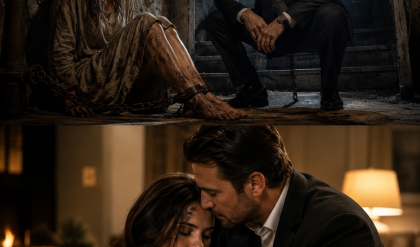
Before leaving, she crept into Mae’s room.
Her daughter slept curled around a stuffed fox named Peanut, one hand tucked beneath her cheek. Clara knelt, kissed the air above Mae’s forehead, and whispered, “I’m going to bring us home, baby.”
Then she took the plastic bag from the counter.
Inside it was a gallon freezer bag. Inside that were her résumé, printed references, Social Security card copy, job description, and a drawing Mae had made the night before. Purple crayon. A crooked sun. Two stick figures holding hands. Five words across the top.
Mommy, you already won.
Clara had stared at those words for almost a minute when Mae handed it to her.
“I haven’t won yet,” Clara had said gently.
Mae had shrugged with the authority of a child who had not yet been taught to doubt love. “You got up.”
So Clara folded the drawing and placed it behind her résumé.
At 6:37, she stepped into the rain.
By the end of the first mile, her blazer clung to her shoulders. By the second, her shoes had become weights. By the third, hunger had moved from discomfort to nausea. She had not eaten breakfast because mothers like Clara did not describe that as sacrifice. They described it as making sure the child had enough.
A pickup truck hit a puddle near Moreland Avenue and threw filthy water over her legs.
Clara stopped.
Her eyes closed. Her throat burned. For three seconds, she wanted to scream so badly her hands shook.
Then she opened the plastic bag and checked the zipper seal.
The documents were dry.
The drawing was dry.
She tied the bag again and kept walking.
Two blocks behind, Julian Vale watched without blinking.
“She’s freezing,” Caleb said finally.
Julian’s eyes stayed on Clara’s figure ahead. “I can see that.”
“We could offer her a ride.”
“No.”
The word was quiet but final.
Caleb’s hands tightened around the wheel. “With respect, sir, this is no longer an observation. This is a woman walking in a flood.”
“She doesn’t know we’re watching. That matters.”
Caleb looked at him in the mirror, and something old moved across his face. Disappointment, perhaps. Or recognition.
“Does it matter more than helping?”
Julian did not answer.
Because that question irritated him.
Because irritation was easier than shame.
At the fourth mile, Clara’s phone rang.
She almost ignored it. Taking it out meant shifting the plastic bag and letting the rain hit the side of her blazer where Mae’s drawing was pressed beneath the documents. But the screen showed Ruth’s name.
Clara ducked beneath the narrow awning of a closed nail salon and answered. “Is Mae okay?”
“She’s fine, honey,” Ruth said. “She wanted to hear your voice before school.”
A rustle. Then Mae came on, bright and sleepy.
“Mommy?”
Clara closed her eyes. “Hi, sunshine.”
“Miss Ruth says it’s raining a lot.”
“A little.”
“Did you take an umbrella?”
Clara swallowed. “Not exactly.”
“Mommy.”
“I know.”
“You’re going to get wet.”
Clara looked down at her blazer, at water dripping from her cuffs onto the concrete. “Maybe a little.”
Mae was quiet. Then she whispered, “Are you scared?”
The question hit harder than the rain.
Clara could lie about weather, food, bills, and whether the couch hurt her back. But fear was different. Children could smell it through walls.
“Yes,” Clara said softly. “A little.”
Mae breathed into the phone. “You can still do things scared.”
Clara pressed a wet hand to her mouth.
“Who told you that?” she asked.
“You did.”
Clara laughed once, but it broke in the middle. “That sounds like something smart I would say.”
“You already won, Mommy.”
Clara looked through the rain toward the towers of Midtown, blurred and silver under the storm. “I’m going to try to make that true.”
When the call ended, she stood under the awning for five seconds, letting tears mix with rain until there was no way to tell which was which. Then she stepped back into the storm and walked faster.
Less than a mile from ValeRoad headquarters, a woman in a red Honda slowed beside her and rolled down the passenger window.
“Honey, you look half drowned,” the woman called. “Can I take you somewhere?”
Clara stopped.
Warm air spilled from the car. The seat inside was dry. The dashboard glowed. A coffee cup sat in the holder. A canvas bag rested on the floor. Everything in that car looked like relief.
“I’m headed downtown,” Clara said.
“Get in. I’m going that way.”
The word rose in Clara’s throat.
Yes.
Yes, please.
But she did not say it.
It was not pride, exactly. Pride had been worn thin by eviction court and grocery store declined transactions. It was something more complicated. She had spent months being carried by Ruth, by food pantries, by donated rides, by charity that came wrapped in kindness but still left her feeling like a debt someone could call due. This interview was the first thing in months that felt like hers. Every painful step had become part of that ownership.
If she arrived because someone rescued her at the end, would she still believe she had made it?
The thought was not entirely fair. She knew that. Help did not erase effort. Kindness was not weakness. But exhaustion makes people hold strange lines because they are the only lines left.
“Thank you,” Clara said. Her teeth chattered. “I really mean that. But I need to finish this myself.”
The woman stared at her for a long moment. Then her face softened. “Then finish it, baby.”
Clara nodded and stepped back from the curb.
The Honda drove away.
In the Maybach two blocks behind, Julian sat very still.
Caleb said nothing this time.
He did not need to.
Julian had watched Clara refuse comfort not because she did not need it, but because she needed something else more: the proof that she could still move under her own power. The distinction struck him with a force he had not expected.
Words were free. That was what he believed.
Then what was walking worth?
What was the price of soaked shoes, an empty stomach, numb fingers, and six miles of choosing not to stop?
For the first time that morning, Julian saw not a candidate but a memory.
His mother, Marian Vale, twenty-two years old, hair pinned under a factory scarf, leaving their one-bedroom apartment before sunrise when Julian was five. He remembered her white sneakers by the radiator, stuffed with newspaper, damp and misshapen. He remembered asking why they were wet.
“Rain got nosy,” she had said, smiling as if rain were a neighbor who talked too much.
Years later, he learned the truth. Her car had broken down. The bus did not run before five. She had walked nearly eight miles to a warehouse shift because missing one day meant losing the job, and losing the job meant losing the apartment.
Julian had buried that memory beneath money, discipline, betrayal, and a private belief that needing help made people dangerous. Clara’s walk dug it up without permission.
He picked up his phone.
“Call Tessa at reception,” he told Caleb. “Tell her to have hot coffee waiting for Ms. Bennett when she reaches the fourth floor.”
Caleb’s eyes flicked to the mirror. “From you?”
“No. From no one.”
Caleb nodded.
It was a small gesture. Almost insultingly small after everything Julian had withheld. But it was the first thing he had offered a stranger in years without calculating return.
That frightened him more than he cared to admit.
This story was written by the author “hoanganh1” – if you see any account copying it, please report it to respect the author. Thank you very much, readers!!
Clara reached ValeRoad headquarters at 8:52.
She was eight minutes early.
In the ground-floor restroom, she transformed the best she could. She wrung water from her blazer into the sink. She dried her face with brown paper towels until they shredded. She changed from running shoes into black pumps and stuffed the wet shoes into the grocery bag. She combed her fingers through her hair, twisted it into a low knot, and pinned it with the one bobby pin she had brought.
Then she opened the freezer bag.
Her résumé was dry.
Her references were dry.
Mae’s drawing was dry.
Clara unfolded it just enough to read the words again.
Mommy, you already won.
She touched the purple crayon letters, folded the page, and slid it inside her blazer pocket over her heart.
The fourth-floor waiting room looked like a place designed by people who had never waited for anything that could change whether their child had a bedroom. Tall windows. Leather chairs. Glass table. Business magazines arranged with military precision. A water dispenser with lemon slices floating in it, as if even water had been promoted.
Three other candidates were already there.
A man in a gray suit looked up, saw Clara, and looked back down at his phone too quickly. A woman with a sleek ponytail and a leather portfolio gave Clara a polite smile that did not reach her eyes. The third candidate, a young man in a blue suit and polished brown shoes, stared openly.
“Rough commute?” he asked.
Clara sat two chairs away. “Something like that.”
He smirked. “You know interviews are usually indoors, right?”
The woman with the portfolio coughed into her hand. It might have been a laugh.
Clara opened her freezer bag, removed her résumé, and read it as though the room had gone empty.
A few minutes later, the receptionist approached with a paper cup. Steam curled through the lid.
“Ms. Bennett?”
Clara looked up.
“Someone asked me to bring you this.”
“Someone?”
The receptionist smiled gently. “That’s all I was told.”
Clara accepted the coffee with both hands. Heat moved into her palms, up her wrists, and into the deep cold that had settled behind her ribs. She did not drink it at first. She simply held it because sometimes warmth is too surprising to trust immediately.
The young man in the blue suit frowned. “Do we all get coffee?”
The receptionist looked at him. “There’s a machine down the hall.”
Clara took one sip and nearly cried.
At 9:03, her name was called.
The interview room held three chairs on one side of the table and one chair on the other. Two people sat across from her: Evelyn Park from HR and Grant Huxley, senior vice president of regional operations. Grant had iron-gray hair, a narrow mouth, and the kind of gaze that made every answer feel like evidence.
The third chair was empty.
Clara noticed it but said nothing.
The first fifteen minutes were standard. Experience. Scheduling software. Conflict resolution. Vendor communication. Route adjustments under time pressure. Clara answered carefully. She did not oversell herself. She did not apologize for herself. She explained what she knew, admitted what she would need to learn, and connected her small-company experience to the larger systems ValeRoad used.
Grant was not impressed.
Or if he was, he hid it well.
“Ms. Bennett,” he said, tapping her résumé with one finger, “you have an eleven-month gap. Before that, you worked for a company that operated forty trucks. ValeRoad coordinates more than thirty thousand shipments a week. Why should we believe you can handle this pace?”
Clara’s hands tightened beneath the table.
There it was.
The gap.
The hole in her life reduced to white space on paper.
She could say family circumstances. She could say caregiving. She could say the economy. She could dress the truth in professional cloth until nobody had to feel awkward looking at it.
Instead, she looked Grant in the eye.
“For the last eleven months, I’ve coordinated survival under conditions that changed every week,” she said. “I managed food assistance appointments, school schedules, medical paperwork, job applications, housing deadlines, and transportation problems with no car and no income. I tracked every application I sent. Eighty-one total. Six interviews. Six rejections. I learned which offices answered phones, which buses ran late, which bills could wait three days, and which ones could not. I understand pressure, Mr. Huxley. I understand moving pieces. I understand that one missed detail can cost more than money.”
The room went quiet.
Evelyn lowered her pen.
Grant’s expression changed by a fraction. Not warmth. Not approval. But attention.
Clara continued, her voice steady now because the truth, once spoken, had weight enough to stand on.
“At my last job, I scheduled trucks. In my life, I scheduled consequences. The scale is different here, but the discipline is not.”
Before Grant could respond, the door opened.
A man stepped inside.
Tall. Silver at the temples. Navy suit. No folder. No phone. No introduction needed because his photograph hung in the lobby and his name was on the building.
Julian Vale.
Evelyn stood halfway. “Mr. Vale.”
Grant stiffened. “Julian, we weren’t expecting—”
“I know.”
Julian sat in the empty chair.
Clara felt the temperature of the room change. Not the air, exactly. The power. Every person in the room rearranged themselves around him without moving.
Julian studied her for five seconds.
Then he asked, “Why didn’t you reschedule?”
Clara’s stomach dropped.
She knew he meant the rain. The damp blazer. The wet hair she had failed to hide. The evidence of her morning still clinging to her like a confession.
“The bus was suspended,” she said.
“That’s not what I asked.”
Clara held his gaze. “Because I have been waiting eleven months for a chance. I couldn’t afford a ride. I could afford to walk.”
“You walked six miles?”
Evelyn looked sharply at Julian.
Clara froze.
Grant turned toward him. “How would you know that?”
Julian did not answer Grant. His eyes remained on Clara.
There it was, the first fake twist: for one terrible second, Clara thought she had been disqualified before she arrived. Maybe someone had seen her on the street and reported her as unstable. Maybe they knew she had come from Ruth’s apartment instead of a home of her own. Maybe the whole building had been watching the wet woman like entertainment.
“I walked,” Clara said slowly. “Yes.”
“Why?”
A lesser question would have insulted her. That one did not. It asked for the center of the thing.
Clara’s hand moved, almost unconsciously, to the blazer pocket where Mae’s drawing rested.
“Because my daughter thinks I already won,” she said. “And I couldn’t go home and teach her that rain gets to decide what kind of woman her mother is.”
Evelyn looked down.
Grant stopped tapping his pen.
Julian did not move at all.
But something behind his eyes cracked.
Clara left the interview believing she had ruined it.
No one had smiled much. Julian Vale had appeared like a judge in the final act of a trial. Grant Huxley had asked whether she was comfortable with “high accountability environments,” which sounded to Clara like a polite way of saying, We do not have time for your life.
By noon, she was back at Ruth’s apartment, barefoot under a blanket, drinking tea while Mae drew rainbows on the floor.
At 3:17, the phone rang.
Clara answered with a voice she tried to make normal.
Evelyn Park said, “Ms. Bennett, we’d like to offer you the operations coordinator position.”
Clara did not speak.
“Ms. Bennett?”
Clara turned away from Mae because her face was breaking open.
“Yes,” she whispered. “Yes, I’m here.”
“The start date would be Monday. Standard ninety-day probationary period. Full benefits begin after thirty days.”
Clara pressed her hand to the wall.
Mae looked up from her crayons. “Mommy?”
Clara covered the phone and said, “I got it.”
Mae screamed so loudly Ruth dropped a spoon in the kitchen.
That night, after Mae fell asleep and Ruth pretended not to see Clara crying over the offer letter, Clara unfolded the purple drawing and placed it in a cheap frame Ruth found in a closet.
“You did already win,” Ruth said.
Clara wiped her face. “No. I got a chance.”
Ruth smiled. “Sometimes that’s the same thing, baby.”
It was not the same thing, Clara would learn. A chance was not a rescue. A chance was a door. You still had to walk through it, and some doors opened into rooms full of people hoping you would prove you did not belong.
Her first month at ValeRoad was hard enough to humble her and not hard enough to break her. The software was unfamiliar. The scale was overwhelming. She made mistakes: one mislabeled delivery window, one vendor callback not entered into the system, one shipment note attached to the wrong regional hub. Nothing disastrous, but enough for Grant Huxley to watch her closely.
The rumor began in week two.
The CEO hired her personally.
No, the CEO found her outside.
No, she cried in the lobby.
No, she was some charity case from one of Evelyn’s diversity programs.
No, Julian Vale had a thing for broken women.
Clara heard pieces. People rarely say cruel things directly when indirect cruelty is available. Conversations paused when she entered the breakroom. Eyes slid toward her badge. The young man from the waiting room—the one in the blue suit—had been hired too, though in a different department. His name was Drew Larkin, and he had a gift for smiling as if every room belonged to him.
One afternoon at the coffee machine, Drew looked at Clara’s paper cup and said, “Careful. You know what happens when you get things wet.”
Clara did not answer.
Not because she had no answer.
Because her mother had once told her, “Never spend good ammunition on pigeons.”
By week six, Clara had stopped trying to appear comfortable and started becoming useful.
She arrived early because Ruth could take Mae to school. She used the quiet hour before eight to review route exceptions. She made handwritten notes because writing helped her see patterns software hid. She asked warehouse coordinators direct questions and listened to the answers no one put in reports.
That was how she noticed the first problem.
Three trucks assigned to overlapping delivery zones north of Macon within the same five-hour window. The system treated them as separate routes because the customer codes were separate. Clara saw them as three grocery bags on one kitchen table. Same direction. Same time. Same waste.
She checked mileage. Fuel. Driver hours. Maintenance estimates. Then she checked three months back.
The waste was not occasional.
It was baked in.
She brought it to her team lead, Nate Orman, a quiet man with tired eyes and a habit of chewing pen caps.
Nate looked at the numbers. “You pulled this yourself?”
“Yes.”
“Why?”
Clara hesitated. “Because when you only have eight dollars, you notice every dollar leaving the room.”
Nate stared at her, then laughed once—not at her, but in surprise. “I’m taking this upstairs.”
The fix saved ValeRoad nearly two hundred thousand dollars a year.
Grant Huxley sent Clara an email with two words: Good catch.
For Grant, that was practically a parade.
Julian heard about it from Evelyn, then from Nate, then from the weekly savings report. He did not call Clara to his office. He did not praise her publicly. He simply began watching her work for different reasons than before.
Not to test.
To understand.
And the more he understood, the more uncomfortable he became with the man he had been on the morning of her interview.
One evening, Caleb drove him past the same stretch of road where Clara had refused the stranger’s ride. Rain tapped lightly against the car roof.
Julian said, “You think I should have stopped.”
Caleb did not pretend not to know what he meant. “Yes, sir.”
“I was trying to see who she was.”
“You saw who you were too.”
Julian looked out the window.
It was an unforgivable thing, perhaps, to be told the truth by someone whose paycheck you signed.
It was also a gift.
The real trouble began in March, four months after Clara was hired.
A major client, Hollis & Crane Grocery Group, threatened to cancel a three-million-dollar regional contract. Their refrigerated shipments had been arriving late across Georgia and Alabama for months. Produce spoiled. Stores complained. ValeRoad issued credits. Grant’s team had tried everything: additional drivers, earlier dispatch windows, alternate staging, revised shift coverage. Nothing held.
The account belonged to Warren Pike, senior regional director, a man who wore cuff links to warehouse visits and believed volume could solve most problems if you threw enough bodies at it. Warren had been with ValeRoad for fifteen years. He had Julian’s confidence, Grant’s patience, and the quiet fear of employees who knew he could end a career with a sentence.
Warren did not like Clara.
He disliked her before he had reason, which is the most honest kind of prejudice. After her route-overlap savings reached senior leadership, his dislike gained vocabulary.
“Interesting little discovery,” he said once in a meeting. “Though we should be careful not to confuse fresh eyes with expertise.”
Clara wrote that down in her notebook under a private heading: Things Men Say When They Mean Stay Small.
The Hollis & Crane crisis landed on a Thursday. The client’s procurement team would arrive Monday. Warren had three days to produce an answer.
Clara was not invited to the strategy meeting.
She found the answer anyway.
At 11:38 on Friday night, after Mae fell asleep in the bottom bunk of the room she and Clara now rented in a modest apartment of their own, Clara sat at the kitchen table with a secondhand laptop and reviewed temperature logs. She had been asked to clean up routing notes, not solve the account, but the pattern bothered her.
The delays were not random. They clustered around shipments assigned through a specific cold-storage transfer point outside Montgomery. The software showed that location as efficient. On paper, it reduced mileage. In reality, trucks sat there for hours waiting for trailer release.
Clara dug deeper.
Then deeper.
By 1:12 a.m., she found the first false charge.
Emergency refrigeration surcharge.
Then another.
Then twelve more.
All tied to the same third-party vendor: Blue Ridge Thermal Support.
The name meant nothing to her until she checked the vendor onboarding date. Eight years earlier. The same period when Marcus Bellamy had stolen from ValeRoad. Blue Ridge had survived the audit because the charges were small, scattered, and coded as emergency exceptions rather than standard invoices.
Clara’s pulse quickened.
This was no routing problem.
This was a leak.
Someone was deliberately pushing shipments through a failing transfer point, triggering emergency refrigeration support from a vendor that should not have been involved at all. It cost money, caused delays, and made ValeRoad look incompetent while someone else collected.
At 1:43 a.m., Clara found the signature approving the most recent vendor renewal.
Warren Pike.
For a while, she sat perfectly still in the blue light of the laptop.
Then she built a report.
Not an accusation. Accusations could be dismissed as emotion. She built a map of facts: route paths, delay times, surcharge frequency, vendor renewal dates, approval chains, loss estimates, client impact. She attached screenshots. She wrote a summary so clean it frightened her.
At 3:06 a.m., she addressed the email to Nate.
Her finger hovered over send.
If she was wrong, she might look reckless.
If she was right, she was accusing a senior director of either negligence or fraud.
Mae stirred in the bedroom and murmured in her sleep.
Clara looked toward the sound.
Then she added Evelyn Park to the email.
Then Grant Huxley.
Then, after a long breath, Julian Vale.
In the body, she wrote:
I may be overstepping, but the Hollis & Crane delays appear connected to repeated emergency surcharges and a vendor pattern that does not look operationally necessary. I’m sending the data because Monday’s meeting may depend on it.
She hit send before courage could evaporate.
At 7:18 a.m., her phone rang.
Julian Vale’s voice came through the line. “Ms. Bennett. Are you able to come to the office?”
Clara looked at Mae eating cereal in pajamas and Ruth—who still came over most mornings—washing a bowl at the sink.
“Yes,” Clara said. “Is something wrong?”
Julian was quiet for half a second.
“No,” he said. “Something may finally be right.”
Monday’s meeting began as a client rescue session and turned into an autopsy.
Hollis & Crane sent three executives. Warren Pike arrived confident, carrying a leather folder and wearing the expression of a man prepared to explain weather, driver shortages, and market conditions. Grant sat stone-faced. Evelyn sat beside Julian. Clara sat at the far end of the table, unsure whether she was supposed to speak unless called.
Julian opened the meeting.
“We found the cause of the delays,” he said.
Warren’s face flickered. “We have several theories, Julian. I wouldn’t say—”
“I would.”
Julian looked at Clara. “Ms. Bennett.”
Every head turned.
Clara stood.
Her hands trembled for the first ten seconds. Then the data steadied her. She explained the transfer point delays, the cold-storage bottlenecks, the unnecessary emergency surcharges, the vendor relationship, the financial damage, and the corrective route model that bypassed the problem entirely.
She did not say fraud.
She did not say Warren.
She did not need to.
When she finished, the room was silent.
The Hollis & Crane procurement director leaned forward. “How soon can the alternate model go live?”
“Within seventy-two hours for the highest-volume lanes,” Clara said. “Two weeks for full integration, assuming vendor access is suspended immediately.”
Warren laughed softly. “This is a very dramatic presentation from someone who has been here less than six months.”
Julian turned toward him.
“Then answer it.”
Warren blinked. “Excuse me?”
“Answer the data.”
Warren’s jaw shifted. “Operational exceptions happen.”
“Four hundred and twelve times in nine months?”
“That figure lacks context.”
“Then provide context.”
Warren opened his folder.
It was empty of answers.
The twist did not arrive like thunder. It arrived like a door opening in a room everyone thought was locked.
By Wednesday, internal audit confirmed that Blue Ridge Thermal Support was owned through layered LLCs connected to Warren Pike’s brother-in-law. By Friday, Warren was gone. By the following month, ValeRoad had recovered enough documentation to involve federal investigators.
The larger shock came later.
Blue Ridge had been one of Marcus Bellamy’s dormant shell vendors.
Marcus had not acted alone eight years earlier. He had planted relationships that remained after him, tiny hidden pipes beneath the company Julian believed he had purified.
The betrayal Julian thought was history had been breathing inside his walls the entire time.
And the person who found it was the woman he had once judged from the back seat of a warm car.
Hollis & Crane stayed.
Clara was promoted to senior operations analyst.
Grant Huxley wrote the recommendation himself.
At the bottom, in ink, he added: Exceptional judgment under pressure.
Clara read the line three times before she believed it.
Two years later, Clara Bennett had an office on the tenth floor.
Not a grand office, not a billionaire’s office, not one with a private bathroom or a wall of awards. But it had her name on the door: Clara Bennett, Regional Operations Manager. It had a window facing east, a plant Mae insisted was “emotionally important,” and a framed purple crayon drawing on the bookshelf.
Mommy, you already won.
Mae was eight now. She had her own bedroom in an apartment with working heat, a lease in Clara’s name, and a kitchen table they had chosen together from a clearance warehouse. Ruth still came over on Sundays. Clara had bought a used Toyota with a dent in the passenger door that Mae named “Daisy” because children are generous with imperfect things.
Julian changed too, though he hated that word. He preferred “revised.” He revised hiring practices. Revised candidate evaluation. Revised transportation support. Revised emergency grants. Revised the idea that people should prove suffering before they deserved opportunity.
The program launched quietly at first, then publicly after its first year succeeded.
It was called The Six Mile Fund.
It provided transportation vouchers, emergency childcare support, interview clothing stipends, mentorship, and skills-based hiring pathways for applicants whose lives did not fit cleanly into corporate software filters. Julian did not tell the company where the name came from.
Clara knew.
Caleb knew.
Evelyn suspected.
In the program office on the second floor, mounted inside a simple glass frame, was a plastic grocery bag. Cleaned, dried, folded carefully. Beneath it was no plaque at Clara’s request. No inspirational quote. No explanation for visitors to consume.
Just the bag.
People asked sometimes, “Is that art?”
Clara would say, “In a way.”
Julian once stood beside her in front of it after everyone else had left a company event.
“I owe you an apology,” he said.
Clara looked at the bag, not at him. “For what?”
“For watching.”
She was quiet long enough that he had to live inside the silence.
Then she said, “You gave me the job.”
“That doesn’t erase it.”
“No,” she said. “It doesn’t.”
Julian nodded. The answer hurt, but it was clean. He had learned to value clean pain over polished lies.
“I thought I was testing you,” he said.
“You were.”
“I was testing the wrong person.”
Clara finally looked at him. “Yes.”
The word held no anger. That made it heavier.
Julian looked older than he had two years earlier. Not weaker. More human, perhaps, which powerful men often mistake for damage.
“I don’t know if I would have stopped the car,” he admitted.
Clara smiled faintly. “I know.”
He looked at her.
She said, “That’s why the program matters.”
On a Tuesday morning in November, almost exactly two years after her interview, Clara was driving to work when the sky opened over Atlanta. Rain came down hard enough to turn brake lights into red smears. Daisy’s wipers fought and lost and fought again.
On Moreland Avenue, Clara saw a woman walking.
Young. Soaked. Black blazer. Hair plastered to her face. Plastic bag clutched against her chest.
For a second, time folded.
Clara was back in wet shoes. Back with eight dollars and nineteen cents. Back with Mae’s purple drawing pressed over her heart. Back beneath a sky that seemed determined to prove she had no right to hope.
Her foot moved before thought.
She pulled to the curb, rolled down the window, and leaned across the passenger seat.
“Hey,” Clara called.
The woman flinched, suspicious and embarrassed. “I’m okay.”
“No, you’re not.” Clara unlocked the door. “Get in.”
“I have an interview.”
“I figured.”
“I can’t pay you.”
“I didn’t ask.”
The woman hesitated. Rain ran down her face, dripping from her chin. Her fingers tightened around the plastic bag.
Clara softened her voice. “I’ve been where you are.”
Something in the woman’s expression changed.
She got in.
Warm air filled the car. The woman held the plastic bag on her lap and stared straight ahead, breathing as if she had been holding her breath for miles.
“What’s your name?” Clara asked.
“Denise.”
“I’m Clara.”
“I’m interviewing at a warehouse office downtown,” Denise said. “The bus stopped running. I thought I could make it.”
“You can.”
Denise looked at her, startled.
Clara smiled. “You already did the hard part.”
They drove in silence for several blocks.
Then Denise whispered, “Why did you stop?”
Clara thought of Julian in the Maybach. Of Caleb’s question. Of the coffee that came from no one. Of Warren Pike’s empty folder. Of Mae’s drawing. Of the framed plastic bag on the second floor. Of all the systems that made people walk through storms and then called their wet clothes unprofessional.
“Because someone should have stopped for me,” Clara said. “And because I remember what it feels like when no one does.”
She dropped Denise at the warehouse office thirteen minutes before her interview. Denise stepped out, straightened her blazer, held the plastic bag close, and turned back.
“Thank you,” she said.
Clara nodded. “Go get your chance.”
As Denise disappeared through the door, Clara sat for a moment with the engine running and the rain striking the windshield.
She understood now what Julian had taken years to learn.
The distance between desperation and dignity is not always a job offer. Sometimes it is a ride. Sometimes it is a cup of coffee handed over without explanation. Sometimes it is a door opened before someone has to beg.
Julian Vale had built an empire by watching what people did when they thought no one was looking. Clara Bennett built something better by deciding that when she saw someone suffering, she would not simply watch.
That was the twist no billionaire could buy.
The real test was never whether Clara would walk six miles in the rain.
The real test was whether anyone with a warm car, dry clothes, and the power to help would stop.
And on that rainy November morning, Clara passed the test Julian Vale had failed.
Not by proving she could suffer.
By proving she would not let someone else suffer alone.
THE END