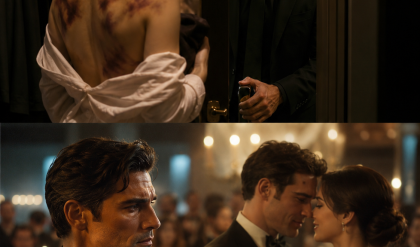
“With the guy from the internet?” Leo asked. “The scary billionaire?”
“He’s not from the internet.”
“Everybody is from the internet if you Google them.”
She almost smiled, but he saw the tension in her face and became serious. At fifteen, Leo had his mother’s eyes and too much knowledge of adult problems. “You don’t have to do this.”
“Yes,” Sofia said gently. “I do.”
The driver took her north, out of the tight pressure of Queens and into the green quiet beyond the city. Adrian Blackwood’s estate stood near Tarrytown, set back from the Hudson behind iron gates and old trees. It was not beautiful in the way mansions in magazines were beautiful. It was massive, restrained, almost severe, with stone walls and tall windows that caught the morning light without giving anything away. Inside, the floors shone, the art was expensive, and the silence had discipline.
Within ten minutes, Sofia understood that the house had not been built merely to impress. It had been built to withstand.
The men at the doors wore suits instead of uniforms, but their eyes never stopped moving. The lower windows were thicker than ordinary glass. Hallways had clean sight lines. The kitchen had two exits, the library had a concealed panel that did not quite fool her, and every staff member seemed to know where every other staff member was without asking. This was a home pretending it had never been a fortress.
Elena Blackwood’s suite occupied the sunniest corner of the second floor. Sofia found her sitting upright in bed, reading a paperback mystery with a pair of red-framed glasses balanced on her nose. Without the ballroom around her, Elena looked both smaller and more formidable. There were signs of pain in the tightness around her mouth, but her eyes were alert.
“You’re the waitress,” Elena said.
“Sofia Rivera.”
“I remember.” Elena closed her book. “Adrian frightens most people into politeness. You were polite before you knew who he was.”
“I was raised right,” Sofia said. Then, because exhaustion sometimes loosened honesty before caution could stop it, she added, “And I hate bullies.”
Elena’s mouth curved. “Good. Sit down. Tell me what you need from this job.”
Sofia had expected forms, instructions, perhaps a lawyer. She had not expected the old woman to ask the question as if Sofia’s needs mattered. That almost made her defensive.
“My mother is at St. Anne’s in Queens,” Sofia said. “She needs respiratory care we can’t afford. My brother has medication that insurance keeps fighting. I need enough stability to stop choosing which bill becomes an emergency.”
Elena listened without pity, which made it easier to keep speaking. Sofia told her about Rosa, about Leo, about double shifts and hospital elevators and the fear that sat in her chest like a second heart. She did not tell everything. She had learned not to give strangers all the pieces of herself. But she gave enough.
When Adrian entered half an hour later with a lawyer and an employment contract, Elena glanced at him over her glasses.
“She starts today,” Elena said.
Adrian stopped. “We were going to review—”
“She starts today,” Elena repeated.
Something passed between mother and son that Sofia could not read. Then Adrian handed Sofia the contract and a pen.
The salary number made her stare. The medical coverage clause made her throat tighten. The protection clause made her uneasy.
“You write protection into employment contracts?” she asked.
Adrian’s eyes met hers. “For people near my family, yes.”
“That’s either thoughtful or terrifying.”
A faint shift touched his mouth, not quite a smile. “Both.”
Sofia signed because Rosa needed care that week, not after Sofia finished building a moral philosophy about dangerous men. But she did not sign blindly. She read every page, asked three questions, crossed out one line that gave the household authority over her personal communications, and looked up to find Adrian watching her with a new expression.
“No one crosses out my contracts,” he said.
“Then your contracts have been lonely.”
Elena laughed. It was a small sound, rusty from disuse, but Adrian went still as if someone had opened a window in a sealed room.
That was the first change Sofia caused without meaning to.
The second came through routine.
Elena’s official care plan was careful, expensive, and uselessly timid. It protected her from pain by protecting her from progress. The physical therapist came three times a week, moved her limbs, praised minor effort, and left. The doctor adjusted medication as if Elena were an antique vase that might shatter if handled honestly. Everyone treated her survival as the victory and her longing as an inconvenience.
Sofia recognized that too.
On her fifth day, while Elena stared out the window at the garden below, Sofia asked, “Do you want to go outside?”
Elena’s fingers tightened on the blanket. “It’s cold.”
“I’ll get a coat.”
“The chair is difficult on the gravel.”
“I saw a paved side path by the east door.”
Elena looked at her carefully. “Adrian doesn’t like me outside when he isn’t home.”
“Does Adrian own the sun?”
For a moment, Sofia thought she had gone too far. Then Elena’s eyes brightened with something fierce and delighted.
“No,” Elena said. “Though I’m sure he has considered it.”
That afternoon, Sofia wrapped Elena in a wool coat and pushed her into the garden. The air was sharp. The leaves had begun to turn copper along the stone walls. Elena closed her eyes when the wind touched her face, and Sofia looked away because the old woman’s expression felt private, almost sacred. Freedom, even a small serving of it, could be intimate.
When Adrian returned early and found them outside, three guards behind him and a storm forming in his face, Sofia braced herself.
Elena spoke first. “Don’t you dare scold her. I asked.”
“You shouldn’t be in the cold.”
“I was cold inside too.”
Adrian’s anger changed direction and had nowhere to go. Sofia watched him struggle with the difference between protecting his mother and imprisoning her. It was not an easy difference for a man who had learned to measure love in locked doors.
“She needs more than safety,” Sofia said quietly.
Adrian looked at her. “You think I don’t know that?”
“I think knowing it scares you.”
The guards found the trees suddenly fascinating.
Elena held her breath.
Adrian said nothing for so long that Sofia considered updating her résumé in her head. Then he turned to one of the men. “Have the south garden path resurfaced by tomorrow.”
After that, the estate began to shift around Elena’s wanting.
A ramp was added near the greenhouse. Therapy sessions became harder because Sofia sat beside Elena and counted every repetition like it mattered. The doctor objected until Sofia brought him three medical articles, two notes from Rosa’s pulmonologist, and a tone of voice that reminded him he was being paid to help a patient live, not merely remain. Elena complained, cursed, laughed, and improved by inches that felt like miles. Her right hand, weakened since the attack that had put her in the chair, began to close around a rubber therapy ball. Her shoulder lifted higher. Her voice grew stronger because hope, once admitted, has a way of strengthening the body it inhabits.
Adrian watched all of it.
He told himself he watched because his mother was the only soft place left in him. He told himself he checked the garden cameras because the estate had enemies. He told himself he appeared in the kitchen at odd hours because he worked too much and forgot meals. None of these explanations accounted for why he started knowing how Sofia took her coffee, why a new winter coat appeared outside her door after she mentioned the old one had a broken zipper, or why he stood in the hallway one evening listening to Elena and Sofia argue about whether Frank Sinatra or Etta James had the better version of heartbreak.
Sofia did not treat him the way others did. His staff respected him. His associates feared him. Politicians flattered him. Old rivals studied him for weakness. Women at charity events smiled at him as if proximity to danger made them more interesting. Sofia looked at him directly and told him, on a Wednesday night, that he could not hold a conference call outside Elena’s room while Elena was trying to sleep.
For one full second, nobody breathed.
Then Adrian looked at his phone, looked at Sofia, and walked down the hall.
The house whispered about it for two days.
Leo arrived at the estate on a Sunday after a man followed him for three blocks near his school.
Sofia did not panic until she was alone in the laundry room with a basket of Elena’s blankets. Then her hands began to shake so badly she had to sit on the floor. She had brought danger home to the only person she was trying to protect. That was the thought that kept circling. Not Adrian’s enemies, not Cassandra Whitcomb’s humiliation, not the strange black car she had seen twice near the hospital. Her fault. Her choice. Her brother.
Adrian found her there because the estate cameras found everything.
He did not ask if she was all right. That would have been insulting. He lowered himself to sit on the floor across from her, expensive suit and all, and waited.
“I should leave,” Sofia said.
“No.”
“You don’t get to decide that.”
“No,” he agreed. “But leaving won’t make you safer. It will only make you easier to reach.”
She hated that he was right. “Leo is a kid.”
“I know.”
“He acts like he’s not scared because he thinks that helps me.”
“I know that too.”
Sofia looked up, surprised by the softness in his voice.
Adrian rested his elbows on his knees. “When I was twelve, my father was killed outside a restaurant in Brooklyn. My mother told me not to be afraid, so I wasn’t. Not where she could see. I thought that was love.” He paused. “It took me years to understand that children should not have to protect adults from their fear.”
Sofia’s anger loosened, though it did not disappear. “Then help me make sure he doesn’t.”
Within an hour, Leo was picked up by two security men and brought to Tarrytown. He arrived pretending to be thrilled by the mansion and betrayed his terror by staying within ten feet of Sofia all evening. Elena claimed him immediately. She asked about school, praised his math notes, and told him that if he was going to live under her roof temporarily, he would have to learn chess because television had already stolen enough American minds.
Leo looked at Sofia and mouthed, “Temporarily?”
Sofia mouthed back, “Behave.”
By the end of the week, Leo was playing chess badly, eating too much of the housekeeper’s lasagna, and sleeping through the night for the first time in months. Rosa was moved to a better respiratory unit under a grant that Adrian insisted had nothing to do with him, though the hospital administrator suddenly began returning Sofia’s calls as if she were a senator.
For a little while, life became almost gentle.
That was when Sofia found the file.
She had been searching the estate office for Elena’s old therapy notes after a new specialist requested them. Adrian was in Boston, Elena was resting, Leo was doing homework in the kitchen, and the rain outside made the whole house feel sealed away from the world. The file cabinet was locked, but the drawer beside it had not closed properly. When Sofia nudged it shut, a folder slipped from the top and spilled papers across the rug.
One name caught her eye.
Rosa Rivera.
Sofia stopped breathing.
She should have closed the folder. She should have called Adrian. Instead, she knelt and read because poor people learn that the truth is often hidden in papers nobody thinks they will understand.
Rosa’s name appeared in a witness summary from four years earlier, the night Elena Blackwood was hit by a car outside a private clinic in Brooklyn. Sofia had known the official story: a reckless driver, rainy road, tragic accident. The file told another version. The vehicle had been stolen. The driver had ties to Victor Callahan, an old rival whose family had once controlled half the waterfront before Adrian forced them out of the city’s most profitable shadows. Elena had not been unlucky. She had been targeted because she was Adrian’s only visible tenderness.
Rosa had worked nights cleaning the clinic then. She had seen the car. She had written down part of the plate on a receipt because, in her words, “the driver waited too calmly before the impact.” She had given a statement to a private investigator and then withdrawn from contact after receiving threats. Two months later, the factory where Rosa worked part-time caught fire from an “electrical malfunction” no inspector ever fully explained.
Sofia sat back on her heels as the room tilted.
Her mother’s illness had not simply been bad luck. The smoke that ruined Rosa’s lungs might have been tied to the same war that put Elena Blackwood in a wheelchair. And Adrian had known enough to have a file.
When he returned that night, Sofia was waiting in his study with the folder on his desk.
For once, Adrian Blackwood looked unprepared.
“How long have you known my mother was connected to yours?” she asked.
He closed the door behind him slowly. “Not when I offered you the job.”
“That is not an answer.”
“No,” he said. “I learned a week after you started.”
“A week.” Her voice shook. “You let me sit with your mother, you moved my brother here, you paid bills at my mother’s hospital, and you never thought I deserved to know that my family was already part of this?”
“I thought telling you before I understood the threat would put you in more danger.”
“That sounds noble if you say it calmly enough.”
His jaw tightened, but he accepted the hit. “Your mother saw something Callahan wanted buried. After the factory fire, she refused to speak again. By the time I found the connection, she was intubated, and the original investigator had disappeared. I was trying to confirm whether Callahan caused the fire before I put that weight on you.”
“It was already on me,” Sofia said. “I just didn’t know who put it there.”
Adrian looked away first.
That mattered. It did not fix anything, but it mattered.
“I’m sorry,” he said.
Sofia wanted to reject the apology because it came from a man who could buy hospitals and bend city departments and make socialites vanish from gala lists. But his voice was not polished. It was rough with something closer to shame.
“You don’t get to protect me by keeping me ignorant,” she said.
“I know.”
“No,” she said. “You’re learning.”
He looked back at her then, and the strange thing was that he seemed grateful for the distinction. Men like Adrian had been obeyed, feared, flattered, challenged by enemies, but perhaps rarely corrected by someone who intended to stay in the room afterward.
From that night on, Sofia stopped being merely careful and became watchful.
She learned the estate’s rhythms. Which guard drank coffee at nine. Which hallway camera had a blind spot for four seconds when the pantry door swung open. Which service stairs connected the second-floor family wing to the reinforced cellar. She did not snoop because curiosity had become a hobby. She paid attention because she had spent too much of her life being surprised by disaster and was done granting it the advantage.
The first obvious sign came three days before Thanksgiving.
A florist delivery arrived for Elena, though no one had ordered flowers. The arrangement was beautiful: white roses, eucalyptus, lilies. Sofia saw the card before Elena did.
For the woman who still walks in his dreams.
No signature.
Adrian burned the card in the kitchen sink. Elena watched him do it and said, “Fear is not a strategy, Adrian.”
“No,” he said. “But it is information.”
The second sign came from Rosa.
She had been improving slowly in the new unit, still unable to speak for long, communicating mostly through squeezes, blinks, and an alphabet board Sofia hated because it made every word a mountain. On Thanksgiving morning, while Leo slept in a chair beside her bed and the parade played silently on a wall-mounted television, Rosa gripped Sofia’s wrist with sudden strength.
“Mom?”
Rosa’s eyes were fierce above the oxygen tube. Her finger tapped the board slowly.
K.
Then E.
Then Y.
“Key?” Sofia asked.
Rosa blinked once.
“Key to what?”
Rosa’s eyes moved toward Leo. Sofia followed the glance to the old Saint Christopher medal he wore around his neck, a dented keepsake Rosa had given him after his first seizure. Sofia had seen it a thousand times. She had never noticed the seam along the back.
Rosa tapped again.
B.
A.
G.
“Bag,” Sofia whispered. “Your old work bag?”
Rosa blinked once, then closed her eyes, exhausted.
Sofia found the bag that night in a storage bin at the Queens apartment, behind winter coats and a broken fan. Inside was a cheap makeup pouch, three expired MetroCards, a prayer card, and a tiny memory drive taped beneath the lining. The Saint Christopher medal contained the key to open it: a miniature connector hidden under the back plate. Leo stared at it on the kitchen table at the estate, pale and silent.
“What is it?” he asked.
“The reason Mom was scared,” Sofia said.
Adrian had the drive examined in a secure office, with Sofia standing beside him because this time he knew better than to send her away. The video was grainy and timestamped, copied from the clinic’s old side entrance camera. It showed Elena stepping out under a black umbrella. It showed the car waiting with its lights off. It showed the driver’s face for less than two seconds when lightning brightened the street.
It was Nathan Price.
Sofia knew Nathan. Everyone in the house knew Nathan. He had been Adrian’s head of internal security for six years, calm, broad-shouldered, courteous to Elena, patient with Leo, the kind of man whose loyalty seemed so complete it became part of the architecture. He had been younger in the video, leaner, but it was him.
Adrian did not speak for almost a minute.
When he did, his voice was empty in a way that frightened Sofia more than anger would have. “Where is he now?”
“In the east wing,” one of his men said. “Supervising the holiday rotation.”
Adrian turned to Sofia. “Take Leo and go to the cellar safe room.”
“No.”
“Sofia.”
“No,” she said again, though fear had already tightened her throat. “Elena is upstairs.”
That was when the first explosion hit the gate.
It was not like movies. There was no dramatic fireball visible from the study, only a deep pressure that punched through the house and rattled every window in its frame. Alarms began at once. Somewhere below, men shouted. The estate, which had always felt like a fortress pretending to be a home, remembered what it had been built for.
Adrian moved to the door. “Sofia, now.”
She grabbed Leo by the shoulders. “Listen to me. Go with Mr. Camden to the safe room. Do not argue.”
Leo’s face twisted. “I’m not leaving you.”
“You are doing exactly what Mom would tell you to do, and you know it.”
That reached him. Tears flashed in his eyes, but he nodded. Camden, one of the older guards, took him through the service door.
Sofia ran the opposite way.
Later, Adrian would tell her that was the moment he understood she would never be someone he could order into safety. At the time, he cursed under his breath and followed because fear for her had become as immediate as fear for his mother.
But the house had already split into confusion. A second alarm triggered in the west corridor. Emergency lights strobed. Sofia reached Elena’s suite before Adrian did and found the older woman already in her wheelchair, trying to push herself toward the door with one working hand.
“I heard,” Elena said.
“We’re moving.”
“Where’s Adrian?”
“Being Adrian.”
“God help everyone, then.”
Sofia almost laughed, which steadied her. She wrapped a blanket over Elena’s lap and pushed the chair through the bedroom into the service corridor. She did not choose the main hall. She chose the narrow passage behind the family rooms, the one she had walked in her head night after night. Her fear became a map. East was compromised. Main stairs exposed. Pantry passage to cellar, then safe room, then Leo.
They were forty feet from the service elevator when Nathan Price stepped out of the shadows.
He held no weapon in his hands. That was worse. Behind him stood two men Sofia had never seen.
“I’m sorry,” Nathan said.
Elena’s face hardened into something older than fear. “For which part?”
Nathan flinched. “All of it.”
Sofia looked at him and saw not satisfaction, not cruelty, but a man being crushed by a choice he had made and kept making. That did not make him innocent. It made him dangerous in a different way.
“They have my daughter,” Nathan said, as if the words had been waiting years to escape. “Callahan took Lily two days ago. He said if I didn’t open the east gate tonight, she’d disappear.”
Adrian appeared at the far end of the corridor, gunmen behind him, but Sofia raised a hand before anyone moved. She did not know if she was saving Nathan or buying seconds. Maybe both.
“Where is she?” Sofia asked.
Nathan’s eyes flicked to her. “I don’t know.”
“Yes, you do,” she said. “You know something, or you wouldn’t still be breathing this hard. You helped hurt Elena four years ago. You helped tonight. If you want one decent choice left in your life, make it now.”
The two unfamiliar men shifted. Nathan closed his eyes for half a second.
“Laundry truck,” he said. “Old service road by the river. White box truck. They said they’d move her after midnight.”
One of the men behind him cursed and reached for his jacket.
Everything happened quickly after that, but Sofia remembered it slowly: Adrian’s men surging forward, Elena grabbing Sofia’s wrist, Nathan throwing himself sideways into one of Callahan’s men, the sharp crack of impact, the corridor filling with bodies and commands. Adrian reached Sofia and Elena in seconds, his composure cracked at the edges.
“You were told to go to the safe room,” he said.
“Elena was told to stay indoors last month,” Sofia shot back. “Neither of us is obedient.”
Elena, pale but upright, looked between them. “Argue after we rescue the child.”
That sentence changed the night.
Adrian could have focused only on his estate, his mother, his revenge. The Adrian Blackwood Sofia had first imagined might have done exactly that. But the man in front of her looked once at Nathan Price being restrained on the floor, then at Elena, then at Sofia.
“Find the truck,” he ordered. “Alive. The girl comes back alive.”
The attack failed because Victor Callahan had planned for Adrian’s rage, not his restraint.
Callahan had expected Adrian to pursue him blindly once Elena was threatened. He had expected the estate to become a battlefield, attention fixed inward while Lily Price was moved and the incriminating evidence disappeared. He had expected Nathan to remain silent out of terror and shame. He had expected Sofia to behave like a frightened employee. Most of all, he had expected mercy to be weakness because men like Callahan always made that mistake.
By midnight, Lily Price was found in a locked truck near the Hudson, frightened but unharmed. By one in the morning, Nathan had given a full recorded statement naming Callahan, Cassandra Whitcomb, and two retired detectives who had buried the original clinic evidence. By dawn, federal agents were moving through Callahan properties in New York, New Jersey, and Connecticut with warrants built from Rosa’s video, Nathan’s confession, and financial records Adrian had kept untouched for years because he understood the value of patient evidence.
Victor Callahan was arrested at a private airfield in Westchester before sunrise.
Cassandra Whitcomb was not arrested that morning, though she woke to find her accounts frozen, her charity board seat suspended, and photographs of her meeting with Callahan’s attorney delivered to three people whose approval she needed to remain socially alive. Her attempted slap had not been a spontaneous cruelty after all. She had agreed to provoke Elena at the gala to test Adrian’s security response and humiliate the woman Callahan considered Adrian’s weak point. Cassandra had believed it would be a small scene, a paid insult, a private favor to people she considered useful. She had not counted on a waitress. People like Cassandra never did.
Nathan Price asked to see Elena before the federal marshals took him.
Adrian refused at first.
Elena overruled him.
They met in the sunroom, with Sofia beside Elena and Adrian near the door. Nathan looked diminished without authority. His face had the gray exhaustion of a man whose lies had kept him alive and destroyed him anyway.
“I don’t expect forgiveness,” he said.
“Good,” Elena replied. “Expectation would insult me.”
He nodded, accepting the blow. “I drove the car. Callahan owned me before Adrian hired me. I told myself I had no choice then. I told myself that for four years. When he took Lily, I understood what I had helped do to you.”
Elena looked at him for a long time. Sofia watched the older woman’s right hand curl slowly around the armrest, stronger now than it had been months ago.
“You did have a choice,” Elena said. “You made the wrong one more than once. But last night, when that girl’s life depended on it, you made one right choice. I will not forgive the first truth because of the second. I will also not erase the second because of the first.”
Nathan began to cry silently. That was the only kind of crying a man like him seemed to allow himself.
Adrian looked away.
Sofia understood then that the night had not ended lives in the way the old stories meant. It had ended false lives. Cassandra’s life as untouchable. Nathan’s life as loyal. Callahan’s life as a ghost who could reach anyone. Adrian’s life as a man who believed every problem could be solved by fear. Elena’s life as a woman preserved in safety but denied the risk of living. Sofia’s life as someone invisible.
The aftermath did not become simple just because the villains had names.
Rosa’s recovery was slow. Some days she could breathe for an hour without assistance, some days not. When she was strong enough to understand that her old evidence had helped stop Callahan, she cried with a quiet pride that broke Sofia’s heart more gently than grief had. Leo began therapy after Elena told him that chess was useful but not a substitute for telling the truth to someone trained to hear it. Nathan went to prison after cooperating fully, and Adrian made sure Lily Price and her aunt had a home far from New York, with money placed in a trust that could not be touched by any man trying to purchase silence.
“You’re paying for the child of the man who hurt your mother,” Sofia said when she found out.
Adrian stood beside the garden wall, watching Elena practice three careful steps with her therapist. “The child didn’t hurt my mother.”
Sofia looked at him, and he glanced away as if embarrassed by decency when it appeared without armor.
“You’re changing,” she said.
“No,” he replied. “You’re making it harder for me to lie to myself.”
Winter settled over the estate. Snow gathered on the hedges. The garden emptied of color, but Elena insisted on going outside wrapped in wool, claiming cold air reminded the body it was alive. Sofia stayed beside her, one hand near the wheelchair, though Elena used it less. Progress became less dramatic after the attack but more meaningful because it continued without an audience. Three steps became five. Five became the length of the sunroom. Her cane became an object of hatred, then grudging respect, then routine.
Adrian began coming home earlier.
At first, he pretended it was for security reviews. Then for dinner with his mother. Then because Leo had somehow convinced him to help with a mock trial assignment and discovered that a feared billionaire could be cross-examined into irritation by a teenager with a legal pad. Eventually, he stopped explaining.
Sofia did not fall in love with him all at once. She distrusted stories that made love sound like lightning because lightning burned things down. What happened instead was slower and more inconvenient. She noticed that he knocked before entering any room that belonged to her. She noticed that when Rosa had a bad night, a car was ready before Sofia asked. She noticed that he never again made a decision involving her family without telling her first. She noticed that he listened, even when listening cost him pride.
One evening in February, he came to the small sitting room Sofia used as an office and placed her employment contract on the desk.
Her chest tightened. “Am I being fired?”
“No.”
“Then why do you look like you’re about to negotiate a hostage release?”
His mouth moved slightly. “Because I’m not good at this.”
“At what?”
He tore the contract in half.
Sofia stared at the pieces.
Adrian set them down carefully. “Everything I promised you remains. Your mother’s care. Leo’s schooling. Your salary up to this point. None of that changes if you leave tomorrow.”
Her throat went dry. “Why would I leave tomorrow?”
“Because I hired you into my life under circumstances that gave you very few real choices.” His voice was controlled, but not cold. “I told myself I was helping you. I was. But help can still become a cage if the person receiving it can’t afford to refuse.”
Sofia looked at him for a long moment. Outside the window, snow moved through the dark like ash made harmless.
“What are you asking me?” she said.
“To stay only if you want to. Not as my mother’s employee. Not as someone under my protection. Not because your family needs me.” He paused, and for once the silence belonged to fear rather than calculation. “As yourself. With whatever time you need to decide what that means.”
Sofia picked up one torn half of the contract. She thought about the Hargrove ballroom, the raised hand, the way Adrian had looked like a storm when he crossed the floor. She thought about Elena’s laughter, Rosa’s fingers spelling key, Leo sleeping safely down the hall, Nathan’s ruined face, Cassandra’s fear, Callahan in handcuffs. She thought about how easy it would be for a man like Adrian to mistake possession for love and how carefully he was trying not to.
“I won’t disappear into your world,” she said.
“I know.”
“I won’t become an ornament at galas.”
“I would be terrified to try.”
“I need my own work. My own name. My own way of helping people who don’t have someone like you showing up with lawyers and money.”
“I know,” he said again. “That’s why there’s a second document.”
He placed a folder on the desk.
Inside were incorporation papers for the Rivera Relief Fund, a nonprofit dedicated to emergency medical debt support, caregiver assistance, and legal advocacy for low-income families trapped between illness and bureaucracy. Sofia read the mission statement twice because the words blurred the first time.
“You wrote this?” she asked.
“Leo helped. My attorneys cleaned up the parts where he threatened insurance companies directly.”
Despite herself, Sofia laughed.
Adrian’s expression softened. “It’s yours if you want it. Not mine. I’ll fund the first three years anonymously unless you choose otherwise. Elena wants a board seat and has already informed me that I am not allowed to argue.”
Sofia closed the folder gently. “You did all this before asking me to stay?”
“Yes.”
“So I would know I had somewhere to stand either way?”
“Yes.”
The answer was simple. The effect was not.
Sofia stepped around the desk. Adrian did not move toward her, and that restraint decided something inside her. She took his hand first.
“You’re still dangerous,” she said.
“Yes.”
“You still scare half the city.”
“Probably more than half.”
“You still think control is a love language.”
“I’m in recovery.”
She smiled then, and his eyes dropped to her mouth as if joy from her was something he did not want to mishandle.
“I’ll stay,” she said. “But not because you saved me.”
“No?”
“Because you learned how not to turn saving into ownership.”
For a man feared across New York, Adrian looked almost undone by that.
The following November, the Hargrove Hotel held its annual charity gala under the same chandeliers, with the same white linens and the same orchestra warming up beneath arrangements of flowers flown in from somewhere expensive. The guest list had changed. Some names had vanished quietly after the Callahan investigation. Some had left New York to pursue smaller kingdoms in cities where fewer people knew what they had done. Cassandra Whitcomb now lived in Palm Beach, where she hosted modest lunches for women who pretended not to know why Manhattan no longer returned her calls.
Sofia entered through the front doors that year.
She wore deep green, not because a stylist chose it but because Elena said it made her look like spring had decided to attend in person. Leo walked beside Rosa, who leaned on a portable oxygen device and cried twice before reaching the ballroom because she had not believed she would ever see her daughter belong anywhere so grand. Elena walked slowly with a cane, Adrian at her left and Sofia at her right. Every step cost effort. Every step announced victory.
The room saw them.
It saw Elena Blackwood upright in the same burgundy color she had worn the night someone tried to reduce her to a chair. It saw Adrian Blackwood with his hand resting lightly at Sofia’s back, not guiding, not claiming, simply present. It saw Sofia Rivera, once a waitress with champagne on her shoes, now founder of a relief organization that had already paid emergency medical bills for one hundred and twelve families and embarrassed three hospitals into reviewing predatory billing practices. It saw Rosa alive. It saw Leo watching everything with the serious eyes of a young man already planning law school.
Most of all, the room saw what it had failed to do.
People approached carefully. Some apologized to Elena without naming the old cowardice directly. Elena accepted the apologies she considered sincere and punished the vague ones by asking polite questions until their owners sweated. Sofia watched her with admiration.
Halfway through the evening, after the speeches and before dessert, the hotel manager found Sofia near the east wall, the same place where the slap had almost happened.
“I don’t know if you remember me,” he said awkwardly.
Sofia did. He had fired her in the service corridor twelve minutes after Adrian offered her a job, whispering that she had created a scene and embarrassed the hotel.
“I remember,” she said.
He flushed. “I wanted to say we handled that night poorly.”
“Yes,” Sofia said. “You did.”
He looked as if he expected more, perhaps anger, perhaps forgiveness offered quickly enough to relieve him. Sofia gave him neither. She had learned that human endings did not require pretending harm had not happened.
“We’re updating staff training,” he said. “Bystander intervention. Guest misconduct policies. Clear authority for servers to call security when a guest abuses another guest or staff member.”
“That’s good.”
“It was suggested by Mrs. Blackwood.”
“Elena suggests things like a queen issues decrees.”
He laughed nervously, then sobered. “You were brave that night.”
Sofia looked across the room at her mother, at Leo, at Elena speaking with a young nurse from the foundation’s first grant program, at Adrian standing a few feet away while a councilman tried and failed to impress him.
“I was tired,” Sofia said. “Sometimes tired people stop having energy left for fear.”
The manager did not know what to do with that, which was fine. Some truths were not meant to be comfortable.
Later, Adrian found her by the windows overlooking the city. Manhattan glittered beyond the glass, all height and hunger and light. For years, Sofia had looked at buildings like these from buses and sidewalks, imagining that the people inside lived without fear. Now she knew better. Wealth did not remove fear. It only gave people more elaborate rooms in which to hide it.
Adrian handed her a glass of sparkling water. “You disappeared.”
“I’m right here.”
“You know what I mean.”
She did. He still noticed absence as threat before he remembered it could simply be space. But he was learning. So was she.
He stood beside her, not too close. “Elena is terrorizing a deputy mayor.”
“Good for her.”
“Leo asked me whether racketeering statutes could apply to insurance claim delays.”
“That was your influence.”
“I’m choosing to take pride in it.”
Sofia smiled. The city lights reflected in the glass, placing another version of them over Manhattan: Adrian in black, Sofia in green, standing close enough to be together and separate enough to be free.
After a while, he said, “A year ago, I stood in this room surrounded by people who feared me, needed me, or wanted something from me. Every powerful person here knew my mother was being humiliated, and none of them moved.”
Sofia looked at him. His gaze remained on the room, but his voice had lowered.
“The only person who moved had nothing to gain from me,” he continued. “You didn’t know my name. You didn’t know what I could give you. You didn’t even know what it might cost you. You just knew someone was about to be hurt.”
“It almost cost me my job.”
“It gave me back my mother.”
“She was never gone,” Sofia said gently.
“No,” Adrian said. “But I was losing the part of myself that still knew how to see her as more than someone to guard.”
That truth settled between them. Sofia took his hand, not because anyone was watching, not because the gesture completed a story, but because after everything they had survived, choosing tenderness still felt like the bravest rebellion available.
“The thing about invisible people,” she said, “is that we see the whole room.”
Adrian turned to her then. “And what do you see now?”
Sofia looked around the ballroom. She saw shame trying to become manners. She saw wealth pretending it had always cared. She saw her mother alive beneath the chandeliers. She saw her brother laughing for real. She saw Elena Blackwood standing with a cane like a sword. She saw a dangerous man who had chosen, imperfectly and repeatedly, to become safer for the people he loved. She saw herself reflected in the window, no tray in her hands, no need to shrink.
“I see consequences,” she said. “Some people fear them. Some people become them. And some people finally learn from them.”
Adrian’s smile came slowly, as if it had traveled a long distance to find his face.
Across the room, Elena raised her glass toward them. Rosa did the same. Leo, not wanting to be left out, lifted his soda with solemn importance.
Sofia laughed, and the sound moved through Adrian Blackwood’s world like light entering a locked house.
The slap had never landed. But mercy had. Courage had. Truth had. And in the end, those had changed more lives than violence ever could.
THE END