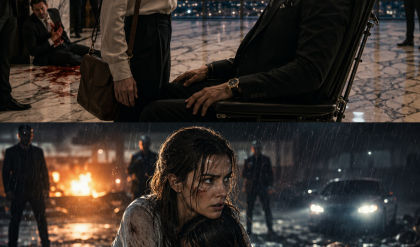
When Mason turned four, he had Julian’s eyes.
That was the cruelty of blood. Claire could change her last name, hide every photograph, avoid every newspaper that mentioned Hartwell Global, and teach herself not to flinch when she heard helicopters overhead. But she could not stop her son from growing into the shape of his father’s ghost.
Mason’s eyes were gray, not soft gray, not sweet gray, but silver-gray like lightning reflected in steel. He had Claire’s mouth, her dimple in his left cheek, and her habit of tilting his head when he was curious. But his eyes belonged to Julian. His serious stare belonged to Julian too, especially when he studied adults as if he were deciding whether they were worth trusting.
Claire loved him so fiercely that it frightened her.
She loved his muddy boots by the door, his crooked drawings taped to the refrigerator, his serious belief that pancakes counted as dinner if shaped like dinosaurs. She loved how he called Lake Superior “the giant water” and how he insisted the red lighthouse was not a lighthouse but a castle for brave seagulls. She loved how he curled into her side at night, warm and heavy with sleep, and mumbled questions too big for his age.
“Mommy,” he asked once, while snow scratched at the window, “do I have a dad somewhere?”
Claire’s hands stilled over the blanket.
She had prepared for that question and discovered preparation meant nothing when a child’s voice carried the empty space you had tried to cover.
“Yes,” she said carefully. “You have one somewhere.”
“Is he lost?”
Claire looked at the tiny stars glowing on his ceiling.
“In a way,” she whispered.
Mason considered that answer with Julian’s solemn frown.
“Maybe he needs a map.”
Claire pressed her lips to his hair so he would not hear her breath break.
“Maybe he does.”
In Chicago, Julian Hartwell spent the first months after Claire disappeared hunting for her with the disciplined fury of a man accustomed to winning.
He hired investigators, reviewed security footage, questioned staff, paid favors that would have ruined careers if anyone talked, and turned every highway camera between Illinois and Wisconsin into a personal insult. He found the pawnshop where she had sold her phone. He found the dealer who took the ring. He found the highway exit where her trail vanished into snow and old surveillance footage.
Then nothing.
At first, Julian told himself she would return when pride, fear, or cash ran out. Then he imagined she had found another man, an idea so unbearable and so deserved that it kept him awake until dawn. Finally, he accepted the cruelest version, not because he believed it, but because it was the only one he could survive.
Claire had decided to forget him.
And perhaps, he told himself, he had no right to disturb the freedom he had forced her to claim.
Yet every anniversary of that night, Julian stood before the same window where he had destroyed his marriage and drank alone while rain, snow, or clear moonlight looked back at him. He never said those four words again. Even memory spat them at him like poison.
The truth was uglier than the sentence, and Julian knew it, though he confessed it to no one.
That morning, four years ago, he had received a manila envelope with photographs of Claire leaving a medical building. In one photo, her hand rested lightly over her abdomen. In another, she looked over her shoulder as if she sensed danger but did not know where it stood.
The note inside contained six words.
Your wife first. Your empire second.
The sender had signed with a black chess knight, the mark of Victor Crowe, a private security contractor turned extortionist who had once helped Hartwell Global operate in countries where polite businessmen hired monsters and called them consultants. Julian had cut ties with Crowe after discovering he was kidnapping union organizers and billing their disappearances as “regional stabilization.” Crowe had sworn revenge.
Julian believed the threat was immediate. He believed men were watching Claire. He believed if he told her the truth, she would refuse to leave him, because Claire’s courage was one of the reasons he loved her and one of the reasons he feared for her life.
So he chose the fastest weapon he had.
Cruelty.
He believed if he made her hate him, she would run farther and faster than any bodyguard could escort her. He believed he could control pain the way he controlled money, judges, companies, newspapers, and armed men.
He did not understand that a wounded woman does not always beg.
Some women save themselves.
Four years later, Claire’s secret returned to Chicago in a photograph taken by accident.
It happened during Harbor Point’s fall festival, the kind of small-town event Julian would never have noticed under ordinary circumstances. Children painted pumpkins. Retired men argued over chili recipes. The elementary school sold pies to raise money for new playground equipment, and a volunteer photographer posted seventy-eight pictures on the town’s website.
Claire was in the forty-sixth photo, standing behind a folding table covered in apple pies. She was laughing at something outside the frame, her hair pinned messily at the back of her neck, a flour mark on one cheek. Beside her stood a small boy in a green dinosaur hoodie, holding a paper cup of cider and staring straight into the camera with Hartwell eyes.
Julian would never have seen the photograph if his executive assistant, Rebecca Sloan, had not grown up in a town forty miles from Harbor Point and clicked the local festival gallery during lunch because her mother had mentioned an old neighbor’s grandchild winning the pumpkin toss.
Rebecca found Claire by accident.
Then she found Mason.
She walked into Julian’s office without knocking.
“Mr. Hartwell,” she said, pale as paper.
Julian looked up from a merger file with irritation, but the expression on her face changed the temperature of the room.
“What is it?”
She set her tablet on his desk as if it might burn her.
Julian glanced down.
The world stopped moving.
Claire.
Alive.
For one second, seeing her was enough to break something in him. She looked thinner, older, stronger, not the fragile rich man’s wife society had tried to make her, but a woman rebuilt by weather and work and decisions nobody else had the right to judge.
Then Julian saw the boy.
His breath left him.
Mason stared out from the photograph with the exact eyes Julian had inherited from his father and hated since childhood. The same slight arch of the brow. The same stubborn chin. The same grave attention that made adults uncomfortable.
Julian touched the screen with two fingers, as if he could reach through glass and prove the image was real.
“When was this taken?” he asked.
His voice was so low Rebecca barely heard him.
“Three days ago,” she said. “A school festival in Harbor Point, Michigan.”
Julian did not move for several seconds. Four years of false certainty collapsed inside him, not loudly, not dramatically, but with the finality of a condemned building dropping inward floor by floor.
A memory returned.
Claire’s hand near her stomach.
The doctor’s office in the photographs.
The unanswered call from Dr. Helena Brooks that he had ignored the next day because by then Claire was gone and Julian was already drowning in the consequences of his own decision.
“She was pregnant,” he whispered.
Rebecca said nothing.
Julian stood so abruptly his chair struck the window behind him.
“Prepare the plane.”
“Security?”
“No visible detail.”
“Mr. Hartwell—”
“No one scares her again because of my name.”
Rebecca looked at the photograph, then back at him.
“Are you going to bring them back?”
Julian’s face tightened.
Even his arrogance understood the limit.
“No,” he said. “I’m going to ask whether I’m allowed to stand in front of the door.”
Harbor Point received him with a low sky, damp wind, and the smell of wet cedar after rain. Julian arrived in a dark wool coat too expensive for that honest street. People watched him from behind diner windows and hardware store glass, recognizing immediately that he did not belong. Wealth like his did not blend in. It disturbed the air around it.
Claire was behind the counter at Miller’s Diner, refilling coffee for a truck driver, when the bell over the door rang.
She looked up with the automatic smile she had practiced for customers.
The smile died before it reached her eyes.
During four years of nightmares, she had imagined this moment in dramatic ways. Julian breaking down her door. Men in black suits outside the daycare. Lawyers at the school. Helicopters over the harbor. But the reality was quieter and crueler.
He stood alone.
He looked almost the same and nothing like himself. His hair was still dark, his posture still controlled, his coat still cut by a tailor who probably never had to check a price tag. But he was leaner now, tired around the eyes, carrying a sadness money had failed to disguise.
Claire set the coffee pot down without spilling a drop.
“Don’t make a scene,” she said.
Her voice did not tremble, and that hurt Julian more than shouting would have.
He glanced around, noticing the customers, the owner behind the grill, the way every local body shifted slightly toward Claire.
“I’m not here to hurt you,” he said.
Claire laughed once, short and joyless.
“You said that in a hundred different ways before you destroyed me.”
Julian lowered his eyes because for once he had no polished answer.
“I saw the photograph.”
Her fingers tightened around the edge of the counter.
There it was. The truth entering the room like cold air through a crack she had sealed for years.
“Then you know you have a son,” she said.
Julian closed his eyes for less than a second, but the second contained a life sentence.
“I didn’t know, Claire.”
She looked at him with such painful calm it almost resembled mercy, but it was not mercy.
“No,” she said. “You didn’t want to know.”
The sentence landed between them with more force than any legal accusation because it was simple, clean, and impossible to deny.
Julian opened his mouth to explain the threat, the photographs, the black chess knight, the panic dressed up as strategy. But the kitchen door swung open before he could speak.
Mason came running in with a wrinkled drawing clutched in one hand and his scarf dragging behind him like a defeated flag.
“Mom, Mrs. Bellamy said my dragon looks like a sick lizard, but she doesn’t understand it’s a swamp dragon, so it’s supposed to look—”
He stopped.
The diner went quiet.
Mason stared at the stranger by the counter. His gaze moved over Julian’s coat, his polished shoes, his rigid posture, and then his face. Something in the child’s expression shifted, not recognition, not exactly, but an awareness deeper than language.
Julian felt the world tilt toward that small face.
Mason stepped closer to Claire and looked up at her.
“Mom?”
Claire’s eyes had filled with tears she had not permitted herself to feel.
Mason turned back to Julian.
“Did you make my mom cry?” he asked.
The room held its breath.
Julian did not look at Claire. He looked at his son.
“Yes,” he said, and the honesty scraped his throat raw. “I did.”
Mason frowned with an inherited severity that nearly broke him.
“Then you have to apologize right,” the boy said. “Mom says sorry without changing is just noise.”
A woman at the counter pressed a napkin to her mouth. The owner turned away from the grill as if giving the moment privacy he could not provide.
Julian slowly knelt, not caring that the floor was wet from tracked-in rain.
“You’re right,” he said. “And I don’t know if I can ever apologize enough.”
Mason studied him.
“What’s your name?”
Julian had negotiated with billionaires, threatened criminals, testified before Congress, and spoken calmly to men who wanted him dead. But no question had ever made him feel so defenseless.
“Julian,” he said. “My name is Julian Hartwell.”
Mason looked at Claire, waiting for permission to decide what that name meant.
Claire understood then that no gentle lie could protect them from this day. The past had found the door, but she still controlled what entered.
“Mason,” she said softly, “Julian is your father.”
The child did not run into his arms.
He did not smile as children do in movies written by adults who want forgiveness to look easy.
He only blinked several times, processing a word that had been an empty chair in school drawings, a blank space on forms, a question under blankets during snowstorms.
“I don’t have a dad,” Mason said.
Julian felt the sentence pass through him with perfect aim.
“I know,” he whispered. “And that was my fault.”
Claire closed her eyes. The answer repaired nothing, but at least it added no lie.
Mason backed into her legs and gripped her blue apron.
Julian understood then that he was not facing a romantic loss. He was facing a life that had continued without him. Birthdays, fevers, first words, first steps, bad dreams, muddy boots, favorite books, all of it had happened somewhere outside the reach of his power.
He had not been punished by Claire’s disappearance.
He had been replaced by her courage.
That afternoon, Claire agreed to speak with him on the pier, far from the diner and the protective ears of neighbors. Mason stayed with Mrs. Bellamy after solemnly instructing her not to let “the fancy man” steal his mother.
The lake stretched gray and enormous before Claire and Julian, striking the rocks with old, indifferent force. Claire walked with her hands in the pockets of her coat. Julian kept beside her but not too close, respecting a distance he would once have crossed without thinking.
“You are not taking my son,” she said.
“I didn’t come to take him.”
“Men like you always come to take something.”
He accepted the blow without defending himself.
Years ago, he would have answered with cold pride, a legal distinction, or a threat disguised as concern. But under the Michigan sky, in front of the woman he had broken and the life she had built anyway, all his old weapons looked ridiculous.
“I received a threat that morning,” he said. “There were photographs of you leaving a medical building.”
Claire stopped walking.
The wind moved loose strands of her hair, and Julian remembered so vividly how much he had loved her that it almost knocked the breath out of him.
“A man named Victor Crowe sent them,” he continued. “He knew where you were, what route you took, what time you left the house. He had people watching you. I thought if I made you hate me, you’d run before he could reach you.”
Claire stared at him as if he had handed her a diamond covered in blood.
“And you chose to tell me you never loved me?”
Julian’s throat tightened.
“I chose the worst thing because I thought it would work the fastest.”
“It did,” she said.
The quiet answer devastated him.
“I thought I was saving you.”
“No, Julian. You were controlling the damage without trusting the person you claimed to love.” Her voice shook now, but it did not weaken. “I did not need a martyr. I needed a husband who would tell me the truth and let me decide about my own life.”
Every word was just, and because it was just, he had no shield against it.
“I was pregnant,” she said. “I walked out of your house believing my child had been rejected before he was born.”
Julian lowered his head. There was no explanation large enough to cover that wound.
“I’m sorry,” he said.
Claire looked out over the lake.
“Mason was right.”
Julian lifted his eyes.
“Sorry without change is just noise.”
The following days did not bring miracles.
Claire did not invite Julian into her house. Mason did not call him Dad. Harbor Point did not welcome him simply because he could have bought every building on Main Street before lunch. Julian rented a cedar cabin near the harbor, refused most calls from Chicago, and learned the humiliating discipline of waiting without demanding reward for it.
On the first morning, he left a bag of expensive winter clothes on Claire’s porch for Mason.
She returned it to his cabin unopened.
“You don’t get to gift-wrap guilt,” she said when he found her at the diner.
“I thought he might need them.”
“He does need them. That’s why I bought him gloves at the church sale last week. They cost two dollars and he likes the dinosaur patch. Don’t compete with my life like it’s a charity auction.”
Julian looked down.
“You’re right.”
That irritated her more than an argument would have.
The next day, the diner’s front door broke when a gust of lake wind caught it wrong. Julian asked the owner if he could repair it, and when old Mr. Miller laughed in his face, Julian removed his coat, borrowed tools from the hardware store, and worked on the door in the cold for two hours.
He did not put his name on a bill.
He did not announce it.
He simply fixed what was broken and left.
Claire noticed.
She hated that she noticed.
A week later, Harbor Point Daycare received a donation large enough to replace its leaking roof, buy new nap mats, and repair the rusted playground fence. The check came from an anonymous foundation, which meant Claire knew immediately who had sent it.
She confronted him in the parking lot outside the diner.
“Here we don’t buy affection from the shadows,” she said.
Julian was standing beside his rental SUV, snow collecting on his shoulders.
“I didn’t want attention.”
“You didn’t want accountability. There’s a difference.”
He absorbed that too.
The next morning, he walked into the daycare office, introduced himself to Mrs. Waverly, and explained exactly who was paying for the repairs and that no conditions came with the money. By noon, the entire town knew. By evening, half the town was still suspicious, but at least their suspicion had something honest to examine.
Mason took longer.
At first, he allowed Julian to walk behind him and Claire on the way to school, but only at “three big steps” of distance. Then he permitted Julian to carry his backpack when it was heavy with library books, though he clarified this did not mean friendship. Later, he asked whether Julian knew how to build a wooden boat because his mother was excellent at pancakes and bedtime stories but “kind of bad with hammers.”
Julian accepted that assignment with the seriousness of a man given command of a nation.
They built the boat in Mr. Miller’s storage shed on Saturdays. Mason insisted it needed a red stripe because red made boats faster. Julian explained that paint did not affect speed unless they were discussing racing hulls, and Mason stared at him with such disappointment that Julian immediately agreed the red stripe was essential.
Claire watched from the diner window as they sanded boards side by side.
She did not trust Julian.
Not yet.
Love does not always die when it breaks, but trust can be killed by one sentence and buried for years.
Julian seemed to understand that. He never asked her to forget. He never asked her to return to Chicago. He never mentioned custody, lawyers, money, or the Hartwell name. When Mason invited him to the fall school concert, Julian sat in the back row with his hands clasped so tightly his knuckles whitened, and when Mason waved once from the stage, the man looked as if he had been pardoned by a governor.
Then Chicago found him.
It began with a gossip blog, then a business column, then national headlines.
HARTWELL HEIR HIDDEN IN MICHIGAN?
BILLIONAIRE’S VANISHED WIFE FOUND RAISING SECRET SON.
FORTUNE, PATERNITY, AND THE SMALL-TOWN MOTHER WHO RAN.
Reporters arrived in vans before sunrise. They parked outside Miller’s Diner, the daycare, the church, and Claire’s small rented house with the blue porch. They shouted questions at neighbors, photographed Mason’s school, and offered cash for old stories to anyone morally weak enough to consider selling them.
Mason came home from daycare pale and silent after a woman with a camera asked whether his mother had kidnapped him from his “real family.”
Claire’s fear returned so violently she had to grip the kitchen counter until her hands stopped shaking.
This was the world she had run from. Not just Julian, but the hungry machinery around men like him, the machine that ate private pain and sold it as public entertainment.
Julian arrived at her porch that evening in falling snow.
He did not knock immediately.
He stood at the bottom step until Claire opened the door.
“I can stop them,” he said. “But I won’t do anything without your approval.”
Claire studied him.
Four years earlier, he would have acted first and explained later, if he explained at all. He would have called lawyers, judges, police chiefs, security teams, and editors, then told her afterward that it had been necessary.
“What are you proposing?” she asked.
“A public statement,” he said. “I take responsibility. I make it clear you and Mason are not to be touched.”
“I won’t stand there like a rescued woman.”
“No.”
“And I won’t let them call him a scandal.”
“No.”
“I speak first.”
Julian nodded.
“You speak first.”
The next morning, in front of the county courthouse, Claire faced cameras, microphones, and faces hungry for disgrace. She wore a navy coat, plain boots, and no jewelry. Julian stood beside her, not in front of her, not behind her, but exactly where she permitted.
Her voice did not shake.
“My name is Claire Bell,” she said. “Before that, it was Claire Hartwell. Four years ago, I left Chicago while pregnant and built a life for my son in Harbor Point. I did not hide him because he was shameful. I protected him because children deserve peace more than powerful families deserve explanations.”
The reporters stirred.
Claire continued.
“I raised Mason with honest work, good neighbors, donated clothes, grocery coupons, bedtime stories, and more fear than any child should ever have to live near. Julian Hartwell is Mason’s father, but fatherhood is not a trophy he gets to claim, and it is not a punishment I get to use. It will be earned day by day, with my son’s safety first.”
She stepped back.
Julian took the microphone.
The press expected arrogance, denials, legal threats, or a polished statement written by attorneys who charged by the comma. Instead, Julian looked at Claire before he looked at the cameras.
“Four years ago, I hurt my wife with words no man should ever speak,” he said. “She was pregnant. I did not know because I chose fear and control over honesty. My ignorance was not innocence. It was cowardice.”
The murmuring stopped.
“I will not discuss my son as property, inheritance, scandal, or leverage. Claire protected him when I failed them both. I am here now only because she allowed me to be, and I will remain only in the ways Mason and Claire permit.”
A reporter shouted, “Mr. Hartwell, are you pursuing custody?”
Julian’s eyes hardened, but his voice stayed calm.
“No. I am pursuing the chance to become worthy of the word father.”
For a day, it worked.
The headlines changed. Some were still cruel, because cruelty sold better than humility, but many turned cautious. Harbor Point residents closed ranks around Claire. Mr. Miller banned reporters from the diner after one of them offered a waitress five hundred dollars for gossip. Mrs. Waverly moved daycare pickup inside the church hall. Mrs. Bellamy told a cable news producer that if he stepped on her begonias again, she would introduce his shin to a snow shovel.
But the public statement did something else.
It flushed out Victor Crowe.
The first sign was a black chess knight left on Claire’s windshield.
She found it after closing the diner, resting under a thin crust of snow like a piece from a game played by a bored devil. For a moment, she did not understand. Then Julian saw it in her palm and went still in a way that frightened her more than panic would have.
“What is that?” she asked.
“The man who threatened you four years ago.”
Claire’s fingers closed around the piece.
“You said he was gone.”
“I said I thought he couldn’t reach you.”
“That isn’t the same thing.”
“No,” Julian said. “It isn’t.”
This time, he did not tell her to pack. He did not order men to surround the house without asking. He did not decide what fear required.
He stood in her kitchen while Mason slept upstairs and laid out everything he knew.
Victor Crowe had been released from federal custody six months earlier after cooperating in a corruption case. He had lost money because of Julian, status because of Julian, and, in his mind, a kingdom because of Julian. The public discovery of Claire and Mason had given him something he had wanted for years: a visible wound.
“He won’t start with violence,” Julian said. “He likes pressure first. Fear. Isolation. Making people doubt each other.”
Claire’s face was pale but steady.
“And if pressure doesn’t work?”
Julian did not soften the truth.
“Then he escalates.”
Claire looked toward the stairs.
“My son is not bait in your unfinished war.”
“No,” Julian said. “He isn’t.”
“Then we call the sheriff.”
Julian hesitated for only half a second.
Claire saw it.
“No,” she said sharply. “No private army. No secret plan. No disappearing evidence into whatever drawer rich men use when they don’t want consequences in court.”
“You’re right.”
“There it is again,” she muttered.
“I can be right and still hate how slow it feels.”
“Good. Hate it quietly.”
They called Sheriff Tom Alvarez, who had served Harbor County for eighteen years and did not care whether Julian Hartwell could buy a helicopter. He took the chess piece into evidence, placed deputies near Claire’s house and the school, and made it clear that any security Julian brought into town would coordinate with local law enforcement or leave.
To Claire’s surprise, Julian agreed.
For three days, nothing happened.
That made everyone more nervous.
On the fourth day, Mason disappeared for seven minutes.
It happened at the spring craft fair in the church hall. The room was crowded with parents, kids, handmade soap, quilts, cookies, and wooden toys. Claire was buying a jar of jam from Mrs. Bellamy. Julian was speaking with Sheriff Alvarez near the door. Mason had been at the next table choosing between two carved animals.
Then he was gone.
Claire turned and saw empty space where her son had been.
At first, her mind refused to understand. She checked under the table, behind Mrs. Bellamy’s display, near the cookie stand. Then she said his name once, too quietly.
“Mason?”
Julian heard the change in her voice across the room.
He moved before anyone else understood why.
“Mason!” Claire shouted.
The church hall erupted.
Parents grabbed children. Tables shook. A jar shattered. Sheriff Alvarez barked orders into his radio while Julian crossed the hall with terrifying focus.
A side door near the storage corridor stood open.
Cold air entered.
Claire ran.
Outside, behind the church, a man in a gray coat had one hand over Mason’s mouth and the other around his waist. He was dragging him toward a dark pickup idling near the alley.
For one blinding second, Claire was back in the Gold Coast mansion, one hand on her stomach, learning what helplessness tasted like.
Then helplessness burned away.
“Get your hands off my son!” she screamed.
The man turned.
Mason bit him.
Hard.
The man cursed and loosened his grip. Mason dropped to the snow and scrambled backward. The pickup door opened. Another man reached out.
Julian hit the first man like a storm breaking loose.
He did not look elegant then. He did not look controlled or expensive or cold. He looked like a father who had arrived four years late and would spend the rest of his life paying for it with his body if necessary.
They went down hard on the ice.
The second man jumped from the pickup, but Sheriff Alvarez was already there with his gun drawn.
“Down! Now!”
Deputies swarmed the alley.
Claire reached Mason and pulled him into her arms so tightly he gasped.
“Mom,” he sobbed. “Mom, I bit him.”
“You did perfect,” she choked. “You did perfect, baby.”
Julian stood slowly, blood at his mouth, one eye already swelling. The man on the ground groaned beneath a deputy’s knee.
Claire looked from Julian to Mason and back again.
In his hand, Julian held the torn edge of the kidnapper’s sleeve. Beneath the gray coat, visible on the man’s wrist, was a tattoo of a black chess knight.
Victor Crowe had not sent a warning.
He had sent collectors.
The arrests should have ended it.
Instead, they opened the final door.
One of the men, promised a deal if he cooperated, revealed that Crowe had not acted alone four years earlier. The first photographs of Claire outside the clinic had not come from Crowe’s surveillance team. Crowe had received them from someone inside Julian’s own household, someone who wanted Claire gone long before any threat was made.
The name reached Julian in Sheriff Alvarez’s office the next morning.
Rebecca Sloan sat across from him, her face gray, her hands folded in her lap.
Claire stood near the window with Mason in her arms, refusing to leave because secrets had cost her enough.
Julian stared at Rebecca.
“No,” he said.
Rebecca closed her eyes.
“I didn’t know about the baby.”
The room went silent.
Julian’s voice dropped.
“What did you do?”
Rebecca’s composure cracked.
“Your father told me Claire was weakening you. He said she was making you careless, that the board was concerned, that Crowe was already circling and she would be used against you eventually. He said if she left, you’d recover. He said Hartwell men survive loss better than domestic softness.”
Claire felt the words like cold hands around her throat.
Julian’s father, Malcolm Hartwell, had died two years earlier, revered in business magazines as a visionary and feared in private by everyone who had known him well. Claire remembered him at the wedding, kissing her cheek without warmth and saying, “My son thinks love makes him different. Be careful, dear. Hartwell men always return to form.”
Julian looked physically ill.
“My father gave Crowe the photographs?”
“Through me,” Rebecca whispered. “I delivered the envelope. I thought it was a scare tactic. I thought you’d increase security. I never imagined you would—”
“Say it,” Claire said.
Rebecca looked at her.
Claire’s voice was quiet enough to be deadly.
“You never imagined he would destroy his wife so efficiently that she would flee pregnant and alone?”
Rebecca began to cry.
“I’m sorry.”
Claire shook her head.
“Sorry without change is just noise. My son taught us that.”
Rebecca confessed to everything. Emails. Payments. The use of Hartwell household access. Malcolm’s private instruction to “remove the wife before she breeds weakness into the bloodline.” By afternoon, Julian had turned every document over to federal investigators, including records that implicated his father’s old advisors and board members who had helped bury Crowe’s crimes.
The story exploded nationally.
For once, Julian did not try to control the narrative. He let the truth be ugly. He resigned temporarily from Hartwell Global leadership while an independent board review began. He liquidated a private family trust Malcolm had used as a slush fund and placed the money into a foundation for domestic violence survivors, witness protection support, and legal aid for parents fleeing coercive control.
Reporters called it reputation management.
Claire did not care what they called it.
She cared that Victor Crowe went back to prison. She cared that the men who tried to take Mason were charged. She cared that Rebecca Sloan, who had helped create the storm, stood in court and told the truth under oath. She cared that Julian did not hide behind lawyers, inheritance, or his dead father’s name.
Still, none of that made them a family.
Not automatically.
Months passed.
Snow melted from the roofs. The harbor broke open. The red lighthouse stood against blue water instead of gray ice. Mason’s wooden boat, finally finished after interruptions, sat on Claire’s kitchen table with its red stripe shining proudly along the side.
Julian remained in Harbor Point.
He bought nothing except coffee, groceries, and one used pickup after Claire told him his rental SUV looked like it belonged to a villain in a courtroom drama. He learned which streets flooded after rain. He learned that Mr. Miller’s pancakes were better on Thursdays because the batter sat overnight. He learned that Mason hated peas, loved machines, feared loud thunder, and needed exactly two bedtime stories when anxious but only one when happy.
He also learned that Claire no longer needed saving.
That lesson hurt his pride in the beginning and healed him afterward.
One evening in May, Claire found Julian sitting on her porch steps while Mason slept inside after a long day at the lake. The air smelled of wet grass and lilacs. For once, no reporters waited near the road. No deputies sat outside. No storm pressed against the windows.
Julian stood when she came out.
“I was about to leave,” he said.
“You always say that when you’re hoping I’ll tell you not to.”
A brief smile touched his mouth.
“I deserved that.”
Claire sat on the porch swing. After a moment, she nodded toward the other end.
Julian sat, leaving careful space between them.
They listened to the lake wind moving through the trees.
“I used to think,” Claire said, “that if I ever saw you again, I would want you to suffer exactly the way I suffered.”
Julian looked at his hands.
“And now?”
“Now I know suffering doesn’t balance anything. It just makes more broken people.”
He swallowed.
“I don’t want forgiveness if it costs you your peace.”
“That’s the first decent thing you’ve said about forgiveness.”
He gave a quiet, humorless laugh.
“I’ve had a slow education.”
Claire looked through the window at the faint glow from Mason’s night-light.
“He asked today if you could come to his school picnic.”
Julian went still.
“He did?”
“He also said you are not allowed to bring fancy sandwiches.”
“What counts as fancy?”
“Anything with an herb he can see.”
Julian nodded solemnly.
“I’ll bring peanut butter.”
“He hates crunchy.”
“Smooth peanut butter.”
Claire’s mouth curved despite herself.
Silence settled again, softer this time.
“I don’t know what we are,” she said.
Julian turned toward her, not quickly, not hungrily, but with the caution of a man approaching sacred ground.
“We don’t have to name it.”
“I’m not going back to Chicago.”
“I know.”
“I’m not becoming Mrs. Hartwell again for the newspapers.”
“I don’t want a newspaper version of you.”
“And I won’t let Mason carry the weight of your family’s name unless he chooses it someday.”
Julian nodded.
“He can be Mason Bell as long as he wants. Forever, if that’s what he chooses.”
Claire studied him.
Four years ago, he would have argued. He would have explained legacy, protection, inheritance. Now he simply accepted that a child was not an extension of his pride.
That did not erase what he had done.
But it changed the shape of what might come next.
The spring festival arrived under a pale blue sky.
It was the same festival that had once exposed Claire’s hiding place, but Harbor Point had decided no billionaire scandal would ruin its pie tables, children’s games, and stubborn local traditions. This time, Claire stood openly beside the school booth. Mason ran between her and Julian, carrying his wooden boat as though it were a priceless ship built for war and glory.
At noon, they walked to the lake for the children’s boat race.
Mason knelt by the water, cheeks flushed, hair wild in the wind.
“Ready?” Julian asked.
“No,” Mason said. “But I’m doing it anyway.”
Claire laughed softly.
Julian looked at her then, and the expression on his face held no demand, no claim, no expectation that love owed him a reward because he had finally learned decency.
Only gratitude.
Mason set the boat on the water.
For one terrible second, it tipped sideways.
Then it righted itself and floated.
The red stripe caught the sunlight. Mason shouted as if he had conquered an ocean. Claire clapped, laughing with her whole face, and Julian watched them both as though the world had given him a glimpse of a life he had no right to own but might be allowed to honor.
Mason grabbed his hand.
Julian froze.
The boy did not look up at him.
“Come on,” Mason said. “It’s going to beat Tommy’s boat.”
Julian’s fingers closed gently around his son’s.
Claire saw it. The sight pierced her, not with pain this time, but with something more frightening because it asked for courage too.
Hope.
Not the foolish kind that pretended storms never came.
The hard kind.
The kind that stood on a cold Michigan shore after lies, danger, pride, blood, and fear had done their worst, and still chose to watch a small boat move forward.
Julian looked back at Claire over Mason’s head.
He did not ask if she loved him.
He did not ask if he could come home.
He did not ask for promises.
Claire gave none.
She only stepped beside them, close enough that their shadows joined on the wet stones.
Sometimes, after great wounds, healing does not arrive like music or fire. Sometimes it arrives as a man waiting in the rain instead of commanding the door open. Sometimes it looks like a woman who no longer runs because she knows she can survive staying. Sometimes it is a child with storm-gray eyes, pulling two broken adults toward the water and demanding they cheer for a wooden boat.
Four years earlier, Claire had fled through rain believing love had been a lie.
Now, under a clean American sky, she understood the deeper truth.
Love without trust could destroy.
Power without honesty could endanger everyone it claimed to protect.
But truth, once faced fully, could become a shoreline.
And on that shoreline, with her son laughing and Julian standing humbly beside them, Claire did not forget the storm.
She simply stopped letting it decide the weather.
THE END