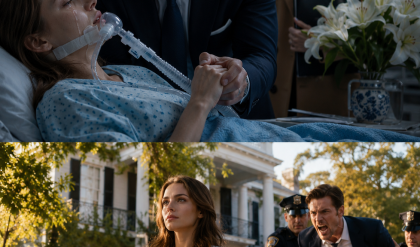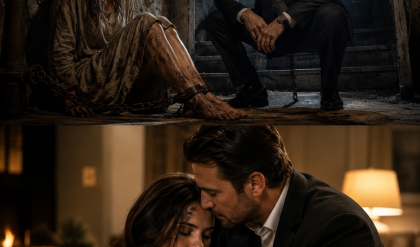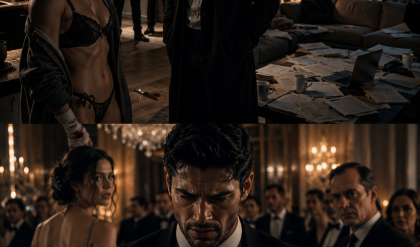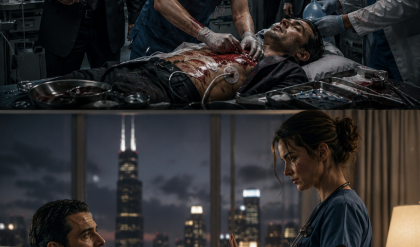
A cold thread slid down her spine. “Why?”
“Because Rick Harlan is not the only man who wanted you silent.”
The city seemed to dim.
Clara’s fingers tightened around the strap of her bag. “He’s in custody.”
“Yes.”
“Then what are you talking about?”
Dominic looked past her toward the café, then back at her. “You saw something the night he locked you in that freezer. Something more important than you understood.”
“The envelopes.”
“And the man receiving them.”
She remembered a gray suit. A gold watch. A scar at the corner of his mouth. She remembered Rick’s nervous smile, so different from the cruel one he used with employees. She remembered the man saying, “Callahan won’t tolerate loose ends.”
Clara stared at Dominic. “He said your name.”
“I know.”
“Were those men working for you?”
“No.” His answer came instantly, cold enough to cut. “They were using my name because cowards like borrowing fear that isn’t theirs.”
Relief and suspicion collided inside her.
Dominic opened the rear door of the sedan. “Let me take you home.”
Clara looked at the warm interior, then at him. “That sounds like the beginning of a kidnapping.”
“If I planned to kidnap you,” Dominic said, “I would not start by asking.”
She should not have laughed.
But she did.
It burst out of her unexpectedly, small and shaky, and for one second Dominic looked genuinely surprised. Then his mouth softened in a way that made him seem less like a monument and more like a man.
Clara got into the car.
The ride to her apartment should have been awkward. Instead, the silence inside the sedan felt too deliberate to be awkward. Rain traced silver lines down the tinted windows. The city blurred by in streaks of amber and red. Dominic sat beside her with enough distance to make clear he was not trying to crowd her, but close enough that she felt the weight of his presence like heat.
“You’ve been watching me,” she said.
“Yes.”
She turned her head. “You admit that very easily.”
“I dislike wasting time on lies that won’t work.”
“That’s comforting in a deeply alarming way.”
Again, the faintest trace of amusement. “You moved apartments last month.”
Her spine stiffened.
Dominic’s expression remained calm. “So did one of Rick’s friends.”
Clara’s mouth went dry.
“He asked questions near your old building,” Dominic continued. “Then near the café.”
“You knew that and didn’t tell me?”
“I’m telling you now.”
“After following me for weeks?”
“I had people watching the men who hurt you. They led us to you.”
That sounded reasonable.
It also sounded terrifying.
Clara looked out the window. “I can take care of myself.”
“No,” Dominic said quietly.
She turned sharply, anger rising because she had heard versions of that sentence before from men who meant she was weak, naive, inconvenient. But Dominic’s eyes did not hold contempt. They held something far more painful.
“You survived by enduring,” he said. “That is not the same as being protected.”
The anger drained out of her so fast she almost hated him for it.
Because he was right.
She had endured Rick’s insults because she needed the job. She had endured twelve-hour shifts because rent was due. She had endured men brushing too close behind her at the bar because complaining only made her difficult. She had endured until someone mistook her silence for permission to destroy her.
The car stopped outside her building, a narrow brick walk-up with a faulty buzzer and a front door that never latched properly unless slammed twice.
Dominic studied it with visible distaste.
“It has locks,” Clara said defensively.
“It has suggestions.”
She almost smiled, then remembered she was sitting beside a man whose entire life was built on threats she did not understand.
Dominic pulled a black card from his coat and held it out. No logo. No name. Only a number embossed in silver.
“If anything feels wrong,” he said, “you call me directly.”
Clara stared at the card. “Why?”
The question came out softer than she intended.
Dominic’s gaze dropped to her hands. Even in the dim car light, the faint pale scars across her fingers showed where frostbite had kissed too deeply.
His jaw tightened.
“Because when I found you,” he said, “it was obvious nobody had protected you for a long time.”
Something inside Clara cracked, quietly and dangerously.
She took the card.
For four days, she did not call.
She kept the card in the side pocket of her bag and pretended it was not there. She went to work. She learned how to steam oat milk properly. She changed her bus route twice. She checked her locks every night. She told herself that Dominic Callahan was a dangerous man, and dangerous men did not become safer just because they had once carried you out of death.
But memory did not obey logic any better than trauma did.
She remembered his coat. His voice. The way he had noticed her fear without feeding on it.
On the fifth evening, as she left the café after a double shift, her phone buzzed.
Unknown number.
She almost ignored it.
Then she knew.
“Hello?”
“Did you eat today?”
Clara stopped beneath the café awning. Rain dripped from the green canvas above her. “Dominic?”
“You sound tired.”
“That’s not an answer to how you got my number.”
“You gave it to the hospital.”
“Are you admitting to accessing my medical records?”
“No.”
A pause.
Clara narrowed her eyes even though he could not see her. “That pause was suspicious.”
“Mrs. Alvarez called me.”
That startled her. “My boss?”
“She was worried when a man came by asking whether you worked closing shifts.”
The rain suddenly sounded louder.
Clara’s grip tightened on the phone. “What man?”
“Scar near his mouth. Gold watch.”
The freezer flashed in her mind.
White. Black. White.
Her knees weakened.
Dominic’s voice changed instantly. “Clara.”
“I’m fine.”
“No, you’re not. Turn around.”
Her heart lurched.
She turned.
Across the street, beneath the red glow of a pharmacy sign, Dominic stood beside the black sedan with a phone to his ear.
People moved around him without looking directly at him. Even strangers seemed to understand that he was not part of the ordinary world.
Clara crossed slowly, pulse pounding.
“You can’t just appear like this,” she said when she reached him.
“I can.”
“That was not permission.”
“No.”
His honesty was becoming a problem.
“I’m not getting in that car every time you decide I look hungry or endangered.”
“You are tonight.”
“Why?”
“Because you skipped dinner, worked eleven hours, and someone who helped put you in a freezer came within two blocks of your job.”
Clara stared at him.
Dominic opened the car door. “Dinner first. Panic after.”
Despite herself, she laughed again.
This time, Dominic did not look surprised. He looked almost relieved.
He took her to a small Italian restaurant tucked behind a hotel near the river, the kind of place with low lights, dark wood, and waiters who seemed to know who Dominic was before he said a word. Conversations dipped as he entered. A man near the bar moved aside so quickly he almost spilled his drink.
Clara noticed everything.
Dominic noticed her noticing.
“You don’t like this,” he said after they sat in a private corner.
“I don’t know what this is.”
“Dinner.”
“No. This.” She gestured faintly at the room, the staff, the way people avoided his eyes. “You.”
Dominic poured water into her glass before his own. “What do you think I am?”
The sensible answer was billionaire. The whispered answer was criminal. The honest answer was complicated.
Clara looked at his hands. There were small scars across his knuckles.
“I think you’re the kind of man people are afraid to disappoint,” she said.
He considered that. “Usually.”
“But you helped me.”
“Yes.”
“Why?”
“Because you were dying.”
“That can’t be the whole answer.”
For the first time, Dominic looked away.
The silence that followed felt different from his usual silence. Less controlled. More guarded.
“When I was twelve,” he said finally, “my mother locked herself in a pantry during one of my father’s rages. I sat outside the door for three hours and told her stories until she stopped crying.”
Clara did not move.
Dominic’s expression did not change, but his voice became quieter. “After that, I learned something. Closed doors are rarely just doors.”
The food arrived then, saving him from saying more and robbing Clara of any simple way to respond. She reached for her wallet automatically.
Dominic looked at her.
“What?” she asked.
“You’re preparing to apologize for needing food.”
Heat rose in her face. “I am not.”
“You are.”
“You’re very irritating for someone trying to be mysterious.”
That faint smile again. Brief, but real. “Mystery is overrated.”
“No, it isn’t. Some of us would like a little more of it from men who show up outside our jobs.”
His smile lasted a full second this time.
Then his expression softened.
“You do not owe anyone repayment for being cared for,” he said.
The words landed too deeply.
Clara looked down before he could see how close she was to tears. Rick had made kindness transactional. Her childhood had made love conditional. Her adult life had taught her that being difficult meant being abandoned. And now this dangerous man sat across from her, saying care did not require an invoice.
She wanted to believe him.
That was what scared her.
Three nights later, the note appeared under her apartment door.
No envelope.
No signature.
Just one sentence written in thick black marker.
Pretty girls shouldn’t make powerful men bleed.
Clara read it three times before the hallway began to tilt.
Her apartment building creaked around her. A television laughed behind one wall. Somewhere upstairs, a couple argued about laundry. Ordinary sounds. Safe sounds.
Except nothing felt safe.
She locked the door. Then the chain. Then the second lock. Then she dragged a chair under the handle like people did in movies even though she knew it would not stop anyone determined enough.
Her hands shook so badly she dropped the note twice.
The black card lay on the kitchen counter.
Dominic answered before the first ring finished.
“Clara.”
She should have been disturbed that he knew it was her. Instead, the sound of his voice nearly made her knees give way.
“There was a note,” she whispered.
The silence on the other end turned lethal.
“Read it.”
She did.
Dominic said nothing for three seconds.
Then: “Pack enough for three days.”
“What?”
“I’m coming.”
“Dominic—”
“Lock the door. Stay away from the windows.”
The line went dead.
Twenty-two minutes later, three controlled knocks sounded at her door.
She looked through the peephole and saw Dominic standing in the dim hallway, rain on his shoulders, two men in dark suits behind him. His face was calm.
Too calm.
When she opened the door, his gaze moved over her quickly. Hair, face, hands, throat, arms. Checking for harm.
“Did anyone follow you inside?”
“I don’t know.”
He looked at the flimsy locks. “That answer is why you’re leaving.”
“I can’t just leave my apartment.”
“You can.”
“I have rent. My clothes. My life.”
Dominic’s eyes returned to hers. “Your life is the part I’m concerned about.”
She wanted to argue, but fear had worn her out. The note on the counter looked obscene beneath the kitchen light. She packed in silence while Dominic stood near the door, not watching her, watching the hallway. That mattered. He was careful even with his protection. He did not make her feel trapped in the room with him.
When they drove north along Lake Shore Drive, Chicago glittered wet and distant beyond the windows. The skyline slowly gave way to quieter streets, then gated roads, then estates hidden behind stone walls and black iron.
Clara stared when the car stopped before enormous gates guarded by men with earpieces.
“This is where you live?”
“One of my homes.”
“One of them,” she repeated weakly.
Dominic did not seem to understand why that sounded insane.
The gates opened without anyone asking for identification. The mansion beyond them rose out of the rain like something built for a family that had never known the word no. Stone walls. Tall windows glowing gold. Security cameras tucked under eaves. A circular driveway shining beneath the headlights.
Clara stepped out slowly.
“I don’t belong here,” she said before she could stop herself.
Dominic closed the car door beside her. “You do tonight.”
Inside, the house was enormous and quiet. Not cold quiet, despite the marble floors and high ceilings. Warm lamps glowed along the walls. Somewhere far away, a piano played softly, though Clara never found out who was playing it. Staff greeted Dominic with respectful nods. Guards moved like shadows at the edges of rooms.
A poised older woman with silver hair met them near the staircase.
“Good evening, Mr. Callahan,” she said. Her eyes moved kindly to Clara. “The east suite is ready.”
Clara looked at Dominic. “You already had a room ready?”
“I prepare for problems before they become emergencies.”
“Is that your way of saying you expected my life to fall apart?”
“No,” he said. “I expected cruel men to behave consistently.”
The east suite was larger than Clara’s apartment. A sitting area faced tall rain-streaked windows overlooking the city. Fresh clothes lay folded on the bed. A tray with tea, soup, and bread waited near the fireplace.
Clara stood in the doorway, overwhelmed.
“This is too much.”
Dominic remained behind her, leaving space. “It’s a locked door between you and people who want to hurt you.”
“You make everything sound practical.”
“Most frightening things become smaller when made practical.”
She looked back at him. “And what about you?”
His eyes held hers.
“I am not small,” he said quietly.
No, she thought. He was not.
That night, Clara slept for six hours without waking once.
The mansion revealed itself slowly over the next week.
In daylight, it was less intimidating but more impossible. The library had two floors and a rolling ladder. The kitchen smelled of coffee and cinnamon every morning because Mrs. Donnelly, the silver-haired housekeeper, believed trauma should be fed before it was discussed. The west wing was closed off after midnight for security reasons Clara did not understand and chose not to ask about.
Dominic came and went at odd hours. Sometimes he appeared at breakfast in a dark suit, reading messages on his phone while telling Clara to eat the eggs Mrs. Donnelly placed in front of her. Sometimes he vanished for an entire day and returned near midnight with exhaustion shadowing his face. He never explained fully where he had been, but he never lied when Clara asked.
“Was it dangerous?” she asked once.
“Yes.”
“Should I ask more?”
“Probably not.”
“Are you trying to protect me from information or from fear?”
Dominic considered that. “Both.”
His honesty should have pushed her away. Instead, it built a strange kind of trust. He did not pretend his world was safe. He only made clear that inside his walls, she was.
But the false safety of walls cracked one night just after two in the morning.
Clara woke from a nightmare with ice in her lungs. Instead of trying to force herself back to sleep, she wrapped a robe around herself and went downstairs for tea. The mansion was dim and silent, rain whispering against the windows.
Halfway past the library, she heard a child crying.
The sound stopped her cold.
She followed it through a side hall to a small sitting room with the door half open. Warm light spilled onto the carpet. Dominic sat on the floor beside a couch, still wearing his shirtsleeves from the day, his tie loosened. A little girl no older than six was curled beneath a blanket, crying into her knees. A woman Clara recognized from the kitchen staff stood nearby with red-rimmed eyes.
“I’m sorry, Mr. Callahan,” the woman whispered. “She keeps waking up.”
Dominic’s voice was quieter than Clara had ever heard it. “You don’t apologize for a frightened child.”
The little girl hiccuped on a sob. “I don’t want to go back.”
Dominic leaned closer, but not too close. “You’re not going back.”
“What if he finds us?”
“He won’t.”
“How do you know?”
“Because I’m here.”
The child stared at him as if measuring whether adults could still be believed. Then, slowly, her breathing began to ease.
Clara stood frozen in the hallway.
This was not the Dominic people whispered about. This was not the billionaire with enemies or the man whose name could empty a room. This was a man sitting on the floor at two in the morning, telling a terrified child that monsters had limits.
“Do you want the fox story?” he asked.
The little girl nodded.
Dominic began softly. “Once, there was a little fox who thought she was alone in the woods…”
His voice carried through the half-open door, steady and low. He told the story of a fox hiding from wolves during a storm, of dark trees and cold rain, of fear that seemed endless until the fox found a den with a fire inside. He never rushed. He never sounded bored. When the little girl slowly leaned against his sleeve, Dominic went completely still so he would not disturb her.
By the time he finished, she was asleep.
Only then did he look up and see Clara.
For a second, she expected him to shut down, to become the composed stranger again. Instead, he only looked tired.
“You should be sleeping,” he said.
“So should you.”
A faint recognition passed through his eyes, as if she had touched a bruise without knowing it.
“Who is she?” Clara asked softly.
“Daughter of one of my employees.”
“She’s hiding from someone?”
“Yes.”
“You protect families too?”
Dominic stood carefully and adjusted the blanket around the sleeping child. “I protect people under my roof.”
“That sounds simple when you say it.”
“It is simple.”
“No, Dominic. It isn’t.”
He looked at the child, and for once his mask slipped enough for Clara to see grief beneath it. “It should be.”
That was the moment Clara began to understand him.
Dominic’s kindness was not softness. It was discipline. It was a choice sharpened by violence and repeated anyway. He had enough power to be cruel without consequence, yet here he was, kneeling for a crying child because fear mattered to him. Because closed doors were rarely just doors.
And that made him far more dangerous to Clara’s heart than his enemies ever could.
The woman who nearly ruined everything arrived on a Sunday afternoon wearing cream cashmere, red lipstick, and the kind of confidence Clara had only seen in women who had never had to ask whether they belonged.
Clara saw her from the top of the staircase.
Dominic was in the entry hall below, speaking to one of his men, when the front doors opened and the woman swept in as if the mansion had been waiting for her. She handed her coat to Mrs. Donnelly without looking away from Dominic.
“Still brooding in black, I see,” she said.
Dominic’s expression shifted. Not warmth exactly. Familiarity.
“Vivian,” he said. “Still entering homes like warrants don’t apply to you.”
She laughed and kissed his cheek.
Clara’s stomach dropped.
The reaction was immediate and humiliating. She had no claim on Dominic. He had saved her, sheltered her, fed her, watched over her with unsettling attention. None of that meant he belonged to her. Men like him had histories. Women like Vivian, elegant and fearless, belonged in those histories.
Then Dominic glanced up and saw Clara.
His entire expression changed.
It was small, but Vivian noticed. Her gaze followed his to the staircase. She studied Clara for one long second, then smiled in a way that was not unkind but far too knowing.
Clara fled before either of them could speak.
An hour later, she heard their voices in the library.
She had not meant to listen. She had been heading to the kitchen when Vivian’s voice drifted through the cracked door.
“You’re distracted.”
“I’m reading.”
“You’ve turned the same page three times.”
Silence.
Vivian laughed softly. “Oh, Dominic.”
“Careful.”
“That serious?”
Clara stopped breathing.
Dominic said nothing.
Vivian’s tone softened. “You used to look at me like that when we were teenagers.”
Clara backed away before she heard more.
That night, she barely touched dinner.
Dominic noticed by the second minute.
“You’re not eating.”
“I’m not hungry.”
“You lie badly when you’re upset.”
“I’m not upset.”
“You also repeat yourself when cornered.”
Clara set down her fork too hard. “Maybe I don’t enjoy being studied like a case file.”
Dominic went still. “That’s not what I’m doing.”
“Isn’t it?”
“No.”
The silence stretched.
Clara hated the tears burning behind her eyes. She hated feeling small in his dining room, wearing clothes he had bought, eating food he provided, sleeping under his protection like a stray he had taken in during a storm.
“This isn’t real,” she said.
Dominic’s voice became careful. “What isn’t?”
“This.” She gestured at the table, the house, herself. “Me being here. You acting like I belong.”
His brow tightened slightly. “You do belong.”
“Women like Vivian belong. Women who can kiss you in your entry hall and make jokes about when you were teenagers. Women who don’t need rescuing from walk-up apartments and freezer doors.”
Dominic stared at her.
Then, very slowly, his mouth curved.
Clara froze. “Don’t.”
“Vivian is my cousin.”
The room died.
“She’s your what?”
“My cousin.”
Heat flooded Clara’s face so fast she felt dizzy. “Oh.”
Dominic leaned back, amusement warming his eyes in a way she had never seen. “You thought she was a former lover.”
“I absolutely did not.”
“You stopped speaking to me for seven hours.”
“That was unrelated.”
“You asked Mrs. Donnelly if Vivian often stayed overnight.”
Clara covered her face with both hands. “I hate this house. It has spies.”
“It has staff with excellent hearing.”
“This is humiliating.”
“It is a little charming.”
She lowered her hands just enough to glare at him. “Do not call my emotional downfall charming.”
His amusement faded gently.
“Clara,” he said, and her name in his voice made her anger weaken despite her best efforts. “You think my care for you has an expiration date.”
The accuracy hurt.
Dominic leaned forward. “You think one day I will wake up and realize you were only a responsibility. A crisis. A woman I saved once and housed until the story became inconvenient.”
She looked away.
He did not let the silence protect her.
“You still think you’re temporary,” he said.
Clara’s throat tightened. “Aren’t I?”
Dominic’s expression changed.
Before he could answer, the first gunshot cracked through the night.
At first, Clara thought something had fallen in the kitchen.
Then a second shot shattered the windows in the east hall.
Dominic was on his feet before she moved. Men shouted outside the dining room. Alarms flashed red across the walls. Somewhere below them, glass broke. Clara froze so completely that for one horrifying second she was back in the freezer, unable to move, waiting for footsteps that might never come.
Dominic reached her in two strides.
“Look at me,” he said.
She couldn’t.
“Clara.”
His hand closed around hers, warm and firm. Not painful. Anchoring.
She dragged her eyes to his.
“Breathe.”
Another gunshot sounded.
She flinched hard.
Dominic pulled her behind him as two guards burst in.
“East gate breached,” one said. “Two vehicles. One got through the lower drive.”
“Inside?” Dominic asked.
“Not yet.”
“Find them.”
The voice was Dominic’s, but stripped of every softness she had come to know. This was the man other men feared. Cold. Final. A weapon wearing human skin.
Then his eyes cut back to Clara, and fear broke through.
Not for himself.
For her.
“They came because of me,” she whispered.
“No.”
“Dominic—”
“No.” The word hit like steel. “They came because weak men mistake care for weakness.”
A guard returned breathlessly. “Sir, we found charges near the secondary entrance.”
Dominic went very still.
Clara knew from his face before anyone explained. The secondary entrance was the private route he used when taking her in and out of the property.
They had not come for him.
They had come for her.
The next ten minutes blurred into noise and movement. Dominic kept Clara close while guards swept the mansion. His phone rang twice. He answered with clipped words. His jaw tightened. Rain slammed against the windows as if the whole city were trying to get inside.
Finally, the gunfire stopped.
A guard appeared in the doorway. “Handled.”
Dominic closed his eyes for one second.
Only one.
But Clara saw the exhaustion beneath the control. The terror beneath the rage.
When they were alone in the ruined dining room, surrounded by broken glass glittering like ice on the floor, Clara said, “You were scared.”
His eyes opened.
“For me,” she added softly.
Dominic looked away.
That was answer enough.
“You almost died once already,” he said, his voice rougher than she had ever heard it. “I thought I was too late then.”
“Dominic.”
“When I opened that freezer door, I thought you were dead.” His control slipped on the last word. “Do you understand what that does to a man who has spent years teaching himself not to care?”
Clara’s chest ached.
He laughed once, bitter and quiet. “I told myself you were someone I helped. A stranger. A loose end that needed protection because my name had been used by the men who hurt you.”
He looked at her then, and the room seemed to narrow around them.
“But every time I saw you alive, I felt…” He stopped, frustrated with the language of vulnerability. “I felt human again.”
Clara could not speak.
Dominic stepped closer, then stopped, as if even now he would not take space she did not give.
“I can handle enemies,” he said. “I can handle betrayal. I can handle violence. But the thought of losing you—”
He did not finish.
He did not have to.
Clara crossed the space between them and took his hand.
His fingers closed around hers like he had been falling and she had caught him.
The attack changed the mansion.
More guards appeared. Security doubled. Doors that once stood open now locked behind quiet clicks. Dominic vanished for longer stretches and returned with harder eyes. Clara tried not to ask what happened to the men who had breached the gate, but secrets pressed against the walls.
Three days later, she found him in the library near midnight, standing by the window while rain blurred the city lights.
“You should sleep,” he said without turning.
“You say that like you do.”
He smiled faintly, still facing the glass. “You’ve learned too much.”
She came to stand beside him.
For a while, neither spoke.
Then Clara saw what he held: the note that had been slipped under her apartment door.
Pretty girls shouldn’t make powerful men bleed.
“You kept it,” she said.
Dominic folded it once. “Evidence.”
“Against Rick?”
His silence answered too late.
Clara turned toward him. “Dominic.”
His jaw tightened.
“It wasn’t Rick, was it?”
“It started with Rick.”
“That’s not what I asked.”
Dominic looked at her then, and the exhaustion in his face made him seem older.
“The man behind Rick is Grant Callahan.”
The name hit strangely because it sounded like Dominic’s.
“My half brother,” he said.
Clara stared. “Your brother tried to kill me?”
“He tried to use you.”
“For what?”
“To prove I’ve become weak.”
The words were absurd and monstrous, but Dominic’s face told her they were true.
Grant Callahan had been the invisible heir no newspaper mentioned anymore, the son from Dominic’s father’s first marriage, disinherited years ago after a scandal involving bribery and a dead witness. Dominic explained in careful pieces. Grant had spent years building alliances with men who resented Dominic’s control over the family’s legitimate businesses and its darker legacy. Whitcomb’s Steakhouse had been one of Grant’s laundering fronts. Rick had worked for him. The man with the scar and gold watch was Grant’s lieutenant.
“And the freezer?” Clara whispered.
Dominic’s eyes darkened. “Rick panicked after you saw the handoff. Grant ordered him to scare you. Rick chose the freezer.”
“He left me to die.”
“Yes.”
The word was quiet, but rage lived beneath it.
Clara sank onto the sofa.
All this time, she had believed she was a random victim caught in a cruel man’s power trip. Now she understood she had been a message written in suffering. A way for one brother to hurt another before Dominic even knew her name.
“There’s more,” Dominic said.
She looked up.
His face had closed again, but not completely. He was bracing himself.
“Grant knows you’re the only witness who can connect his lieutenant to Whitcomb’s that night.”
“I don’t remember enough.”
“You remember the scar. The watch. The phrase he used.”
Callahan won’t tolerate loose ends.
Clara felt cold spread through her again.
Dominic crouched in front of her, not touching, making himself lower than her. “The federal investigation is moving. My attorneys have already given them financial records. Vivian is handling the foundation side for the employees Rick exploited. But if you testify, Grant loses the one thing he still has.”
“What?”
“The illusion that he’s untouchable.”
Clara laughed weakly. “I’m supposed to bring down a Callahan?”
“No,” Dominic said. “You’re supposed to tell the truth. I’ll handle the rest.”
She looked at him for a long time.
A month earlier, she would have heard command in that sentence. Now she heard restraint. He was not asking her to be brave for his empire. He was offering to stand between her and the consequences of bravery.
“What happens if I testify?” she asked.
Dominic’s eyes did not leave hers. “He comes harder.”
“And if I don’t?”
“He hurts someone else.”
That was the truth neither of them could soften.
The gala took place two weeks later at the Langford Hotel, in a ballroom full of crystal chandeliers, polished marble, and people who could destroy lives with donations and whispers.
Clara wore a black dress Vivian had chosen after declaring, “If Chicago society wants to stare, darling, we’ll at least make them work for it.”
Vivian, as it turned out, was terrifying in a completely different way than Dominic. She ran the Callahan Foundation with surgical elegance, cursed like a dockworker when angry, and had known within thirty seconds that Clara loved Dominic.
“You’re very obvious,” Vivian had said.
“I am not.”
“You look at him like he invented shelter.”
Clara had no defense against that.
Now, standing beside Dominic in the ballroom, Clara felt every eye.
People knew. Maybe not everything, but enough. They knew she was the waitress from the freezer. They knew Dominic Callahan had brought her into his mansion. They knew Grant Callahan’s name had begun circulating again in federal offices. Rumors moved through the room like perfume.
Dominic’s hand rested lightly at the small of her back.
“You can leave whenever you want,” he murmured.
“You told me I belonged wherever you brought me.”
His eyes warmed. “I did.”
“I’m trying to believe you.”
“Take your time.”
That was why she loved him, though she had not said it yet. Not because he made fear disappear. Because he let her move through it at her own speed.
Halfway through the evening, Dominic was pulled into a conversation with a senator, a prosecutor, and two men who looked like they had never sweated in their lives. Clara stepped toward the balcony for air.
She had only been alone for a minute when three women approached.
The blonde in front wore emerald silk and a smile sharpened for injury.
“You’re Clara Bennett,” she said.
Clara straightened. “Yes.”
“How fascinating.”
The other women laughed softly.
Clara knew that laugh. She had heard versions of it in restaurant kitchens, locker rooms, school hallways. It was the sound of people deciding cruelty was entertainment.
“I’ve heard so much about you,” the blonde continued. “Everyone has. The tragic little waitress.”
Clara’s throat tightened.
“Careful,” one of the women murmured, though she was smiling.
“What?” the blonde said. “I’m being kind. It must be exhausting for Dominic, always rescuing broken things.”
Old instinct told Clara to look down.
She almost did.
Then she remembered Dominic on the floor telling a child that monsters had limits. She remembered his hand around hers during gunfire. She remembered herself on a freezer floor, thinking silence might save her.
It had not.
Clara lifted her chin.
“I’m not broken,” she said.
The blonde blinked.
Clara’s voice shook, but she kept going. “And if you need someone else’s pain to feel superior, then whatever you are is much sadder than whatever you think I am.”
The silence that followed was immediate.
Then another silence settled behind the women.
A heavier one.
Dominic stood a few feet away, his expression cold enough to make the blonde’s confidence collapse.
“Miss Whitaker,” he said.
The blonde went pale. “Mr. Callahan, I didn’t realize—”
“That Clara could speak for herself?” he asked softly.
The woman swallowed.
Dominic stepped beside Clara, not in front of her. That mattered more than any defense could have.
“You will apologize,” he said.
The blonde’s mouth opened.
“Now.”
“I’m sorry,” she said quickly, but Dominic did not look at her.
He looked at Clara.
Clara realized he was waiting.
Not controlling the moment. Giving it to her.
She took a breath. “I don’t need it.”
Dominic’s eyes stayed on hers.
“I don’t want an apology she’s only making because she’s afraid of you,” Clara said, louder now. “I want her to remember that she was cruel and nobody laughed.”
Around them, people were staring openly.
The blonde looked as if she might cry from humiliation. Clara found, to her surprise, that she did not enjoy it. She only felt tired.
Dominic turned his gaze back to the woman. “Leave.”
She did.
When the balcony emptied, Clara released a breath she had not known she held.
Dominic studied her with something like awe.
“What?” she asked.
“You didn’t endure it.”
“No,” Clara said softly. “I didn’t.”
His hand found hers.
And in a room full of people who feared him, Dominic Callahan looked at her as if she were the brave one.
The final twist came three days before Clara’s testimony.
She was in the mansion kitchen making tea when Mrs. Donnelly entered with a face like paper.
“There’s a woman at the gate,” she said. “She says she’s your mother.”
Clara nearly dropped the kettle.
Her mother, Elaine Bennett, had not called in eight years. Not after Clara left Milwaukee at nineteen. Not after birthdays. Not after the hospital. Their relationship had ended in a kitchen full of accusations, Elaine insisting Clara was selfish for leaving, Clara insisting she would rather be alone than live beneath her stepfather’s temper.
Dominic appeared behind Mrs. Donnelly seconds later, already alert.
“You don’t have to see her,” he said.
But Clara did.
Elaine looked smaller than Clara remembered when she entered the sitting room. Older, too. Her hair had gone gray at the temples. Her coat was cheap and soaked from rain. She held her purse in both hands like a shield.
For a moment, neither woman spoke.
Then Elaine began to cry.
Clara went still.
“I saw you on the news,” her mother said. “About the restaurant. About tomorrow. I should have come sooner.”
“Yes,” Clara said.
The honesty hurt both of them.
Elaine flinched, but she nodded. “Yes. I should have.”
Dominic stood near the doorway, silent. Clara knew he would leave if she asked. She also knew he would stay if she needed him. That choice gave her strength.
Elaine took a shaking breath. “Grant Callahan’s people came to me.”
Dominic’s body changed before his face did.
Clara whispered, “What?”
“They offered me money to say you were unstable. That you made things up. That you’d always wanted attention.”
The room seemed to shrink.
Clara’s childhood rushed back in ugly flashes. Her mother choosing peace over truth. Her stepfather’s shouting. Clara learning early that being believed was a luxury.
Elaine opened her purse with trembling hands and pulled out a small recorder. “I said yes.”
Clara’s chest cracked.
“But then I listened to myself,” Elaine continued, sobbing now. “I listened to them tell me how to ruin you, and I heard your stepfather’s voice coming out of my mouth. I couldn’t do it again. I couldn’t choose fear over you again.”
She held out the recorder.
“It’s all here. Names. Money. What they wanted me to say.” Her voice broke. “I’m late, Clara. I know I’m late. But I’m here now.”
Clara stared at the recorder, then at her mother’s ruined face.
This was not forgiveness. Not yet. Maybe not ever in the clean way people liked stories to offer.
But it was truth arriving late with wet shoes and shaking hands.
Clara took the recorder.
Dominic’s expression was unreadable, but his eyes were fierce.
The next day, Grant Callahan was arrested before Clara even entered the courthouse.
The recorder, combined with Dominic’s financial records and Clara’s testimony, broke the case open. Rick Harlan took a deal. The scarred lieutenant tried to flee through O’Hare and failed. News vans crowded the courthouse steps. Reporters shouted questions. Cameras flashed.
Clara testified anyway.
Her voice shook at first. Then steadied.
She told them about the envelopes. The freezer. Rick’s laugh. The sentence spoken behind the private room door. She did not make herself smaller. She did not apologize for forgetting details trauma had stolen. She did not look down when Grant’s attorney suggested she had misunderstood.
At one point, the attorney asked, “Miss Bennett, isn’t it true that your relationship with Mr. Callahan gives you a motive to harm his brother?”
Clara looked at Dominic sitting behind the prosecutor.
He did not move. He did not signal. He only watched her with absolute faith.
Clara turned back to the attorney.
“No,” she said. “My relationship with Mr. Callahan gave me enough safety to tell the truth. There’s a difference.”
The courtroom went silent.
And for the first time since the freezer, Clara felt warm all the way through.
Spring came slowly to Chicago.
Snow melted from the curbs. The lake changed from steel to blue. The wind softened. At Juniper & Rye, Mrs. Alvarez cried when Clara returned for one afternoon just to help during the lunch rush, then refused to let her touch the trash because “women who bring down criminal conspiracies do not haul garbage on my watch.”
Clara laughed more than she used to.
Not constantly. Not perfectly. Healing was not a straight road, and some nights still opened beneath her without warning. A freezer hum could still steal her breath. Rain could still take her back. But now, when the memories came, they no longer found her alone.
Dominic changed too.
The newspapers called it restructuring. Federal officials called it cooperation. Vivian called it “finally cleaning the blood out of the family carpet.” Dominic divested from businesses tied to old corruption, testified behind closed doors, and turned sections of the Callahan estate into a protected residence for witnesses and families escaping violence.
People said he was weakening.
Clara knew better.
One evening in May, she found him in the kitchen, sleeves rolled up, failing spectacularly at making tea.
“You’re boiling leaves like evidence,” she said.
Dominic looked down at the pot. “Mrs. Donnelly made the instructions sound simple.”
“They are simple.”
“I build towers.”
“And yet chamomile defeated you.”
His mouth curved.
Clara moved beside him and took the kettle. Rain tapped softly against the windows, but it no longer sounded like a warning. It sounded like weather.
Dominic watched her hands as she worked. The frostbite scars had faded, pale lines across her fingers, visible only when the light caught them.
“You’re thinking about it,” she said.
“Yes.”
“You always tell the truth.”
“Not always.”
She looked at him.
He took the cup from her and set it down untouched. “I told myself for years that fear was the same thing as respect. That control was the same thing as strength. That if I became untouchable, nothing could hurt me.”
Clara waited.
Dominic reached for her hand carefully, as he always did, giving her the chance to pull away.
She didn’t.
“Then I opened a freezer door,” he said, voice low, “and found a woman I had never met fighting harder for one breath than most men fight for their entire lives. And I realized I had spent years surviving too. Just in a more expensive cage.”
Tears filled Clara’s eyes.
“You saved me,” he said.
She shook her head. “Dominic—”
“You did.” His thumb brushed softly over her scars. “Not by needing me. By making me want to be someone worthy of being needed.”
Clara stepped closer and rested her forehead against his chest. His arms came around her immediately, not like a cage, like shelter.
“For a long time,” she whispered, “I thought that night only took things from me.”
His hold tightened.
“It did take things,” she said. “But it also brought me here.”
Dominic lowered his face to her hair. “Home?”
The word was quiet.
Careful.
More vulnerable than any confession he had made.
Clara looked up at him. This house had once seemed too large, too rich, too dangerous. Now it held Mrs. Donnelly’s cinnamon rolls, Vivian’s ruthless laughter, a little girl sleeping through the night down the hall, and a man who had spent his life becoming feared only to learn that love required him to become brave in an entirely different way.
“Yes,” Clara said. “Home.”
Dominic kissed her then, slowly and gently, with none of the desperation of near loss and all of the certainty that came after choosing peace again and again. Outside, rain washed the city clean. Inside, warmth gathered in the kitchen light.
Clara knew the scars would remain.
So would the memories.
But she also knew this now: survival was not the end of her story. It was only the door opening.
And this time, when warmth rushed in, she was awake enough to walk toward it.
THE END