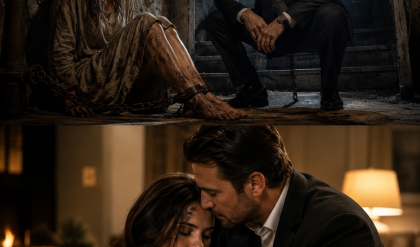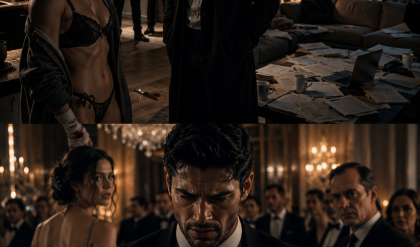
“What the hell are you doing?” Evan said.
Claire held out the trimmer, handle first. “Finishing what your mother started.”
Patricia’s face twitched, uncertain.
Claire walked past them to the bed. She pulled on a robe, tied the belt, and looked from mother to son.
“You’re right,” she said calmly. “Tomorrow I’ll stay home.”
Patricia’s expression warmed with victory. “That’s more like it.”
“I’ll cancel my meetings,” Claire continued. “I’ll take care of everything.”
Evan exhaled with relief. “Good. Okay. We can talk in the morning.”
Claire nodded. “Yes. We can.”
Patricia stepped over the hair on the floor and patted Evan’s arm. “See? A firm hand saves a marriage.”
Claire smiled.
Neither of them understood that by morning, there would be nothing left for their hands to hold.
After they went back to sleep, Claire did not.
She sat in the dark at the kitchen island with her laptop open and a mug of coffee going cold beside her. The house was silent except for the refrigerator and the rain tapping against the windows. Patricia’s lavender robe hung over the back of a chair like a flag planted in stolen territory.
Claire started with the credit cards.
Evan’s authorized-user card: removed.
Patricia’s emergency card: removed.
Apple Pay access: revoked.
Streaming accounts: changed.
Truck insurance payment: stopped.
Patricia’s medical bill autopay: canceled.
Landscaping service, country club charges, wine subscription, meal delivery, housekeeper, storage unit, premium cable package Patricia insisted was necessary because “news matters to older people”: all canceled.
Then Claire opened the mortgage portal. The house in Belle Meade had been purchased under her name alone because Evan’s credit score was too weak to qualify. Patricia had called that “humiliating.” Evan had said it was only temporary until his business took off. Yet for three years, he introduced it as “our house” while Claire quietly sent $4,812 every month to the lender.
The next payment was scheduled for Friday.
Claire paused over the autopay button.
Then she turned it off.
Not because she intended to lose the house. Because from that moment on, nothing would be paid automatically for people who treated her like a machine.
At 4:09 a.m., she sent a message to her assistant, Maya.
Family emergency. I’ll work remotely today. Please block my morning and move the regional call to 1 p.m.
Maya replied within two minutes.
Are you safe?
Claire stared at the screen. That was the first time anyone had asked the right question.
She typed back.
I will be.
Then she opened the security app.
The Hensleys had forgotten about the cameras. Six months earlier, after two packages disappeared from the porch, Claire had installed a full home security system. Evan had mocked her for it. Patricia had complained the cameras made the house feel “like a prison.” Claire had explained that only the downstairs cameras ran continuously, while the upstairs hallway camera and bedroom-entry motion sensor recorded when triggered.
Patricia had triggered both.
Claire watched the footage once.
Only once.
The video showed Patricia entering at 3:15 a.m. with the trimmer hidden in her robe pocket. It showed her standing over the bed, watching Claire sleep. It showed her pressing Claire’s forehead down. It recorded the buzzing. Claire’s scream. Evan’s arrival. Patricia’s speech. Evan’s failure.
Claire downloaded the files, saved them to the cloud, emailed copies to herself, then forwarded them to an attorney whose card had been sitting in her desk drawer for eight months.
Rachel Novak, Family Law and Financial Abuse Litigation.
Claire had taken the card from a women’s leadership luncheon after hearing Rachel speak about financial control inside marriages. At the time, Claire had slipped it into her purse and told herself she was only keeping it for a friend.
Now she wrote one sentence.
I need help, and I have evidence.
At 7:02 a.m., Patricia came downstairs expecting breakfast.
She found Claire sitting at the kitchen island, bald, dressed in black slacks and a white blouse, reviewing bank statements.
Patricia stopped near the pantry. “You look ridiculous.”
Claire did not look up. “Good morning.”
Evan came in behind her, yawning. “Is there coffee?”
“In the pot,” Claire said.
Patricia frowned at the empty stove. “Where are the eggs?”
“In the refrigerator.”
“You said you were staying home.”
“I am.”
Patricia pulled herself upright. “Then make breakfast.”
Claire looked up at last. “No.”
A small word. A plain word. But it landed in the kitchen like a dropped plate.
Evan rubbed the back of his neck. “Claire, don’t start.”
“I already started,” she said. “At 3:42 this morning.”
He blinked. “Started what?”
“Ending the arrangement.”
Patricia narrowed her eyes. “What arrangement?”
“The one where I pay for everything and you both call it family.”
Evan reached for his phone, irritated now. “We agreed not to do the money talk.”
“No,” Claire said. “You agreed I should stay silent about it.”
His screen lit up. His face changed.
“What did you do to my card?”
Claire closed the laptop halfway. “Canceled it.”
He stared at her. “What?”
“Technically, I removed you as an authorized user from my credit account. Your mother too.”
Patricia’s hand went to her chest. “You spiteful little—”
“And I canceled every automatic charge attached to my accounts that was not legally mine or personally necessary.”
Evan tapped frantically at his phone. “My truck payment is due tomorrow.”
“Then pay it.”
“With what?”
Claire tilted her head. “That sounds like a question for a man of the house.”
Patricia slammed her palm on the island. “You will not mock my son.”
Claire stood.
Patricia took one step back before she could stop herself.
“You held me down while I slept,” Claire said. “You cut my hair. You told me to quit the job that pays for your prescriptions, your dental implants, your church donations, your robe, your phone, your groceries, and the roof over your head. Then your son told me I provoked it. So listen carefully, Patricia. I am done financing my own humiliation.”
Evan’s face reddened. “You can’t just cut us off overnight.”
“You cut me overnight.”
Silence.
For a second, Claire saw the truth pass across his face. Not remorse. Calculation. He was adding up the missing pieces: the cards, the truck, his mother’s expenses, the mortgage, the quiet machinery of comfort he had never bothered to understand because Claire had kept it running.
The doorbell rang.
Patricia flinched.
Claire walked to the foyer and opened the front door.
Rachel Novak stood on the porch in a navy suit, holding a leather briefcase. Beside her stood a uniformed Nashville police officer with kind eyes and a body camera clipped to his chest.
“Claire Hensley?” Rachel asked.
“Yes.”
“I’m Rachel. This is Officer Dale. May we come in?”
Claire stepped aside. “Please.”
Evan appeared in the hallway. “What is this?”
Rachel looked at Claire’s head. Her gaze moved to the red scrape near the crown, then back to Claire’s eyes. She did not gasp. She did not pity. She simply nodded once, as if recognizing a fact that required action.
“Mr. Hensley,” Rachel said, “your wife contacted me regarding an assault that occurred in this residence early this morning. Officer Dale is here to document the incident.”
Patricia barked a laugh. “Assault? For heaven’s sake. It was hair.”
Officer Dale opened his notebook. “Ma’am, did you touch Mrs. Hensley while she was asleep?”
Patricia’s confidence faltered. “I was trying to help my son’s marriage.”
“Did you shave part of her head without her consent?”
“She needed humbling.”
Evan closed his eyes.
Rachel’s voice stayed even. “You may want to stop talking.”
Patricia turned on her. “I don’t answer to you.”
“No,” Rachel said. “You answer to the law.”
Officer Dale photographed Claire’s scalp in the hallway. The camera flash felt less humiliating than the bedroom light had. Each click changed the story from shame to evidence.
Then Claire opened her phone and played the recording.
Patricia’s voice filled the foyer.
“A wife who wants to live under this roof will learn obedience.”
The buzzing followed.
Claire’s scream.
Evan’s voice: “You pushed this, Claire. Mom went too far, but you pushed this.”
Patricia grabbed the banister. “You recorded us?”
“The camera recorded you,” Claire said.
Evan went pale. “The bedroom camera?”
“The hallway motion camera caught the doorway and audio,” Claire said. “The bedroom-entry sensor caught the rest.”
Rachel looked at Officer Dale. “We’ll provide full files.”
Officer Dale turned to Claire. “Mrs. Hensley, based on what you’ve shown me, you can request an emergency protective order. I also need to ask whether you feel safe staying here today.”
Claire looked around the house. Her house. The marble counters she had chosen. The oak floors she had refinished. The staircase Patricia decorated with fake ivy every Christmas and called “hers.” Evan standing in the middle of it all, suddenly a guest in the life he had mistaken for ownership.
“Yes,” Claire said. “I’ll feel safe once they leave.”
Evan’s head snapped toward her. “Claire.”
Patricia gasped. “You cannot throw out family.”
Claire looked at the officer. “Can they be escorted while they pack essentials?”
Rachel answered before he could. “We can request that.”
Evan’s voice dropped. “You’re really doing this over hair?”
Claire looked at him for a long time. She wanted the question to hurt, but it was too small now. Too revealing.
“No,” she said. “I’m doing this because when your mother tried to break me, you held the door open for her.”
By noon, Evan and Patricia were gone.
Patricia left with two suitcases, her Bible, and the pearl earrings Claire had given her on Mother’s Day. Evan left with a gym bag and his laptop. He tried to take the keys to the truck, but Rachel reminded him the truck was in Claire’s name because he had needed her credit to lease it.
He threw the keys on the console table.
“You’ll regret this,” he said.
Claire picked them up calmly. “I already do. Just not in the way you mean.”
After the door closed, the house exhaled.
Claire stood in the foyer, surrounded by quiet. For years, quiet in that house had meant tension—the pause before Patricia criticized dinner, the space before Evan asked for money, the heavy silence after Claire came home late from work and found both of them watching TV as if she had interrupted them by entering the home she paid for.
This quiet was different.
This quiet was empty enough to become peace.
But peace, Rachel warned her, would require paperwork.
That afternoon, Claire sat at the dining room table with Rachel and a forensic accountant named Marcus Bell. They spread three years of financial records across the polished wood: bank statements, credit card bills, insurance policies, mortgage documents, wire transfers, tax returns, loan applications, and Venmo histories.
By hour two, Claire understood that her humiliation had only been the visible wound.
The deeper injury had been happening quietly for years.
Evan had transferred money from their joint household account to Patricia under labels like “medicine,” “roof repair,” “church pledge,” and “emergency.” The roof had never been repaired. The church treasurer confirmed Patricia’s pledge was $100, not $2,700. Several “medicine” transfers happened on weekends when Patricia posted photos from casinos across the Kentucky border.
“How much?” Claire asked.
Marcus adjusted his glasses. “So far, $58,430 over thirty-four months.”
Claire folded her hands to stop them from shaking. “So far?”
Rachel’s face hardened. “There’s more.”
Marcus opened another file. “Your signature appears on a personal guarantee for Hensley Residential Strategies LLC.”
Claire stared at him. “I never signed anything for Evan’s company.”
“It was submitted electronically,” Marcus said. “The line of credit was approved for $90,000.”
Claire heard rain again, though the sky outside was clear. “How much does he owe?”
“Seventy-six thousand outstanding. And the lender believes you guaranteed it.”
The room tilted slightly.
Rachel leaned forward. “Claire, look at me. Did you authorize him to use your name?”
“No.”
“Did you provide income documents for this loan?”
“No.”
“Then we have potential fraud.”
Claire looked down at the financial records. Every number seemed to pulse with insult. She remembered the nights she had eaten crackers for dinner because work ran late and Patricia said reheated food upset her stomach. She remembered paying Evan’s conference fee so he could “network” in Atlanta, only to learn from Instagram that the conference had ended two days before he came home. She remembered Patricia telling her, “A man needs to feel respected,” while Claire quietly moved money from savings to checking to cover the mortgage.
“File everything,” Claire said.
Rachel studied her. “That can become ugly.”
Claire touched her shaved head, feeling the rough heat of scraped skin. “It already is.”
The next morning, Claire returned to work.
She had considered wearing a scarf. There was a silk blue one in her closet, folded neatly beside the jewelry Patricia once called “too flashy for a married woman.” Claire stood with it in her hand for almost a minute.
Then she put it back.
She dressed in a charcoal suit, small silver hoops, and red lipstick. She drove downtown with the windows cracked open, letting the Tennessee spring air touch her bare scalp. Every stoplight gave her a new reflection in the rearview mirror. At first she looked unfamiliar. By the time she parked beneath Vireo Medical Systems’ glass tower, she looked inevitable.
The lobby went quiet when she walked in.
Not cruel quiet. Shocked quiet. Human quiet.
Maya stood from behind the reception desk. “Claire.”
“I’m okay,” Claire said before Maya could ask.
Maya’s eyes filled anyway. “Conference Room A is ready.”
At 9:00 a.m., Claire stood before eighteen managers and executives with her laptop connected to the screen behind her. The first slide showed revenue projections for the Southeast expansion. The second showed hospital network growth. The third showed a map of new accounts across Tennessee, Georgia, Alabama, and the Carolinas.
Everyone looked at the slides.
Everyone also looked at her head.
Claire let them.
“Before we begin,” she said, “my appearance changed because someone in my home believed humiliation would make me obedient. It didn’t. Now let’s talk about the $38 million pipeline we are going to close this quarter.”
No one interrupted.
By the end of the meeting, the regional vice presidents were taking notes fast enough to tear paper. Claire spoke with a precision that surprised even herself. She had always been good. That morning, she was dangerous. Not reckless. Not emotional. Dangerous in the way a surgeon is dangerous—with clean hands, sharp instruments, and no wasted motion.
At noon, CEO Linda Carr called her upstairs.
Linda was sixty-one, silver-haired, and famously allergic to nonsense. She had built Vireo from a struggling device distributor into one of the fastest-growing medical technology firms in the South. She listened to men interrupt her with the calm expression of a woman choosing where to bury them.
Claire entered her office expecting concern.
Linda closed the door. “Do you need security?”
Claire swallowed. “Maybe.”
“You have it.”
“Thank you.”
“Do you need legal support beyond what you have?”
“I have an attorney.”
“Good. Send her our HR contact if documentation is needed.”
Claire nodded.
Linda came around the desk and leaned against it. “Twenty-seven years ago, my first husband hid my car keys the morning I was supposed to interview for director of operations. He said a mother didn’t need a title. I walked three miles in heels, got the job, and divorced him before Christmas.”
Claire stared at her.
Linda’s expression softened by one degree. “Small men love tradition when tradition gives them a throne they didn’t earn.”
Claire laughed once, unexpectedly, and it hurt her throat.
Linda pointed toward the conference rooms below. “You are not resigning.”
“No,” Claire said. “I am not.”
“Good. Because the Southeast region needs a director, and apparently so do a lot of women watching you walk through that lobby.”
In the weeks that followed, Evan tried every version of himself.
First came the sweet husband.
White lilies arrived at her office, though Claire had always hated lilies because they smelled like funeral homes. The card said, One terrible night shouldn’t erase seven years.
Claire gave the flowers to the building security desk.
Then came the wounded son.
Mom can’t sleep. You’ve destroyed her reputation. She’s staying with Aunt Janice in Murfreesboro and crying every day.
Claire did not reply.
Then came the offended man.
You’re financially abusing me by cutting off access.
Rachel saved the message.
Then came the victim.
I feel like you’re punishing me for being less successful than you.
Claire almost answered that one. She almost typed, No, Evan, I am punishing you for helping your mother assault me.
Instead, she sent it to Rachel.
The protective order hearing took place three weeks later at the Davidson County courthouse. Patricia arrived wearing black and carrying tissues. Evan sat beside her, clean-shaven and pale, his tie slightly crooked. His attorney kept whispering to him. Patricia’s attorney had clearly advised her not to speak, because she pressed her lips together so tightly they almost disappeared.
Claire wore a navy dress and no scarf. Her scalp had begun to show a faint dark shadow of new growth.
The judge reviewed the photographs, listened to the audio, and watched enough of the security footage to remove his glasses and rub the bridge of his nose.
“Mrs. Hensley,” he said to Patricia, “you entered your daughter-in-law’s bedroom while she was sleeping and shaved her head without consent?”
Patricia’s attorney stood. “Your Honor, my client deeply regrets an emotional mistake made during a family conflict.”
The judge looked down at his notes. “The audio suggests she described it as a lesson.”
Patricia’s attorney sat down.
Evan was asked whether he intervened.
He said he had been half asleep. He said he had been shocked. He said he had tried to calm everyone down. He said Claire had been under work stress and that his mother’s intentions had been misunderstood.
The judge looked at him over his glasses. “Mr. Hensley, when your wife said your mother attacked her, your recorded response was that she ‘pushed this.’ Pushed what, exactly?”
Evan opened his mouth.
Closed it.
“I don’t know,” he said.
Claire watched him shrink beneath the weight of his own words.
The protective order was granted. Patricia was barred from contacting Claire or coming within 500 feet of her home, workplace, or vehicle. Evan was also ordered to stay away pending further proceedings. Claire was granted exclusive use of the house.
Outside the courthouse, Patricia’s performance finally cracked.
“You think you’re special because you have a paycheck and a shaved head?” she hissed as Claire passed. “You ruined my son.”
Claire stopped.
Rachel touched her elbow. “You don’t have to respond.”
Claire turned anyway. “No, Patricia. I stopped paying for the illusion that he was whole.”
A man standing near the courthouse steps heard the line and repeated it to someone with a phone.
By that evening, the clip was on local social media.
Nashville Executive Wins Protective Order After Mother-in-Law Shaves Her Head.
“She Stopped Paying for the Illusion.”
The internet did what the internet always did. It turned pain into debate.
Some people called Patricia abusive. Some said Claire was brave. Some said hair grew back and women were too sensitive now. Some asked why Claire had stayed with a man who spent her money and resented her for earning it. That question hurt because it was reasonable, and because Claire had asked herself the same thing every night since the assault.
The answer was not simple.
She had stayed because leaving felt like admitting failure. She had stayed because Evan was not always cruel. He could be charming, tender, funny. He remembered how she took her coffee but forgot that she paid for the beans. He kissed her forehead when she had migraines but let his mother call her selfish for resting. He said he loved her ambition in private and mocked it in public when it made him feel small.
She had stayed because abuse did not arrive wearing a name tag.
It arrived as compromise. Family. Patience. Prayer. One more chance.
Then one night, it held her down.
As the legal case expanded, the financial truth became impossible for Evan to soften.
Marcus uncovered the forged loan documents. He found that Evan had submitted Claire’s W-2, bonus history, and scanned signature to secure the business line of credit. He found withdrawals from that credit line to restaurants, clothing stores, a men’s golf resort in Florida, and a luxury hotel in Atlanta.
He found something else too.
A lease application for an apartment in East Nashville under Evan’s name and a woman named Kelsey Ward.
Claire had never heard of Kelsey Ward.
Rachel’s investigator found her quickly. Kelsey was a twenty-eight-year-old interior designer who believed Evan was separated and “waiting for the house to sell.” Evan had paid six months of Kelsey’s rent with money drawn from the business line of credit Claire had supposedly guaranteed.
Claire sat in Rachel’s office when the report came in.
For a few seconds, she felt the old pain rise: hot, humiliating, intimate. Not because she wanted Evan back. Because he had taken her labor, turned it into leisure, and spent it on being adored by someone who did not know his meals came from another woman’s exhaustion.
Rachel slid a glass of water toward her. “You okay?”
Claire took it. “I think I’m finally insulted enough to be free.”
Rachel smiled sadly. “That is a stage.”
The divorce filing went out the next day, along with civil claims related to the unauthorized transfers and identity misuse. The lender was notified. The district attorney’s office received the evidence.
Evan called from a blocked number at 11:46 p.m.
Claire answered because she wanted to see whether he could still reach anything in her.
“You’re trying to put me in jail,” he said.
“No. I’m telling the truth in places where lying has consequences.”
“You loved me.”
“I loved a version of you I kept paying to maintain.”
His breathing went ragged. “Mom could get a record. I could lose everything.”
Claire stood by the kitchen window, looking out at the backyard Patricia once insisted needed a fountain. The fountain had cost $3,200 and never worked right.
“You should have thought of everything before you treated me like nothing,” she said.
His voice softened then, but not into remorse. Into strategy.
“Claire, please. I’m scared.”
For years, his fear had been her assignment. If Evan felt useless, Claire encouraged him. If he felt embarrassed, she protected his pride. If he felt broke, she transferred money. If he felt guilty, she forgave him before he had to ask properly.
Now his fear arrived at her door and found the locks changed.
“Call your lawyer,” she said.
Then she hung up.
The deposition was where Evan’s story fully died.
Rachel placed bank statements in front of him one by one. Evan sat with his attorney in a gray conference room, his hands folded too neatly on the table.
“Is this your signature on the loan application?” Rachel asked.
“It’s electronic.”
“That was not my question.”
“I believed Claire would support the business.”
“Did she know about the loan?”
Evan glanced at his attorney.
“Answer,” Rachel said.
“No.”
“Did she give you permission to use her income documents?”
“No.”
“Did you refer to her in a text message to your mother as ‘the funding source’?”
His attorney objected. Rachel produced the screenshot.
There it was.
Mom, relax. The funding source is cranky because she works too much. Once she quits or gets pregnant, she’ll settle down.
Patricia’s reply sat beneath it.
If she won’t settle, we’ll make her.
Claire read the messages once.
Her chest hollowed out.
Rachel asked, “Mr. Hensley, what did your mother mean by ‘we’ll make her’?”
Evan rubbed his jaw. “I don’t know. She says dramatic things.”
“Three days later, your mother shaved your wife’s head while she slept.”
“That wasn’t planned.”
Rachel slid another page forward. “Then explain this.”
It was a search history from Patricia’s tablet, recovered through discovery because she had used the shared home Wi-Fi account Claire paid for.
Can you discipline an adult daughter-in-law?
Women who disrespect husband career punishment
How to make wife quit job
Best clippers for women’s thick hair
Evan’s attorney requested a break.
Claire did not cry in the conference room. She had cried in the shower the night before. She had cried when Maya hugged her in the parking garage. She had cried once while eating cereal alone at midnight because freedom was quieter than she expected. But in the deposition, she only felt the cold clean click of a lock opening.
The assault had not been impulse.
It had been escalation.
And Evan had known enough not to be surprised.
The criminal case against Patricia ended in a plea. She pleaded no contest to misdemeanor assault and received probation, mandatory counseling, community service, and a permanent record. She left the courthouse wearing sunglasses and refused to look at Claire.
Evan did not attend her sentencing.
That surprised Patricia more than the judge’s ruling. For decades, she had built her identity around her son’s importance. Evan was her proof that her sacrifices mattered, that her opinions ruled, that some corner of the world still crowned her queen. Yet the moment accountability arrived, Evan protected himself first. He moved into a budget apartment near Antioch and told relatives his mother had “gone too far” and “complicated the divorce.”
Patricia learned late what Claire had learned slowly.
Evan’s loyalty lasted only as long as someone else carried the bill.
Meanwhile, Claire’s career did not collapse.
It expanded.
At first, colleagues approached carefully. Women stopped by her office with excuses: a question about a report, a request for a signature, a coffee invitation. Then the stories came.
One woman said her husband hid her laptop before client presentations.
Another said her father-in-law called her paycheck “family money” but called her opinions “noise.”
Another admitted she had a secret bank account with only $312 in it and had never told anyone.
Claire did not know what to do with so much pain at first. She was a sales director, not a counselor. But she learned to say the words she wished someone had said to her earlier.
“Document everything.”
“Open an account in your own name.”
“Tell one safe person.”
“Control is not love.”
“Fear is information.”
Six months after the assault, Linda Carr asked Claire to speak at Vireo’s national leadership summit in Atlanta.
Claire almost refused. She did not want to become a symbol. Symbols were flattened by other people’s needs. She was still a woman who forgot to buy milk, cried during dog food commercials, and occasionally sat on the bathroom floor because grief had strange hours.
But then she remembered Patricia standing in her bedroom with the trimmer.
A firm hand saves a marriage.
So Claire went to Atlanta.
She stood on a stage in front of nearly a thousand employees, her hair grown into a short dark crop. Behind her, the screen showed growth charts, hospital contracts, and quarterly wins. She gave the business presentation first because she refused to let her trauma become the only thing people knew about her.
Then she clicked to the final slide.
It was blank except for one sentence.
Do not confuse being needed with being loved.
The room went still.
Claire looked out over the crowd. “I spent years thinking that if people depended on me, it meant they valued me. But dependency without respect is not love. It is consumption. Leadership taught me how to read numbers. Survival taught me how to read behavior. Both matter.”
She paused.
“Some of you are keeping homes running where you are not respected. Some of you are paying for lifestyles that diminish you. Some of you are being told ambition makes you selfish by people who spend the money your ambition earns. I can’t tell you when to leave. I can tell you this: the day you start documenting the truth is the day the truth starts working for you.”
The standing ovation began in the back.
Claire did not know what to do with it. Then she saw Linda in the front row, clapping with both hands, eyes bright and fierce.
So Claire let herself receive it.
A clip from that speech spread online. Invitations followed: podcasts, women’s groups, financial literacy panels, domestic abuse organizations. Claire accepted only the ones that felt useful, not exploitative. She would not perform her pain for curiosity. But she would turn it into a map if it helped someone else find a door.
The divorce finalized eleven months after the night Patricia shaved her head.
Claire kept the house, her retirement accounts, her stock options, and every asset she could prove she had purchased independently. Evan received no spousal support. The court ordered him to repay part of the unauthorized transfers and assigned him responsibility for the fraudulent business debt after the lender accepted the evidence.
He sold his truck before it could be repossessed.
Patricia moved in with her sister in Murfreesboro and began telling anyone who would listen that Claire had been “poisoned by modern womanhood.” Unfortunately for Patricia, modern womanhood had receipts.
On the day the final decree arrived, Claire did not throw a party. She did not post a dramatic photo. She did not drink champagne alone in the kitchen.
She drove to a small salon in East Nashville owned by a woman named Tasha Bell, who specialized in short haircuts for women after illness, loss, and reinvention.
Tasha ran gentle fingers over Claire’s new growth. “You’ve got a beautiful pattern. Strong cowlick at the crown, but we can work with it.”
Claire smiled at herself in the mirror. Her hair was barely two inches long. It could not curtain her face. It could not be twisted nervously around a finger. It could not be grabbed.
For the first time, she liked that.
“Make it look intentional,” Claire said.
Tasha grinned. “Honey, you already do.”
When Tasha finished, Claire looked transformed—not softened, not hardened, but revealed. The cut framed her face with clean lines. Her cheekbones looked sharper. Her eyes looked awake. She looked like a woman who had stopped asking damage to explain itself before walking away.
That evening, Claire returned to the Belle Meade house. It no longer felt like a museum of things she had bought to keep other people comfortable. Patricia’s porcelain angels were gone from the entry table. Evan’s golf trophies were gone from the den. The heavy drapes Patricia loved had been replaced with linen curtains that let sunlight in.
Plants stood in the corners. Books filled the shelves. A framed photo of Claire and her late father sat near the fireplace. On the mantel was a small brass key in a shadow box.
It was the key to the front door from the day Evan left.
Claire had placed it there not as a trophy, but as a reminder: access was a privilege.
A week later, a letter arrived from Evan.
Rachel scanned it first, then forwarded it with a note.
No threats. Mostly self-pity.
Claire read it at the kitchen island.
Evan wrote that he had been raised to believe a man should lead. He wrote that her success made him feel invisible. He wrote that Patricia had been wrong but came from “a different generation.” He wrote that Claire’s intensity had made the house hard to live in. He wrote that he missed the old her.
Claire almost laughed.
The old her had not been a person to him. She had been a service.
At the end, he wrote, I hope someday you can forgive me for not protecting you better.
Claire folded the letter.
Not protecting me better.
Even then, he could not say attacking, stealing, lying, allowing, benefiting.
She burned the letter in the fireplace, not with rage but with gratitude. Some documents clarified nothing except that the door should remain closed.
A year after the assault, Vireo Medical Systems named Claire Hensley Executive Vice President of National Accounts.
Her salary doubled. Her bonus was larger than Evan’s best income year had ever been. At the announcement dinner in a downtown Nashville hotel, Linda Carr raised a glass and said, “To women who stop making insecure people comfortable.”
Claire laughed until she had to dab her eyes.
Her hair had grown into a sleek, dark pixie cut. When people complimented it, she no longer thought of the trimmer, the white sheet, or Patricia’s cold hand on her forehead.
She simply said, “Thank you. I chose it.”
That was what Patricia had never understood.
The violence had not been the hair.
The violence had been taking away choice.
So Claire rebuilt choice into every part of her life.
She chose who entered her home.
She chose what bills she paid.
She chose which calls went unanswered.
She chose to keep her married name professionally because she had built it into something Evan could not touch.
And six months after her promotion, she chose to start The Hensley Fund—not for Evan, not for the family that had misused the name, but for the woman who had survived it. The fund helped women in financially controlling relationships open emergency accounts, pay legal retainers, recover documents, and plan exits safely. Claire seeded it with the first civil settlement payment Evan made after selling what remained of his failed consulting company.
The memo line contained three words.
Hair grows back.
The first grant went to a nurse in Knoxville whose husband monitored every debit card purchase. The second went to a teacher in Memphis whose in-laws had taken her paycheck “for household management.” The third went to a young mother in Chattanooga who needed $600 for a deposit on an apartment her husband would never find.
At a women’s leadership event in Houston, a young woman approached Claire in the restroom after her speech. She was twenty-five at most, with trembling hands and mascara smudged beneath her eyes.
“I’m sorry,” the young woman said. “I don’t want to bother you.”
“You’re not bothering me,” Claire said.
“I watched your Atlanta speech last year. I opened my own bank account the next day.”
Claire’s throat tightened.
The woman looked down. “He didn’t hit me. That’s why I kept telling myself it wasn’t abuse. But he took my checks and gave me cash for groceries like I was a teenager. He said I was lucky because he handled everything.”
Claire’s voice softened. “Control can wear a suit. It can say it’s helping.”
The woman nodded, crying now. “I left three weeks ago.”
Claire hugged her.
She had never imagined that the worst night of her life could become a lantern in someone else’s. She wished the lantern had been lit another way. She wished no one needed it. But wishing did not change the dark. Light did.
On the flight home to Nashville, Claire looked out the window at the black sky and scattered city lights below. Her laptop sat open on the tray table. An email from Rachel waited in her inbox.
Subject: Final Settlement Installment Cleared.
Claire opened it.
Evan had paid the last required portion, likely with borrowed money and bitterness. It did not erase the years. It did not repay the humiliation. It did not give back the version of Claire who used to think patience could teach people to love her properly.
But it was enough to fund twelve more emergency grants.
Claire forwarded the money to The Hensley Fund before the plane began its descent.
For a moment, she imagined Evan and Patricia somewhere telling the smaller version of the story. That Claire had ruined a marriage over a haircut. That she had become cold after a promotion. That she had chosen money over family. People like them always needed a smaller story. The truth was too large. It required them to admit that they had lived inside Claire’s generosity and mistaken it for weakness.
Years later, when strangers repeated what had happened, they usually began with the shocking part.
The mother-in-law.
The clippers.
The sleeping woman waking to half her head shaved.
They made it sound like Claire’s power was born that night in a bedroom filled with cut hair.
Claire knew better.
Her power had been there all along.
It had been in every early morning she went to work while Evan slept. In every bill she paid without applause. In every insult she survived without becoming cruel. In every spreadsheet, every contract, every late-night drive home, every moment she chose dignity when disrespect would have made revenge easy.
The night Patricia shaved her head was not the beginning.
It was the receipt.
The next morning, Claire walked into Vireo’s top-floor boardroom for the national accounts strategy meeting. The Nashville skyline shimmered beyond the glass walls. Twenty executives stood when she entered. At the head of the table, a silver nameplate waited.
CLAIRE HENSLEY
EXECUTIVE VICE PRESIDENT, NATIONAL ACCOUNTS
She touched the side of her short hair once.
Not from insecurity.
From memory.
Then she sat down.
“Good morning,” she said. “Let’s talk about growth.”
And far away, in borrowed rooms and bitter conversations, Evan and Patricia could keep saying Claire had destroyed them over hair.
Let them.
Claire had not destroyed them.
She had simply stopped paying for the stage where they pretended to be powerful.
She had cut the cards.
Cut the payments.
Cut the lies.
Cut the marriage loose from her life.
And when the dust settled, she did not stand over the wreckage laughing. She stood beyond it—free, beautiful, unowned, and impossible to frighten with anything as small as shame.
THE END