Celeste removed her sunglasses and tilted her head. “Still testing the leash?”
Brooke did not answer. She turned toward the garden room and led them through the house.
The Whitaker estate sat on a manicured bluff overlooking Lake Washington, all steel-framed windows, pale stone, and curated restraint. Camden liked to tell people his family had “kept the place simple,” as if simplicity included twelve thousand square feet, a private dock, two guest houses, an art vault, and a climate-controlled garage. What he never mentioned was that the estate did not belong to him, and it had never belonged to the Whitakers.
Brooke had purchased it through the Hartwell Trust three months before their wedding, using proceeds from the sale of her company. Camden had contributed opinions about the wine cellar and nothing else.
He did not know that.
Celeste certainly did not know that.
They believed Brooke had been allowed into the Whitaker world. They did not understand that she had quietly been financing the stage on which they performed their superiority.
In the garden room, lunch waited under silver covers. Roasted chicken with thyme, lemon potatoes, asparagus, sourdough, and a bottle of white wine Celeste considered acceptable. Rain tapped against the glass ceiling. Beyond the windows, the lake lay dark and restless under the spring sky.
Celeste took the chair at the head of the table.
Brooke let her.
Camden sat to Celeste’s right. Dennis Hale sat uncomfortably near the middle, clutching his folder as if it might protect him. The two workmen remained standing until Brooke turned to them.
“Please join us,” she said.
Celeste’s mouth tightened. “They’re not guests, Brooke.”
“In my home, people who arrive at lunchtime are fed.”
One of the workmen, a broad-shouldered man with kind eyes, gave Brooke a quick grateful nod and sat at the far end. The other followed.
Camden leaned toward Brooke. “Don’t start.”
Brooke lifted her water glass. “I haven’t.”
Celeste took a sip of wine and settled into the meal as if presiding over court. “Now, as I was saying last night before Brooke became emotional, the arrangement will benefit everyone. Camden has been under enormous pressure, and I can help restore order here.”
“What kind of order?” Brooke asked.
Celeste seemed pleased by the question. “First, staff. Marta is too familiar with you. A housekeeper should not behave like a cousin. Second, the primary suite is wasted on you two, especially when I host donors or family friends. Third, the home office needs proper oversight. Camden tells me you keep foundation files here, and that simply won’t do.”
Camden cut into his chicken. “Mother has experience managing large households.”
“She has experience managing people who depend on her,” Brooke said.
The fork paused halfway to Camden’s mouth.
Celeste smiled thinly. “Dependence is not always financial, dear. Sometimes it is social. Sometimes it is reputational. Sometimes a woman should ask herself where she would be if an important family had not decided to make room for her.”
Dennis Hale shifted in his chair.
Brooke turned slightly toward him. “Mr. Hale, did Mrs. Whitaker tell you I approved renovations?”
His face reddened. “I was told the family had agreed to begin planning.”
“The family did not.”
Camden set down his fork. “Brooke.”
Celeste gave a little laugh. “This is exactly why I need to be here. She becomes possessive over things she doesn’t understand how to maintain.”
Brooke looked at Camden. “Do you agree with that?”
His eyes flicked toward her cheek. He was trying to decide how much she could be pushed in front of witnesses. He chose arrogance over caution.
“I think,” he said slowly, “that you’ve benefited from my family’s stability. I think you’ve forgotten that doors opened for you because of the Whitaker name. I think the foundation grew because people trusted who you married.”
A strange quiet filled the room.
Brooke felt it like a hand at the back of her neck, steadying her.
“Is that what you believe?” she asked.
Camden leaned back, growing more confident now that he had found the familiar shape of humiliation. “It’s what everyone believes.”
Celeste placed her napkin neatly across her lap. “Your story is touching, Brooke, but touching stories do not become national institutions without serious people behind them.”
Brooke looked at the recorder hidden beneath the sideboard and almost smiled.
There it was.
The first mistake.
For months, she had wondered whether Camden was a frightened accomplice or an ambitious thief. Whether Celeste was simply cruel or actively dangerous. But cruelty had a way of becoming careless when it believed itself protected.
Brooke reached for her glass. “And you consider yourselves serious people?”
Celeste’s smile sharpened. “We are Whitakers.”
One of the workmen stared at his plate as if trying to become invisible.
Camden said, “My mother is moving in. That is final.”
“No,” Brooke replied.
The word was quiet, but it landed like a dropped knife.
Camden blinked. “What did you say?”
“I said no. Your mother will not move into this house. She will not take my bedroom. She will not inspect my staff. She will not enter my office. She will not touch foundation files. And she will not use my marriage as a hallway into my life.”
Dennis Hale closed his folder with a soft, decisive sound.
Celeste’s face lost all amusement. “Your life?”
“Yes,” Brooke said. “Mine.”
Camden’s chair scraped back an inch. “Careful.”
For years, that word had worked. It had floated across dinner tables, hallways, hotel rooms, parking garages, and charity galas. Careful meant lower your voice. Careful meant smile for the donors. Careful meant my mother is watching. Careful meant I know how to make you regret honesty.
This time, Brooke heard it and felt nothing but clarity.
The doorbell rang.
Camden’s head turned sharply toward the foyer. “Who is that?”
Brooke dabbed her mouth with her napkin. “Probably my attorney.”
His face changed so quickly that even Celeste noticed.
“Your what?” Celeste asked.
Brooke stood. “I invited her for lunch. Technically dessert, but she’s early.”
Camden rose at once. “Brooke, sit down.”
“No.”
The second no was easier.
She walked out of the garden room before either of them could stop her. Camden followed, his shoes striking the floor too hard. Celeste came behind him, controlled but quick, her pearls shifting at her throat.
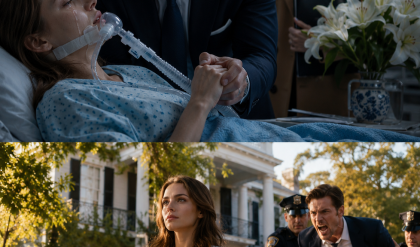
When Brooke opened the front door, Nina Albright stood on the porch in a navy coat, silver hair tucked neatly behind one ear, holding a leather briefcase that had ended more than one powerful man’s good week. Beside her stood Cole Ramsey, the private investigator Brooke had hired, tall and unsmiling. Behind them were two Medina police officers.
Camden stopped three feet behind Brooke.
“What the hell is this?” he demanded.
One officer stepped forward. “Sir, keep your voice down.”
Celeste appeared beside her son. “This is a private residence.”
Nina’s eyes moved to Brooke’s face. She took in the makeup, the stiff posture, the split lip that no concealer could fully hide. Her voice remained calm, but something in it hardened.
“Brooke,” she said, “are you safe at this moment?”
Camden laughed once. “This is insane.”
Brooke did not look at him. “I am safe because you’re here.”
Nina nodded and stepped inside.
Cole followed. The officers came in last.
Celeste lifted her chin. “I am Celeste Whitaker. I don’t know what performance Brooke has arranged, but you should be very careful about participating in a domestic misunderstanding.”
Brooke turned toward her. “It stopped being domestic when you tried to steal from sick children.”
Celeste went still.
For the first time since Brooke had known her, the older woman did not have a sentence ready.
Nina opened her briefcase and removed several sets of documents. “Camden Whitaker, you are being served with a petition for dissolution of marriage, an emergency protection order filing, a preservation demand regarding financial records, and notice of civil action connected to attempted fraud against the Lily Grace Children’s Fund.”
Camden stared at the papers as if they had been written in another language.
“This is a joke,” he said.
“No,” Brooke replied. “The joke was you thinking I would cover the bruise and hand you the house.”
His eyes snapped to hers.
The officers were watching him closely now, and that made him careful in a way conscience never had.
Celeste recovered enough to speak. “You vindictive little—”
Nina cut her off. “Mrs. Whitaker, before you finish that sentence, I should inform you that we are in possession of recorded statements made in this home today, internal emails between you and your son, access logs, forged authorization documents, and tracing information for a scheduled two-point-seven-million-dollar transfer.”
Celeste’s face drained of color.
Camden turned toward his mother. It was a quick look, but Brooke saw panic pass between them like a match in dry grass.
“Recorded?” Celeste said.
Nina smiled without warmth. “Washington is a one-party consent state.”
Dennis Hale had stepped into the hallway behind them, pale and rigid. The two workmen stood farther back, staring at the scene with the horrified fascination of people who had accidentally delivered themselves into a courtroom exhibit.
Camden gripped the papers. “You planned this.”
Brooke looked at him for a long moment. “You hit me, went to sleep, woke up, and told me to hide my face so your mother could feel comfortable taking my bedroom. Yes, Camden. I planned.”
The words landed with such force that one of the officers glanced at Camden’s hands.
Camden opened his mouth, closed it, then tried a different tactic. His voice softened into the public version of himself. “Brooke, you’re upset. You had a hard night. You’re letting strangers turn a family disagreement into something ugly.”
“No,” she said. “You did that when you raised your hand.”
Celeste stepped closer. “You will regret this.”
Brooke turned toward her. “I already regret enough. Loving your son. Ignoring the first warning. Explaining away the second. Letting you speak to me like gratitude was a debt I owed your bloodline. But this? No. This is the first thing I’ve done in years that I don’t regret.”
Nina handed documents to Celeste as well. “You are named in the preservation notice. Any attempt to delete correspondence, alter records, contact foundation staff regarding this matter, or interfere with assets under review will be treated accordingly.”
Celeste looked at the papers, then at Brooke’s face. For one flickering second, Brooke saw the thing beneath the pearls and etiquette: fear. Not remorse. Not shame. Fear of exposure.
“Camden,” Celeste said sharply, “call Mitchell.”
Nina answered before he could. “Your family counsel has already received copies.”
Camden’s expression twisted. He looked not like a man grieving the loss of a marriage, but like a man trying to understand how a locked safe had opened from the inside.
One officer asked Camden to step into the formal living room. He resisted with a scoff, but when the officer repeated the instruction, Camden obeyed. Celeste followed him, whispering fast. Brooke could not hear the words, but she knew the rhythm. Damage control. Blame transfer. Strategy disguised as maternal concern.
Nina came to Brooke’s side.
“Do you want to leave today?” she asked quietly.
Brooke looked around the foyer. The chandelier shimmered above them. Rain ran down the tall windows. On the console table stood a vase of white roses Celeste had once called “tasteful enough.” Everything was expensive, polished, and cold.
Last night, Brooke had bled on the bathroom floor of this beautiful house.
“Yes,” she said. “Today.”
Within an hour, Nina’s assistant arrived with a private security team and a small moving truck. Brooke did not take furniture. She did not take paintings. She did not take the wedding china Celeste had selected because Brooke’s taste was “too provincial.” She took documents, laptops, hard drives, medical files, foundation records, her grandmother’s jewelry, Lily’s bracelet box, a stack of handwritten letters from families the foundation had helped, and one framed photograph of Lily in a yellow scarf, grinning from a hospital bed like death had no right to interrupt her.
Camden stood in the living room while she packed, watched by officers and wounded by restraint. He looked as if every item leaving the house insulted him personally.
When Brooke came down the stairs with a suitcase, he stepped forward.
The officer shifted.
Camden stopped.
“You’re making the biggest mistake of your life,” he said.
Brooke looked at the man she had married. For a moment, she remembered him at a fundraising dinner in Chicago, asking about Lily with tears in his eyes. She remembered thinking he had a tender heart. Later, she would understand that Camden’s gift had never been tenderness. It had been mimicry. He knew what goodness looked like from a distance and could copy it convincingly when applause was possible.
“No,” Brooke said. “I made that mistake six years ago. Today I’m correcting it.”
Celeste stood by the staircase, her arms folded.
“You had no name when you came to us,” she said.
Brooke smiled faintly. “That’s what confused you. I had a name. You just didn’t recognize it because nobody had taught you to respect one that wasn’t printed on your invitations.”
Then Brooke walked out through the front door of the house Camden thought he owned.
She did not look back until she reached the car.
Not because she missed it.
Because she wanted to remember the exact shape of the cage after the door opened.
That night, Brooke stayed in a secure hotel under Nina’s name. A doctor documented the swelling under her eye, the split lip, the bruising on her ribs, the red mark along her shoulder where she had struck the dresser. A photographer took pictures under clear light. A counselor came at Nina’s request and asked questions that sounded simple until they touched old wounds.
“Has he hurt you before?”
Brooke looked toward the window. Seattle glittered beneath the rain, all towers and traffic and lives continuing without permission.
“Yes,” she said finally. “But before last night, I helped him hide it.”
The counselor did not flinch. “That is common.”
Brooke wanted to argue. She wanted to say she was too educated, too wealthy, too strong, too aware of other women’s suffering to have become one of them. But pain did not care about résumés. Control did not avoid women with degrees. Violence did not ask whether its victim sat on boards, signed grants, owned homes, or could afford good lawyers.
Camden had not trapped her all at once. He had adjusted the walls by inches.
At first, it was concern. “That donor hugged you too long.” Then preference. “Don’t wear that dress around my business partners.” Then correction. “My mother is traditional. Try not to provoke her.” Then isolation dressed as elegance. “Why do you need to fly to Louisville again? Your parents are gone. Lily is gone. Your real life is here.” Then humiliation softened by apology. “I’m sorry I grabbed your arm. You know how anxious I get when you embarrass me.”
By the time he struck her hard enough to leave proof, he had already trained everyone around them to see Brooke as quiet, delicate, slightly emotional, and Camden as patient.
That was the genius of his cruelty.
It built witnesses before it built bruises.
The next morning, Nina arrived with coffee, a tablet, and a folder thick enough to bend.
“The emergency protection order hearing is set,” she said. “The foundation injunction request is ready. Cole brought the complete package last night, and the forensic team confirms the transfer attempt was not accidental. It was structured.”
Brooke wrapped both hands around the coffee cup. “How bad?”
Nina sat across from her. “Bad enough that they should have been more careful.”
The transfer was scheduled for Monday morning from a restricted fund designated for pediatric oncology family housing. The destination account belonged to Alder Ridge Consulting, an entity created four months earlier by a former Whitaker family office employee named Paul Strickland. The authorization packet contained Brooke’s digital signature, but the metadata showed it had been applied from a device logged into the Whitaker estate’s private network at 1:19 a.m. on a night Brooke had been in Denver speaking at a hospital conference.
There were emails.
Celeste to Camden: Once I’m inside the house, access becomes easier. She keeps too much separate. That has to end.
Camden to Celeste: She’s suspicious. I can handle her.
Celeste to Camden: Handle her before the audit. Sentimental women cling to charities because they have nothing else.
Camden to Celeste: After the transfer, we can claim donor reallocation if she notices.
Celeste to Camden: She won’t notice if you keep her focused on the marriage.
Brooke read the last line twice.
For six years, she had thought Camden’s sudden tenderness before board meetings, his manufactured arguments during audit season, and Celeste’s perfectly timed insults were emotional chaos. Now she saw the pattern. They had not merely hurt her while trying to take her money. They had used hurt as a tool to keep her from seeing the theft.
The bruise on her face was not separate from the forged signature.
It was part of the same plan.
By Monday afternoon, a judge froze the suspicious transfer, restricted Camden and Celeste from accessing foundation systems, ordered preservation of communications, and prohibited Camden from contacting Brooke except through counsel. The protection order was temporary but immediate.
By Tuesday morning, the Lily Grace Children’s Fund board called an emergency meeting.
Brooke did not want to go.
For the first time since she had built the foundation, the idea of walking into that boardroom made her stomach turn. She knew what they would see first. Not the founder. Not the woman who had negotiated hospital partnerships, raised endowments, sat with dying children, comforted parents, and fought insurance bureaucracy until her voice gave out.
They would see the bruise.
Nina seemed to know what she was thinking.
“You don’t owe them invisibility,” she said.
Brooke touched the fading purple beneath her eye. “I hate that this is part of the record.”
“It is part of the truth.”
“The truth is messy.”
“Yes,” Nina replied. “But lies are expensive.”
The meeting took place at the foundation headquarters in downtown Seattle, a warm brick building Brooke had restored because Lily had loved old libraries. The lobby walls were covered with photographs of families helped by the fund: children in hospital gowns, siblings asleep on waiting room couches, parents holding gas cards with tears in their eyes, nurses laughing beside donated wagons filled with blankets and toys.
Brooke paused before Lily’s portrait near the entrance.
Her sister had been twelve in the photo, wearing a yellow scarf, her cheeks round from steroids, her smile reckless and bright. Brooke remembered Lily telling her, “When I get better, we should build a house for everybody who has to live in hospitals.”
Lily did not get better.
So Brooke built the house anyway.
Inside the boardroom, Camden sat with his attorney. Celeste sat beside him in pale blue silk, her posture flawless, her mouth soft with practiced sorrow. Several board members avoided Brooke’s eyes when she entered. Others looked stricken. Dr. Andrew Keene, a pediatric oncologist who had served on the board for years, stood at once.
“Brooke,” he said quietly. “I’m sorry.”
The kindness almost undid her.
She nodded and took her seat at the head of the table.
Camden’s jaw tightened.
That chair had always bothered him. He liked Brooke best in photographs beside him, never at the head of anything.
Celeste spoke first, because of course she did.
“Before this becomes unnecessarily hostile,” she said, “I want to say that our family’s only concern has been the stability of the foundation and Brooke’s well-being. She has been under intense emotional strain, and while we sympathize, we must be careful not to let private marital pain distort financial judgment.”
Brooke opened her folder.
“My sister’s death was not a branding opportunity,” she said. “My grief is not instability. And the children this fund serves are not cover for your consulting scheme.”
The room went silent.
Nina distributed the packets. The first contained the forged transfer authorization. The second contained metadata and access logs. The third contained the emails. The fourth contained Brooke’s medical documentation and police report. The fifth contained a timeline of Camden and Celeste’s attempts to gain access to Brooke’s home office, foundation passwords, donor records, and restricted accounts.
Dr. Keene read the first page and lowered himself slowly back into his chair.
Another board member, Marisol Grant, whispered, “Oh my God.”
Camden leaned forward. “These emails are being taken out of context.”
Brooke looked at him. “Which context improves ‘Handle her before the audit’?”
His attorney placed a hand on Camden’s sleeve.
Celeste’s expression remained calm, but her fingers pressed so tightly against her pen that Brooke thought it might snap.
“This is an ugly misunderstanding,” Celeste said. “A family disagreement has been inflated into—”
“A two-point-seven-million-dollar attempted transfer,” Nina finished.
A board member named Howard Bell, who had always seemed more impressed by Camden’s last name than Brooke’s work, cleared his throat. “Mrs. Whitaker, did you authorize any consulting relationship with Alder Ridge?”
Brooke turned to him. “No.”
“Did the board?”
Marisol answered. “Absolutely not.”
Nina opened another document. “Additionally, Alder Ridge’s founder worked under the Whitaker family office until last year. Payment routing suggests the funds were intended to move through two additional entities before reaching a private investment vehicle associated with a Whitaker-controlled trust.”
Camden shot to his feet. “That is a lie.”
Brooke did not raise her voice. “Sit down, Camden. You’re not at home.”
The boardroom froze.
For a second, Camden looked like he might cross the room. Then he remembered the cameras. He remembered the attorneys. He remembered that the world had changed while he was still using old threats.
He sat.
By the end of the meeting, the board voted unanimously to suspend Camden’s honorary advisory status, remove Celeste from all donor-hosting authority connected to the foundation, authorize a full forensic audit, cooperate with law enforcement, and issue a statement confirming that suspicious activity had been stopped before funds were lost.
As everyone stood, Camden moved too quickly.
In the hallway outside the boardroom, he caught Brooke by the arm.
It was instinct. Ownership before thought.
“Do you understand what you’re doing?” he hissed.
Brooke looked down at his hand.
Then she looked up at the security camera above them.
“So do you,” she said.
His eyes followed hers.
He released her instantly.
A security guard stepped forward. Nina appeared at Brooke’s shoulder. Celeste, behind Camden, looked less angry now and more afraid.
Brooke rubbed the place where his fingers had pressed into her skin.
“Thank you,” she said to the camera, though of course cameras did not answer.
Three days later, the story broke.
At first, it was a local business item: “Major Pediatric Charity Freezes Suspicious Multimillion-Dollar Transfer.” By evening, it had become a national scandal. A beloved children’s foundation. A billionaire family. A forged signature. A founder with a visible bruise. A husband accused of violence. A mother-in-law accused of attempting to seize control of both a mansion and a charity. Every outlet wanted a piece of it.
Camden released a statement through counsel denying financial wrongdoing and calling the allegations “a malicious attempt to weaponize a private marital breakdown.”
Celeste released a statement about “a young woman in crisis.”
Brooke released nothing.
She had spent too many years explaining herself to people committed to misunderstanding her. For once, silence belonged to her, not to them.
During that first week, she moved into a small house in Bellevue under the protection of a security consultant Nina trusted. She changed passwords, replaced devices, gave statements to investigators, met with her therapist, and learned the strange discipline of sleeping alone. At first, every sound woke her. Pipes settling. Rain against windows. A car passing too slowly outside. Her own phone vibrating.
Freedom, she discovered, did not arrive like music.
Sometimes it arrived like exhaustion.
Sometimes it looked like crying in a grocery store because no one was standing beside you telling you which cereal was childish.
Sometimes it looked like realizing you could wear red lipstick again and then being too tired to put it on.
Sometimes it looked like sitting on the floor of an unfurnished living room, eating takeout noodles from a carton, and feeling richer than you ever felt in a mansion.
On the eighth day, Brooke posted one photograph.
Not of her bruise.
Not of Camden.
Not of Celeste.
Lily.
In the picture, Lily sat in a hospital bed wearing her yellow scarf, holding a handmade sign that read: SOMEDAY WE’LL BUILD A HOUSE FOR EVERYBODY.
Brooke wrote only one paragraph beneath it.
“My sister Lily believed no sick child’s family should have to choose between treatment and rent, between gas money and groceries, between hope and survival. I built the Lily Grace Children’s Fund for children like her. Recent attempts to divert restricted funds have been stopped. The work continues. No family name, no intimidation, no violence, and no lie will take this mission from the children it serves.”
By morning, the post had gone viral.
Donations flooded in from across the country. Nurses shared it. Pediatric oncologists shared it. Parents who had stayed in foundation-funded apartments posted photographs of children ringing remission bells. Former patients, now teenagers and college students, wrote messages that made Brooke weep into her coffee.
One mother posted: “The Lily Grace Fund paid for our motel when my daughter’s transplant center was four hours from home. My husband was sleeping in our car before they helped us. Brooke, we are standing with you.”
Brooke read the comment three times.
Then she called the mother and thanked her personally.
That was the day she stopped feeling like her private pain had swallowed her public purpose. Camden and Celeste had tried to reduce the foundation to a battlefield, but families reminded her what it really was.
A bridge.
A shelter.
A promise to a little girl in a yellow scarf.
The divorce did not become easier, but it became clearer.
Camden made mistakes the way arrogant men often do when deprived of control. He sent Brooke a message from an encrypted number saying, “You will regret what you’ve done to my mother.” Nina filed it. He contacted a major donor and suggested Brooke was mentally unstable. The donor forwarded the email to Brooke. Nina filed it. Camden attempted to access a shared investment account already flagged for review. The bank froze the attempt. Nina filed it.
Celeste made mistakes too, though hers were wrapped in better stationery.
At a luncheon in Palm Springs, she told a table of women that Brooke had “always been fragile” and that Camden had “married beneath him with noble intentions.” Someone recorded it. By dinner, the clip was everywhere.
A retired nurse commented beneath one repost: “That ‘beneath him’ woman paid for my patient’s little brother to fly across the country for a final goodbye. What has Celeste done besides wear pearls near money?”
The phrase spread quickly.
What has she done besides wear pearls near money?
For the first time in decades, Celeste Whitaker became a punchline outside rooms she controlled.
Brooke did not celebrate it.
She had imagined revenge would feel satisfying, but mostly it felt like watching a rotten wall collapse and realizing how long you had breathed mold. Justice mattered. Accountability mattered. But humiliation, even deserved humiliation, was too small a meal to live on.
Two months after leaving the estate, Brooke returned with Nina, two officers, and a court order to retrieve the rest of her personal belongings.
Camden was not there.
Celeste was.
She stood in the foyer in black trousers and a cream sweater, as elegant as ever, though thinner in the face. The chandelier glowed above her. The white roses were gone. The house smelled faintly unused.
“You look pleased with yourself,” Celeste said.
Brooke looked around. Without Marta’s flowers, without Lily’s framed drawings from foundation events, without Brooke’s books stacked in the sunroom, the house looked like a showroom waiting for actors.
“No,” Brooke said. “I look awake.”
Celeste’s eyes flicked toward the officer. “You’ve always had a talent for performance.”
Brooke almost smiled. “You mistook my silence for performance because yours was.”
The movers began upstairs. They packed Brooke’s books, her grandmother’s dishes, her winter coats, Lily’s quilt, personal art, photo albums, letters, and the blue reading chair she had bought before Camden started mocking anything that looked comfortable instead of expensive.
Celeste followed at a distance, watching each item leave like a theft.
“This house was meant for a family,” Celeste said.
“It still might be,” Brooke replied.
“You won’t keep it.”
Brooke turned. “I already own it.”
Celeste’s face sharpened. “What?”
Brooke had not planned to tell her this way, but the moment offered itself with such clean symmetry that she accepted it.
“The house is held by the Hartwell Trust,” Brooke said. “My trust. It was purchased before the wedding. Camden never owned it. The Whitaker family never owned it. You have been threatening to take bedrooms in a house where you were only ever a guest.”
Celeste’s lips parted.
For one perfect second, she had no mask.
Brooke saw disbelief, then calculation, then fury, then something close to humiliation.
“Camden told me—”
“Camden believed what made him feel powerful.”
Celeste looked up the staircase, as if the walls themselves had betrayed her.
Brooke lowered her voice. “That is what you never understood. I didn’t stay because I needed your money. I stayed because I loved your son and kept hoping the man he pretended to be was real.”
Celeste’s mouth tightened. “He was real before you turned him against me.”
“No,” Brooke said. “He was yours before I met him. That was the problem.”
In Camden’s office, Brooke found the wedding photograph.
It sat on a shelf behind his desk, framed in silver. In the picture, Camden smiled at the camera with one hand around Brooke’s waist. Brooke looked younger, softer, lit from within by the dangerous hope of a woman who thought love could teach kindness to someone who had only learned possession. Celeste stood behind them, slightly blurred, already watching Brooke as if evaluating an acquisition.
Nina appeared in the doorway. “Do you want that?”
Brooke removed the photo from the frame. She studied it for a long moment.
Then she tore Camden’s half away.
She kept the half with herself.
Not because she wanted to remember the marriage fondly. Not because she missed him. Because the woman in that photograph deserved compassion. She had walked into a beautiful house unaware it had no exits marked. She had confused being chosen with being cherished. She had ignored the first small humiliations because the apologies were expensive and the flowers were beautiful.
Brooke folded the half-photo and placed it in her purse.
“The frame can stay,” she said.
Four months later, criminal charges were filed.
There was no dramatic arrest in a ballroom, no handcuffs in front of news cameras, no cinematic confession beneath thunder. People like Camden Whitaker usually fell through paperwork first. Subpoenas. Depositions. Frozen accounts. Quiet meetings in law offices where powerful men realized their names did not erase metadata.
The investigation into the attempted transfer expanded into charges related to attempted wire fraud, identity misuse, conspiracy, and obstruction. Paul Strickland, the former family office employee, agreed to cooperate. That decision hit the Whitakers like a storm through old glass.
Strickland confirmed the plan had originated with Celeste.
He also confirmed Camden knew.
According to his statement, Celeste believed Brooke’s foundation had become “too independent” and Camden believed Brooke could be pressured into approving retroactive documents if the transfer was discovered. The money was intended to move through Alder Ridge, then into a development investment that had been bleeding cash for eighteen months. The Whitakers did not need money the way ordinary people did. They needed liquidity, reputation, control, and the appearance that their empire had never cracked.
They had chosen children’s cancer money because they believed Brooke was too emotionally manageable to stop them.
That sentence appeared in an investigator’s summary.
Emotionally manageable.
Brooke printed the page and stared at those words for a long time. They hurt more than she expected, not because they were true, but because they revealed how clearly Camden and Celeste had seen the tenderness she tried to protect. They had seen grief and called it leverage. They had seen loyalty and called it weakness. They had seen love and tried to turn it into a leash.
At the divorce hearing, Camden appeared thinner, paler, and less polished. His hair was still perfect, his suit still expensive, but something essential had dimmed. His attorney did most of the talking. Camden kept his eyes on the table until the judge asked directly about the night he struck Brooke.
“Mr. Whitaker,” the judge said, “do you deny hitting your wife?”
The room held its breath.
Camden’s attorney leaned toward him, whispering.
Camden did not look at his mother. Celeste sat behind him in the gallery, rigid as carved marble.
Finally, Camden said, “No.”
Brooke felt Nina’s hand gently touch her arm beneath the table.
The judge’s pen moved. “You do not deny it?”
Camden swallowed. “I hit her.”
For months, Brooke had imagined that hearing him say it would feel like victory. Instead, it felt like a locked room opening somewhere inside her chest, letting out stale air.
The judge continued. “Did you instruct her the following morning to conceal the injury before your mother arrived?”
Camden’s face tightened.
“Yes,” he said.
Celeste closed her eyes as if the confession wounded her more than the assault had wounded Brooke.
Brooke did not look back at her.
The divorce settlement preserved Brooke’s separate assets, confirmed the estate belonged to her trust, imposed financial penalties related to Camden’s misuse of marital access, and kept the protection order in place. Camden waived any claim to foundation-related property under threat of further discovery that his attorneys clearly did not want opened in civil court.
After the hearing, he approached Brooke in the courthouse hallway.
Nina stepped forward, but Brooke lifted one hand slightly.
Camden stopped a safe distance away. For the first time since she had known him, he looked uncertain without becoming cruel.
“I did love you,” he said.
Brooke studied his face. Once, that sentence would have pulled her apart. Now it simply sounded incomplete.
“You loved being admired by me,” she replied. “You loved my silence. You loved the version of me that made you feel generous. But love does not ask a woman to hide blood for lunch.”
His face crumpled, whether from shame or self-pity she could not tell.
“I’m sorry,” he whispered.
Brooke nodded once. “I hope someday you become sorry for what you did, not just for what it cost you.”
Then she walked away.
Celeste waited near the elevators. Her hatred was so naked now that it almost seemed honest.
“You destroyed my son,” she said.
Brooke pressed the elevator button. “No. I stopped helping him destroy me.”
The doors opened.
Brooke stepped inside.
When they closed, she did not feel triumphant. She felt tired, sad, and free.
A year later, the Lily Grace Children’s Fund opened its newest family residence near a children’s hospital in Atlanta. It was a brick building with blue shutters, twelve family suites, a shared kitchen, counseling rooms, a laundry area, a playroom, a quiet chapel, and a garden full of yellow flowers because Lily had loved yellow more than any color in the world.
Brooke stood at the ribbon-cutting in a pale cream suit.
Not the cream dress Camden had ordered her to wear.
Her own cream.
Reporters wanted to ask about the scandal, the divorce, the Whitakers, the charges, the viral post, the bruise. Brooke redirected every question with a practiced kindness that left no room for argument.
“Today is about the families,” she said. “Today is about children who need treatment and parents who need a place to sleep. The people who tried to interrupt that work do not get to be the center of this story.”
A little boy named Mateo cut the ribbon with oversized scissors while his mother cried behind him. He had leukemia, a gap-toothed smile, and a laugh that reminded Brooke so sharply of Lily that she had to look away for a second.
After the ceremony, Mateo tugged on Brooke’s sleeve.
“Are you the lady who built the house?” he asked.
Brooke knelt carefully so they were eye to eye. “A lot of people helped build it.”
“But it was your idea?”
“My little sister’s idea first.”
“Is she coming?”
The question struck softly and deeply.
Brooke smiled. “In a way, yes. She’s in all the yellow flowers.”
Mateo considered this with grave seriousness. Then he handed Brooke a folded drawing. It showed a house with a bright blue door, yellow flowers, a stick-figure woman with long brown hair, and a child standing beside her with both hands raised like the sun.
“My mom said we get to stay here while I get better,” he said. “So I drew you a house too.”
Brooke pressed the paper to her heart. “Thank you. I’ll keep it in my office.”
That evening, after donors left and staff finished cleaning, Brooke walked alone through the residence. She opened the door to one empty family suite. Two twin beds. A sleeper sofa. Soft lamps. A basket with snacks, toiletries, gas cards, and a handwritten note: You are not alone here.
She sat on the edge of one bed and allowed herself to cry.
Not from fear.
From recognition.
This was what Camden and Celeste had tried to steal. Not money in the abstract. Not numbers on a transfer sheet. They had tried to steal nights of sleep from terrified parents. They had tried to steal gas cards, medication copays, hotel rooms, warm meals, counseling sessions, sibling visits, and the small dignities that kept families human while hospitals fought to keep children alive.
Brooke wiped her face and stood.
Her phone buzzed.
A message from Nina: Camden accepted plea terms. Celeste’s case continues. No need to respond tonight. Just wanted you informed.
Brooke read it once.
Then she turned off the phone.
Outside, the garden lights glowed among the yellow flowers. For the first time, news about Camden did not change her breathing. His consequences were no longer the weather in her life. They were a report from a country she had escaped.
Six months later, Brooke sold the Medina estate.
Not because she had to.
Because she wanted to.
A young couple bought it, both surgeons, with three children and a golden retriever that immediately slipped on the polished floors during the showing. The wife stood in the garden room and said, “This place needs noise.”
Brooke smiled. “Yes. It does.”
With part of the sale proceeds, she funded three more family suites in Atlanta and bought herself a house outside Asheville, North Carolina, close enough to the mountains to see blue ridges from the back porch. It was smaller than the estate, warmer than any mansion Celeste had ever tried to control, with wide-plank floors, a kitchen full of morning light, a study lined with shelves, and a guest room where foundation families could stay privately if they needed rest between appointments.
On moving day, Brooke placed Lily’s photograph on the mantel first.
Then she opened a small box and removed the half wedding photo.
She did not display it.
She did not throw it away.
She placed it in an envelope labeled: The woman who survived not knowing.
Some memories did not deserve a frame, but they deserved a witness.
That first Sunday in the new house, Brooke hosted lunch. Nina flew in from Seattle. Cole came with his wife. Dr. Keene arrived with a bottle of wine and a stack of medical journals he claimed were a housewarming gift. Marta, who had refused three job offers after leaving the estate, came to help cook and ended up staying at the table. Two nurses from a partner hospital stopped by after their shift, exhausted and laughing.
There was roast chicken with thyme, lemon potatoes, asparagus, sourdough, and lemon cake cooling by the window.
Nobody sat at the head of the table unless they happened to get there first.
Nobody told Brooke what to wear.
Nobody inspected the staff.
Nobody asked her to cover anything.
As conversation filled the dining room, Brooke stepped into the hallway and looked in the mirror near the stairs. The bruise was long gone. The split lip had healed. The mark on her ribs had faded. To a stranger, she looked untouched.
But Brooke knew healing was not returning to the woman she had been before.
That woman had ignored the locked doors because the rooms were beautiful.
This woman checked for exits, kept copies, trusted patterns over apologies, and understood that love without safety was just a prettier word for danger.
Nina found her there.
“You okay?” she asked.
Brooke looked toward the dining room, where real laughter rose without performance.
“Yes,” she said.
Nina studied her. “Really?”
Brooke smiled. “Really.”
That night, after everyone left, Brooke washed dishes slowly while rain tapped against the windows. The house smelled like rosemary, lemon, and mountain air. When the last plate was dry, she walked into her study and sat at the desk facing the dark outline of the trees.
A blank page waited in front of her.
For months, organizations had asked her to speak publicly. Domestic violence groups. Financial abuse panels. Charity conferences. Women’s leadership events. Brooke had declined almost every invitation. She did not want to become a symbol before she had become a person again.
But now she picked up a pen.
She wrote one sentence.
The first time he hit me was not the first time he hurt me.
She stared at it until the words stopped shaking.
Then she wrote another.
The morning he told me to cover the bruise, I realized I had spent years covering smaller wounds for people who benefited from my silence.
By midnight, she had written eight pages.
Not a press statement.
Not testimony.
A map.
For another woman, maybe. For the version of herself still sitting on a bathroom floor with a makeup bag in her lap. For anyone who thought a beautiful life could not be a dangerous one. For anyone who believed wealth protected women from control. For anyone who needed to hear that leaving was not a single brave moment but a thousand small decisions that finally agreed with one another.
Years later, people still whispered about the fall of the Whitaker family.
They talked about Camden’s guilty plea, Celeste’s trial, the forged transfer, the recording from the garden room, the lunch where Brooke said no, the house that never belonged to them, and the bruise Camden told his wife to hide. Some called it scandal. Some called it karma. Some called it the most expensive lunch in Seattle history.
Brooke rarely corrected them.
But she knew the truth was deeper and quieter.
It was not only the story of a cruel husband losing his mask.
It was not only the story of a mother-in-law who mistook pearls for power.
It was not only the story of money protected, a house reclaimed, or a foundation saved.
It was the story of a woman who stopped confusing endurance with love.
One spring evening, Brooke sat on her porch in Asheville with tea cooling beside her. The mountains were blue in the distance. Yellow flowers moved in the garden below. Inside, her phone buzzed with foundation updates, hospital requests, donor messages, and photographs of families standing outside the Atlanta residence beneath the sign that read LILY GRACE HOUSE.
Brooke opened one photo.
Mateo stood in the garden, hair growing back in soft dark curls, holding a cardboard sign: LAST CHEMO.
His mother stood behind him, crying and smiling at the same time.
Brooke touched the small scar near her lip, the one almost no one could see unless she pointed it out.
For one brief moment, memory returned: Camden in the bathroom doorway, clean and perfumed, tossing the makeup bag into her lap like a command.
Cover it and smile.
Brooke closed her eyes.
Then she opened them and smiled.
Not the smile Camden demanded.
Not the smile Celeste approved.
Not the smile that made cruelty comfortable for everyone else.
This smile belonged to her.
And no one in the world could make her cover that.
THE END