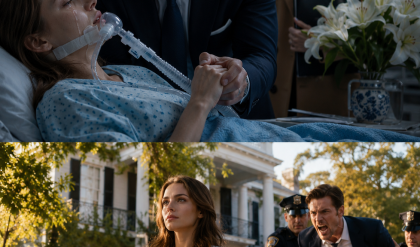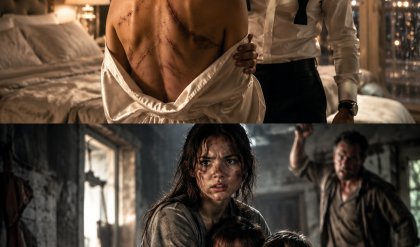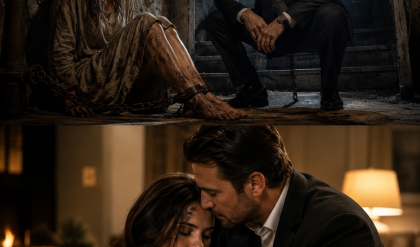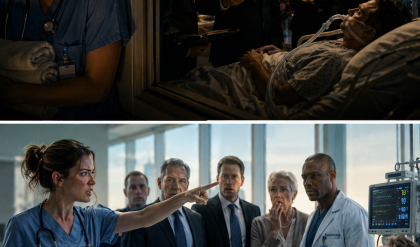
A sound rose in her throat, but she trapped it behind her teeth.
If she screamed, she might never stop.
“Did the medical examiner see this?”
Russell hesitated.
“She came from a private hospital. Cause of death was listed as internal injuries due to accidental fall. Preston’s attorney delivered the paperwork himself.”
“His attorney?”
Russell nodded.
Margaret bent over her daughter and touched the edge of the sheet.
“I’m sorry,” she whispered. “I’m sorry I let him build walls around you.”
Russell stood back, respectful and helpless.
Margaret straightened.
Her tears had stopped.
“Don’t bury her yet.”
“Margaret—”
“Delay it. Misplace a form. Say the ground is too wet. Say whatever you have to say.”
“He’ll come after me.”
“He’s already coming after everyone who knows the truth.”
Russell looked at Hannah’s still face.
Then he nodded once.
“I can give you twenty-four hours.”
Margaret walked out into the rain with no umbrella and no plan, only the certainty that she had buried enough of herself already. She would not bury the truth with Hannah.
Two days later, Margaret stood before the iron gates of Preston Vale’s estate.
The mansion sat on six acres of manicured wealth, all white columns, glass walls, imported stone, and silence. It was the kind of house magazines called timeless, though Margaret had always thought it looked like a museum where no one was allowed to touch anything.
The housekeeper, Maria, opened the door only a crack.
“Mrs. Hale,” she whispered. “Mr. Vale isn’t home.”
“I came for Hannah’s things.”
Maria’s eyes darted toward the security camera above the entry.
“I don’t know if—”
“I’m her mother.”
Something in that sentence broke through the woman’s fear. Maria opened the door.
Inside, the mansion smelled of lemon polish and money. Every surface gleamed. No shoes by the door. No toys in the hallway. No sign that a young mother had once danced barefoot in that kitchen with her son while pancakes burned on the stove.
Margaret climbed the curved staircase slowly.
The bedroom Hannah had shared with Preston was enormous. A fireplace. A balcony. A bed arranged with military precision. On the dresser stood a framed photograph from a charity gala: Preston smiling at the camera, Hannah beside him in emerald silk, her hand resting lightly on his arm.
Margaret noticed what she had missed when the photo appeared online.
Hannah was smiling with her mouth, not her eyes.
She opened the closet. Preston’s suits dominated one side, dark and identical. Hannah’s dresses hung on the other, arranged by color. Margaret packed a cardigan she had knitted for Hannah years ago, a pair of worn sneakers hidden behind designer heels, a stack of paperbacks with cracked spines.
Then she saw the loose panel.
It was at the back of the closet, half-hidden behind winter coats. One edge sat slightly raised, as if someone had removed it in a hurry and failed to press it back into place.
Margaret’s pulse quickened.
She pulled.
The panel came free.
Behind it sat a small blue metal box.
Her hands shook as she opened it.
Inside were medical documents from a private clinic, an ultrasound image, a flash drive, and a notebook with a navy cover.
Margaret unfolded the first paper.
Hannah Vale. Fourteen weeks pregnant.
The room tilted.
Margaret gripped the shelf to stay upright.
Fourteen weeks.
A baby.
Noah had been going to have a little brother or sister. Hannah had carried life inside her when death came for her. Preston had stood in a chapel calling it a fall while his unborn child lay hidden beneath a funeral dress.
Margaret pressed the ultrasound to her chest and sobbed once, a broken sound that seemed too small for what had been taken.
Then she opened the notebook.
The first pages were ordinary. Grocery lists. School reminders. A birthday idea for Noah. A note that said, Mom likes chamomile tea when she pretends she doesn’t need comfort.
Margaret almost smiled.
Then the entries changed.
April 9: Preston got angry because I moved the sculpture in the foyer. He said I embarrass him by touching things I don’t understand. He didn’t hit me tonight, but he stood so close I could feel the spit when he spoke. I hate that I was relieved.
April 21: He shoved me against the glass table. I told Noah I slipped on his Lego box. Noah looked like he knew I was lying. I am teaching my son to recognize lies before he can spell them.
May 3: I found the offshore statements. Preston is moving money through the foundation. The scholarships are fake. The children in those brochures don’t exist. I took photos. I don’t know who to trust.
Margaret’s eyes burned.
May 17: I told him about the baby. For one second I thought he might cry from happiness. Instead he laughed. He said another child would complicate the trust, the divorce, the optics. I asked what divorce he meant. He said, “The one you’ll never survive if you try.”
The final entry was dated the day Hannah died.
Mom, if you find this, I’m sorry. I should have told you. I thought if I stayed quiet, I could protect Noah. I was wrong. Silence only taught Preston he could go further.
If something happens to me, take Noah.
Do not let Preston raise him.
He will kill me before he lets me leave.
Margaret was still holding the notebook when she heard the front door open downstairs.
Preston’s voice carried through the foyer.
“Maria? Why is my gate log showing a visitor?”
Margaret shoved the notebook, ultrasound, documents, and flash drive into her handbag. She replaced the panel badly, grabbed the cardboard box of clothing, and stepped into the hallway.
Preston appeared at the top of the stairs.
For a second, neither moved.
Then his gaze dropped to her handbag.
“What exactly are you taking?”
“My daughter’s sweaters.”
“Her sweaters don’t usually make women look that guilty.”
Margaret lifted her chin.
“You would know more about guilt than I do.”
His expression cooled.
He walked closer until his body blocked the staircase.
“You’re grieving,” he said. “So I’ll forgive that.”
“I don’t need forgiveness from you.”
“No. What you need is to stop poisoning Noah with your little suspicions.” His voice remained quiet, almost gentle. That made it worse. “He is my son. This is my house. Hannah was my wife.”
“She was my child first.”
Preston’s smile faded.
“That kind of thinking is exactly why Hannah struggled. You encouraged disobedience.”
Margaret felt fear crawl along her spine, but beneath it something stronger rose.
“My daughter is dead, Preston. Don’t confuse her silence with your victory.”
His eyes sharpened.
“You always thought you were better than me because you were poor and honest. People like you love honesty because it’s the only luxury you can afford.” He leaned closer. “Listen carefully. Whatever you think you found, it won’t matter. I have judges at my table, senators in my phone, and police chiefs who owe me favors. You have a pension and a dead daughter.”
Margaret stared at him.
Then she walked straight past him.
For one moment, his shoulder brushed hers. She could feel his anger like heat.
At the front door, he called after her.
“Margaret.”
She stopped but did not turn.
“If you try to take Noah from me, you’ll lose him forever.”
Outside, the air was cold and bright.
Margaret carried the box to her car with both arms steady.
Only when she drove past the gates did she begin shaking.
The next morning, Margaret went to the private hospital where Hannah had been treated.
Greenwich Meridian Medical Center looked more like a hotel than a place where people bled. There was a waterfall wall in the lobby, white orchids on the reception desk, and a concierge who asked whether Margaret had an appointment as though illness respected schedules.
“I need to speak to Dr. Helen Park,” Margaret said.
“Dr. Park is unavailable.”
Margaret placed Hannah’s ultrasound, a copy of the death certificate, and three pages from the diary on the desk.
“Tell her Hannah Vale’s mother is here. Tell her I’ll wait in the lobby, or I’ll wait outside with every reporter in Connecticut.”
Twenty minutes later, Dr. Park appeared.
She was in her late fifties, composed, elegant, and visibly terrified.
“Mrs. Hale,” she said. “Please come with me.”
Her office had no family photos. Only medical diplomas and a window overlooking the parking lot.
Margaret did not sit.
“My daughter did not die from falling down stairs.”
Dr. Park closed the door.
“No,” she said softly. “She didn’t.”
The confirmation should have felt like progress. Instead, it landed like another burial.
“Say it again,” Margaret demanded.
Dr. Park’s mouth trembled.
“Hannah arrived with massive internal bleeding caused by blunt force trauma to the abdomen. There were signs of previous injuries. Not all recent. Some older.”
“She was pregnant.”
“Yes.”
“Did the baby survive long enough for anyone to try?”
Dr. Park’s eyes filled.
“No.”
Margaret gripped the back of a chair.
“Why did you sign that certificate?”
“I didn’t sign the final certificate. The attending physician did after Mr. Vale’s attorney intervened.”
“But you knew.”
“I knew enough to request a forensic review.”
“And?”
Dr. Park looked at the closed door as if Preston might be standing behind it.
“Mr. Vale threatened the hospital board. He said Hannah had a history of dizziness. He had a neurologist on retainer submit notes we had never seen before. He claimed a public investigation would traumatize Noah and damage Hannah’s dignity.” Her voice broke. “Then his attorney reminded me my husband’s research program depends on donors.”
Margaret leaned forward.
“My daughter’s dignity was not damaged by the truth. It was damaged by everyone who dressed a murder as an accident.”
Dr. Park flinched.
“I should have fought harder.”
“Yes,” Margaret said. “You should have.”
The two women stood in silence.
Then Dr. Park opened a locked drawer and removed a sealed envelope.
“These are copies of my initial notes,” she whispered. “Photos. Observations. The request for forensic review before it disappeared from the system. I kept them because I was ashamed.”
Margaret took the envelope.
“Shame won’t save anyone unless it learns to speak.”
Dr. Park nodded, crying silently.
“It will now.”
For three days, Margaret built a case the way poor women build survival: quietly, carefully, using whatever they can reach.
She copied Hannah’s diary at a library two towns over. She hid the originals in an old flour tin in her pantry. She gave one copy to Russell. Another to her neighbor, a retired court clerk named Joan. She called a family lawyer who had once helped her fight an insurance company after her husband died.
The lawyer, Denise Carver, read the documents in Margaret’s kitchen and removed her glasses.
“You need police,” Denise said.
“I need police who don’t golf with Preston Vale.”
Denise nodded. “Then we go above local.”
But before they could contact the state prosecutor, Preston made his next move.
A temporary custody petition arrived by courier.
Preston Vale alleged that Margaret Hale was emotionally unstable, hostile, and attempting to alienate Noah from his father. He requested that all contact between grandmother and child be suspended pending evaluation.
Margaret read the papers twice.
Then she laughed.
It was not a happy sound.
“He killed my daughter and filed paperwork before I could even buy flowers for her grave.”
Denise’s face hardened. “That means he’s scared.”
Margaret looked at the photograph of Noah on her refrigerator. Missing front tooth. Grass-stained knees. Hannah’s eyes.
“Good,” she said. “Let’s make him terrified.”
That night, unable to sleep, Margaret drove to the Vale estate and parked across the road behind a line of hedges.
She told herself she only wanted to see whether Noah’s bedroom light was on.
Instead, just after nine, Preston’s Range Rover rolled out through the gates.
Margaret followed at a distance.
He drove into downtown Greenwich and stopped outside the Delamar Hotel, where the lobby glowed gold behind rain-slick glass. A young woman in a red coat waited near the entrance.
Ava Mercer.
Margaret recognized her from the funeral. Preston’s assistant. Twenty-four, maybe twenty-five. Sleek dark hair, beautiful in the polished way young women become when powerful men pay for their clothes and tell them it is mentorship.
Preston kissed Ava on the cheek.
Then on the mouth.
Margaret’s hands tightened on the steering wheel.
Hannah had been dead less than a week.
Preston and Ava entered the hotel bar together.
Margaret took photos through the windshield. Preston’s hand on Ava’s waist. Ava laughing too brightly. A champagne flute. Preston leaning close.
At first, rage blinded her.
Then she remembered Hannah’s diary.
May 3: I found the offshore statements.
Maybe Ava was not only the mistress.
Maybe she was the key.
The next morning, Margaret waited outside Ava’s boutique gym in Stamford. She watched women in expensive leggings drift in and out carrying green juices and yoga mats. At 10:17, Ava emerged alone.
Margaret followed her to a coffee shop.
When Ava sat at a corner table, Margaret sat across from her.
Ava looked up, startled. “Mrs. Hale?”
Margaret placed the ultrasound photo on the table.
“My daughter was pregnant.”
Ava went white.
Margaret placed the hotel photos beside it.
“And you were drinking champagne with the man who killed her.”
Ava’s lips parted. “I didn’t—”
“Don’t insult me.”
People nearby glanced over.
Ava lowered her voice. “You need to leave.”
“No. You need to listen. Preston is already building his story. When rich men run out of lies, they look for someone smaller to bury underneath them. That someone will be you.”
Ava shook her head, but fear had already entered her eyes.
“He loves me.”
Margaret almost pitied her.
“No, honey. He uses you. There’s a difference, and women often learn it too late.”
Ava looked toward the door.
Margaret took out copies of Hannah’s diary pages and slid them across the table.
“She wrote about the money. The fake scholarships. The night she found out. She wrote that he would kill her.”
Ava read the pages with trembling hands.
Then she whispered, “He said she was unstable.”
“Of course he did.”
“He said she trapped him.”
“Of course he did.”
“He said…” Ava’s voice cracked. “He said the baby might not be his.”
Margaret held her gaze.
“And you believed him because believing him made you less ashamed.”
Tears filled Ava’s eyes.
For a long moment, she said nothing.
Then her shoulders collapsed.
“She came home early,” Ava whispered. “That night.”
Margaret’s heartbeat slowed until each beat hurt.
Ava covered her mouth.
“We were in the living room. I was there because Preston said he needed me to help with documents before a board meeting. Then he opened wine. Then he kissed me. I should have left. I know I should have left.”
“What happened when Hannah came in?”
“She saw us. She didn’t scream at first. That was the worst part. She just looked tired. Preston started talking fast, saying it wasn’t what it looked like. Hannah told him she had already called a lawyer. She said she knew about the foundation accounts and the offshore transfers. She said she was leaving with Noah.”
Margaret’s eyes burned, but she did not interrupt.
Ava gripped the coffee cup so hard the lid bent.
“Preston changed. I’d seen him angry before, but not like that. He grabbed her arm. She told him not to touch her. She said, ‘I’m pregnant, Preston. You don’t get to scare me anymore.’ He laughed. Then he slapped her.”
Margaret’s stomach turned.
“I tried to step between them. He shoved me into the wall. Hannah ran toward the stairs, but not down them. Away from him. He caught her at the landing and threw her back onto the floor. She curled around her stomach.” Ava began crying openly. “He kicked her. Once. Then again. She begged him to stop. Noah was upstairs. He was crying.”
Margaret closed her eyes, and for one terrible instant she heard it: her daughter begging in that cold, perfect house.
Ava continued.
“After Hannah stopped moving, Preston told me to shut up. He said if I called 911 and told the truth, he would say I pushed her because I was jealous. He said no jury would believe a mistress over a grieving husband. Then he dragged Hannah to the stairs and called emergency services.”
Margaret opened her handbag.
Her phone screen glowed.
Recording.
Ava saw it.
Her face twisted in terror. “You recorded me?”
“Yes.”
“He’ll kill me.”
“He might. Unless the truth gets bigger than him.”
Ava wiped her cheeks, breathing hard.
“There’s more,” she said.
Margaret went still.
Ava reached into her purse and pulled out a small silver key.
“Hannah gave me this two days before she died.”
Margaret stared at it.
“She came to my office,” Ava said. “I thought she was going to confront me about Preston, but she didn’t. She said she knew I wasn’t the first woman and probably wouldn’t be the last. She said Preston kept women like me close because he could make us feel chosen and disposable at the same time.”
Ava cried harder.
“She told me if anything happened to her, I should open a safe-deposit box at First Harbor Bank. I didn’t go. I was scared.”
Margaret took the key.
For the first time since Hannah’s death, she felt her daughter not as a victim, but as a woman who had been fighting in the dark.
“What’s in the box?” Margaret asked.
Ava shook her head.
“I don’t know. But Hannah said it was the thing Preston feared most.”
The safe-deposit box was registered under Hannah’s maiden name.
Denise Carver went with Margaret to First Harbor Bank the next morning. The bank manager hesitated until Denise placed court forms and identification on the desk with the calm aggression of a woman accustomed to men underestimating her.
Inside the box were three things.
A stack of printed financial records.
A sealed letter addressed to Noah.
And a tiny blue dinosaur watch.
Margaret picked up the watch with both hands.
Noah loved dinosaurs. Hannah had bought him that watch for his seventh birthday. It recorded voice memos when he pressed the side button, though Margaret had always assumed he used it only to capture silly jokes and roaring sounds.
There was a note wrapped around it.
Mom, if you’re reading this, I’m sorry I couldn’t tell you in person.
Noah accidentally recorded Preston threatening me last month. After that, I taught him to press the dinosaur button if Daddy started yelling. I hated myself for putting that burden on him, but I needed proof that could not be called a wife’s imagination.
The watch from the night I died is here.
Please tell Noah none of this was his fault.
Margaret sat down on the bank’s little privacy chair because her knees gave way.
Denise connected the watch to her laptop.
There were several recordings.
The last one began with muffled crying.
Then Hannah’s voice.
“Preston, don’t do this in front of him.”
Preston’s voice followed, low and vicious.
“You don’t leave me. You don’t take my son. You don’t expose my company because you suddenly found courage in a pregnancy test.”
A child sobbed in the background.
Hannah said, “Noah, baby, go to your room.”
Then Ava’s voice: “Preston, stop.”
A crash.
Hannah cried out.
Preston shouted, “That baby is not going to ruin everything I built.”
Then came a sound Margaret would carry forever.
A dull impact.
Hannah screaming.
Noah crying, “Mommy!”
Margaret slammed the laptop shut.
Denise put a hand over her mouth.
For several minutes, neither woman spoke.
Finally, Margaret whispered, “My daughter saved herself enough for us to finish it.”
Denise nodded.
“Now we go to the state attorney.”
Preston Vale was arrested on a Tuesday at noon.
It happened in the glass lobby of Vale Motors International, beneath a suspended sculpture shaped like silver wings. Fifty employees watched state police walk past the reception desk. Two news crews had been tipped off by someone in the attorney general’s office. Phones rose like a field of dark flowers.
Preston stepped out of the elevator smiling, until he saw the warrants.
His face emptied.
“Do you know who I am?” he asked.
Detective Lena Morales answered, “Yes, Mr. Vale. That’s why we brought extra cameras.”
They charged him with murder, domestic violence resulting in death, evidence tampering, obstruction, financial fraud, and intimidation of witnesses. The fraud charges mattered because money had built the walls around Hannah. The murder charge mattered because violence had destroyed her inside them.
As officers cuffed Preston, he saw Margaret standing near the entrance.
For one second, his control vanished.
“You did this,” he snarled.
Margaret held his gaze.
“No,” she said. “Hannah did. I only listened.”
The clip went viral before dinner.
By midnight, Preston Vale was no longer the grieving billionaire widower. He was America’s perfect husband in handcuffs.
But justice did not move like a viral video. It moved slowly, through hearings, motions, delays, sealed filings, expert reports, custody evaluations, and nights when Margaret woke to Noah crying from nightmares.
Preston’s lawyers attacked everyone.
They called Ava Mercer a jealous mistress.
They called Dr. Park a frightened doctor trying to save her reputation.
They called Margaret a bitter, working-class grandmother hungry for a rich man’s money.
They even tried to suggest Hannah had been emotionally unstable, that the diary was unreliable, that the bruising could have been caused by an unusual fall.
Then came the first false twist.
Preston’s defense team produced security footage from the mansion. It showed Hannah near the stairs, Preston several feet away, Ava in the background. Hannah appeared to stumble backward.
The media exploded.
“Could the billionaire widower be innocent?”
“Did grief become a witch hunt?”
“Was the grandmother wrong?”
For one terrible afternoon, Margaret watched commentators discuss her daughter like a puzzle on television.
Noah saw the footage on a screen in a diner before Margaret could turn him away.
“That’s not right,” he said.
Margaret knelt in front of him. “What do you mean, sweetheart?”
Noah’s face tightened with concentration.
“Mommy didn’t fall like that. Daddy pulled her first. The video is lying.”
That night, Denise contacted a forensic video analyst. The expert discovered what Preston’s team had hoped no one would see: the footage had been altered. Frames were missing. The angle had been cropped. A timestamp jumped eight seconds at the exact moment Hannah moved from the living room toward the landing.
Then investigators recovered the original from a backup server Preston believed had been wiped.
The real footage did not show the final blow clearly.
But it showed enough.
It showed Preston grabbing Hannah.
It showed Ava trying to intervene.
It showed Noah at the top of the stairs.
It showed Preston dragging Hannah’s limp body toward the staircase after she collapsed.
The false twist became the trap.
Preston’s own fake evidence proved consciousness of guilt.
At trial, the courtroom was packed every day.
Margaret sat in the front row with Noah beside her only when the judge allowed it. She did not let him hear the worst testimony. He had already heard too much in his short life.
Ava testified for seven hours.
She did not look glamorous on the stand. She looked young, ashamed, and frightened, which made her more believable, not less.
“Did Mr. Vale tell you what to say?” the prosecutor asked.
“Yes.”
“What did he tell you?”
“That if anyone asked, Mrs. Vale fell. He said if I contradicted him, he would destroy me.”
“And what did you see?”
Ava looked at Margaret.
Then at the jury.
“I saw him attack his wife after she said she was leaving him. I saw him kick her while she was pregnant. I saw him choose his reputation over her life.”
Preston stared at Ava with such hatred that the judge warned him to look away.
Dr. Park testified next. Then Russell. Then the forensic experts. Then the financial investigators, who revealed that Hannah had uncovered millions stolen from scholarship funds and laundered through shell companies. Preston had not only feared divorce. He had feared exposure. Hannah had threatened his image, his empire, and his freedom.
But the courtroom changed completely when the prosecutor played the dinosaur watch recording.
The judge had warned everyone beforehand.
Still, nothing prepared them.
Hannah’s voice filled the courtroom.
“Preston, don’t do this in front of him.”
Then Preston’s.
“You don’t leave me. You don’t take my son.”
Margaret closed her eyes.
A juror began to cry.
At the defense table, Preston went pale.
When the recording ended, the silence was heavier than any scream.
The prosecutor turned to the jury.
“Hannah Vale did what so many victims are forced to do. She documented her fear because the world taught her that fear alone would not be believed. She hid proof in walls, in diaries, in bank boxes, and finally in her own child’s toy. She did everything except survive.”
Preston’s lead attorney stood for closing argument with less confidence than he had shown at the start.
He spoke of reasonable doubt.
He spoke of grief.
He spoke of complicated marriages.
Margaret wanted to stand and shout that there was nothing complicated about a woman begging not to be hurt.
But she stayed seated.
Because Hannah had already spoken.
The jury deliberated for nine hours.
When they returned, Preston stood with his jaw clenched.
The forewoman read the verdict.
Guilty.
Guilty.
Guilty.
On the murder charge, guilty.
A sound went through the courtroom, not celebration, not relief exactly, but release. Margaret bowed her head. Denise squeezed her shoulder. Ava covered her face and cried.
Preston exploded.
“You think this is justice?” he shouted. “She was going to ruin everything!”
The judge ordered him restrained.
But Preston kept yelling, his mask gone forever.
“I built that life! She had nothing before me!”
Margaret rose slowly.
For the first time since the funeral, she spoke to him in open court.
“No, Preston. She had herself before you. That was what you couldn’t stand.”
The judge sentenced Preston Vale to life in prison without parole, plus additional years for obstruction, witness intimidation, and financial crimes. The fortune he had used as armor became evidence, then restitution, then ash.
Margaret did not smile when the sentence was read.
A sentence could punish a man.
It could not bring Hannah home.
It could not let Noah run into his mother’s arms after school.
It could not give a name to the baby whose heartbeat had appeared once on a clinic monitor and then vanished beneath violence.
But when Preston was led away, Margaret felt something loosen in the air around her.
Not peace.
Not yet.
But room to breathe.
Three years later, the Hale house in Bridgeport was painted yellow.
Noah had chosen the color because he said it looked like mornings.
Margaret had sold her old car, used part of the victim restitution fund, and turned the first floor into the Hannah House Resource Center, a place where women could come without appointments, explanations, or shame. There was a legal desk on Tuesdays, counseling on Thursdays, childcare during emergency appointments, and a back pantry stocked with diapers, prepaid phones, grocery cards, and spare keys to safe apartments.
On the wall near the entrance hung a framed sentence in Hannah’s handwriting:
Silence only protects the person who benefits from it.
Noah was ten now. Taller. Quieter than many boys his age, but quick to laugh when he trusted the room. He still had nightmares sometimes. Margaret never told him to forget. Instead, she taught him that remembering was not the same as being trapped.
On Hannah’s birthday, they drove to the cemetery.
The grave was beneath a maple tree. Margaret brought white roses. Noah brought a small plastic dinosaur.
They placed the ultrasound photo in a weatherproof frame beside Hannah’s picture.
Noah stood with his hands in his jacket pockets.
“Grandma?”
“Yes, sweetheart?”
“Was Mom scared?”
Margaret looked at the name carved into stone.
Then she looked at the boy Hannah had saved with every scrap of courage she had left.
“Yes,” she said. “She was scared.”
Noah swallowed.
“But she was brave too?”
Margaret put an arm around him.
“The bravest people are usually scared. They just decide someone they love matters more than the fear.”
Noah nodded slowly.
After a while, he said, “I’m glad I said something at the church.”
Margaret’s throat tightened.
“So am I.”
“I thought Daddy would be mad forever.”
“He was mad because the truth was stronger than him.”
Noah leaned against her.
“Do you think Mom heard me?”
Margaret closed her eyes as wind moved through the maple leaves.
She thought of Hannah as a little girl running barefoot through sprinkler water. Hannah at sixteen slamming doors and then apologizing with pancakes. Hannah in a wedding dress, smiling too carefully. Hannah writing in a diary with shaking hands. Hannah hiding a dinosaur watch in a bank box because even terror had not erased her love.
“Yes,” Margaret whispered. “I think she heard you.”
That evening, back at the yellow house, a woman arrived with a bruise hidden beneath makeup and two children waiting in the car. She stood on the porch as if the doorway were a border between one life and another.
Margaret opened the door.
The woman’s voice trembled. “I didn’t know where else to go.”
Margaret stepped aside.
“You came to the right place.”
Inside, Noah set the table for dinner. The kettle whistled. Rain tapped softly against the windows, not like the storm on the day of the funeral, but like something gentler. Something cleansing.
Margaret had learned that justice was not a single verdict, and healing was not a straight road. Some days grief still sat beside her at breakfast. Some nights she still woke reaching for a daughter who was gone.
But every time a woman crossed that porch and chose life, Hannah’s story did not end at the bottom of a staircase.
It began again.
THE END