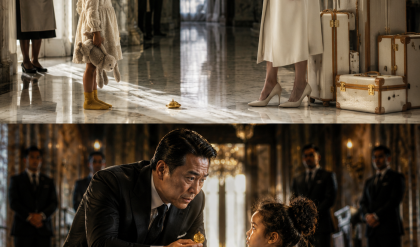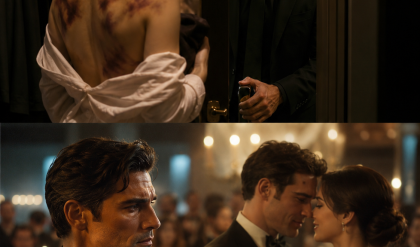
She wrapped both hands around the warm mug. “Start with why you never touched me.”
A muscle worked in his jaw. He looked out through the kitchen windows at Manhattan waking beneath a gray rain. For years, his profile had seemed almost inhuman to her, all angles and discipline. That morning, with his sleeves rolled and a bandage on his hand, he looked less like a monument and more like a man who had survived badly and called it strength.
“I wanted to,” he said.
Elena went still.
Dominic did not look at her. “From the first day. Before the wedding, even. Your father brought you to my office to sign the agreement. You wore a green coat. You were furious and pretending not to be. Leonard kept talking, making excuses, trying to sell me the arrangement as if I had not already seen what he was. You read every page of the contract before signing. Then you looked at me and said, ‘Does buying a wife make you feel powerful, Mr. Moretti, or just efficient?’”
Elena remembered. She had been terrified. Terrified women sometimes became brave because the alternative was begging.
“You said nothing,” she murmured.
“I almost laughed.”
She looked up. “You?”
“I said almost.” His mouth moved faintly, not quite a smile. “Then your father put his hand on your shoulder, and you flinched. Not much. Enough.”
The kitchen seemed to narrow around them.
Dominic turned from the window. “That was when I knew Leonard had not only brought me his debt. He had brought me his victim.”
Elena’s throat tightened before she could stop it. She had never told Dominic about the years before the wedding, the shouting behind closed doors, the bills, the blame, the way her father’s fear always found her first. She had assumed Dominic did not care. That was easier than believing he had noticed and still let her live alone inside his house for seven years.
“So you pitied me,” she said.
“No.” His voice sharpened. “I recognized you.”
The words struck harder than she expected.
Dominic looked down at his bandaged hand. “I grew up in rooms where love was leverage. My father loved people by owning them. My mother died trying to leave him. My brother died because he stayed loyal to him. By twenty-eight, I had learned that wanting anything made it a target. By thirty-five, when I married you, I had learned something worse.”
“What?”
“That I could become my father if I was not careful.”
Elena stared at him over the steam rising from her tea.
Dominic’s voice lowered. “I wanted you too much. I did not trust the wanting. You were forced into my world because of Leonard’s debt, and I told myself that if I kept distance between us, at least I would not take more from you than had already been taken.”
Elena let the silence sit until it became uncomfortable enough to tell the truth.
“You decided my loneliness was safer than my consent.”
His eyes lifted to hers.
“Yes,” he said.
No defense. No excuse dressed as sacrifice. Just the word, plain and ugly.
It hurt more because it was honest.
“And now?” she asked.
“Now I understand that distance can be another kind of possession.”
Elena looked into her tea because looking at him was beginning to cost too much. “You understand that after I packed?”
“Yes.”
“That is convenient.”
“It is late,” he said. “Not convenient.”
For the first time in years, Elena had no immediate answer.
Over the next two days, Dominic began doing small things that unsettled her more than grand gestures would have. He came home before midnight. He ate dinner at the table. He asked about the photography series she had been quietly building for three years, urban portraits taken from rooftops, subway platforms, and rain-blurred sidewalks. When she told him she had a small gallery show scheduled in Chelsea, his attention sharpened.
“You never told me,” he said.
“I did,” Elena replied. “At dinner last year. You took a phone call halfway through my sentence.”
His face went still.
She expected him to retreat behind work. Instead, he said, “Tell me again.”
So she did. Not because she forgave him. Not because tea and dinner could repair seven silent years. She told him because he listened, and listening was the first currency he had ever spent on her that did not feel like hush money.
On the fourth day, he sent a car to take her to lunch.
Elena almost refused out of principle. Then she decided principle had fed her poorly for years, and curiosity at least had flavor.
The restaurant was tucked into a quiet block in Tribeca, without a sign, full of dark wood, white tablecloths, and people who recognized Dominic without looking directly at him. He stood when she arrived. That small courtesy made her angrier than it should have, because it was exactly the sort of thing he could have been doing all along.
“You look like you’re deciding whether to stab me with the butter knife,” he said after she sat.
“You noticed.”
“I notice more than I say.”
“That has not worked in your favor as a husband.”
“No,” he said. “It has not.”
They ordered. Elena chose sea bass. Dominic chose nothing until she raised an eyebrow, and then he ordered steak because apparently even crime bosses could be bullied by silent judgment. Somewhere between the first course and coffee, conversation became almost normal. He asked what made her start photographing strangers. She told him it was easier to look at other people’s lives through a lens than to look too closely at her own. He absorbed that without flinching, which she respected against her will.
They were leaving when his phone buzzed.
Dominic glanced at the screen and stopped walking.
The change in him was immediate. Nothing dramatic. No curse, no raised voice. Only a stillness so complete it made the air around him feel dangerous.
“What is it?” Elena asked.
He turned the phone toward her.
The photograph showed her through the restaurant window, seated across from him fifteen minutes earlier. Her face was turned slightly, caught in profile. Beneath it was a message from an unknown number.
Pretty wife. Shame if she finally learned why you bought her.
Elena read it twice.
The city noise around them seemed to separate into pieces: tires over wet pavement, a woman laughing into a phone, the distant wail of a siren, Dominic breathing once through his nose.
“Who sent that?” she asked.
“The Harbor Crew,” he said.
“The men from the attack?”
“Yes.”
“What do they mean, why you bought me?”
Dominic’s fingers tightened around the phone. “Get in the car.”
“No.”
His eyes cut to hers.
Elena stood on the sidewalk in her cream coat with rain misting in her hair, seven years of obedience dead at her feet. “No, Dominic. You asked for one week to tell the truth. This sounds like part of it.”
A black SUV pulled to the curb. One of Dominic’s men stepped out and opened the rear door, scanning the street with a hand inside his jacket.
Dominic lowered his voice. “This is not the place.”
“Then take me to the place.”
For a second, she thought he might order her into the car anyway. Instead, he looked at her with something like grim admiration.
“Fine,” he said. “But you sit away from the window.”
The place turned out to be not the penthouse, but a secure office inside Moretti Global’s headquarters near the Hudson Yards rail lines. Elena had been there only twice, both times for charity events in rooms scrubbed clean of anything real. This time Dominic took her through a private elevator, down a corridor with no nameplates, and into a conference room where three people waited: his chief legal counsel, Marianne Bell; his security director, Caleb Frost; and an older man Elena had seen at their wedding, silver-haired and watchful.
Dominic introduced him as Father Paul D’Angelo.
That startled her.
“You brought a priest to a crime briefing?” Elena asked.
The priest smiled tiredly. “I brought the crime boss to confession once. I have been paying for it ever since.”
Dominic did not smile. He placed his phone on the table and looked at Elena as if bracing for impact.
“Your father’s debt was real,” he said. “But it was not the reason I married you.”
Elena sat very still.
Dominic continued, “Leonard owed money to several people, including my organization. But a week before he brought you to me, he made a separate deal with the Harbor Crew. He promised them access to Moretti shipping routes through a ledger he claimed he could steal from my accountants.”
“My father was an accountant for small casinos,” Elena said. “He did not have access to your ledgers.”
“No,” Marianne Bell said gently. “But he had access to you.”
Elena looked at her.
Dominic’s voice became colder, not toward Elena, but toward the memory of Leonard Parker. “Leonard told them you were already engaged to one of my men.”
“That’s insane.”
“Yes. But he had forged emails, photographs from charity events, enough garbage to make it look plausible to men who wanted it to be true. His plan was to put you near me, use you to gain access, and then disappear with whatever payment he could get from both sides.”
Elena felt as if the floor had dropped one clean inch beneath her chair. “My father sold me twice?”
No one answered quickly enough.
That was answer enough.
She stood, then sat again because her knees had become unreliable. Her father had died three years into her marriage, liver failure after a lifetime of cheap whiskey and expensive cowardice. Elena had mourned him in the complicated way children mourn parents who were both wound and origin. She had thought there were no more betrayals left to discover.
She had been wrong.
Dominic’s hands were flat on the table. “The Harbor Crew realized Leonard had lied, but by then your name was in their files. You were leverage before you ever walked into my office. If I refused the marriage, they would have taken you to force Leonard’s hand or mine. If I accepted, you became legally and publicly connected to me, which made touching you expensive.”
Elena turned her head slowly toward him. “You married me to protect me from a threat you never told me existed.”
“Yes.”
“You let me believe I was payment for my father’s debt.”
His voice roughened. “Yes.”
“You let me hate myself for being purchased because it was easier than telling me my father had tried to use me as bait.”
Dominic closed his eyes once. When he opened them, the control was back, but barely. “I thought hatred would give you distance from me.”
Elena stared at him.
“And distance,” she said, “was your favorite solution.”
“Yes.”
The room was quiet for a long time.
Then Father Paul spoke, his voice soft but unsparing. “Dominic believed if Mrs. Moretti despised the marriage, she would never become emotionally useful to his enemies.”
Elena laughed, but it came out broken. “Congratulations. I was useless to everyone, including myself.”
Dominic flinched.
Good, she thought. Let him.
She stood. “I want every file. Everything about my father. Everything about the Harbor Crew. Everything you kept from me.”
Marianne glanced at Dominic. Dominic did not look away from Elena.
“Give it to her,” he said.
That night, Elena read until sunrise.
She read emails her father had sent under fake accounts. She read transcripts from wiretaps. She read a memo written by Caleb Frost seven years ago recommending that Dominic move Elena to a protected location outside New York until the Harbor Crew threat cooled. Beneath it, in Dominic’s handwriting, was a single line: She has lost enough choice already. Do not make her disappear.
Elena hated him for that line.
She loved him a little for it too, which made her hate him more.
At 6:30 a.m., Dominic found her in the office, surrounded by paper, her eyes dry and burning. He said nothing. He set tea near her left hand and coffee near his own, then sat across from her as if awaiting sentencing.
“My father was worse than I knew,” she said.
“Yes.”
“You were better than I knew.”
Dominic looked up, and there was something almost naked in his face.
Elena continued, “Do not look relieved. Better is not the same as good.”
The relief died, but he nodded. “I know.”
“You should have told me.”
“Yes.”
“You should have let me decide what danger I was willing to live with.”
“Yes.”
“You should have come to bed.”
His breathing changed.
Elena’s voice softened, not from forgiveness but from exhaustion. “You should have let me decide whether you were something I needed protection from.”
Dominic looked down at his hands. “I did not know how to ask without becoming the man who takes.”
“Then learn,” she said. “Because I am not spending the rest of my life being protected into loneliness.”
The Chelsea gallery opening happened two nights later.
Dominic wanted to cancel it. Elena refused before he finished the sentence. She had spent too many years shrinking her life to fit the shape of his danger, and now that she knew the danger had always had her name in its mouth, she was done surrendering rooms she had earned.
The gallery was small, brick-walled, and bright with white track lighting. Her photographs hung in a clean sequence: night workers under awnings, a little girl in a yellow coat watching pigeons lift from a curb, an old man laughing in a laundromat, rain on taxi glass, a woman alone in a museum looking at a painting as if it had asked her a question. Elena had called the collection “Proof of Life.”
Dominic arrived beside her in a black suit, no entourage visible except to those who knew where to look. He did not stand in front of her. He did not answer for her. He stayed near enough that she could feel his presence but not his shadow.
That mattered.
Guests approached. Critics asked questions. A collector named Russell Vane, wealthy in the polished way of men who inherited clean money and dirtied it themselves, lingered too close over one of her photographs.
“This one,” he said, pointing to the image of the woman in the museum, “feels lonely.”
“It is not loneliness,” Elena said. “It is attention.”
Russell smiled. “That sounds like something lonely people say.”
Before Elena could answer, Dominic’s hand settled lightly at the center of her back.
It was the first time he had touched her in public as a husband.
Not possessively. Not theatrically. Just enough to say he was there and she was not alone.
Russell looked at him and understood immediately that he had made a social error with possible physical consequences.
“Moretti,” he said.
“Vane,” Dominic replied.
Elena glanced up. “Are you interrupting my professional conversation?”
Dominic’s hand left her back at once. “Yes.”
She blinked.
He looked at Russell. “My wife is capable of handling herself. I am working on not confusing support with interference.”
Russell’s smile faltered because he had no idea what to do with a dangerous man practicing emotional growth in the middle of an art opening.
Elena almost laughed.
Almost.
Later, near the end of the evening, Dominic stood in front of the photograph of the woman in the museum for a long time. Elena came beside him.
“You bought it,” she said.
“Yes.”
“You cannot buy my own photograph from my own show.”
“I already did.”
“That is ridiculous.”
“It is my favorite.”
She studied him. “Why?”
He did not answer immediately. “Because she looks alone,” he said. “And then you told Vane she was paying attention. I would like to believe you were right.”
Elena looked at the photograph, then at him. “She was alone too.”
Dominic absorbed that like a deserved blow.
When they left the gallery, the rain had stopped. The sidewalks shone under streetlights. For once, Dominic did not rush her into the car. He walked beside her, matching her pace, his hand close to hers but not taking it.
Elena took his first.
He looked down as if their joined hands were something impossible.
“Do not make a speech,” she warned.
“I was not going to.”
“You were thinking something intense.”
“I am always thinking something intense.”
“That sounds exhausting.”
“It is,” he said, and for the first time, she heard amusement in his voice.
Three days later, the Harbor Crew struck again.
Not with bullets this time. With humiliation.
Elena woke to twenty-three missed calls from friends she had not known still considered themselves close enough to panic on her behalf. The story had broken across three gossip sites and two business blogs: Dominic Moretti’s lonely wife seen in intimate exchange with billionaire collector Russell Vane. The article included a cropped photograph from the gallery, angled to make Russell’s closeness look mutual and Dominic’s distance look like indifference. Another image showed Elena leaving the gallery with her hand near Dominic’s, but the frame cut him out.
The old Elena might have waited for Dominic’s people to manage it.
The new Elena made coffee, opened her laptop, and wrote her own statement.
Dominic entered the kitchen in shirtsleeves and found her typing.
“I can have it removed within the hour,” he said.
“No.”
“Elena—”
“No,” she repeated. “You may own judges, docks, and half the emergency exits in Manhattan, but you do not own my voice.”
He stopped.
She looked up. “Did you doubt me?”
His answer came without hesitation. “No.”
“Then stand there and be proud quietly.”
Dominic’s mouth parted slightly, and if the situation had been less infuriating, Elena would have enjoyed shocking him.
Her statement was calm, precise, and devastating. She did not mention the Harbor Crew. She did not dignify Russell Vane. She posted the uncropped photograph, the acquisition record showing Russell had been denied a private purchase, and a short paragraph about how women’s loneliness was often misread by men who needed it to be available.
By noon, her response had more reach than the original article.
By evening, Russell Vane’s publicist had issued an apology.
Dominic read the statement three times. Elena pretended not to notice, but she did.
“You are remarkable,” he said finally.
“I know,” she replied.
He laughed.
It was low, surprised, and brief, as if the sound had escaped a locked room by accident. Elena turned toward him. In seven years, she had seen Dominic angry, controlled, watchful, and cold. She had never seen him delighted.
The expression changed his whole face.
“Do that again,” she said.
He looked wary. “Laugh?”
“Yes.”
“I cannot perform it on command.”
“Shame. I was beginning to like you.”
His eyes warmed. “Beginning?”
“Do not get greedy.”
For a moment they simply looked at each other across the kitchen, and the years between them seemed less like a wall and more like a field they had not yet crossed.
The Harbor Crew’s final move came sooner than Dominic expected.
It began with a call from Caleb Frost at 2:17 a.m. Dominic listened for less than thirty seconds before Elena saw the man she was learning vanish behind the boss everyone feared.
“What happened?” she asked when he hung up.
“They took Marianne Bell.”
Elena sat up in bed. Dominic had begun sleeping there three nights earlier, on his side, stiff as a soldier at first, then gradually less so. Nothing had happened beyond touch and sleep, and somehow that restraint felt more intimate than any hurried attempt to erase the past. But now the room snapped back into danger.
“Your lawyer?”
“Yes.” He was already dressing. “They want a meeting. No police. No delay.”
Elena got out of bed.
Dominic turned. “No.”
“You do not know what I am going to say.”
“You are going to say you’re coming.”
“I am.”
“No.”
Elena walked to him, close enough that he had to look down at her. “Marianne gave me the files. She told me the truth when you were still deciding whether I could survive it. I am coming.”
“This is not a gallery opening.”
“No. It is the part of your life you used to keep behind a locked door. Open it.”
His face hardened. “I cannot protect you there.”
“That has never been entirely true,” she said. “You could not protect me from my father. You could not protect me from loneliness. You could not protect me from becoming a headline. Maybe protection is not the point, Dominic. Maybe the point is partnership.”
The word landed between them.
Partnership.
Not possession. Not sacrifice. Not distance dressed up as devotion.
Dominic looked as if she had handed him a weapon he did not know how to hold.
Finally, he said, “You do exactly what I say.”
“No.”
His eyes flashed.
“I will listen,” she said. “I will not obey blindly.”
He breathed once, hard. “That is going to be inconvenient.”
“You married inconvenient. You just ignored it for seven years.”
Despite everything, his mouth almost curved.
The meeting took place at an abandoned ferry terminal in Red Hook, all rusted beams, broken windows, and river wind. Dominic arrived with six men visible and more hidden. Elena stayed in the armored SUV at first, watching through tinted glass as the Harbor Crew leader, Frank Sutter, stepped from beneath a dead security light with Marianne Bell beside him. Marianne’s hands were zip-tied. Her face was bruised but composed.
Sutter was broad, red-faced, and smiling in the way of men who mistook cruelty for confidence.
Dominic stood ten yards away, hands empty at his sides.
Elena could not hear everything through the glass, but she saw the shape of the negotiation deteriorate. Sutter gestured toward the SUV. Dominic did not move. Sutter laughed. One of his men raised a phone and turned the screen toward Dominic.
Caleb, seated in the front passenger seat, swore under his breath. “Damn it.”
“What?” Elena asked.
He hesitated.
“What?”
“They have your father’s original recording.”
Elena’s stomach tightened. “What recording?”
Caleb looked trapped. “Leonard made a video before the wedding. Insurance, maybe. He said Dominic forced him to hand you over. Said if anything happened to him, the world should know Dominic Moretti bought his daughter.”
Elena stared through the windshield at Sutter’s smile.
Of course.
Even dead, her father had found a way to sell her again.
Sutter’s voice rose enough to carry through the cracked night air. “You built legitimacy on that wife of yours, Moretti. Charities, clean family image, society pages. What happens when they see her daddy crying into a camera about how you took his little girl?”
Dominic said something too low to hear.
Sutter laughed again. “Or give us the port route. Permanent access. No oversight. No percentage. Maybe then the video stays buried.”
Caleb opened his door. “Stay here.”
Elena grabbed his sleeve. “Give me your phone.”
“Elena—”
“Now.”
There must have been something in her face, because Caleb handed it over.
Elena stepped out of the SUV before anyone could stop her.
The river wind hit her like cold water. Dominic turned sharply, and the look he gave her was pure fury braided with fear.
“Elena,” he warned.
She ignored him and walked until she stood beside him, not behind, not in front.
Sutter’s grin widened. “There she is. The purchased princess.”
Elena held up Caleb’s phone. “Send me the video.”
Sutter blinked.
“I want to see my father’s performance before you try to use it to ruin my life.”
Sutter glanced at Dominic, amused. “You hear that? She has teeth now.”
Dominic’s voice was lethal. “Speak to her with respect.”
Elena touched his arm once. Not to calm him. To remind him she was there by choice.
Sutter sent the video.
Elena watched it in the blue light of Caleb’s phone while the river slapped against the pilings below. Her father appeared on-screen thinner than she remembered, eyes wet, voice trembling. He spoke of debt, coercion, threats. He called her his innocent daughter. He said Dominic had taken advantage of a desperate family.
It was convincing.
It was disgusting.
Elena watched until the end. Then she looked at Sutter.
“You should have watched this more carefully,” she said.
His smile faded. “Excuse me?”
“My father is wearing his gold casino watch.”
Sutter stared.
Elena turned the screen toward Dominic, then Caleb. “He pawned that watch two days before he brought me to Dominic’s office. I remember because he accused me of stealing it first. This video was filmed earlier than he claimed. Before any alleged threat. Before the wedding contract. Before Dominic even agreed to see him.”
Marianne Bell’s head lifted slightly.
Elena continued, “Meaning this was not a confession. It was a script. He made it in advance because he planned to use me, and he planned to blame Dominic afterward.”
Sutter’s jaw tightened. “No one will care about that.”
“I will make them care.”
“You think people will believe you over a crying father?”
Elena stepped closer. Dominic moved with her, but she did not let him pass.
“I think people believe women less when men tell their stories first,” she said. “That is why I learned to document everything.”
She tapped the phone. “The watch. The metadata. The pawn shop receipt in the files Marianne gave me. The forged emails. My father’s debts to you. His debts to Dominic. His debts to three casinos and a woman in Queens who lent him money for a surgery he gambled away. I have all of it.”
Sutter’s face had gone flat.
Elena smiled without warmth. “You came here thinking I was leverage. You should have checked whether I had become evidence.”
For three seconds, no one moved.
Then Marianne Bell did something Elena would remember for the rest of her life.
She laughed.
It was small, bruised, and magnificent.
Dominic’s men moved on that sound. So did Sutter’s. The next minute became chaos, but not the kind from movies. No elegant violence. No speeches. Just bodies shifting, guns drawn but not fired because too many witnesses watched from too many angles Dominic had clearly arranged, and because Caleb Frost had already sent the video, metadata, and Elena’s statement to three federal contacts who owed Moretti Global favors on the legitimate side of the law.
Sutter realized too late that Dominic had not come to negotiate.
He had come to let Elena destroy the lie in front of everyone who had planned to profit from it.
By sunrise, Marianne was safe. Sutter was in federal custody on charges unrelated to the Morettis but very related to weapons trafficking, kidnapping, and the kind of financial records men like him always believed were hidden until someone richer paid to find them. The Harbor Crew fractured within forty-eight hours. Men who had followed Sutter for fear discovered that fear changed direction quickly when prison became possible.
Dominic drove Elena home himself.
Neither of them spoke until they were back in the penthouse kitchen, where the sky over Manhattan had turned pale and ordinary, as if the night had not rearranged several lives.
Elena stood at the sink, washing river grit from her hands. Dominic stood behind her, not touching.
“You planned that,” she said.
“Some of it.”
“You planned for me to see the video?”
“No.” His voice was rough. “I planned to bury it.”
She turned.
Dominic looked exhausted in a way she had never seen. Not physically. Morally. As if all the choices he had once called necessary had arrived to collect their names.
“I was going to trade for it,” he said. “The port route, money, whatever he wanted. I was going to make the lie disappear.”
“Without telling me.”
“Yes.”
Elena nodded slowly. “So you almost made the same mistake again.”
His face changed. “Yes.”
“And then I got out of the car.”
“Yes.”
“And you let me speak.”
His eyes held hers. “I am learning.”
It was not enough.
It was also not nothing.
Elena walked to him. “Dominic, I need you to understand this. If we stay married, I will not be the woman in the locked room. Not for enemies. Not for lawyers. Not for your guilt. Not for your love.”
His voice was quiet. “If we stay married?”
The vulnerability in the question was so clear it hurt.
Elena placed her hand against his chest, over the heartbeat she had never touched until this week. It was fast. Dominic Moretti, who could slow a room with one glance, could not slow his own heart beneath her palm.
“I am still deciding,” she said.
He closed his eyes, and his hand came up to cover hers. “Then I will stand where you can see me while you decide.”
That was the first promise he made her that sounded like a husband instead of a guard.
The weeks after Red Hook did not transform their marriage into something simple. Elena would have distrusted simple. Simple was for people who had not built a home over secrets and called the foundation stable. There were hard mornings. There were arguments that began with logistics and ended with old grief. There were nights when Dominic disappeared into silence, and Elena had to say his name sharply enough to bring him back from whatever internal room he had locked himself inside.
But he came back.
That was new.
He told her about his mother, Catherine Moretti, who had loved jazz records and peach pie and had died in a car crash after trying to leave Dominic’s father. He told her about his younger brother, Anthony, who had believed loyalty could make a cruel man gentle and had been wrong. He told her about the first man he ordered hurt, the first man he failed to save, the first night he understood that becoming feared was easier than becoming free.
Elena did not absolve him. She listened.
Sometimes listening was mercy. Sometimes it was witness. Sometimes it was simply the price of knowing a person fully and refusing to pretend the dark rooms were not there.
Dominic, in return, learned her. Not the version of her he had watched through security reports and household routines, but the woman herself. He learned that she hated orchids because they looked too perfect to trust. She preferred diners to fine dining when she was sad. She edited photographs barefoot. She could forgive a sharp word faster than a hidden truth. She had wanted children once, then trained herself not to want them because wanting anything inside a silent marriage felt foolish.
That last confession nearly undid him.
They were sitting on the floor of her studio when she said it, sorting prints for a second showing. Dominic held a photograph in his hand, but his eyes had gone to her face.
“Elena,” he said.
“No,” she replied gently. “Do not apologize yet. I am not saying it to punish you.”
“It punishes me anyway.”
“Good. But that is not why I said it.”
“Why did you?”
“Because if we are going to build anything real, grief gets a chair too.”
Dominic set the photograph down with great care. Then he reached for her hand. He did that often now, as if asking permission each time, and each time she chose whether to grant it. That mattered too.
Three months after the night she packed her suitcase, Dominic took Elena to a small Italian restaurant in Hoboken that had no website, no sign beyond a fading red awning, and a back table the owner kept empty every Sunday. Dominic’s grandmother had eaten there for forty years. Elena had never known.
The owner, a woman named Rosa with white hair and sharp eyes, kissed Dominic on both cheeks and then turned to Elena.
“So,” Rosa said. “You are the wife he was too stupid to bring me.”
Elena looked at Dominic.
Dominic looked at the ceiling.
“I like her,” Elena said.
Rosa fed them like she had a personal grudge against hunger. Over handmade pasta and red wine, Dominic told Elena about his grandmother, Lucia, the only adult in his childhood who had not been afraid of his father. Lucia had called Dominic “Nicky” until he was seventeen and threatened to buy the restaurant just to make her stop. She had laughed in his face and called him Nicky louder.
“She told me once that power is where frightened men hide,” Dominic said, turning his glass between his fingers. “I was twenty-two and thought that was sentimental nonsense.”
“What do you think now?”
“I think my grandmother understood me before I became difficult to reach.”
Elena watched his face in the candlelight. “Would she have liked me?”
Dominic looked at her as if the answer were obvious. “She would have loved you.”
“Because I saved you from yourself?”
“No.” His gaze softened. “Because you refuse to flatter broken things by calling them noble.”
That made Elena quiet for a moment.
After dinner, they walked along the Hoboken waterfront. Manhattan rose across the river, bright and unreal, the city where she had been lonely in rooms most people would envy. Dominic stopped near the railing.
“Elena,” he said.
She turned, and when she saw the small velvet box in his hand, her first instinct was not joy but grief. The old grief, the memory of a wedding arranged like a business acquisition, vows exchanged under pressure, a ring chosen by someone on Dominic’s staff because Elena’s taste had not mattered.
Dominic saw it. Of course he did.
“This is not a proposal,” he said. “Not exactly.”
“That is good, because we are already married, unless your lawyers missed something truly impressive.”
His mouth curved faintly. “They did not.”
He opened the box.
Inside was a ring unlike the diamond she wore for public appearances. This one was a simple gold band set with a small deep-blue sapphire, old-fashioned and understated.
“My mother’s,” he said. “My grandmother kept it after she died. Rosa had it. I asked for it four years ago.”
Elena looked from the ring to him. “Four years ago?”
“The month I moved fully into the study.”
The words entered her slowly.
Dominic stared down at the box. “I thought about giving it to you. I thought if I gave you something that belonged to my mother, I would have to admit I wanted this marriage to become real. I wanted that so badly I convinced myself it was dangerous.”
“And now?”
He lifted his eyes. There was still darkness in him. There would always be darkness in him. But tonight it was not a locked door. It was a room with the lights on.
“Now I am asking you to choose,” he said. “Not the contract. Not the protection. Not the life your father forced near you or the life I built around you without asking. Me. As I am, and as I am trying to become. If the answer is no, I will still protect your freedom. I will give you the divorce, the homes, the money, whatever you want. But if there is any part of you that wants to stay, I want to spend the rest of my life making sure that part of you never feels foolish for choosing me.”
The river moved black and silver behind him.
Elena thought of the suitcase. The gunshots. The files. Her father’s recorded lie. Dominic standing in the kitchen saying yes to every accusation because denial would have been easier. Dominic letting her speak at Red Hook. Dominic reaching for her hand as if consent were sacred because he had learned too late that it was.
She thought of seven years lost.
Then she thought of the dangerous mercy of not letting lost years devour the living ones.
“I am not giving you a clean slate,” she said.
“I do not deserve one.”
“I am not forgetting.”
“I would not ask you to.”
“I am still angry.”
“I know.”
Her throat tightened. “But I am here.”
Dominic’s face changed. Not dramatically. The world would not have noticed. Elena noticed. The man before her seemed to become younger and older at once, relieved and wounded and unbearably present.
She held out her hand.
His hands were steady when he slid the ring onto her finger.
His face was not.
Elena stepped into him, and Dominic wrapped his arms around her with the careful strength of a man holding something alive, not something owned. She felt his mouth press against her hair.
“I love you,” he said.
This time, the words did not sound like a confession dragged from him by fear. They sounded like a decision.
Elena closed her eyes against his coat. “I love you too,” she said. “But I reserve the right to be difficult.”
His arms tightened slightly. “I was counting on it.”
Six months later, Elena’s second gallery opening filled a larger space in SoHo. The collection was called “Rooms With Doors.” Critics praised its restraint, its intimacy, its strange tenderness toward guarded subjects. The final photograph showed Dominic standing at their kitchen window at dawn, barefoot, wearing an old gray T-shirt, one hand around a coffee mug, the city beyond him blurred by rain. His face was turned slightly toward the camera. He knew she was there. He was not hiding.
The photograph sold before the doors opened.
Dominic tried to buy it under a fake name.
Elena caught him in twelve minutes.
“You are not subtle,” she told him.
“I run several multinational companies and a criminal network with fewer mistakes than I make trying to purchase my wife’s art.”
“That is because your criminal network fears you and I do not.”
His smile came easier now. Not easily, exactly, but easier.
Later that night, after the guests left and the lights were dimmed, Elena found him standing before that final photograph.
“This is how you see me?” he asked.
She stood beside him. “Now.”
“And before?”
She considered lying kindly, then decided kindness had too often been confused with silence. “Before, I saw a locked house with someone breathing inside.”
Dominic nodded slowly.
Then he reached for her hand.
“And now?” he asked.
Elena looked at the photograph: the man at the window, the cup in his hand, the rain-soft city, the door behind him open.
“Now,” she said, “I see someone learning how to come home.”
A year after the suitcase, Elena woke before sunrise to find Dominic already awake beside her, watching her with the quiet intensity of a man still occasionally surprised to be allowed joy.
“You are staring,” she murmured.
“Yes.”
“You used to do that from across rooms. It was unsettling.”
“It is still unsettling?”
“A little.”
“I will work on blinking.”
She smiled despite herself and touched the scar near his temple, the one from a life he no longer pretended had not shaped him. His eyes closed under her fingers.
On the nightstand sat two mugs from the kitchen, one tea, one coffee, both gone cold because neither of them had wanted to leave the bed yet. In the corner of the room, Elena’s old navy suitcase sat open, not packed for leaving this time, but for a weekend trip to Maine where she planned to photograph winter beaches and Dominic planned to pretend he was not worried about the roads.
The suitcase no longer looked like an ending.
It looked like proof that doors could open both ways.
Downstairs, Manhattan began its day with horns, rain, ambition, and noise. Inside the bedroom, the silence was different from the one that had almost destroyed them. This silence had warmth in it. Breath. Choice. The ordinary miracle of two people staying, not because they were trapped, not because danger had cornered them, not because a contract said their names belonged on the same page, but because every morning they were learning how to choose each other without turning love into a cage.
Dominic covered Elena’s hand with his.
“Still here?” he asked quietly.
Elena looked at him, at the man she had once survived, then confronted, then chosen with her eyes open.
“Still here,” she said.
And this time, neither of them mistook staying for surrender.
THE END