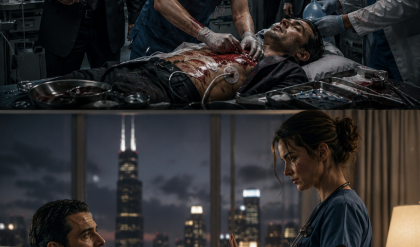
Then he returned to the call.
I walked to the sideboard and poured orange juice into a glass. My hands shook so badly that juice spilled across the marble top.
Adrien noticed that.
Of course he did.
He noticed a misplaced decimal in a two-hundred-page ledger. He noticed when a guard’s holster shifted half an inch. He noticed fear in a rival’s face before the rival knew he was afraid.
He noticed everything except pain.
“You’re shaking,” he said, ending the call. “Did you sleep?”
“A little.”
His gaze sharpened. “That’s not an answer.”
“It’s the only one I have.”
He leaned back in his chair, studying me with the calm disapproval he used on men who had failed him.
“You need to stop doing this to yourself, Evelyn.”
My hand tightened around the glass. “Doing what?”
“Staying up all night crying. Skipping meals. Making yourself sick.”
I stared at him.
Making myself sick.
That was how he saw it.
Not as a woman drowning. Not as a wife begging silently for her husband to reach for her. A self-inflicted inconvenience.
“I’m trying,” I said.
Adrien’s jaw flexed. “Trying what, exactly? You have doctors. Security. A therapist. Anything money can provide. You live in comfort most people cannot imagine, and still you look at me every day like I’ve sentenced you to something.”
My throat burned.
Comfort.
I almost laughed.
Instead, I set the glass down because my fingers had gone numb.
“Do you ever wonder why comfort isn’t enough?”
He frowned slightly, as if the question irritated him because it required emotional math he had no patience for.
“I wonder why you refuse to help yourself.”
The words landed quietly.
That made them worse.
I nodded once because I did not trust my voice.
Adrien looked at his tablet again, already moving on. “Rosa will make breakfast. Eat something.”
Conversation over.
That was how Adrien ended everything he did not want to feel.
I walked out before the tears came back.
By afternoon, the rain stopped, leaving Manhattan gray and slick beneath a low ceiling of clouds. I sat in the library with a book open on my lap and read the same paragraph twelve times without understanding a word.
The Moretti penthouse library had been designed to look warm. Leather chairs. Brass lamps. Floor-to-ceiling shelves. A fireplace that turned on with a switch because even fire had to be obedient here.
But warmth cannot be decorated into a room.
I kept thinking about the small white envelope hidden in the drawer of my bedside table.
Inside were three things: a train ticket to Vermont, a business card from a divorce attorney in White Plains, and a folded ultrasound appointment reminder I had not shown Adrien.
The appointment was for Friday.
Three days away.
My period had been late. Then the nausea started. Then the exhaustion became so deep I sometimes had to sit on the shower floor because standing felt impossible.
I had bought the test at a pharmacy three blocks from the therapist’s office, wearing sunglasses and a baseball cap like a criminal. Two pink lines had appeared before I even set the stick down.
Pregnant.
I had sat on the edge of a public bathroom toilet and stared at those lines until my hands stopped feeling attached to my body.
At first, I wanted to tell Adrien.
A dangerous, foolish hope had bloomed in me. Maybe this would reach him. Maybe a child would pull something human back into his eyes. Maybe the man who once stood in the rain outside my childhood home and said, “You don’t ever have to be afraid again,” still existed somewhere beneath the boss, the empire, the endless midnight calls.
Then he came home late that night, smelled faintly of rain and gun oil, and walked past me while speaking into the phone.
The next morning, he told me I was “too fragile lately.”
The hope withered.
I had not decided whether to leave him forever. I only knew I could not raise a child in a home where sadness was treated like a disturbance.
So I bought the train ticket.
Not a plane. Planes were too easy to track. Adrien owned pieces of airports, airlines, people.
A train felt old-fashioned enough to be possible.
I would go to Burlington, then to a small town near Lake Champlain where my mother’s cousin ran an inn and owed Adrien nothing. I would sleep. Eat. Think. Decide whether love was still love if it kept asking you to disappear quietly.
That evening, Adrien came home before nine, which was early enough to make the staff nervous.
I heard the elevator doors open, followed by voices. I did not move from the library couch. I was wrapped in a gray blanket, watching rain start again against the windows.
Adrien appeared in the doorway wearing a black overcoat with droplets shining across his shoulders.
His eyes found me immediately.
“You didn’t eat lunch,” he said.
No greeting.
Not “How are you?”
Just an accusation disguised as observation.
“I wasn’t hungry.”
“You weren’t hungry yesterday either.”
Something in me stirred painfully. “So you did notice.”
He paused while removing his gloves. “I notice more than you think.”
“No,” I said softly. “You notice symptoms. Not causes.”
His expression cooled.
“Evelyn.”
There it was. The warning in my name. Speak carefully. Stay reasonable. Do not force him into territory where bullets would be easier than feelings.
But something had shifted in me after hearing him tell his men to ignore my tears. Some small, obedient part of me had died on that bathroom floor.
I closed the book on my lap.
“If I stopped talking tomorrow,” I asked, “how long would it take you to realize it wasn’t peace?”
Adrien looked at me for a long moment.
Then his phone buzzed.
His eyes dropped to the screen.
The tiny movement answered me better than anything he could have said.
He silenced the call, but the damage was done.
“You spend too much time alone in this apartment,” he said. “Your mind starts creating problems.”
“My mind?”
“You know what I mean.”
“No, Adrien. I don’t think you know what you mean. I think Victor tells you I’m unstable, Dr. Sloane tells you I’m anxious, Rosa tells you I’m not eating, Matteo tells you I’m crying, and you collect all these reports about me like I’m another department in your organization.”
His face changed slightly at Victor’s name.
“Victor has nothing to do with this.”
“He has everything to do with everything around you.”
“Careful.”
I gave a tired smile. “There it is again.”
“What?”
“The voice you use when you want me to remember everyone is afraid of you.”
Adrien’s eyes darkened, but I was too exhausted to be afraid.
“I am not everyone,” I whispered. “I’m your wife.”
For a second, something moved across his face. Pain, maybe. Or anger at pain. With Adrien, they often looked the same.
Then his phone buzzed again.
This time, he answered.
“Yes,” he said, turning away from me. “I’m here.”
I stared at his back as he walked out of the library.
The room seemed to grow larger after he left. Larger and colder. I put one hand over my stomach without thinking.
“I won’t let you feel this,” I whispered, though I did not know whether I was speaking to myself or the tiny unknown life inside me.
At midnight, the storm turned violent.
Thunder rolled over Manhattan with enough force to shiver through the glass. Lightning flashed white across the library, turning the shelves into black ribs around me.
I should have gone to bed.
Instead, I sat on the couch in Adrien’s library, dressed for leaving.
Leggings. Sweater. Flat boots by the door. My small leather overnight bag hidden behind the armchair.
The train was at 5:40 a.m. from Penn Station.
I had arranged a car under a false name for 4:50.
All I had to do was make it downstairs.
All I had to do was stop hoping he would come upstairs and ask me to stay in a way that meant something.
My phone rested on the coffee table. Adrien’s contact glowed at the top of my recent calls because I had opened it three times and closed it three times.
Tell him, a voice inside me whispered.
Tell him about the baby.
Tell him you’re leaving.
Tell him you cannot breathe in this house anymore.
Downstairs, another meeting had started. I could hear men’s voices faintly through the vents when the thunder quieted. Victor’s polished tone. Adrien’s lower answer. Glasses clinking. Papers moving.
Business.
Always business.
I stood too quickly and the room tilted.
I grabbed the back of the couch, breathing through a wave of nausea. My heart began to pound, not fast exactly, but wrong. Heavy. Uneven.
“Okay,” I whispered. “You’re okay.”
I was not okay.
The pressure in my chest spread into my ribs. The library grew too warm. My fingers tingled. Panic climbed my throat in a way I had learned to recognize, except this time my body felt weaker underneath it, like the floor had become water.
I reached for my phone.
Adrien’s name blurred.
My thumb hovered over the call button.
Then I heard his voice from downstairs, faint but clear through the cracked door.
“I don’t care if she’s upset. Keep the meeting moving.”
Not about me, maybe.
Probably not about me.
But my body heard the sentence and believed it.
I set the phone down.
A strange calm settled over me then. Not peace. Something emptier.
I picked up the overnight bag from behind the chair and took one step toward the door.
The room lurched.
My hand flew out, striking the coffee table. The teacup toppled and shattered against the marble. Hot tea spread across the floor in a thin amber pool.
I tried to call for help, but no sound came.
My knees hit the floor.
Pain flashed through me, then faded under a heavier darkness. I curled instinctively on my side, one hand pressed against my stomach.
The last thing I saw was lightning crawling across the glass walls like a crack in the sky.
The last thing I thought was not Adrien’s name.
It was: Please don’t let my baby learn loneliness from me.
Adrien’s meeting ended at 3:08 a.m.
He remembered the time later because he looked at his watch while Victor Baines was still talking.
“Russo won’t accept the delay,” Victor said. “If we appear distracted, Philadelphia will test us before the weekend.”
Adrien closed the folder in front of him. “Then Philadelphia should pray I remain distracted.”
Victor studied him over the rim of his glasses. “This is about Evelyn.”
Adrien’s jaw tightened. “Careful.”
The older man inclined his head, but his eyes did not soften. “You know I care for the girl.”
“No, Victor. You care for order.”
“In our world, order keeps people alive.”
Adrien stood. “Then keep it.”
He walked out before Victor could answer.
The penthouse had gone unnaturally silent. Rain hammered the windows. Most of the staff had retired to the lower wing. Matteo stood near the elevator, posture straightening as Adrien approached.
“Anything?”
“No outside movement,” Matteo said. “No calls from the desk.”
Adrien nodded and started toward the stairs.
Then Matteo added, “Mrs. Moretti never came down.”
Adrien stopped.
“She was in the library earlier,” Matteo continued carefully. “Lights are still on.”
A small irritation moved through Adrien first. Then something else followed it.
Memory.
Evelyn’s face in the kitchen. Her question in the library. The way she had said, I’m your wife, like she was reminding him of a fact he had misplaced.
He walked faster.
The library doors were open a few inches. Warm light spilled across the hallway.
Adrien pushed inside.
He saw the broken cup first.
White ceramic shards scattered across the marble. Tea drying in a dark stain near the couch.
Then he saw Evelyn.
Barefoot. Curled on her side. Motionless.
For one impossible second, his mind refused the image.
Then the world narrowed to a single point.
“Evelyn.”
Her name came out sharp enough to cut.
No response.
Adrien crossed the room and dropped to his knees beside her. Her skin was cold when he touched her cheek. Too cold. Her lashes trembled, but her eyes stayed closed.
“Evelyn, look at me.”
Nothing.
His hand found her wrist. Pulse faint. Uneven.
Panic slammed through him so violently it disguised itself as rage.
“Matteo!” he roared.
Footsteps pounded down the hall.
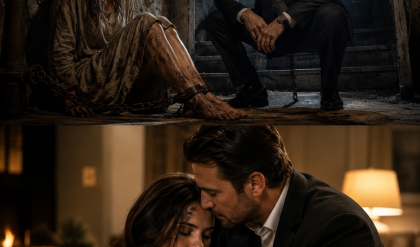
Adrien slid one arm beneath Evelyn’s shoulders and pulled her carefully against his chest. She was lighter than she should have been. That detail hit him with sickening force. Her head fell weakly against his shirt. Her hair smelled faintly of lavender shampoo and rain-chilled air.
“Call Dr. Levin,” Adrien snapped when Matteo appeared. “Now. Tell him if he is not here in fifteen minutes, I will drag him here myself.”
Matteo vanished.
Adrien looked down at his wife.
Now that terror forced him to see, he saw everything.
The shadows under her eyes. The sharp bones at her wrists. The cracked dryness of her lips. The way her fingers curled protectively against her abdomen even unconscious.
His stomach clenched.
“Hey,” he said, voice low and rough. “Stay with me.”
Her brow twitched faintly.
He brushed hair away from her face with a hand that did not feel steady.
In his life, men had pointed guns at him. Friends had betrayed him. Blood had soaked through his shirts. He had learned early that fear was only useful if you could turn it into action.
But holding Evelyn’s limp body on the library floor, Adrien discovered a kind of fear that had no target.
No enemy to threaten.
No deal to make.
No room to control.
Only the horrible possibility that the woman he loved had been dying quietly beside him while he dismissed every warning as inconvenience.
Matteo returned with Rosa and two guards. Rosa gasped and pressed a hand to her mouth.
“Blankets,” Adrien ordered. “Water. Towels. Move.”
Everyone moved.
Adrien did not.
He held Evelyn against him and felt shame rise like poison.
Ignore it.
His own voice came back to him.
She cries every week.
He closed his eyes once, briefly, as if that could block the memory.
It did not.
Dr. Samuel Levin arrived nineteen minutes later, soaked from the storm, silver medical case in hand. He was in his late fifties, with tired eyes and the professional calm of a man who had treated bullet wounds in basements and champagne poisoning in penthouses without judging either too loudly.
Adrien was still on the library floor.
“Help her,” he said.
Dr. Levin knelt. “How long has she been unconscious?”
“I don’t know.”
The answer tasted like failure.
The doctor checked Evelyn’s pulse, blood pressure, pupils, breathing. He asked questions. Adrien answered too few of them.
When did she last eat?
He did not know.
When did she last sleep through the night?
He did not know.
Has she been vomiting?
He did not know.
Any medication?
Adrien opened his mouth, then shut it.
He did not know.
Dr. Levin’s face tightened with every silence.
“She is severely dehydrated,” he said at last. “Exhausted. Her blood pressure is low. This did not happen in one night.”
Adrien stared at him.
The doctor’s voice remained quiet, but not gentle. “Has she been under extreme stress?”
Rosa made a small sound near the doorway.
Adrien looked up.
The housekeeper’s face had gone pale. “Sir, she has been trying to tell you.”
The room froze.
Rosa looked terrified, but something maternal and fierce pushed her forward anyway.
“She asked me three days ago if women can faint from being sad,” Rosa said. “I told her she needed a doctor. She said she did not want to bother you.”
Adrien’s expression went blank in the way that frightened men who knew him.
“She said that?”
Rosa nodded, eyes shining. “She said she had become too much trouble already.”
Adrien looked down at Evelyn.
Too much trouble.
His wife had been apologizing for the space her suffering took up.
Dr. Levin opened Evelyn’s medical pouch from the bedside drawer Rosa had brought down. Prescription bottles clicked against one another. The doctor examined the labels, frowning at one in particular.
“Who prescribed this sedative?”
“Dr. Sloane,” Adrien said automatically. “Her therapist.”
Dr. Levin’s eyes lifted. “Therapists do not prescribe medication unless they are psychiatrists. Dr. Marissa Sloane is not a psychiatrist.”
Adrien’s head came up slowly.
“What?”
Levin turned the bottle toward him. “This dose is high. Combined with not eating, not sleeping, and dehydration, it could worsen dizziness, depression, fainting.”
Adrien felt the room sharpen.
“Who recommended Sloane?”
No one answered at first.
Then Matteo said, “Mr. Baines arranged it.”
Victor.
For a moment, Adrien was completely still.
Then his phone rang.
Victor’s name appeared on the screen.
Adrien answered without speaking.
Victor’s voice came smooth and cautious. “Is she all right?”
Adrien stared at the pill bottle in Levin’s hand. “How did you know something happened?”
A pause.
Small.
Fatal.
“Matteo called for the doctor,” Victor said.
“No,” Adrien replied. “Matteo called Levin directly. I was standing beside him.”
Silence.
Adrien’s voice dropped. “Come upstairs.”
Victor exhaled softly. “Adrien—”
“Now.”
When Victor entered the library five minutes later, he looked older than usual beneath the warm lamps. His silver hair was combed perfectly. His suit was flawless. Only his eyes betrayed calculation.
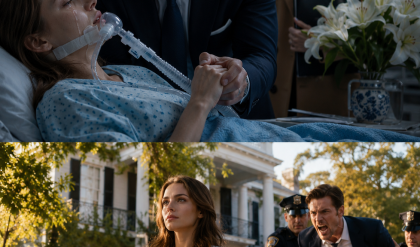
Evelyn had been moved to the couch, covered in blankets, an IV started in her arm. Adrien sat beside her, one hand wrapped around her cold fingers.
Victor glanced at the doctor’s case.
Then at the medication bottle.
Understanding flickered.
Adrien saw it.
“Explain,” he said.
Victor removed his glasses slowly. “Sloane came highly recommended.”
“By you.”
“Yes.”
“Why?”
“Because your wife was becoming unstable.”
Adrien stood so abruptly Rosa flinched.
“My wife was sick.”
Victor’s mouth thinned. “Your wife was lonely, emotional, and increasingly careless with what she said around staff. She asked questions about things she should not have noticed. Accounts. Names. Routes. You were too close to see the risk.”
Adrien went very still.
“What accounts?”
Victor’s gaze shifted toward Evelyn.
Adrien stepped into his line of sight.
“What accounts, Victor?”
The older man’s silence answered before he did.
Adrien remembered then.
Three weeks earlier, Evelyn had come into his office holding a charity gala invitation. She had asked why the Moretti Children’s Foundation wired money through a shell company in Delaware. He had been on a call. He had told her it was complicated and taken the paper from her hand.
He had forgotten.
Victor had not.
Adrien’s voice went cold enough to change the room temperature. “You drugged my wife because she saw your theft.”
“I protected this family,” Victor said sharply. “You were distracted. Soft. She was making you soft. Russo smelled it. Philadelphia smelled it. Every man at that table watched you become weaker every time she walked into a room with tears in her eyes.”
Adrien moved so fast Victor took a step back.
But Adrien did not hit him.
That would have been easy.
Instead, he leaned close enough that Victor could see exactly what kind of restraint was saving his life.
“You do not get to call my love weakness after using my neglect as a weapon.”
Victor’s face tightened.
Adrien turned to Matteo. “Take his phone. His keys. His access cards. Lock down every account he touched. No one leaves this building until I know who helped him.”
Victor’s mask cracked. “Adrien, listen to me.”
“I did listen,” Adrien said. “For years. That was my mistake.”
The guards moved in.
Victor looked once toward Evelyn, then back at Adrien. “She will never survive your world.”
Adrien’s eyes did not leave him.
“Then I will burn down my world before I let it bury her.”
Victor was taken from the room without another word.
But the victory, if it was one, felt hollow.
Because when Adrien turned back to Evelyn, she was still unconscious.
And the truth was worse than Victor’s betrayal.
Victor had pushed.
Sloane had poisoned.
But Adrien had opened the door by refusing to see what was happening in front of him.
Near dawn, Dr. Levin asked everyone except Adrien to leave the bedroom.
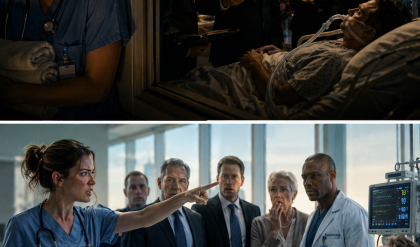
Evelyn lay beneath layers of blankets, pale but breathing more evenly now. An IV bag hung beside the bed. Rain softened against the windows, the storm exhausting itself over the city.
Dr. Levin stood near the foot of the bed, reviewing fresh test results sent from his lab courier.
Adrien watched his face change.
“What?” Adrien asked.
The doctor looked at Evelyn, then at him.
“She needs to hear this from a physician when she wakes,” Levin said. “But given her condition, you should know now.”
Adrien’s chest tightened.
“She is pregnant.”
The words did not enter him all at once.
They seemed to stop in the air between them.
Pregnant.
Adrien looked at Evelyn’s sleeping face, then at the hand resting loosely above her abdomen.
“How far?”
“Approximately seven weeks, based on the bloodwork. She needs a proper ultrasound. The dehydration and stress are serious, but at this moment, I see no immediate evidence of miscarriage.”
At this moment.
The phrase sliced through him.
Adrien sat down heavily in the chair beside the bed.
A child.
His child.
Their child.
And Evelyn had known.
Of course she had known. The nausea. The exhaustion. The way she touched her stomach unconsciously. The distance in her eyes when he spoke of business as though business were life itself.
“She tried to tell me,” he said, though he was not sure whether he was speaking to Levin or to the punishment gathering inside his own chest.
The doctor did not soften the truth for him.
“Maybe. Or maybe she decided you were not safe enough to tell.”
Adrien closed his eyes.
No bullet had ever landed so cleanly.
When Evelyn woke, the first thing she noticed was warmth.
Not the warmth of blankets, though there were several tucked around her. Not the fireplace glowing low across the bedroom. Something steadier. Human.
Someone was holding her hand.
She opened her eyes slowly.
Adrien sat beside the bed wearing the same black shirt from the night before, sleeves rolled unevenly, hair disordered, face drawn with exhaustion. He looked like a man who had not moved in hours because movement might cost him the only thing anchoring him to the earth.
The moment her fingers shifted, he leaned forward.
“Evelyn.”
Her name sounded different.
Not commanded.
Offered.
She tried to sit up, but dizziness pushed her back into the pillow.
Adrien stood instantly, one hand supporting her shoulder with a gentleness that startled her.
“Don’t,” he said. “Levin said you need rest.”
The name brought fragments back.
The library. The cup. The bag. The storm.
Her hand moved to her stomach.
Adrien saw.
His expression broke before he could hide it.
Evelyn’s throat tightened. “You know.”
He nodded once.
The tears came before she could stop them. She turned her face away, humiliated by how easily her body still betrayed her.
“I’m sorry,” she whispered.
Adrien froze.
For a second, he looked almost wounded.
“Don’t say that.”
“I was going to leave.”
“I know.”
Her eyes snapped back to him.
He reached toward the nightstand and picked up the white envelope. He did not open it. He only held it carefully, as if even the paper deserved his respect because it contained her desperation.
“I found it when Rosa brought your things upstairs,” he said. “The train ticket. The attorney’s card. The appointment reminder.”
Evelyn looked at the ceiling because meeting his eyes hurt too much.
“I didn’t know what else to do.”
Adrien sat slowly on the edge of the bed, leaving space between them.
That space hurt him.
He left it anyway.
“You should have left,” he said.
She stared at him.
His jaw tightened, but he forced the words out. “If staying here made you feel invisible, you should have left. If I made you afraid to tell me you were carrying our child, then leaving was not betrayal. It was survival.”
A sob caught in her throat.
Adrien’s eyes shone, though no tears fell.
“I told them to ignore you,” he said. “I heard you crying, and I told them to ignore it because facing your pain required something from me I did not know how to give. That is not an excuse. It is the ugliest truth I have.”
Evelyn pressed her lips together, shaking.
“Victor used that,” Adrien continued. “He arranged Sloane. The medication was wrong. He was stealing from the foundation and thought you had noticed.”
Her face went pale in a new way. “I asked you about the Delaware account.”
“I remember now.”
“You told me not to worry.”
“I know.”
“You always told me not to worry.”
Adrien lowered his eyes. “Because I thought protection meant keeping you outside the truth.”
“No,” she whispered. “It meant keeping me alone.”
He absorbed that without defense.
“Yes.”
The silence between them filled with rain, monitors, and all the things apology could not repair by itself.
Finally, Evelyn asked, “What happens now?”
Adrien looked at her then, and for the first time in months, she saw no strategy in his eyes.
Only fear.
Not of enemies.
Of her answer.
“That depends on what you want,” he said. “If you want Vermont, I will arrange it with someone I trust who is not mine. If you want the divorce attorney, I will not stop you. If you want me out of this room, I will go.”
Her breath trembled.
“And if I don’t know?”
“Then I will wait while you decide.”
“You don’t wait.”
“I will learn.”
Evelyn looked down at their hands. His was near hers, not touching now. Waiting for permission.
That small restraint undid her more than any grand speech could have.
“I loved you so much,” she said, voice cracking. “I think that’s why it hurt so badly. If you had been cruel all the time, maybe I could have hated you. But you were absent in pieces. One missed dinner. One dismissed tear. One phone call you took instead of looking at me. It made me feel ridiculous for breaking.”
Adrien’s throat worked.
“You were not ridiculous.”
“I was lonely.”
“I know.”
“No,” she said, tears slipping sideways into her hair. “You know now.”
He bowed his head.
“You’re right.”
For a long moment, neither of them spoke.
Then Evelyn moved her fingers, barely brushing his.
Adrien looked at the touch like it was mercy he had not earned.
She did not forgive him.
Not then.
But she let him hold her hand.
Three days later, Adrien Moretti walked into the lower conference room of his penthouse and ended the life he had spent fifteen years building.
Every captain in his organization sat around the table. Men from Queens, Brooklyn, Jersey, Boston. Men who had mistaken his silence over the past seventy-two hours for distraction and arrived ready to test the walls.
Adrien let them look.
He had not slept much. He had not shaved. He wore a plain black suit and no tie. At his right stood Matteo. At his left stood a federal prosecutor named Claire Donnelly, whose presence made every man in the room go still.
Victor Baines sat at the far end, bruised by exhaustion rather than fists, guarded by two men who had once answered to him.
Adrien placed a folder on the table.
“For years,” he said, “you called me powerful because I could keep this city afraid.”
No one spoke.
“I believed you.”
Victor’s mouth twisted. “Adrien—”
Adrien lifted one finger.
Victor stopped.
“The foundation accounts are being turned over. The shell companies are being dissolved. Anyone who used children’s charity money to hide weapons, narcotics, or bribes will be named.”
A murmur broke through the room.
Adrien’s voice cut it down. “You have two choices. Cooperate through counsel or run and become someone else’s example.”
One of the Boston men stood. “You’re handing us to the feds for your wife?”
Adrien looked at him.
The man sat back down.
“No,” Adrien said. “I’m handing you to consequences because I should have done it before my wife had to collapse for me to understand what this empire cost.”
Claire Donnelly opened her briefcase.
The old world began to end in paper, signatures, and the stunned silence of men who had prepared for bullets but not accountability.
Upstairs, Evelyn did not watch.
She sat by the bedroom window with Rosa beside her, sipping ginger tea and listening to the rain finally stop. Her body remained weak. Her trust remained weaker. But when Adrien came up hours later, he stopped at the door and knocked.
His own bedroom.
Her boundary.
She noticed.
“Come in,” she said.
He entered slowly.
“It’s done,” he said.
“All of it?”
“The first part.”
She studied his face. “You’ll have enemies.”
“I already had enemies.”
“Worse ones.”
“Yes.”
“And you’re not doing this just because you’re scared I’ll leave?”
Adrien walked to the foot of the bed, but no closer.
“I am scared you’ll leave,” he said. “But that cannot be the reason I change. Fear burns out. Guilt becomes performance. I need to become someone our child can trust even if you decide not to stay married to me.”
Evelyn looked away quickly.
The tears were different now. Still painful, but cleaner.
“I don’t know how to believe you yet.”
“I know.”
“I don’t know how to stop hearing what you said.”
“I know.”
“I don’t want our baby raised around men whispering in hallways and women learning to cry quietly.”
Adrien’s face tightened with grief.
“Neither do I.”
She looked back at him.
For the first time, there was no demand in his posture. No expectation that love would excuse him. No silent confidence that money, protection, and remorse could purchase forgiveness.
Only a man standing in the ruins of his own making, finally willing to name them ruins.
“Dr. Levin says I need less stress,” she said.
A faint, broken smile touched Adrien’s mouth. “Dr. Levin has become the most feared man in my life.”
Despite herself, Evelyn almost smiled.
Almost.
Adrien saw it and did not reach for more.
That mattered.
Weeks passed.
Not easily. Not like romance in movies where one terrifying night cleanses years of neglect.
Evelyn still woke sometimes with panic pressing on her chest. Adrien still reached for his phone too quickly when silence made him uncomfortable. Some mornings, she could barely look at him. Some nights, he sat outside the bedroom door because she needed space but he could not bear being far in case she called.
They learned slowly.
Therapy changed after Sloane was arrested. Evelyn chose her own doctor, a woman in Brooklyn with warm eyes and no connection to Adrien’s world. Adrien began therapy too, though he called it “strategic behavioral correction” until Evelyn gave him such a tired look that he never used the phrase again.
They ate breakfast together because Dr. Levin ordered regular meals, and Adrien obeyed the doctor with the grim discipline he once reserved for criminal negotiations.
At first, breakfast was awkward.
Toast. Eggs. Silence.
Then small truths.
“I hated the black marble,” Evelyn admitted one morning.
Adrien looked around the kitchen. “All of it?”
“It feels like living inside a museum for expensive villains.”
He considered this seriously. “We can change it.”
“You don’t have to redesign the kitchen because I insulted your villain marble.”
“I want to.”
“No, Adrien. Wanting to fix discomfort with money is part of the problem.”
He paused.
Then nodded.
“What would help today?”
The question was clumsy.
It was also new.
Evelyn looked at him over her tea. “Sit with me for ten minutes without checking your phone.”
He turned the phone off.
Not silenced.
Off.
It was such a small thing that it should not have made her cry.
It did.
This time, when tears filled her eyes, Adrien did not freeze, sigh, or look away. He moved slowly, giving her time to refuse, and when she did not, he covered her hand with his.
“No more apologizing for hurting,” he said quietly.
She believed that sentence before she believed forever.
By the time winter loosened into spring, they had moved out of the penthouse.
Not far. A brownstone in Brooklyn Heights with creaking stairs, imperfect floors, and windows that opened to real air. Adrien kept security, but fewer men. Fewer shadows. No meetings after dinner. No business in the library. No phones at the table.
The first time Evelyn stood in the unfinished nursery, sunlight pouring over pale yellow walls she had chosen herself, she felt fear and hope rise together.
Adrien entered carrying a box of books.
Children’s books.
He looked uncomfortable with them, as if they were sacred objects from a country where he did not yet speak the language.
“Where do these go?” he asked.
Evelyn pointed to the low shelf by the rocking chair.
He placed them carefully, one by one.
Goodnight Moon.
The Snowy Day.
Where the Wild Things Are.
When he reached the last book, he stopped.
It was a worn copy of Charlotte’s Web.
Evelyn’s mother had read it to her when she was little, before illness took her and politics swallowed her father whole. The cover was faded. The corners soft. Evelyn had thought it was lost until Adrien found it in storage and brought it home wrapped in tissue paper.
She touched the book gently.
“You found it.”
Adrien nodded. “Rosa remembered you mentioning it.”
“Thank you.”
He stood beside her in the quiet nursery.
After a while, he said, “I bought something else.”
She gave him a wary look. “If it’s a diamond rattle, I’m leaving you immediately.”
“No diamonds.”
He reached into his coat pocket and took out a small white ceramic mug.
It had been repaired with gold seams, Japanese kintsugi style, the cracks visible and shining.
Evelyn went still.
“The cup from the library,” he said. “I asked Rosa to save the pieces.”
Her throat tightened.
Adrien held it carefully between both hands.
“I used to think broken things were evidence of failure,” he said. “Something to hide. Replace. Throw away before anyone saw the damage.” He looked at the gold lines. “You taught me broken things can tell the truth.”
Evelyn’s eyes filled.
Adrien set the mug on the nursery shelf, not as decoration exactly, but as a witness.
“I don’t want our daughter growing up in a house that pretends nothing cracks,” he said.
“Daughter?” Evelyn asked, one eyebrow lifting. “Dr. Levin said it could be a boy.”
Adrien looked mildly alarmed. “Rosa says girl.”
“And Rosa outranks modern medicine?”
“In this family? Obviously.”
Evelyn laughed then.
A real laugh.
Small, surprised, and bright enough that Adrien closed his eyes for half a second like a starving man feeling sunlight.
She saw that.
She stepped closer and touched his jaw.
“You’re still learning,” she said.
His hand covered hers. “Every day.”
“I’m still healing.”
“I know.”
“I may always remember that night.”
His eyes darkened with pain, but he did not look away. “Then I will remember it with you. Not to drown in it. To never become that man again.”
Outside, Brooklyn moved in ordinary afternoon sounds. A dog barking. A delivery truck backing up. Children shouting somewhere down the block. No sirens below a glass tower. No men murmuring threats behind closed doors.
Just life.
Imperfect. Noisy. Uncontrolled.
Evelyn leaned into Adrien slowly, and he wrapped his arms around her with careful strength. Not possession. Not fear.
Presence.
Months later, when their daughter was born during a thunderstorm, Adrien cried before the baby did.
Evelyn noticed immediately.
So did Rosa, who burst into tears herself and declared the child had Moretti lungs and Hart stubbornness.
Adrien held the baby like she was made of breath and miracles. His hands, once feared across New York, trembled beneath the weight of six pounds, nine ounces, and an entire future.
“What’s her name?” Dr. Levin asked, smiling despite himself.
Adrien looked at Evelyn.
Her choice.
Always her choice now.
Evelyn touched the baby’s cheek.
“Hope,” she said.
Adrien bowed his head.
Hope Moretti opened her tiny mouth and screamed at the world as if making it clear she had arrived and expected to be heard.
Evelyn laughed through tears.
Adrien laughed too, brokenly, beautifully, with his daughter crying in his arms and his wife alive beside him.
He had once believed power meant making the world quiet.
Now he understood better.
Power was hearing the cry.
Love was answering it.
And sometimes the most dangerous silence in a home is not the absence of sound, but the moment someone stops asking to be seen.
Evelyn had stopped once.
Adrien never let himself forget it.
Not because guilt was love.
But because remembering became a promise.
In the years that followed, people in New York told many stories about Adrien Moretti. Some said he turned federal witness. Some said he bought his way clean. Some said love ruined him. Some said fatherhood saved him. Men who feared him preferred the old stories because they understood violence better than repentance.
Evelyn knew the truth was quieter.
No single night saved them.
No apology erased the pain.
No baby repaired a marriage by being born into it.
They saved what could be saved the hard way: with truth, treatment, boundaries, patience, and the daily decision to notice each other before silence became another locked room.
On rainy nights, Adrien still woke first.
He would listen to the storm, then turn toward Evelyn, not touching her until he knew she was awake.
“You okay?” he would ask softly.
Sometimes she said yes.
Sometimes she said no.
Either answer was allowed.
Either answer was heard.
And that, more than diamonds, penthouses, guards, or power, became the life Evelyn had once thought impossible.
A home where pain did not have to perform to matter.
A love that finally learned to look up.
THE END