Another man said, “What if she finds the room?”
Victor laughed. “Then Callaway will handle her. You heard him. Tears don’t move him.”
Dorian felt every sound leave the room.
“Play that again,” he said.
The technicians exchanged a nervous glance. Dorian did not look at them. He watched Victor’s mouth move, watched his own arrogance become a weapon someone else had counted on.
For years, Victor had been his father’s man before becoming his. He knew where old bodies were buried, which accounts had been washed, which favors had been repaid in cash instead of conversation. Dorian had inherited him like a scar. Useful. Ugly. Familiar.
“What room?” Dorian asked quietly.
No one answered.
He left the office without another word and drove home through rain that blurred Highway One into black glass. Normally, he took calls during the drive. That evening, his phone remained untouched. His mind kept returning to Celeste in the reflection. Not just wounded. Used. Not just overhearing cruelty, but overhearing proof that his contempt had made her vulnerable to men who wanted something from her work.
When he entered the villa, the first thing he noticed was another absence.
The small ceramic bowl on the hallway table was gone. Celeste used to place his watch there whenever he forgot to take it off before bed. A pale circle remained in the wood where it had rested for years.
The house had become a museum of things he had failed to value until they disappeared.
He found Celeste in the studio, studying photographs of the abandoned St. Agnes Cannery Chapel. The building sat near Monterey’s old waterfront, half-collapsed and forgotten, a place where fishermen had once prayed before going out in bad weather. Celeste had been fighting to restore it as a public arts center. Dorian had thought the project was sentimental. Victor had called it inconvenient.
Now Dorian wondered why.
Celeste looked up when he entered.
“You’re home early,” she said.
“Yes.”
Her desk lamp warmed her face. There was paint on the side of her hand and a pencil tucked behind her ear. She looked more alive in that room than she had looked beside him at any dinner table in months.
Dorian stepped closer to the plans. “What room did you find in the cannery?”
The pencil slipped slightly from behind her ear. She caught it before it fell.
For the first time since the night of the reception, her expression changed.
“What did you say?”
“I heard Victor mention a room. On the gala footage.”
Celeste stood very still.
Dorian’s voice lowered. “You heard me that night.”
The silence after that question was not empty. It was full of everything she had chosen not to say.
“Yes,” she replied.
Dorian swallowed. “Celeste—”
“Don’t apologize yet,” she said softly.
He froze.
She turned back to the drafting table and pulled a rolled plan from beneath a stack of photographs. When she opened it, Dorian saw a century-old architectural drawing of the cannery. Beneath the chapel floor, behind a false wall near the old boiler room, someone had marked a storage chamber that did not appear on modern property records.
“I found the original plan in the county archive,” Celeste said. “At first, I thought it was just a forgotten storage space. Then I visited the site with the engineering team and saw fresh pry marks near the sealed stairwell. Someone had been there recently.”
“Victor,” Dorian said.
“I didn’t know who at first. I only knew the demolition request came from a shell company tied to Callaway Coastal Development.”
Dorian’s jaw tightened. “I never approved a demolition request.”
“I know.”
That answer struck him harder than accusation would have.
Celeste reached into a drawer and removed a folder. Inside were photographs, copies of permits, shipping manifests, and handwritten ledger pages sealed in archival sleeves. Dorian recognized his father’s handwriting before his mind accepted what he was seeing.
“My father kept records there,” he said.
“Not just your father.” Celeste placed one photograph in front of him. It showed rusted metal cabinets inside the hidden chamber. “Victor has been using the room for years. The ledgers connect him to illegal port fees, payoffs, and at least three forced property sales along the coast. One of those properties belonged to the woman who raised me after my parents died.”
Dorian looked up sharply.
Celeste’s face remained controlled, but her eyes finally held pain.
“She lost her house because someone forged a lien and threatened her son. I was seventeen. I never knew who arranged it.” She tapped the photograph. “Now I do.”
Dorian’s hands curled slowly.
“Why didn’t you tell me?”
Celeste looked at him then, not as a wife asking to be understood, but as a woman who had already survived the answer.
“Because that night I heard you tell a room full of men that my tears meant nothing to you. Then I heard Victor say you had no weak points. I realized if I brought you my fear, he might be right.”
The words landed with brutal precision.
Dorian had been insulted before. Threatened. Betrayed. Shot at once outside a warehouse in Long Beach. None of it had ever made him feel as defenseless as Celeste speaking calmly across a drafting table.
“You thought I would protect him,” he said.
“I thought you would protect the empire first.”
He wanted to deny it immediately. Pride rose in him, old and automatic. Then he saw the ringless hand resting on the folder, and the denial died before it became another lie.
“I might have,” he admitted.
Celeste’s eyes softened, but not enough to rescue him from the truth.
“Yes,” she said. “That was the problem.”
The next morning, Dorian canceled every meeting before noon and summoned his private counsel, his head of compliance, and Nora, his assistant, who had worked for him long enough to know when a day would end with someone unemployed or arrested. Victor was not invited.
By three o’clock, Dorian had frozen three development accounts and ordered an internal audit of every property acquisition connected to the cannery district. By five, Victor Salerno knew enough to come to the estate uninvited.
Celeste was in the kitchen reviewing exhibition notes when the front gates opened.
Dorian saw the SUV from his study window and went downstairs before the doorbell rang. Victor entered like a man who still believed history belonged to him. He wore a charcoal coat and a smile that had survived too many crimes.
“Dorian,” Victor said. “We need to talk.”
“No,” Dorian replied. “You need to leave.”
Victor’s eyes flicked toward Celeste.
“There she is,” he said pleasantly. “The architect of all our problems.”
Celeste did not move.
Dorian stepped between them.
Victor laughed under his breath. “Careful. A wife with a cause is expensive. A wife with evidence is fatal.”
Dorian’s voice stayed quiet. “You used my company.”
“I protected your company.”
“You forged permits under my signature.”
“I did what your father would have done.”
“My father is dead.”
“And yet you’ve been living off his shadow for years.” Victor leaned closer. “You think she loves the man you are? She loves the man she invented because the real one scared her too much to look at. I heard what you said that night. So did she. Don’t pretend a few flowers and dirty hands in the garden turned you into a husband.”
The words were designed to cut. Some of them did.
Dorian felt Celeste behind him, silent again, but this silence was different. It no longer meant surrender. It meant she was watching what he would choose without telling him who to become.
Dorian opened the front door.
“You have ten seconds.”
Victor’s smile faded. “You’re making a mistake.”
“No,” Dorian said. “I made the mistake when I let men like you convince me cruelty was strength.”
Victor stared at him for a long moment. Then he looked past Dorian at Celeste.
“You think he chose you?” Victor asked her. “Wait until choosing you costs him.”
Celeste finally spoke.
“It already has,” she said. “That is why it means something.”
Victor left with a look that promised damage.
The damage arrived two days later.
On Friday evening, the Carmel Arts Council hosted the opening reception for Celeste’s restoration project. The gallery stood in the historic district, all warm light, white walls, and polished concrete floors. Architects, donors, reporters, local officials, and preservationists filled the space. Models of the St. Agnes Cannery Chapel sat beneath glass, showing how the ruined building could become a public arts center without erasing its working-class history.
Dorian was supposed to be on a private flight to Seattle for an expansion negotiation worth hundreds of millions of dollars. Three months earlier, he would have gone without thinking. That Friday, he walked into the gallery at seven-fifteen wearing a dark suit and no bodyguards inside the room.
Celeste saw him from across the gallery.
Surprise crossed her face before she controlled it. She excused herself from the retired architect she was speaking with and walked toward him.
“I thought you had a flight,” she said.
“I did.”
“And?”
“I postponed it.”
Her gaze searched his face. “For this?”
“For you,” he said, then corrected himself because he finally understood precision mattered. “For what matters to you.”
Celeste did not forgive him in that moment. Life was not that generous. But something guarded in her expression shifted, as if a locked window had opened a fraction.
“Would you like to see the project?” she asked.
“I would.”
She guided him from one display to another. She explained the chapel’s original use, the families who had built it, the workers who had gathered there after storms, and the plan to preserve the old beams instead of replacing them with something shinier and false. Dorian listened. Not politely. Not while checking his phone. He listened because he was beginning to understand that love was not proved by owning the house someone lived in, but by entering the rooms where their soul still worked.
Near the final display, a reporter asked Celeste why the project mattered.
Celeste looked at the model of the chapel before answering.
“Because some places are dismissed as too damaged to save,” she said. “But damage is not the same as worthlessness. Sometimes restoration begins when someone finally stops pretending the cracks aren’t there.”
Dorian felt the sentence move through him like a verdict and a mercy at once.
Then the gallery lights flickered.
A murmur passed through the room. The large projection screen at the front, which had been showing historical photographs of the cannery, suddenly went black. A second later, video footage appeared.
Dorian’s own face filled the screen.
“She still thinks I care if she cries.”
The room went silent.
Someone gasped. Someone whispered Celeste’s name. The clip played again, louder this time, followed by the men’s laughter. Victor Salerno had chosen his weapon well. He could not stop the evidence from surfacing, so he had decided to destroy Celeste publicly by making her humiliation the center of her own night.
Dorian moved toward the AV table, but Celeste touched his sleeve.
“Wait,” she said.
The video continued. Dorian expected the room to turn against him, and they should have. He had earned their disgust. But then the clip shifted to the portion Victor had not realized was still on the archive: his own voice, low and clear.
“Keep the wife busy with her little chapel project. As long as she’s drawing windows and playing saint, she won’t ask why we need the old cannery gone before January.”
Another voice asked, “What if she finds the room?”
Victor laughed from the speakers.
“Then Callaway will handle her. You heard him. Tears don’t move him.”
The gallery erupted.
Reporters lifted phones. Board members turned toward Dorian. Two city officials looked at each other with the stunned recognition of men who had just heard evidence walk into the room and introduce itself.
Celeste stood very still beside Dorian.
He looked at her. “Did you do this?”
“No,” she said. “But I made copies of everything before tonight.”
Across the gallery, Victor stood near the exit.
For one second, he looked almost impressed.
Then he ran.
Dorian did not chase him. That would have been the old instinct, the instinct to solve betrayal with force and call it justice. Instead, he turned to Nora, who had entered moments earlier with two federal agents Celeste had quietly contacted after giving Dorian the chance to choose truth first.
“Give them the audit files,” he said.
Nora nodded.
The agents moved toward the exit. Outside, security stopped Victor before he reached his SUV. Through the gallery windows, everyone saw him arguing, then twisting, then being forced against the hood as one agent read him his rights.
Inside, no one spoke to Dorian.
He stepped onto the small platform near the projection screen. His first instinct was to control the room. His second was to defend himself. For once, he followed neither.
“My wife did not deserve what you heard me say,” he said, his voice carrying through the silent gallery. “No explanation will make it less cruel. No business pressure, no upbringing, no reputation, no danger surrounding my work excuses a man humiliating the person who trusted him most.”
Celeste’s eyes glistened, but she did not look away.
Dorian continued, “Victor Salerno used my arrogance because I made it useful to him. He believed I would protect power before people because that is what I taught him to believe. Tonight, that ends. Callaway Coastal will cooperate fully with the investigation. Every property connected to the cannery district will be reviewed. Anyone harmed by forged liens or illegal pressure will have a path to restitution funded by my company and overseen by independent counsel.”
A board member near the front stiffened. “Dorian, you should speak with counsel before making commitments.”
Dorian looked at him. “I am.”
The man closed his mouth.
Then Dorian turned to Celeste, not as a performer, not as a boss, not as a man demanding a public ending that made him look redeemed.
“I am sorry,” he said. “Not because people heard what I said. Because you did.”
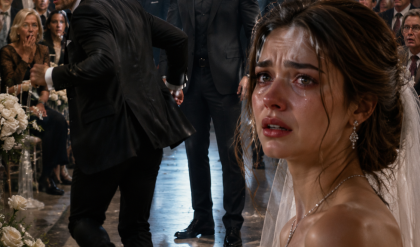
Celeste’s expression trembled for the first time that night.
She did not walk to him. She did not embrace him. She simply nodded once, and in that nod was more dignity than any forgiveness he could have demanded.
The scandal broke across California by morning. Headlines called Dorian a crime boss, a reformed kingpin, a hypocrite, a husband exposed by his own cruelty. Some articles focused on Victor’s arrest. Others focused on the hidden cannery ledgers. A few focused on Celeste, calling her poised, brilliant, wronged, brave.
She hated all of those words.
“I was not brave every day,” she told Dorian one rainy afternoon a week later. They were sitting across from each other at the kitchen island while attorneys occupied the dining room with boxes of documents. “Some days I was just tired.”
“Tired still counts,” Dorian said.
She gave him a faint, surprised smile. “You would not have said that before.”
“No,” he admitted. “Before, I would have called it weakness.”
“And now?”
“Now I think weakness is needing everyone to believe nothing hurts you.”
Celeste looked down at her tea.
That evening, after the lawyers left, she placed a polished walnut box on the dining table. Dorian recognized it from her studio shelf. The edges were worn smooth from years of handling.
“I think you should read these,” she said.
“What are they?”
“The conversations I stopped trying to have.”
She left him alone with the box.
Inside were dozens of folded letters tied with a pale blue ribbon. None had been mailed. Each carried a date in Celeste’s handwriting.
The first letter was from six years earlier.
Today you forgot to ask how my presentation went, but I know the port strike worried you. I wish I did not have to make myself smaller every time your world feels heavy.
Another was dated the night he missed their anniversary dinner.
I told the restaurant you had an emergency because it sounded kinder than saying you chose another meeting. I do not know whether I was protecting you from embarrassment or myself from the truth.
Another was shorter.
I miss you most when you are sitting beside me.
Dorian read until the words blurred. There were no dramatic accusations. That made them worse. The letters were records of ordinary injuries, each one small enough to dismiss alone and devastating together. A missed question. A forgotten promise. A dinner eaten cold. A song played to an empty room. A wife slowly learning not to reach for a husband who had trained himself not to reach back.
Near the bottom was the letter from the night of the reception.
Today I heard the truth you never meant for me to hear. I cried where you could not see me because I refused to let your cruelty become another room where men laughed. Tomorrow I will stop waiting for you to become the man I hoped you already were.
Dorian covered his face with both hands.
The last envelope had no date.
If you are reading this someday, I hope it is because you finally wanted to know me, not because you are afraid of losing me.
He found Celeste on the terrace watching rain dissolve the horizon.
“I read them,” he said.
“I know.”
“I don’t know how to carry what I did.”
She kept her eyes on the ocean. “You start by not handing it back to me.”
That answer changed him more than comfort would have.
Over the next months, Dorian’s life did not become simple. Victor’s case widened. Former partners turned on one another. Callaway Coastal lost contracts, then regained some under new oversight. Dorian stepped down from two boards, fired three executives, and sold a private development parcel to fund restitution for families harmed by forged liens. Reporters waited outside gates. Old enemies tested his weakened influence. Men who had once laughed at his cruelty now called him sentimental behind closed doors.
He let them.
At home, the changes were quieter and harder.
He came home for dinner and left his phone in another room. He learned his mother was allergic to lilies. He learned Celeste liked her coffee with cinnamon in winter, not because she told him as a test, but because he paid attention when she reached for it twice. He learned the names of the buildings she loved and the reasons certain rooflines made her sad. He washed dishes. He weeded the garden badly until she showed him how to pull from the root. He sat in the music room one evening while she played half a song, then stopped.
“You can keep playing,” he said.
“I know,” she replied.
But she did not.
Trust did not return on command. It returned like a cautious animal, approaching only when no one lunged for it.
One Saturday before sunrise, Dorian stepped onto the terrace with two mugs of coffee. The Pacific was still dark, the horizon barely silver. Celeste joined him a minute later in a gray sweater, her hair loose over her shoulders.
“You remembered,” she said, looking at the second mug.
“You always liked sunrise before the world started asking for things.”
She accepted the coffee.
They stood side by side while the sky brightened. For once, Dorian did not rush the silence.
After a while, he reached into his coat pocket and removed a small velvet box. He opened it in his palm. Inside lay her wedding ring.
Celeste looked at it for a long time.
“I’m not asking you to put it on,” he said. “I’m not asking you to forget. I only wanted you to know I found it, and I finally understood why you took it off.”
She touched the ring with one finger, then gently closed the box.
“Some things cannot go back to what they were,” she said.
“I know.”
Her eyes lifted to his.
“Do you?”
He nodded. “I don’t want what we were. I want to become someone who can be trusted with what comes next.”
For a long moment, only the waves answered.
Then Celeste took his free hand.
It was not forgiveness. Not fully. It was not surrender. It was not the ending Dorian once would have demanded because powerful men preferred clean victories.
It was a beginning, and because it was honest, it meant more.
Later that morning, while sunlight filled the villa, Dorian heard the piano for the first time in months. The melody was quiet at first, uncertain, then steadier. He stopped outside the music room but did not enter until Celeste looked up and invited him with the smallest nod.
He sat in the chair near the window and listened.
The house did not become whole because of one apology, one public confession, or one sunrise. It became warmer through repeated choices: a question asked before it was too late, a meeting canceled for a meal, a hand held without demanding proof that it had healed everything.
The sentence that broke their marriage could never be erased.
But it no longer had the final word.
Celeste’s restoration of St. Agnes Cannery Chapel opened the following spring. The hidden room beneath it was sealed behind glass, not to glorify the crimes once stored there, but to remind visitors that truth survives best when people stop burying it. On opening day, Dorian stood at the back while Celeste gave her speech.
“Restoration is not pretending damage never happened,” she told the crowd. “It is choosing care after neglect, truth after silence, and patience after pride.”
Dorian did not clap first. He waited, listened, and let the room honor her without making himself part of it.
When the applause finally faded, Celeste walked down the aisle toward him. On her left hand, the ring was still absent. But her fingers found his, steady and warm, and this time Dorian understood the difference between possession and grace.
Outside, the Pacific wind moved through the old chapel doors, carrying the sound of waves against the California shore.
For the first time in years, Dorian did not feel powerful.
He felt grateful.
And for the first time, that was enough.
THE END