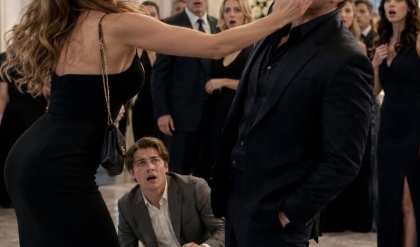
Dominic stared. “Are you out of your mind?”
“I asked because if he’s still throwing glass, I’ll wait. If he’s done, I need to sweep before it gets ground into the rug.”
Another man gave a stunned laugh, then stopped when he realized she was serious.
Dominic lowered his voice. “That’s Sebastian Vale in there.”
“I know who signs the checks.”
“He’ll tear you apart for walking in.”
Maggie looked at her watch. “Mrs. Harlan wants the private wing finished by eleven. I have another shift after this.”
Before Dominic could stop her, she took her broom, pushed open the door, and entered the lion’s den.
The study looked as if a wealthy hurricane had passed through it. Papers covered the floor. Whiskey ran in amber streams down the side of a carved mahogany desk. A broken vase lay near the fireplace in blue-and-white pieces. Sebastian Vale stood among the wreckage with his tie discarded, his white shirt open at the throat, and a dark scar visible beneath his collarbone.
He turned slowly.
Maggie had seen handsome men before. Sebastian was not handsome in any comforting way. He was sharp-boned, dark-haired, and built with the controlled strength of someone who did not waste motion. His face belonged on a magazine cover; his eyes belonged to a locked room.
“What the hell,” he said, “do you think you’re doing?”
Maggie surveyed the floor and sighed with the sincere weariness of a woman who had cleaned up after too many grown men. “My job.”
His stare hardened. “I didn’t call for a maid.”
“No, sir. But you did break glass on an antique rug.”
Sebastian took one step toward her. “Get out.”
Maggie leaned her broom against the desk, crouched with effort, and began gathering shards into a dustpan. “I will as soon as this is safe.”
The silence behind her became enormous.
“Do you know who I am?”
“Yes.”
“And you’re still ignoring me?”
“No, Mr. Vale. I’m listening while sweeping.”
He moved closer until his shadow fell across her hands. “People have disappeared for less disrespect than this.”
Maggie straightened slowly. Her knees cracked. She was not tall, not delicate, and not quick, but she had spent her life refusing to apologize for occupying space she needed to survive. She met his eyes.
“With respect, sir, if you keep stepping there, you’ll grind glass into the fibers. Then I’ll spend three hours with tweezers pulling pieces out one by one. I have no intention of doing that because you had a bad morning. Please move to your left.”
From the doorway, someone inhaled like a man witnessing his own funeral.
Sebastian Vale stared at her.
Then, astonishingly, he moved left.
Maggie nodded. “Thank you.”
She went back to sweeping.
That should have been the end of her employment. Instead, it became the beginning of an arrangement nobody in Vale House knew how to explain. Sebastian did not apologize for the mess, but he did not dismiss her either. He stood in the middle of his ruined study and watched her restore order piece by piece. When she wiped whiskey from his desk, he lifted his hands without being asked. When she gathered the scattered papers, he told her which stack mattered. When she finished, he asked her name.
“Maggie Calloway.”
“Are you afraid of me, Maggie Calloway?”
She considered lying, but she was too tired. “I’m afraid of late fees, hospital bills, and my brother answering calls from numbers he should block. You’re just a man with expensive furniture and poor coping skills.”
For three seconds, Sebastian did nothing.
Then he laughed.
Not politely. Not warmly. A real laugh, rough and surprised, as if something locked inside his chest had been forced open against its will.
From that day forward, Maggie was allowed into the study.
The household noticed. Armed men who had seen Sebastian break knuckles over betrayal watched a plus-size maid walk into his meetings with fresh coffee and a dust cloth, and they said nothing. She moved through discussions of shipping routes, union problems, political favors, and territorial threats with the same practical calm she brought to clogged drains. She never reacted to names. She never repeated conversations. She never lingered. If Sebastian’s voice rose while she was in the room, one glance from her could lower it.
“You’re scaring the silverware,” she once told him while replacing a tray.
His men froze.
Sebastian looked at the tray, then at her, and his mouth twitched. “My apologies to the silverware.”
That made it worse for Graham Sloane.
Graham had been Sebastian’s second for five years, a slim, elegant man with ash-blond hair, tailored suits, and ambition polished so bright it reflected nothing human. He had survived in Sebastian’s world by becoming useful. He knew which city inspectors could be bought, which dock supervisors could be frightened, which politicians preferred checks through charities rather than envelopes. He believed loyalty was a costume intelligent men wore until power came within reach.
Maggie offended him by existing.
“She waddles into meetings like she owns the place,” Graham said one afternoon in the billiard room, his voice carrying just enough for nearby men to hear. “I don’t understand your fascination, Sebastian. If you wanted company, you could buy prettier silence.”
Sebastian set down his cue.
The room chilled.
Maggie was in the hallway outside with a basket of folded towels. She stopped because no working woman with sense walked into a room when men were about to show their worst selves.
Sebastian’s voice came softly. “Repeat that.”
Graham gave a short laugh. “I only meant the maid is becoming a distraction.”
“The maid has a name.”
“Fine. Maggie.” Graham’s tone sharpened. “You cannot run an organization while letting some fat housekeeper look at you like she’s your conscience.”
A chair scraped.
Maggie closed her eyes.
Inside the billiard room, Sebastian crossed the floor and seized Graham by the collar, slamming him back against the paneled wall hard enough to rattle a framed photograph. His voice remained quiet.
“You will speak of her with respect.”
Graham choked out, “Sebastian—”
“No. Listen carefully. Maggie Calloway has more courage carrying towels through this house than you have carrying a gun beside me. If I hear you mock her body again, I will remove you from my table so completely your own shadow won’t remember you.”
He released him.
The humiliation did not make Graham cautious. It made him inventive.
Over the next two weeks, Maggie noticed the house changing. Men who had once nodded to Graham began avoiding his eyes. Dominic, the guard who had warned her away from the study, started appearing near the service halls without explanation. Mrs. Harlan checked locks twice. Sebastian spent longer hours behind closed doors, his temper quieter but more dangerous.
Then Noah disappeared.
At first, Maggie thought he was ignoring her calls because he owed her money again. That was Noah’s pattern. Charm, apology, promise, relapse. He was twenty-four, handsome in a boyish way, and tragically convinced the next game would fix the last game. Maggie had raised him after their mother’s death and resented him in the complicated way only exhausted love can resent. She wanted to shake him. She wanted to save him. Sometimes she wanted one full day when nobody needed anything from her.
By noon Tuesday, his phone went straight to voicemail.
By two, Maggie was carrying linens toward the laundry room when Graham stepped out of the shadows.
“Maggie.”
She stopped.
Two men she did not recognize blocked the hallway behind her. They were not Sebastian’s usual guards. That mattered. In Vale House, unfamiliar men in familiar halls meant someone had opened a door that should have stayed closed.
Graham smiled. “Your brother has expensive hobbies.”
Maggie’s fingers tightened around the linens. “Where is he?”
“Safe, for the moment.”
“If you hurt him—”
“You’ll what?” Graham’s smile thinned. “Sweep aggressively?”
Heat crawled up Maggie’s neck, but fear for Noah held her still.
Graham stepped closer and took a small glass vial from his jacket. Clear liquid caught the service light. “Sebastian takes espresso at four. You prepare it. You bring it. Today, you add this.”
Maggie stared at the vial. “No.”
“Noah owes fifty thousand dollars.”
“That’s impossible.”
“It was easy, actually. A few friendly games. A few generous advances. Boys like Noah always believe debt is something that happens later.” Graham pressed the vial into her hand. “Later has arrived.”
She tried to give it back. “I’m not killing anyone.”
Graham caught her wrist. His grip bruised. “Then Noah loses his hands tonight. After that, we’ll see how long a man can stay charming without fingers.”
Maggie’s breath shook.
Graham leaned near her ear. “Don’t be sentimental. Sebastian Vale is not your friend. You clean his floors. He protects you because you amuse him. When that ends, you’ll be back in Briar Glen with shutoff notices on your refrigerator and a brother who never learns. One cup of coffee, and both your problems go away.”
He let go.
The vial remained in her palm.
At 3:55, Maggie stood in the kitchen with the espresso machine hissing behind her and the vial in her apron pocket. Rain struck the tall windows. Copper pots gleamed above the island. The kitchen staff had been cleared out by some invisible order. That frightened her more than witnesses would have.
She set the cup on the silver tray.
Her hands shook so badly the saucer clicked.
Noah as a little boy flashed through her mind, small and feverish in a thrift-store blanket while Maggie fed him soup from a chipped mug. Noah at sixteen, crying after their mother’s funeral where only seven people came. Noah at twenty, swearing he could win enough money to get Maggie out of the apartment above the laundromat.
Then Sebastian’s face came to her. Not the terrifying Don everyone whispered about, but the man who moved left when she told him to. The man who drank cold espresso rather than interrupt her when she was dusting. The man who once found her sitting on the back steps after a cruel call from Noah and said, awkwardly, “There are guest rooms if you need ten minutes where nobody asks you for anything.”
She had laughed because rich men believed guest rooms fixed grief.
But he had meant it.
That made the choice harder, not easier.
At four exactly, Maggie knocked on the study door.
“Come in,” Sebastian called.
He sat behind his desk, jacket off, sleeves rolled, dark hair slightly disordered. He looked tired in a way power could not hide. When he saw her, the severity around his mouth eased.
“Right on time.”
Maggie walked toward him. Each step felt like crossing a frozen lake.
He reached for the cup.
She slapped his hand away.
Now, standing in the aftermath of truth, Maggie understood that her choice had not ended danger. It had only moved danger into the open.
The estate lockdown happened with terrifying efficiency. Doors sealed. Guards shifted. Radios murmured. Somewhere below, vehicles moved across gravel. Sebastian left Maggie inside the study with the deadbolt turned and the poisoned espresso covered on the desk.
For seven minutes, nothing happened.
Then came shouting.
Maggie pressed her back against the bookshelves, arms wrapped around herself. She expected gunfire. She expected screams. She expected the kind of violence people later pretended not to hear.
Instead, she heard Sebastian’s voice through the hall, cold and carrying.
“On your knees, Graham.”
Another voice—Graham’s—answered with a laugh too high to be confident. “You’re making a mistake.”
“No,” Sebastian said. “I almost made one. Maggie corrected it.”
The study door remained locked. Maggie’s imagination filled in what she could not see: Graham cornered, Sebastian’s men surrounding him, the mansion holding its breath. Then another voice broke through the tension.
“Mags?”
Maggie’s heart nearly stopped.
“Noah?” She rushed to the door and grabbed the handle, forgetting the lock.
“Mags, don’t open it!” Noah shouted from the hallway. His voice cracked with panic. “Don’t open anything!”
Sebastian said, “Bring him here.”
The lock turned from the outside. When the door opened, Noah stumbled in with Dominic gripping his arm. Her brother’s lip was split, his face white, but he was alive. Maggie caught him so hard the breath left him.
“You idiot,” she sobbed into his shoulder. “You stupid, stupid idiot.”
“I’m sorry,” Noah whispered. “I thought I could win it back.”
“You always think that.”
“I didn’t know it was him.” Noah looked past her at Sebastian, who stood in the doorway with Graham kneeling in the hall behind him, wrists bound. “I didn’t know they wanted you to do anything.”
Graham’s laugh cut through them. “Touching. Really.”
Sebastian did not look away from Noah. “Who invited you to the games?”
Noah’s eyes darted to Graham.
Sebastian’s jaw tightened. “Say it.”
Noah swallowed. “Mr. Sloane. He said he knew people who could help me earn fast cash. Said Maggie worked too hard and I should act like a man for once.”
Maggie felt the words like a knife because they had been chosen perfectly. Graham had not simply found Noah’s weakness. He had named his shame and fed it.
Sebastian turned to Graham. “You built the debt.”
Graham’s face twisted. “I built an opportunity. She was nobody. Nobody watches the help. That was the whole point.”
There it was. The assumption that had almost killed a man and destroyed a woman. Nobody watches the help.
Maggie stepped out from behind Sebastian before anyone could stop her. Her cheeks were wet. Her uniform was wrinkled. Her body was exactly the body Graham had mocked, dismissed, and underestimated.
“You’re wrong,” she said.
Graham smirked despite the fear in his eyes. “Am I?”
“Yes.” Her voice steadied. “The help watches everyone.”
Sebastian glanced at her.
Maggie moved to the desk, opened the lower drawer, and took out a narrow leather notebook. Sebastian’s notebook. She had found it three days earlier beneath a pile of old invoices while cleaning, and because she did not read private things, she had put it away. But she had noticed something sticking out: a torn receipt with the name Bellweather Civic Fund.
At the time, it had meant nothing.
Now it meant too much.
She opened the notebook to the marked page and placed it on the desk. “I’ve seen this name before. Bellweather Civic Fund. It was on the court papers when my father’s trucking company was taken after he died. I was seventeen. My mother said the judge called it a lien transfer. We never understood it. We lost everything.”
Sebastian went still.
Graham’s expression changed, just for a heartbeat.
Maggie saw it.
So did Sebastian.
“What judge?” Sebastian asked.
“Harland Bell,” Maggie said.
Graham looked away.
Sebastian stepped toward him. “You’ve been feeding Archer Voss information through Judge Bell.”
Graham said nothing.
Sebastian crouched in front of him. “And Bellweather Civic Fund is how Voss launders seized assets.”
Graham’s silence became confession.
The twist did not come like lightning. It came like a door opening onto a room Maggie had unknowingly lived beside for twelve years. Her father’s death. The impossible paperwork. The freight company sold for pennies. Her mother working herself sick. The apartment above the laundromat. Noah’s shame. Every desperate year had roots in a machine men like Graham and Judge Bell had built, then hidden beneath legal language.
Maggie had walked into Vale House for money to pay an electric bill.
She had found the people who helped destroy her family.
Sebastian understood before she did. His face changed, not with rage this time, but with something more dangerous because it contained guilt.
“My father used Bell for filings years ago,” he said quietly. “I knew he was corrupt. I didn’t know he was stealing civilian businesses.”
Maggie looked at him. “Does not knowing make it clean?”
The hallway went silent.
Dominic shifted as if expecting Sebastian to explode.
Sebastian did not.
“No,” he said. “It doesn’t.”
That answer changed something between them. Not forgiveness. Not yet. But a line had been drawn, and Sebastian Vale had chosen to stand on the side where truth hurt him.
Graham tried one last time to save himself. “You think she cares about truth? She wants someone to blame. Give her Bell, give her Voss, she’ll still look at you like a monster. Because that’s what you are, Sebastian. You can dress this place in marble, but it’s built on fear.”
Sebastian rose.
“For once,” he said, “you’re almost right.”
He turned to Dominic. “Take Graham downstairs. Alive. I want every phone, every account, every file. Nobody touches him without my order.”
Graham’s eyes widened. He had expected violence. He had prepared for it. Men like him understood bullets better than consequences.
“Sebastian,” he said, his voice cracking. “Don’t do this.”
Sebastian looked at Maggie, then at Noah, then at the poisoned cup still waiting on his desk.
“I’m done letting men call murder management.”
That night, nobody slept in Vale House.
Noah sat in the kitchen with an ice pack against his mouth while Maggie made him eat toast because terror on an empty stomach helped no one. Dominic stood by the door, pretending not to listen while Maggie scolded her brother in a low, furious voice.
“You don’t get to gamble with my life because you hate feeling helpless.”
Noah stared at the table. “I know.”
“No, you don’t. Knowing means changing.”
“I’ll change.”
“You’ll get help,” she said. “Real help. Not promises. Not tears. Not flowers from a gas station. Help.”
He nodded, crying quietly.
Maggie’s anger softened because love was cruel that way. It could not stay sharp when the person bleeding in front of you was still the little boy you once carried through a snowstorm because the bus stopped running.
Across the estate, Sebastian’s loyal men dismantled Graham’s network. By dawn, they had phones, ledgers, wire records, payoff lists, and enough evidence to make several powerful men wish they had chosen honest work. Graham had not merely betrayed Sebastian to Archer Voss. He had helped Judge Harland Bell create a pipeline between criminal pressure and legal theft. Small businesses were pushed into debt, seized through corrupt rulings, sold to shell companies, and folded into larger operations. Some became fronts. Some vanished. Families like Maggie’s were treated as collateral damage.
At six in the morning, Sebastian found Maggie in the laundry room folding towels with mechanical precision.
“You don’t have to work today,” he said.
“I know.”
“Then why are you folding towels?”
“Because if I stop moving, I’ll start screaming.”
He accepted that and leaned against the doorway.
For a while, the only sound was fabric snapping softly into shape.
Finally, Maggie said, “What happens now?”
Sebastian looked older than thirty-four in the gray morning light. “I can handle Voss the old way.”
She set a towel down. “And?”
“And nothing changes.” He rubbed a hand over his face. “Another man steps in. Another judge takes money. Another family loses everything and never learns why.”
Maggie studied him carefully. “That sounds almost like a conscience.”
“It’s inconvenient.”
“They usually are.”
He gave the smallest smile, but it faded quickly. “There is another way. Riskier. Slower. My attorneys have enough legitimate distance to approach federal investigators through a protected channel. If I give them Bell and Voss, they’ll want more. They’ll want pieces of my father’s business, maybe mine. I can protect some people. Not everyone.”
“Including yourself?”
His eyes met hers. “Maybe less than I’d like.”
Maggie folded another towel. “Why are you telling me?”
“Because your family was harmed by the machine my family benefited from. You deserve to know whether I plan to keep feeding it.”
That was not an apology. It was not enough. But it was something rare in Sebastian Vale’s world: an admission without decoration.
Maggie nodded toward the towel stack. “Then stop feeding it.”
Three weeks later, the sit-down with Archer Voss took place at a private restaurant called Maribel’s, tucked behind a brick courtyard in downtown Alderport. It was the sort of place with no sign, no menu prices, and too many exits to be accidental. Sebastian arrived with Dominic and two guards. Maggie arrived beside him in a deep green dress Mrs. Harlan had insisted on having tailored after declaring the maid uniform “emotionally inappropriate for revenge.”
Maggie had protested. She was not a gangster’s girlfriend. She was not a queen. She was a housekeeper with overdue dental work and a brother in addiction counseling.
Mrs. Harlan had only zipped the dress and said, “Tonight you are evidence with earrings.”
Sebastian had gone silent when Maggie entered the foyer. His gaze moved over her, not greedily, not with surprise that she could be beautiful, but with something steadier and far more dangerous to her composure.
“You look like yourself,” he said.
Maggie glanced down at the dress skimming her full hips, her soft stomach, her generous arms. “That’s a diplomatic answer.”
“No,” he said. “It’s the highest compliment I know.”
At Maribel’s, Archer Voss waited at the far end of a long table. He was older than Sebastian, with silver hair, a scar near his jaw, and the relaxed cruelty of a man who had ruined lives from comfortable chairs. Judge Harland Bell sat beside him, red-faced and sweating despite the cool room. Two of Voss’s captains stood behind them. Their eyes flicked to Maggie and dismissed her in the same breath.
Archer smiled. “Sebastian. I heard you survived a rough week.”
“I had help.”
“So I see.” Archer’s smile widened at Maggie. “When rumors said you brought a woman to the table, I expected strategy. Not dessert.”
Dominic’s hand shifted toward his jacket.
Sebastian’s face went lethal.
Maggie placed her hand on his forearm. “Don’t.”
Archer laughed. “She gives commands too? That’s charming.”
Maggie opened the folder in front of her. Her hands were steady now. Fear had burned through and left purpose behind.
“Mr. Voss, twelve years ago Bellweather Civic Fund acquired Calloway Freight after Judge Bell approved an emergency lien transfer. The debt used to justify that seizure was fraudulent.”
Judge Bell’s mouth fell open.
Archer stopped smiling.
Maggie continued, her voice calm enough to make every word heavier. “The same pattern appears in thirty-one other cases across Alder County and Briar Glen. Small companies. Family properties. Independent warehouses. In each case, the asset was transferred under court pressure to a shell corporation connected to your network. In several cases, those assets were later used for trafficking stolen goods through your logistics chain.”
Archer looked at Sebastian. “Control your maid.”
Sebastian leaned back. “I tried once. She told me to move left.”
Maggie slid copies of bank transfers across the table. “These are not originals. The originals are already with people you cannot threaten before breakfast.”
That was not entirely true. The evidence was with Sebastian’s attorneys, who were waiting for one phone call to deliver it. But Archer did not know that, and men like him feared uncertainty more than accusation.
Judge Bell wiped his forehead. “This is absurd.”
“No,” Maggie said. “Absurd is a seventeen-year-old girl being told her father’s company vanished because she was too poor to understand legal paperwork. Absurd is my mother dying ashamed because men in suits made theft look official.” Her voice thickened but did not break. “I understand now.”
Archer’s eyes narrowed. “What do you want?”
Sebastian answered. “You sign over every asset tied to Bellweather seizures into a restitution trust. You withdraw from Hawthorne Harbor. You give up Bell’s records and Graham’s contacts. Then you spend whatever time you have left praying the federal government gets to you before your own men realize how much you skimmed from them.”
A Voss captain stiffened. “Skimmed?”
Maggie took out another set of papers and placed them on the table. “Private accounts under three names. Quarterly transfers. Your men took pay cuts after the Morrow Pier loss. Mr. Voss did not.”
Archer’s face lost color.
This was the second trap, and Maggie had built it from the same skill that had kept her alive for years: noticing what powerful people assumed nobody saw. Overdue bills had trained her to understand numbers. Cleaning offices had taught her which drawers executives locked and which mistakes they left in trash bins. Being ignored had given her invisibility. Pain had taught her patience.
Archer reached for the papers.
His captain reached faster.
The room changed.
Sebastian did not draw a weapon. He did not have to. Voss’s own men were reading now, and suspicion moved through them like smoke. Archer had survived by making everyone afraid of betrayal. Maggie had simply shown them where to look.
“You stupid woman,” Archer hissed.
Maggie looked at him, and for the first time in her life, the insult did not enter her skin.
“No,” she said. “Just one you didn’t count.”
Judge Bell began to talk before dessert plates could be cleared.
By dawn, Archer Voss was under federal protection because his own organization had fractured around him. Judge Bell’s records opened cases that had been buried for a decade. Graham Sloane traded testimony for a sentence that still left him shaking when he heard Sebastian Vale’s name. Assets moved into court-supervised restitution. Families who had believed themselves foolish, unlucky, or alone received letters explaining that what happened to them had been a crime.
Maggie received one too.
Calloway Freight could not be returned as it had been. Her father could not walk through the door, wiping grease from his hands, teasing her mother about burnt toast. Her mother could not be given back the years she spent drowning in debt. But money arrived in a trust bearing her family’s name, along with something Maggie had not expected to matter until she held it: a formal acknowledgment that they had been wronged.
She cried harder over the acknowledgment than the check.
Six months after the poisoned espresso, Vale House no longer felt like a fortress waiting to bite. The gates still stood, but fewer armed men occupied the halls. Several of Sebastian’s businesses had been separated, audited, sold, or remade under legal oversight. The process was ugly, expensive, and humiliating to men who preferred shadows. Sebastian lost allies. He gained enemies. He also slept more, though he denied it.
Noah worked in the filing department of a legitimate warehouse three towns over, not because Sebastian handed him an easy life, but because Maggie insisted he earn one. He attended counseling twice a week, surrendered his paycheck to automatic budgeting, and called Maggie every evening at nine. Some nights he sounded hopeful. Some nights ashamed. Maggie learned to love him without rescuing him from every consequence, which was harder than facing Graham in a hallway.
Mrs. Harlan retired twice and returned both times because “men left alone with marble cannot be trusted.”
Dominic became Maggie’s most loyal ally after she caught him hiding pastries behind security monitors and told him men with cholesterol should not gamble with cannoli.
And Sebastian Vale, once the storm at the center of Hawthorne Harbor, learned the strange discipline of asking before acting.
He asked Maggie to dinner.
She said no the first time because gratitude was not romance, and she refused to be turned into a symbol because she had done the decent thing under pressure.
He asked again three weeks later.
She said no because he still used silence as a weapon.
He began speaking more honestly, which made everyone in the house uncomfortable.
The third time, he asked her to walk with him along the bluff after rain. Maggie wore a navy coat and practical shoes. Sebastian wore a black overcoat and the expression of a man approaching a negotiation he could not win by intimidation.
“I don’t know how to be gentle,” he admitted as they watched waves strike the rocks below.
Maggie kept her eyes on the water. “Gentle is overrated when it’s fake.”
“I don’t want to own you.”
“That’s good, because I’m not furniture.”
His mouth curved. “I know.”
“Do you?”
Sebastian turned toward her. “I want to stand beside you. I want to listen when you tell me I’m wrong. I want to build something that does not require people to lower their eyes when I enter a room. And I want you in my life, Maggie. Not because you saved me. Because when you look at me, I have to decide whether I’m worth saving.”
The wind moved between them.
Maggie thought about the first day in his study, the glass in the rug, the man too angry to see the damage beneath his own feet. She thought about the poisoned cup, Graham on his knees, Archer’s face when the woman he mocked dismantled him with paperwork. She thought about her mother, who had once said love was not a rescue boat but a porch light. It could guide someone home, but they still had to walk.
“I’m not here to redeem you,” she said.
“I know.”
“I won’t be your pretty excuse.”
“You were never an excuse.”
“And if you ever call me yours like I’m property, I’ll leave so fast your guards will think I evaporated.”
Sebastian nodded solemnly. “Understood.”
Maggie finally looked at him. “But you can ask me to dinner again.”
He smiled then, not like a Don, not like a millionaire, not like a man feared by half the county. He smiled like someone who had been handed a second chance and was terrified of dropping it.
“Maggie Calloway,” he said, “would you have dinner with me?”
She pretended to consider. “Only if the restaurant has chairs that don’t punish women for having hips.”
“I’ll buy the restaurant if it doesn’t.”
“Sebastian.”
“Right. Too much.”
She laughed, and this time the sound did not surprise him. It steadied him.
A year later, the west wing of Vale House opened as the Calloway Center for Restitution and Renewal. The name embarrassed Maggie, but Sebastian refused to change it. The center offered legal aid for families harmed by corrupt seizures, financial counseling for people drowning in predatory debt, and job placement for those leaving criminal networks before those networks consumed them. It did not fix everything. Nothing did. But every Thursday, Maggie sat in a sunlit office that had once stored imported liquor and listened to people tell stories others had dismissed.
A mechanic whose garage had been stolen.
A widow whose home had been tied up in false liens.
A young man with gambling debt who reminded Maggie painfully of Noah.
She listened without pitying them. Pity looked down. Maggie had spent too much of her life being looked down on to offer that to anyone else. Instead, she gave them forms, phone numbers, coffee, and the steady assurance that shame was not proof of guilt.
On the first anniversary of the day she slapped Sebastian’s hand away from the espresso, he found her in the old study. It had changed too. The heavy curtains were gone. The rug had been replaced. The desk remained, but there were fewer locked drawers and no whiskey decanters to throw.
Maggie stood near the fireplace, holding a small framed document.
“What is that?” Sebastian asked.
“My father’s first business license.” She smiled softly. “They found it in the restitution files.”
Sebastian came to stand beside her. “He would be proud of you.”
“He’d be confused by most of this.”
“That too.”
She leaned into him, and he put an arm around her with the care of a man who had learned that holding was not the same as possessing.
After a while, Maggie looked at the clean rug beneath their feet.
“You remember the first thing I said to you?”
Sebastian’s mouth twitched. “You told me to move left.”
“You did.”
“I’ve been moving left ever since.”
She laughed, but her eyes stung. “Good.”
Outside, the estate gates stood open for once. Cars came and went. People arrived carrying folders, questions, grief, and hope. Vale House, once a monument to fear, had become something stranger and braver: a place where damage was admitted, where power was forced to kneel before repair, and where a woman the world had called too much became exactly enough to change it.
Maggie Calloway had not tamed a monster with sweetness. She had not won by becoming thin, silent, cruel, or easy to display. She had walked into a room full of broken glass and demanded space to do what needed doing. She had refused to become a murderer, refused to remain invisible, and refused to confuse protection with love unless it came with respect.
And Sebastian Vale, who had once believed fear was the only language power understood, learned from a chubby housekeeper with tired eyes and an iron will that the strongest person in any room is often the one who can still choose mercy when fear gives them every excuse not to.
THE END