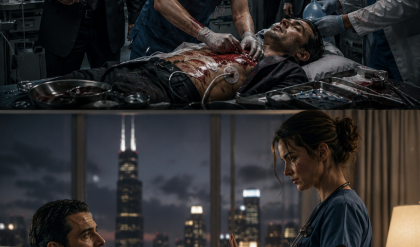
I looked up at the rooftop terrace far above us.
“No,” I said. “But I’m here.”
The party looked like something designed for a magazine spread. White roses spilled from tall glass vases. Candles flickered on every table. A jazz trio played near the bar. Servers moved through the crowd with champagne and tiny food nobody actually ate. A neon sign behind the dessert table read Brooke & Nate, glowing soft gold against a wall of ivy.
And there, in the center of it all, was my sister.
Brooke Whitaker looked breathtaking.
Her dress hugged her like liquid champagne. Her hair fell in perfect waves. Her ring was so large people kept asking to see it, and she offered her hand with a practiced laugh every time.
Beside her stood Nathan Carlisle, heir to a real estate family with old money, good manners, and a face too honest for the world he was marrying into. Nate had always been kind to me. Not pitying. Kind. There was a difference.
When he spotted me near the elevator, his smile warmed.
“Claire,” he said, coming straight over. “I’m so glad you came.”
He bent and hugged me carefully, asking first with his eyes before touching me. That small courtesy nearly undid me.
“Congratulations,” I said.
“Thank you.” He looked over his shoulder at Brooke, then back at me. “It means a lot that you’re here.”
Across the terrace, Brooke’s smile tightened.
At first, the night was almost bearable.
People came by to say hello. Some were awkward. Some were sincere. An older woman from Nate’s family crouched beside my chair and told me she had followed my recovery updates through Diane.
“You’re so brave, sweetheart,” she said.
I hated being called brave for existing, but I smiled anyway.
“Thank you.”
Another guest asked if the venue had been accessible enough. Someone else said they were praying for me. A cousin I hadn’t seen in years squeezed my hand and cried a little.
Every kind word landed like a stone in Brooke’s perfect pond.
I saw it happening.
Her laughter got sharper. Her eyes kept cutting toward me. When a photographer suggested we take a family picture with me positioned near the front, Brooke said, “Maybe later,” in a voice that meant never.
At the bar, I overheard her hiss to our mother, “This is starting to feel like a charity event.”
“Brooke,” Mom whispered. “Smile. People are watching.”
“They’re watching her.”
I turned my chair toward the city and swallowed the old ache.
There it was again. The competition I never entered and somehow kept winning in her mind.
I stayed quiet. I kept my hands folded in my lap. I tried to make myself smaller, the way I always had. Smaller than the wheelchair. Smaller than the pity. Smaller than Brooke’s hunger.
Then Nate’s aunt came over.
She was a silver-haired woman with soft eyes and a navy shawl. She didn’t crouch dramatically or speak to me like a child. She simply sat in the chair beside mine and said, “I heard you work with children in rehab.”
“I did,” I said. “I’m hoping to go back part-time eventually.”
“That’s beautiful work.”
“I miss it.”
“I imagine they miss you too.”
Such a simple sentence.
Such a gentle one.
But Brooke heard it.
The music was still playing when she snapped.
“Oh my God,” she said loudly.
Conversations faltered.
Nate turned. “Brooke?”
She laughed, but there was nothing joyful in it. “Can everybody stop acting like my sister is the guest of honor for five minutes?”
The rooftop froze.
Heat rushed to my face. “Brooke, don’t.”
“No, seriously.” She stepped away from Nate and walked toward me, champagne dress glittering under the lights. “Every conversation tonight has turned into some sad little sympathy session.”
Our mother moved quickly. “Honey, this is not the time.”
“It’s my engagement party,” Brooke said. “My party. And somehow Claire still finds a way to make it about her.”
“I didn’t ask anyone to come talk to me,” I said, my voice thin.
“You don’t have to ask.” Brooke’s eyes shone. Not with tears. With fury. “You just sit there looking tragic and everyone rushes over.”
Nate’s face changed. “That’s enough.”
But Brooke wasn’t looking at him.
She was looking at me.
At the chair.
At the visible proof of what she had done and what I had never said.
“You know what?” she whispered.
Then she walked behind me.
My whole body went cold.
“Brooke,” I said. “Step away.”
She gripped the handles.
“Stop faking for attention already.”
And she shoved me onto the floor.
Part 2
Pain has a way of making time cruel.
It stretches seconds into rooms you cannot escape.
I lay on the marble floor with my cheek pressed against something cold and polished, hearing voices break apart above me.
Someone screamed.
A glass shattered.
The jazz trio stopped playing mid-note.
My wheelchair lay on its side a few feet away, one wheel still spinning slowly, uselessly, like it hadn’t realized my life had just broken open again.
“My back,” I gasped. “My back, my back.”
Nate reached me first.
“Don’t move,” he said, dropping to his knees beside me. His voice shook so hard I barely recognized it. “Claire, don’t move. Somebody call 911.”
“I can’t—” I tried to breathe through the fire climbing my spine. “I can’t feel—”
“Look at me.” He took my hand, careful not to shift my body. “Stay with me.”
Brooke stood several feet away, pale beneath her makeup.
For the first time all night, no one was looking at her the way she wanted.
They were looking at her like they had finally seen her clearly.
“I didn’t mean—” she started.
“You shoved her,” someone said.
“I saw it,” another guest snapped. “She grabbed the chair and pushed.”
Our mother rushed forward, hands fluttering, face rigid with panic.
“It was an accident,” she said. “Everyone needs to calm down.”
An accident.
That word sliced deeper than the fall.
Nate looked up slowly. “Diane, are you serious?”
“She was emotional,” Mom said. “Brooke would never hurt her sister intentionally.”
A man from Nate’s side of the family stared at her. “She pushed a woman out of a wheelchair.”
“They’re sisters,” Mom insisted, as if that explained violence away. “This is private.”
“Private?” Nate’s voice hardened. “She could have paralyzed her.”
I closed my eyes.
Paralyzed.
The word I had spent six months avoiding. Doctors called it incomplete spinal cord trauma. Nerve damage. Mobility impairment. Uncertain long-term prognosis. They gave me careful language and cautious hope. They told me recovery could take years, that some function might return, that pain did not always mean damage and numbness did not always mean loss.
But there on the rooftop, on the floor beneath Brooke’s engagement lights, all I heard was the truth I had tried not to live inside.
My sister had broken me once.
And now she might have done it again.
Sirens wailed faintly somewhere below.
Nate stayed beside me. His thumb rubbed the back of my hand in small, helpless circles.
“I’m sorry,” he whispered.
I wanted to tell him he had nothing to be sorry for, but speaking hurt too much.
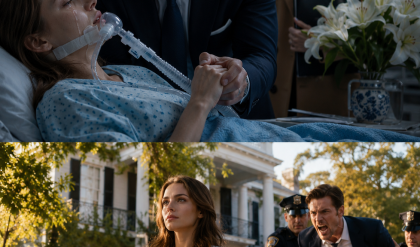
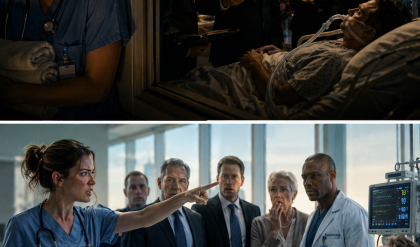
The elevator doors opened minutes later, and Dr. Hannah Reeves stepped out with two paramedics.
I had never been so relieved to see anyone.
Dr. Reeves wasn’t supposed to be there. Later, I learned Nate had invited her because she had become a family friend through my rehabilitation clinic’s charity board. She had arrived late, missing the shove by less than ten minutes.
When she saw me on the floor, her entire expression changed.
“What happened?” she demanded.
Nobody answered.
Then Nate said, “Brooke pushed her out of the wheelchair.”
The words landed across the terrace like thunder.
Dr. Reeves knelt beside me, instantly calm. “Claire, I need you to stay still. Tell me where the pain is.”
“Lower back,” I whispered. “And down my legs. Worse than before.”
“Any numbness?”
“I don’t know. It’s all burning.”
She touched my shoulder gently. “Okay. We’re going to move you carefully.”
Then she looked up.
Her gaze found Brooke.
I had seen Dr. Reeves angry before, but never like that. Hers was not loud anger. It was the kind that made a room colder.
“Do you understand what you may have just done?” she asked.
Brooke’s lips parted. “I didn’t push her that hard.”
Nate closed his eyes like the sentence physically hurt him.
Dr. Reeves stood. “Ms. Whitaker, your sister has an unstable spinal injury. She lives with chronic nerve pain, reduced mobility, and incomplete neurological recovery. A fall like this could cause permanent loss of function.”
Brooke’s face crumpled, but still, still, she looked more frightened for herself than for me.
“I didn’t know,” she whispered.
“You knew she was in a wheelchair,” Dr. Reeves said. “That was enough.”
Silence swallowed the rooftop.
The paramedics slid a board beneath me with agonizing care. I bit down on a sob as pain ripped white-hot through my lower back.
Nate swore under his breath.
“I’m okay,” I lied.
“No, you’re not,” he said.
Our father appeared beside my mother. Robert Whitaker looked old under the lights. Old and afraid. He stared at me on the stretcher, then at Brooke, then at the guests. For once, he seemed unable to disappear.
“Brooke,” he said weakly. “Apologize to your sister.”
Apologize.
As if she had stepped on my dress.
Brooke began to cry.
“I’m sorry,” she said, but she was looking at Nate when she said it. “I just—everyone kept acting like—this was supposed to be our night.”
Our night.
Not her sister’s body.
Not the ambulance.
Not the possible damage.
Our night.
Something inside me went very still.
The paramedics lifted the stretcher. As they secured the straps across me, memories from six months earlier rose up with the force of floodwater.
Brooke behind the wheel of her white Mercedes.
Rain exploding across the windshield.
The smell of vodka on her breath, hidden under peppermint gum.
“Slow down,” I had said, clutching the door handle.
“Relax,” she sang, one hand on the wheel, the other holding her phone. “You always think something bad is going to happen.”
“Because you’re driving too fast.”
She laughed. “God, Claire, do you ever get tired of being perfect?”
“I’m not trying to be perfect. I’m trying not to die.”
That made her angry.
Everything made Brooke angry when she thought she was being judged.
We had been leaving a private party at a lake house in Wisconsin. Brooke had fought with Nate that night because he asked why she was drinking so much. She stormed out and demanded I come with her. I followed because I always followed. Because someone had to get her home. Because I thought protecting Brooke was the same as loving her.
“You think he likes you better,” she snapped suddenly as the Mercedes flew along the wet road.
“What?”
“Nate. Everyone. Mom. Dad. Everyone acts like poor Claire is so good, so patient, so wonderful.”
“Brooke, look at the road.”
“Maybe if you weren’t always standing there looking innocent, people would actually see me.”
“Your eyes,” I said, panic rising. “On the road.”
Headlights appeared around the curve.
Brooke screamed.
The car swerved toward the guardrail and the steep drop beyond it. Instinct moved faster than thought. I grabbed the wheel and yanked it away from the edge.
The Mercedes slammed into a concrete barrier.
Metal screamed.
Glass burst.
My spine became fire.
When I woke in the hospital three days later, Brooke was beside my bed, sobbing so hard she could barely speak.
“I’m sorry,” she whispered. “I’m sorry, I’m sorry, I’m sorry.”
My mother stood behind her, mascara streaked, gripping Brooke’s shoulders as if my sister were the one in pieces.
“The police need a statement,” Dad said from the corner.
Brooke made a broken sound. “I’ll lose everything.”
Mom looked at me then.
Not with comfort.
With desperation.
“Claire,” she said softly. “The rain was terrible. You grabbed the wheel. You were scared. It was an accident.”
I stared at her through the fog of medication. “She was drunk.”
My mother flinched.
“She made a mistake,” Mom whispered. “A terrible mistake. But if this follows her, it will ruin her life. Nate’s family, her career, everything. You know how people talk.”
I looked at Brooke.
My twin. My mirror. My first friend. My lifelong wound.
She was shaking.
“Please,” Brooke said. “I can’t go to jail. I can’t lose Nate. Please, Claire. Please don’t let them hate me.”
I was twenty-nine years old, lying in a hospital bed, unable to feel my legs properly.
And I comforted her.
When the investigators came, I told them the weather was bad. I said I panicked. I said I grabbed the wheel and caused the crash.
Brooke cried with relief.
My mother kissed my forehead and called me “our strong girl.”
My father couldn’t look at me.
After that, the lie became a family member.
It sat at holiday dinners. It rode along in every car. It came to doctor appointments and whispered in corners. It stood between Brooke and me every time she posted another smiling photo while I learned how to live inside a body that no longer obeyed me.
And still, I kept it.
Until the engagement party.
The paramedics rolled me toward the elevator while guests parted like I was a funeral procession.
I heard whispers.
“She pushed her.”
“Did you hear the doctor?”
“That poor girl.”
Then I heard Brooke crying behind me.
“Nate, please. Please say something.”
The elevator doors started to close.
But before they did, I saw Nate step back from her.
Not angrily.
Worse.
Like he was afraid touching her would make him complicit.
At the hospital, tests blurred into pain and fluorescent light. Dr. Reeves ordered scans. Nurses checked sensation in my legs. Someone cut the sleeve of my dress. I cried quietly when they moved me from stretcher to bed.
Hours passed.
The fall had inflamed everything. There was no new complete break, no catastrophic damage, but my recovery had been set back. More swelling. More pain. More uncertainty. Weeks of progress undone in one cruel moment.
When Dr. Reeves told me, I felt relief and grief at the same time.
“You need rest,” she said. “And distance from stress.”
I laughed once, bitterly. “Can you prescribe a new family?”
Her face softened. “Sometimes the treatment is learning they don’t get unlimited access to you.”
I turned my head toward the dark hospital window.
My reflection looked like Brooke’s.
That had always been the cruelest part.
Even shattered, I still carried her face.
The next morning, Nate came to the hospital.
He looked like he hadn’t slept. His suit from the party was wrinkled, tie gone, eyes red.
“I’m sorry,” he said from the doorway.
“You already said that.”
“I know.” He stepped inside but didn’t come too close. “I’m saying it differently now.”
I studied him.
There was something in his face that made my pulse change.
“What happened?”
He swallowed.
“After the ambulance left, I went to find some air. I heard your parents arguing in a private room near the elevators.”
My hands tightened on the blanket.
“They said things,” he continued quietly. “About the first accident.”
The room seemed to shrink.
“Nate.”
“Brooke was drunk, wasn’t she?”
I looked away.
His voice broke. “Claire.”
I couldn’t answer.
That was answer enough.
He sat down heavily in the chair beside my bed, both hands covering his mouth. For a long time, he said nothing.
Then he whispered, “You protected her.”
I stared at the ceiling.
“I thought that was what sisters did.”
“No,” he said. “That’s what victims do when everyone around them teaches them their pain matters less.”
Tears spilled before I could stop them.
Part 3
By Sunday night, the story was everywhere.
Not online in any official way, at least not at first. The Whitakers were too polished for messy public scandal. My mother moved fast. She called guests. She begged for discretion. She framed it as an unfortunate family misunderstanding during an emotional evening. She said I was recovering privately and Brooke was devastated.
But rich people whisper faster than poor people post.
By Monday morning, half of Chicago’s charity circle knew that Brooke Whitaker had shoved her disabled twin sister out of a wheelchair at her own engagement party.
By Monday afternoon, they knew Nate Carlisle had left the venue without her.
By Tuesday, they knew the first accident might not have been what the Whitakers claimed.
And by Wednesday, Brooke’s perfect life began to collapse.
Nate ended the engagement in private, but the absence of the ring in her photos told the public everything. The Carlisle family quietly canceled the wedding planner. The venue deposit disappeared into the cost of shame. Brooke deleted dozens of posts, then her whole account.
My mother called me seventeen times in two days.
I answered on the eighteenth.
“Claire,” she said, voice raw. “Thank God. I’ve been worried sick.”
“No,” I said quietly. “You’ve been worried people are talking.”
Silence.
Then, wounded outrage. “How can you say that to me?”
“Practice.”
She inhaled sharply. “Your sister is in pieces.”
I looked down at my legs under the hospital blanket. “That must be hard for her.”
“Don’t be cruel.”
The laugh that came out of me sounded nothing like laughter.
“Cruel?”
“Brooke made a terrible mistake,” Mom said. “But she is your sister.”
“She pushed me out of my wheelchair.”
“She was humiliated. People were staring. She felt like she was losing Nate’s family before she even joined it.”
“And what did I lose?”
Mom didn’t answer.
So I answered for her.
“My career. My independence. My body. My sleep. My apartment stairs. My ability to take a shower without planning it like a military operation. My trust in every person who stood in that hospital room and asked me to lie.”
Her breathing trembled.
“We were trying to protect the family.”
“No,” I said. “You were trying to protect Brooke from consequences. I was part of the family. You didn’t protect me.”
“Claire, please. If the investigation reopens—”
“There it is.”
“I’m your mother.”
“You were hers first.”
That broke something between us. Or maybe it only named the break that had always been there.
She started crying then, but I didn’t comfort her.
For once in my life, I let someone else carry their own pain.
The police contacted me two weeks later.
A detective named Marisol Grant came to the rehab center where I had been transferred after the hospital. She was direct, kind without being soft, and she did not speak to me like I was fragile.
“Ms. Whitaker,” she said, sitting across from me in a small consultation room, “new statements have raised questions about the original crash report. I know this may be difficult, but I need to ask whether your first statement was complete.”
I looked out the window.
In the garden, a boy with leg braces was practicing steps between parallel bars while his father clapped like each inch was a miracle.
Six months earlier, I had believed silence was love.
Now I understood silence can be a cage.
“No,” I said. “It wasn’t complete.”
Detective Grant waited.
“My sister was driving,” I said. “She had been drinking. She was speeding in the rain and checking her phone. We argued. She lost control on a curve. I grabbed the wheel because we were heading toward the edge.”
My voice shook, but I did not stop.
“I lied because my family asked me to. Because Brooke begged. Because I thought saving her future was more important than telling the truth about mine.”
The detective’s expression did not change, but her eyes did.
“I’m sorry that happened to you.”
It was such a small sentence.
No drama. No excuses. No family history wrapped around it.
Just truth.
I cried harder than I expected.
The legal process moved slowly, as legal processes do. Brooke hired a lawyer. My parents hired another. Statements were gathered. Footage from traffic cameras and emergency records were reviewed. The rooftop incident had too many witnesses to vanish. The first accident had enough cracks that once people looked closely, the lie began falling apart.
Brooke tried to see me once.
I was in the rehab center garden, wrapped in a cream cardigan, watching leaves skate across the path in the October wind. I had just finished a brutal therapy session. My legs trembled from effort, and my pride was bruised because I had fallen while transferring from the bars to the chair.
Then I saw her.
She stood near the gate in jeans and a beige coat, hair pulled back, face pale and bare of makeup.
For one foolish second, my heart reacted like it always had.
My sister.
Then my body remembered marble.
A nurse approached me. “Claire, there’s someone here asking if you’ll speak with her.”
Brooke saw me and lifted one hand.
She looked smaller than I had ever seen her.
Not humble. Not yet.
Small.
I could have refused.
I almost did.
But there were words I needed to say with her looking at me.
The nurse wheeled me to a quiet corner but stayed close enough that I felt safe.
Brooke cried before she spoke.
“I don’t know what’s wrong with me,” she said.
That was not an apology, but it was the closest she had ever come to honesty.
I waited.
She wiped her cheeks with shaking fingers. “I ruined everything.”
“Yes.”
She flinched.
“Nate won’t answer my calls. Mom and Dad barely speak. People hate me. I can’t go anywhere without feeling like everyone knows.”
I looked at her for a long moment.
“You still started with what happened to you.”
Her mouth opened, then closed.
Wind moved between us.
Finally, she whispered, “I’m sorry I pushed you.”
I nodded once.
“I’m sorry about the accident,” she continued, voice breaking. “I’m sorry I let you lie. I’m sorry I let everyone treat you like you were the problem when I was the one who—”
She stopped, sobbing.
For years, her tears had been a command. When Brooke cried, everyone moved. Everyone softened. Everyone forgave before she had to change.
This time, I stayed still.
“I loved you,” I said.
She looked up fast. “Loved?”
“I don’t know what I feel now.”
Her face crumpled.
I thought saying it would make me feel cruel.
It didn’t.
It made me feel honest.
“You were my twin,” I said. “You were supposed to be the one person who knew what it felt like to share a heartbeat before we even had names. But you spent our whole lives treating me like I was stealing air from you.”
“Claire—”
“No. You need to hear this.” My hands trembled in my lap, but my voice held. “I lost my legs protecting you, Brooke. And after that, you still looked at me and saw competition.”
She covered her mouth.
“I can’t heal you,” I said. “I can’t keep saving you from yourself. I can’t keep paying for your choices with my body.”
“I’ll do anything,” she whispered. “Please. Tell me what to do.”
“Tell the truth.”
Her eyes filled with fear.
There it was.
The old Brooke.
Consequences frightened her more than hurting me ever had.
“I can’t,” she whispered.
“Then we’re done.”
I turned my chair away.
“Claire, please.”
The nurse stepped forward gently.
I did not look back as Brooke cried my name.
That night, I expected to fall apart.
Instead, I slept five straight hours for the first time since the crash.
Healing was not beautiful.
People like to make it sound that way, like sunrise and soft music, like forgiveness floating down from heaven. Real healing was uglier. It was paperwork and nerve pain. It was learning how to shower from a bench. It was deleting texts without reading them. It was saying no and shaking afterward. It was grieving people who were still alive because the version of them you loved had never truly existed.
Dr. Reeves told me progress would not be linear.
She was right.
Some days I stood for twenty seconds and felt like I had conquered the world. Some days I couldn’t transfer without help and hated everyone who told me I was inspiring. Some days I missed Brooke so badly it felt like a phantom limb. Some days I remembered her hands on my chair and felt nothing but cold clarity.
Nate visited three times.
The first time, he brought flowers and apologized again.
The second time, he brought coffee and asked about my old job.
The third time, he brought a box of children’s thank-you cards from the rehab clinic where I used to work. The kids had drawn stick figures of me with a cape, which made me cry so hard Nate had to hand me napkins from the cafeteria.
“I spoke to the board,” he said carefully. “They’d love to have you back in any capacity when you’re ready. Remote consults, family support, whatever works.”
My throat tightened.
“I don’t know who I am if I can’t do what I did before.”
“You’re still you,” he said. “The work can change shape.”
I looked at him.
There was no flirtation in it, no easy romance pasted over trauma. Just a decent man sitting beside someone whose life had been mishandled by people who claimed love.
“Why are you being so kind to me?” I asked.
Nate looked down at his coffee.
“Because when I learned the truth, I realized I had been standing close to your pain for months and never really seeing it. I don’t want to do that anymore.”
We became friends slowly.
Nothing dramatic. Nothing scandalous. No revenge romance for gossip pages to chew on.
Just friendship.
He checked in. He listened. He never asked me to forgive Brooke so he could feel less guilty about once loving her. That mattered.
My father came in November.
He arrived with gray stubble and flowers from a grocery store, because he had never known how to choose anything personal. He stood at the edge of the therapy gym while I practiced weight shifting with my therapist.
I saw him watching me struggle, and for once, I didn’t perform strength for him.
I let him see the pain.
Afterward, he sat across from me in the lobby.
“I failed you,” he said.
I had imagined that sentence many times. In my imagination, it fixed something.
In real life, it only opened the door to grief.
“Yes,” I said.
He nodded, eyes wet. “I told myself I was keeping the family together.”
“You were keeping Brooke comfortable.”
“Yes.”
I waited.
He rubbed both hands over his face. “Your mother and I are separating.”
That surprised me.
“Dad.”
“She still thinks this can be managed. Smoothed over.” His mouth twisted. “I can’t live in that house pretending anymore.”
Part of me wanted to comfort him, too.
But I was learning.
“I’m sorry you’re hurting,” I said. “But I can’t carry it for you.”
He looked at me, and something like pride and sorrow crossed his face.
“I know.”
For the first time in my life, he did not ask me to understand Brooke.
That was a beginning.
Winter came hard to Chicago.
Snow stacked against windows. The rehab garden turned white and silent. My therapy moved indoors. I learned to stand with braces for longer periods. I learned to accept the wheelchair not as a symbol of defeat, but as a tool that carried me through a world not built gently enough.
The investigation concluded months later with charges related to the original crash and the assault at the engagement party. Brooke’s lawyers negotiated. There were hearings, statements, consequences that felt both too late and not enough.
I gave my statement in court from my wheelchair.
Brooke sat across the room in a dark blazer, face pale, eyes swollen. My mother sat behind her. My father sat behind me.
When I spoke, my voice shook at first.
Then it steadied.
“I lied because I thought love meant protecting my sister from consequences,” I told the judge. “But love without truth became a weapon against me. I’m not here because I hate Brooke. I’m here because I finally believe my life matters too.”
Brooke cried silently.
This time, the room did not rearrange itself around her tears.
Afterward, outside the courthouse, reporters called my name.
I ignored them.
Nate walked beside me. My father held the door. Dr. Reeves waited near the curb with my coat because she had insisted on coming.
For the first time in a long time, I looked at the people around me and did not feel like an obligation.
I felt held.
A year after the rooftop, I returned to work.
Not the same way as before.
Different hours. Different role. More counseling, fewer hands-on sessions. I worked with newly injured patients and their families, teaching them how to speak honestly without letting fear become cruelty.
One afternoon, a teenage girl in a wheelchair told me she hated when people called her brave.
I smiled.
“Me too.”
She looked surprised. “Then what am I supposed to say?”
“Whatever is true.”
She thought about that.
Then she said, “I’m angry.”
I nodded. “That’s a good truth.”
On the anniversary of the engagement party, my phone buzzed while I sat near the lakefront watching gulls wheel over gray water.
Brooke.
I stared at her name for a long time.
She still called sometimes. Not constantly anymore. Her messages had changed. Less begging. More accountability. Therapy had entered her vocabulary. So had restitution, responsibility, and shame. Maybe she was changing. Maybe she wasn’t.
But her healing was not my assignment.
I let the call go to voicemail.
A minute later, a message appeared.
I won’t ask you to call back. I just wanted to say I told the truth today in group. About all of it. I’m sorry, Claire. I know sorry doesn’t fix anything. I hope you’re somewhere peaceful.
I read it twice.
Then I put the phone face down.
The lake moved under a pale sky. Wind lifted my hair. My chair was parked on a wide accessible path that ran along the water, the same lakefront I used to run before the crash. For a long time, I had believed returning to myself meant becoming the woman who could run again.
Now I knew better.
Returning to myself meant no longer abandoning myself to be loved.
Nate arrived with two coffees and a paper bag from my favorite bakery.
“You okay?” he asked.
I looked out at the water.
“I think so.”
He handed me a coffee and sat on the bench beside me.
The city rose behind us, steel and glass and noise. Somewhere inside it, my mother was learning to live with the daughter she had chosen too often. My father was learning that regret was not the same as repair. Brooke was learning, maybe, that attention was not love and tears were not absolution.
And I was learning peace.
Not the kind given by apologies.
The kind built, painfully and deliberately, inside the space where I finally stopped making myself small.
My twin sister pushed me out of my wheelchair because she thought I was stealing her spotlight.
But the truth was, I had spent my whole life standing in the dark so she could shine.
The night she tried to humiliate me, she exposed the secret that had kept me trapped.
And when everyone finally saw what she had done, I did not get my old life back.
I got something harder.
Something better.
I got myself.
THE END