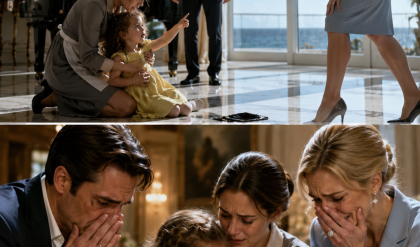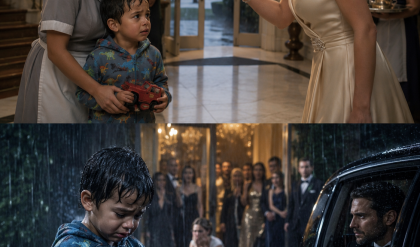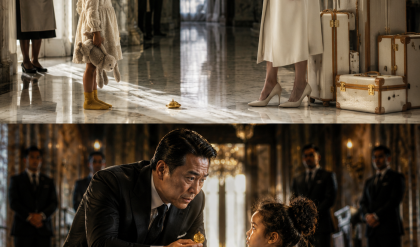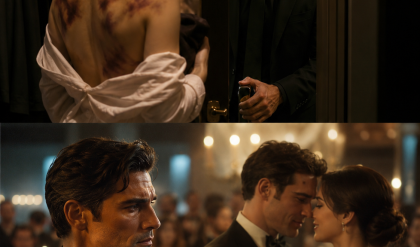
“Why,” Madeline said, not to Emma but to the air above her, “is there a barefoot child in the hallway?”
Naomi came from the laundry room at once, wiping her hands on her apron. “I’m sorry, Ms. Graves. She was with me. I only stepped away for a moment.”
Madeline’s eyes moved over Naomi slowly, from her worn black flats to the plain clip holding back her hair.
“This is not a daycare, Ms. Reed. I admire your situation, but my guests should not have to navigate household complications.”
Emma’s face changed at the word complications. She did not know what it meant, but she knew where it landed.
Naomi lifted her daughter into her arms. “It won’t happen again.”
“No,” Madeline said, smiling faintly. “It won’t.”
That evening, Thomas came to Naomi’s small sitting room in the staff wing. He looked uncomfortable before he even spoke.
“Ms. Graves has asked that Emma remain entirely out of view when family or guests are present.”
Naomi sat on the edge of the narrow bed while Emma slept behind her, one arm thrown over a stuffed rabbit with one missing ear.
“I understand,” Naomi said.
Thomas exhaled. “For what it’s worth, I don’t believe the child has caused any trouble.”
Naomi looked down at her hands. They were rough from cleaning solution, though she used lotion every night because Lucille had taught her that poverty did not excuse neglecting yourself.
“Trouble doesn’t always mean you did something,” she said quietly. “Sometimes trouble means somebody doesn’t like seeing you.”
Thomas had no answer for that.
Afterward, Naomi became stricter. Emma stayed in the staff quarters while Naomi worked. Mrs. Calder watched her during meal prep. Luis brought leaves and seedpods to the back window so Emma could still study the garden without wandering into it. Life narrowed, but Naomi told herself narrow was still safe.
Then she began to notice the phone calls.
The first happened near the conservatory. Madeline stood among the lemon trees with her back to the glass, speaking in a voice so low Naomi would not have heard it if she had not been collecting empty coffee cups from the breakfast tray.
“I don’t care what Wallace promised you,” Madeline said. “I’m not risking my position unless David confirms the language is enforceable.”
Naomi slowed, then forced herself to keep walking. Wallace was Bennett’s father. Everyone in the house knew the name, though the man rarely visited. When he did, the temperature seemed to drop before he entered the room.
The second call happened two days later, behind the closed door of Bennett’s private study while Bennett was in New York. Naomi was cleaning the hallway when she heard Madeline laugh.
“He trusts grief more than he trusts people,” Madeline said. “That’s the whole point. Mention his mother, and he stops reading.”
Naomi froze with one hand on the handle of her cleaning cart.
A man’s voice answered, muffled but clear enough. “The substituted agreement has to be signed before the board vote. If he signs the clean copy first, we lose the window.”
“I said I can handle Bennett.”
“Can you handle the maid?”
Naomi’s stomach tightened.
Madeline was quiet for a beat. “What maid?”
“The one with the kid. She was near the conservatory yesterday.”
Naomi moved before fear could lock her legs. She pushed the cart around the corner and into the linen closet, standing in the dark between shelves of folded sheets while her pulse pounded in her ears.
For the rest of the day, she told herself she had misunderstood. Wealthy people discussed documents all the time. Maybe the agreement was ordinary. Maybe the words substituted and enforceable meant something harmless in their world. Maybe Madeline’s cruelty made Naomi eager to believe worse.
But that night, after Emma fell asleep, Naomi wrote down every word she remembered. She dated the page. Then she tore it out of her notebook, folded it twice, and tucked it into the lining of her suitcase.
Her grandmother’s voice came to her in the quiet.
Dignity has to live inside you.
Naomi whispered back, “Dignity doesn’t pay for a lawyer.”
Two weeks later, Madeline proved Naomi right about power.
It happened during a dinner for twelve donors connected to the Eleanor Harlan Memorial Trust, the charitable foundation Bennett’s mother had created before her death. Naomi had never met Eleanor Harlan, of course, but the house carried her in small ways Madeline had not yet managed to erase. Her books remained in the library. Her piano stood in the music room. A portrait of her, dark-haired and thoughtful, hung near Bennett’s study because Bennett had quietly refused to let it be moved.
Naomi was helping Patrice clear dessert plates when Madeline touched her wrist.
“Ms. Reed, would you bring my wrap from the upstairs guest suite? The cream cashmere one.”
“Yes, ma’am.”
The request felt ordinary. Naomi went upstairs, found the wrap laid neatly across the chaise, and carried it down. Halfway through the back hall, she heard Emma crying.
Not loudly. That was what frightened her. Emma’s loud cries were storms that passed quickly. This was a small, broken sound.
Naomi hurried to the staff sitting room and found Emma standing beside the little table where she colored. Her crayons had been dumped into the trash. The picture she had been drawing was torn in half.
“What happened?”
Emma tried to speak but hiccupped instead.
Mrs. Calder appeared behind Naomi, flour on her cheek and anger in her eyes. “Ms. Graves came through looking for you. Said the child was making a mess where guests might see.”
Naomi knelt and gathered Emma. “Baby, did she touch you?”
Emma shook her head. “She said this house is not for messy little girls.”
Naomi held her too tightly for a moment, fighting the part of herself that wanted to walk into the dining room and say every true thing she had swallowed. But the rent-free staff room was behind her. Her paycheck was ahead of her. Emma’s winter coat still needed replacing. Courage, Naomi had learned, was not always a fire. Sometimes it was a woman choosing not to burn the only shelter her child had.
She soothed Emma, cleaned her face, and returned to work with her hands steady enough to pour coffee.
The next morning, a diamond bracelet went missing from Madeline’s dressing table.
By noon, the whole staff knew. By one, Thomas asked Naomi to come to the small office near the service entrance. Madeline was already there, standing beside Bennett, who had been called home from a downtown meeting.
Naomi knew from Bennett’s face that he did not want to be there. That gave her less comfort than it should have.
Madeline placed a velvet jewelry pouch on Thomas’s desk. “This was found in Ms. Reed’s laundry basket.”
Naomi looked at the pouch, then at Madeline.
“That isn’t mine.”
Madeline gave her a pitying smile. “Obviously.”
Bennett’s jaw tightened. “Who found it?”
“My assistant,” Madeline said. “While looking for a missing silk blouse. I didn’t want to embarrass anyone, Bennett, but this can’t be ignored. We have guests. We have valuables. We have a child wandering around unsupervised.”
“My daughter didn’t steal from you,” Naomi said.
The words came out sharper than she intended.
Madeline’s eyes brightened. She had been waiting for emotion. Emotion could be used.
“I didn’t say she did. But perhaps we should discuss whether this arrangement is becoming too complicated.”
Bennett looked at Naomi. “Did you take the bracelet?”
“No.”
He held her gaze for several seconds. Naomi did not beg. Something in her refused to perform innocence for a woman who had staged guilt.
Bennett turned to Thomas. “Check the cameras.”
Thomas’s face tightened. “The upstairs corridor camera was offline for maintenance between ten and eleven.”
Madeline spread her hands gently. “How unfortunate.”
Naomi almost laughed. Not because anything was funny, but because the trap was so clean it admired itself.
Bennett looked back at her. “Naomi, until we understand what happened, I think it’s best if you remain on housekeeping duties in the staff wing only. Paid, of course. No guest areas.”
Madeline’s mouth softened with victory.
Naomi nodded once. “Yes, Mr. Harlan.”
She could have told him then. She could have said, Your fiancée is working with a man named David to substitute legal documents, and your father may be involved, and she just framed me because she thinks I heard too much. But the bracelet sat on the desk between them like proof of what Madeline could do with no effort at all. If Naomi accused her and failed, she would lose everything. Worse, Emma would lose everything.
That night, Emma crawled into Naomi’s bed after a nightmare.
“The pretty lady has a bad smile,” she whispered.
Naomi brushed curls from her daughter’s forehead. “Some people are unhappy inside, baby. Sometimes they pour it on other people.”
Emma thought about that. “Why doesn’t Mr. Bennett see?”
Naomi looked toward the small window, where the dark shape of the mansion rose beyond the staff courtyard.
“Because he wants to.”
It hurt to say, because she understood it. Bennett wanted to believe he had been chosen for something other than money, name, and power. He wanted to believe Madeline’s hand on his arm meant warmth. He wanted to believe a woman who spoke softly about his mother’s foundation could not be planning to use that same grief against him.
Lonely people did not miss warning signs because they were foolish. They missed them because the alternative was admitting they had been lonely enough to be fooled.
The engagement celebration was scheduled for the first Saturday in November at the Langford Hotel downtown. For weeks, the house became a machine built to produce a perfect evening. Floral designers came and went. Madeline’s stylists occupied the blue guest room. Thomas managed deliveries with a clipboard and the expression of a general trying not to lose a war.
Naomi remained mostly in the staff wing, which suited Madeline. It also suited Naomi until Thomas came to her three days before the party.
“I’m sorry,” he said. “Ms. Graves specifically requested you for wardrobe support at the hotel.”
Naomi understood at once. Madeline wanted her close enough to watch, low enough to humiliate, and frightened enough to remain silent.
“My childcare is arranged,” Naomi said, though it wasn’t fully true. A neighbor from church, Denise, had agreed to keep Emma that evening, but her own son had been feverish all week.
Thomas heard the hesitation. “If there is a problem, tell me.”
Naomi almost did. But Thomas’s authority ended where Bennett’s household began, and Bennett’s household was about to become Madeline’s.
“I’ll manage,” she said.
By Saturday afternoon, Denise called in tears. Her son’s fever had spiked. She was at urgent care. Naomi thanked her, hung up, and sat for thirty seconds on the edge of her bed while Emma played with a purple ribbon on the floor.
There was no one else. Mrs. Calder was working the event kitchen. Patrice would be at the hotel laundry suite. Luis had the night off but was visiting his brother in Joliet. Naomi could not leave Emma alone at the estate, and she could not refuse the assignment without giving Madeline exactly what she wanted.
So she packed a small bag with crackers, a juice box, crayons, a worn picture book, and Emma’s rabbit. She dressed Emma in her lavender church dress and gave her the speech she had given in different forms since the child learned to walk.
“You stay where Mama puts you. You don’t open doors. You don’t follow music. You don’t talk to strangers unless Mama says so.”
Emma looked solemn. “What if Mr. Bennett is there?”
Naomi’s heart tightened. “Mr. Bennett will be very busy tonight.”
“With the bad smile lady?”
“Emma.”
Her daughter lowered her eyes.
Naomi knelt. “I need you to listen to me. This is important.”
Emma touched Naomi’s cheek with one small hand. “I listen.”
At the Langford Hotel, staff were assigned to a service room two corridors behind the ballroom. Naomi settled Emma there with her snacks and crayons behind a folding screen. The room smelled like coffee, garment bags, and carpet cleaner. It was not ideal, but it was safe enough if Emma obeyed.
For the first hour, she did.
Naomi worked in Madeline’s dressing suite, steaming fabric, fetching water, adjusting garment bags, and keeping her face blank while Madeline’s friends drifted in and out with champagne.
Madeline wore a silver-white gown that clung to her like moonlight. Around her throat was a diamond necklace Bennett had given her that morning, though Naomi noticed Madeline kept touching it not with affection, but appraisal.
“You’re quiet tonight, Ms. Reed,” Madeline said while a stylist pinned her hair.
“I’m working, ma’am.”
Madeline smiled at the mirror. “That must be comforting. Knowing exactly where you belong.”
One of her friends laughed.
Naomi folded a garment bag over her arm. “Yes, ma’am. It saves time.”
Madeline’s eyes flicked toward her reflection.
For a second, Naomi saw the anger beneath the polish. Then Madeline laughed lightly, as though Naomi had amused her.
A hotel coordinator came to say Bennett was asking whether Madeline was ready for photographs. The room emptied in a rush of perfume and silk. Naomi remained behind to gather pins from the carpet and make sure nothing had been left behind.
That was when she heard voices through the adjoining service alcove.
Madeline’s voice first. “You said he wouldn’t bring it up tonight.”
Then Wallace Harlan’s voice, cold enough to be recognized even by someone who had heard it only twice. “My son is sentimental, not stupid. There’s a difference. Keep him focused on Eleanor. Tell him the revised trust language honors what she wanted.”
“It doesn’t honor what she wanted,” Madeline snapped. “It gives you voting control after the proxy transfer.”
“It corrects a mistake my wife made when she was dying and emotional.”
Naomi stood very still.
Another man spoke then. David, she assumed, the attorney from the calls. “The agreement is in the private signing folder. Bennett signs the engagement trust acknowledgment tonight for the photographers, then the full prenuptial packet Monday. Once the spousal trustee clause is accepted, Madeline has standing. Wallace’s group gets the proxy votes after separation. Everybody gets what they came for.”
Madeline’s laugh was thin. “I came for more than a separation check.”
“And you’ll get it,” Wallace said. “If you stop improvising.”
Naomi’s skin prickled. She moved toward the alcove door, not to confront them, only to get away before she was discovered. As she did, she bumped the edge of a rolling rack. A hanger clicked against metal.
Silence.
Naomi slipped into the corridor and walked fast, every instinct screaming. She reached the service room, pushed open the door, and stopped.
Emma was gone.
The crayons were scattered on the chair. The rabbit lay on the floor. The door on the opposite side of the room, the one that should have latched, stood open by three inches.
Naomi’s heart dropped so hard she gripped the doorframe.
“Emma?”
No answer.
She checked behind the folding screen, under the table, inside the restroom. Then she ran into the corridor, calling her daughter’s name in a whisper because panic still had to obey rich people’s rules in a hotel full of guests.
What Naomi did not know then was that Emma had stayed put until she heard the bad smile lady in the hallway.
Children do not understand legal fraud, voting trusts, or proxy control. Emma did not understand what a prenuptial agreement was. She did not know what a trustee did. But she knew Bennett’s mother had a portrait in the house. She knew Bennett sometimes looked at that portrait when he thought nobody saw. She knew her own mother’s voice changed whenever someone threatened the little safety they had built. And she knew Madeline’s voice because fear teaches children what adults wish they could ignore.
Emma had opened the wrong door looking for Naomi and found herself near the service alcove, hidden behind a tall arrangement of white roses waiting to be moved into the ballroom. She had seen Madeline, Wallace, and David. She had heard Madeline say, “After he signs, Eleanor is ours.” She had heard Wallace answer, “My son won’t know until his mother’s name is already on the transfer.”
Emma did not know Eleanor was dead. Not in the adult way. To her, a mother’s name was a mother. A mother’s picture was a mother. A mother’s song, a mother’s book, a mother’s house, a mother’s smell in old rooms, all of it was mother. And stealing someone’s mother was the worst thing a person could do.
So when the ballroom door opened and music spilled out like light, Emma followed it.
The Langford ballroom had been designed to humble people who thought they could not be humbled. Its ceiling rose three stories. Its chandeliers glittered over a floor polished until it reflected gowns and shoes and the long stems of champagne glasses. At one end stood a stage draped in white roses. At the other, photographers waited for Bennett and Madeline to sign a ceremonial engagement trust acknowledgment, a glossy, harmless-looking document meant to symbolize their future charitable work together.
Bennett stood near the stage beside Madeline, listening as a retired senator praised the couple’s commitment to family legacy. He was smiling at the right moments, but something inside him had been uneasy all day.
It had begun that morning when Madeline pushed him to sign the trust acknowledgment during the party rather than after legal review. It deepened when his father arrived early, unusually attentive, and placed a hand on his shoulder in front of photographers.
“Your mother would have wanted this,” Wallace said.
Bennett had not answered immediately. For most of his life, that sentence had functioned like a key in a lock. His mother, Eleanor, had died when he was nine. She had been the only warm place in his childhood. After her death, Wallace turned the house into a mausoleum of discipline. Bennett learned quarterly earnings before he learned how to grieve. He built Harlan Life Systems from a medical software patent his mother had started and his father had dismissed as sentimental nonsense. The Eleanor Harlan Memorial Trust held the original family shares because Eleanor had wanted the company’s wealth tied to children’s health clinics, not private greed.
Wallace had hated that.
Bennett knew it. He had always known it in the way children know weather. But knowing a parent resents a decision is different from believing that parent would spend years plotting to undo it.
Then Emma appeared.
At first, Bennett thought he was seeing a strange mercy. There was Emma Reed in the middle of the ballroom, small and serious, cutting through all the performance with the honest disorder of real life.
He crouched because that was what you did when a child came to you frightened. You made yourself less large.
“Emma?” he said. “Honey, where’s your mom?”
She looked past him.
“You stole his mommy,” she said.
The first shock was silence. The second was Madeline’s face.
Bennett had seen Madeline under pressure before. Paparazzi questions, board dinners, airline delays, family tension. She always became smoother under pressure, more graceful, more controlled. But now, for one unguarded second, she looked not offended, but caught.
“What did you say?” Bennett asked, his voice low.
Emma pointed at Madeline. “You said after he signs, his mommy belongs to the gray-haired man.”
A murmur moved through the ballroom.
Madeline recovered quickly. “Bennett, this is absurd. She’s a child. She shouldn’t even be here.”
Emma’s mouth trembled. “Mama cried because of you. You put the sparkly bracelet in her basket. You said messy little girls don’t belong.”
Naomi reached the ballroom entrance just in time to hear that sentence.
For one second, shame nearly stopped her. Hundreds of faces turned toward her. She was in a black staff dress, breathing hard, hair loosened from its clip, one hand pressed to her stomach as though she could hold herself together physically. She saw Bennett crouched before Emma. She saw Madeline’s white face. She saw Wallace watching with the flat expression of a man calculating whether a small witness could be crushed.
Naomi thought of Lucille Reed mopping school hallways with a straight back.
Then she walked forward.
Not fast. Fast would look frantic. She walked with the dignity she had been told did not belong in rooms like that.
“Mr. Harlan,” she said, when she reached him. “I’m sorry Emma came in here. But she is telling the truth.”
Madeline laughed once, sharply. “This is insane.”
Naomi looked at her. “No, ma’am. What’s insane is framing a housekeeper for theft because she overheard you discussing a substituted legal agreement.”
The ballroom reacted like a living thing. People shifted, whispered, drew closer while pretending not to.
Bennett stood slowly.
“What agreement?”
Wallace stepped forward. “Bennett, do not humiliate yourself by entertaining gossip from staff in front of guests.”
That sentence did what Emma’s accusation had begun. It clarified the room. Bennett turned toward his father, and the old habit of obedience rose in him like a ghost. For twenty-five years, Wallace’s disapproval had been a wall Bennett either climbed or bloodied himself against. But Emma was clutching his sleeve now. Naomi stood beside her daughter with fear in her eyes and truth in her mouth. Madeline was looking not at Bennett, but at David Sloan near the side exit.
Bennett understood something then. The truth did not feel dramatic when it arrived. It felt like grief becoming organized.
“Lock the ballroom exits,” Bennett said.
His security chief, a former Chicago police detective named Andre Bell, moved at once.
Madeline stared at him. “You cannot be serious.”
“I am.” Bennett looked at Andre. “No one leaves with documents. No one from my legal team, my father’s office, or Ms. Graves’s party goes anywhere alone.”
Wallace’s voice hardened. “Careful, son.”
Bennett looked at him then, fully. “I have been careful my entire life.”
Gerald Price, Bennett’s personal attorney, arrived from a donor table within seconds. He was a compact man in his fifties with a bow tie, tired eyes, and the calmest hands Naomi had ever seen. Bennett spoke to him quietly, but the nearest guests could hear enough.
“Find the signing folder. Compare it to the version your office approved.”
Gerald did not ask why. Good lawyers, Naomi realized, knew the smell of disaster before anyone named it.
David Sloan tried to step backward. Andre blocked him.
Madeline’s perfect face changed again. “Bennett, darling, this is humiliating for both of us. Let’s go somewhere private.”
“No,” Bennett said. “You wanted witnesses for the signing. We have witnesses for the truth.”
That was when Wallace made his mistake.
“Eleanor was my wife,” he said, louder than he intended. “That trust should never have been placed beyond family control.”
Bennett turned very still.
Every camera in the room seemed to point itself without moving.
“Family control,” Bennett repeated.
Wallace realized too late that anger had exposed what denial could have hidden.
Gerald returned with the folder in one hand and his phone in the other. His face had gone gray.
“Bennett,” he said quietly, “the document in the signing folder is not the approved acknowledgment. It contains an attachment granting future spousal trustee standing over Eleanor Trust proxy decisions upon marriage, with a cross-reference to the prenuptial packet. My office did not draft this.”
Madeline whispered, “David.”
David Sloan said nothing.
Bennett looked at his fiancée. For a moment, the crowd disappeared for him. Naomi saw it happen. All the cameras, donors, enemies, friends, servants, flowers, and chandeliers fell away, leaving only a man who had wanted to be loved and a woman who had studied the wound carefully enough to put her hand inside it.
“Was any of it real?” Bennett asked.
Madeline’s eyes filled with tears so quickly that, in another life, Naomi might have believed them.
“Bennett, I did care for you.”
He nodded once, almost gently. “That wasn’t the question.”
Madeline looked toward Wallace.
There it was. The answer.
Bennett inhaled as though something had struck him in the chest. Then he removed the diamond engagement ring from Madeline’s finger. She resisted for half a second before the room reminded her she was being watched.
“This engagement is over,” he said.
The words were not loud. They did not need to be.
Within minutes, the party was no longer a party. It became a controlled collapse. Guests were guided toward exits after giving statements if they had seen anything. The hotel’s security footage was secured. The signing folder was placed under legal hold. David Sloan was separated from Wallace and Madeline. Bennett’s public relations director, pale but efficient, began calling news editors before rumors could become weapons.
Naomi sat in a quiet conference room off the service corridor with Emma in her lap. Emma had finally begun to cry properly, not because she understood the size of what had happened, but because adults had raised their voices and her mother’s hands were shaking.
“I did bad?” Emma whispered.
Naomi kissed her forehead. “No, baby. You told the truth.”
“But people looked.”
“Sometimes they do that when the truth walks in without shoes.”
Emma sniffed against her shoulder.
A few minutes later, Bennett entered. His tuxedo jacket was gone. His bow tie hung loose. He looked older than he had an hour earlier, but also less hidden.
Naomi began to stand. “Mr. Harlan, I’m sorry.”
“Please don’t apologize.”
She sat back down because Emma had fallen asleep against her.
Bennett took the chair across from them. For a while, he said nothing. Outside the room, footsteps passed, phones rang, and a magnificent evening continued dismantling itself piece by piece.
Finally, Bennett said, “How long have you known?”
Naomi could have protected herself with vagueness. Instead, she told him everything. The conservatory call. The study call. David’s name. The bracelet. The camera outage. Madeline tearing Emma’s picture. Wallace in the alcove. She did not embellish. She did not make herself braver than she had been.
“I wrote down what I heard,” she said. “But I didn’t have proof. After the bracelet, I knew what she could do. I have Emma. I couldn’t gamble with her safety.”
Bennett listened without interrupting. That, more than anything, made Naomi’s throat tighten. Powerful people often listened only until they found the part they could use. Bennett listened like he was accepting punishment.
When she finished, he looked at Emma asleep in her lap.
“She wasn’t supposed to have to be brave,” he said.
“No child is,” Naomi answered. “But they become brave when adults leave truth lying around like broken glass.”
Bennett closed his eyes.
“I should have seen it.”
Naomi shook her head. “Maybe. But people who know where you hurt can stand right in the blind spot.”
He opened his eyes and looked at her then, not as staff, not as a problem, not as the mother of a child who had interrupted his engagement, but as a person who had told him the hardest truth of his life in the cleanest way she could.
“My mother used to say almost exactly that,” he said.
For the first time, Naomi saw the boy inside him clearly. Not the billionaire, not the founder, not the son of a brutal man, but the nine-year-old who had lost the one person who made the house feel human and had spent the rest of his life building machines because machines did not leave.
“What happens now?” Naomi asked.
Bennett leaned back. “Now my lawyers do their jobs. David Sloan will face the bar association and probably prosecutors. Madeline will be sued for fraud if Gerald thinks it’s wise. My father…” He stopped, and the word father seemed to cost him more than any number attached to the company. “My father will never again have access to Eleanor’s trust.”
Naomi looked down at Emma. “And us?”
Bennett’s expression tightened with regret. “You will not lose your job. You will not lose your room. And if you want to leave because this house has become unsafe for your peace, I’ll provide a full severance and references for anywhere you want to go.”
Naomi had expected relief. Instead, she felt an ache.
Leaving would be safer in one way. But safety had never been only distance. Sometimes safety was justice staying where fear had tried to push you out.
“I don’t know yet,” she said honestly.
Bennett nodded. “Fair.”
He stood to leave, then paused at the door.
“Ms. Reed?”
“Yes?”
“Thank you for raising a daughter who has not learned to be afraid of the truth.”
Naomi looked at Emma’s sleeping face.
“I hope she never has to learn it the hard way.”
The story made headlines by morning, though not the way gossip blogs wanted. Bennett’s team moved quickly, releasing a brief statement about the termination of the engagement due to attempted legal fraud involving documents connected to the Eleanor Harlan Memorial Trust. No mention was made of Emma. Naomi’s name was kept out of the press. The guests, for all their love of whispers, understood that harming a child witness would make them look monstrous, and rich people feared looking monstrous almost as much as becoming poor.
Within forty-eight hours, Gerald Price’s legal team uncovered the full structure of the scheme. David Sloan had drafted substitute attachments designed to create a path for Madeline, once married, to claim spousal trustee rights in the Eleanor Trust. Wallace’s private investment group had prepared a purchase agreement that would activate after a staged marital separation, transferring voting influence over Harlan Life Systems under the cover of resolving a domestic dispute. Madeline would receive seventy-five million dollars through a settlement and consulting arrangement. Wallace would regain control of the company he believed his wife had stolen from him by leaving it to their son and to a foundation for sick children.
It was elegant, cruel, and nearly successful.
The bracelet frame was confirmed a week later when hotel footage from a previous estate delivery showed Madeline’s assistant removing the jewelry pouch from a travel case and handing it to her before the alleged theft. The upstairs camera outage had been requested through a temporary contractor hired by David Sloan’s office. Bennett personally apologized to Naomi in front of the entire household staff.
He did not make it grand. Naomi appreciated that. Grand apologies often became performances for the apologizer. Bennett stood in the staff kitchen on a Wednesday morning while Mrs. Calder’s biscuits cooled on the counter and said, “I allowed false evidence to limit Ms. Reed’s duties when I should have looked harder. I am sorry. This house failed her, and by failing her, it failed every person who works here.”
Naomi did not cry. She had cried enough in private.
Thomas cleared his throat and looked at her with open respect. Patrice squeezed her hand. Luis brought Emma a pot of purple pansies and told her they were truth flowers now. Emma believed him immediately.
Madeline left Chicago before Thanksgiving. Her friends released statements about emotional distress and private misunderstandings. Nobody important believed them, but belief had never been required for society to move on. David Sloan resigned from his firm before he could be fired. Wallace Harlan retreated to his estate in Kenilworth and issued no statement at all.
Bennett did not see his father for six weeks.
When he finally did, it was not in a boardroom or a courtroom, but in the old library of the Lake Forest house, beneath the portrait of Eleanor Harlan that Madeline had once tried to remove.
Wallace arrived at noon, as requested, wearing a navy overcoat and the expression of a man prepared to be inconvenienced, not defeated.
Bennett stood by the window. “Why?”
Wallace removed his gloves slowly. “You know why.”
“I want to hear you say it.”
Wallace looked at Eleanor’s portrait. “Your mother was brilliant, but she was sentimental. She tied Harlan assets to charity structures when she should have consolidated family control. You were a child. You worshiped her. You still do. Someone had to correct the damage.”
“You used my engagement.”
“I used an opportunity.”
“You used my grief.”
Wallace’s jaw shifted. “Grief is not sacred simply because you refuse to outgrow it.”
For years, that kind of sentence would have made Bennett either furious or silent. This time, it made him clear.
“No,” Bennett said. “Grief is sacred because it is love with nowhere to go. You wouldn’t know that because you turned yours into ownership.”
Wallace’s eyes hardened.
Bennett walked to the desk and placed a folder on it. “You’re removed from every advisory role connected to Harlan Life Systems and the Eleanor Trust. Your investment group is under review. If you contest it publicly, Gerald has enough to bury you legally and reputationally.”
“You would destroy your own father?”
Bennett thought of Emma in white socks, pointing at the truth no adult wanted to touch.
“No,” he said. “I’m refusing to let my father destroy what my mother built.”
Wallace stared at him for a long time. Some men, when finally exposed, become sorry. Others become smaller versions of the same weapon. Wallace only put his gloves back on.
“You always were Eleanor’s son,” he said.
For the first time in Bennett’s life, it sounded like a compliment.
After Wallace left, Bennett stayed in the library until the winter light dimmed. Then he went to the staff wing and found Naomi sitting at the small table, helping Emma glue cotton balls onto construction paper clouds.
Emma looked up. “Mr. Bennett, my cloud is too fat.”
Bennett examined it. “Clouds are allowed to take up space.”
Emma considered this excellent news.
Naomi smiled despite herself. Bennett noticed, and the sadness behind his eyes eased slightly.
“I’m starting the childcare initiative,” he said. “Not as a press release. For real.”
Naomi set down the glue. “The one connected to your mother’s trust?”
He nodded. “My mother wanted the trust to fund pediatric clinics, education access, and support for working families. I expanded the clinics and ignored the family support piece because I thought it was too soft to measure. I was wrong.”
Naomi did not rush to fill the silence.
“I want you involved,” he said. “Not as charity. As paid work. You know the problem from the inside. Staff childcare, emergency backup care, legal aid for domestic workers, scholarships for single parents who want certification or college credits. I can hire people with degrees, and I will, but I need someone in the room who knows what it feels like when one sick babysitter can cost a woman her job.”
Naomi looked at him carefully. “I’m a housekeeper, Mr. Harlan.”
“You’re a mother who held a household together under pressure most executives would fail.”
“That isn’t the same as running a program.”
“No,” he said. “It isn’t. So we build the role honestly. Training, mentorship, whatever you need. You don’t have to say yes now.”
Naomi looked at Emma, who was pressing another cotton ball onto the page with absolute concentration. Her grandmother had cleaned classrooms for thirty-one years. Naomi had cleaned rooms where people with power said words like opportunity while never seeing the women emptying their trash.
“What would the job be called?” Naomi asked.
Bennett almost smiled. “Community operations coordinator to start. If you hate the title, we’ll change it.”
“I don’t want my daughter used in some story about your redemption.”
That landed. Bennett accepted it without flinching.
“She won’t be.”
“And I don’t want people saying you saved us.”
“I didn’t.”
Naomi nodded slowly. “Good. Because Emma saved herself by telling the truth. I saved us every day before that. You’re just opening a door.”
This time, Bennett did smile. “Then I’ll try not to stand in it.”
By spring, the Eleanor Harlan Family Access Program had a small office in a renovated carriage house on the edge of the estate. Naomi took classes in nonprofit administration twice a week. Bennett hired an experienced director, a former social worker named Alicia Grant, who treated Naomi neither like a symbol nor a charity case, but like a colleague with valuable field knowledge and plenty to learn.
The first program they launched was emergency childcare for the estate staff and employees of Harlan Life Systems’ Chicago office. The second offered legal clinics for domestic workers and caregivers. The third provided small grants to single parents pursuing job training.
Naomi made mistakes. She learned spreadsheets could be more stubborn than toddlers. She learned some people in conference rooms used kindness as a tone while resisting every practical change that cost money. She learned to speak anyway.
The first time she challenged a budget decision in a meeting with senior executives, her voice shook. Bennett, sitting at the end of the table, did not rescue her. He simply waited, giving her the dignity of finishing.
Naomi placed both hands on the table.
“You’re calling backup childcare an employee benefit,” she said, looking at the finance director. “But for low-wage workers, it’s job protection. If a mother loses three shifts because her sitter cancels, she doesn’t need a wellness webinar. She needs somewhere safe to leave her child and a supervisor who won’t punish her for being poor.”
The room went quiet.
Alicia Grant leaned back with the faint smile of a woman watching someone step into her own authority.
The budget passed.
Emma started preschool in September. On her first day, she wore purple shoes and carried a backpack almost as large as her body. Bennett happened to be leaving for work when Naomi walked her through the side courtyard.
“Mr. Bennett!” Emma shouted. “I’m going to school to learn all the rules.”
Bennett crouched, as he always did. “That sounds useful.”
Emma lowered her voice. “But Mama says some rules are wrong.”
Naomi closed her eyes briefly.
Bennett nodded seriously. “Your mom is right.”
Emma grinned. “I knew it.”
Naomi expected life to feel transformed after that year, but real healing was less dramatic than the stories made it seem. It came in ordinary pieces. A savings account that grew instead of vanished. An apartment of their own, not because the estate had turned them out, but because Naomi chose a sunny two-bedroom in Evanston close to Emma’s school. Sunday pancakes. A winter coat bought before the first snow instead of after. A locked door that belonged to them.
Bennett changed too, though not into a different man overnight. He remained intense, private, and too willing to work past midnight. But he began eating supper in the staff kitchen once a month, not as a performance, and not at the head of the table. He restored Eleanor’s photographs to the main hallway. He turned the blue guest suite, where Madeline had once dressed for the engagement party, into a childcare room for staff family events. Luis painted the walls soft yellow. Mrs. Calder donated a shelf of picture books. Emma insisted on a sign that said Cloud Room because clouds were allowed to take up space.
No romance bloomed between Naomi and Bennett in the way gossip sites tried to invent after someone leaked a photograph of them leaving a foundation meeting. Naomi shut that down with one sentence to a reporter outside the office.
“A man respecting a woman’s work is not a love story. It’s just what should have happened already.”
Bennett laughed when he saw the clip. Naomi did not, but only because she was trying not to.
Two years after the engagement party, the Eleanor Harlan Family Access Program held its first public anniversary event in the same Langford Hotel ballroom. Naomi almost refused the venue when Alicia suggested it.
“I don’t need to be poetic,” Naomi said.
Alicia shrugged. “Maybe not. But sometimes a room should see who came back standing.”
So Naomi returned.
This time, she did not enter through the service corridor. She came through the front doors wearing a navy dress she had bought herself and low heels because she still believed in practical shoes. Emma, now five, wore a yellow cardigan and carried a small bouquet of purple pansies for the memorial table beneath Eleanor Harlan’s photograph.
The ballroom looked different in daylight. Less threatening. Less hungry. The chandeliers were still there, but they no longer seemed to belong only to people with diamonds. The audience included executives and donors, yes, but also housekeepers, nurses, cafeteria workers, single fathers, grandmothers raising grandchildren, and children who ate too many cookies from the refreshment table because Mrs. Calder had supervised the baking.
Bennett spoke first. He did not tell the whole story. He did not mention Madeline’s name. He did not turn betrayal into entertainment. He spoke about his mother, about how love without structure could become sentiment, but structure without love became cruelty. He spoke about learning that a company’s legacy was not protected by controlling shares alone, but by the lives improved because the company existed.
Then he introduced Naomi.
She walked to the podium with her speech folded in her hand. For a moment, she saw the ballroom as it had been that night: the gowns, the staring faces, Emma barefoot under the chandeliers, Madeline’s smile collapsing, Wallace’s cold eyes.
Then she saw the room as it was now.
Emma in the front row, swinging her feet. Thomas beside Mrs. Calder. Luis holding his phone ready to record. Patrice wiping her eyes before Naomi had even spoken. Bennett standing near the side wall, not center stage, exactly where he had promised to be: opening a door, not standing in it.
Naomi unfolded her speech.
“My grandmother cleaned a high school in Kentucky for thirty-one years,” she began. “She used to say dignity was not something people gave you. It was something you practiced until nobody could convince you it was gone.”
The room quieted.
Naomi continued, her voice steady. “For a long time, I thought power meant having enough money that nobody could threaten your home, your job, or your child’s safety. I still think that kind of security matters. It matters more than speeches. But I have learned another kind of power too. The power of a worker telling the truth. The power of an employer listening before damage becomes disaster. The power of a child who has not yet learned that some rooms expect silence from certain people.”
Emma smiled because she knew that part was about her, even though Naomi had not used her name.
Naomi looked out at the faces before her. “This program exists because too many parents are one emergency away from losing everything, and because too many workplaces pretend that problem lives outside their walls. It does not. It walks in with the people who clean the rooms, cook the food, answer the phones, stock the shelves, code the software, and care for everyone else’s children while praying someone safe is caring for theirs. We are here to make sure fewer parents have to choose between honesty and survival.”
By the time she finished, people were standing.
Naomi did not look down in embarrassment. She let herself receive it. Not as charity. Not as rescue. As recognition.
Afterward, Emma tugged Bennett’s sleeve near the memorial table.
“Mr. Bennett,” she said, “did your mommy like speeches?”
Bennett looked at Eleanor’s photograph. The grief was still there, but it had changed shape. It no longer owned every room inside him.
“She liked useful ones,” he said.
Emma nodded, satisfied. “Mama’s was useful.”
“Yes,” Bennett said. “It was.”
Naomi joined them, catching the last words. “Emma, did you eat three cookies?”
Emma looked offended. “No.”
Naomi raised an eyebrow.
Emma sighed. “Four. But one was small.”
Bennett turned away, pretending to study the flowers.
Naomi gave him a look. “Don’t encourage her.”
“I would never.”
“You are smiling.”
“I’m reflecting.”
Emma slipped her hand into Naomi’s and leaned against her side. “Mama, are we safe now?”
The question was simple. The answer was not. Naomi knew better than to promise a child that life would never hurt. Safety was not a permanent place you reached and locked behind you. It was something built and rebuilt with truth, work, boundaries, and people who chose courage before convenience.
But some answers did not need every adult complication.
Naomi squeezed her daughter’s hand.
“Yes, baby,” she said. “We’re safe enough to keep growing.”
Across the ballroom, the afternoon light touched the chandeliers and broke into a hundred small pieces, scattering over workers, donors, children, flowers, and the portrait of a woman whose name had almost been stolen by greed but had instead become the shelter she intended.
And beneath all that light, Emma Reed stood in purple shoes, no longer barefoot, no longer frightened, still honest.
THE END